This week covers President Biden’s recent executive order on AI, China’s recent warning about “gene weapons,” a recent Senate committee hearing that featured several points about the nation’s efforts to prevent WMD use, and more. Several publications are listed as well, including ones focused on everything from drones, US biotech regulations, AI, and China’s false claims about alleged Taiwanese BW labs. Upcoming events and more professional opportunities finish out this issue.
Schar School Open Houses
Virtual PhD Open House
Prospective students are invited to attend a virtual open house to learn more about the Schar School of Policy and Government PhD Programs and interact with the admissions staff and faculty program directors. This event will take place on November 8 from 7 to 8:30 pm EST. Learn more and register here.
Virtual Biodefense MS Open House
Prospective students are invited to attend a information session to hear more about the Biodefense M.S. program offered at the Schar School. The online session will provide an overview of the program, as well as the application process, student experience and graduate outcomes. This session admissions will be led by the Graduate Admissions team. This event will take place on November 13 from 12 to 1 pm EST. Learn more and register here.
One Health Commission Celebrates Annual One Health Day
The One Health Commission once again celebrated its annual One Health Day yesterday, November 3, with associated events continuing through the end of the year. “Initiated in 2016 by the One Health Commission, the One Health Platform, and the One Health Initiative Team, International One Health Day is officially celebrated around the world every year on November 3. The One Health Platform closed its doors in 2021 so One Health Day was overseen in 2021 and 2022 by the One Health Commission and One Health Initiative Autonomous team.”
“The goal of One Health Day is to build the cultural will necessary for a sea change in how planetary health challenges are assessed and addressed and how professionals exchange information across disciplines. One Health Day brings global attention to the need for One Health collaborations and allows the world to ‘see them in action’. The One Health Day campaign is designed to engage as many individuals as possible from as many arenas as possible in One Health education and awareness events and to generate an inspiring array of projects worldwide.”
Read 2023’s launch message and view this year’s event map here.
EO on AI Ee I Ee I O: President Biden Issues Executive Order On Artificial Intelligence
This week, the White House announced President Biden signed an executive order aimed at “seizing the promise and managing the risks of artificial intelligence.” In a press statement, the White House said “The Executive Order establishes new standards for AI safety and security, protects Americans’ privacy, advances equity and civil rights, stands up for consumers and workers, promotes innovation and competition, advances American leadership around the world, and more.”
The EO takes several actions under the main categories of New Standards for AI Safety and Security, Protecting Americans’ Privacy, Advancing Equity and Civil Rights, Standing Up for Consumers, Patients, and Students, Supporting Workers, Promoting Innovation and Competition, Advancing American Leadership Abroad, and Ensuring Responsible and Effective Government Use of AI.
The statement further explained “As we advance this agenda at home, the Administration will work with allies and partners abroad on a strong international framework to govern the development and use of AI. The Administration has already consulted widely on AI governance frameworks over the past several months—engaging with Australia, Brazil, Canada, Chile, the European Union, France, Germany, India, Israel, Italy, Japan, Kenya, Mexico, the Netherlands, New Zealand, Nigeria, the Philippines, Singapore, South Korea, the UAE, and the UK. The actions taken today support and complement Japan’s leadership of the G-7 Hiroshima Process, the UK Summit on AI Safety, India’s leadership as Chair of the Global Partnership on AI, and ongoing discussions at the United Nations.”
China’s MSS Warns of “Gene Weapons”
“Some countries have “armed” themselves with deadly weapons targeting human genes, China’s top spy agency alleged on Monday – the first time a Chinese state body has mentioned such a threat publicly,” an article from the South China Morning Post reported this week.
The same article explains, “In a post on its official WeChat account, the Ministry of State Security said some nations had targeted the Chinese population for “ulterior motives”…The ministry did not name those countries or offer evidence to support the claim…While up to 99.9 per cent of human DNA is shared between all individuals on earth, there are key genetic differences that distinguish those of a certain ethnicity or race, the Chinese ministry said.”
While this may be the first time a ministry, let alone the one focused on non-military intelligence, has made such public claims, this is not the first time authoritative statements on the matter have come from the Chinese government. For example, as highlighted by Elsa Kania and Wilson Vorndick in a 2019 piece for Defense One, “The 2017 edition of Science of Military Strategy (战略学), a textbook published by the PLA’s National Defense University that is considered to be relatively authoritative, debuted a section about biology as a domain of military struggle, similarly mentioning the potential for new kinds of biological warfare to include “specific ethnic genetic attacks,” indicating that prominent members of the PLA are also focused in part on this concept.
Furthermore, despite ethnic bioweapons being a long-disputed concept, this statement from the MSS likely was intended to incite public concerns by drawing on the size of the country’s largest ethnic group-Han Chinese-who make up about 92% of the PRC’s population. As the SCMP article notes, developing this kind of weapon would be, at best, plagued by several substantial technical challenges, and there is no evidence such weapons exist, contrary to claims made by the likes of RFK Jr. and Russian state media. However, the PRC has increasingly spread false information about biological weapons and peaceful biological research in recent years, building on a decades-long effort to undermine global norms on BW, making it likely this is more of the same rather than a genuine expression of concern from the MSS.
Senate Homeland Security and Governmental Affairs Committee Holds Hearing on Threats to the Homeland
This week, the Senate Homeland Security and Governmental Affairs Committee held a full committee hearing titled “Threats to the Homeland.” Panelists included DHS Secretary Alejandro Mayorkas, FBI Director Christopher Wray, and NCCO Director Christine Abizaid. Senator Gary Peters, Committee Chairman, said in part of his opening statement, “Our nation also faces emerging threats from biological, chemical, nuclear, and radiological weapons – especially if those weapons fall into the wrong hands. I have long been concerned about the danger this poses – which is why I led the effort to re-authorize the Office of Countering Weapons of Mass Destruction, and will continue to work towards its passage. We must also re-authorize the Chemical Facility Anti-Terrorism Standards Program, and ensure that facilities that store or produce chemicals are secure from terrorist threats.”
Much of Secretary Mayorkas’ testimony focused on this topic, with the DHS Secretary touching on the work of his department’s Countering Weapons of Mass Destruction Office and the recent expiration of the Chemical Facility Anti-Terrorism Standards, which was overseen by CISA. A portion of Secretary Mayorka’s testimony is included below:
“Countering Weapons of Mass Destruction”
“Although terrorist capabilities to conduct large-scale attacks have been degraded by U.S. counterterrorism operations and policies, terrorists remain interested in acquiring and using weapons of mass destruction (WMD) in attacks against U.S. interests and the Homeland. Congress established the DHS Countering Weapons of Mass Destruction Office (CWMD) in 2018 to elevate, consolidate, and streamline DHS efforts to protect the Homeland from WMD and chemical, biological, radiological, and nuclear (CBRN) threats. CWMD serves as the DHS nexus for WMD and CBRN coordination, which includes providing direct support to both our government and industry partners. Of significant concern is DHS’s ability to continue the mission to counter WMDs after the authorization for CWMD terminates on December 21, 2023. DHS’s tools to accomplish this mission are at risk.”
“The CWMD Office has primary authority and responsibility within DHS to protect the Homeland against CBRN threats by interpreting national strategies and developing departmental strategic guidance; monitoring and reporting on related threats; generating and distributing related risk assessments; and researching, developing, acquiring, and deploying operationally effective solutions, such as equipment, training, and exercises, in support of SLTT communities and Departmental Components. CWMD strengthens DHS-wide and federal interagency coordination and provides direct financial and operational support nationwide to SLTT partners who serve as first-responders. Additionally, as part of the President’s EO on AI, CWMD was tasked with helping to evaluate and mitigate the potential for AI to be used to develop WMDs, such as through AI-enabled misuse of synthetic nucleic acids to create biological weapons. If CWMD authorization is allowed to expire, not only will DHS not be able to support these AI efforts, but over $130 million in annual grants will cease to support state and local first responders for full time biological detection, illicit nuclear material detection, training, and exercises. CWMD will also cease important CBRN research to improve security standards and equipment for SLTTs and DHS, including threat detection and prevention at large events.”
“Chemical Facility Anti-Terrorism Standards”
“Chemical Facility Anti-Terrorism Standards (CFATS) is the nation’s first regulatory program focused specifically on security at high-risk chemical facilities. Managed by CISA, the CFATS program identifies and regulates high-risk facilities to ensure security measures are in place to reduce the risk that certain dangerous chemicals can be weaponized by terrorists. An attack on one of these U.S. sites could be as lethal as a nuclear blast. On July 28, 2023, DHS authorities to implement the CFATS expired, and the program ceased to operate. With the expiration of the program, DHS can no longer reassure the more than 3,200 communities surrounding chemical facilities at high risk of terrorist attack that everything is being done to ensure those chemicals are protected.”
“As of today, we have no longer been authorized to conduct over 450 inspections, when historically more than a third of inspections identify at least one gap in a facility’s security. We have lost crucial visibility, with likely more than 100 facilities having newly acquired chemicals without reporting them, resulting in the inability of CISA to conduct risk assessments of these facilities. Cybersecurity and physical security measures at these sites are being allowed to lapse, and government planners and first responders are forced to rely on out-of-date information about what civilian industry chemical stores exist in their areas of responsibility.”
“It is critical to the DHS mission and the safety of the Homeland that Congress reauthorize the Department’s C-UAS authority, the CFATS program, and the CWMD Office without delay. These programs are vital to protecting our communities against drones, WMDs, and other related CBRN threats.”
A recording of the hearing and the statements from the Chairman, Ranking Member, and those testifying are available here.

“Beijing Dusts Off an Old Playbook with Disinformation about Taiwan Biological Warfare Labs”
The Global Taiwan Institute’s John Dotson recently published this piece for the Global Taiwan Brief, writing in part “On July 9 of this year, the Taiwan newspaper United Daily News (UDN, 聯合報) published a pair of articles with startling headlines: “Does America Want Taiwan to Build a P4 Laboratory to Develop Biological Weapons? Documents Reveal the Discussions in a Democratic Progressive Party Government Meeting” (美要台灣設P4實驗室開發生物戰劑? 文件顯示民進黨政府曾開會討論); and “From Researching Biological Warfare to Secretly Advancing Research and Development / The Democratic Progressive Party’s Blind Pro-Americanism Abandons Conscience” (從反生物戰劑到秘密推動研發 民進黨盲目親美毀棄良知). The articles, both written by UDN reporter Kao Ling-yun (高凌雲), purported to reveal the minutes of a secret June 2022 meeting of a government body titled the “South Sea Working Committee” (南海工作會議), which indicated plans for the construction of a new level 4 bio-containment laboratory (P4 laboratory). This new lab would be housed within the Ministry of National Defense’s (MND, 中華民國國防部) existing National Defense Medical School Preventive Medicine Research Institute (國防醫學院預防醫學研究所) (located in the San Hsia district of New Taipei City), and used for purposes of biological warfare research.”
Dotson offers concise yet thorough discussion and insight into the history of the PRC’s BW disinformation efforts and how this narrative is being presented once more.
“Let the Experts Shape U.S. Biotech Regulations”
Gigi Kwik Gronvall recently authored this piece for Lawfare, writing in part “The Department of Health and Human Services (HHS) is currently considering proposed rules for scientific research that, if adopted in their current form, would severely handicap America’s economic competitiveness and its ability to prevent and treat infectious diseases. The proposed federal rules were suggested by civilian advisers to address certain types of research conducted on viruses and bacteria that cause human disease. Safety reviews of proposed research experiments are both essential and routine, and most scientists in U.S. laboratories would welcome a serious, thoughtful, comprehensive review of biological experiments involving potentially harmful microbes. The problem with the proposed rules, though, is that they are vague about which pathogens and what experiments should be targeted. This uncertainty is likely to cause scientists and their institutions to shun too wide an array of research out of an abundance of caution about running afoul of the new regulations. Some of the projects likely to be avoided could be crucial to making advances in biomanufacturing, engineered biology, environmental restoration, and even promising biotechnology applications like rare-earth mineral mining. In other words, the new rules threaten to throw the baby out with the bathwater.”
“Continued US and Allied Integration Is Essential to Deter Russian CBRN Use”
From the Atlantic Council: “This report presents the findings and recommendations of the Atlantic Council project, Conceptualizing Integrated Deterrence to Address Russian Chemical, Biological, Radiological, and Nuclear (CBRN) Escalation. The objective of this project was to develop an approach for incorporating European allies and partners into the US model of integrated deterrence against Russian CBRN use.
Key findings summary:
- Allies and partners already significantly contribute to US approaches to counter Russian CBRN threats in Europe. Future cooperation—bilaterally, multilaterally, and through NATO— should focus on areas of greatest need as mutually identified by the United States and its European allies and partners.
- As a concept, integrated deterrence is a useful frame for examining cooperation with European nations to counter Russia’s CBRN threats, but the US Government should use this framing to identify new opportunities, rather than detract from or encapsulate ongoing cooperation.
- Civil-military cooperation across a variety of sectors is essential to respond to CBRN threats, especially among public health agencies and law enforcement. To fully realize integrated deterrence in the next five to ten years, greater coordination among civilian and military communities—within the United States and among its European allies and partners—is essential to enhancing resilience.
- Challenges for US cooperation with allies and partners to counter CBRN threats, especially as these threats become more complex. The United States and its European allies should remain vigilant about emerging threats, while leveraging new technological developments in detection and attribution systems and emergency response mechanisms to build comprehensive defenses against CBRN threats.
- As Russia deploys hybrid warfare tactics to support and conceal potential CBRN escalation, the United States and its European allies must prepare to combat malign influence efforts, such as information influence activities, targeted assassinations, energy sabotage, and economic coercion, related to CBRN use as part of the US strategy of integrated deterrence.”
“A Fragile State of Preparedness: 2023 Report on the State of the World’s Preparedness”
From the Global Preparedness Monitoring Board: “The GPMB 2023 Report, ‘A Fragile State of Preparedness’, which is based for the first time on an analysis using the GPMB Monitoring Framework, finds that global preparedness for pandemics and other disease outbreaks remains inadequate. There have been some areas of progress since COVID-19 but this progress remains fragile, and some areas have declined, highlighting an urgent need for political commitment and increased resources. The Board makes four key recommendations to urgently strengthen global preparedness.”
“PERSPECTIVE: Time’s Ticking: Tell Congress to Act Now to Protect Our Homeland, Reauthorize DHS’s CWMD Office”
Ron Fizer recently published this opinion piece in Homeland Security Today, writing in part “Failure to authorize the continuance of the Department of Homeland Security (DHS) Countering Weapons of Mass Destruction (CWMD) Office is an invitation to terrorism, a betrayal of our security, and a perilous gamble with our nation’s future. With our homeland on high alert for terrorism, the threat of a Chemical, Biological, Radiological, and Nuclear (CBRN) event is more existential than ever. Now is not the time to diminish our nation’s capability to safeguard against these threats. With the DHS CWMD Office facing imminent expiration on December 21, 2023, Congressional action is of utmost urgency. Vital to our nation’s security, any closure, even temporary, may make it impossible to bring DHS CWMD staffs’ gifted and rare skillsets back in an effective and timely manner to reconstitute our current vigilance.”
“Global Catastrophic Biological Risks: A Guide for Philanthropists”
From Founders Pledge, this report highlights several key points, including:
- “Pandemics have long been a scourge on humanity, from the Black Death to the 1918 Flu to COVID-19.
- But nature is not “the biggest bioterrorist.” Malevolent actors — of which there are many examples in history —could out-engineer evolution to create horrific pandemic pathogens.
- Such deliberately-released engineered pandemics could result in the collapse of modern civilization and pose an existential risk to humanity.
- Advances in the life sciences and enabling technologies like AI are shifting the risk landscape, creating a threat that is growing, complex, and adaptive to our risk-mitigation efforts, while at the same time proliferating powerful tools to thousands.
- Despite billions spent on health security, most government spending does not target the most extreme pandemic scenarios.
- Private philanthropists therefore need to fill this gap with funding for interventions that are threat agnostic and robust to the worst-case scenarios.”
An executive summary is also available here.
“Indo-Pacific Missile Arsenals: Avoiding Spirals and Mitigating Escalation Risks”
Ankit Panda recently authored this report for the Carnegie Endowment for International Peace, writing in his summary “The Indo-Pacific region is on the cusp of a new missile age: inventories of short- to intermediate-range surface-to-surface missile systems are quickly growing in the region. Military planners and policymakers may view these capabilities as essential to preserving peace and maintaining deterrence, but this proliferation could intensify already complex security dilemmas, particularly related to North Korea and the Taiwan Strait, and heighten nuclear escalation risks. A new Carnegie report identifies the motivators of missile proliferation dynamics in Asia and offers recommendations for addressing the most salient risks.”
“Perspective- Drone Proliferation in the Conflict Zones: Who Are the Suppliers and Users?”
Mahmut Chengiz recently published this piece in the Small Wars Journal Blog, explaining in part “Unmanned Aerial Vehicles (UAVs), also known as drones, have evolved from reconnaissance tools to deadly weapons. Drones play critical roles in changing wars and become tools in the hands of fighting groups in the conflict zones. Increasing interest in acquiring drones makes its proliferation inevitable, and today, state actors and non-state actors, composed of militia groups, insurgents, and terrorist organizations, procure these drones. Its deployment in the conflict regions complicates the security environment further.”
“States have deployed drones to provide round-the-clock surveillance and carry out targeted strikes, even in foreign countries, which could result in legal and human rights issues. In some cases, these drones violate territorial sovereignty and cause collateral damage, raising questions about legality, secrecy, and absence of government accountability.”
“The Convergence of Artificial Intelligence and the Life Sciences: Safeguarding Technology, Rethinking Governance, and Preventing Catastrophe”
This new report from NTI reads in part, “Rapid scientific and technological advances are fueling a 21st-century biotechnology revolution. Accelerating developments in the life sciences and in technologies such as artificial intelligence (AI), automation, and robotics are enhancing scientists’ abilities to engineer living systems for a broad range of purposes. These groundbreaking advances are critical to building a more productive, sustainable, and healthy future for humans, animals, and the environment.”
“Significant advances in AI in recent years offer tremendous benefits for modern bioscience and bioengineering by supporting the rapid development of vaccines and therapeutics, enabling the development of new materials, fostering economic development, and helping fight climate change. However, AI-bio capabilities—AI tools and technologies that enable the engineering of living systems—also could be accidentally or deliberately misused to cause significant harm, with the potential to cause a global biological catastrophe.”
“These tools could expand access to knowledge and capabilities for producing well-known toxins, pathogens, or other biological agents. Soon, some AI-bio capabilities also could be exploited by malicious actors to develop agents that are new or more harmful than those that may evolve naturally. Given the rapid development and proliferation of these capabilities, leaders in government, bioscience research, industry, and the biosecurity community must work quickly to anticipate emerging risks on the horizon and proactively address them by developing strategies to protect against misuse.”
“The Promise and Peril of Artificial Intelligence — Violet Teaming Offers a Balanced Path Forward”
A recent preprint from Alexander Titus and Adam Russell: “Artificial intelligence (AI) promises immense benefits across sectors, yet also poses risks from dual-use potentials, biases, and unintended behaviors. This paper reviews emerging issues with opaque and uncontrollable AI systems and proposes an integrative framework called violet teaming to develop reliable and responsible AI. Violet teaming combines adversarial vulnerability probing (red teaming) with solutions for safety and security (blue teaming) while prioritizing ethics and social benefit. It emerged from AI safety research to manage risks proactively by design. The paper traces the evolution of red, blue, and purple teaming toward violet teaming, and then discusses applying violet techniques to address biosecurity risks of AI in biotechnology. Additional sections review key perspectives across law, ethics, cybersecurity, macrostrategy, and industry best practices essential for operationalizing responsible AI through holistic technical and social considerations. Violet teaming provides both philosophy and method for steering AI trajectories toward societal good. With conscience and wisdom, the extraordinary capabilities of AI can enrich humanity. But without adequate precaution, the risks could prove catastrophic. Violet teaming aims to empower moral technology for the common welfare.”
An episode of the MLSecOps Podcast also discusses this paper with one of its authors.
“Decoding Intentions: Artificial Intelligence and Costly Signals”
Georgetown’s Center for Security and Emerging Technology recently published this issue brief: “How can policymakers credibly reveal and assess intentions in the field of artificial intelligence? Policymakers can send credible signals of their intent by making pledges or committing to undertaking certain actions for which they will pay a price—political, reputational, or monetary—if they back down or fail to make good on their initial promise or threat. Talk is cheap, but inadvertent escalation is costly to all sides.”
What We’re Listening To 🎧
Poisons and Pestilence, 17 I’m All About That Basilisk
Brett Edwards is back with a new episode of Posisons and Pestilence! “In this episode, we examine the western gunpowder revolution and consider ideas for poison weapons which were outlined at this time in numerous military manuals.”

EVENT RECAP: UNODA and the Organisation for the Prohibition of Chemical Weapons Hold Joint Event About Priorities and Challenges for Sustaining a World Free of Chemical Weapons
From UNODA: “On Wednesday, 18 October 2023, the United Nations Office for Disarmament Affairs (UNODA) and the Organisation for the Prohibition of Chemical Weapons (OPCW) organized a joint event on the margins of the United Nations General Assembly First Committee to discuss the remaining priorities and challenges for sustaining a world free of chemical weapons after the verified destruction of all declared chemical weapons stockpiles in July 2023.”
Read more here.
NEW: Charting a Responsible Future in AI & Biosecurity: A Webinar Series
From NASEM: “This two-part webinar will bring together technology developers, researchers, and policymakers working at the intersection of generative artificial intelligence (AI) and biological research for nuanced discussions that explore the impact of these technologies on innovation, potential biosecurity risks, and promising solutions. The first session (Nov 6) will examine the technological capabilities and bridge the needs for risk management between developers and policymakers. The second session (Nov 15) will focus on governance of these emerging technologies, including challenges in defining regulatory policies as well as approaches in safeguarding against these risks.”
Learn more and register here.
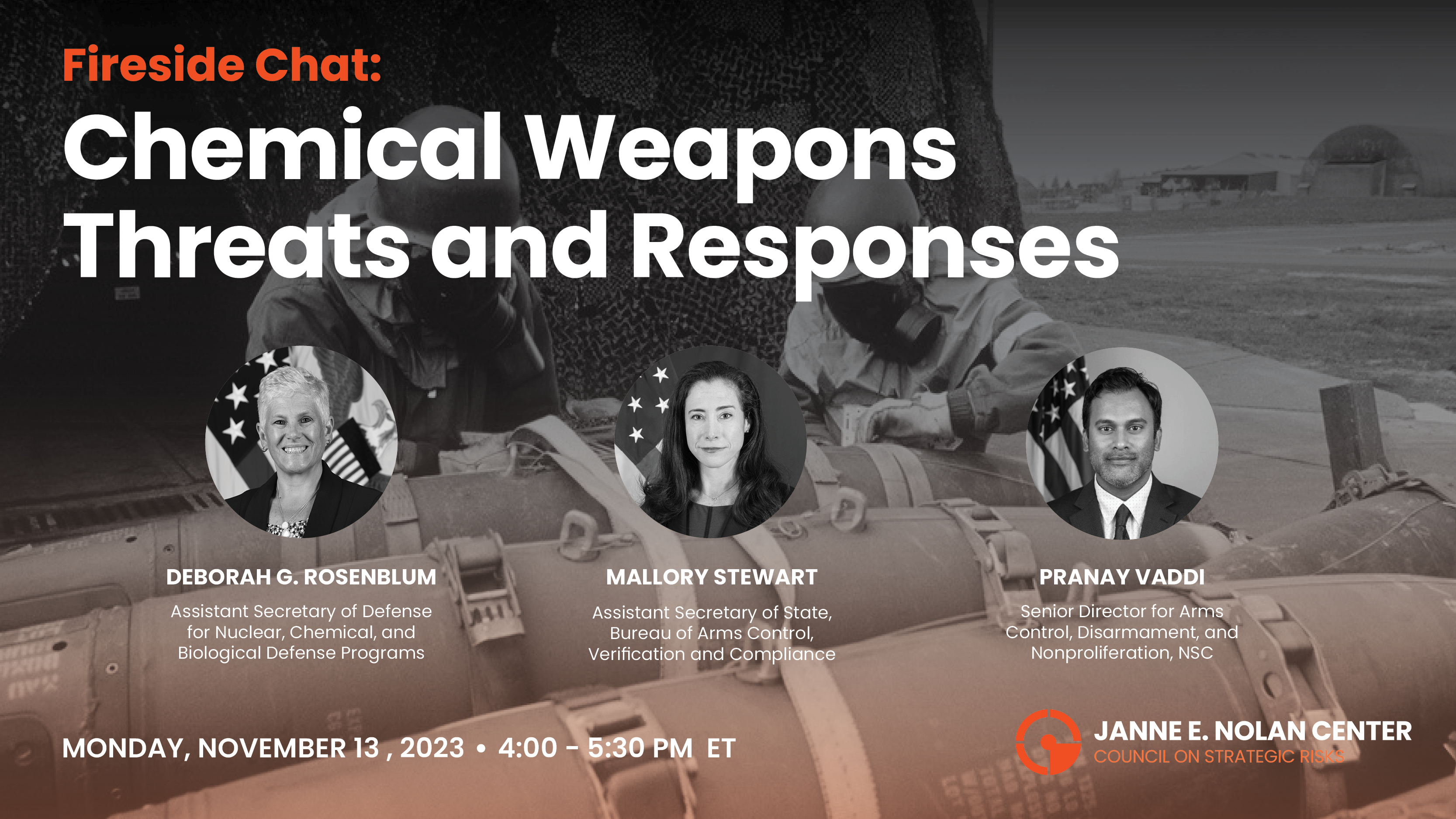
NEW: Fireside Chat: Chemical Weapons Threats and Responses
“The Council on Strategic Risks (CSR) will host a public event on Monday, November 13, 2023 in Washington, D.C. on chemical weapons threats and responses. This will be the first in a series of quarterly “fireside chat” discussions that CSR plans to host regarding weapons of mass destruction issues.”
Learn more and register here.
NEW: Key Issues at the 28th CWC Conference of States Parties
“The CWC Coalition will host a webinar on Tuesday, November 14 on the key issues facing the Chemical Weapons Convention ahead of its annual Conference of States Parties in The Hague from November 27 through December 1, 2023.
We will highlight key issues, followed by a general discussion with all participants. Our goal is to define the issues that civil society would like to raise at the Conference of States Parties. Issues include:
– Compliance
– Accountability
– Universality
– Expansion of schedules
– and more”
This event will take place at 10 am EST. Learn more and register here.
2023 EPA International Decontamination Research and Development Conference-“Advancing Preparedness through Science and Collaboration”
“The clean-up of chemical, biological, or radiological (CBR) contamination incidents and natural disasters is a critical challenge for the United States. Understanding how to characterize and remediate affected areas of environmental contamination and waste is necessary for daily life to return.”
“The Decon Conference is designed to facilitate presentation, discussion, and further collaboration of research and development topics focused on an all-hazards approach to remediate contaminated indoor and outdoor areas, critical infrastructure, water distribution systems, and other environmental areas/materials.”
“This conference is free and open to the public. Content and presentations are geared towards the emergency response community, including local and state emergency managers, homeland security officials, first responder coordinators, private sector industry, risk managers, educators in the field of emergency management, and others.”
This event will take place December 5-7 in Charleston, SC. Learn more and register here.
61st ISODARCO Course: Nuclear Order and International Security after Ukraine
“The war in Ukraine has had an enormous impact on global security, reviving nuclear fears, undermining the prospects for arms control, and shattering many of the norms and constraints that were the foundation of European security. ISODARCO 2024 will examine the global nuclear order in light of the Ukraine war, focusing on the states, the policies and the technologies that will shape the future in a much more difficult environment. How will we cope with this more dangerous world?”
This course will take place January 7-14, 2024, at the University of Trento. Learn more and register here.
Registration for GHS 2024 Now Open
Registration is now open for the Global Health Security 2024 conference in Sydney, Australia. This iteration will take place 18-21 June, 2024. The call for abstracts is also still open. “The mission of the Global Health Security conference is to provide a forum where leaders, researchers, policy-makers, and representatives from government, international organisations, civil society, and private industry from around the world can engage with each other, review the latest research and policy innovations, and agree solutions for making the world safer and healthier. To that end, our mission is to help foster a genuinely multidisciplinary community of practice that is committed to working collaboratively to enhance global health security and eliminate disease, irrespective of its origin or source.”

Job Opportunity: Senior Research Program Manager
“The Hoover Institution’s Biotechnology Policy Initiative, based at Stanford University, is seeking highly motivated Senior Research Program Manager to join our team”.
Job purpose and duties include: “Lead biopolicy research efforts on matters arising at the intersection of emerging biotechnologies and national security, economic strategy, political theory, democracy, and freedom. Work under the general direction of joint senior faculty at Stanford/Hoover to develop, implement, and administer the vision, strategy, and goals of the assigned academic entity/program(s). Participate in entity/program strategy development, long-range planning, and partnership development. Open to considering candidates from post baccalaureate through post-doctoral or others with significant industry or government experience.”
Learn more and apply here.
Job Opportunity: WHE External Emergency Roster – Toxic chemicals and/or Pathogenic Biological materials (CB) TECHNICAL SPECIALIST – (2307472)
This job posting is from the WHO’s Health Emergencies Program. “The mission of WHO’s Health Emergencies Programme (The Programme) is to help countries, and coordinate international action, to prevent, prepare for, detect, rapidly respond to, and recover from outbreaks and emergencies. The team objective is to support the Incident Management team in Operation Support and logistics related to response operations. The scope of the work will be aligned with the WHO principles of work and strategic documents on the health system infrastructure and health care services provision, public health essential operations and public health emergency preparedness and response principles.” Learn more and apply here.
Standing Committee on Advances and National Security Implications of Transdisciplinary Biotechnology: Call for Experts
The National Academies of Sciences, Engineering, and Medicine is seeking suggestions for experts to be considered for the membership rotation with the Standing Committee on Advances and National Security Implications of Transdisciplinary Biotechnology and associated activities, including forthcoming meetings of experts and a workshop. This Standing Committee convenes meetings and workshops to identify advanced biotechnology capabilities of interest and to explore transdisciplinary biotechnological research and development that holds promising scientific or technical capabilities for addressing national security needs. The committee discusses barriers or challenges to adoption, and practical and operational factors in the innovation ecosystem that enable the translation of these technologies. In addition to exploring broad biotechnology developments, the Standing Committee during 2023-2024 will have a particular emphasis on exploring the applicability of artificial intelligence and machine learning and automated experimentation (also referred to as “cloud labs” and “self-driving labs”) for biotechnology discovery and development across various applications (e.g., health, agriculture, materials, etc.). The committee also will: explore these technologies for the prevention of misuse of biotechnology; identify methods and data that can be used to forecast and track the development and adoption of these technologies; discuss opportunities for driving innovation in these technologies including technical, policy, financial, and similar types of drivers; and discuss methods to assess the costs and benefits of investing (or not investing) in the development of these technologies. The committee will further explore the feasibility of developing a US-based research network related to these technologies, and regulatory processes related to the transition of these and associated defense-specific biotechnology products and services to different sectors.
Using these suggestions, National Academies staff will look to fill 2-4 open seats on the standing committee of approximately 20 total volunteer experts and to establish a workshop planning committee of approximately 6-7 members, in addition to collecting information for potential speakers, participants, and other forms of engagement.
Learn more and submit nominations by November 10 here.
Participant Nomination Call: Launching a Global Research Agenda for Evidence-Based Biosafety
From Gryphon Scientific: “Join us to build a global research agenda for evidence-based biosafety! We’re hosting a series of workshops on the sidelines of international conferences and seeking technical experts to contribute from across the one health spectrum and from countries of all resource levels. Participants will have the opportunity to shape potential future biosafety research projects and to collaborate with multisectoral experts from around the world.”
Learn more and submit nominations here.
 The Pandora Report