This week covers updates on the press to reauthorize DHS’ CWMD Office and other programs, CDC’s expansion of the Traveler-Based Genomic Surveillance Program, and more from Google, the WHO, the US Department of State, and others. New publications follow, including several focused on the intersection of AI and biodefense and multiple publications from alumni of the Biodefense Graduate Program.
Schar School Biodefense MS Virtual Open House
Prospective students are invited to attend an information session to hear more about the Biodefense MS program offered at the Schar School. The online session will provide an overview of the program, as well as the application process, student experience, and graduate outcomes. This admissions session will be led by the Graduate Admissions team. This event will take place on November 13 from 12 to 1 pm EST. Learn more and register here.
Secretary Mayorkas Urges Congress to Reauthorize Several DHS Programs
The Department of Homeland Security Secretary, Alejandro Mayorkas, urged Congress this week to reauthorize several programs in his department, including DHS’ counter-unmanned aircraft systems authority (set to expire November 18), the Countering Weapons of Mass Destruction Office (set to expire December 21), and CISA’s authority to implement the Chemical Facility Anti-Terrorism Standards Program, which expired this summer.
According to ExecutiveGov, Mayorkas said in a Senate hearing ‘“As of today, we have no longer been authorized to conduct over 450 inspections, when historically more than a third of inspections identify at least one gap in a facility’s security.”
The same article explained that “Mayorkas also urged Congress to protect DHS’ intelligence collection authorities by reauthorizing Section 702 of the Foreign Intelligence Surveillance Act and resisting a provision in a proposed bill that would limit the authority of the department’s Office of Intelligence and Analysis.”
CDC to Screen for COVID-19, Flu, RSV, and Other Diseases at Major Airports
The CDC Travelers’ Health Branch is set to roll out an expanded version of the Traveler-Based Genomic Surveillance Program at four major US airports-Boston Logan, San Francisco International, Washington’s Dulles International, and New York’s John F. Kennedy. CNN explained that “The program currently operates Covid-19 surveillance at seven major international airports in the United States. For a pilot program, it’s now expanding to test for more than 30 bacteria, antimicrobial resistance targets and viruses including influenza A and B, and respiratory syncytial virus, known as RSV…The traveler surveillance program was introduced in 2021 when the CDC began collecting nasal swab samples from anonymous international travelers arriving at participating airports who volunteer to get swabbed.”
Google Joins Bio-ISAC
Google announced this week that it has joined the not-for-profit organization, the Bioeconomy Information Sharing and Analysis Center (Bio-ISAC), as an industry member. The company said in a statement, “As the bioeconomy grows and evolves, its manufacturers are increasingly reliant on digital technologies and interconnected systems. Cybersecurity is paramount. Ensuring the security of supply chains, industrial control systems, intellectual property and data, protecting the connected critical infrastructure becomes essential to prevent disruptions and maintain trust. Robust cybersecurity measures safeguard the bioeconomy’s valuable assets and maintain public confidence in the sector’s ability to drive sustainable innovation and economic growth.”
“To support these efforts and Google Cloud’s commitment to securing the cloud, our customers, and the planet, we have joined the Bioeconomy Information Sharing and Analysis Center (Bio-ISAC) as an Industry Member. As an Industry Member, we will help connect organizations working to better secure the bioeconomy with Google Cloud’s own cybersecurity resources and expertise.”
Explaining the goal of Bio-ISAC, the statement further elaborated “Bio-ISAC is an international not for profit organization that addresses threats unique to the bioeconomy. Working to enhance the cybersecurity posture of the biotechnology industry, Bio-ISAC brings together companies, research institutions, government agencies, and cybersecurity experts to share timely and relevant information on emerging cyber threats, vulnerabilities, and mitigation strategies to keep the industry informed and better prepared to protect critical assets and infrastructure.”
WHO, Johns Hopkins Announce WHO Generic All-Hazards Risk Assessment Tool for Mass Gathering Events
The Johns Hopkins Center for Health Security announced this week that it has partnered with WHO to create the WHO Generic All-Hazards Risk Assessment Tool for Mass Gathering Events (All-Hazards MG RA Tool). According to the Center, “This user-friendly and innovative digital tool aims to support WHO Member States and mass gathering event organizers in identifying, assessing, and mitigating risks associated with large-scale gatherings, ultimately enhancing event safety.”
The All-Hazards MG RA Tool aims to build “…upon earlier risk assessment tools for mass gatherings developed by WHO and the Johns Hopkins Center for Health Security, which focused on the risk of amplifying COVID-19 spread. The WHO All-Hazards MG RA Tool represents a collaborative effort between 2 renowned organizations with a shared commitment to global health and safety.”
The tool provides:
- “A systematic, evidence-based approach to identifying and classifying priority risks.
- A description of the necessary level of national preparedness and readiness to mitigate specific hazards.
- Guidance on the implementation of a comprehensive and strategic risk assessment to inform preparedness and response plans, ahead of the mass gathering.
- An estimated assessment of the host country’s capacity to identify and respond to potential negative health impacts related to the event.”
State Department Launches North Korea Sanctions Website
The US Department of State Export Control and Related Border Security Program has collaborated with CRDF Global to launch the North Korea Sanctions website. According to their press statement, “This website has been meticulously designed to serve as a valuable resource for government officials and private sector practitioners alike, offering accessible and pertinent information in three languages: English, Spanish, and Bahasa. The website contains digestible, searchable syntheses of open-source information about UN sanctions on the Democratic People’s Republic of Korea (DPRK) with the aim of assisting practitioners in finding, understanding, and referencing authoritative information on sanctions.”
“Addressing the Threat of Disease Spillover”
A team from the Council on Strategic Risks recently authored this report. Two of the authors, Yong-bee Lim and Saskia Popescu, are alumni of the Biodefense PhD Program. The report’s summary promises “The report provides a deeper understanding of the current landscape of pandemic prevention activities that focus on high-risk disease spillover sites. It provides examples of the complex web of biological and ecological factors that contribute to spillover risks, and highlights a range of current activities and practices. It also identifies gaps and challenges currently stemming from the existing silos between the biological and ecological security fields—gaps and challenges which result in siloed approaches to the way these activities are conceptualized, considered, executed, and prioritized.”
“Biotechnology: The Deadly Weaponization of Life”
Diego Laje recently interviewed Sonia Ben Ouagrham-Gormley, an associate professor in the Schar School, for this piece in Signal. Laje writes in part, “Using biological agents as weapons is illegal, but an organism that scientists lawfully use for genuine research could be repurposed for an attack. Therefore, what is banned depends on what an actor plans to do rather than the actual pathogens.”
“Leveraging biotechnology could be a new, more terrorizing form of adopting technologies for greater destruction. Nevertheless, for one specialist, this is only another iteration of the age-old weaponization of life…“There are no biotechnological weapons. They don’t exist. It’s biological weapons,” explained Sonia Ben Ouagrham-Gormley, deputy director of the biodefense program at George Mason University.”
Read more here.
“Social Media Lies: User’s Private Information and the Spread of Misinformation and Disinformation”
Christina Roberts and Keith Ludwick (a Biodefense PhD Program alumnus) recently published this article in Global Security and Intelligence Studies: “Social media is becoming more and more integrated with everyday life. Individuals around the globe use social media to stay connected with family and friends, conduct business, market products, run political campaigns, and a myriad of other activities. Unfortunately, the integration of social media with daily life is becoming so ubiquitous as to numb users to the possibility that the companies controlling our access to social media might be using the private information gleaned from individual users to help spread misinformation/disinformation (MIDI). This paper asks: How does the use of private information by social media companies lead to the spread of misinformation or disinformation? Using a Grounded Theory approach and examining three instances of social media companies accessing users’ private information (Cambridge Analytica, Russian interference in the 2016 U.S. Presidential Election, and the January 6th insurrection at the U.S. Capitol), this paper interprets these incidents to determine the extent of culpability of the company’s use of private user information. The findings indicate a strong link between these companies’ private, personal information use and the spread of MIDI. The study finishes with policy recommendations and suggestions for future research.”
“Can’t Quite Develop That Dangerous Pathogen? AI May Soon Be Able to Help”
Allison Berke recently published this piece with The Bulletin of the Atomic Scientists, in which she explains “Imagine the near future of artificial intelligence (AI) models. One model might be able to replicate the email-writing styles of others. Mimicking a virologist, it could convince his colleagues to provide sensitive information on a newly identified viral mutation. Another might evaluate existing chemotherapies and suggest variations for making the drugs even more toxic, including to non-cancerous cells. Yet another model might be able analyze a failed genetic engineering experiment and could, through generated photos, guide a beginner toward an improved protocol for making antibiotic-resistant bacteria.”
“The capabilities these scenarios describe are close to what the current crop of advanced and publicly available AI tools can already do. The day when a bad actor could use such an AI model to develop, say, a biological weapon, could potentially be soon. But how can these risky uses of AI be deterred without curtailing the extraordinary potential of these tools to accelerate helpful biotechnology development?”
Read more here.
“Can Chatbots Help You Build a Bioweapon?”
Steph Batalis published this article in Foreign Policy, writing “Human extinction, mass unemployment, cheating on exams—these are just some of the far-ranging fears when it comes to the latest advances in artificial intelligence chatbot capabilities. Recently, however, concern has turned toward the possibility that a chatbot could do some serious damage in another area: making it easier to construct a biological weapon.”
“These fears are based in large part on a report from a group at the Massachusetts Institute of Technology, as well as testimony in the U.S. Congress from Dario Amodei, the CEO of AI company Anthropic. They argue that chatbots could provide users with step-by-step instructions to genetically engineer and produce pathogens, such as viruses or bacteria. Armed with such information, the thinking goes, a determined chatbot user could go as far as to develop and deploy a dangerous bioweapon without the need for any scientific training.”
“The Mad Scientists of AI”
Carmen Paun recently authored this piece for POLITICO, explaining in her introduction “Artificial intelligence designs a new toxin that doesn’t exist in nature. Someone then uses a machine the size of a microwave — called a benchtop DNA synthetic device — to produce it and spread it, potentially triggering a new pandemic.”
“This might sound like science fiction but experts warn that it could happen if governments don’t set rules for how AI is used in synthetic biology.”
“The White House is taking a crack at it.”
“In his executive order on AI this week, President Joe Biden requested:
— A National Academies of Sciences, Engineering, and Medicine report with recommendations on how to mitigate risks from AI trained on biological data and also an assessment of how AI could be used to reduce biosecurity risks;
— Rules from the White House Office of Science and Technology Policy for providers of synthetic nucleic acid sequences, requiring them to identify biological sequences that could be used to engineer a bioweapon and to screen their customers;
— Requirements for the beneficiaries of federal life science research grants that they procure synthetic nucleic acid only from companies that follow the OSTP rules.”
“Prepare for Pandemics or CBRN Threats? We Must Do Both.”
Greg Burel and David Lasseter recently published this piece in Real Clear Defense. In it, they write in part: “In our fight against the growing threat of manmade weapons and natural born agents, we no longer have the luxury of focusing on one at the expense of the other. It’s time for the preparedness community to walk and chew gum at the same time.”
“That’s especially true given the relatively little attention that many in the U.S. Government and the media pay to the biological threat compared to the shiny objects of cybersecurity, artificial intelligence, and hypersonic missiles. While those evolving capabilities will certainly shape dynamic and changing future battlefields, the threats posed by manmade chemical, biological, radiological, and nuclear (CBRN) weapons and natural occurring germs are a clear and present threat today that is only growing given the sheer scale of violence the world is now experiencing. The U.S. Government must ensure the American people and warfighters, as well as its allies and partners, have the capabilities necessary to defend against and respond to the broad array of threats that can turn from regional to global in days.”
“All-Hazards Policy for Global Catastrophic Risk”
This Technical Report from the Global Catastrophic Risk Institute was authored by Rumtin Sepasspour and explains that “A variety of threats could cause catastrophic harm to humanity globally. The list of threats include, but are not limited to, nuclear weapons, climate change, pandemics, asteroids and comets, supervolcanic eruption and ecological collapse. Although each threat has distinctive characteristics, they are not unrelated or mutually exclusive.”
“An all-hazards approach to global catastrophic risk (GCR) addresses GCR as a whole. An allhazards policy approach provides a strategic policy framework to reducing GCR. It helps reduce multiple threats and hazards at the same time. It also helps tackle threats that are unknown or underestimated. Ultimately, all-hazards GCR policy will enable more efficient, effective and holistic reduction of GCR compared to treating the threats and hazards separately.”
“This report introduces the concept of all-hazards GCR and applies it to government policy for reducing GCR. It presents two approaches to all-hazards GCR policy.”
“We Are Not Prepared for Biological Attacks Resulting From the Escalating Israel-Hamas War”
Joe Lieberman and Tom Ridge make the case for paying attention to biological threats arising from the Israel-Hamas War in this Messenger Opinion piece, writing in part “It is urgent that the Biden administration and Congress take these biological threats seriously and act to prevent them and, if necessary, be ready to respond. We need our government to pull together at this time of danger to ensure that our nation’s defense, intelligence, and public health communities can continue to protect us and do their critical work at home and around the world.”
“Immediate priorities are to avoid the imminent government shutdown on November 17, send military and humanitarian aid to the regions at war, and reauthorize of Section 702 of the Foreign Intelligence Surveillance Act (FISA) which expires at the end of this year. Section 702 authorizes the U.S. Intelligence Community, under court supervision, to target communications of non-Americans located overseas and ensures that our government can quickly obtain critical intelligence while protecting the rights of Americans. Section 702 is absolutely essential for intelligence gathering to address the potential of biological terrorism and warfare.”
“TB Is the World’s Second Deadliest Infectious Disease”
Anna Fleck for Statista: “Tuberculosis, or TB, was the world’s second deadliest infectious disease in 2022, following only after Covid-19. According to data from the World Health Organization, an estimated 1.13 million HIV-negative people died from TB last year. To put this into perspective, the officially reported death toll for Covid was 1.24 million in 2022, while total deaths from AIDS/HIV totaled 0.63 million and malaria 0.62 million.”
“When people with HIV die from TB, their deaths are officially classified as deaths from AIDS/HIV. Tuberculosis is also known as the leading killer for people living with HIV/AIDS.”
“In terms of all known causes of deaths, the WHO estimated in 2019 that where heart disease, strokes and chronic obstructive pulmonary disease were the three biggest killers, TB came in rank 13.”‘

“More Medical Gloves Are Coming From China, as U.S. Makers of Protective Gear Struggle”
If you have forgotten the horror of the mad dash to acquire PPE in the US during the early days of the pandemic, revive that sense of panic with Nell Greenfieldboyce’s recent analysis piece for NPR. Greenfieldboyce dissects how many of the plants the federal government invested in heavily to address these PPE shortages have yet to actually produce anything as China and other Asian countries grow their output.
The piece explores the effects of the panic-and-neglect funding cycle, explaining in part “A spokesperson for the Department of Health and Human Services (HHS), which worked with the Department of Defense to give out grants during the pandemic, says that the efforts by the HHS have “strengthened our preparedness for future public health threats but sustaining the gains that our country has made over the last few years is difficult, important, and requires continued investment in domestic manufacturing.”‘
What We’re Listening To 🎧
Issues in Science and Technology Podcast, EP 38: Sustaining Science for the Future of Ukraine
“After Russia invaded Ukraine, hundreds of scientists fled the country and hundreds more remained behind. Those scientists who stayed are trying to continue their research and engage with the global scientific community under often difficult circumstances, with the ultimate goal of being able to help rebuild Ukraine when the war ends.”
“Since the early days of the war, Vaughan Turekian, the director of the Policy and Global Affairs Division of the National Academies of Sciences, Engineering, and Medicine, has been leading efforts to support Ukrainian scientists and their research, enlisting the help of international science academies and philanthropic partners. Turekian has spent much of his career in science diplomacy. Before joining the Academies, he served as the fifth science and technology advisor to US Secretary of State John Kerry and was also the founding director of the Center for Science Diplomacy at the American Association for the Advancement of Science.”
“In this episode, recorded on October 5, Turekian joins host Molly Galvin to discuss efforts to support Ukrainian scientists and why such efforts are important for the future of Ukraine.”

NEW: Global Health Security and Diplomacy in the 21st Century
Join the State Department’s Bureau of Global Health Security and Diplomacy and the Council on Foreign Relations for their inaugural symposium, “Global Health Security and Diplomacy in the 21st Century.” This event will take place on November 13, from 8:15 am through 2:30 pm EST. Access the livestream here.
NEW: Better Testing Now: A New Testing Playbook to Aid Planning & Mitigate Harms from Biological Emergencies
“On November 16th at 12PM EST the Pandemic Center will host Better Testing Now: A new Testing Playbook to aid planning & mitigate harms from biological emergencies.“
“In October of 2023, the “Testing Playbook for Biological Emergencies” was published. Its purpose is to provide executive leaders with easy-to-use information that will inform their planning on how equitable access to accurate testing can quickly be provided to all communities during an emerging biological event and how the data from testing can inform emergency decisions at each stage of a crisis.”
“On November 16th, the Pandemic Center will bring together authors of the Testing Playbook to discuss lessons learned and next steps.”
Learn more and register here.
NEW: Meeting the Moment: Biodefense Policy, Procurement, and Public Health
From the Bipartisan Commission on Biodefense: “As the Nation continues to endure the consequences of recent pandemics, and with continued interest in biological weapons by nation states and other enemies, the federal government has an opportunity to address vulnerabilities in the biodefense enterprise. At this meeting, titled Meeting the Moment: Biodefense Policy, Procurement, and Public Health, the Commission intends to further explore : (1) biodefense policies and activities at the Department of Defense; (2) federal stockpile evaluation and decision-making for smallpox medical countermeasures; (3) needed authorities of the Department of Health and Human Services, including the Centers for Disease Control and Prevention; and (4) biodefense leadership.”
This meeting will take place on December 5, from 10:30 am until 4 pm ET. Register here.
NEW: Mitigating Arboviral Threats and Strengthening Public Health Preparedness
“Arboviruses are a broad group of viruses that are spread by arthropods, such as ticks and mosquitoes. Diseases caused by arboviruses, like dengue, chikungunya, Zika, and yellow fever, present a significant public health burden and threaten billions of people worldwide. Despite the global recognition of the devastating health and economic impacts of these diseases, the need persists for improved integration of mitigation efforts into public health systems and environmental and urban planning.”
“The National Academies Forum on Microbial Threats will conduct a two-day workshop that will identify lessons learned from previous outbreaks, outline current arbovirus surveillance capacities, and describe novel approaches to arbovirus mitigation. The workshop will include perspectives from researchers, public health practitioners, and environmental management experts from across the globe.”
This event will take place on December 12 and 13. Learn more here.
NEW: International Conference, CBRNE Research & Innovation
“The last 40 years have demonstrated that both military and civilian populations could be exposed to highly hazardous CBRNE agents following conflicts, natural outbreaks and disasters, industrial incidents or terrorist attacks.”
“Worldwide, researchers, responders and industrial capacities have been commited to provide adapted response to these challenges.”
“Building on the success of the first 5 International Conferences « CBRNE Research and Innovation » which took place in Antibes (2015), Lyon (2017), Nantes (2019), on line (2021) and Lille (2022), we want to give you a new opportunity to build up or strengthen collaborative networks in Strabourg (March 19th – 21rst 2024).”
“The CBRNE R&I Conference is specifically devoted to scientific updates, responders’ feedbacks and expression of needs. It also includes workshops and demonstrations of innovative materials, technologies and procedures, according to the following themes: DETECTION – IDENTIFICATION, PROTECTION – DECONTAMINATION, MEDICAL COUNTERMEASURES, RISKS & CRISIS MANAGEMENT.”
“Looking forward to your proposals for communication and to welcoming you at Strasbourg in March 2024!”
Learn more here.
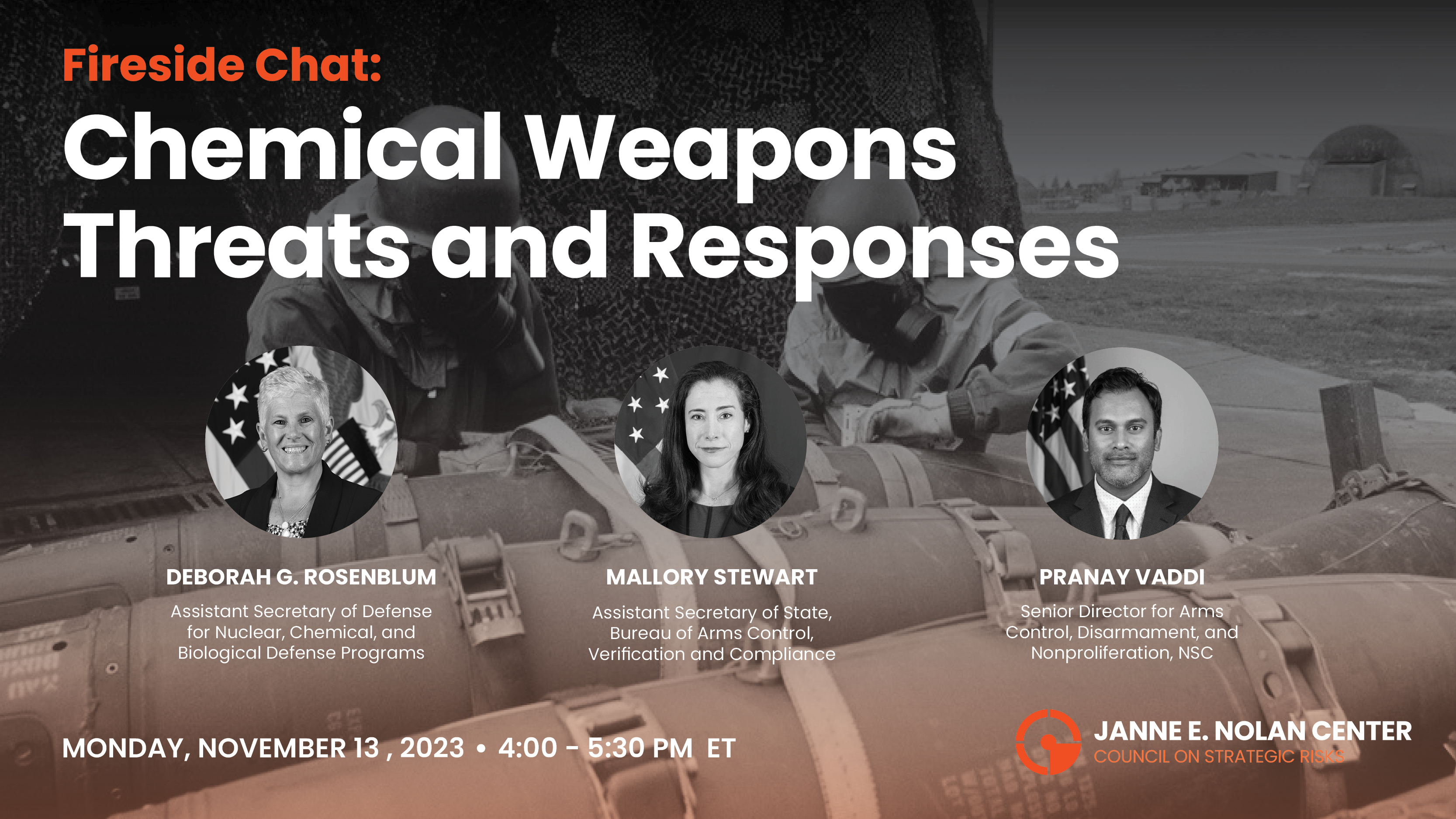
Fireside Chat: Chemical Weapons Threats and Responses
“The Council on Strategic Risks (CSR) will host a public event on Monday, November 13, 2023 in Washington, D.C. on chemical weapons threats and responses. This will be the first in a series of quarterly “fireside chat” discussions that CSR plans to host regarding weapons of mass destruction issues.”
Learn more and register here.
Charting a Responsible Future in AI & Biosecurity: A Webinar Series
From NASEM: “This two-part webinar will bring together technology developers, researchers, and policymakers working at the intersection of generative artificial intelligence (AI) and biological research for nuanced discussions that explore the impact of these technologies on innovation, potential biosecurity risks, and promising solutions. The first session (Nov 6) will examine the technological capabilities and bridge the needs for risk management between developers and policymakers. The second session (Nov 15) will focus on governance of these emerging technologies, including challenges in defining regulatory policies as well as approaches in safeguarding against these risks.”
Learn more and register here.
Key Issues at the 28th CWC Conference of States Parties
“The CWC Coalition will host a webinar on Tuesday, November 14 on the key issues facing the Chemical Weapons Convention ahead of its annual Conference of States Parties in The Hague from November 27 through December 1, 2023.
We will highlight key issues, followed by a general discussion with all participants. Our goal is to define the issues that civil society would like to raise at the Conference of States Parties. Issues include:
– Compliance
– Accountability
– Universality
– Expansion of schedules
– and more”
This event will take place at 10 am EST. Learn more and register here.
2023 EPA International Decontamination Research and Development Conference-“Advancing Preparedness through Science and Collaboration”
“The clean-up of chemical, biological, or radiological (CBR) contamination incidents and natural disasters is a critical challenge for the United States. Understanding how to characterize and remediate affected areas of environmental contamination and waste is necessary for daily life to return.”
“The Decon Conference is designed to facilitate presentation, discussion, and further collaboration of research and development topics focused on an all-hazards approach to remediate contaminated indoor and outdoor areas, critical infrastructure, water distribution systems, and other environmental areas/materials.”
“This conference is free and open to the public. Content and presentations are geared towards the emergency response community, including local and state emergency managers, homeland security officials, first responder coordinators, private sector industry, risk managers, educators in the field of emergency management, and others.”
This event will take place December 5-7 in Charleston, SC. Learn more and register here.
61st ISODARCO Course: Nuclear Order and International Security after Ukraine
“The war in Ukraine has had an enormous impact on global security, reviving nuclear fears, undermining the prospects for arms control, and shattering many of the norms and constraints that were the foundation of European security. ISODARCO 2024 will examine the global nuclear order in light of the Ukraine war, focusing on the states, the policies and the technologies that will shape the future in a much more difficult environment. How will we cope with this more dangerous world?”
This course will take place January 7-14, 2024, at the University of Trento. Learn more and register here.
Registration for GHS 2024 Now Open
Registration is now open for the Global Health Security 2024 conference in Sydney, Australia. This iteration will take place 18-21 June, 2024. The call for abstracts is also still open. “The mission of the Global Health Security conference is to provide a forum where leaders, researchers, policy-makers, and representatives from government, international organisations, civil society, and private industry from around the world can engage with each other, review the latest research and policy innovations, and agree solutions for making the world safer and healthier. To that end, our mission is to help foster a genuinely multidisciplinary community of practice that is committed to working collaboratively to enhance global health security and eliminate disease, irrespective of its origin or source.”

Job Opportunity: Senior Research Program Manager
“The Hoover Institution’s Biotechnology Policy Initiative, based at Stanford University, is seeking highly motivated Senior Research Program Manager to join our team”.
Job purpose and duties include: “Lead biopolicy research efforts on matters arising at the intersection of emerging biotechnologies and national security, economic strategy, political theory, democracy, and freedom. Work under the general direction of joint senior faculty at Stanford/Hoover to develop, implement, and administer the vision, strategy, and goals of the assigned academic entity/program(s). Participate in entity/program strategy development, long-range planning, and partnership development. Open to considering candidates from post baccalaureate through post-doctoral or others with significant industry or government experience.”
Learn more and apply here.
Job Opportunity: WHE External Emergency Roster – Toxic chemicals and/or Pathogenic Biological materials (CB) TECHNICAL SPECIALIST – (2307472)
This job posting is from the WHO’s Health Emergencies Program. “The mission of WHO’s Health Emergencies Programme (The Programme) is to help countries, and coordinate international action, to prevent, prepare for, detect, rapidly respond to, and recover from outbreaks and emergencies. The team objective is to support the Incident Management team in Operation Support and logistics related to response operations. The scope of the work will be aligned with the WHO principles of work and strategic documents on the health system infrastructure and health care services provision, public health essential operations and public health emergency preparedness and response principles.” Learn more and apply here.
 The Pandora Report