
Happy Lunar New Year from the Pandora Report! This week’s edition includes this year’s batch of CBRN and global health security-themed Valentine’s Day cards, coverage of the opening of the CDC’s new regional center in Tokyo, Japan, and new publications.
Pandora Report Valentine’s Day Cards 2024
It’s that time of year again! Download and share the Valentine’s Day cards below with friends and that special someone!



CDC Opens New East Asia and Pacific Regional Office
This week, the US Centers for Disease Control and Prevention opened its new CDC East Asia and Pacific (EAP) regional office in Tokyo, Japan. In a statement, CDC Director Mandy Cohen said “America’s safety and security is dependent on the strong linkages between countries around the world…CDC’s East Asia and Pacific regional office will address health security – globally and in the region – by focusing on cooperation in advanced threat detection, laboratory networks, response capacities, and other platforms and systems for rapid response to ongoing and emerging public health threats.”
CDC says that priorities for the office include “Expanding CDC’s core global health security capacity by building stronger collaboration and partnerships in the East Asia and Pacific region,” “The ability to detect public health threats and respond quickly, and,” “Knowledge and information exchange between CDC and the region.”
In its statement, the organization explained that “Through this office, CDC will focus on identification, response, and mitigation of health threats in international settings to rapidly respond to outbreaks at their source and prevent spread to and within the U.S. Expanding government and nongovernment partnerships will help CDC build the trust and transparency needed for the rapid exchange of data, and it will also strengthen core global health security capacities. Partnering to train a global workforce to prevent, detect, and respond, and sharing scientific expertise will strengthen programs and people to prevent emerging threats.”
J. Stephen Morrison and Mitchell Wolfe recently authored a commentary piece for CSIS discussing the new office, writing in part “CDC’s new East Asia and Pacific office will unquestionably advance U.S. national interests. It will strengthen preparedness against future dangerous outbreaks and improve the health status of the region’s citizens while contributing to U.S. foreign policy and geopolitical goals. It will accomplish those goals principally through enlarged health diplomacy, new partnerships, and deepened alliances backed by CDC’s wide technical expertise.”

“MATCH ‘2.0’” and “Automating Strategic Chemical Trade Control Enforcement”
The Stimson Center recently released its MATCH ‘2.0’ Proof-of-concept and a video covering challenges customs officers face in identifying proliferation-controlled chemicals. The Center explains that “The Monitoring and Tracking Chemicals (MATCH) proof-of-concept is a prototype software system that demonstrates how distributed ledger technology (DLT) can make the process of regulatory compliance more efficient for the global chemical industry and support national authorities in identifying and reconciling discrepancies in declared transfers of commonly traded dual-use chemicals. These “dual-use” chemicals have both peaceful commercial and industrial uses but are also precursors to chemical weapons and subject to export controls and reporting requirements under the Chemical Weapons Convention.”
“The MATCH platform supports a fictional ecosystem of chemical industry participants, national authorities, and a “World Authority.” Industry participants report quantities of transferred dual-use chemicals to their respective national authorities. National authorities aggregate these reported quantities of chemical trade for their subsequent annual declaration to an international regulator referred to as the “World Authority.” In MATCH’s fictional ecosystem, the World Authority loosely represents the real-world Organisation for the Prohibition of Chemical Weapons (OPCW).”
Biodefense Graduate Program Director Gregory Koblentz serves as a consultant on this project.
“Attributing Biological Weapons Use Strengthening Department of Defense Capabilities to Investigate Deliberate Biological Incidents”
From the RAND Corporation: “The White House has given the U.S. Department of Defense (DoD) a lead role in U.S. efforts to strengthen the United Nations Secretary-General’s Mechanism for Investigation of Alleged Use of Chemical and Biological Weapons (UNSGM). In 2022, a White House report highlighted the importance of determining the facts related to the attribution of alleged use of biological weapons (BW), including toxin weapons. That 2022 report aimed to outline the U.S. government’s approach to counter the full range of possibly catastrophic biological incidents, whether natural, accidental, or deliberate, and outlines goals and objectives for strengthening the biodefense enterprise. It also identifies priorities and target areas for each mission objective during a biological incident.”
“In this report, the authors examine issues related to the attribution of BW use and identify areas in which DoD could enhance its capabilities to (1) support U.S. investigative capabilities into alleged uses of biological and toxin weapons and (2) strengthen international efforts, specifically United Nations mechanisms, to hold state and nonstate actors accountable for BW use.”
This report was co-authored by Biodefense MS alumna Annette Prieto.
“Doomsday or Business as Usual? Artificial Intelligence, Machine Learning, and CBRN Threats”
Dan Kaszeta recently published this article in European Security & Defence: “Chemical, biological, radiological, and nuclear (CBRN) threats are potential sources of disaster in modern life. Enemies might be able to use them for some sort of advantage, terrorists could use them for havoc, and accidents could cause disruption, property loss, and death. The same could be said of the broad field of artificial intelligence and machine learning. This expanding field has intersected that of CBRN in both practical and theoretical ways. There are areas for concern. But how concerned should we really be? And is often the case, concern can also bring opportunity. As this new aspect of modern life will be with us from now on, it is worth examining some of the more prominent ways in which AI and machine learning may penetrate in CBRN defence and security.”
“WHO Benchmarks for Strengthening Health Emergency Capacities”
The WHO recently published this report: “Benchmarking is a strategic process often used by businesses and institutes to standardize performance in relation to the best practices of their sector. The World Health Organization (WHO) and partners have developed a tool with a list of benchmarks and corresponding suggested actions that can be applied to implement the International Health Regulations 2005 (IHR) and strengthen health emergency prevention, preparedness, response and resilience capacities.”
“The first edition of the benchmarks was published in 2019 to support countries in developing, implementing and documenting progress of national IHR or health security plans (e.g. national action plan for health security (NAPHS), national action plan for emerging infectious diseases, public health emergencies and health security and other country level plans for health emergencies). The tool has been updated to incorporate lessons from COVID-19 and other health emergencies, to align with the updated IHR monitoring & evaluation framework (IHR MEF) tools and the health systems for health security framework, and to support strengthening health emergency prevention, preparedness, response and resilience (HEPR) capacities and the Preparedness and Resilience for Emerging Threats (PRET) initiative.”
“The benchmarks support implementation of IHR and HEPR capacities and are broad in nature to improve health security and integrate multisectoral actions at national and subnational levels, where appropriate. The benchmark actions are designed to provide guidance for capacity development to move up capacity levels as measured by the IHR MEF, including voluntary external evaluation such as the Joint External Evaluation (JEE) tool and the States Parties Self-assessment annual reporting tool (SPAR). Other assessment tools including the Performance of Veterinary Services (PVS) Pathway (from the World Organisation for Animal Health (WOAH)), the Dynamic Preparedness Metric (DPM), Universal Health and Preparedness Review (UHPR) and readiness assessments can also measure improvements in capacity, with the ultimate goal to sustain an optimal level of prevention, preparedness, response and resilience for health emergencies in the country.”
“The Origin and Implications of the COVID-19 Pandemic: An Expert Survey”
From the Global Catastrophic Risk Institute: “Exactly how the COVID-19 pandemic began remains a topic of considerable scientific and political debate. However, the opinions expressed in the debate have thus far come from an ad hoc mix of experts and commentators who have spoken up. Therefore, a research team led by the Global Catastrophic Risk Institute (GCRI) and Nemesys Insights conducted a rigorous survey of global expert opinion. The anonymous survey included 168 virologists, infectious disease epidemiologists, and other scientists from 47 countries in a geographic sample of both developed and developing countries. This is the first-ever systematic study of expert opinion on the origin of COVID-19.”
“While expert opinion does not necessarily match the underlying truth, carefully obtained expert opinion can indicate the current state-of-the-art thinking on a topic and the extent of consensus across experts. The survey results correspond to the beliefs expressed by the 168 experts who participated in the study.”
“The survey is summarized in a main report and detailed in a methodological and analytical annex.”
“Harassment in Public Health is Real. Here’s How to Respond.”
Samuel R. Mendez recently authored this piece for Harvard Public Health in which they explain in part, “We don’t have specific data on how common such incidents are today, which reveals the lack of a systematic response within U.S. public health. However, we can be sure that this problem won’t go away on its own. A study led by Johns Hopkins researchers found that in 2021, a quarter of Americans believed it was OK to threaten a public health official. And, in the third year of the pandemic, children’s hospitals across the country endured a sharp jump in online harassment, with Boston Children’s Hospital facing bomb threats. Though anyone in public health might experience harassment, we can’t ignore racism, transphobia, and gender-based discrimination in a field with a workforce that is 79 percent women and 46 percent BIPOC and includes an increasing number of people who identify outside the gender binary.”
“WHO Reports Outline Responses to Cyber-Attacks on Health Care and the Rise of Disinformation in Public Health Emergencies”
The WHO recently released this piece summarizing its recent reports that aim to identify ways to “strengthen health security through operational solutions.” The piece explains, “The first report, Examining the threat of cyber-attack on health care during the COVID-19 pandemic highlights the far-reaching real-life impacts of cyber-attacks on health care. During the COVID-19 pandemic, health information technology (IT) infrastructure was increasingly targeted by cyber-attacks, at times hindering hospitals from delivering timely care when it was needed most. To restore IT systems and retrieve stolen data, health care facilities paid substantial ransoms. These attacks prompted law enforcement agencies to issue warnings about the threat of cyber-attacks to the health sector.”
And later “The second report, Understanding disinformation in the context of public health emergencies: the case of COVID-19, reflects on different approaches to counter disinformation. Disinformation, unlike misinformation, is created with malicious intent to sow discord, disharmony, and mistrust in targets such as government agencies, scientific experts, public health agencies, private sector, and law enforcement. In other words, disinformation is a weaponization of information.”
“Countering Disinformation Effectively: An Evidence-Based Policy Guide”
Jon Bateman and Dean Jackson recently published this policy guide with the Carnegie Endowment for International Peace: “Disinformation is widely seen as a pressing challenge for democracies worldwide. Many policymakers are grasping for quick, effective ways to dissuade people from adopting and spreading false beliefs that degrade democratic discourse and can inspire violent or dangerous actions. Yet disinformation has proven difficult to define, understand, and measure, let alone address.”
“Even when leaders know what they want to achieve in countering disinformation, they struggle to make an impact and often don’t realize how little is known about the effectiveness of policies commonly recommended by experts. Policymakers also sometimes fixate on a few pieces of the disinformation puzzle—including novel technologies like social media and artificial intelligence (AI)—without considering the full range of possible responses in realms such as education, journalism, and political institutions.”
“This report offers a high-level, evidence-informed guide to some of the major proposals for how democratic governments, platforms, and others can counter disinformation. It distills core insights from empirical research and real-world data on ten diverse kinds of policy interventions, including fact-checking, foreign sanctions, algorithmic adjustments, and counter-messaging campaigns. For each case study, we aim to give policymakers an informed sense of the prospects for success—bridging the gap between the mostly meager scientific understanding and the perceived need to act. This means answering three core questions: How much is known about an intervention? How effective does the intervention seem, given current knowledge? And how easy is it to implement at scale?”
“Biotech is the New Focus in U.S.-China Tech Rivalry”
Allison Snyder recently authored this piece providing an overview of Congress’ efforts to hamper Chinese biotech companies’ operations in the US (which we covered previously here). Snyder provides insight into the consequences this may have in other countries and in the US government research world, writing in part “Moving too fast to lock out Chinese biotech tools risks disrupting U.S. research efforts and bioproduction because BGI and its affiliates are so deeply embedded in NIH-funded clinical trials and approved therapies, TD Cowen analysts wrote in a research note this week.”
“US Industry Leaders Repeat Calls to Reinstate Security Programme”
Rebecca Trager recently published this piece in Chemistry World covering the expiration of the CFATS program. She explains in part, “Over the lifespan of CFATS, the CISA had identified more than 10 individuals with possible ties to terrorism, and given that rate of vetting Murray said CISA likely would have identified at least one individual as a known or suspected terrorist in the last six months. Murray also pointed to good data showing that CFATS made a difference in getting chemical facilities better prepared to handle security incidents, with plants introducing multiple security measures as part of the approval process.”
“Global Terrorism Threat Assessment 2024”
CSIS’s Transnational Threats Project recently published this report and a corresponding spoken-word summary: “Terrorism is no longer the leading international threat to the United States or its top defense priority, but challenges related to violent extremism remain. The threat from Salafi-jihadist groups such as al Qaeda and the Islamic State has declined, and ethnonationalist threats are largely contained. However, a broader patchwork of violent far-right and far-left extremist ideologies has become more prominent on the global stage. Meanwhile, terrorism continues to overlap in significant ways with strategic competition, especially via Iran’s support to terrorist groups like Hamas and Hezbollah.”
What We’re Listening To 🎧
The BWC Global Forum: Biotech, Biosecurity & Beyond Episode 11-Gene Synthesis Screening
From Johns Hopkins Center for Health Security: “In this episode, we discuss the role of international screening efforts in protecting against the misuse of synthetically manufactured genetic materials. Rapid expansion in the capacity, affordability, and accessibility of gene synthesis—the ability to assemble genetic sequences from scratch—enables anyone with an internet connection to order custom genomes from vendors around the world. In the absence of consistent national or global regulatory frameworks, the responsibility falls on gene synthesis companies and researchers themselves to ensure that these services are not being misused to produce dangerous pathogens or their components. The International Gene Synthesis Consortium (IGSC) is an industry organization that supports the development and implementation of screening protocols for gene synthesis orders and customers to mitigate the risk of this misuse, in order to facilitate the broadest use of these technologies for peaceful purposes.”
EBRC In Translation
“EBRC In Translation is a podcast working to bring you conversations with leaders in the world of Engineering Biology. The show is the official podcast of the Engineering Biology Research Consortium Student and Postdoc Association and is hosted by a rotating cast of graduate students and postdocs…”

NEW: Artificial Intelligence and Automated Laboratories for Biotechnology: Leveraging Opportunities and Mitigating Risks
From the National Academies’ Board on Life Sciences: “Please join us April 3-4, 2024 for a hybrid workshop on the opportunities and mitigation of risks of the use of artificial intelligence and automated laboratories (i.e., self-driving labs) for biotechnology.”
“The workshop will consider opportunities to leverage AI and laboratory automation capabilities for discovery and development, explore methods and approaches to identify, track, and forecast the domestic and international development of such technologies, and convene experts across sectors to highlight recent advances and explore implications for the development and use of these technologies.”
Learn more and register here.
Introducing IBBIS: Safeguarding Bioscience and Biotechnology for a Safer Future
“The Nuclear Threat Initiative (NTI) is launching the International Biosecurity and Biosafety Initiative for Science (IBBIS) during an official side event at the 2024 Munich Security Conference. IBBIS is a new, independent organization based in Geneva that will work with global partners to strengthen biosecurity norms and develop innovative tools to uphold them. IBBIS will help reduce the risk of catastrophic events that could result from deliberate abuse or accidental misuse of bioscience and biotechnology so they can flourish, safely and responsibly.”
“NTI Co-Chair and CEO Ernest J. Moniz will moderate a senior-level panel discussion featuring: Weiwen Zhang, director, Center for Biosafety Research and Strategy, Tianjin University; James Diggans, head of biosecurity, Twist Bioscience; Luciana Borio, venture partner, ARCH Venture Partners and senior fellow for global health, Council on Foreign Relations; and Piers Millett, executive director, IBBIS. Amandeep Gill, UN Secretary General’s Envoy on Technology, will provide recorded remarks.”
This in-person event will take place at Literaturhaus München on Thursday, February 15. Learn more and RSVP here.
Enhancing the Global Food System’s Resilience to Biological Threats
“This virtual event, hosted by the Scowcroft Institute of International Affairs at Texas A&M, will take place on February 20, 1:00-2:30 PM [EST].”
“A year after the Biden Administration’s National Security Memorandum on Strengthening the Security and Resilience of United States Food and Agriculture (NSM-16), Scowcroft is convening stakeholders from across industry, academia, and government to identify the policies and technologies needed to safeguard the world’s food system against biological threats. Planned topics include microbial food production, AI-enabled crop disease surveillance, and genomic engineering to improve plant disease resistance, among others.”
“For more details, find a draft agenda here.
Speakers include:
- David Stiefel, National Security Policy Analyst, National Security Division, USDA and former Director for Biodefense on the National Security Council
- Nils Justen, Policy Analyst, National Security Commission on Emerging Biotechnology (NSCEB)
- Shannon Nangle, CEO and Co-Founder, Circe Biosciences
- Seth Murray, Professor Butler Chair, Soil and Crop Sciences, Texas A&M University
- Yiping Qi, Professor, Plant Sciences and Landscaping, University of Maryland”
Register here.
The Advancing Threat Agnostic Biodefense Webinar Series
From PNNL: “Join us as we welcome Dr. Tony Goldberg, professor in the School of Veterinary Medicine at the University of Wisconsin-Madison. His talk, titled “Assessing the Zoonotic Risk of Pre-emergent Viruses” will be Tuesday, February 20, at noon PT.“
“Exploration of the “virosphere” is in its golden age. The sheer number of new viruses discovered daily, and the fact that most cannot be cultured, creates enormous uncertainty about where to allocate attention and resources. It is not an intractable problem, however, to distinguish those few viruses that are likely to emerge as zoonoses from the many others that are not. This talk describes two diametric approaches to addressing this problem.”
Learn more and register here.
Presidential Advisory Council on Combating Antibiotic-Resistant Bacteria Public Meeting
“The 24th PACCARB public meeting will be held virtually on February 22, 2024. This will be the second of two meetings to address the task provided to the PACCARB by the Secretary of HHS to address antimicrobial resistance globally. The focus of the meeting will be on international implementers and the gaps, challenges, and opportunities they see to combat AMR globally – specifically focusing on low- and middle-income countries. Current times are tentative and subject to change.”
This event will take place on February 22, at 9 am. Submit public comments and register to attend here.
GP Nonproliferation and Strategic Trade Hub Virtual Launch & Demo
“The Strategic Trade Research Institute (STRI) invites you to participate in the Global Partnership Nonproliferation and Strategic Trade Hub Virtual Launch and Demo event taking place on February 27, 2024, from 9:00-10:00 am EST.”
“Please join us to learn about the main features of the Hub, how to use it, and how it can be useful and impactful for nonproliferation and export control professionals. The event will feature Andrea Viski, Director of STRI, as well as introductory remarks from the Hub’s sponsor, the United Kingdom’s Counter-proliferation and Arms Control Center (CPACC).”
Learn more and register here.
International Conference, CBRNE Research & Innovation
“The last 40 years have demonstrated that both military and civilian populations could be exposed to highly hazardous CBRNE agents following conflicts, natural outbreaks and disasters, industrial incidents or terrorist attacks.”
“Worldwide, researchers, responders and industrial capacities have been commited to provide adapted response to these challenges.”
“Building on the success of the first 5 International Conferences « CBRNE Research and Innovation » which took place in Antibes (2015), Lyon (2017), Nantes (2019), on line (2021) and Lille (2022), we want to give you a new opportunity to build up or strengthen collaborative networks in Strabourg (March 19th – 21rst 2024).”
“The CBRNE R&I Conference is specifically devoted to scientific updates, responders’ feedbacks and expression of needs. It also includes workshops and demonstrations of innovative materials, technologies and procedures, according to the following themes: DETECTION – IDENTIFICATION, PROTECTION – DECONTAMINATION, MEDICAL COUNTERMEASURES, RISKS & CRISIS MANAGEMENT.”
“Looking forward to your proposals for communication and to welcoming you at Strasbourg in March 2024!”
Learn more here.
Registration for GHS 2024 Now Open
Registration is now open for the Global Health Security 2024 conference in Sydney, Australia. This iteration will take place 18-21 June, 2024. The call for abstracts is also still open. “The mission of the Global Health Security conference is to provide a forum where leaders, researchers, policy-makers, and representatives from government, international organisations, civil society, and private industry from around the world can engage with each other, review the latest research and policy innovations, and agree solutions for making the world safer and healthier. To that end, our mission is to help foster a genuinely multidisciplinary community of practice that is committed to working collaboratively to enhance global health security and eliminate disease, irrespective of its origin or source.”
SBA.3 International Synthetic Biology, and Biosecurity Conference in Africa
“Join us for the SBA.3 International Synthetic Biology and Biosecurity Conference in Africa, a groundbreaking event that brings together experts, researchers, and enthusiasts in the field of synthetic biology. This in-person conference will take place at the Laico Regency Hotel from Wed, Jul 17, 2024 to Friday, Jul 19, 2024.”
“Get ready to dive into the exciting world of synthetic biology and explore its potential applications in Africa. From cutting-edge research to innovative solutions, this conference offers a unique opportunity to learn, network, and collaborate with like-minded individuals.”
“Discover the latest advancements, trends, and challenges in synthetic biology through engaging keynote speeches, interactive workshops, and thought-provoking panel discussions. Immerse yourself in a vibrant atmosphere where ideas flow freely and new connections are made.”
“Whether you’re a seasoned professional or just starting your journey in synthetic biology, this conference provides a platform to expand your knowledge, exchange ideas, and contribute to the growth of the field in Africa.”
“Don’t miss out on this extraordinary event that promises to shape the future of synthetic biology and biosecurity in Africa. Mark your calendars and join us at the SBA.3 International Synthetic Biology and Biosecurity Conference in Africa!”
Learn more and register here.

High School and College Student Internship: Data Analytics for Elite Young Scholars – Biology and Medical Science Experience
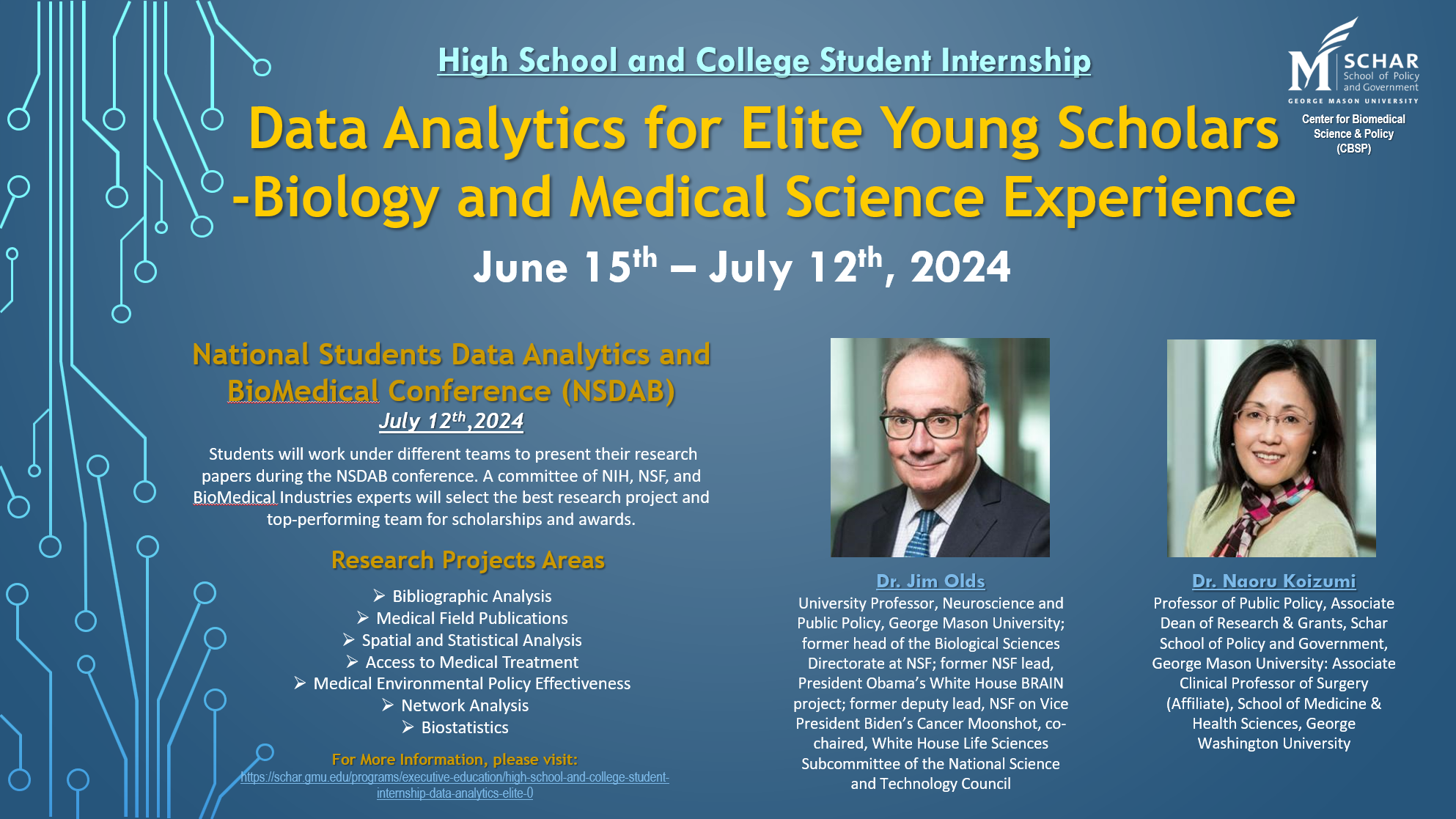
“The Young Scholars Research Program is tailored for high-achieving high school and undergraduate students aspiring to delve into the realms of biology or medical science, with a strong focus on advanced data analytics. Participants will have the unique opportunity to collaborate with esteemed faculty members from GMU, forming interdisciplinary teams comprising 3 to 4 individuals encompassing both high school and undergraduate students.”
“At the outset of the program, students will be assigned to specific team projects based on their indicated preferences. Each team is expected to produce two significant outputs by the program’s conclusion. Firstly, a final paper showcasing their research findings will be published on the Center for Biomedical Science & Policy (CBSP) website and the Schar School Young Scholars Journals Webpage. Secondly, teams will present their projects at a conference where students have the chance to compete for prizes.”
“Throughout the program, participants will engage in hands-on research projects employing a variety of methodologies. This may include but is not limited to, biostatistics utilizing R or Stata, data visualization employing QGIS or ArcGIS, and network visualization using tools like Gephi. The comprehensive nature of the program ensures a rich and immersive experience for students passionate about advancing their understanding and skills in the fields of biology and medical science.”
Learn more here.
Agricultural Bioterrorism Protection Act of 2002; Biennial Review and Republication of the Select Agent and Toxin List
“In accordance with the Agricultural Bioterrorism Protection Act of 2002, we are proposing to amend and republish the list of select agents and toxins that have the potential to pose a severe threat to animal or plant health, or to animal or plant products. This Act requires the biennial review and republication of the list of select agents and toxins and the revision of the list as necessary. This action would implement findings from the biennial review for the list. The biennial review was initiated within 2 years of the completion of the previous biennial review. In addition, we are proposing to add definitions for several terms; codify policies regarding the role of responsible officials and alternate responsible officials, conclusion of patient care, and annual internal inspections; and revise or clarify provisions related to validated inactivation procedures and viable select agent removal methods, recordkeeping, non-possession of select agents and toxins, electronic Federal Select Agent Programs, registration, Tier 1 enhancements, and exclusion of naturally infected animals. We are also proposing to add requirements for reporting discoveries of select agents and toxins, provisions regarding effluent decontamination system, biosafety provisions for facility verification requirements for registered biosafety level 3 and animal biosafety level 3 laboratories, a new requirement related to restricted experiments, and to correct editorial errors. These proposed changes would economically benefit producers, research and reference laboratories, and State and Federal oversight agencies, while also maintaining adequate program oversight of select agents and toxins.”
Read more and submit comments here.
 The Pandora Report