
This week’s Pandora Report includes updates from the Biodefense Graduate Program as well as discussion about the Trump administration’s response to measles and H5N1, the state of USAID, and more.
Biodefense MS Information Session
“Prospective students are invited to attend a information session to hear more about the Biodefense M.S. program offered at the Schar School. The online session will provide an overview of the program, as well as the application process, student experience and graduate outcomes. This session admissions will be led by the Graduate Admissions team.”
This sessions will take place at 12 pm EDT on March 20. Learn more and register here.
Biodefense Doctoral Students at ELBI Research Symposium
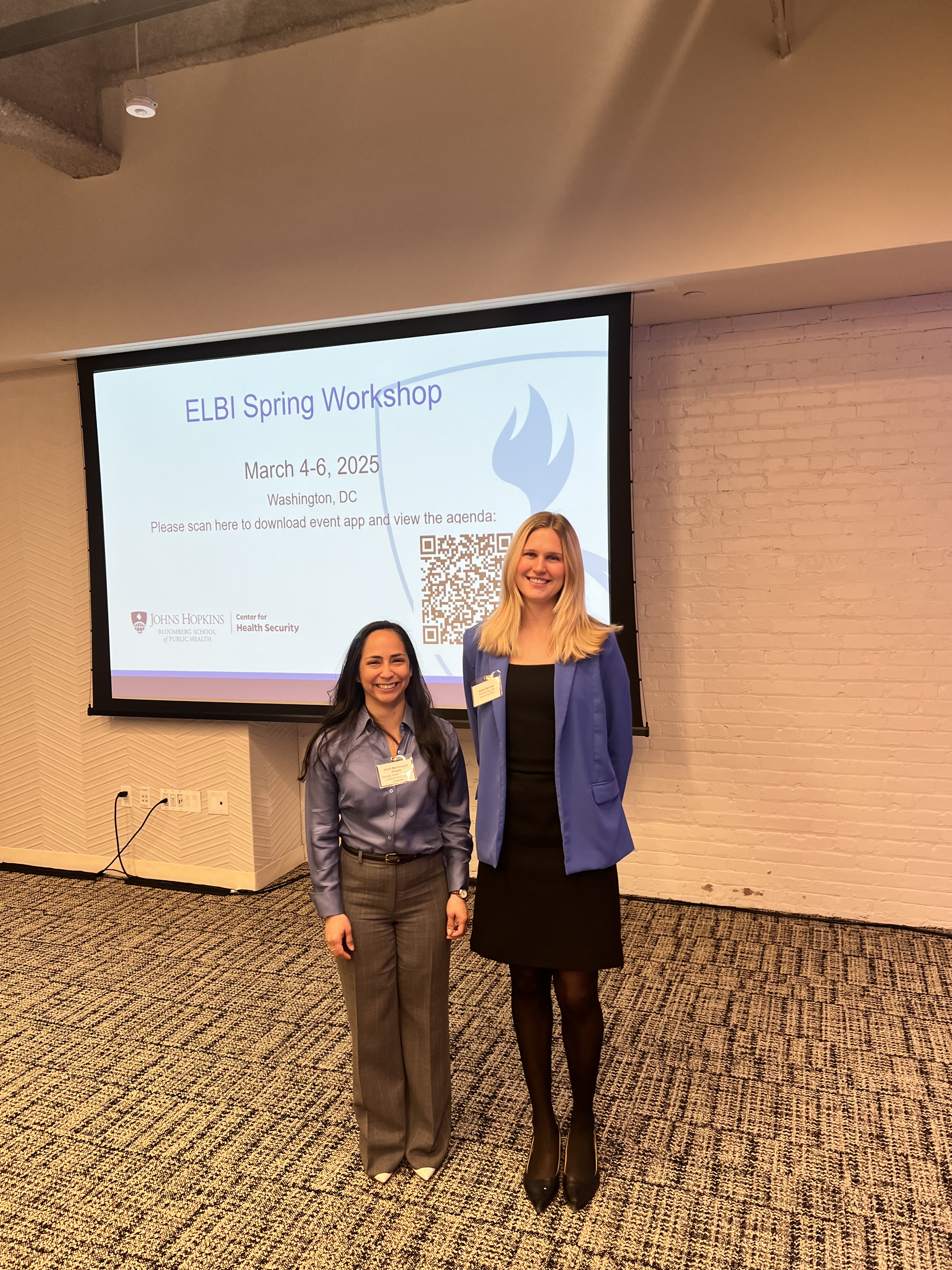
From March 4-5, 2025, GMU Biodefense PhD students Janet Marroquin and Katie Dammer participated in the spring symposium for the Emerging Leaders in Biosecurity (ELBI) Fellowship offered by the Center for Health Security at the Johns Hopkins Bloomberg School of Public Health. This event was the first of multiple gatherings for this year’s cohort, and events/discussions touched on agricultural biosecurity and health preparedness in the context of the H5N1 epidemic, the convergence of risks and benefits from AI and synthetic biology, and more. The 2025 cohort includes 29 other young professionals in biodefense, public health, and other adjacent fields from across the world.
COVID-19 Pandemic Declaration Five Year Anniversary
More than five years ago, on March 11, 2020, the World Health Organization declared COVID-19 a pandemic, prompting the organization and national governments around the world to grow or begin their pandemic responses. While the US was successful in some aspects of its response, such as Operation Warp Speed (the public-private partnership that accelerated the development and roll-out of COVID-19 vaccines), the country was also left with many tough lessons learned. Unfortunately, rather than growing and strengthening public health in the US in response to these lessons, the nation is left less prepared today than it was in 2020.
Hundreds of new laws have been created in at least 24 states that restrict public health orders or otherwise undercut emergency responses. Under the second Trump administration, we have seen major staff cuts to agencies like the Centers for Disease Control and Prevention while the majority in Congress aims to slash funding for federal health agencies. Meanwhile, the Advisory Committee on Immunization Practices’ meeting was postponed, the FDA advisory meeting that selects strains for the next flu vaccines was cancelled without explanation, and NIH is set to terminate or limit grants relate to vaccine hesitancy and uptake.
Thus, while much has been learned about SARS-CoV-2 itself and the disastrous long-term impacts it has had, the administration and its allies are working to dismantle the ability to not just respond effectively to future pandemic threats, but to provide services for addressing infectious and communicable diseases and challenges in air and water quality at all levels of the system. Jennifer Nuzzo, director of the Pandemic Center at Brown University School of Public Health, said of this approach in an interview with Axios, “Imagine if we just had a major fire ripping through our city, and our first instinct once we finally put the flames out is to basically get rid of all of our fire departments.”
Amid Growing Numbers of Measles Cases, Chaos Continues at HHS
The disbandment of the National Advisory Committee on Microbiological Criteria for Foods and the National Advisory Committee on Meat and Poultry Inspection, massive NIH grant terminations, a $25,000 buyout offer made to HHS employees, and a still-growing measles outbreak are all in a week’s work for the Department of Health and Human Services under Secretary Robert F. Kennedy Jr.. While continuing to peddle alternative remedies to those suffering from measles, Secretary Kennedy also did an interview in which he implied that contracting measles is better than being vaccinated for it.
Unfortunately for Secretary Kennedy and everyone else, vitamin A and cod liver oil are not going to cut it in responding to this expanding outbreak. Rural Texas and other areas like it do not have the infrastructure in place needed to effectively respond to measles on their own. In fact, 64 counties in Texas do not have a hospital, and 25 counties lack primary care physicians. Places like these counties often have sparse resources for public health awareness campaigns, and they certainly do not have the necessary number of medical professionals available to provide one-on-one education. In places like Seminole, Texas, the kindergarten vaccination rate for MMR is at 82%, while the CDC says that outbreaks tend to occur when a community’s vaccination rate drops below 95%.
In the absence of sustained federal funding and strong leadership from offices like that of the Secretary of HHS, places like rural Texas will not be able to effectively respond to outbreaks like the one that is happening right now. The reality is that continuing to promote unproven remedies and sharing incorrect information about vaccines and natural immunity will only harm these communities. People have already died because of this outbreak, including a child who could not choose whether or not to get vaccinated, and Secretary Kennedy still has not made the necessary efforts to address this situation.
Further Reading:
- “‘America Can’t be Great Without Great Science. That is Where the Academies Can Help,” Molly Galvin, NASEM
- “Thousands “Stand Up for Science” Across the Country,” Jackie Flynn Mogensen, Mother Jones
- “NIH Grants Fueled $95 Billion in FY 2024 Economic Activity, Finds New Report,” Michael T. Nietzel, Forbes
- “How the NIH Dominates the World’s Health Research – in Charts,” Nisha Gaind, Nature
- “RFK Says Most Vaccine Advisers Have Conflicts of Interest. A Report Shows They Don’t,” Pien Huang, NPR
- “During the Last Major Measles Outbreaks in the US, It Took Extraordinary Measures to Stop the Spread,” Deidre McPhillips, CNN
RFK Jr. and the Backside to Bird Flu Vaccines
By Meredith Fletcher, Pandora Report Associate Editor
It comes to no surprise that RFK Jr., the US Secretary of Health and Human Services, feels there is the possibility of backfire for vaccinating poultry against H5N1. Kennedy noted that there is no indication that “those vaccines” provide sterilizing immunity and voiced his concerns that vaccinating poultry without such immunity would result in the birds becoming “mutant factories”. Creators of the vaccine and other scientists tried to lessen these concerns by stressing the use of extra biosecurity measures to ensure the virus doesn’t mutate faster. The other suggestion of Kennedy and the Trump administration for the USDA is to, “let it run through the flock so that we can identify the birds and preserve the birds that are immune to it.” H5N1 continues to mutate, and scientists are concerned that the continued inaction could give the influenza A virus time to mutate and increase pandemic potential. Vaccinating birds in the millions also gives farmers practicality concerns and many of them would prefer to give the vaccine via their feed or water. With the average price of eggs being $5.90 across the US, many Americans are struggling to keep up with the devastation of the virus and calling for action from US politicians.
Rubio Says Purge of USAID Programs is Complete
Secretary of State Marco Rubio announced on Monday that the administration has finished its purge of programs at the US Agency for International Development, having cut 83% of its programs. Rubio said that he will move the remaining programs under the State Department. He said in a statement that the 5,200 of USAID’s 6,200 programs that were eliminated “spent tens of billions of dollars in ways that did not serve, (and in some cases even harmed), the core national interests of the United States.”
Just hours later, a federal judge ruled that President Trump has overstepped his Constitutional authority in shutting down most of the country’s foreign assistance. The judge, Judge Amir H. Ali, did say that the administration cannot simply keep the billions of Congressionally-approved dollars for foreign aid, but did not order officials to use the money to revive terminated program contracts.
Further Reading:
- “Countries, Global Health Groups Band Together as US Aid Gaps Threaten Lives,” Jennifer Rigby and Aaron Ross, Reuters
- “How Foreign Aid Cuts Are Setting the Stage for Disease Outbreaks,” Apoorva Mandavilli, The New York Times
- “It’s Time for PEPFAR to Embrace Reform,” Jirair Ratevosian, Global Health Now
Resources for Researchers and Scholars Under Threat in the United States
The National Academies’ Committee on Human Rights maintains a page dedicated to resources for researchers and scholars who are under threat in the United States. This includes links to the websites of groups dedicated to addressing this problem, events, and publications. Checks this page out here.
“Applying Counterfactual Analysis to the Study of Terrorism”
Biodefense PhD candidate Chris Quillen recently published a new article titled “Applying Counterfactual Analysis to the Study of Terrorism” in the March 2025 issue of the Georgetown Security Studies Review. Counterfactual analysis explores “what might have been” by imagining a different historical path. Political scientists and historians regularly use this social science technique to reveal the impact of important events and the methods in which events could have turned out differently if not for the actions of individuals. Most often applied to the study of military conflicts, counterfactual analysis has not yet been applied to the study of terrorism in any significant way despite the field being particularly well-suited to the question of “what if?”. By applying this technique to both successful and thwarted terrorist plots, analysts can better understand the intentions of terrorists in conducting their attacks and the impact that terrorism has had upon history.
To demonstrate the utility of this approach, this article first outlines the process of conducting counterfactual analysis and then applies this technique to several terrorist attacks conducted or attempted by Sunni Islamic extremists affiliated with the al-Qa’ida terrorist organization: What if the attacks on September 11th had been disrupted? What if the Bojinka plot had succeeded in attacking Pope John Paul II and bringing down multiple airliners? What if the bombing of the USS Cole had sunk the ship? Once completed, this counterfactual analysis demonstrates the significant impact al-Qa’ida’s successful attacks have had on recent history and better reveals what al-Qa’ida and affiliated extremists intended to achieve with the attacks that failed.
Exploring counterfactuals of terrorist attacks offers two primary benefits. First, such analysis demonstrates the significant impact terrorism has had on world history and reveals in fuller detail the impacts that terrorists have had—intentionally or not. Second, counterfactual analysis better reveals terrorist intentions and expands our analysis beyond their demonstrated capabilities to reveal what terrorists sought to achieve. Broader application of counterfactual analysis to terrorism studies will improve understanding of the influence of terrorist attacks on world events and the intentions of terrorist groups in the future.
“The Far-Reaching Impacts of Agricultural Biorisk Research: A Summary of the USDA ARS 8th International Biosafety & Biocontainment Symposium”
Biodefense MS Student Jay Bickell recently summarized her trip to the 8th International Biosafety & Biocontainment Symposium. She writes in part, “There is a deep interconnection between agricultural biorisks and human health. It is critical that this perspective is brought to the forefront of policy and research discussions so that agricultural biorisks are prioritized as a threat to national security and receive the necessary research funding. My attendance at the USDA Agriculture Research Services (ARS) 8th International Biosafety & Biocontainment Symposium in Baltimore, Maryland on February 11-13, 2025 couldn’t have illustrated this more clearly.”
Read Jay’s summary of here experience here.
“Policy Options to Prevent the Creation of Mirror Organisms”
Gerald L. Epstein, Forrest W. Crawford, and Sella Nevo recently published this RAND Corporation commentary: “In this paper, the authors describe U.S. and international policy mechanisms that could contribute to halting research and development programs to create mirror organisms. Domestic policy options could include executive branch statements and norm-building actions, a ban on federal funding of research toward the creation of mirror organisms, regulatory changes under the existing statutory authority in the federal select agent program and export controls, and legislation tailored to prohibiting and preventing the construction of mirror organisms. Policy options in the international arena include bilateral and multilateral engagement; invoking and using the authorities of the Biological Weapons Convention, the Environmental Modification Convention, and the United Nations Security Council; and the development of a new treaty banning research into mirror organisms.”
“Fifty Years After ‘Asilomar,’ Scientists Meet Again to Debate Biotech’s Modern-Day Threats”
Jon Cohen discusses February’s meeting, the Spirit of Asilomar and the Future of Biotechnology, in this piece for Science: “Some 300 participants from around the world—including a few who had attended the 1975 meeting—came together on 23–26 February for the follow-up, the Spirit of Asilomar and the Future of Biotechnology. Whereas the original meeting had a tight focus on genetic engineering and was dominated by biologists from one small field, this one had a sprawling agenda and a crowd that included scientists from many disciplines as well as conservationists, bioethicists, lawyers, former government officials, national security experts, journalists, and a dance troupe from New York City. Attendees received notebooks made from apple skins and badges with names engraved in wood.”
Read more here.
“Biosecurity and the Republic of Georgia: Maintaining Progress in an Uncertain Future”
Jackson du Pont and Christine Parthemore authored this Council on Strategic Risks briefer: “The Republic of Georgia has long served as a crucial biosecurity leader—an essential actor in this field and a trailblazer in Central Asia. Over three decades since independence, Georgia built its domestic public health system, working bilaterally with nations such as Germany and Canada, and through long-term engagement with the US Cooperative Threat Reduction (CTR) program to embed safety and security into its operations, reduce biological risks, and enhance biosecurity cooperatively.1 As a consistent player in multilateral and international cooperation to address the full range of biological risks, Georgia continues to serve as a strong example of how to enhance domestic and regional security through innovation, transparency, and cooperation. Nevertheless, political dynamics in both Georgia and the region threaten to undermine this important progress.”
“As of this writing, as protesters continue to fill the streets of Tbilisi to fight for Georgia’s democratic future, policymakers and biosecurity experts in the United States grow increasingly concerned about the durability of Georgia’s longstanding biosecurity efforts.2 On October 26, 2024, Georgians voted in a highly anticipated Parliamentary election that the current President, Salome Zourabichvili, then refused to recognize as legitimate given concerns and accusations that the ruling, yet unpopular, Georgian Dream party received support from Russia.3 Following the election and an EU Parliament vote questioning its legitimacy, Georgia Prime Minister Irakli Kobakhidze suspended Georgia’s EU accession process for four years—triggering the protests which have now raged for the last three months.4 These worrying events come after the Georgian Dream-led parliament passed a “foreign agents” bill last summer which opposition parties in Georgia have likened to a Russian law used to quash political and popular dissent.5“
“Developments in Tbilisi arrive at a moment of uncertainty as Eastern Europe and former Soviet states face increased pressure and coercion from Russia. This situation is now complicated by signs of major shifts in longstanding US foreign policy. Worryingly, political turmoil may jeopardize decades of investments in Georgian and regional biosecurity capacities while global biological threats from all sources are increasing.”
“This briefer outlines the historically important and ongoing Georgian efforts to strengthen global nonproliferation and biosecurity capacity. While Georgia’s future as a democracy will surely be tested in the near term, its critical contributions to regional biosecurity should not be forgotten or allowed to grow weak.”
“Environmental DNA”
From the Royal Society: “Rapid progress in eDNA research over the past decade has led to developments in biodiversity monitoring, disease detection, and forensic science. Indeed, eDNA now offers a wide range of applications, many of which will have interest and relevance to policymakers. Now is an important moment to consider how these recent advances in eDNA technologies can most effectively benefit society, and also to consider the limitations of the technologies and how to avoid harm.”
“This Royal Society programme of work aims to raise awareness of the breadth of current and emerging applications within this fast-moving area of science, as well as promote collaboration and a joined-up approach between the range disciplines that utilise these techniques.”
We have published both an explainer document and an ‘at a glance’ summary, as well as a set of illustrative case study examples. Alongside these, the Royal Society will also be hosting the next UK DNA Working Group conference on 13-14 May 2025. For more information see the conference page on the UKEOF website.”
“French Researcher Uncovers France’s Chemical Warfare Crimes in Algeria”
Latifa Ferial Naili recently published this reporting for Al 24: “French historian Christophe Lafaye has denounced the use of chemical weapons during the National Liberation War, saying that he has identified “450 military operations” using such weapons over the period of 1957-1959…“Christophe Lafaye has managed to identify 450 military operations using chemical weapons in Algeria, mainly in mountain areas in High Kabylia and in the Aures region,” said actu.fr, the news website that interviewed him…However, “the picture needs to be completed by opening archives that are still currently classified.”’
“The Scene of the Crime”
Mark MacKinnon recently published this piece for The Globe and Mail: “Syrians who suffered and lost loved ones under Bashar al-Assad want justice from the government that overthrew him. But where to begin? And what takes precedence, rebuilding cities or righting wrongs?”
“Chemical Disarmament in Syria – A Door Opening?”
Una Jakob recently authored this blog post for PRIF: “On March 5, 2025, the caretaker foreign minister of Syria, Asaad Hassan al-Shaibani, delivered a speech at the Organisation for the Prohibition of Chemical Weapons (OPCW) in which he promised that his government would eliminate the Syrian chemical weapons programme and bring the country back into compliance with the Chemical Weapons Convention (CWC). If implemented, this would end over a decade of Syrian violations of the CWC, offer the opportunity to hold those responsible to account, and reaffirm the global norm against chemical weapons. Deeds will have to follow these words, but this announcement at least allows for some cautious optimism in an otherwise gloomy international disarmament climate.”
“Identifying Chemical Warfare Agents Through Analytical Chemistry”
From CNTR: “The CNTR Fact Sheet by Carmen García López (CNTR/PRIF) provides an overview of the main analytical techniques used by the OPCW designated laboratories to analyze environmental and biological samples that could point to the presence of chemical warfare agents. In addition, the example of the sarin poisoning in Syria is used to show how chemical warfare agents can be detected in a real forensic case.”
“Facts and Myths About Nuclear Materials Trafficking: A Q&A with Robert Kelley”
From SIPRI: “In January this year, a nuclear trafficking case made the international news headlines. The United States Department of Justice announced that Takeshi Ebisawa, an alleged Japanese gangster, had pleaded guilty to charges of major narcotics trafficking as well as conspiring to traffic nuclear materials. The indictment states that Ebisawa believed he was offering the materials—including uranium and plutonium—to representatives of the Iranian government, but they were in fact US agents. He claimed to be selling the nuclear material on behalf of a Myanmar rebel group in return for guns.”
“The Ebisawa case and how it has been covered highlight important questions about how the issue of nuclear materials trafficking is reported in the media, and how serious a security threat it really poses today. To separate the facts from the myths, SIPRI talked to nuclear expert Robert E. Kelley, a veteran of the US nuclear weapons complex, nuclear analyst and SIPRI Distinguished Associate Fellow.”
“Interview by Caspar Trimmer, Senior Communications Officer, with additional input from Vitaly Fedchenko, Senior Researcher in the SIPRI Weapons of Mass Destruction Programme.”
Read here.
“Seeking Gender Equality in the Global Health Workforce”
Analyne Rapa Ignacio, Kim Sales, and Reiner Lorenzo Tamayo recently published this article in Think Global Health: “Community health workers (CHWs), the majority of whom are women, deliver essential health care to more than 1 billion people in low-income countries. According to researchers, women health workers are better able to retain female patients in family planning programs and ensure uptake of maternal, newborn, and child health services. The impact of women in public health extends beyond providing effective care: countries that performed significantly better against COVID-19 were led by women and reported almost 40% fewer deaths.”
“Because women health workers’ dedication and expertise are vital to public health, what can governments and organizations do to make the health workforce more inclusive?”
“Hantavirus Pulmonary Syndrome in the Spotlight: Understanding Risks After Betsy Arakawa’s Tragic Death”
From NETEC: “The recent passing of Betsy Arakawa, wife of the late actor Gene Hackman, due to hantavirus pulmonary syndrome (HPS) has brought renewed attention to this rare but serious disease. HPS is a severe respiratory illness caused by hantaviruses, which are transmitted primarily by rodents. Given the challenges in diagnosing and treating HPS, it is important for clinicians to stay informed about its risks, symptoms, and management.”
Read here.
What We’re Listening To 🎧
Tech, Policy, and Our Lives, Ep 27 – The Mirror Life Problem: When Every Threat Looks Like the Next Existential Crisis Listen here.

NEW: Highly Pathogenic Avian Influenza in Livestock Research Update
From RAV3N: “📢 Please join us for the RAV3N Highly Pathogenic Avian Influenza (HPAI) in Livestock Research Update Webinar on Monday, March 17, 2025 from 1:00 pm – 3:30 pm CST. This 2.5-hour webinar seeks to inform animal health stakeholders about current research results and findings related to the outbreak of HPAI in dairy cattle.”
Register to attend here.
NEW: Foreign Aid Fallout: The Future of US Global Leadership
From the Chicago Council on Global Affairs: “The dismantling of USAID marks the end of a six-decade era in American foreign assistance and humanitarian response. This shift will not only reshape international development and disaster relief, but also how the United States conducts diplomacy and projects soft power worldwide. How will the absence of USAID impact global stability, security, and America’s standing in the world? How will this affect the numerous communities that USAID has worked with around the globe? Join the Council for a discussion on what USAID’s closure means for the future of American soft power and international development.”
This hybrid event will take place on March 18 at 5:30 pm CDT. Learn more and register here.
NEW: How Lab Automation is Advancing Biotech
From GEN: “Lab workflows are constantly evolving to handle higher throughput demands, increased efficiency, and more complex tasks. For some, that means allowing automation to play a bigger role in the lab. Whether talking about one liquid handler, or a modular system of multiple instruments, the role of automation in streamlining workflows is increasing. Many agree that automation affords scalability and offers more accuracy in lab work. However, there are challenges in the automation field as well.”
“On this episode of GEN Live, we will discuss the role of automation now and what the future looks like. Among the topics we will discuss: What is the role of AI in automating complex biological systems? What are the ethical concerns in the field? Can automation be scaled without compromising quality?”
This event will take place on March 19 at 12 pm ET. Learn more and register here.
NEW: Five Years After COVID-19: Is Texas Better Prepared for the Next Public Health Crisis?
From the Texas Tribune: “Texas entered the COVID-19 pandemic five years ago already at a disadvantage, with an unhealthy and uninsured population, an underfunded public health system and workforce shortages spread across the health care system. While some hoped the pandemic might force improvements, all of these long-standing issues remain, or are worse, than before.”
“Today, Texas’ spending on public health funding is worse than before the pandemic. Vaccine hesitancy is surging. Local health authorities have fewer tools to protect their constituencies. Growing distrust of science, expertise and authority have unraveled the hard-earned lessons from COVID.”
“Faced with the newest bird flu strain and the resurrection of the once-eradicated measles disease, can the state and local leaders change the enduring legacy of COVID-19 before the next pandemic ravages the state?”
This event will take place on April 2 at 11:30 am CDT. Register here.
NEW: NACCHO Preparedness Summit-Pathway to Recovery in the Aftermath of Disasters
From NACCHO: “The Preparedness Summit is the place for you to reenergize while gaining the knowledge, resources, and relationships necessary to prepare for and respond to public health emergencies. Join more than 2,500 attendees—who work in all levels of the government (federal, state, and local), emergency management, volunteer organizations, healthcare coalitions, and academia—to share best practices, build partnerships, advance your skillset, and take away innovative solutions and practical strategies to address the vulnerabilities in our country’s health security system.”
This year’s summit will take place April 29-May 2 in San Antonio. Learn more and register here.
NEW: Astrobiodefense: Biological Threats and the Next Frontier
From the Bipartisan Commission on Biodefense: “This Commission meeting, Astrobiodefense: Biological Threats and the Next Frontier, will be held on May 8, 2025. The focus of this meeting will be to provide the Bipartisan Commission on Biodefense with a better understanding of how to strengthen international astrobiodefense and planetary protection efforts through: (1) current government astrobiodefense efforts; (2) new scientific and technological advances for astrobiodefense; and (3) collaborative efforts and public-private partnerships to improve astrobiodefense. More information will be provided as the event date approaches.”
This event will take place on May 8 from 10 am-3:40 pm ET in Washington, DC. Register here.
NEW: SBA.4 International Synthetic Biology and Biosecurity Conference in Africa
From SynBio Africa: “The SBA 4.0 conference will serve as a platform for fostering connections among industry, academia, community groups, and policymakers. It will showcase innovative applications of synthetic biology and AI, and highlight ongoing efforts in biomathematics, biomanufacturing, one-health, biosafety and biosecurity. It will also facilitate networking and information exchange. Key focus areas include tackling agriculture, health, environmental management, and industry challenges. In Africa, synthetic biology is poised to drive the national development agenda by promoting a sustainable bioeconomy, supporting health and agricultural systems, and aiding environmental conservation and restoration. This event will provide a vital opportunity for stakeholders to discuss and strategize the integration of synthetic biology innovations, address policy, legal frameworks, and communicate the benefits of the technology.”
This conference will take place July 23-25 in Kigali. Learn more and register here.
ICYMI: How to Avoid Human-Made Pandemics
The Asia Center for Health Security hosted this webinar in January. “Studying viruses with outbreak potential is one productive approach to combat the risk of pandemics. Yet, such research – when it involves field collection and experimental manipulation of pathogens – carries the hazard of accidentally or even intentionally seeding a pandemic. Dr Filippa Lentzos from King’s College London, will discussed her findings from the Pathogen Project, which brought together an international taskforce of scientists, biosecurity and public health experts, ethicists, and civil society leaders to seek consensus on this question: Can we agree on ways to manage research that carries pandemic risk as safely, securely and responsibly as possible?”
Download the slides here and watch the recording of the webinar here.
2025 Scowcroft Institute Pandemic Policy Summit
From the Scowcroft Institute: “The Scowcroft Institute of International Affairs at Texas A&M University invites you to attend the 2025 Scowcroft Institute Pandemic Policy Summit examining the ongoing H5N1 outbreak across the U.S. Dairy industry. This summit will bring together experts from government, academia, and industry to review the response efforts, discuss current challenges and opportunities, and identify options for moving forward. Listen to panels of subject matter experts, explore case studies from the field, and participate in networking opportunities.”
This event will take place on March 18 in Washington, DC. Learn more and RSVP here.
Gaming Weapons of Mass Destruction Course – From Policy to Practice
From MORS: “Gaming Weapons of Mass Destruction (WMD – defined as Nuclear, Chemical, and Biological agents) will be a three-day course focused on developing and executing games related to WMD in all its forms. While the basics of WMD capabilities and game design will be discussed, this will be a course focused on the intersection of WMD and gaming. It will not be either a WMD or gaming course; for those topics see other offerings.”
“No prior experience is required for this course, though a basic familiarity with various agents and their effects would be helpful, as would a basic understanding of professional gaming and how it is used. The instructors will adapt in real time to class requirements (e.g., if the class is interested in animal and plant targets, the instructors have extensive experience in designing games on those subjects as well).”
This course will take place March 18-20 on Zoom. Learn more and register here.
Building Trust in the H5N1 Response: Perspectives from the Field
From NASEM: “Since avian influenza (H5N1) was first detected in dairy cattle in March 2024, H5N1 has resulted in human infections, diminished livestock production, and decimated wildlife populations. Uncoordinated policies at the national, state, and local levels have challenged mitigation efforts, and mistrust has hindered the urgent response needed for the rapidly evolving threat. The National Academies Forum on Microbial Threats will host a public webinar on March 27 where agricultural producers and workforce health specialists will explore strategies to build greater mutual trust and a coordinated One Health response.”
This webinar will take place on March 27 at 2 pm ET. Register here.

NEW: Panel on the Effects of Nuclear War Applications
From UNODA: “Under Resolution A/RES/79/238 (‘Nuclear war effects and scientific research’), adopted on 24 December 2024, the United Nations General Assembly decided to establish an Independent Scientific Panel on the Effects of Nuclear War (“the Panel”). The Panel has been tasked with examining ‘the physical effects and societal consequences of a nuclear war on a local, regional and planetary scale, inter alia, the climatic, environmental and radiological effects, and their impacts on public health, global socioeconomic systems, agriculture and ecosystems, in the days, weeks and decades following a nuclear war.’”
“It will produce a comprehensive report, make key conclusions, and identify areas requiring future research.”
“The Panel will conduct research in the following seven areas relevant to the topic of the report:
1) Nuclear and Radiation Studies;
2) Atmospheric Sciences and Climate;
3) Earth and Life Sciences;
4) Environment and Environmental Studies;
5) Agriculture, Biology and Life Sciences;
6) Public Health and Medicine;
7) Behavioural and Social Sciences and Applied Economics.”
“The Panel will consist of 21 scientific experts, participating in their personal capacity, in the abovementioned fields, who will be selected on the basis of a public call and through nominations from Member States. Panel members will be appointed by the Secretary-General.”
“The Panel will also engage and receive inputs from the widest possible range of stakeholders, including international and regional organizations, civil society, and affected communities, in order to understand local, regional and global perspectives on the effects of a nuclear war.”
Learn more and submit nominations here by March 17.
NEW: Call for Experts-Mirror Image Biology: Pushing the Envelope in Designing Biological Systems – A Workshop
From NASEM: “Most biological molecules are chiral entities where their mirror images have different structures and functional characteristics. Scientists have begun synthesizing left-handed DNA and RNA and creating proteins that can write left-handed nucleic acids. This, and other related research, is described as “mirror biology” and includes research toward creating mirror-image self-replicating living systems. The National Academies will host a foundational workshop on mirror biology, focusing on the state of the science, trends in research and development, risks and benefits of this research, and considerations relating for future governance of relevant enabling technologies.”
“We invite you to submit suggestions for experts to participate in this activity. The call for experts closes on March 31, 2025 at 11:59 PM EDT.“
Submit recommendations here.
Apply for the 2025 Youth for Biosecurity Fellowship
“The global norm against biological weapons cannot be maintained without the inclusion of youth voices in the multilateral discussions taking place in the framework of the Biological Weapons Convention (BWC). Youth perspectives are key to create innovative solutions and generate long-term engagement. There are benefits to including the perspectives of young people from developing countries, where over 90% of the world’s youth reside.”
“Organized by the United Nations Office for Disarmament Affairs in Geneva, in partnership with key international actors that empower youth in science diplomacy and global biosecurity, the Youth for Biosecurity Fellowship provides a unique learning and networking experience in the framework of the Biological Weapons Convention.”
“Launched in 2019 as a Biosecurity Diplomacy Workshop, the Youth for Biosecurity Initiative organized its first fellowship in 2023. For the third edition, the fellowship will provide the opportunity for 20 competitively selected young scientists from the Global South to join an online interactive training programme prior to a field visit during the meeting of the BWC Working Group on the Strengthening of the Convention in Geneva.”
Learn more and apply by April 7 here.
NASEM Has Questions
The National Academy of Science, Engineering, and Medicine (NASEM) is hosting a workshop on Navigating the Benefits and Risks of Publishing Studies of In Silico Modeling and Computational Approaches of Biological Agents and Organisms on April 3-4 in Washington, DC. In preparation for the workshop, NASEM is soliciting input on how publishing computational models can support biological research while minimizing potential DURC/PEPP risks. The purpose of the questionnaire is to ascertain if organizations that publish or disseminate scientific knowledge have considered or created guidelines or policies to review, host or interact with in silico and computational models and tools, studies, datasets, etc. research that constitutes dual use, dual use research of concern (DURC) or pathogens with enhanced pandemic potential (PEPP). Have answers? Then fill out the In Silico Research Publications Pre-event Questionnaire.
NOFO, Addressing Agricultural Biorisk Evidence Base Gaps with Applied Research
“There is a global recognition that the current evidence base to inform laboratory biological risk management has gaps, and that biosafety and biosecurity policies are not always based on evidence.1 This notice of funding will support the design and implementation of applied biorisk research to address evidence gaps in working with high-consequence veterinary and agricultural pathogens as identified during the RAV3N Biorisk and Biosafety Gap Assessment Workshop2 or similar gap analysis like the WOAH working group agent specific biorisk gap analysis.1 ERGP is seeking proposals that address one or more key focus area components listed below. Each proposal will go through an internal ERGP and external expert review. Successful proposals should address at least one of the three key focus areas and at least one component under that area.”
“This funding opportunity aims at the design and implementation of applied biorisk research to address evidence gaps in working with high-consequence veterinary and agricultural pathogens.”
“This work will contribute to recommended guidance on laboratory biosafety and agricultural biosecurity, using research techniques to evaluate the application and effectiveness in operational contexts. All proposals must make a clear experimental plan for how the applicant will test the application and outcomes of their focus area(s)/component(s) in their facility.”
Learn more and submit application by April 14 here.
 The Pandora Report