International Perspectives on Biodefense Strategies

By Nick Bertini

Biodefense is an international undertaking. The successful implementation of biodefense strategies demands cooperation from global partners. This session, moderated by the National Defense University’s Dr. Gerald Epstein, analyzed different perspectives on biodefense issues ranging from policies to practices.

First to present was Sarah Telford from the British Embassy in Washington. Telford presented the United Kingdom’s newly published UK Biological Security Strategy. The document was designed to be a transparent and accessible plan for the public to obtain and understand. Telford highlighted that more than 13 government departments collaborated on the drafting of the document. The main focus of the document aims towards improving coordination and capabilities. One unique item that stood out is the recognition of the use of the internet to acquire materials that could be used to generate a biological threat. The United Kingdom is focused on modernizing their biodefense strategies to tackle future challenges by addressing the rising importance of new technologies and emphasizing fluid cooperation with international partners. Telford finished her presentation by illustrating the need for further cooperation on the global scale in order to keep the UK and its partner nations safe. Continue reading “International Perspectives on Biodefense Strategies”

The WHO Research and Development Roadmaps

By Nick Bertini

The World Health Organization (WHO) is constantly attempting to address public health threats before they become major local, regional, and global issues. This session focused on the research and development roadmaps that the WHO has implemented and managed to initiate a targeted research campaign for the early delivery of vaccines, therapeutics, and diagnostics of Crimean Congo Hemorrhagic Fever (CCHF) and Nipah Virus. Moderated by Tim Brooks of Public Health England, the session was geared toward educating the audience on the research and development frameworks that the WHO has in place in order to address the potential major public health threats of the near to midterm future.

Marie-Pierre Prezios, the head of the R&D roadmap program at WHO, started the session off with a general overview of what the WHO’s goals are for implementing these research blueprints. Prezios laid out the strategic priorities of her program by stating that the goals of the WHO are to “keep the world safe, improve health, and serve the vulnerable.” According to Prezios, the framework is designed to improve coordination, map the key stakeholders, and clearly identify products in the drug development pipeline. If these steps are completed, then the research and development process should be accelerated—specifically for priority pathogens and diseases. The roadmaps are generated using two key steps. First, a Baseline Situation Analysis (BSA) is conducted to identify gaps in knowledge and survey the current public health landscape. Second, a diverse technical taskforce is assembled and comes to a consensus regarding the results of the BSA. After a consensus is made, the technical taskforce drafts the research and development roadmaps. Finally, Prezios highlights the success of the roadmap by sharing that in May 2018 there was an outbreak of Nipah Virus in Kerala, India and a successful response was initiated within the first 24 hours. Furthermore, researchers and developers were able to provide the field with monoclonal antibodies within a week, stemming the number of cases and allowing the community to address the public health concerns and to recover from the outbreak. Continue reading “The WHO Research and Development Roadmaps”

From Detection to Diagnosis to Vaccines

By Katelyn Smith

During the “From Detection to Diagnosis to Vaccines” symposium, we were able to hear about research projects and product development from all over the United States pertaining to detection, diagnosis, and/or vaccines. Each of the six speakers, ranging from engineer to scientist, brought something unique and different to the table, from a dog’s nose, to immunoassays, to accelerated vaccines.

The first speaker was Matthew Staymates, a mechanical engineer from the National Institute of Standards and Technology, who spoke on a project titled “Non-Contact Aerodynamic Sampling Approaches for Aerosols and Airborne Particles: Lessons Learned from the Dog Nose”.  This project focused primarily on the olfaction background of canines, studying how a dog’s nose is a great detector system, and is “considered the gold standard in trace chemical sampling”.  Matthew spoke about how this research included looking into the fluid dynamics of the olfaction system of a canine, and how important biomimicry may be. He ended his session by asking this question: “Is there a smarter way to sample our environment (based on lessons learned from the dog’s nose)?”. Continue reading “From Detection to Diagnosis to Vaccines”

Detection of Biological Agents in the Field: Then and Now

By Katelyn Smith

Biology is an ever-changing, growing, and evolving field. To increase our defenses against biological agents in natural occurrences, accidental occurrences, and deliberate occurrences. At the ASM Biothreats Conference this year, there was a panel session organized to hear multiple experts’ commentary on biological agent detection in the field over the years.  Mediated by Dr. Kenneth B. Yeh, a senior science advisor at MRIGlobal, the panel of members were able to comment and answer questions, speaking about previous experiences of their own, as well as some of the research that they do.

To start off the session, the panelists discussed a comparison of Real-Time qPCR and Sequencing, the roles they have played overtime in the biological field, as well as changes in the biodefense field in the last few decades.  More than 20 years ago, two major platforms were yielded in the Department of Defense: a real-time PCR system and a current generation diagnostic system.   Continue reading “Detection of Biological Agents in the Field: Then and Now”

Converging Technologies & Emerging Risks

By Georgia Ray

This was a panel discussion involving four speakers discussing biotechnologies and the potential for mis-use, and the challenges of regulatory oversight.

Jesse Kirkpatrick– GMU’s assistant director of the Institute for Philosophy and Public Policy.

Chris Oehmen– PNNL cybersecurity expert

Gregory Koblentz– The GMU Biodefense program’s very own director.

Megan Palmer– A senior research scholar at Stanford’s Center for International Security and Cooperation.

Oehmen kicked off the panel by drawing parallels between the fields of cybersecurity and biosecurity. First he noted how we tend to misinterpret them – we draw on our classic metaphors for defense and security, and imagine building a castle or a fortress with physical walls, to guard that which we want to keep safe. But information is not a physical material. Its transfer is not cleanly constrained by energy, time, or physical space as physical matter is, and nor are the defenses we build. Oehmen suggests we replace this with a resilience-based model, taking other approaches to thinking of security in flawed systems. What assumptions are we relying on when we think of biosecurity? Are they true? Continue reading “Converging Technologies & Emerging Risks”

Clade X Discussion Panel

By Justin Hurt

Moderator: Gigi Gronvall, PhD

Julie Gerberding, PhD, former CDC Director

Jeffrey Smith, Partner, Arnold and Porter

Imagine a never-before-seen virus emerging simultaneous in multiple places on Earth with no warning, no current countermeasures, and no idea as to the origin. Think about the difficulties that leaders could encounter if one of the outbreaks was in a nation with which we had less than desirable relations, but was close enough that it was likely to spread to our shores quickly. What could that mean for effective response or humanitarian assistance and how would we broach that with our own leaders and diplomatically with our international partners? What if the virus was found to have been engineered and intentionally released? Finally, how do we determine the most effective distribution of any countermeasures we might develop? Continue reading “Clade X Discussion Panel”

Review of the “Digitization of WMD” Symposium

by Justin Hurt, GMU Biodefense PhD student

As part of National Defense University’s hosted topical discussion series, the Center for the Study of Weapons of Mass Destruction (CSWMD) hosted a symposium titled “The Digitization of Weapons of Mass Destruction (WMD): exploring the Impact of Digital Components of Emerging Technologies on January 17th, 2019 on Fort McNair. The discussion “The Digitization of Biology” presented a very pertinent conversation of the emerging concerns of new technologies in biodefense and biosecurity. Hosted by Dr. Diane DiEuliis of CSWMD, the panel included an initial topical discussion by Dr. Corey Hudson from Sandia National Laboratory regarding modeling genomic and synthetic biology facilities at scale. Next, Dr. Eleonore Pauwels of the United Nations University talked about biointelligence and the availability of knowledge. Finally, Supervisory Special Agent Ed You from the Federal Bureau of Investigation discussed ideas on how to address safeguards in the emerging bioeconomy. Continue reading “Review of the “Digitization of WMD” Symposium”

Event Review: Editing Biosecurity, Needs and Strategies for Governing Genome Editing

By Justin Hurt, GMU Biodefense

On December 3rd, 2018, the New America policy study organization hosted an event entitled “Biosecurity in the Age of Genome Editing,” a panel discussion moderated by Daniel Rothenberg of Arizona State University. The discussion centered around the findings of the recently released study, Editing Biosecurity, Needs and Strategies for Governing Genome Editing, and included authors Jesse Kirkpatrick of Arizona State University, Greg Koblentz and Edward Perello, both from George Mason University, and Megan Palmer and David Relman, both from Stanford University. Each author spoke about specific portions of the study, a two-year project designed to ascertain the inherent risks and security challenges regarding the rapidly developing field of genome editing, which includes such technologies as the highly promising but potentially risky CRISPR gene editing technique. Continue reading “Event Review: Editing Biosecurity, Needs and Strategies for Governing Genome Editing”

Reflections on the 5th Ministerial Meeting of the Global Health Security Agenda

On October 6-8, 2018, the 5h Global Health Security Agenda (GHSA) Ministerial Meeting was held in Bali, Indonesia. This summit aimed “to review the work done to date by GHSA, successes and challenges encountered, and to chart the way forward. Under the theme ‘Advancing Global Partnerships’, the meeting will further elaborate on the existing and possible partnerships at the global and regional levels, as well as a broader engagement of the non-governmental stakeholders in the whole process of our work.” The GHSA is growing with partnership including 64 nations, international organizations, and non-governmental stakeholders.

In partnership with Next Generation Global Health Security Network, GMU’s Schar School Biodefense graduate program sponsored two student fellowships to attend through the George Mason Global Health Security Student Ambassador program. These two students, Annette Prieto and Saskia Popescu, represented GMU Biodefense and have provided a report on their experiences in conjunction with NextGen’s coordinator, Jamechia D. Hoyle, and other NextGen representatives. This is the second year for the George Mason Global Health Security Student Ambassador program and you can read the recap of last year’s summit in Uganda here.

We’re pleased to provide you with reflections from these three days focused on the past, present, and future of the GHSA. Below you’ll find brief sections of and links to the reflections from Dr. Hoyle, and our student ambassadors. You can also access the entire page here (also available in the Word doc here), which includes all reflections from Dr. Hoyle, the student ambassadors, and members of the Next Generation Global Health Security Network.

Next Generation Global Health Security Network Coordinator, Jamechia D. Hoyle
“The 3-day event included a variety of high-level updates and more intimate discussions in side events on next steps under the newly-launched GHSA 2024. Under the GHSA 2024 Framework, the initiative will move toward a more structured approach with “clear governance, collaboration structures and processes, increased engagement of the broader GHSA community, tracking and measurement of progress and enhanced accountability for delivery on commitments”. With over 100 countries expected to complete an external evaluation of health security capacity under this new framework, GHSA members and relevant partners remain committed to undergo planning and resource mobilization to address gaps. However, as repeatedly discussed during the Ministerial Meeting, a key issue remains: financing health security.” Continue reading…

George Mason Global Health Security Student Ambassadors

Saskia Popescu, Biodefense Doctoral Candidate
“While the DRC battles an outbreak of Ebola virus disease and influenza hits the Northern Hemisphere, one might think that antimicrobial resistance was an afterthought at this meeting. The GHSA and those invested in its future are used to putting out fires and still battling the slow burning threats, like antimicrobial resistance, which means that this topic was a frequent point of discussion. Throughout the presentations and sessions, the topic of antimicrobial resistance was frequently brought up, especially in the context of One Health. In the U.S. alone, 23,000 people die a year as a result of resistance infections. The latest WHO reportsreveal a global issue in which the most common infections are increasingly becoming drug resistant. From the agricultural sector to healthcare and the environment, combatting antimicrobial resistance is extremely challenging and many at the meeting vocalized their concerns with such a chimeric dilemma.” Continue Reading..

Annette Prieto, Biodefense MS Candidate
“Although the theme for the 5th Global Health Security Agenda (GHSA) Ministerial Meeting was “Advancing Global Partnerships,” session 3 was the first session that offered insight into the many ways global partnerships can and should be approached for the GHSA 2024. The panel was composed of diverse leaders from different sectors and countries, highlighting the importance of using a multi-sectoral method to achieve the overarching targets of GHSA 2024. The panel discussed a wide range of topics. The first panelist, Dr. Nick Adkin, Deputy Director of Global Health Security, Department of Health and Social Care, United Kingdom, started the session with a specific but enormous problem to global health security: antimicrobial resistance (AMR). AMR affects not only public health, but also trade and food safety.” Continue reading..

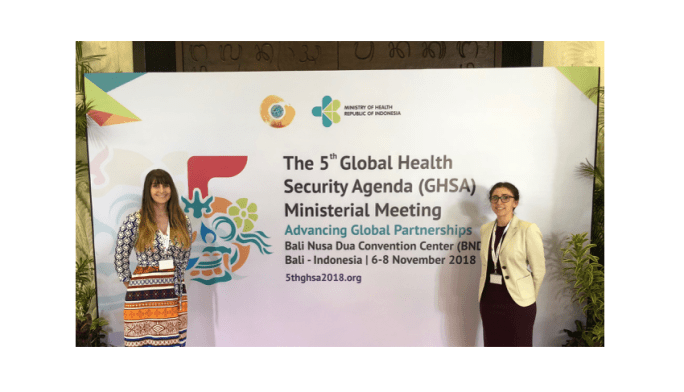
 

GMU Biodefense Student Ambassador GHSA Reflection – Annette Prieto

Annette Prieto, M.S. Biodefense Candidate Schar School of Policy and Government, George Mason University Vice President, Next Generation Global Health Security Network Mason Chapter – USA

Although the theme for the 5th Global Health Security Agenda (GHSA) Ministerial Meeting was “Advancing Global Partnerships,” session 3 was the first session that offered insight into the many ways global partnerships can and should be approached for the GHSA 2024. The panel was composed of diverse leaders from different sectors and countries, highlighting the importance of using a multi-sectoral method to achieve the overarching targets of GHSA 2024.

The panel discussed a wide range of topics. The first panelist, Dr. Nick Adkin, Deputy Director of Global Health Security, Department of Health and Social Care, United Kingdom, started the session with a specific but enormous problem to global health security: antimicrobial resistance (AMR). AMR affects not only public health, but also trade and food safety. As Dr. Adkin stressed, AMR is currently undermining progress already made in the public health field and has the potential to make everyday procedures—like hip replacements and chemotherapy—too risky to perform. Therefore, there is a great need for the global community to work together to fight against AMR. Although it would have been nice to hear how AMR is currently being explicitly battled, it was encouraging to see that many countries had action plans on fighting AMR and that environmental aspects are now being incorporated in the Action Package. Continue reading “GMU Biodefense Student Ambassador GHSA Reflection – Annette Prieto”