For anyone who may be on the fence about shelling out $10.50 for a ticket to Argo, let me just assure you that you will not be disappointed. I am not just saying this because of my infatuation with political thriller movies or with Ben Affleck, but Affleck proves, yet again, that he has certainly got a knack for directing. The plot, based on the true story of the unusual rescue of six Americans during the 1979 Iranian hostage crisis, keeps the audience engaged right from the beginning. Affleck plays the role of Tony Mendez, the CIA operative who spearheaded the creative plan to rescue the hostages from the Canadian ambassador’s home in Tehran. The casting of Alan Arkin and John Goodman as two Hollywood professionals helping to create the fake movie that brings the hostages home provides the perfect amount of comic relief in an otherwise humorless situation. Sporting the true late 1970s style of feathered hair and polyester suits, the cast successfully takes the audience back to 1979 and 1980 to experience the suspenseful events surrounding the little-known rescue of the six hostages.
For me, what made this film so interesting was its focus on the six American hostages. While the movie begins with scenes of the Iranians protesting outside of, and then storming the U.S. Embassy, the true focus is on the story of the six Americans hiding out in the Canadian ambassador’s home. It shows a different aspect of a crisis we have all studied. It can be difficult to keep an audience in suspense when the ending of the story is already known, but Argo successfully keeps you engaged and eagerly waiting to see how the hostages make it home.
At the heart of the movie is the notion of international cooperation and diplomacy, and the benefits of both. This mission could not have moved forward or ended in success without the critical aid of Canada, which Affleck understands and illustrates in the film. While the film does not depict exactly what happened during the course of these events (it is a Hollywood movie after all), it is an entertaining and dramatized look at a once classified operation. Ultimately, this is a very enjoyable film for anyone interested in politics and international affairs, history, or Ben Affleck.
Over the past decade, China and India have emerged as hotbeds of innovation for new biomedical products that have benefitted millions of people throughout the developing world. At this session expert panelists will discuss each nation’s contributions in this area; describe the policy priorities that have set the stage for recent R&D activities; identify barriers to continued R&D expansion; and discuss the optimal mix of incentives and regulations that can stimulate further growth in this sector.
Watch the video here.
The Center for International Science and Technology Policy presents a Science and Technology Policy Seminar Series Lecture. Dr. Ray O Johnson will discuss the relationships between universities and industry and the importance of both for a secure future.
RSVP to cistp@gwu.edu
The symposium will examine whether cross-border cyberattacks qualify as acts of war under international law, whether the difficulties of distinguishing civilian and military targets require a special legal regime to govern cyber warfare, and how legislation that has been passed or is currently being considered by the U.S. Congress will affect the international context of such attacks.
RSVP here.
Saturday, November 10
George Mason Biodefense Mixer!
8:00PM to 10:00PM
Brion’s Grille
10621 Braddock Road,
University Mall Shopping Center,
Fairfax, VA
Pay-to-Attend Events
Friday, November 9 2012 Symposium on Preventing Catastrophic Threats and FAS Awards
Federation of American Scientists
Cost: $250 (individual ticket)
On November 9, 2012, just three days after the national election, FAS will host a day-long symposium that features distinguished speakers who will recommend to the new administration how to respond to catastrophic threats to national security. Policy and technological issues include conventional, nuclear, biological, and chemical weapons; biotechnology; nuclear safety; electricity generation, distribution, and storage; and cyber security.
Register here.
Subscribe to the Friday News Roundup and get the week’s most important news, with only the slightest veneer of snark, in one email. Click here!
Highlights include: microbiologists and the ER – a match made in heaven, the CDC testing RIDTs, Malaysia and BW (not what you think), bacterial voyeurism, more drug contamination at the infamous NECC, and vaccinia – now in technicolor!
How I see this playing out: ‘Excuse me, pardon me – ooh that looks bad – don’t mind me, just need to collect samples of the ER floor here.’
“Jack Gilbert, a microbiologist from the University of Chicago…and a group of microbiologists will take over a brand new hospital in an experiment called the ‘Hospital Microbiome’. The goal of ‘Hospital Microbiome’ is to try to see what microbes and viruses will move in to the hospital and how patients and hospital staff impact the variety of microbes that live in the hospital. Gilbert and his team will track the bacteria in the hospital before it opens and as it starts accepting staff and patients. This data will help hospital administration, doctors, nurses, and researchers get a better understanding of how these bacteria and viruses make their way around a hospital, sometimes causing dangerous infections in the patients.”
For a link to the Hospital Mircobiome study itself, click here.
To absolutely no one’s surprise, tests were better at detecting influenza when given higher concentrations of virus.
CDC in MMWR – “The findings in this report further emphasize the importance of collecting respiratory specimens when the amount of influenza virus is at its peak (within 24–72 hours of symptom onset). The high virus concentrations at which the evaluated FDA-cleared RIDTs detected recent circulating viruses might exceed levels expected in clinical specimens, even those collected at the peak of virus load in the specimen (2–4). Although all RIDTs were able to detect virus at the highest virus concentrations, some were unable to detect certain viruses at any subsequent dilution.”
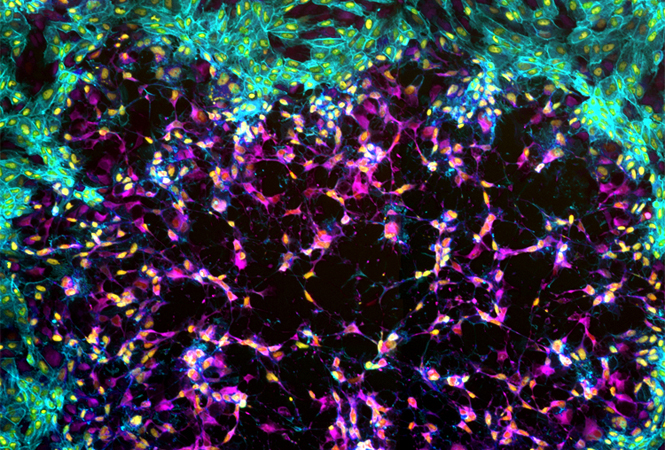
Researchers at two Australian universities have captured in trippy fluorescent detail the progression of vaccinia virus through cells (extra point if you know what vaccinia is used for – yes just one point, you should know!) The giant cloud of pink is the virus, with the halo of healthy host cells surrounding in green.
Image: Green fluorescent protein expressing vaccinia virus (pink) spreads from a single infected cell through an entire monolayer of green monkey kidney cells (blue with yellow nuclei) over three days.
For other equally impressive photographs, check out the full gallery. Who knew viruses could be so pretty?
NTI – “Malaysian Defense Minister Ahmad Zahid Hamidi said on Tuesday the nation would prepare legislation aiming to address the threat of conflict involving biological agents, Bernama reported. ‘Biological warfare is a new war which can happen not only in Malaysia but also in the ASEAN region,’ Zahid said, referring to the territory covered by the 10 member states of the Association of Southeast Asian Nations.”
What about the rights of microbes? Don’t they get any privacy? Occupy petri dishes! Just kidding, tuberculosis is awful.
Infection Control Today – “Weill Cornell Medical College researchers report that mass spectrometry, a tool currently used to detect and measure proteins and lipids, can also now allow biologists to ‘see’ for the first time exactly how drugs work inside living cells to kill infectious microbes. As a result, scientists may be able to improve existing antibiotics and design new, smarter ones to fight deadly infections, such as tuberculosis. The new study was published in an early online edition of Science.”
Things are going from bad to worse for the New England Compounding Center, the pharmacy at the center of the multi-state fungal meningitis outbreak. According to the FDA, two additional products from the pharmacy have tested positive for bacterial contamination. Three batches of injectable betamethasone and one batch of cardioplegia solution tested positive for a combined eight bacterial species, including the (rarely) pathogenic Bacillus idriensis and Bacillus circulans.
The total number of cases of fungal meningitis associated with the pharmacy’s Exserohilum rostratum contaminated drugs has reached 386, with 28 fatalities in 19 states (CDC).




 The Pandora Report