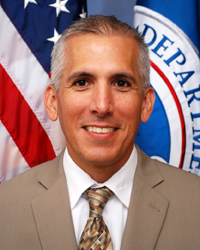
April Seminar: ”Health Threats in a Security World” Speaker: Dr. Alexander Garza When: 7:20PM, Thursday April 18th, 2013 Where: Meese Conference Room, Mason Hall, George Mason University
The Biodefense Policy Seminar is the D.C. area’s premiere speaker series focused on biodefense and biosecurity issues. The monthly seminars – free and open to the public – feature leading figures within the academic, security, industry, and policy fields of biodefense.
About the Speaker: Dr. Alexander Garza is the Assistant Secretary for Health Affairs and Chief Medical Officer of the Department of Homeland Security. He manages the Department’s medical and health security matters, oversees the health aspects of contingency planning for all chemical, biological, radiological and nuclear hazards, and leads a coordinated effort to ensure that the Department is prepared to respond to biological and chemical weapons of mass destruction. Prior to joining the Department in August 2009, Dr. Garza spent 13 years as a practicing physician and medical educator.
Highlights include the H7N9 update, funding for the NBAF, using flight patterns to stop pandemics, North Korean biosurveillance, and why biotech companies matter. Happy Friday!
North Korean bioweapons are coming for us all (Credit: Karl Baron)
H7N9 continues apace in China, with the total number of cases up to 43. The virus is especially difficult to track because birds are asymptomatic carriers. While the number of laboratory-confirmed cases is closely monitored, it’s possible there are many more human cases going unnoticed due to a milder disease presentation. Still, there have been no confirmed cases of person-to-person transmission, and scientists in the US have just received the first batch of the virus, and are working on developing a diagnostic.
New York Times – “A report on three of the first patients in China to contract a new strain of bird flu paints a grim portrait of severe pneumonia, septic shock and other complications that damaged the brain, kidney and other organs. All three died…During a telephone news briefing on Thursday, Nancy J. Cox, of the influenza division at the Centers for Disease Control and Prevention, said that several features of H7N9 were particularly troubling: it causes severe disease, it has genetic traits that help it infect mammals and humans probably have no resistance to it.”
The National Bio- and Agro-Defense Facility has received the strongest funding endorsement to date from the Obama Administration, with $714 million included for the lab in the President’s FY2014 budget. The lab is slated to replace Plum Island as the nation’s premier research center on agricultural pathogens.
Wall Street Journal – “Republican Sen. Pat Roberts of Kansas said the recommendation signals the administration’s support for building the $1.15 billion lab, which will study large animal diseases and develop measures to protect the nation’s food supply…Roberts said the proposal will require additional financial commitments from Kansas, which will be worked out by Republican Gov. Sam Brownback and legislators…Kansas agreed when it was awarded the project to contribute 20 percent of the cost of construction. Thus far, the state has issued $105 million in bonds and $35 million from the Kansas Bioscience Authority.”
Researchers in Toronto, after studying the 2009 H1N1 pandemic, developed basic guidelines for passenger screenings during a pandemic. The results are relatively intuitive – screening passengers as they leave a region in which the pathogen is spreading is more useful than screening them upon arrival at their final destination.
Medical News – “Dr. Khan used his experience analyzing air traffic patterns to review the flights of the nearly 600,000 people who flew out of Mexico in May 2009, the start of the H1N1 pandemic. He found that exit screening would have caused the least disruption to international air traffic. In fact, all air travelers at risk of H1N1 infection could have been assessed as they left one of Mexico’s 36 international airports. Exit screening at just six airports in Mexico coupled with entry screening at two airports in Asia (Shanghai and Tokyo) would have allowed for screening of about 90 per cent of the at-risk travelers worldwide.”
Anything that is related to biological warfare and is also called the Kracken is automatically included in the Pandora Report. Here, the Kracken is a 15ft high thermal, acoustic, and infrared sensor.
Baltimore Sun – “While the danger of missiles is more pressing, Army officials said developing better capabilities to detect biological warfare threats has also been a priority for the past six years. The Joint Program Executive Office for Chemical and Biological Defense is working with APG’s Edgewood Chemical Biological Center on the program, which is called the Joint United States Forces Korea Portal and Integrated Threat Recognition, or JUPITR. The program will also serve to detect naturally occurring biological threats. A key part of the program is the Kraken, which Army officials described as ‘a massive, multifunctional, all-seeing sensor suite designed to rapidly establish a defensive perimeter.'”
Collaboration between the biotech industry and the US government has been notoriously difficult, starting with the threat of breaking Bayer’s patent on Cipro during the Amerithrax attacks and continuing into today. While relations have improved, and the hurdles to a successful working relationship are significant, we can’t afford to not work on this.
Genetic Engingeering and Biotechnology News – “Despite product success Acambis has had a bumpy ride with its funding. ‘Any biotech that believes developing products to serve public health emergencies is access to easy money needs to think again,’ Dr. Lewin cautioned. ‘Collaborating with the U.S. government is different from working in the biotech world. You have to produce a proposal for the government to digest, a cost of around $400,000, and if you don’t get the contract that’s all money down the drain.'”
This week’s image come via Microbiology and Immunology, and is of cell lytic enzymes attached to nanoparticles, which are then used to kill listeria!
“Fighting Listeria with Nanobiotechnology: Using nature as their inspiration, the researchers successfully attached cell lytic enzymes to food-safe silica nanoparticles, and created a coating with the demonstrated ability to selectively kill listeria—a dangerous foodborne bacteria that causes an estimated 500 deaths every year in the United States. The coating kills listeria on contact, even at high concentrations, within a few minutes without affecting other bacteria. The lytic enzymes can also be attached to starch nanoparticles commonly used in food packaging.”
Highlights include H7N9, China’s SARS lessons, H5N1, the seminal UN global arms treaty, bird flu bureaucracy, and the problems with the term “WMD”. Happy Friday!
H7N9 Update: 14 cases, five fatalities, no evidence of person-to-person transmission
We’re keeping a very close eye on news about the H7N9 avian flu strain emerging from China. To date there have been fourteen cases with five fatalities. Unlike the H5N1 strain of avian influenza, this is the first time we’re seeing H7N9 in humans. It’s pandemic potential is still considered low due to its current inability to transmit person-to-person. However, although there have been no confirmed cases of person-to-person transmission, it’s been reported that a person caring for one of the people who died of H7N9 has since developed similar, flu-like symptoms.
Reuters – “Genetic sequence data on a deadly strain of bird flu previously unknown in people show the virus has already acquired some mutations that might make it more likely to cause a human pandemic, scientists say. But there is no evidence so far that the H7N9 flu – now known to have infected nine people in China, killing three – is spreading from person to person, and there is still a chance it might peter out and never fully mutate into a human form of flu.”
The short answer? It depends on whom you ask. China has improved its communication with the international and scientific community. However, there have been complaints about the lack of clear communication by the Chinese government with its own people, particularly at the time of the virus’ original emergence.
Xinhua – “The news of two men dying from a new variant of bird flu has reminded Chinese of the SARS pandemic that hit the country one decade ago. Many are wondering if the government will handle the situation any better than it did in 2003, should another pandemic break out…Now, on the 10th anniversary of the pandemic, fear is spreading following reports of two Shanghai men who died from H7N9 avian influenza, a strain that has not previously been detected in humans. That fear was aggravated this week after four more patients in neighboring Jiangsu Province were confirmed to have contracted the virus. All four are in critical condition.”
In all the chatter about H7N9, H5N1 seems almost tame. While it may seem high, ten cases in four months is in keeping with expected numbers.
Xinhua – “A six-year-old boy from Southwestern Kampot province was confirmed to have contracted with Avian Influenza H5N1, bringing the number of the cases to 10 and the death toll remained at eight in 2013, a health expert said Wednesday. ‘The boy was admitted to the Kantha Bopha Hospital in Phnom Penh on March 31 for severe pneumonia, and he was tested positive for H5N1 at the Instituts Pasteur on Tuesday,’ Dr. Denis Laurent, deputy director of the hospital, told Xinhua.’The boy is still alive, but in severe conditions (sic).”
Including everything from battle tanks to light weapons, this is the first UN treaty “aimed at controlling the trade in conventional weapons”, and prohibits the sale of conventional weapons to state in violation of arms embargoes, in support of terrorism, war crimes, genocide, or in use against civilians (it doesn’t regulate domestic sales of arms).
The Guardian – “The United Nations…vot[ed] it through by a large majority despite earlier being blocked by three countries. Member states represented in the UN general assembly voted by 154 to three, with 23 abstentions, to control a trade worth an estimated £46bn a year. The landmark deal went to a vote after Syria, Iran and North Korea – all at odds with the US – blocked its adoption by consensus….It is expected to come into force after the first 50 ratifications next year”
It’s been an avian-themed report. This piece included in commiseration with of all of us just now getting around to taxes – filing paperwork appropriately with the government is apparently as important for billion-dollar corporations as it is for the rest of us.
MedPage – “GlaxoSmithKline’s (GSK) human vaccine against H5N1 avian influenza did not win approval from the FDA, but only on technical grounds that should not keep it off the market for long, the company said. Called Q-Pan H5N1, the product is meant to be stockpiled in case the H5N1 virus becomes capable of causing a pandemic. It received a unanimous endorsement from an FDA advisory committee last November. Nevertheless, GSK said last week that it had received a so-called complete response letter from the agency, indicating that approval was not immediately forthcoming. The company said it was ‘triggered due to an administrative matter that has recently been rectified.'”
The title says it all. It was arguably too broad when it was just chemical, biological, radiological (mass destruction? a rad bomb? really?) and nuclear, and it seems to only be getting broader.
Wired – “In fact, as a fascinating paper by W. Seth Carus at the National Defense University shows, the Defense Department’s definition of the term has long been problematic. For years, its official definition included ‘high explosives,’ to make it consistent with the federal statute that Harroun ran up against. But ‘most military weaponry relies on high explosive charges,” Carus writes, ‘meaning that even the mortars and grenades used by infantrymen might qualify as WMD.’ The doctrinal answer was ultimately to limit the definition to “chemical, biological, radiological and nuclear weapons capable of a high order of destruction or causing mass casualties.”
This week’s image falls within one of our favorite topics here at GMU Biodefense – cells in space.
The picture, titled “Goldfinger” due to the placement of the immune cells on gold-coated slides, depicts monoctyes in zero gravity. Monocytes are critical immune defenders, helping fight off bacteria and viruses.
The relationships between the Middle East and maritime Asia are becoming ever more extensive. Against the backdrop of this deepening cross-regional interdependence with Asian economies and middle classes expanding rapidly, the Arab Middle East is grappling with profound political changes and challenges, and the United States is engaged in strategic “rebalancing.” Dr. Michael Hudson will discuss how the political upheaval in the Middle East and US involvement in the Arab world are viewed in Singapore and, more broadly, in maritime Asia.
At a time when Europe really has to lead in its own region, is it able to do? This is the first in-depth analysis of this key question for the transatlantic relationship. Janne Haaland Matlary, professor in the Department of Political Science at University of Oslo in Norway and co-editor of NATO’s European Allies: Military Capability and Political Will, will discuss this topic.
Celeste Wallander, associate professor and director of the International Politics Program at American University’s School of International Service and former U.S. deputy assistant secretary of Defense for Russia/Ukraine/Eurasia in the Office of the Under Secretary of Defense for Policy, will discuss this topic.Note: Attendees are welcome to bring their lunch to the event.
Ever increasing global threats coupled with the financial constraints our nation is addressing make it imperative that agencies and private sector stakeholders have the resources and path forward for a critical component to ensuring National Security. Join Nextgov and INSA on April 4th and hear from key leadership at IARPA, DIA, and the Applied Research Laboratory, Penn State University who will address these issues and more
During the first Obama term, global health diplomacy took on elevated importance as a U.S. foreign policy objective. Both the Department of State and the Department of Health and Human Services appear poised to continue to raise the diplomatic profile of global health during the second Obama term. Over the next year, U.S. diplomats will be challenged to help ensure: smooth, sufficient replenishments of the GAVI Alliance, the World Bank International Development Association, and the Global Fund to Fight AIDS, Tuberculosis and Malaria; the articulation of a robust set of goals to advance the post-2015 Millennium Development agenda; and mutually beneficial relationships with emerging powers, many of which are active global health actors. This session will feature a lively discussion with high-level officials and experts from inside and outside the U.S. government.

 April Seminar: ”Health Threats in a Security World”



 The Pandora Report