
Happy Arbor Day! 🌳 This week we are covering a recent House hearing on biosafety, the evolving situation in Sudan involving a public health laboratory, and Bavian Nordic’s efforts to improve its production capacity based on its experience with the spread of mpox last year. This week also includes several new publications, upcoming events, and professional development opportunities, including a MOOC from OpenWHO and upcoming events hosted by George Mason’s Schar School of Policy and Government.
Energy and Commerce Subcommittee Holds Hearing on Science Policy and Safety
Yesterday, the House Energy and Commerce Committee’s Oversight and Investigations Subcommittee held a hearing titled “Biosafety and Risky Research: Examining if Science is Outpacing Policy and Safety”. Among the witnesses testifying were Dr. Gregory Koblentz, Director of George Mason’s Biodefense Graduate Program. In his testimony, Dr. Koblentz presented the findings of Global Biolabs Report 2023 from the Global BioLabs initiative.
He explained in part that “Since its inception in May 2021, the Global BioLabs initiative has identified more than 100 BSL-4 and BSL-3+ labs around the world that conduct high consequence biological research, with more planned and under construction. Europe is home to half of these labs while the United States is home to the single largest concentration of such labs. 11 out of the 20 highest containment facilities that are planned or under construction are in Asia…The Global BioLabs Initiative has also identified several trends that raise biosafety and biosecurity concerns given the global boom in construction of these labs, particularly where biorisk management oversight is weak.”
In his conclusion, he told the subcommittee “The biological risk landscape is rapidly evolving and presents significant new challenges to preventing the accidental, reckless, or malicious misuse of biology. At the same time, oversight systems to ensure that life sciences research is conducted safely, securely, and responsibly are falling behind. An urgent overhaul to realign biorisk management with contemporary risks is needed.”
Watch the hearing recording here and access information about other witnesses and their testimonies here.
Fighting in Sudan Threatens National Laboratory
The World Health Organization announced this week that it is assessing threats posed to public health in Sudan after fighters occupied a national public health laboratory. Nima Saeed Abid, the WHO’s representative in the country, told reporters that “There is a huge biological risk associated with the occupation of the central public health lab,” and that this occupation is an “extremely, extremely dangerous” situation. As Politico explains, “A power struggle between Sudan’s military leader Abdel Fattah al-Burhan and the commander of the paramilitary Rapid Support Forces (RSF), Mohamed Hamdan Dagalo, known as “Hemeti,” has plunged Sudan into fierce fighting.” However, the WHO has not specified which side is responsible for the lab seizure.
Olivier le Polain, the WHO’s incident manager for the organization’s Sudan’s response, said Wednesday that the facility holds samples of the causative agents of measles, tuberculosis, cholera, polio, and COVID-19, among other pathogens. “The assessment is ongoing to better understand what the public health threats might be with those, and of course, the risk as well of having untrained personnel or untrained individuals in the lab,” he said.
Politico reports that “Fighters “kicked out all the technicians from the lab … which is completely under the control of one of the fighting parties as a military base,” Abid said, adding that this created an “extremely, extremely dangerous” situation.”
This has, naturally, led many to jump on this opportunity to further ongoing disinformation narratives, with many prominent accounts claiming this Sudanese public health lab is producing biological weapons on behalf of the US government or asserting that Sudan is an odd place to have such a facility. Of course, it is not strange for any country to have a national laboratory focused on public health work, and US support for these kinds of facilities is strictly peaceful as we have discussed at length previously. Furthermore, it seems that the biggest threats posed by this situation are those to the state of public health in the country by threatening the facility, personnel, and the legitimacy of the lab’s work.
Bavarian Nordic Says Mpox Outbreak Was a “Wake Up” Call for Smallpox Preparation
Bavarian Nordic’s CEO Paul Chaplin told CNBC this week that the spread of mpox last year was a wake-up call for his company. CNBC explains that the Danish company is looking to dramatically scale up its production capacity to make larger quantities of its JYNNEOS vaccine. Chaplin said this week “If it wasn’t mpox but it was smallpox, we are completely at the wrong scale…We’re looking at ways we can dramatically change the way we manufacture to increase our scale.”
According to CNBC, “Bavarian Nordic plans to simplify its production process so it can easily partner with other manufacturers and scale up production capacity to hundreds of millions of doses in the event of an emergency.”
WHO Launches Preparedness and Resilience for Emerging Threats Initiative
This week, the World Health Organization released a statement about the launch of its new Preparedness and Resilience for Emerging Threats Initiative, reading in part: “To help countries better prepare for future pandemics, WHO launched a new initiative today that provides guidance on integrated planning for responding to any respiratory pathogen such as influenza or coronaviruses.”
“The new Preparedness and Resilience for Emerging Threats Initiative, or PRET, incorporates the latest tools and approaches for shared learning and collective action established during the COVID-19 pandemic and other recent public health emergencies.”
“Through the initiative, WHO will use a mode of transmission approach to guide countries in pandemic planning, given that many capacities and capabilities are common among groups of pathogens. PRET answers the call for technical guidance and support for promoting and strengthening integrated preparedness and response, as outlined in World Health Assembly resolutions.”
“Improved Understanding of Biorisk for Research Involving Microbial Modification Using Annotated Sequences of Concern”
In this new article in Frontiers in Bioengineering and Biotechnology, Godbold et al. discuss challenges of sequences of concern in biorisk management. Abstract: “Regulation of research on microbes that cause disease in humans has historically been focused on taxonomic lists of ‘bad bugs’. However, given our increased knowledge of these pathogens through inexpensive genome sequencing, 5 decades of research in microbial pathogenesis, and the burgeoning capacity of synthetic biologists, the limitations of this approach are apparent. With heightened scientific and public attention focused on biosafety and biosecurity, and an ongoing review by US authorities of dual-use research oversight, this article proposes the incorporation of sequences of concern (SoCs) into the biorisk management regime governing genetic engineering of pathogens. SoCs enable pathogenesis in all microbes infecting hosts that are ‘of concern’ to human civilization. Here we review the functions of SoCs (FunSoCs) and discuss how they might bring clarity to potentially problematic research outcomes involving infectious agents. We believe that annotation of SoCs with FunSoCs has the potential to improve the likelihood that dual use research of concern is recognized by both scientists and regulators before it occurs.”
This article was co-authored by Dr. Gregory Koblentz, Director of the Biodefense Graduate Program at George Mason University.
“Finding the Origin of a Pandemic Is Difficult. Preventing One Shouldn’t Be.”
In this opinion piece for the New York Times, Dr. W. Ian Lipkin explains “Finding the origin of a viral outbreak can be incredibly difficult, even with full government cooperation and the best available technologies. It’s important to try, because the insights into how a virus emerged may be useful in reducing the risk of future outbreaks. But these efforts and debates over uncertainties cannot come at the expense of action. We cannot wait for answers that may never come before doing what must be done to prevent the next pandemic.”
“There have been several news cycles dedicated to theories about the origin of Covid-19 that focus on the roles of wild animal markets versus research-related incidents. The latest revelations have gotten us no closer to resolution and agreement than when I visited China in January 2020 at the outset of the pandemic to try to investigate the cause and contain it. To the contrary, rancor has increased and the relentless focus on the origins of the virus has obscured the primary objective: preventing future pandemics.”
“Even if scientists could confirm the link of SARS-CoV-2 to a laboratory or to a raccoon dog, that wouldn’t mean that wild animal markets in cities can safely continue or that regulations concerning scientific experimentation with infectious agents are less important. And yet very little has been done in the wake of this pandemic to better either source of risk.”
“Chinese Censorship Is Quietly Rewriting the Covid-19 Story”
In this piece for the New York Times, Mara Hvistendahl and Benjamin Mueller write, “Under government pressure, Chinese scientists have retracted studies and withheld or deleted data. The censorship has stymied efforts to understand the virus.” They explain later in their piece that “That the Chinese government muzzled scientists, hindered international investigations and censored online discussion of the pandemic is well documented. But Beijing’s stranglehold on information goes far deeper than even many pandemic researchers are aware of. Its censorship campaign has targeted international journals and scientific databases, shaking the foundations of shared scientific knowledge, a New York Times investigation found.”
“Under pressure from their government, Chinese scientists have withheld data, withdrawn genetic sequences from public databases and altered crucial details in journal submissions. Western journal editors enabled those efforts by agreeing to those edits or withdrawing papers for murky reasons, a review by The Times of over a dozen retracted papers found.”
“A Memo for the President on Preserving U.S. Leadership in Biotechnology”
Check out this piece from the Special Competitive Studies Project’s (SCSP) Future Technology Platforms team, in which they make “the tech competition case for why we need a National Action Plan for U.S. Leadership in Biotechnology in the style of a Memo to the President of the United States.” SCSP also explains that “Today, April 12, the SCSP’s Platforms Panel released its National Action Plan for U.S. Leadership in Biotechnology, which outlines a series of policy recommendations the United States should take to ensure American leadership in biotechnology through 2030 and beyond. This will be the first of a series of action plans that will be published throughout the year focused on the battleground technologies SCSP identified in last year’s Mid-Decade Challenges to National Competitiveness report.”
“The Call is Coming From Inside the House: U.S. Misinformation Agents Fuel Global Vaccine Opposition”
From Public Good News (PGN): “For six years, PGP’s Monitoring Lab has monitored public media data, collecting insights on the most pressing public health topics, including the opioid epidemic, mental health, sexual and reproductive health, nutrition, school wellness, tobacco products, gun violence, outbreaks and pandemics, and vaccines. But vaccines have special standing. When PGP created North America’s largest vaccine misinformation monitoring program in 2019, it tried to mobilize public health and its allies against what was already a well-funded and highly organized global network of vaccine opponents. In mid-2020, PGP co-founded a United Nations global vaccination demand program that helped Country Offices respond to vaccine misinformation. Running these two programs in parallel granted PGP unique visibility into global vaccine discourse. For four years, PGP’s analysts watched the anti-vaccine movement evolve within the U.S., and for three, they have seen how misinformation and disinformation travel through global social networks. In 2022, PGP launched PGN to partner with trusted local voices and combat the spread of misinformation in communities.”
“Today’s vaccine opposition landscape is unrecognizable compared to the pre-pandemic period. More vaccine misinformation reaches more people at a faster rate than ever before. Recognition of a problem may be the first step toward solving it. Since the pandemic began, the White House’s National Security Strategy referenced misinformation as a driver of polarization, the U.S. surgeon general issued an Advisory on misinformation, and the CDC and FDA tasked multiple media monitoring teams with tackling the problem. Numerous state and local health departments have also taken on “infodemic management,” training professionals in social listening and anti-misinformation tactics. Congress has even attempted to hold social media companies and their executives to account for their misinformation policies. And yet the problem persists.”
“This report is titled “The Call Is Coming From Inside the House,” a line popularized by horror movies meaning the villain already controls the space you thought was safest—your home. The U.S. creates and spreads most of the world’s vaccine misinformation and disinformation. Reporting to date has focused on the smoke but largely missed the fire. The many urgent calls to address the global infodemic skirt around the primary source of the problem: Vaccine misinformation is now a chief export of the U.S., benefiting from decades of unchecked anti-vaccine organizing, the ease with which many Americans can create compelling media, and the unrivaled influence of the U.S. on global media.”
Pandora’s Gamble: Lab Leaks, Pandemics, and a World at Risk
From Kaiser Family Foundation News: “In 2019, federal lab regulators ordered the prestigious U.S. Army Medical Research Institute of Infectious Diseases to halt all work with dangerous pathogens, such as Ebola and anthrax, which can pose a severe threat to public health and safety.”
“Army officials had assured the public there was no safety threat and indicated that no pathogens had leaked outside the laboratory after flooding in 2018. But in a new book released April 25, investigative reporter Alison Young reveals there were repeated and egregious safety breaches and government oversight failures at Fort Detrick, Maryland, that preceded the 2019 shutdown. This article is adapted from “Pandora’s Gamble: Lab Leaks, Pandemics, and a World at Risk.”’
“Science and Tech Spotlight: Synthetic Biology”
This Science and Tech Spotlight from the Government Accountability Office offers a brief overview of synthetic biology and discusses opportunities and challenges it poses to the US. It explains in part “Synthetic biology can modify or create organisms to help address challenges in medicine, agriculture, manufacturing, and the environment. This technology is already being used for commercial products, and recent advances in biotech and computation have broadened its potential benefits. But it also may raise safety, national security, and ethical concerns.”
“2022 Preparedness Profile Study Preview Report”
New from NACCHO: “Since 2016, the National Association of County and City Health Officials (NACCHO) has conducted the Preparedness Profile study every few years to provide a foundation for future public health preparedness initiatives. This nationally representative survey gathers information about preparedness trends and emerging issues at LHDs to inform priorities at the local, state, and national levels. This preview report provides a highlight of key findings from the 2022 Preparedness Profile on a multitude of important topics in local preparedness. A full report will be released in Summer 2023.”
“Lessons Learned From a COVID-19 Dog Screening Pilot in California K-12 Schools”
In this Research Letter for JAMA Pediatrics, Glaser et al. write “The California Department of Public Health sponsors a statewide, school-based COVID-19 antigen testing program. Although effective, this program requires personnel, testing resources, and sample collection and generates medical waste. Scent-trained dogs are a strategy for rapid, noninvasive, low-cost, and environmentally responsible COVID-19 screening. We conducted a dog screening program to complement a school antigen testing program.”
“Dog screening for COVID-19 infection can be completed in a matter of seconds. However, dog screening directly on individuals introduced variables, such as distractions (eg, noises, young children) and environmental factors (eg, wind, smells), that likely contributed to decreased sensitivity and specificity. We considered other options, including a sample collection strategy used by other investigators…however, those options would sacrifice cost and time efficiency. Study limitations included the low prevalence of SARS-CoV-2 during the study period and the consequently low number of COVID-19 infections.”
What We’re Listening To 🎧
SynBioBeta Podcast-From Ideas to Reality: Synthetic Biology Comes of Age – with Jason Kelly
“Today John Cumbers talks with Jason Kelly, Co-founder and CEO of Ginkgo Bioworks. Together they will discuss synthetic biology’s coming of age” and get Jason’s take on several topics, such as the history of programmable biology, Sam Altman, Ai and the role of AI in biology, and the new congressional commission covering national security and emerging biotechnology.” Listen here.
“The Coming of Age of Global Health Podcasts”
Speaking of podcasts…check out this story written by Parth Chandna discussing global health podcasts and how they can further discourse.

Advancing Threat Agnostic Biodefense Webinar: Technologies Accelerating Infectious Disease Research
“PNNL’s invited speaker is Dr. Reed Shabman, program officer in the Office of Genomics and Advanced Technologies at the National Institute of Allergy and Infectious Diseases (NIAID). The systems biology program consists of a community that integrates experimental biology, computational tools and modeling across temporal and spatial scales to develop strategies that predict and alleviate disease severity across multiple human pathogens. Reed will describe the program history and notable accomplishments leveraging “multi-omics” infectious disease data. He will also highlight additional NIAID programs and provide perspectives on potential future applications for “omics” technology in the infectious disease space.” This event will take place on May 3 at 12 pm PT. Register here.
Lessons From the COVID War: An Investigative Report
The independent, nonpartisan Covid Crisis Group has spent two years investigating the causes and consequences of the COVID-19 pandemic. The Schar School of Policy and Government and Biodefense Graduate Program are proud to host two members of the group, Andrew Kilianski and Melissa Harvey, for an in-depth discussion of the group’s long-awaited report on what went wrong—and right—with America’s response to the pandemic: Lessons from the Covid War: An Investigative Report (Public Affairs, 2023).
The Covid Crisis Group is a remarkable group of 34 distinguished practitioners and scholars from a variety of backgrounds who came together determined to learn and share the most valuable lessons from the worst peacetime catastrophe of modern times. Lessons from the Covid War is plain-spoken and clear-sighted. It cuts through the jumble of information to make some sense of it all and answer: What just happened to us, and why? And crucially, how, next time, could we do better? Because there will be a next time.
Register here: https://gmu.universitytickets.com/w/event.aspx?id=1471
National Biodefense Science Board Public Meeting
The NBSB will meet virtually on May 4 at 2 pm EST to discuss lessons from COVID-19 and will present recommendations on several topics, including collection, analysis, and sharing of operational health data, uses of virtual healthcare during disaster response, and disaster response challenges specific to rural and underserved communities. Register here.
Virtual Workshop: Prioritizing Actions for Epidemic and Pandemic Preparedness
From the National Academies: “Please join us May 4 & 18, 2023 from 8 a.m. to 12 p.m. ET for a virtual symposium examining how to strengthen the evidence-based prioritization of epidemic and pandemic preparedness and response capabilities.
The symposium will convene global health planning stakeholders, including those in government and academia, and across health- and non-health sectors to:
- Review assessment tools and how, independently and together, they relate to national action planning.
- Gain insight into how countries and organizations currently select priorities in funding for epidemic prevention, detection, and response.
- Assess evidence for effective prioritization approaches to building disease surveillance and risk communication capabilities.
- Identify governance structures that can support robust and reliable systems for epidemic and pandemic preparedness and response investments.
This symposium is in collaboration with the Division on Earth and Life Studies. Learn more about this workshop by visiting the event webpage.”
The Heat is On: Climate Change, the Arctic, and National Security
“Join the Michael V. Hayden Center for Intelligence, Policy, and International Security as we host a discussion on climate change and its intersection with national security and intelligence. In October 2022, the Biden Administration released its National Security Strategy, in which climate change is noted as one of the most significant challenges for all nations. In February 2023, the Office of the Director of National Intelligence followed with its Annual Threat Assessment, in which climate change is mentioned first on the topic of shared global challenges. The growing concerns of climate change have greatly impacted traditional security challenges, and are affecting migration, agriculture-dependent communities, natural resources, illicit activities, violence, and geopolitics. Additionally, it has spurred a dramatic growth in strategic competition over critical minerals, technologies, and economic opportunities in the Arctic.”
This hybrid event will take place on May 10 at 7 pm EST. Register for the in-person event here, and for the livestream here.
Benchtop DNA Synthesis Devices: Capabilities, Biosecurity, Implications, and Governance
From NTI: “Synthetic DNA is used by bioscience laboratories globally and plays a fundamental role in a wide range of science and biotechnology advances. A new generation of benchtop DNA synthesis devices will soon enable users to print DNA more quickly and easily. This advanced technology has the potential to disrupt the DNA synthesis market and its associated biosecurity practices and could allow malicious actors to more easily obtain pathogen or toxin DNA.”
“This new report, Benchtop DNA Synthesis Devices: Capabilities, Biosecurity Implications, and Governance, draws on more than 30 interviews with experts from benchtop DNA synthesis companies, the broader biotechnology industry, the biosecurity and bioscience research communities, and other sectors. The report addresses the anticipated capabilities, biosecurity implications, and governance of benchtop DNA synthesis devices, and it makes recommendations for future oversight.”
“Refreshments will be served from 10:30 am. The event will start promptly at 11:00 am.”
Learn more and register for this May 10 hybrid event here.
Nobel Prize Summit-Truth, Trust and Hope
Taking place May 24-26 this year in DC and virtually, this Nobel Prize Summit asks “How can we build trust in truth, facts and scientific evidence so that we can create a hopeful future for all?”
“Misinformation is eroding our trust in science and runs the risk of becoming one of the greatest threats to our society today.”
“Join us at this years’ Nobel Prize Summit which brings together laureates, leading experts and you in a conversation on how we can combat misinformation, restore trust in science and create a hopeful future.”
Learn more and register here.
CSWMD 2023 Annual Symposium: WMD in the Decisive Decade
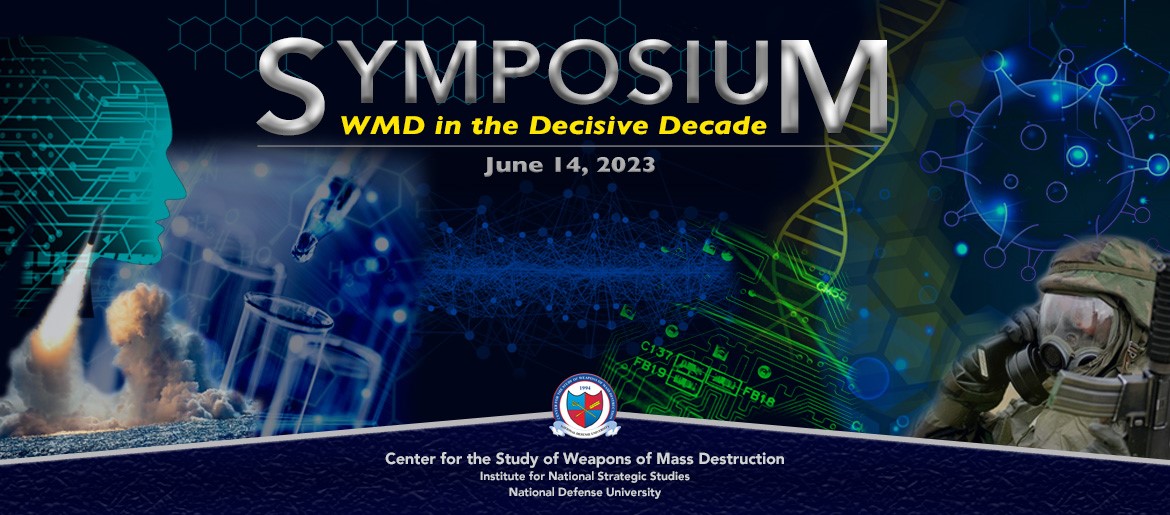
“The National Defense University’s Center for the Study of Weapons of Mass Destruction (CSWMD) invites you to join us on 14 June 2023 for the virtual Annual CSWMD Symposium, titled WMD in the Decisive Decade.”
“This year’s symposium will explore the cognitive impacts WMD has on strategic decision making and the challenges associated with operating in an environment where WMD has been employed. It will be an opportunity for the WMD community to engage with officials and thought leaders on current WMD challenges at the unclassified level, including keynote addresses by Richard Johnson, Deputy Assistant Secretary of Defense for Nuclear and CWMD Policy and Rebecca Hersman, Director of the Defense Threat Reduction Agency.”
“For more information and to register for this event click here. Please RSVP by 9 JUNE 2023.”
“We look forward to hosting you for the event. For more information about the WMD Center and reference our research, please visit our website at https://wmdcenter.ndu.edu/ and follow us on Twitter and on LinkedIn.”
Gordon Research Conference: Cross-Cutting Science Facilitating Collaboration Across the Threat-Science Research Community
“The Nonproliferation, Counterproliferation and Disarmament Science GRC is a premier, international scientific conference focused on advancing the frontiers of science through the presentation of cutting-edge and unpublished research, prioritizing time for discussion after each talk and fostering informal interactions among scientists of all career stages. The conference program includes a diverse range of speakers and discussion leaders from institutions and organizations worldwide, concentrating on the latest developments in the field. The conference is five days long and held in a remote location to increase the sense of camaraderie and create scientific communities, with lasting collaborations and friendships. In addition to premier talks, the conference has designated time for poster sessions from individuals of all career stages, and afternoon free time and communal meals allow for informal networking opportunities with leaders in the field.”
This conference will take place July 9-14 in Ventura, CA. Learn more and register here.

Request for Proposals: Foresight Process Horizon Scan Exercise for Dual-Use Research in One Health Context
From the UN Global Marketplace: “The purpose of this Request for Proposals (RFP) is to enter into a contractual agreement with a successful bidder and select a suitable contractor to carry out the following work: foresight process, a horizon scan exercise for dual-use research in One Health context.” Learn more and express interest here.
Foresight Approaches in Global Public Health
From OpenWHO: “The course “Foresight Approaches in Global Public Health” provides an overview of various methods and tools that can be used to understand emerging trends and changes with a futuristic lens and to explore their potential impacts on global public health. Foresight creates space for thinking about new opportunities and possibilities, taking a longer-term perspective, and articulating current needs and priority actions that can be taken to shape the preferred future scenario.” Take the course and others from OpenWHO here.
Call for Applications: Early-Career Fellowship for Reducing Nuclear Weapons Risks
The Council on Strategic Risks “is announcing a continuation of its Early-Career Fellowship for Reducing Nuclear Weapons Risks. Through this six-month program, early-career professionals will work with leading experts from CSR’s team and network to develop a better understanding of practical risk reduction concepts and to generate new ideas regarding:
- Nuclear strategic stability
- Strengthening norms against nuclear weapons threats and use
- Avoiding miscalculations and preventing accidents/incidents
- Preventing and addressing nuclear proliferation
- Responsibilities of nuclear weapons-capable states”
Learn more and apply here.
Seeking Subject Matter Expert(s) (SMEs) with Experience Educating Global Audiences on the Importance of Securing Emerging Technologies
“CRDF Global is seeking subject matter expert(s) (SMEs) to engage and educate global audiences. The expert(s) will work on deliverables relating to building a culture of security in the private sector. These deliverables will include the development of an online asynchronous course and four hybrid hackathons, which will take place at local incubator hubs in several countries.”
“The expert(s) will design and develop an asynchronous course to counter misuse and raise awareness of emerging technologies with potential weapons of mass destruction (WMD)-related applications by state and non-state actors. The audience for this course will be individuals in the private sector (particularly in start-ups, innovation hubs, and incubator spaces) in various countries globally. This asynchronous course should train key stakeholders on how to develop and foster a culture of security.”
Learn more here.
Weekly Trivia Question
You read the Pandora Report every week and now it’s time for you to show off what you know! The first person to send the correct answer to biodefense@gmu.edu will get a shout out in the following issue (first name last initial). Our question this week is: “Before their famous work finding the source of the 1854 cholera outbreak in London’s Soho district, which physician administered chloroform to Queen Victoria during childbirth?”
Shout out to Don S. for correctly answering last week’s question. Our question was: “In 1984, what group spread Salmonella enterica at restaurants and shops in Dulles, Oregon in an attempt to influence local elections?” The answer is the Rajneeshee cult.
 The Pandora Report