
This week’s Pandora Report covers the recently-reported outbreak of Marburg virus disease in Rwanda, the recent discovery of four more Missouri healthcare workers who experienced respiratory symptoms after caring for a patient infected with H5 avian influenza, new human cases of bird flu in California, and more.
Upcoming Virtual Information Sessions on the Biodefense Graduate Program
If you are interested in a career in biodefense or global health security or want to develop the knowledge and skills necessary to work at the nexus of health, science, and security, find out what the Schar School of Policy and Government has to offer.
A virtual open house for the MS in Biodefense will be held online on Thursday, October 17, 7 to 8 p.m. ET . The Biodefense Program offers flexible part-time or full-time options that teach applicable, real-world skills for bridging the gap between science and policy. The online session will provide an overview of the program, as well as the application process, student experience and graduate outcomes. Register here.
The Schar School PhD programs will be holding a virtual open house on Wednesday, October 30 from 6-7:30 PM. Please join Dr. Gregory Koblentz, director of the Biodefense Graduate Program, to learn more about the Biodefense PhD program and ask any questions you may have. Register here.
Marburg Outbreak Confirmed in Rwanda
Last week, the Rwanda Ministry of Health announced that it had confirmed cases of Marburg virus disease (MVD) in the country. Blood samples taken from symptomatic people were tested using RT-PCR, and were found to be positive for Marburg virus. So far, there have been 36 confirmed cases and eleven deaths across at least seven of the country’s 30 districts. As of last week, over 70% of cases were in healthcare workers from two locations in Kigali, the nation’s capital. More than 300 contacts have been traced so far.
This is the first time MVD has been reported in the country, and the WHO has emphasized that it is likely the disease will spread to neighboring countries, many of which are currently struggling amid the mpox outbreak. There is currently no available treatment or vaccine for MVD. WHO has assessed the risk of this outbreak to be very high nationally, high regionally, and low globally.
MVD, formerly known as Marburg hemorrhagic fever, is severe, often fatal in humans, and is caused by a virus in the Filoviridae family, which also includes Ebola virus. Egyptian fruit bats are natural hosts of the virus; it is spread from them to people, and it then spreads further via human-to-human transmission. While the average MVD case fatality rate is about 50%, this has varied from 24% to 88% during past outbreaks. Early supportive care improves survival odds.
Experts are concerned as there were already more than two dozen confirmed cases by the time the Rwandan government announced the outbreak. It can take as long as 21 days between exposure and symptom onset with MVD. Furthermore, because Rwanda has never had an outbreak before, healthcare professionals may have not been suspicious of MVD and did not think to test for it. All of these are worrying signs that the disease may have been circulating in the country for a few weeks before the announcement.
The Centers for Disease Control and Prevention issued a Health Alert Network Health Advisory on Thursday to inform clinicians and health departments in the US about the outbreak and advise them to be aware of the potential for imported cases.
Read more:
- “Deadly Marburg Virus: Scientists Race to Test Vaccines in Outbreak,” Ewen Callaway, Nature News
- “Marburg Virus Outbreak in Rwanda Draws Concern Over Possibility of International Spread,” Helen Branswell, STAT News
- “Marburg is an Especially Scary Virus. How Scared Should We Be of Rwanda’s Outbreak?” Gabrielle Emanuel, Goats and Soda
World Leaders Announce Target of 10% Fewer Superbug Deaths by 2030
World leaders gathered during a meeting at the UN General Assembly announced a new political declaration on antimicrobial resistance (AMR) that was signed by 193 member states. Each year, AMR is linked to 4.7 million deaths, and that number is projected to reach 8.2 million by 2050. The declaration calls for increased action across sectors like farming, pharmaceutical manufacturing, environmental protection, and healthcare to combat AMR. Furthermore, it calls for financial support for poorer countries, who are most affected by this issue, and to commit to scaling up efforts in order to reduce AMR-related deaths by 10% by the end of the decade. The declaration also invites the Quadripartite organizations (WHO, UN Environment Programme, World Organisation for Animal Health, and the Food and Agriculture Organization of the UN) to create an independent panel to provide scientific evidence to support strategies to combat AMR. They will also update a global AMR action plan by 2026.
Avian Influenza Updates
Four More Missouri Healthcare Workers Develop Respiratory Symptoms After Contact with Bird Flu Patient
Four more healthcare workers who came into contact with a hospitalized bird flu patient in August are now confirmed to have later developed mild respiratory symptoms, bring the total to six. The Missouri patient had no contact with infected animals. One worker tested negative on a flu test, while the others’ symptoms were discovered too late to do testing. Missouri is continuing to investigate this situation with CDC’s assistance.
New Human Cases in California
CDC has confirmed two additional human cases of H5 bird flu from specimens submitted by California. Both cases are in people with occupational exposure to infected cattle. While California’s investigation is ongoing, there is no known link or contact between the two cases, which suggests these are two separate instances of animal-to-human spread of the virus. As the identification of H5 in people with exposure to infected animals is expected, CDC has not changed its risk assessment for the general public.
Read more:
- “Pathogen Detection, Testing & Monitoring the H5N1 Outbreak,” Ava Desouza, Council on Strategic Risks
ISC Announces Expert Group for the Biological Weapons Convention
The International Science Council (ISC) recently announced the formation of its Expert Group dedicated to enhancing the Biological Weapons Convention (BWC). In May, ISC and the UN Office for Disarmament Affairs were jointly awarded a grant by the Geneva Science Policy Interface to strengthen the BWC. In a statement, ISC said this “…initiative is a significant step toward integrating scientific advancements into the operations of the BWC, addressing the critical need for a structured mechanism to review relevant science and technology developments.”
It further explained that “The ISC project “Science-policy synergies for the Biological Weapons Convention” fosters collaboration between BWC delegates and scientific experts, developing methodologies that build mutual understanding and trust. By facilitating targeted discussions and creating tailored knowledge products, the initiative aims to equip delegates with tools to tackle current and future biological threats, enhancing the BWC’s effectiveness in global biosecurity.”
Learn more here.

“Inside HHS’ ‘One-Stop Shop’ for Health sector Cybersecurity”
Federal News Network’s Justin Doubleday interviews Biodefense PhD Program alumnus and Schar School adjunct professor Brian Mazanec in this article and accompanying Federal Drive episode. Mazanec is currently the deputy director of the Administration for Strategic Preparedness and Response’s Center for Preparedness. He discusses how his organization is responding to recent attacks like the Change Healthcare ransomware attacks and what HHS can offer health organizations recovering from major cyber incidents.
“Anonymous Answers: How Can We Manage Infohazards in Biosecurity?”
Anemone Franz and Tessa Alexanian discuss input from eleven experts on how to best manage infohazards in biosecurity in the third part of this series from 80,000 Hours. Answers focus on helping researchers use information responsibly, limiting secrecy to improve problem solving, considering the effects of withholding information, and more.
“Vanishing Workforce: An Antimicrobial Resistance Threat”
James Anderson, Chair of the AMR Industry Alliance, discusses the decline of the antimicrobial research and development field, its importance to the fight against AMR, and how this decline can be reversed, writing in his conclusion, “Ultimately, to meet the need for new antimicrobials that can stay ahead of the resistant bacteria, both the public and private sectors should invest in the people who are responsible for the discovery of antimicrobials to attract and retain the best scientists into the future.”
“Proceedings of Workshop: Mitigating Arboviral Threat and Strengthening Public Health Preparedness”
From NASEM: “Arboviruses, or viruses carried by arthropods like mosquitoes or ticks, are responsible for hundreds of thousands of deaths worldwide each year. As the climate changes globally, the geographic distribution of these diseases, including Zika, dengue, chikungunya, West Nile, and yellow fever, are steadily expanding. The National Academies Forum on Microbial Threats hosted a public workshop in December 2023 to explore avenues of threat reduction from known and emerging arboviral diseases in the context of public health preparedness and capacity building. The workshop featured talks from experts in entomology, public health, ecology, virology, immunology, disease modeling, and urban planning.”
“This proceedings highlights the presentations and discussions that occurred at the workshop.”
“WHO Technical Advisory Group on the Responsible Use of the Life Sciences and Dual-Use Research: Report of the Meeting, Geneva, Switzerland, 16-18 April 2024”
“The WHO Technical Advisory Group on the Responsible Use of the Life Sciences and Dual-Use Research (TAG-RULS DUR) was established to provide independent advice to WHO on the monitoring and mitigation of biorisks, the advances in the life sciences and related technologies, the governance of dual-use research and the responsible use of the life sciences. The first hybrid meeting of the group took place at WHO headquarters in Geneva, from 16 to 18 April 2024, in order to provide the opportunity for TAG-RULS DUR members to exchange on WHO and related advisory groups activities relevant to their areas of work; to discuss current and upcoming activities related to the implementation of the WHO Global Guidance Framework for the responsible Use of the Life Sciences and to provide technical guidance to WHO.”
Read the meeting report here.
“Exclusive: Sen. Todd Young on biosecurity, National Security Commission on Emerging Biotechnology (NSCEB)”
“Sen. Todd Young (R-IN) was recently named Chair of the National Security Commission on Emerging Biotechnology (NSCEB), established by Congress to recommend policy on biotech and national security. Bio.News spoke to him in an exclusive interview about the work of the commission, the BIOSECURE Act and PASTEUR Act, and more.”
1540 Compass Second Issue
“The second issue of the 1540 Compass explores the critical components of United Nations Security Council resolution 1540 (2004), with a focus on border and export control systems crucial for its full and effective implementation. This edition particularly underscores the significance of clauses in operative paragraph 3, highlighting the global commitment to securing a world where proliferation risks are minimized through robust domestic controls.”
“This issue offers a comprehensive look at the implementation, especially across Africa, examining the varied approaches to managing exports of biological weapons-related materials. It presents a range of contributions and in-depth interviews that delve into national efforts to develop voluntary action plans and regional collaborations.”
“Discussions also extend to the impact of emerging technologies, including artificial intelligence, on the resolution, especially concerning the need for end-user controls in exports. The edition further explores strategic trade controls with best practices from selected countries that have effectively implemented such measures.”
“A significant portion of this issue is dedicated to addressing the challenges of proliferation finance, providing insights into the complexities of this area without an official definition and offering practical recommendations for future approaches.”
“In recognizing the role of civil society in preventing weapons of mass destruction proliferation, the journal includes discussions on how various stakeholders can collaborate with governments and international organizations to ensure compliance with the resolution.”
“This issue also introduces a new Letters-to-the-Editor section, encouraging a thoughtful and nuanced discussion within the dedicated community towards enhancing global security through stringent border and export controls.”
“Reforming the Australia Group to Better Combat Biological Threats”
Kyle Wilgus discusses recent moves by the Department of Commerce’s Bureau of Industry and Security to remove export controls on biological materials and technologies for companies and individuals residing in nations participating in the Australia Group. He argues that this is an important step in strengthening biotechnology and broader technological innovation because it “…incentivized free, unburdened trade in biological materials and technologies among its members and showcased the potential impact of the Australia Group.” He argues that, in the future, the group should build on this progress by “reformulating and expanding to better mitigate the ever-evolving spectrum of biological threats.”
“Healthy Ecosystems, Healthy Humans”
Tomas Weber discusses how biodiversity acts as a barrier against disease as “Flourishing ecosystems safeguard humans from a panoply of zoonotic illnesses,” in this piece from Hopkins Bloomberg Public Health. He covers multiple drivers of biodiversity loss and research work that is being done to help combat these effects.
“‘He Began to Complain of Sharp Pain in the Stomach”: Official Documents Obtained by The Insider Confirm Navalny Was Poisoned in Prison”
Roman Dobrokhotov re-visits Navalny’s death in this piece, writing in part “The Insider has obtained access to hundreds of official documents related to Russian opposition leader Alexei Navalny’s death in the Polar Wolf penal colony in the Russian Far North on Feb. 16, 2024. Officially, Navalny’s death was attributed to natural causes, and Russia’s Investigative Committee stated in July that the case “does not have a criminal nature.” However, the contents of the documents in The Insider’s possession demonstrate that Russian authorities consistently removed references to symptoms Navalny was noted by prison doctors to have been suffering — symptoms that did not fit with the Russian state’s official cause of death. As medical experts confirm, these symptoms clearly indicate that Navalny was poisoned.”
“Chemical Terrorism Threat Perceptions”
In his latest working paper, Alexander Kelle of the Arms Control and Emerging Technologies program at IFSH Hamburg examines the evolving salience of chemical terrorism within the CWC framework and the contribution of the OPCW. He finds that responses have been linked most often to the international cooperation and assistance norms, and regularly noted the work of the Open-Ended Working Group on Terrorism. Read the working paper here.

ICYMI: NTI|Bio Briefs Capitol Hill on Innovative Solutions to Biotechnology Risks
From NTI: “Against a backdrop of growing risks associated with advances in bioscience and biotechnology, NTI | bio and the Center for Arms Control and Non-Proliferation (CACNP) hosted a September 17 Congressional staff briefing on “Preventing Biological Catastrophe and Protecting the U.S. Bioeconomy.”’
“The event, which explored opportunities for Congress and the White House to mitigate the risks, featured a panel discussion on safeguarding evolving capabilities that arise from the combination of artificial intelligence with biotechnology and providing oversight of dual-use life science research of concern. Participants included:
Dr. Ryan Ritterson, specialist lead, Deloitte.
Mr. Daniel Gastfriend, director for Biodefense and Pandemic Preparedness, National Security Council
Dr. Gregory Koblentz, associate professor and director of the Biodefense Graduate Program, George Mason University”
Read more here.
NEW: Synthesis Screening Workshop 2-Securing Bioproduction Against an Evolving Threat Landscape
From AI for SynBio: “Advances in AI are changing the threat landscape in many fields, including in the field of biology. With AI assisted design tools, the complexity and obfuscation potential of the synthetic biological materials is expected to increase. Conversely, the same AI advances can be deployed to help screen DNA/RNA synthesis requests before they can be used for malicious purposes. This workshop seeks insight on current and future advances that will shape both the threat and countermeasure landscapes and prepare the community for the changing threat landscape. The workshop seeks perspectives from academia, industry, and government….The Fall Workshop will focus on the evolving landscape in the years beyond 2026 with an eye towards 2030.”
This hybrid event will take place on October 9. Learn more and register here.
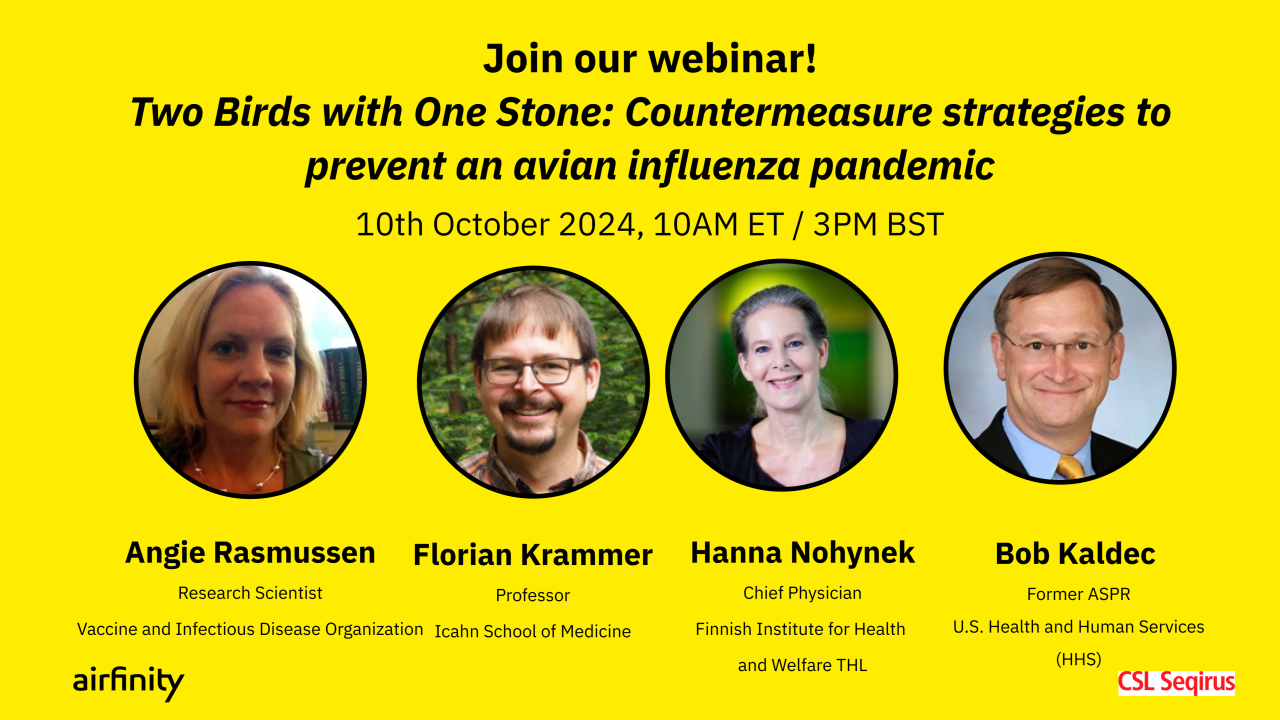
NEW: Airfinity Avian Influenza Webinar
“Join Airfinity and its expert panelists in a discussion of the current avian influenza outbreak. Key topics will include the evolution of the virus, the potential of a recombination event and the current state of pandemic preparedness.”
This event will take place on October 10 at 10 am ET. Learn more and join here.
NEW: Potential Research Priorities to Inform Readiness and Response to Highly Pathogenic Avian Influenza A (H5N1)
“The National Academies will host a 2-day virtual public workshop, October 22-23, to explore research priorities for the ongoing H5N1 outbreak in the U.S. Recognizing the interconnection between people, animals, and their shared environment, this workshop will take a One Health approach to bring together federal government agencies, the academic community, and the private sector, as well as other relevant stakeholders across the health, agriculture, and food safety sectors.”
“Workshop discussions will focus on basic science and research areas of concern and may help inform future research that could provide local, national, and global communities with information about virus transmission, mitigation of risks, and appropriate measures to prevent the spread of disease.”
Learn more and register here.
NEW: One Health and the Politics of COVID-19 Book Launch
The Writer’s Center is hosting a book launch for Dr. Laura Kahn’s new book, One Health and the Politics of COVID-19 (blurb below) on November 23 at 2 pm EST in Bethesda, MD. Learn more and RSVP here.
“One Health and the Politics of COVID-19 unpacks the mysteries of COVID-19’s origins to impart important lessons for future outbreaks. The One Health concept recognizes the interconnected links among the health of humans, animals, plants, and the environment. By comparing the history, science, and clinical presentations of three different coronaviruses—SARS-CoV-1, MERS, and SARS-CoV-2 (COVID-19)—Kahn uncovers insights with important repercussions for how to prepare and avoid future pandemics. The One Health approach provides a useful framework for examining the COVID-19 pandemic. Understanding the origins of this zoonotic disease requires investigating the environmental and molecular biological factors that allowed the virus to spread to humans. The book explores the many ways in which the wild animal trade, wet markets, and the camel industry contributed to the spread of the earlier SARS-CoV-1 and MERS coronaviruses. For SARS-CoV-2 (COVID-19), Kahn examines the biosafety, biosecurity, and bioethics implications of gain-of-function research on pandemic potential pathogens. This book is a must read to understand the geopolitics of the COVID-19 pandemic.”
Responsible AI: Design, Development, and Use
Join the Mason Autonomy and Robotics Center (MARC) for this 3-day in-person course on Responsible AI: Design, Development, and Use! As AI becomes increasingly pervasive across various domains, it is essential that we prioritize responsible principles, policies, and practices. Learn from top AI scholars and industry experts about ethical and safe AI deployment. You’ll also gain the critical skills to navigate the complexities of AI in business, healthcare, transportation and more.
Course Dates: October 15-17, 2024
Registration Deadline: October 8, 2024
FLUency: True Expertise and Effectiveness in the Battle Against Influenza
“This Commission meeting, FLUency: True Expertise and Effectiveness in the Battle Against Influenza, will be held on Tuesday, October 8th, in Washington, DC. The focus of this meeting will be to provide the Bipartisan Commission on Biodefense with a better understanding of: (1) national leadership to defend food and agriculture against influenza; (2) federal operational requirements for preparedness, coordination, and response; (3) biosurveillance, forecasting, and the need for diagnostic tests; and (4) front-line needs and partnerships in the fight against influenza.”
This event will take place in-person on October 8 from 9:20 am to 2 pm EST. Learn more and register here.
Register now: https://bit.ly/3zMvZOR
Bio and Beer (October 10)
From the Northern Virginia BioHub: Join us for a panel discussion with local investors as they share their funding priorities, insights on what’s ahead, and tips for meaningful engagement. Also, connect with our dynamic community of professionals from industry, academia, healthcare, investment, and government for a fun evening of networking!
Our panelists include:
- Deborah Hemingway, Managing Partner, Ecphora Capital
- Bibhash Mukhopadhyay, Managing Partner, Sound Bioventures
- Kevin O’Connell, Senior Vice President, In-Q-Tel
Register to attend for free at: https://ibi.gmu.edu/event/october-2024-bio-beer/
Location: JLL Tysons Office, 1800 Tysons Boulevard, McLean, Virginia 22102
Hosted by: The Northern Virginia BioHub
Signature Sponsor: JLL
Additional Sponsors: Virginia Bio, the Prince William County Department of Economic Development, and George Mason University’s Institute for Biohealth Innovation

External Review of Ethical, Legal, Environmental, Safety, Security, and Societal Issues of Engineering Biology Research and Development
From NASEM: “Engineering biology holds significant potential to transform the U.S. and global economy, with promise to deliver innovative solutions in health, climate, energy, food and agriculture, and more. As research and development in engineering biology and other areas of the bioeconomy advance, addressing the societal issues related to these technologies is imperative. As requested by the CHIPS and Science Act, this study will conduct an evaluation of the ethical, legal, environmental, safety, security, and other societal issues related to engineering biology, and make recommendations on research needs related to these issues and means to effectively incorporate their consideration into research practice.”
“The National Academies of Sciences, Engineering, and Medicine (NASEM) will appoint an ad hoc committee to review and make recommendations on the ethical, legal, environmental, safety, security, and other appropriate societal issues related to engineering biology research and development. The committee will address the scholarship and practice of addressing these issues, focusing specifically on:
(1) An assessment of the current knowledge and practice on assessing and mitigating various societal issues including ethical, legal, environmental, safety, and security issues.
(2) A description of the gaps and needs relating to such issues, focusing on approaches for co-generation of assessment approaches and design of products, technologies, and services with users of engineering biology research and development
(3) Actionable recommendations on how the National Engineering Biology Research and Development Initiative, established by the CHIPS and Science Act, can address the identified gaps and needs.
(4) Actionable recommendations on how researchers across the range of disciplines engaged in engineering biology can best incorporate considerations of such societal issues into the development of research proposals and the conduct of research.”
“NASEM will produce a consensus report presenting the results of its work and offering its findings, conclusions, and recommendations.”
“We invite you to submit suggestions for experts to participate in this activity. The call for experts closes on October 16, 2024 at 11:59 (ET).”
Recommend an expert here.
DARPA Invites Proposals for AI Biotechnology Pitch Days Dec. 5-6
“DARPA funds the research and development of technologies with the potential for transformational impact, central to delivering on the agency’s mission to create and prevent strategic surprise for national security. The agency’s Biological Technologies Office focuses on the natural world to derive revolutionary capabilities centered on:
- Foundational technologies that promote simulation and prediction of biological systems and outcomes, like simulation, foundational models, and data generation,
- Warfighter readiness, health, and recovery, such as medical countermeasures, diagnostics, health IT and medical devices, and
- Operational support of U.S. forces to enable their execution of missions across the spectrum, ranging from fibers for garments to distributed, point-of-need manufacturing.”
“To capitalize on these new opportunities and further accelerate the pace of scientific and technological discovery and development, DARPA looks to include targeted and limited-scope investments via an AI BTO solicitation seeking proposals on technologies focused at the intersection of artificial intelligence and biotechnology.”
‘“AI BTO seeks to fund proposals that catalyze the formation of future research projects by clarifying the opportunity space and de-risking technical barriers to achieving high impact,” said BTO Director Dr. Michael Koeris. “To this end, the office is providing $4.5 million to support up to 45 revolutionary catalyst projects and will be finalizing research agreements day of. We look forward to reviewing the novel biotechnology approaches to further our national security mission.”’
“BTO leadership is interested in engaging first-time or non-traditional proposers and seeks revolutionary approaches to emerging or anticipated Department of Defense challenges. During these events, BTO will introduce five new overarching topics that align with AI/ML applications:
- Prediction and Health
- Autonomous Science
- Biomanufacturing/Synthetic Biology
- Challenges with Scale
- Exciting Frontiers”
Pitch Days
“DARPA will host AI BTO Pitch Days on December 5-6, 2024, in the Washington, DC, region to select and award AI BTO catalyst projects. To be considered for AI BTO Pitch Day participation, offerors must submit a short white paper consisting of a technical description of the proposer’s idea in response to one of the focus areas listed above.”
“DARPA will notify offerors if they are selected for further evaluation via an in-person Pitch Day presentation to a panel of BTO program managers at the AI BTO Pitch Day event.”
“If selected for award at Pitch Day, DARPA may issue a Research Other Transactions award for one of three award scenarios – $100,000, $200,000, or $300,000. The maximum amount of government funding given to any single proposer will be $300,000.”
“To submit a white paper, register at https://usg.valideval.com/teams/aibto_2024/signup. The deadline is Friday, October 9, 2024 by 4:00PM EDT. Late applications will not be accepted.”
“Additional information is available on SAM.gov.”
Call for Experts: Health-Security Interface Technical Advisory Group (HSI-TAG)
“The World Health Organization (WHO) is seeking two experts to serve as new members of the Health-Security Interface Technical Advisory Group (HSI-TAG). This “Call for experts” provides information about the advisory group in question, the expert profiles being sought, the process to express interest, and the process of selection.”
“The concept of Health-Security Interface (HSI) applies to those public health activities whose performance involves to some extent the security sector broadly understood (e.g. international and non-governmental organizations, civil defense, military health personnel, law enforcement and armed forces, defense-related research programmes), certain international organizations and other entities with a security relevant mandate. These activities may include protection of health from traditional and emerging infectious disease threats; deliberate events and investigation of alleged use of chemical and biological agents including non-permissive environments and conflict zones; and any health activities performed in collaboration with security actors.”
“The HSI-TAG is multidisciplinary, with members who have a range of technical knowledge, skills and experience relevant to the Health-Security Interface.”
“Considering the recent developments and global trends, the Secretariat realized that there was a need to strengthen the following areas of expertise/experience, hence welcomes expressions of interest from:
- Bioterrorism experts (knowledge on pathogens of security concern, their microbiological characterization and application/modification for weaponization, diagnostics, countermeasures and containment measures),
- Decision/policy makers with hands-on experience dealing with significant deliberate event(s) (biological/chemical) response at the local, regional, or national level.”
“For the improved geographical and gender representation of the HSI-TAG members, the WHO Secretariat encourages applications from the WHO African, Western Pacific, European, Eastern Mediterranean and Pan American Health Organization/Americas regions and female or non-male gender identities.”
Learn more about the HSI and express interest by October 7 here.
 The Pandora Report