Welcome to this week’s Pandora Report! 🍂 This issue features developments in vaccine safety and regulatory instability in the U.S., including continued leadership upheavals at the FDA and NIH and the potential public health consequences of weakening vaccination mandates. It also covers global health topics, from avian influenza outbreaks to emerging biosecurity and biosafety initiatives.
The Vaccine Safety Net is Fraying – and Communities Will Pay the Price
By Carmen Shaw, Co-Managing Editor of the Pandora Report

Regulatory stability in the U.S. faces major shocks this week. StatNews reported that two senior FDA officials – Vinay Prasad and Tracy Beth Høeg – are quietly reshaping vaccine regulation by introducing new policies. These changes include stricter approval requirements and a narrower focus on high-risk populations for COVID-19 vaccines, raising alarms about transparency, the erosion of established norms, and potential negative impacts on public health. The turbulence continues with the abrupt replacement of the director of the NIH’s National Institute of Environmental Health Sciences (NIEHS). Kyle Walsh, PhD, a neuroepidemiologist and close ally of Vice President JD Vance, was appointed as the new director. NIH employees noted that Walsh was not selected through the standard selection process for filling a vacant position.
At the FDA, deeper turmoil unfolded as Dr. George Tidmarsh, head of the agency’s drug center, resigned last Sunday following the launch of an HHS investigation into “serious concerns” about his personal conduct. His departure came as a drugmaker connected to Tidmarsh filed a lawsuit alleging that he made “false and defamatory statements” during his tenure at the FDA. Tidmarsh’s ousting marks the latest in a string of chaotic leadership changes at the FDA, which have been impaired for months by firings, departures, and controversial decisions on vaccines, fluoride and other issues.
Against this backdrop, experts are working to preserve public trust in vaccines amid mounting disinformation. Michael Osterholm, an epidemiologist at the University of Minnesota, and his team at the Center for Infectious Disease Research and Policy (CIDRAP) launched the Vaccine Integrity Project (VIP) in April – an initiative designed to provide clear, science-based information on vaccine safety and efficacy in order to fill gaps left by weakened advisory bodies such as ACIP.
Meanwhile, in Florida, Surgeon General Joseph Ladapo has announced plans to end nearly half a century of childhood vaccination mandates. Physicians warn that removing these requirements could trigger a resurgence of diseases like measles, hepatitis, meningitis, and pneumonia – disease historically kept at bay because mandates reliably boost vaccination rates. Yet many critics, including doctors, say they are afraid to publicly oppose the policy despite the well-documented evidence that mandates protect communities by increasing vaccine uptake – and in turn, strengthening the overall health and resilience of communities.
The consequences of retreating from immunization are already visible at the regional level. Canada officially lost its measles elimination status, meaning the entire Americas region has now lost the designation due to sustained transmission. The cause is clear: “We’re seeing transmission of the measles virus in communities, essentially, that are under-vaccinated. So measles is a very contagious virus, and when it gets into a community where there’s a low vaccine rate, then we see really quick spread of that virus,” says Dr. Janice Fitzgerald, Newfoundland and Labrador’s Chief Medical Officer of Health.
Further Reading:
- “Wielding Obscure Budget Tools, Trump’s ‘Reaper’ Vought Sows Turmoil in Public Health Biosecurity in Netherlands,” Amy Maxmen, KFF Health News
- “James Watson, dead at 97, was a scientific legend and a pariah among his peers,” Sharon Begley, StatNews
- “The DNA Helix Changed How We Thought About Ourselves,” Carl Zimmer, NYTimes
Bird Flu Outbreak Intensifies Across Two Continents
By Margeaux Malone, Pandora Report Associate Editor
Outbreaks of avian influenza H5N1 continue to emerge across the United States as migratory birds carry the bird flu virus south for winter. In the past 30 days alone, the U.S. Department of Agriculture’s Animal and Plant Health Inspection Service (APHIS) has reported bird flu cases in over 60 commercial and backyard poultry flocks. Indiana has become a hotspot, with Lagrange County recording six major detections since late October. Most recently, three commercial farms were affected, including facilities housing 8,400 ducks, 8,300 ducks, and 18,300 egg-laying chickens. Michigan and Minnesota have also experienced increases activity, with additional cases reported on both coasts in California, Oregon, and Virginia.
Compounding the crisis is a scaled-back federal response. Wendy Puryear, a virologist at Tufts University acknowledged that the U.S. is not in a great position to monitor the ongoing outbreaks as much of the infrastructure to do so has been shut down or hampered by the current administration. Collaboration between researchers and federal health agencies has diminished significantly due to restrictions on communication and staffing cuts within the government. Funding cuts have also forced many to halt H5N1 studies. Even prior to the government shutdown, which further exacerbated the situation, data from federally-run labs processing genetic sequencing data from infected animals was already notably slow. Experts warn this reduced surveillance leaves the country vulnerable, particularly as farm worker testing remains inadequate despite their high-risk exposure.
Europe is experiencing an equally severe surge, with 688 wild bird outbreaks documented this season compared to just 189 last year. Currently, 15 of 27 EU countries have recorded farm outbreaks so far this season. Germany has been hit hardest, recording 66 outbreaks between October 1 and November 5, with over 400 cases in wild birds, particularly cranes. The outbreak has prompted sweeping protective measures across the continent including confinement of poultry indoors to protect them from wild birds. Ireland implemented a nationwide housing order on November 5 after its first outbreak in three years, joining France, Britain, the Netherlands, and Belgium, all of which imposed similar lockdown measures over the past month.
Further Reading:
- “Bird Flu Is Back. Here’s What to Know,” Meghan Bartels, Scientific American
- “Intranasal vaccine against H5 avian flu provokes broad immune response in adults in phase 1 trial,” Mary Van Beusekom, CIDAP
- “Bird flu means rare breeds will disappear,” Emily Johnson and Stever Jones, BBC
- “All the Ostriches Must Die,” Daniel Engber, The Atlantic
Special Collection: How Scandals Shape Responsible Research and Innovation
The Journal of Responsible Innovation is releasing a new series of articles examining how scientific scandals reshape norms, governance, and public expectations of research. Drawing on historical and contemporary cases from both the Global North and South, the collection explores the relationship between scandals and Responsible Research and Innovation (RRI) through three interlinked perspectives: systemically (how scandals expose the gaps between legal frameworks and knowledge production), culturally (how scandals challenge perceptions of legitimacy and ethics), and epistemically (how scandals reveal hidden power structures and vested interests). Together, these pieces argue that scandals are not only moments of wrongdoing, but also opportunities for learning, reform, and strengthening RRI.
Guest Editors: Joy Y. Zhang, Kathleen Yogel, and Sonia Ben Ouagrham-Gormley.
MIHCLE: A New Standard for High-Containment Lab Safety and Transparency
Researchers have proposed a new reporting standard called MIHCLE (Minimum Information about a High Containment Laboratory Experiment) to improve transparency and safety in work with high-risk pathogens. While it’s especially designed for BSL‑4 labs, MIHCLE could also apply to BSL‑3 research, helping standardize how experiments are documented under maximum containment conditions. This framework aims to strengthen biosafety and biosecurity by making high-risk experiments more traceable and accountable.
Biosecurity Knowledge Day 2025: Anticipating Biorisks and Building Preparedness
On last Thursday, November 6, the International Biosecurity Symposium 2025 brought together an inspiring community of biosafety and biosecurity professionals to discuss emerging biorisk topics in the life sciences. Highlights included Johanna Sweere’s presentation on #mirrorlife, exploring how we can anticipate and govern risks from novel biotechnologies before they emerge.
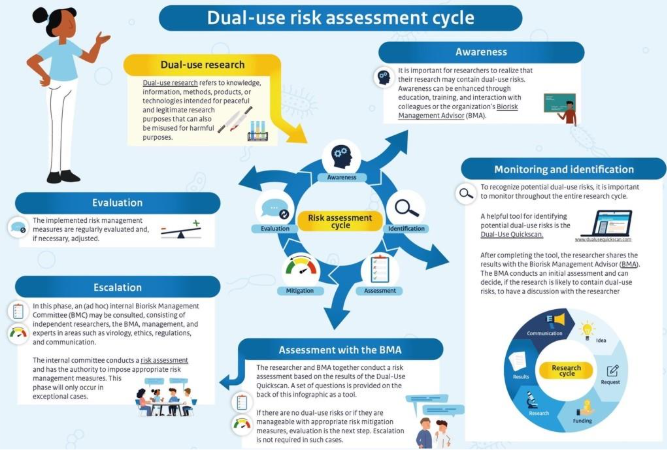
Participants also engaged with the new dual-use infographic developed by the Biosecurity Office, a practical tool for assessing and mitigating dual-use risks (see here: link). Afternoon workshops offered hands-on experiences, from tabletop exercises testing organizational preparedness, to sessions on knowledge security dilemmas led by experts from TUDelft and the National Contact Point for Knowledge Security. Attendees also explored integrating security into Safe & Sustainable-by-Design (or #SSbD) and tackled biosecurity challenges in an interactive escape room. Learn more here.

NEW: How Can the Biological Weapons Convention Address the Dual-Use Challenges of AI-Driven Biodesign Tools?
From UNIDIR: “In collaboration with the Biological Weapons Convention Implementation Support Unit (BWC-ISU) at the United Nations Office for Disarmament Affairs (UNODA), UNIDIR is organizing a series of online technical briefs on emerging technologies and the BWC. The upcoming session will focus on artificial intelligence (AI) enabled tools for molecular design and biological engineering – areas advancing at a rapid pace. It will examine their current capabilities, potential dual-use risks, evolving international policy responses, and implications for strengthening the BWC. The session will include a conversation-style expert panel, followed by an interactive question-and-answer segment with the audience.”
This event will take place online on November 26, 2025. Learn more and RSVP here.
NEW: Cyberbiosecurity: Emerging Risks and Opportunities for the Biological Weapons Convention
From UNIDIR: This session is organized as part of UNIDIR’s “Science and Technology Watchtower” project, aimed at identifying science and technology (S&T) developments and analysing their risks and opportunities for disarmament and international security. It will feature a short presentation of the main findings of UNIDIR’s new paper Cyberbiosecurity: A Matter of International Peace and Security?. The session will then feature a conversation-style panel with experts to explore the implications of cyberbiosecurity for bioscience governance, verification, and national implementation of the BWC, followed by a question-and-answer session with the audience.”
This event will take place online on December 4, 2025. Learn more and RSVP here.
GHS 2026
From GHS: “We’re excited to officially announce that the 4th Global Health Security Conference (GHS2026) will be held in Kuala Lumpur on the 9 – 12 June, 2026!”
“Building on the incredible momentum of GHS2024 in Sydney, we look forward to bringing together the global health security community once again – this time in one of Southeast Asia’s most vibrant and dynamic cities.”
“Registration and Call for Abstracts are now live!”
Learn more, submit abstracts, and register here.
The Human Biosafety Health Foundation – A New Hub for Biosafety in the Mediterranean
From the Human Biosafety Health Foundation: “The Human Biosafety Health Foundation has been established to promote research, training, and international cooperation in the fields of biosafety, public health, and health resilience. The Foundation aims to serve as a Mediterranean hub for the development of shared and innovative strategies in response to global challenges related to conventional and non-conventional biological threats, climate change, and health emergencies. The Scientific Committee is composed of medical officers and biosafety experts in high biocontainment transport from the Italian Air Force, ensuring a highly qualified, interdisciplinary, and operationally secure approach. By bringing together academic expertise, institutions, and civil society, the Foundation seeks to build an integrated network for health security, based on knowledge, prevention, and prediction.”
Learn more and get involved here.
Cyberbiosecurity Quarterly Call for Papers
“We are pleased to announce the launch of Cyberbiosecurity Quarterly, a new academic and trade journal dedicated to the intersection of cybersecurity and the bioeconomy. Published by Kansas State University’s New Prairie Press and sponsored by the Bioeconomy Information Sharing and Analysis Center (BIO-ISAC), this quarterly journal will serve as an important resource for professionals, researchers, and policymakers working to safeguard digital and physical biological infrastructures. Cyberbiosecurity is an emerging discipline that addresses the protection of biomanufacturing, biomedical research, synthetic biology, digital agriculture, and other life sciences sectors from digital threats. This journal will explore topics at the nexus of cybersecurity, digital biosecurity, and the bioeconomy, including but not limited to:
- Best practices for network configuration and management in biomedical environments (ingress/egress protection, segmentation, isolation, access control, traffic protection, etc.)
- Cybersecurity Vendor Management and Assessment
- Cyber and Digital Biosecurity Education for the Bioeconomy’s Workforce
- The Quality-Cybersecurity Tension in Practice and Techniques for Mitigation
- Threat Intelligence for Cyber-Physical Biological Systems
- Regulatory and Policy Perspectives on Cyberbiosecurity
- Incident Response and Risk Mitigation in Biomanufacturing
- AI and Machine Learning in Digital and Cyber Biosecurity”
Learn more and submit your papers here.
Harvard LEAD Fellowship for Promoting Women in Global Health
From Harvard’s Global Health Institute: “To equip and empower more leaders in global health, the Harvard Global Health Institute, in collaboration with the Department of Global Health and Population at Harvard T.H. Chan School of Public Health, offers a transformational 1-year fellowship specifically designed to promote leadership skills in individuals in low- and middle-income countries who will, in turn, mentor future female leaders in global health. Candidates should be currently based/working in a LMIC, and plan to return there after their fellowship.
The fellowship experience provides global health leaders time to reflect, recalibrate, and explore uncharted territories. To date, fellows have come from 18 different countries, with representation from Africa, Asia, Eastern Europe, and South America. Their areas of focus have ranged from HIV/AIDS and healthcare to health policy at the highest levels of government. Past fellows’ areas of expertise span disciplines including research, advocacy, administration, and policy.”
Learn more and submit your application by November 30 here.
Call for Presenters: International Bio Recovery Summit
The American Bio Recovery Association (ABRA) has opened its Call for Presenters for the 2026 International Bio Recovery Summit, taking place March 16-18 in Aberdeen, Maryland. As the industry’s leading event, the summit brings together bio-recovery professionals to address emerging challenges, regulatory updates, new technologies, and evolving safety standards in the field. ABRA invites experts to submit proposals aligned with conference objectives – including discussions on industry guidelines, insurance claims, hazardous substances, and business practices.
Learn more and submit your presentation by December 31 here.
64th ISODARCO Course
From ISODARCO: “In recent years, the global security landscape has become increasingly volatile, shaped by a convergence of geopolitical tensions, technological advancements, and evolving nuclear doctrines. The post-Cold War order that once provided a measure of predictability in global security has eroded. Conflicts such as the wars in Ukraine and Gaza, rising tensions in the Indo-Pacific, and strategic competition between major powers have reshaped alliances and strategic postures.”
“At the same time, disruptive technologies including artificial intelligence, quantum computing, hypersonic missiles, and cyber threats – are adding new layers of complexity to both nuclear and conventional deterrence dynamics. These technologies are not only distorting the information landscape but also compressing decision-making timelines and complicating signaling mechanisms, increasing the risk of miscalculation.”
“Effectively managing nuclear escalation risks in this environment will require a combination of innovative diplomacy, technological safeguards, and renewed dialogue mechanisms to rebuild trust, reduce misperceptions, and stabilize strategic relations.”
“The ISODARCO 2026 Winter Course presents an invaluable opportunity for students and experts to discuss and examine these dynamics in depth and explore approaches to re-establishing strategic stability and reducing nuclear dangers in a volatile world.”
This course will take place January 11-18, 2026, in Andalo. Learn more and apply here.
 The Pandora Report