Melioidosis: Uncovering a Neglected Tropical Disease

By Stephen Taylor

The ASM Biothreats Melioidosis Panel on Tuesday, February 7th, shed light on a largely ignored infectious disease that runs rampant in developing Southeast Asian countries. The speakers, Dr. Direk Limmathurotsakul, the Head of Microbiology at Mahidol-Oxford Tropic Medicine Research Unit, and Dr. Frances Daily, of Diagnostic Microbiology Development Programme, brought a wealth of first-hand knowledge and experience diagnosing and treating this disease in Thailand and Cambodia.

Melioidosis is an infection caused by Burkholderia pseudomallei, a bacterium often found in soil and water.  It is known to cause fever, arthritis, and abscesses of vital organs.  Once inoculated with bacteria, carriers typically experience an incubation period between 1 and 21 days before melioidosis symptoms appear.  Humans acquire B. pseudomallei by inhaling contaminated dust, ingesting contaminated water, or coming into contact with contaminated soil.

In the United States, B. pseudomallei is classified by Health and Human Services and the U.S. Department of Agriculture as a Tier 1 Select Agent, meaning it poses a significant threat to human and animal health and safety and presents a great potential for deliberate misuse.  The Soviet Union and the United States are both believed to have studied B. pseudomallei as a potential biological warfare agent in the 1940s.

In his extensive work caring for patients in northeast Thailand, Dr. Limmathurotsakul documents numerous cases of melioidosis on an annual basis, many of them fatal.  Thailand’s Bureau of Epidemiology, however, only documents about 12 melioidosis deaths per year.  Dr. Limmathurotsakul chalks up the disparity to a poor public health surveillance apparatus and cultural barriers in reporting.  Public health laboratories in Thailand are poorly equipped for diagnostics. Furthermore, physicians in Thailand are not well trained to utilize laboratory diagnoses, nor are they well versed in the transmission and symptoms of melioidosis.  When local health professionals do detect outbreaks of the disease, they are hesitant to report them to the Bureau of Epidemiology for fear of being stigmatized as the only locale to have a significant melioidosis outbreak.

Dr. Daily has encountered similar problems working in Cambodia.  Due to climate change, the rainy season in Cambodia lasts longer every year and with it, the number of melioidosis outbreaks detected by her team also grows.  The Cambodian government, however, is unable to respond effectively to these outbreaks due to a lack of diagnostic capability, patient data, and funding.  Treatment for the infection, which averages a cost of 65 USD, is expensive compared to the Cambodian per capita income of just over 1,100 USD.  Many families struggle to pay for treatment, often going into debt or selling property to afford it.

What can be done to improve detection and treatment of melioidosis?  All of the panel members recommended improving the education and training of the public health and medical workforce.  Knowledge of melioidosis needs to be integrated into training for public health workers in laboratory diagnosis.  Protocols for diagnosis and treatment of melioidosis should be incorporated into medical school curricula.  The speakers also expressed hopes that Thailand and Cambodia would be able to build their capacity to detect and report infectious diseases. Combining his limited data on melioidosis with predictive modeling algorithms, Dr. Limmathurotsakul has estimated that there are 165,000 cases of melioidosis worldwide each year, 89,000 of which result in death.  He hopes the estimates will spur melioidosis researchers worldwide to compile confirmed-case data and paint a more accurate picture.  Then national and international policymakers will have better information to support clinicians and public health officials in their local efforts to fight the disease.
Licensure under the FDA Animal Rule: A Path to Success

By HyunJung (Henry) Kim

Michael Merchlinsky, a subject matter expert from BARDA/CBRN, was the first speaker in this ASM Biothreats 2017 plenary session, overviewing history of the Animal Rule in the US. The Animal Rule is well-known as an innovative policy forming the foundation of U.S. biodefense policies. When no alternatives are available, the Animal Rule provides an investigational mechanism for figuring out “predictive” responses from new medical countermeasures (MCMs) relevant to calculating a dose in humans. Under the Animal Rule, licensure is a legal status awarded by FDA that assures the public that studies to demonstrate safety and efficacy have been performed. According to Merchlinsky’s presentation, it is worthy to note that the Animal Rule was born in the basis of national security purposes, increasingly apparent from Gulf War to 9/11. The primary purpose of the Animal Rule is to increase preparedness and provide means to confidently respond to a public health emergency. Based on the national security perspective at the state-level, Michael Merchlinsky reviews the pros and cons of the Animal Rule. He notes that the Animal Rule is the best course of action for assuring ‘safety’ and ‘efficacy’ where no other alternative is available. Moreover, MCMs under the Animal Rule can attain pre-EUA status during developmental path-MCMs saved in the Strategic National Stockpile (SNS). On the other hand, a critical limitation is that the Animal Rule is inherently longer, harder, and less predictive than traditional pathways.

Next, Dr. Mario Skiadopoulos and Christine Hall represented Emergent BioSolutions and spoke to the regulatory pathway for anthrax and botulism medical countermeasures. BioSolutions applies animal models based on the subject of rabbits as well as non-human primate (NHP) to develop vaccines against anthrax and botulism. It was very interesting to know that there are three types of experiments in animal modeling; Post-Exposure Prophylaxis (PEP), Pre-Exposure Prophylaxis (PrEP) and Passive Transfer. The PEP type demonstrates added value of vaccine over antibiotics alone, in post-exposure settings, whereas the PrEP type established correlation between pre-challenge TNA tilter and probability of survival. The Passive Transfer type demonstrates that neutralizing antibody alone is capable of protection. Compared with the speaker from government sector, speakers from the private sector point to more practical challenges that field researchers are facing under the Animal Rule. They argue that there is no regulatory precedent for licensing a vaccine under the Animal Rule. Technically speaking, it is not clear which time points or which kind of animal models can bridge animal-to-human data. For instance, we have never known which animal model is akin to human trials between rabbits and NHP, as well as which time point is appropriate to apply to humans among the 80%, 90% or 100% survival points from the result of animal models. Consequently, the Animal Rule is essential not only in MCMs development and the realm of national security, but also carries with it many challenges both in government and private sectors. Overall, the inclusion of both government and private sector viewpoints presented the full spectrum of the Animal Rule and its complexities regarding MCM development.

Should I Stay or Should I Go? National Bioterror Emergency Response Preparedness

By Zach Goble

The theme of this ASM Biothreats 2017 symposia was perhaps one of the more noteworthy callings for collaboration among groups. With more than 17 years of experience as the director of Hazardous Materials Emergency Response at the Massachusetts Department of Fire, David Ladd emphasized the need for a unified response when encountering any number of hazards. His slogan during his dialog, “what happens on the left coast, then happens on the right coast”, stressed the importance of initiating and maintaining communication with organizations near and far. No one stays unaffected in the world of today and without the exchange of ideas, experiences, and procedures disasters can have an overwhelming effect.

Rich Ozanich, from Pacific Northwest National Laboratory and Christina Egan, from the NY Dept. of Health, both echoed that close collaboration is a key factor in response. While Rich laid out the Department of Homeland Security’s framework for “The Onion”, which is a set of procedures to guide first responders in the event of a biothreat incident. The emphasis here was that to be successful the training for such events needs to be coordinated at a local, state, and national level.  Christina detailed the many training programs tailored to biological threat response within Emergency Management Departments specific to various states such as Minnesota and Wisconsin. The message here was that while many great programs exist at the state level, there is not a unified national response to confront CBRN threats with the United States.

David Ladd concluded the panel by presenting a proposed model for National Bioterrorism Response that was submitted by the Interagency Board in January, 2017. In the absence of a nationally recognized system for protecting the nation against bioterrorism, the need for such a system is certainly justified. This document provides a model for bringing together various organizations and departments to create a network of local bioterrorism response teams ready to deploy when the need arises. Models such as these represent steps in the right direction to achieving a unified response in ensuring the public remains safe from biological threats.

International Collaborations to Defend against Biological Weapons: The UK/US Experience

By Zach Goble

The second day of the ASM Biothreats 2017 conference focused on a range of topics from synthetic biology to host immune response. Perhaps one of the most interesting was the session on international collaborations to defend against biological weapons. Immediately the conversation began with talk of recognizing foreign organizations for their help in aiding research endeavors or providing resources to further science. Stuart Perkins, from the Defense Science and Technology Laboratory (DSTL) in the United Kingdom, highlighted the importance of shared resources and capabilities when responding to emerging infectious diseases. One organization doesn’t hold all the information, and nor should they, because while one strives for consistency in research methods, it is helpful to have differences to cast a wider net against the many research topics out there.

Lloyd Hough, from the United States Department of Homeland Security, talked about how DSTL helped provided support to their department during the most recent Ebola epidemic. Prior to the Ebola outbreak, DSTL in the United Kingdom had conducted research on how Ebola virus thrived on various surfaces and this inspired new ways forward for the U.S. to aid the countries affected in 2015. When worldly public health events occur it is often unified efforts that bring about successful outcomes.

Andrii Pavlenko, from the State of Service in Ukraine, showed how support from the United States Defense Threat Reduction Agency (DTRA) helped provide equipment and laboratory upgrades to several Ukrainian facilities working with biological pathogens. Not only did these upgrades prevent unauthorized access to potentially dangerous pathogens, but also helped to prevent the spread of emerging infectious diseases. African Swine Flu (ASF), a virus with high mortality rates in pigs and prevalent in Eastern Europe region, was on the rise in Ukraine, but the equipped laboratories helped bolster biosecurity detection and thus prevented the spread of the disease.

The message was very clear that alone, organizations could not effectively deal with biological threats that have no borders and target unremittingly. Thankfully, the gears are already in motion towards international collaboration with the organizations in attendance, among others that exist around the world. The panel left the audience with a strong message in which trust of fellow organizations is needed for it is not always action that is needed, sometimes it is the non-action in letting your partner do the work, so you can tackle another issue. While replication is important, redundancy should be left at the wayside to make room for more knowledge as there is no shortage of scientific questions out there.

Pandemic Preparedness: Learning from Experience

By Stephen B. Taylor

On February 7, 2017, Dr. Anthony Fauci, Director of National Institute of Allergy and Infectious Diseases, National Institutes of Health, gave the keynote speech at the ASM Biothreats 2017 conference. Dr. Fauci has spent over 35 years advocating infectious disease preparedness with United States policymakers. In his speech, Dr. Fauci discussed the substantial progress made in this arena since the 1980s when he first entered the field during the Reagan administration. At the time, there was a lack of appreciation in the U.S. about the potential of the newly emergent Human Immunodeficiency Virus (HIV).  Though Fauci tried to publish some disturbing initial findings about the nascent threat, the medical community rebuffed him for being an alarmist.  As the 1980s progressed, HIV/AIDS spread to epidemic proportions in the U.S.

During George H.W. Bush’s presidency, Dr. Fauci began making headway with national health and policy leaders to take seriously the threat of emerging infectious diseases. President Bush visited Dr. Fauci at NIH for a personal tutorial on HIV and took time to visit with HIV/AIDS patients. After President Bush received Dr. Fauci’s expert counsel and made a personal connection with the HIV/AIDS crisis, public health resources directed at the epidemic increased dramatically.

From the Clinton years onward, Dr. Fauci maintained his connection to lawmakers and executive leadership.  When infectious disease emergencies like West Nile Virus and antibiotic resistance came to a head during the Clinton years, politicians had a stronger relationship with the National Institutes of Health and funding came more quickly.

During George W. Bush’s term, the United States experienced the “double whammy” of 9/11 and Amerithrax.  This was a watershed moment for infectious diseases. For the first time since the early 20th century, it became widely apparent that infectious disease outbreaks posed a major threat to U.S. public health and security.  As the U.S government turned its attention and resources toward developing countermeasures against a bioterror attack, Dr. Fauci urged Washington leaders not to lose sight of the threat posed by natural outbreaks. When the H5N1 bird flu hit in the latter half of Bush’s presidency, the Bush administration worked closely with experts in health security to affect a paradigm shift: instead of reacting to outbreaks as they happen, the U.S. should expend more resources on preparing for future ones.

During Barack Obama’s presidency, emerging and re-emerging infectious disease outbreaks came in rapid succession: the H1N1 flu pandemic in 2009, MERS in 2012, Ebola in 2014, and Zika in 2015.  In close conjunction with experts like Dr. Fauci however, policy-makers have learned important lessons about preparedness, surveillance, capacity building, and coordination in preparation for the next major outbreak. Indeed, even before Inauguration Day this year, the Trump transition team invited Dr. Fauci to the White House for a disaster-response exercise.  As the world grows more interconnected and its climate changes, the threat of emerging infectious diseases looms larger.  U.S. leaders should continue to heed the advice of subject matter experts like Dr. Fauci and work closely with health and defense institutions to prepare for the future.


Sverdlovsk, Three Mile Island, and Government Oversight of Biological Safety

To those of us who follow the world of biodefense, it seems as though every week brings news of a high-profile lapse in biosafety. In just the past month, we’ve seen an employee from the Pasteur Institute Korea transport samples of the coronavirus that causes Middle East respiratory syndrome (MERS) on a commercial airliner and reports that the Centers for Disease Control and Prevention (CDC) shipped chikungunya virus without first performing tests to ensure that the specimens had been completely inactivated. These come on top of such disturbing stories as the US Army’s Dugway Proving Ground accidentally shipping live anthrax to almost 200 facilities and slip-ups at the CDC involving ebolavirus and avian influenza.

While each of these incidents would be alarming in its own right, collectively they imply a systemic failure to properly control biological agents. Determining the extent and severity of the problem is made even more difficult because consistent rules for reporting these types of biosafety events do not exist under the government’s Select Agent Program (SAP). For example, a review this year by the Government Accountability Office found that the number of incidents of incomplete inactivation between 2003 and 2015, similar to what occurred with the Dugway anthrax samples, was at least twice as high as initially reported. Clearly, a more comprehensive and thorough accounting is needed.

The corrosive impact that a lack of oversight can have on biosafety is apparent in the admittedly extreme case of the Sverdlovsk anthrax leak in 1979, in which a Soviet biological weapons facility near present-day Yekaterinburg, Russia unintentionally infected the city with a cloud of anthrax spores. Coincidentally, the incident occurred only five days after the Three Mile Island (TMI) nuclear accident in Pennsylvania, and the two events actually contain a number of similarities. Both were caused, in large part, by errors in maintenance: at Sverdlovsk, technicians neglected to replace an exhaust system filter, while at TMI, staff had isolated an auxiliary feedwater pump during routine maintenance in violation of US Nuclear Regulatory Commission (NRC) rules. Both resulted in the release of toxic materials into the environment: about a gram of anthrax at Sverdlovsk and 370 PBq of (biologically-inert) radionuclides from TMI. The consequences of both were severe as well: casualty estimates from the anthrax release range from 60 to over 100, and while no direct health effects from the Three Mile Island accident have been conclusively documented, the economic cost may have been in excess of $1 billion, in addition to the permanent damage done to the US nuclear industry’s public image.

If the events themselves bear similarities, the official responses to them could not have been more different. The Soviet government responded to the Sverdlovsk incident in its typical manner with a campaign of disinformation, blaming the anthrax cases on contaminated meat and destroying associated hospital records. Biopreparat, the Soviet biological weapons program, added yet more layers of secrecy to hide its involvement, making it even less accountable to the government of the Soviet Union, let alone its people. By the time the Soviet Union collapsed, the government had almost entirely lost operational control over the bioweapons program.

In stark contrast, the Three Mile Island accident prompted the NRC to make significant changes to how US nuclear power plants are regulated and operated. The agency instituted a number of policies such as tracking significant events and safety system actuations to determine which initiating events that might result in a radiological release were most common and issuing guidance to operating plants to reduce their frequency. In the years since TMI, accident precursors, reactor trips, and occupational radiation exposures at nuclear plants have decreased precipitously, in some cases by an order of magnitude. The NRC has also taken steps to increase transparency in its findings, such as publishing safety and performance assessments for all operating plants. This allows for public scrutiny and an informed conversation regarding the risks associated with civilian nuclear power.

What lessons can we take away from Sverdlovsk and Three Mile Island? The most obvious insight is that operational safety can be greatly enhanced by effective oversight, and effective oversight requires a well-informed regulator. A consistent and uniform mechanism for tracking biological safety incidents, perhaps through the SAP, would provide regulatory agencies with a better idea of the nature of the problem and allow them to spot trends. By publishing data on laboratory failures, organizations could be held accountable for poor performance and best practices could be more easily identified. The real lesson from Three Mile Island and the Nuclear Regulatory Commission’s response is that with enhanced scrutiny, the likelihood and severity of an accidental release drops and biological research can become safer and more secure. And in the end, isn’t that what biodefense is all about?

Biodefense in Gaming: Enjoyable but Inaccurate

By Greg Witt

With pathogens like Zika, Ebola, and West Nile now household names, biodefense has rarely been more culturally relevant. One needs look no further for proof than the sudden proliferation of TV shows and movies taking on these themes, including The Last Ship, Containment, and Helix. Depictions of biodefense topics in popular culture are not limited to traditional media, though; numerous video games and board games have been released in the past few years in which biodefense plays an important role. Here are a few of the more notable games:

Dead Island: This 2011 video game involves a genetically-modified version of kuru that is transmissible by blood and turns people into zombies. The disease is released by a shadowy corporation as a biological weapons test on some fictional islands off the coast of Papua New Guinea. With respect to scientific accuracy, the developers make a number of major errors; for example, they repeatedly refer to kuru as a virus when it is actually a neurodegenerative condition caused by a prion. Such creative liberties are understandable considering that a disease with an incubation period of 10+ years would make for a rather boring game. In the end, these epidemiological details are merely window dressing intended to give the game a pseudoscientific backstory in the name of narrative expediency and exciting gameplay.

Tom Clancy’s The Division: In the world of biodefense, few pathogens are as feared as variola, and rightly so. Playing on this concern, The Division follows government agents attempting to restore order in New York City as society collapses in the aftermath of a smallpox attack in the heart of Manhattan. While the specifics of the disease and the outbreak are largely glossed over, the game’s depiction of the aftermath of such an epidemic is eerily plausible, including misdiagnosis of the initial infections, exponential spread of the virus, and the collapse of the public health system under the unprecedented strain of massive casualties. The premise for the story is almost identical to Operation Dark Winter, a simulation conducted in 2001 to analyze US government preparedness for a hypothetical smallpox attack. Ultimately, the variola outbreak is just a plot device to set the stage for a post-apocalyptic shooter, but the game does succeed in bringing some long-overdue attention to the potential threats posed by biological terrorism and the genetic engineering of pathogens.

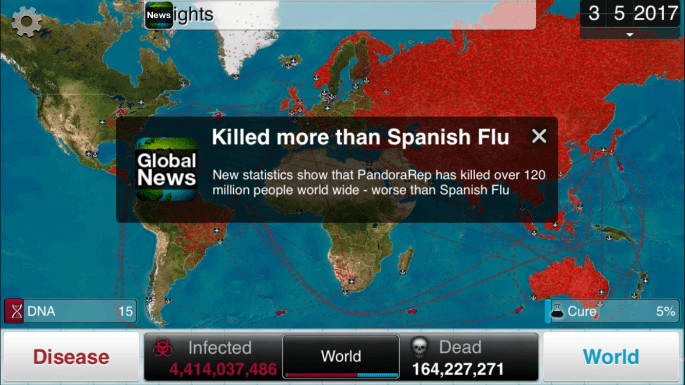
Plague Inc.: This strategy game presents a twist on biodefense, as players take on the role of a pathogen, starting as a bacteria, virus, or parasite, and attempt to eliminate humanity. As time passes and more people are infected, the disease can be upgraded by adding new symptoms (such as coughing, pulmonary edema, or kidney failure) and modes of transmission (such as airborne or vector-borne). Humanity does not go gentle into that good night, however, and fights back by trying to develop a cure and by taking interim measures like the closure of land borders and airports. For a free smartphone app, it actually provides a surprisingly accurate and comprehensive simulation of a pandemic. For example, players must balance transmissibility, infectivity, and lethality in order to maximize the spread of their pathogen.

Pandemic: If you prefer saving the world to destroying it, the cooperative board game Pandemic offers you and 1 to 3 companions the chance to work together to save the human race from not one, but four different virulent and highly contagious pathogens. The game starts at the Centers for Disease Control and Prevention headquarters in Atlanta as biodefense experts and medical personnel scramble around the world in an attempt to contain major outbreaks and ultimately discover and disseminate a cure for each illness. Taking on such roles as “Quarantine Specialist” and “Epidemiologist”, players must contend with scarce resources and the frustration of always having to play catch-up to a constantly morphing and unpredictable threat, a feeling that real biodefense experts know all too well. While never delving too deeply into the specifics of the pathogens or the actual science behind epidemic response, Pandemic provides invaluable insight into the world of those working every day to keep our society safe from biological threats.

When judging the accuracy of these games, a noticeable pattern begins to emerge. Action and shooting games tend to gloss over the epidemiological details and use biological agents and epidemics as merely a plot device or a token justification for the setting. Since these titles are usually focused on fast-paced action and interpersonal relationships, it is understandable that the developers would take poetic license with their depictions of pathogens and epidemics. Strategy games, on the other hand, tend to explore the complexities of pandemic response and provide the player with much better insight into the worlds of epidemiology and biodefense. Other than biological inaccuracies, the most glaring flaw in the depiction of epidemics in gaming is the assumption that some omnipotent intergovernmental organization can take all steps necessary to contain and cure the outbreak. In reality, it could be argued that the greatest challenge is presented not by the contagion itself, but by the inability of different stakeholders to cooperate, in addition to the obviously extreme differences in response infrastructure.

One crucial commonality between all four games is the depiction of virulent and contagious pathogens as existential threats that must be confronted sooner rather than later. So while the actual science and politics on display can often be questionable, these games are an invaluable tool for bringing biodefense to the attention of the general public. And of course it doesn’t hurt if we get to play some enjoyable games along the way!


Containment: the Good, the Bad, and the Contagious

Last week saw the series finale of the CW show, Containment. The show’s plot revolves around a mysterious and dangerous outbreak that we follow through the lives of several characters. “When a mysterious epidemic breaks out in Atlanta, an urban quarantine is enforced, leaving those inside to fight for their lives as local and federal officials search for a cure. Police officer Lex Carnahan works to keep the peace, but the situation becomes personal when he learns his girlfriend Jana and his best friend Jake are both stuck in the cordoned area. Also trapped with the infected are 17-year-old Teresa, who is very pregnant and separated from her boyfriend, elementary teacher Katie Frank, who is on lockdown with her entire class, and CDC researcher Dr. Victor Cannerts. Public trust deteriorates as a journalist, Leo, begins chasing down a conspiracy that unravels the official story.” 

While we love a show involving outbreaks, quarantines, and the politics of disease, it’s rare that the producers actually get the science correct. Like Neil deGrasse Tyson did for astrophysics in films, we’re looking at some of the issues with Containment. Here are some of the lessons learned (pro’s) and cringe-worthy (cons) moments throughout the show:

Scientific Lessons Learned

  • Quarantine/Isolation is vital
  • PPE goes a long way – avoid those bodily fluids
  • Fear and hysteria follow outbreaks like a mosquito loves BBQ’s
  • Biology and epidemiology started off strong….
  • Social distancing is a good practice
  • Genetically engineered viruses are a concern with GoF research
  • Lack of cure – thankfully, it showed the reality that not all diseases get a miracle cure
  • Tensions between Federal versus local and law enforcement versus public health (which is especially prudent with the current situation of San Juan suing the CDC over pesticide spraying). Consider these tensions during Amerithrax, when the FBI wanted to treat the AMI building as a crime scene, while the CDC wanted to go in and do testing, etc. In fact, these lessons have fueled the support for forensic epidemiology, which seeks to combine public health and law enforcement in order to facilitate a better working relationship.
  • Hospitals are woefully unprepared for emerging or unknown diseases, which makes them the perfect transmission tool for diseases (remember Ebola and MERS?).

Cringe-Worth Moments

  • Using the same PPE over and over again
  • Who has jurisdiction for the whole Cordon? State of emergency? Chain of command?
  • Is it really possible a rogue CDC scientist would be able to secretly get away with illegal experiments and work?
  • Why is there such massive hemorrhaging for some and not others?
  • GoF justification due to concerns for bioweapons? Creating chimeric viruses as a biodefense strategy is wrong on so many levels.
  • Do police and tactical people not need PPE?
  • Body disposal and then photo-taking (post-mortem identification) without changing gloves or cleaning hands – apparently not a source of transmission…
  • Never seems to be a consistent route of transmission or isolation practice.
  • People are worried about being touched, but don’t seem to spend much time on environmental decontamination
  • Sadly, science behind the series started to wane as time progressed….

The 2016 Democratic and Republican Platforms Have Things to Say About Nuclear Weapons

By Greg Mercer

This week, the Republican Convention and the Trump campaign brought spectacle and controversy to Cleveland. The Democratic Convention is set for next week in Philadelphia and will presumably be a tamer affair. Working off draft copies of the two parties’ respective platforms, here’s a look at what the two-party system has to say about non-proliferation for the next four years. These are dramatic, confrontational texts, each calling out the opposing party’s leadership and policies.

The Republican Platform starts off the strategic weapons discussion with a Reagan-era throwback, calling for “the development and deployment of ballistic missile defenses.” The platform argues that reduction in interceptor ground sites in Poland, the Czech Republic, and Alaska have made the U.S. vulnerable to nuclear attack. It characterizes the New START (Strategic Arms Reduction Treaty) as weak on verifications and an enabler of a Russian nuclear buildup. Meanwhile, it argues that Russia has violated the Intermediate Range Nuclear Forces Treaty (INF). While not explicitly stated in the platform, this controversy has some history: some have accused Russia of possessing cruise missiles that violate the INF—Russia has argued that American drone strikes violate the same. The platform presents two treaties: one too weak to identify violations, and another flagrantly violated.

Rather than trigger these treaties’ enforcement mechanisms, the platform insists that (if you’ll forgive the block quote):

“We should abandon arms control treaties that benefit our adversaries without improving our national security. We must fund, develop, and deploy a multi-layered missile defense system. We must modernize nuclear weapons and their delivery platforms, end the policy of Mutually Assured Destruction, and rebuild relationships with our allies, who understand that as long as the U.S. nuclear arsenal is their shield, they do not need to engage in nuclear proliferation.” Continue reading “The 2016 Democratic and Republican Platforms Have Things to Say About Nuclear Weapons”

The Disease Slush Fund

By Greg Mercer

This week, House appropriators introduced legislation which would increase NIH funding to $33.3 billion, which is $1.3 billion more than this year’s funding. It would also set aside $390 million for the federal Zika response. STAT’s Dylan Scott has the full story.

This bill comes as an alternative to the emergency funding fight that’s sprawled across the last few months. Republicans have argued that funding for disease relief should come about through the normal appropriations process.

The emergency funding fight, currently on hold for a Congressional recess, started with the Obama administration’s request for $1.9 billion for Zika relief. Since then, proposals and counterproposals have ping-ponged back and forth between houses of the legislature, with the administration drawing on leftover Ebola money to fund the Zika fight. The Senate approved $1.1 billion in funding in May; House Republicans offered $622 million. Senate Democrats blocked a compromise bill for $1.1 billion—$750 million of which was drawn from cuts to other government expenditures—on June 28th. Democrats cited measures inserted by Republicans to cut Affordable Care Act funding (and the removal of a provision to ban flying of Confederate flags at federal cemeteries).

Back in April, FiveThirtyEight’s Maggie Koerth-Baker compared the emergency Zika funding battle to a slush fund for infectious disease. It’s an apt comparison, especially as the Obama administration, absent Congressional financial assistance, drained funds originally appropriated for Ebola to fight Zika, only the latest infectious disease in a time when global infectious disease outbreaks (and varieties) are on the rise. The United States has certainly established itself as a global force in combatting epidemics, providing financial and military assistance in the West Africa Ebola outbreak. The Zika funding fight though, has been particularly brutal. It’s easy to cry government dysfunction and partisanship, and there’s certainly plenty to go around, but there’s another more perverse relationship at play, too. At the end of the day, infectious disease outbreaks just don’t align with legislative cycles. Epidemiological response requires forecasting, detective work, and some guessing. Government agencies might be funded by the fiscal year, but there’s no telling what the CDC, NIH, and others will have to fight next, not how big that fight will be. The best case scenario, perhaps, is influenza, which utilizes half a year of careful surveillance to identify dominant strains and manufacture vaccines before Northern-Hemisphere flu season arrives. Zika and Ebola though, can emerge rapidly, producing calls for help overnight.

Consider the controversy and outrage over the public health response to Flint, Michigan’s lead crisis, a situation that arose more of less entirely because of policy. Now consider an enemy that follows no human schedules. Whether funding arrives in the form of an emergency bill or the regular appropriations process, infectious disease relief in its current form will always see that now-familiar fight over just how much is needed, and how badly. Disease will stay partisan for as long as we allow it to.