Image of the Week

West Nile virus (the mosquito/tickborne encephalitic virus) has been in the news a lot recently (albeit in a much quieter way than it’s flashier cousins) – last year alone there were 5,674 confirmed cases of the virus, the highest since 2003. What is less commonly known is that West Nile virus (WNV) was only introduced into the US in 1999. Pictured below are three maps illustrating the virus’ incredible (and alarmingly rapid) spread across the country.

(all maps courtesy of the CDC)

1999

Introduced in New York State, notice that by the end of 1999 all human cases of WNV were limited to the state of New York.

First introduced in NY, here we have the 1999 map of all cases of WNV in the US.

2001

By 2001, the virus had spread to nearly 30 states, with human cases in 10 states.

WNV cases in 2001
WNV cases in 2001 – the disease exists in humans across the North East and Southern states.

2003

By 2003, the virus was present in humans in 45 of the 48 contiguous states, with just Oregon and Washington remaining  WNV-free.

WNV cases in 2003
WNV cases in 2003

Today, cases of West Nile Virus have occured in all 48 contiguous states, with the numbers of cases often continuing to grow. The moral of the story? Viruses are very resilient. In order to so effectively and quickly spread across the country, the virus had to survive several brutal winters (known as “overwintering”) – remember, this is virus originating in the significantly warmer climates of the African continent.  We were very lucky that while WNV has the capacity to be severely pathogenic (encephalitis is no joke), 80% of those infected are asymptomatic. What if it had been Rift Valley Fever instead?

Image of the Week

Today’s Image of the Week: Cynobacteria!

Via “Microbiology and Immunology”

“Abstract art or fossilized stromatolite? Can’t it be both?

This image of the accumulations of cyanobacteria on a substrate at 12.5x magnification was taken by Douglas Moore of University of Wisconsin – Stevens Point and was awarded an honorable mention in Nikon’s Small World 2012 Photomicrography Competition.” http://bit.ly/10APB0h

Image of the Week: Chemical Weapons in WWI

Image of the Week: Chemical weapons in WWI

While we attempt to figure out who is using what in Syria, let’s stop and look at this very frightening (and quotidian) image of chemical weapons use in WWI. The below picture, showing the Russian trenches as a German gas attacks drifts in, was printed in the New York Times in 1919.

gas WWI LOC
(image courtesy of the Library of Congress)

Image of the Week

This week’s image is brought to you via the ATCC 2013 photo contest. We give you – blood agar! (Twenty points if you can remember which bug prefers this most gruesome of mediums)

image via Marchesan at University of Michigan

Depicted above is “Black-pigmented Porphyromonas gingivalis in blood-agar plates”. This photograph sadly doesn’t look like it has a good chance of winning, but it’s up against some stiff competition (who knew HeLa cells were so cute?) Head over to the gallery and check out the other entries here.

Image of the Week

Red blood cells vs Bacillus anthracis, now in technicolor! More from Microbiology & Immunology – “A newly developed drug, modeled after a bacteriophage, is less likely to encounter antibiotic resistance. The drug mimics cell-wall busting viral enzymes called lysins. Viral lysins appear to resist bacterial evolution that would render them ineffective over time. The new drug, dubbed Epimerox, was tested against Bacillus anthracis.”

Read more here.

Image of the Week: Ricin

For those of you not 100% up to date on your ricin knowledge, we thought a quick refresher course might be useful.

Pictured above is the lowly castor bean, harvested and processed in the millions every year, and used in everything from castor oil to perfume.  Nearly five percent of the waste product (“mash”) in castor bean (bean being loosely used here – its actually the seeds of the plant Ricinus communis) production is the toxin ricin. Ricin can be synthesized as a powder, in aerosol form, dissolved in water, or as a pellet, the latter of which was used in the assassination of Bulgarian dissident Georgi Markov.

Castor beans alone are extremely potent, with just a handful of beans capable of killing an adult human. The toxin ricin is several times more lethal –  less than 2 mg of ricin is thought to be capable of killing a human. Although extremely lethal, ricin is comparably easy to manufacture (Breaking Bad anyone?), making it a common weapon of choice for criminals and terrorists.

Ricin’s incubation period ranges from 4 to 24 hours, depending on the route of exposure. If exposed to a fine enough powder, inhalation of the toxin may occur,  resulting in flu-like symptoms – fever, cough, difficulty breathing – and gradually escalate to profuse sweating, pulmonary edema (fluid accumulation in the lungs) and eventually respiratory failure.

Image of the Week

This week’s image come via Microbiology and Immunology, and is of cell lytic enzymes attached to nanoparticles, which are then used to kill listeria!

“Fighting Listeria with Nanobiotechnology: Using nature as their inspiration, the researchers successfully attached cell lytic enzymes to food-safe silica nanoparticles, and created a coating with the demonstrated ability to selectively kill listeria—a dangerous foodborne bacteria that causes an estimated 500 deaths every year in the United States. The coating kills listeria on contact, even at high concentrations, within a few minutes without affecting other bacteria. The lytic enzymes can also be attached to starch nanoparticles commonly used in food packaging.”

Read more here.

Image of the Week: Monocyte Astronauts

This week’s image falls within one of our favorite topics here at GMU Biodefense – cells in space.

Actin_and_vinculin_in_adherent_monocyte

The picture, titled “Goldfinger” due to the placement of the immune cells on gold-coated slides, depicts monoctyes in zero gravity.  Monocytes are critical immune defenders, helping fight off bacteria and viruses.

For more information on the image, check out the European Space Agency site.

(Image credit: ESA/MIA G.Pani)

Image of the Week: Ebola

We give you – Ebola!

The Ebola virion (image credit: CDC)

The virus and its sister, Marburg, are both marked by their distinct, filament-like morphology (which lead to their family name, Filoviridae)

Despite its high pathogenicity, filovirus infections have killed less than 2000 people since the virus family’s emergence in the late 1960s. Rigorous containment strategies are a big part of the lower fatality numbers – once infected, supportive care is the only available treatment. The natural reservoirs of the virus (not us) remain unknown.

So if for some reason you find this staring up at you from under an (extremely powerful) microscope, hold your breath and run (joke, that was a joke).

To learn more about everyone’s favorite hemorrhagic fever, check out the Federation of American Scientist’s Fact Sheet.

Image of the Week!

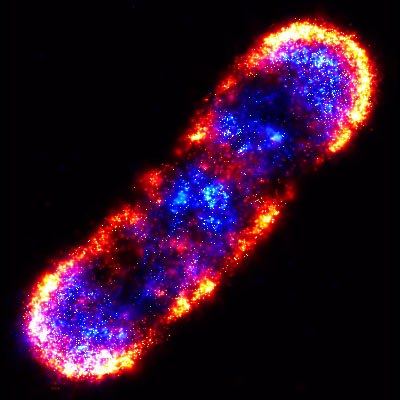
E.Coli Fireworks!


Description via the American Society for Microbiology:

“Each bright dot marks a surface protein that tells the bacteria to move toward or away from nearby food and toxins. Using a new imaging technique, researchers can map the proteins one at a time and combine them into a single image. This lets them study patterns within and among protein clusters in bacterial cells, which don’t have nuclei or organelles like plant and animal cells. Seeing how the proteins arrange themselves should help researchers better understand how cell signaling works.”

Credit Line
Derek Greenfield and Ann McEvoy, University of California, Berkeley”