Pandora Report 8.23.15

We’re starting this update with some big blog news, are you sitting down? This will actually be the last weekend update…at least for a while. We’re in discussion with how to proceed with the blog and social media for GMU Biodefense. Please check back at pandorareport.org and on twitter @PandoraReport for updates as they happen.

Looking back, there have been times since I’ve started as managing editor that the news has been sad, or, frankly, downright depressing. So, for this edition, lets focus on some of the good in the world. The first story comes from (probably the nicest human on the face of the Earth) Jimmy Carter. We’ve also got good news about Polio. Then, of course, we’ve got stories you may have missed.

Thank you for reading… and don’t forget to wash your hands!

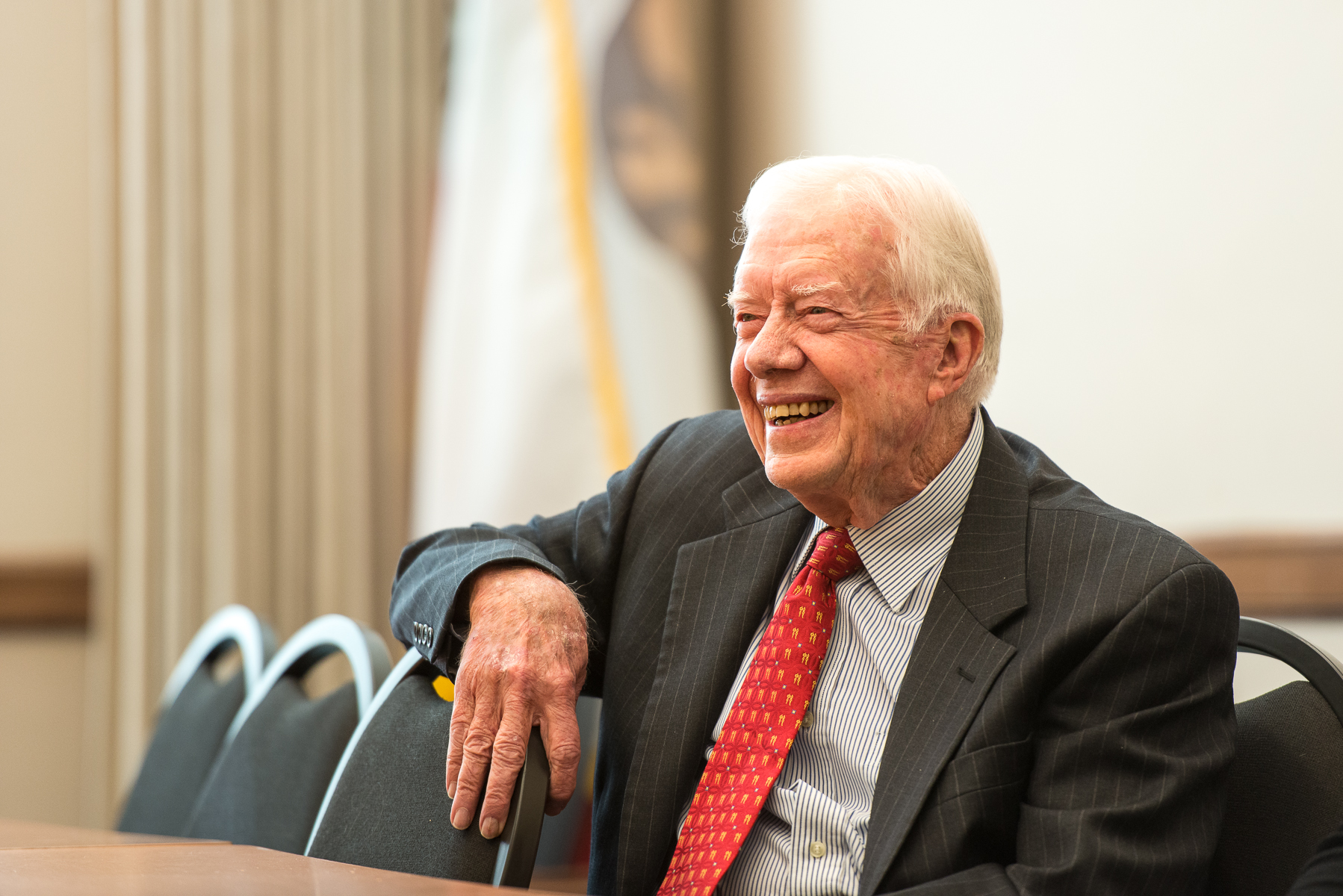
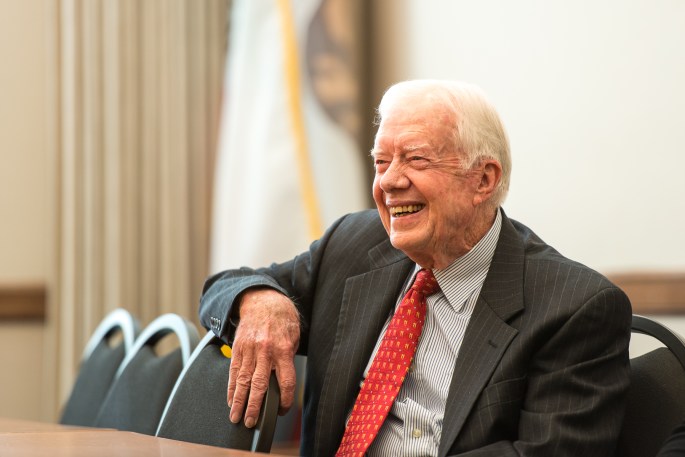
Jimmy Carter Wants to See the Last Guinea Worm Die Before He Does

This week, former President Jimmy Carter announced that his cancer had spread to his brain. Though many members of his immediate family died from cancer, Carter said “I’m perfectly at ease with whatever comes.” Rather than fear or sadness over his diagnosis, Carter instead focused on meeting one of the long-term goals of his nonprofit organization—the Carter Center—the eradication of Guinea worm. In 1986 when the Carter Center began its work there were 3.5 million cases of across 21 countries. In 2014 there were 126 cases; today, there are 11.

The Huffington Post—“When Guinea worm has been eradicated, it will be only the second time in human history that a disease has been totally wiped out. The first, smallpox, was eradicated in 1977, according to the World Health Organization. Experts from the Centers for Disease Control and Prevention estimate that Guinea worm will meet the same fate — a final piece in Carter’s legacy.”

WHO Declares Africa Free of ‘Wild’ Cases of Polio

According to the World Health Organization, Africa has been free of wild cases of Polio since July. This doesn’t mean that there are no cases on the continent; there is still ongoing work in Somalia, Kenya, and Ethiopia, but transmission of the illness has been interrupted. The director of the Polio Global Eradication Initiative has said that even though Africa is now free of wild cases, there are still challenges when it comes to eradication, for example, surveillance of the disease.

io9—“The goal of the Initiative has been to interrupt the natural transmission (wild cases) of the virus, which seems to be the case so far. The next step, according to WHO, will be to continue to monitor the region for additional cases. If none appear in the next two years, the continent will be certified Polio-Free.”

Stories You May Have Missed


Image Credit: Commonwealth Club

New from the Biodefense Faculty

On this #FacultyFriday, we’ve got a recent publication from Dr. Trevor Thrall and Pandora Report staff writer Erik Goepner on the fall of Ramadi. They say,

Though a city of moderate strategic value considering its proximity to Fallujah and Baghdad, Ramadi does not spell victory for ISIS anymore than Iraq’s retaking of Tikrit from the insurgents spelled defeat for ISIS (despite suggestions to the contrary from the Obama administration). The battle for Iraq will depend on the ability of the Iraqi government to mobilize enough effective fighting power to stop the ISIS expansion. Unfortunately for Iraq, despite over a decade of U.S. investment in training and equipment, Iraq’s military appears incapable of mustering consistent fighting effectiveness to deal a decisive blow to ISIS on the battlefield.

Their entire piece is available on The National Review, here.

LAST DAY: SUMMER COURSE EARLY REGISTRATION

The early registration discount for the professional education summer course Pandemics, Bioterrorism, and International Security (July 22-24 in Arlington, VA) expires today, May 15, 2015. 


This three-day, non-credit course introduces participants to the challenges facing the world at the intersection of public health, the life sciences, and national security. The course is designed for professionals and academics in public health, life sciences, industry, international affairs, emergency management, law enforcement, and national security who have responsibilities for preventing, preparing for, or responding to pandemics or bioterrorism. The course faculty are internationally recognized experts who have been extensively involved with research and policymaking on public health, biodefense and national security issues.

Sign up by May 15 for a discounted registration rate. Discounts are also available for GMU alum and groups of three or more from the same organization. For more information and to register, visit ocpe.gmu.edu/PBIS.htm

New From The Biodefense Faculty

On this #FacultyFriday, we’ve got recent publications from two George Mason Biodefense faculty members.


Dr. Gregory Koblentz looks at America’s next big nuclear challenge from Iran.

The April 2 framework agreement between the P5+1 and Iran fails to address an important risk posed by Iran’s nuclear program. Through a combination of restrictions on Iran’s nuclear activities and facilities and more intrusive verification mechanisms, the framework adequately addresses two major risks posed by Iran’s nuclear program—breakout and sneakout. The framework, however, completely ignores the risk of leakout: the proliferation of nuclear technology and expertise from Iran to other countries. Iran, once the recipient of foreign nuclear assistance, is now poised to provide that assistance, either deliberately or through unauthorized acts by scientists or companies, to other countries.

His entire piece in The National Interest can be found here.


Dr. Trevor Thrall (and Pandora Report staff writer Erik Goepner) make the case against ground engagement with the Islamic State.

The most common argument made by hawks for U.S. engagement is to prevent future Islamic State-sponsored terrorism against the U.S. homeland. Our track record on homeland security since 9/11, however, reveals that a ground war is unnecessary. In the 13 years before 9/11, Islamist-inspired groups launched five attacks on U.S. soil. In the same period since 9/11, just four attacks have been carried out in the U.S. despite the rapid rise in Islamist mobilization and growth in global terrorism. From 2000 to 2013, the number of Islamic-inspired terrorist groups on the State Department’s list of Foreign Terrorist Organizations spiked 185 percent, while the estimated number of Islamist fighters rose 243 percent. Clearly, the United States’ success at limiting attacks on its homeland has come not from destroying terrorist groups abroad, but through improved intelligence and other homeland security-focused efforts.

Their piece in The Detroit News can be found here.

New from the Biodefense Faculty

On this #FacultyFriday, we’ve got recent publications and appearances from two George Mason Biodefense faculty members.


Dr. Gregory Koblentz appeared on CBC Radio’s The Current to disucuss the recent Canada-India uranium deal. Listen to the whole segment here.


Charles Blair reflects on the Oklahoma City bombing as the 20th anniversary of the event nears.

Often erroneously explained away as psychopathic, Timothy McVeigh actually comported with psychologist and terrorism expert Clark R. McCauley’s finding that, “the best documented generalization is negative; terrorists do not show any striking psychopathology.” Though abhorrent, McVeigh’s actions are certainly intelligible. Examined extensively by psychiatrist John Smith in the months after the attack, McVeigh was judged as sane—“not delusional.” When asked why McVeigh “would commit such a terrible crime,” Smith concluded that “it was a conscious choice on his part, not because he was deranged … or misinterpreting reality … but because he was serious.”

His entire piece in the Bulletin of Atomic Scientists can be found here.

New from the Biodefense Faculty

Bulletin of the Atomic Scientists, in their Agree to Disagree roundtable, is hosting a Winter-Safe Deterrence Debate. The premise of the debate follows:

In a recent opinion column for the Bulletin, “Deterrence, without nuclear winter,” Seth Baum argued that the biggest danger posed by world nuclear arsenals is a nuclear winter that could be sparked by even a limited exchange of nuclear weapons. Baum’s piece went on to suggest that “the world’s biggest nuclear powers [might] meet their deterrence needs without keeping the large nuclear arsenals they maintain today. They could practice a winter-safe deterrence, which would rely on weapons that pose no significant risk of nuclear winter.”

Baum’s column and the study from which it draws, “Winter-safe Deterrence: The Risk of Nuclear Winter and Its Challenge to Deterrence,” published in the journal Contemporary Security Policy, have been vigorously disputed in social media. In this roundtable, security experts Gregory Koblentz, Martin Furmanski, Brett Edwards, Gigi Kwik Gronvall, and Sonia Ben Ouagrham-Gormley and Baum debate his column and winter-safe deterrence ideas in more depth.

GMU Biodefense Faculty members Gregory Koblentz and Sonia Ben Ouagrham-Gormley have each offered two replies in the debate which are available here and here for Koblentz and here and here for Ouagrham-Gormley.

All replies in the debate are available here.

GMU Biodefense Published

Dr. Sonia Ben Ouagrham-Gormley, Associate Professor in the George Mason Graduate Program in Biodefense, has published a new book, Barriers to Bioweapons: The Challenges of Expertise and Organization for Weapons Development.

The New Scientist has reviewed it, and this is just one of the wonderful things they had to say:

Her fascinating book, Barriers to Bioweapons, also shows that anyone wanting to develop biological weapons faces a raft of other difficulties. Of the five main bioweapons programmes to date, their key feature has been their failures, not their successes. In a forensic and compelling analysis, she describes how the Soviet Union, the US, South Africa and the Japanese terrorist group Aum Shinrikyo, all fell well short, despite spending billions of dollars over decades

Click here to read the whole review or click here to purchase the book online.

Biodefense Graduates: Brian Mazanec

GMU Biodefense Graduate Brian Mazanec’s Deterring Cyber Warfare: Bolstering Strategic Stability in Cyberspace (written with Bradley Thayer) was released on December 5. The book looks at cyber warfare, which is especially relevant after the latest North Korean cyber attack on Sony. The description of the book follows:

Deterrence theory was well developed during the Cold War for the deterrence of kinetic attacks. While the deterrence of cyber attacks is one of the most important issues facing the United States and other nations, the application of deterrence theory to the cyber realm is problematic.
This study offers an introduction to cyber warfare and a review of the challenges associated with deterring cyber attacks. Mazanec and Thayer recommend efforts in three specific areas to aid the deterrence of major cyber attacks: by cultivating beneficial norms for strategic stability; by continuing efforts in the area of improving cyber forensics and defences; and, finally, by developing and communicating a clear declaratory policy and credible options for deterrence-in-kind so as to make escalation unavoidable and costly. This timely study reflects increased international interest in cyber warfare, and is based on the recognition that information networks in cyberspace are becoming operational centres of gravity in armed conflict.
Deterring Cyber Warfare is Prime eligible which means, if you’re a member, you can get it just in time for Christmas! You can order online here.

New from the Biodefense Faculty

While the GMU Biodefense students have been finishing their semester work, the GMU Biodefense faculty have been busy too! Below is an update of the latest published work from members of the faculty.


Dr. Trevor Thrall, Director of the Graduate Program in Biodefense, wrote a piece on ISIS’ strategies for U.S. News and World Report.

President Barack Obama declared the latest beheading by the Islamic State group – this one of American aid worker and former Army Ranger Peter Kassig – an act of “pure evil.” But as ugly as the act was, it was also an action taken with a strategic end in mind. The question we should be asking is: To what end? Why has the Islamic State group pursued a strategy of beheading Westerners, and specifically Americans?

The entire article is available here.


Dr. Gregory Koblentz, Deputy Director of the Biodefense Graduate Program, has been writing on nuclear issues including Op-Eds for the LA Times–“How to Keep Future Cold Wars Cold: Mind the Missiles“–and The National Interest–“The Silver Lining of an Extension of the P5+1 Nuclear Talks with Iran

Since the end of the Cold War, three challenges to strategic stability have emerged. The first is the increasing complexity of deterrence relations among the nuclear weapon states. Whereas the first nuclear age was shaped by the bipolar global ideological and military competition between the United States and Soviet Union, the second nuclear age has been marked by the emergence of a multipolar nuclear order composed of states linked by varying levels of cooperation and conflict. Rising nuclear powers such as China, India and Pakistan are not party to the web of treaties, regimes and relationships that girded strategic stability between the United States and Soviet Union (and now Russia).

Dr. Koblent’z full articles are linked above.

GMU Biodefense Faculty at the CFR

Since the end of the Cold War, a new nuclear order has emerged, shaped by rising nuclear states and military technologies that threaten stability, writes George Mason University’s Gregory Koblentz in a new Council on Foreign Relations report: Strategic Stability in the Second Nuclear Age.


During the Cold War, the potential for nuclear weapons to be used was determined largely by the United States and the Soviet Union. Now, with 16,300 weapons possessed by the seven established nuclear-armed states—China, France, India, Pakistan, Russia, the United Kingdom, and the United States—deterrence is increasingly complex. Since most of these countries face threats from a number of potential adversaries, “changes in one state’s nuclear policy can have a cascading effect on the other states.”


Though many states are downsizing their stockpiles, Asia is witnessing a buildup; Pakistan has the fastest-growing nuclear program in the world. By 2020, Pakistan could have a stockpile of fissile material that, if weaponized, could produce as many as two hundred nuclear devices. The author identifies South Asia as the region “most at risk of a breakdown in strategic stability due to an explosive mixture of unresolved territorial disputes, cross-border terrorism, and growing nuclear arsenals.”


Emerging technologies such as missile defenses, cyber and anti-satellite weapons, and conventional-precision strike weapons pose additional risks, Koblentz warns, and could potentially spur arms races and trigger crises.


“The United States has more to lose from a breakdown in strategic stability than any other country due to its position as a global leader, the interdependence of its economy, and the network of security commitments it has around the world,” he asserts. The United States and Russia still possess more than 90 percent of the world’s nuclear weapons. Despite the increasing chill in U.S.-Russia relations, Washington’s highest priority should be to maintain strategic efforts with Russia and China, the two states with the capability and potential intent to launch a nuclear attack on the American homeland.


The United States should work with other nuclear states to address sources of instability in the near term and establish processes for multilateral arms control efforts over the longer term, writes Koblentz. He urges the Obama administration to:
  • enhance initiatives that foster transparency, confidence-building, and restraint to mitigate the risk that emerging technologies will trigger arms races, threaten the survivability of nuclear forces, or undermine early warning and nuclear command and control systems;
  • deepen bilateral and multilateral dialogues with the other nuclear-armed states; and
  • create a forum for the seven established nuclear-armed states to discuss further steps to reduce the risk of deliberate, accidental, or unauthorized use of nuclear weapons.