
This week’s Pandora Report covers newly introduced legislation that could ban foreign biotech companies like BGI Group from doing business in the US, OpenAI’s evaluation of large language model-aided biological risks, interesting new publications, upcoming events, and multiple announcements.
BGI Group, Other Foreign Biotech Companies Targeted by New US Bills
Recently, members of the House Select Committee on the CCP and the Senate Homeland Security and Governmental Affairs Committee introduced legislation that would ban foreign adversary bioetchnology companies from doing business in the United States, including BGI Group. This follows years of warnings from the Intelligence Community that Chinese companies are amassing American genetic information, threatening national security. As we discussed in 2022, “Early in the pandemic, as the US struggled to build testing capacity and states could not run their own tests in their state labs, BGI Group (formerly known as Beijing Genomics Institute) targeted US state governments with cheap tests that promised to rapidly increase their capacity. The problem, however, was that BGI is known to have used its NIFTY test, a prenatal test used by pregnant people globally, to collect data in collaboration with the People’s Liberation Army, the military wing of the CCP.”
The Pentagon explicitly acknowledged BGI Group’s collaboration with the PLA in 2021, and five subsidiaries and affiliates of the company have since been sanctioned by the US Department of Commerce. However, according to NBC News, “The U.S. National Counterintelligence and Security Center reacted to the Reuters report by warning that “non-invasive prenatal testing kits marketed by Chinese biotech firms serve an important medical function, but they can also provide another mechanism for the People’s Republic of China and Chinese biotech companies to collect genetic and genomic data from around the globe,” the center said.”
BGI Group responded, stating in part “BGI fully embraces the bill’s premise of protecting Americans’ personal data. Unfortunately, this legislation will succeed only in driving BGI out of the US and will not accomplish its stated goal. Rather, the bill will further strengthen the effective market monopoly held by one company that controls more than 90 percent of the market, resulting in increased healthcare costs and limited access to technologies and services.”
The company further denied that it is controlled by the PRC government, CCP, or PLA, emphasizing that it is a privately owned company. However, PRC data security laws implemented in recent years ensure the government is able to access data collected by private Chinese companies and those doing business with Chinese citizens.
Check out our March 2023 reporting on the US Department of Commerce’s addition of three BGI Group subsidiaries to the Entity List.
Open AI Announces Blueprint for LLM-Aided Biological Threat Creation
OpenAI, the organization responsible for ChatGPT, announced this week that it is developing a blueprint for “evaluating the risk that a large language model (LLM) could aid someone in creating a biological threat,” following recent concerns that the platform and others like it could aid potential bioterrorists.
The company explained in a statement that “In an evaluation involving both biology experts and students, we found that GPT-4 provides at most a mild uplift in biological threat creation accuracy. While this uplift is not large enough to be conclusive, our finding is a starting point for continued research and community deliberation.”
Read more about OpenAI’s evaluation and blueprint here.

“Who Are Iran-Backed Militia Groups Targeting U.S. Bases in the Middle East?”
Schar School faculty member Mahmut Cengiz for Homeland Security Today: “Iran-backed militia groups have increasingly targeted the United States (U.S.) military bases and facilities in the Middle East after Hamas’s October 7th terrorist attacks. The U.S. airstrikes continuously retaliate from these groups and target their facilities. The most recent one took place on January 24th and targeted the facilities of Kataib-s Hezbollah in Iraq. However, these militia groups used an uncrewed aerial system and attacked the Tower 22 U.S. military outpost in Jordan on January 27, 2023, killing three U.S. service members and wounding 40 others. The Islamic Resistance in Iraq (IRI) claimed responsibility for this attack.”
“The operational capacity of Iran-backed militia groups has threatened U.S. interests in the region, given the fact that these groups recently seem to be more capable and organized than even jihadist terrorist groups in Iraq, Yemen, and Syria. This article uses the Global Terrorism Trends and Analysis Center (GTTAC) Records of Incidents Database (GRID) and examines active terror groups backed by Iran in the Middle East.”
Read more here.
“NTI Begins Scoping New International AI-Bio Forum”
From NTI: “Significant advances in artificial intelligence (AI) in recent years offer tremendous potential benefits for modern bioscience and bioengineering by supporting the rapid development of vaccines and therapeutics, enabling the development of new materials, fostering economic development, and helping fight climate change. However, AI-bio capabilities—AI tools and technologies that enable the engineering of living systems—also could be accidentally or deliberately misused to cause significant harm, with the potential to cause a global biological catastrophe.”
“To reduce biosecurity risks that arise at the intersection of AI and the life sciences, NTI | bio convened experts in the fields of synthetic biology, machine learning, bioinformatics, and international security policy on January 11, 2024 to outline steps toward establishing an international AI-Bio Forum.”
Read more here.
“Towards Risk Analysis of the Impact of AI on the Deliberate Biological Threat Landscape”
Matthew E. Walsh recently authored this article: “The perception that the convergence of biological engineering and artificial intelligence (AI) could enable increased biorisk has recently drawn attention to the governance of biotechnology and artificial intelligence. The 2023 Executive Order, Executive Order on the Safe, Secure, and Trustworthy Development and Use of Artificial Intelligence, requires an assessment of how artificial intelligence can increase biorisk. Within this perspective, we present a simplistic framework for evaluating biorisk and demonstrate how this framework falls short in achieving actionable outcomes for a biorisk manager. We then suggest a potential path forward that builds upon existing risk characterization work and justify why characterization efforts of AI-enabled tools for engineering biology is needed.”
“Lessons from Kazakhstan for 2024: On the Front Lines of Nuclear and Biological Risks”
From CSR: “The paper starts with a section on Kazakhstan’s past and current roles regarding nuclear risks, and continues with a section on its past and current roles regarding biological risks. Each section starts with a summary of the Soviet weapons of mass destruction legacy that Kazakhstan inherited upon independence. We then provide an overview of Kazakhstan’s decision to relinquish and eliminate these legacies, followed by a discussion of the nation’s unique current roles regarding the NPT and IABS. In each of these sections, we include pertinent background to show why progress in 2024 is central to the international community, remaining confident that existing norms and agreements will persist and be implemented as intended.”
“We then conclude the paper with brief recommendations on how Kazakhstan can leverage its past decisions and current leadership roles to drive such progress, summarized here. First, Kazakhstan and other nations playing key roles in the NPT process should elevate the urgency of reducing the role of nuclear weapons. There is also an opportunity to parse how this might be pursued, in particular in calling for an end to tactical nuclear weapons as one concrete step. Second, Kazakhstan should continue the push within the NPT forum for a nuclear weapons database and universal reporting template to encourage trust and mitigate miscalculation risks. Third, Kazakhstan should continue to pursue the IABS in the manner it has over the past year: driving dialogue on the most important ways such an entity could augment the existing international system and begin filling some of its gaps, and scoping what an achievable launch of the IABS would look like. Finally, while Kazakhstan is presently playing unique leadership roles, no single nation can make progress alone. We hope that all nations will cooperate in advancing concrete steps for the 2026 NPT Review Conference and help perpetuate positive discourse regarding a future IABS.”
“Addressing Misconceptions About Biological and Chemical Weapons and Related Legal Frameworks”
From VERTIC: “This webpage and the related report form the primary outputs of a project undertaken by VERTIC in 2022 and 2023, funded by the UK Chemical and Biological Weapons, Counter Proliferation and Arms Control Centre of the Foreign, Commonwealth and Development Office. The main purpose of this resource is to disprove misconceptions about chemical and biological weapons and related international instruments. It addresses misconceptions about biological and chemical weapons and related legal frameworks that VERTIC staff have identified through interactions with states over 20 years’ work on these treaties, and from other sources such as the media. Each misconception is broken down into an explanation of the misconception and its implications, and how to address it. The misconceptions are then disproved through factual and legal discussions, supported by expert commentary.”
Countering WMD Journal
From USANCA: “Published semi-annually, this edition of the Countering WMD Journal includes articles from authors across the CWMD community on a range of topics relevant to professionals in this field. We would like to publicly acknowledge all the effort put forth by the contributors to the 27th Edition.”
“Among the articles published in the 27th Edition are “The CWMD ‘Operational Void” by Mr. Paul Sigler and Maj. James Bowen, “Avoiding Strategic Miscalculation” by Maj. Kirk Shoemaker, and “A Unique Solution to Nuclear Reactor Parameter Centralization: Streamlining the Search and Analysis of WMD Reactors of Concern” by Cadet Aaron Calhoun and Cadet Matthew Eckert. New sections in this edition of the journal include book reviews and “Journal Article Watch” by Dr. Jeffrey Rolfes, which spotlights policy and scientific research of interest to the CWMD community.”
“Protein Design Meets Biosecurity”
From Science: “The power and accuracy of computational protein design have been increasing rapidly with the incorporation of artificial intelligence (AI) approaches. This promises to transform biotechnology, enabling advances across sustainability and medicine. DNA synthesis plays a critical role in materializing designed proteins. However, as with all major revolutionary changes, this technology is vulnerable to misuse and the production of dangerous biological agents. To enable the full benefits of this revolution while mitigating risks that may emerge, all synthetic gene sequence and synthesis data should be collected and stored in repositories that are only queried in emergencies to ensure that protein design proceeds in a safe, secure, and trustworthy manner.”
Read this editorial here.
WHO Releases Draft Decision on Strengthening Laboratory Biological Risk Management
The WHO recently uploaded this draft decision proposed by the EU and the US.
“Integrating Veterinary Diagnostic Laboratories for Emergency Use Testing during Pandemics”
Hodges et al. recently published this article in Emerging Infectious Diseases: “The SARS-CoV-2 pandemic showed limitations in human outbreak testing. Veterinary diagnostic laboratories (VDLs) possess capabilities to bolster emergency test capacity. Surveys from 26 participating VDLs found human SARS-CoV-2 testing was mutually beneficial, including One Health benefits. VDLs indicated testing >3.8 million human samples during the pandemic, which included some challenges.”
“ASPR TRACIE 2023 Year in Review”
From ASPR TRACIE: “In September 2023, ASPR TRACIE celebrated our eighth anniversary; by the end of 2023, we cumulatively tallied nearly 2 million visits to our website and responded to close to 12,000 TA requests (while maintaining a 99% user satisfaction rating). For close to four years, we have addressed a surge of COVID-19- specific TA requests (over 3,000 TA were related to COVID-19), maintained 20 COVID-19-specific resource collections, and created/refreshed nearly 100 resources to help our stakeholders make their way through this unprecedented challenge. As communities grappled with concurrent disasters and mass casualty incidents, our team worked hard to ensure our website remained available 24/7 and our materials were supportive and timely.”
Read more here.
“An Open Letter to World Leaders: Now Is the Time to Lead and Achieve an Ambitious, Legally-Binding Pandemic Accord”
A recently signed letter from “more than 40 senior representatives from The Elders, The Global Preparedness Monitoring Board, The Independent Panel, Pandemic Action Network, The Panel for a Global Public Health Convention and Spark Street Advisors”: “Therefore, our Chairs, leaders, and members of the Secretariat have come together for the first time to sign this open letter to world leaders.“
“They outline the need for leadership, urgency and commitment to conclude a pandemic accord that goes well beyond business as usual, and guarantees the equitable access, finance and accountability needed to make COVID-19 the last pandemic of such devastation.”
“Their call represents their ongoing commitment to continue to advocate for a world protected from pandemics, and their knowledge that business as usual will absolutely not do.”
Read more here.
“The Pipeline for Pandemic Products is Bare. Here’s Why It Matters”
Jenny Lei Ravelo recently published this article in Devex: “One of the key concepts born out of the COVID-19 pandemic is the 100 Days Mission, an initiative endorsed by the Group of Seven major economies and the Group of 20 industrialized and emerging-market nations whose goal is to have effective diagnostics, treatments, and vaccines within 100 days of a public health emergency declaration.”
“But a new report reveals serious gaps in the clinical pipeline for diseases with pandemic potential, and limited investments in their research and development over the years.”
“There are no approved treatments and very few in clinical trials for diseases with high fatality rates, such as Marburg and Nipah. There are also no diagnostics in late-stage clinical development for Zika and SARS.”
Read more here.
“Why Drug Resistance is Becoming One of Our Biggest Global Health Security Blind-Spots”
Manica Balasegaram recently authored this piece for the World Economic Forum, writing in part “Antimicrobial resistance (AMR) is already one of the biggest global killers, with nearly 5 million deaths a year. Yet, few people know what it is, let alone the threat it poses to them. One reason for this is its insidious nature. AMR likely won’t hit us hard and fast like a pandemic; instead we’ll see a steady rise in cases of treatable infections becoming once again untreatable, with even minor infections or medical procedures becoming life-threatening.”
“In time, the 23-year global increase in life expectancy we have experienced thanks to antibiotics could be steadily reversed. Given that all this could be prevented, perhaps one of the things that makes drug resistance now one of our greatest global health security threats is the very fact that too few people view it as one.”
“Knowledge Is Power in the Fight Against Synthetic Opioids”
From DHS S&T: “The Department of Homeland Security’s (DHS) Homeland Security Investigations recently announced in its Strategy for Combating Illicit Opioids that the agency has seized more than 54,000 pounds of fentanyl and interdicted over 2.2 million pounds of synthetic drug precursor chemicals over the last five years. Still, overdose deaths continue to rise, and the ways opioids reach users constantly evolve.”
“The Science and Technology Directorate (S&T) is working with partners at every government level on opioid detection and is curtailing the illicit flow of fentanyl into the country, both cornerstones of the Biden Administration’s Unity Agenda Strategy for defeating the overdose epidemic. S&T’s Chemical Security Analysis Center (CSAC), the preeminent national laboratory dedicated to identifying and assessing chemical threats, has been researching opioids since its establishment in 2006 and currently has a number of efforts focusing on combating the threat that synthetic opioids pose.”
Read more here.
What We’re Listening To 🎧
Poisons and Pestilence Bonus Episode: The French Connection with Etienne Aucouturier
“In this episode, we examine the development of the French CBW programme post WW-2″.

NEW: Enhancing the Global Food System’s Resilience to Biological Threats
“This virtual event, hosted by the Scowcroft Institute of International Affairs at Texas A&M, will take place on February 20, 1:00-2:30 PM [CST].”
“A year after the Biden Administration’s National Security Memorandum on Strengthening the Security and Resilience of United States Food and Agriculture (NSM-16), Scowcroft is convening stakeholders from across industry, academia, and government to identify the policies and technologies needed to safeguard the world’s food system against biological threats. Planned topics include microbial food production, AI-enabled crop disease surveillance, and genomic engineering to improve plant disease resistance, among others.”
“For more details, find a draft agenda here.
Speakers include:
- David Stiefel, National Security Policy Analyst, National Security Division, USDA and former Director for Biodefense on the National Security Council
- Nils Justen, Policy Analyst, National Security Commission on Emerging Biotechnology (NSCEB)
- Shannon Nangle, CEO and Co-Founder, Circe Biosciences
- Seth Murray, Professor Butler Chair, Soil and Crop Sciences, Texas A&M University
- Yiping Qi, Professor, Plant Sciences and Landscaping, University of Maryland”
Register here.
NEW: The Advancing Threat Agnostic Biodefense Webinar Series
From PNNL: “Join us as we welcome Dr. Tony Goldberg, professor in the School of Veterinary Medicine at the University of Wisconsin-Madison. His talk, titled “Assessing the Zoonotic Risk of Pre-emergent Viruses” will be Tuesday, February 20, at noon PT.“
“Exploration of the “virosphere” is in its golden age. The sheer number of new viruses discovered daily, and the fact that most cannot be cultured, creates enormous uncertainty about where to allocate attention and resources. It is not an intractable problem, however, to distinguish those few viruses that are likely to emerge as zoonoses from the many others that are not. This talk describes two diametric approaches to addressing this problem.”
Learn more and register here.
NEW: Introducing IBBIS: Safeguarding Bioscience and Biotechnology for a Safer Future
“The Nuclear Threat Initiative (NTI) is launching the International Biosecurity and Biosafety Initiative for Science (IBBIS) during an official side event at the 2024 Munich Security Conference. IBBIS is a new, independent organization based in Geneva that will work with global partners to strengthen biosecurity norms and develop innovative tools to uphold them. IBBIS will help reduce the risk of catastrophic events that could result from deliberate abuse or accidental misuse of bioscience and biotechnology so they can flourish, safely and responsibly.”
“NTI Co-Chair and CEO Ernest J. Moniz will moderate a senior-level panel discussion featuring: Weiwen Zhang, director, Center for Biosafety Research and Strategy, Tianjin University; James Diggans, head of biosecurity, Twist Bioscience; Luciana Borio, venture partner, ARCH Venture Partners and senior fellow for global health, Council on Foreign Relations; and Piers Millett, executive director, IBBIS. Amandeep Gill, UN Secretary General’s Envoy on Technology, will provide recorded remarks.”
This in-person event will take place at Literaturhaus München on Thursday, February 15. Learn more and RSVP here.
NEW: Presidential Advisory Council on Combating Antibiotic-Resistant Bacteria Public Meeting
“The 24th PACCARB public meeting will be held virtually on February 22, 2024. This will be the second of two meetings to address the task provided to the PACCARB by the Secretary of HHS to address antimicrobial resistance globally. The focus of the meeting will be on international implementers and the gaps, challenges, and opportunities they see to combat AMR globally – specifically focusing on low- and middle-income countries. Current times are tentative and subject to change.”
This event will take place on February 22, at 9 am. Submit public comments and register to attend here.
NEW: SBA.3 International Synthetic Biology, and Biosecurity Conference in Africa
“Join us for the SBA.3 International Synthetic Biology and Biosecurity Conference in Africa, a groundbreaking event that brings together experts, researchers, and enthusiasts in the field of synthetic biology. This in-person conference will take place at the Laico Regency Hotel from Wed, Jul 17, 2024 to Friday, Jul 19, 2024.”
“Get ready to dive into the exciting world of synthetic biology and explore its potential applications in Africa. From cutting-edge research to innovative solutions, this conference offers a unique opportunity to learn, network, and collaborate with like-minded individuals.”
“Discover the latest advancements, trends, and challenges in synthetic biology through engaging keynote speeches, interactive workshops, and thought-provoking panel discussions. Immerse yourself in a vibrant atmosphere where ideas flow freely and new connections are made.”
“Whether you’re a seasoned professional or just starting your journey in synthetic biology, this conference provides a platform to expand your knowledge, exchange ideas, and contribute to the growth of the field in Africa.”
“Don’t miss out on this extraordinary event that promises to shape the future of synthetic biology and biosecurity in Africa. Mark your calendars and join us at the SBA.3 International Synthetic Biology and Biosecurity Conference in Africa!”
Learn more and register here.
Policy Frontiers: Realizing the Benefits, Managing the Risks of Artificial Intelligence-Driven Biotechnology
From the Center for Health Security: “The conversation will delve into the impact and implementation of the President’s AI Executive Order related to the convergence of AI and biotechnology, challenges and opportunities that still need to be addressed, and Congress’ role in governance of these rapidly evolving technologies.”
“The panel, moderated by Dr. Inglesby, will examine AI in the life sciences and health security, both the potential for advances in pandemic preparedness as well as what needs to be done now to guard against potentially consequential risks of accidents or misuse.”
“A reception including hors d’oeuvres and beverages will follow the program. This is a great opportunity for you to network and engage in meaningful conversations on this timely topic.”
This event will take place on February 8 at 5 pm EST. RSVP here.
ICYMI: CNS Seminar on the Intersection of Artificial Intelligence and WMD Nonproliferation
From CNS: “On January 24, 2024, the James Martin Center for Nonproliferation Studies (CNS) convened a timely seminar to address the intersection of artificial intelligence (AI) and weapons of mass destruction (WMD) nonproliferation.”
“The seminar showcased the wide range of CNS expertise and its collaborative relationships with industry. Dr. Sarah Shoker from Open AI spoke about ongoing efforts to evaluate the potential exploitation of frontier models by nefarious actors seeking WMD capabilities. Dr. Ian Stewart, Head of the CNS DC office, demonstrated how one can leverage cutting-edge AI tools to streamline nonproliferation workflows while Steven de la Fuente discussed how AI approaches can enhance and expedite open-source data collection and imagery analysis. Pivoting to risks, Dr. Allison Berke, Director of the Chemical and Biological Weapons Nonproliferation Program, presented her research assessing the potential dangers of AI-enabled bio-design technologies, which could allow nefarious actors to engineer novel toxins. CNS Scientist-in-Residence Dr. Ferenc Dalnoki-Veress explored classroom applications of AI tools to enhance arms control pedagogy and research through AI agent-based simulations. Dr. Ian Stewart closed out the speaker session by examining emerging policy and governance challenges.”
Read more here.
WEBINAR: State Department 2023 Global Terrorism Data: Trends & Warnings
From Homeland Security Today: “Join HSToday for a Law Enforcement-only analysis of global terrorism trends from 2023 and threat forecasts for 2024. The Department of State’s yearly Annex of Statistical Information Reports uses The Global Terrorism Trends and Analysis Center (GTTAC) database.”
“Dr. Mahmut Cengiz, a senior data analyst at GTTAC since 2018, will discuss terrorism trends from 2023 and areas of concern for law enforcement in the United States (US). More specifically, his analyses will focus on HAMAS and Iran-backed terror groups targeting American facilities in the Middle East, Al Qaeda- and ISIS-affiliated organizations actively involved in terrorist attacks worldwide, increasing far-right terrorism and emerging lone actor threats in the US and Europe. The Terrorism, Transnational Crime and Corruption Center (TraCCC) is the first center in the United States devoted to understanding the links among terrorism, transnational crime and corruption, and to teach, research, train and help formulate policy on these critical issues. TraCCC is a research center within the Schar School of Policy and Government at George Mason University. TraCCC also houses the innovative and highly-respected Anti-Illicit Trade Institute (AITI).”
This event will take place on February 8 at 2 pm EST. Learn more and register here.
GP Nonproliferation and Strategic Trade Hub Virtual Launch & Demo
“The Strategic Trade Research Institute (STRI) invites you to participate in the Global Partnership Nonproliferation and Strategic Trade Hub Virtual Launch and Demo event taking place on February 27, 2024, from 9:00-10:00 am EST.”
“Please join us to learn about the main features of the Hub, how to use it, and how it can be useful and impactful for nonproliferation and export control professionals. The event will feature Andrea Viski, Director of STRI, as well as introductory remarks from the Hub’s sponsor, the United Kingdom’s Counter-proliferation and Arms Control Center (CPACC).”
Learn more and register here.
International Conference, CBRNE Research & Innovation
“The last 40 years have demonstrated that both military and civilian populations could be exposed to highly hazardous CBRNE agents following conflicts, natural outbreaks and disasters, industrial incidents or terrorist attacks.”
“Worldwide, researchers, responders and industrial capacities have been commited to provide adapted response to these challenges.”
“Building on the success of the first 5 International Conferences « CBRNE Research and Innovation » which took place in Antibes (2015), Lyon (2017), Nantes (2019), on line (2021) and Lille (2022), we want to give you a new opportunity to build up or strengthen collaborative networks in Strabourg (March 19th – 21rst 2024).”
“The CBRNE R&I Conference is specifically devoted to scientific updates, responders’ feedbacks and expression of needs. It also includes workshops and demonstrations of innovative materials, technologies and procedures, according to the following themes: DETECTION – IDENTIFICATION, PROTECTION – DECONTAMINATION, MEDICAL COUNTERMEASURES, RISKS & CRISIS MANAGEMENT.”
“Looking forward to your proposals for communication and to welcoming you at Strasbourg in March 2024!”
Learn more here.
Registration for GHS 2024 Now Open
Registration is now open for the Global Health Security 2024 conference in Sydney, Australia. This iteration will take place 18-21 June, 2024. The call for abstracts is also still open. “The mission of the Global Health Security conference is to provide a forum where leaders, researchers, policy-makers, and representatives from government, international organisations, civil society, and private industry from around the world can engage with each other, review the latest research and policy innovations, and agree solutions for making the world safer and healthier. To that end, our mission is to help foster a genuinely multidisciplinary community of practice that is committed to working collaboratively to enhance global health security and eliminate disease, irrespective of its origin or source.”

High School and College Student Internship: Data Analytics for Elite Young Scholars – Biology and Medical Science Experience
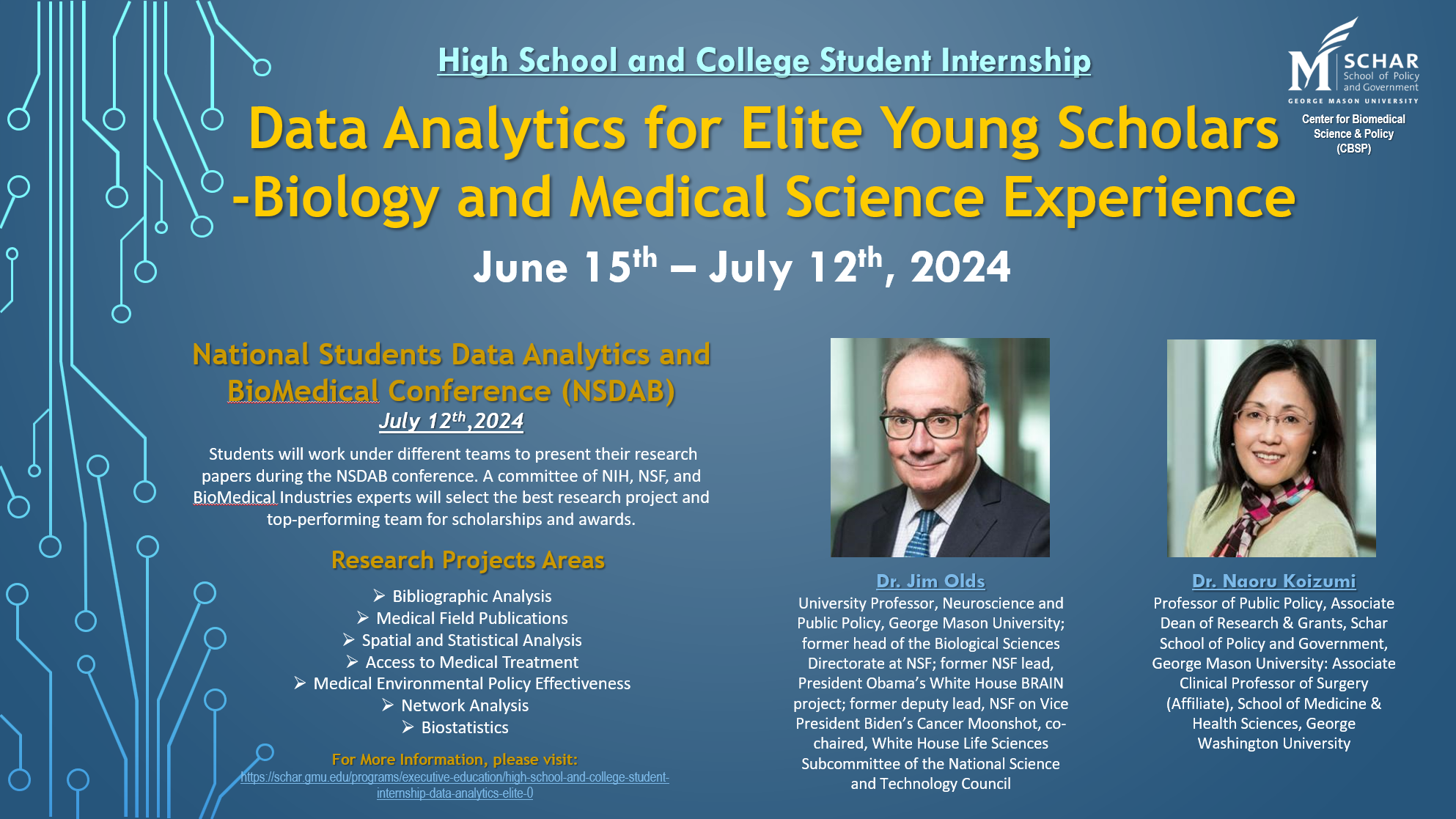
“The Young Scholars Research Program is tailored for high-achieving high school and undergraduate students aspiring to delve into the realms of biology or medical science, with a strong focus on advanced data analytics. Participants will have the unique opportunity to collaborate with esteemed faculty members from GMU, forming interdisciplinary teams comprising 3 to 4 individuals encompassing both high school and undergraduate students.”
“At the outset of the program, students will be assigned to specific team projects based on their indicated preferences. Each team is expected to produce two significant outputs by the program’s conclusion. Firstly, a final paper showcasing their research findings will be published on the Center for Biomedical Science & Policy (CBSP) website and the Schar School Young Scholars Journals Webpage. Secondly, teams will present their projects at a conference where students have the chance to compete for prizes.”
“Throughout the program, participants will engage in hands-on research projects employing a variety of methodologies. This may include but is not limited to, biostatistics utilizing R or Stata, data visualization employing QGIS or ArcGIS, and network visualization using tools like Gephi. The comprehensive nature of the program ensures a rich and immersive experience for students passionate about advancing their understanding and skills in the fields of biology and medical science.”
Learn more here.
Agricultural Bioterrorism Protection Act of 2002; Biennial Review and Republication of the Select Agent and Toxin List
“In accordance with the Agricultural Bioterrorism Protection Act of 2002, we are proposing to amend and republish the list of select agents and toxins that have the potential to pose a severe threat to animal or plant health, or to animal or plant products. This Act requires the biennial review and republication of the list of select agents and toxins and the revision of the list as necessary. This action would implement findings from the biennial review for the list. The biennial review was initiated within 2 years of the completion of the previous biennial review. In addition, we are proposing to add definitions for several terms; codify policies regarding the role of responsible officials and alternate responsible officials, conclusion of patient care, and annual internal inspections; and revise or clarify provisions related to validated inactivation procedures and viable select agent removal methods, recordkeeping, non-possession of select agents and toxins, electronic Federal Select Agent Programs, registration, Tier 1 enhancements, and exclusion of naturally infected animals. We are also proposing to add requirements for reporting discoveries of select agents and toxins, provisions regarding effluent decontamination system, biosafety provisions for facility verification requirements for registered biosafety level 3 and animal biosafety level 3 laboratories, a new requirement related to restricted experiments, and to correct editorial errors. These proposed changes would economically benefit producers, research and reference laboratories, and State and Federal oversight agencies, while also maintaining adequate program oversight of select agents and toxins.”
Read more and submit comments here.
 The Pandora Report