Biodefense in 2012: Year in Review

2012 has been an interesting year, and contrary to all apocalyptic predictions and Hollywood blockbusters, here we still stand. And look back.  Here, in no uncertain terms, is the best and worst of 2012 for the broad and beautiful field of biodefense (all further alliteration will be kept to a minimum). Check out the slideshow below for a quick view, with all of our carefully selected choices explained in detail below.

This slideshow requires JavaScript.

Biggest Controversy
While this technically started in December of last year, enough of the saga also known as “To Publish or Not to Publish” occurred this year that we don’t feel bad including it. The uproar surrounding the potential publication of two studies involving H5N1 and ferrets (“Airborne Transmission of Influenza A/H5N1 Virus Between Ferrets” and “Experimental adaptation of an influenza H5 HA confers respiratory droplet transmission to a reassortant H5 HA/H1N1 virus in ferrets “) was unprecedented. Setting aside for one moment the claims regarding exaggeration, the more controversial of the two studies sought to genetically engineer a strain of H5N1 to make it capable of aersolized transmission between humans (the virus as it occurs currently in nature isn’t effectively transmitted through aerosol). For the first time ever, the National Science Advisory Board for Biosecurity stepped in and asked the authors of both papers (one of which was based in the Netherlands) to hold publication while they reviewed them  for reasons of security.  Although both papers have subsequently been published, the controversy brought the issue of dual-use research into sharp detail.

2nd Biggest Controversy
#2 was a close enough runner-up to merit mention. The decision on the part of the Centers for Disease Control and Prevention (CDC) to include SARS on the select agent list, as well as the potential inclusion of H5N1, has created a good deal of contentious debate within the scientific community. Critics argue that the new regulations will significantly shrink the number of labs allowed to work with the pathogens, limiting both the reaction capacity in a pandemic and the general progression of knowledge. Proponents, however, argue that the more stringent regulations limit the likelihood of dangerous information on weaponizing the pathogens falling into the hands of terrorists. Will 2013 bring a resolution? We’ll see.

Most Exciting New Technology
While there were many honorable mentions (sensing the smallest virus particlesmRNA vaccines) the one which struck us most was Lawrence Livermore National Laboratory’s military uniforms capable of repelling both biological and chemical agents. The uniforms are made of a carbon nanotube fabric which is capable of switching quickly from a breathable “open” state to a more rigid, “protective” state when an agent is detected. The fabric is still a ways away from large-scale production, but the potential of the idea to be adapted for civilian use landed it on our list.

Most Beleaguered Government Program
BioWatch. With or without the L.A. Times’ laser-like interest in the program, BioWatch has had its fair share of troubles. Developing a good assay means finding the ideal place along the two axises of  sensitivity and selectivity, and BioWatch seems to have difficulty with both. First came news that the program’s multiplex assays, which were used for two years before being phased out, were  not selective enough to distinguish between virulent pathogens and their innocuous cousins. This was followed by news that the sensitivity of many of the detectors led to an “unacceptable number of false positives”. While the Department of Homeland Security seems to be standing by the program, funding for its Generation 3 iteration remains uncertain.

Best New(ish) Legislation
Although it hasn’t passed the Senate yet, in December the Pandemic and All Hazards Preparedness Reauthorization Act (H.R. 6672) passed the House handily, in a 383-16 vote. The Act, which seeks to bolster medical countermeasures in response to a potential CBRN attack, reauthorizes portions of  Bioshield and the 2005 PAHPA.

Most Disturbing Rumor
It’s not often that governments admit to possessing secret stockpiles of biological weapons, so when they do it tends to be noteworthy. Especially if said government also happens to be embroiled in a bloody civil war. Despite the insistence of Bashar al Assad’s regime that “no chemical or biological weapons will ever be used, and I repeat, will never be used”, the announcement of the stockpiles sparked immediate debate in the international community. Pundits weighed in from all sides (“Syria’s Assad Will Use Chemical Weapons, Says Former General, Now Defector” vs “Why Assad Won’t Use Chemical Weapons“). Meanwhile the war has raged on, with concerns mounting as to the ongoing security of the stockpiles, and unconfirmed rumors emerging that Assad has used chemical weapons on rebel forces.

Here’s a few things we’re watching out for in 2013

Second Least Popular Day in April: the 3rd
April 3rd, 2013 is the day on which new Department of Health and Human Services (HHS) guidelines regarding labs working with Tier 1 pathogens go into effect. Under the new rules, non-Tier 1 labs have one week to handle samples of  Tier 1 agents before they must either destroy them or pass them along to a Tier 1 – licensed lab. This is all fine and dandy until further verification or comparison of those destroyed samples are needed. Between this and the SARS addition, neither HHS nor the CDC is in contention for most popular government agency.

Best Pieces from the GMU Biodefense Blog

– Destroying Rinderpest: Dr. Roger Breeze, Former Director of Plum Island, Comments – Dr. Breeze is the former Director of Plum Island, current President of the Centuar Science group, and GMU adjunt faculty member.

– An Evolving Threat vs A Stodgy Bureaucracy  – Julia Duckett is a current GMU Biodefense PhD student – her review of the NRC report, “Determining Core Capabilities in Chemical and Biological Defense Science and Technology”, is both incisive and fair.

Most Exciting Upcoming Film
In the spirit of the festive season, we’d like to end on a happier note (please notice Ebola was not mentioned once this entire post, despite the outbreak in Kampala and the rumors of aerosol transmission via pigs). The resurgence of zombies in popular culture definitely gives us better street cred here at GMU Biodefense (our unofficial tagline is “Preventing the Zombie Apocalypse since 2003”).  And while I’m certain many of you biodefense enthusiasts out there are more excited about seeing the film World War Z (global virus leads to zombie apocalypse), if you only see one zombie film next year, make it Warm Bodies. Can love cure the walking dead? See it and let us know (or better yet, send us a review!)

fireworks02And that’s our list! Thank you to all you faithful readers (hi to those of you in the UK and Russia!), it’s been a pleasure writing for you.

As always, send us your comments, suggestions, and/or questions. Otherwise, wishing everyone a pathogen-free New Year!

The Pandora Report

Using bat genes to stay healthy

Merry Holiday Season to all! And stay tuned Monday for George Mason Biodefense’s “year in review”, examining the most interesting and relevant developments in biodefense over 2012.  For now, highlights include the ongoing mystery of the Spanish Flu, bats as the elixir of eternal good health, the fiscal cliff (it’s inescapable) interrupting post-Sandy aid,  the inevitably of another global flu pandemic (yes, this is news. Sort of. Read the article), and the ongoing uncertainty regarding the causes of this year’s West Nile epidemic. Happy Friday and a safe and happy New Year!

The Worst Pandemic in History

Slate has a really interesting piece on the study of the 1918 Spanish Influenza pandemic, which I’ll be the first to admit, legitimately frightens me. In just under a year, the virus infected nearly 40% of the world’s population, resulting in over 50 million deaths.

Slate – “Ninety-five years ago in the little town of Brevig Mission, Alaska, a deadly new virus called Spanish influenza struck quickly and brutally. It killed 90 percent of the town’s Inuit population, leaving scores of corpses that few survivors were willing to touch. The Alaskan territorial government hired gold miners from Nome to travel to flu-ravaged towns and bury the dead. The miners arrived in Brevig Mission shortly after the medical calamity, tossed the victims into a pit two meters deep, and covered them with permafrost. The flu victims remained untouched until 1951, when a team of scientists dug up the bodies, cracked open four cadavers’ rib cages, scooped out chunks of their lungs, and studied the tissue in a lab. But they were unable to recover the virus and threw out the specimens. Nearly 50 years later, scientists dug up another victim from the same site, this time a better preserved, mostly frozen, obese woman, and successfully extracted viral RNA. In 2005, a team of scientists finally completed the project, sequencing the full genome of the viral RNA. But they still don’t know exactly why it caused the Spanish flu pandemic.”

How Bat Genomes Could Help Make You Healthy

A group of scientists with possibly the best team name ever – the Bat Pack – have determined that it may be bats’ ability to fly that helps inure them from of the nastier zoonotic bugs (ebola, SARS, etc). Maybe Batman was on to something?

Popular Science – “A new genetic analysis shows how bats avoid disease and live exceptionally long lives–information researchers could use to design drugs for people. Though they can rapidly spread pathogens that afflict humans, bats somehow avoid getting sick from viruses like Ebola, SARS, and other deadly bugs. A new genetic analysis of two very different bat species shows how the animals avoid disease, and live exceptionally long lives. It may all be related to their ability to fly, researchers say. This research comes from the “Bat Pack,” a team of scientists at the Australian Animal Health Laboratory, and the Beijing Genome Institute. The team sequenced the genomes of a huge fruit bat and a tiny insectivorous bat and found both were missing a gene segment that can cause extreme immune reactions to infection. In most mammals, the so-called ‘cytokine storm’ that results from an invading virus is actually what kills, not the virus itself. This inflammatory response doesn’t happen in bats.”

Fiscal Cliff Discussions Get in Way of Post-Sandy Relief Measure

Homeland Security Newswire – “The post-Sandy rebuilding effort in the northeast has been stalled by the debate going on in Congress about a solution to the national debt…Lawmakers from New York, New Jersey, Connecticut, and several other states are still waiting for support for a measure which would allow speeding up of clean-up efforts construction, but with the focus on the fiscal cliff, the $60 billion White House Sandy relief request has taken a back seat. Last Thursday legislators from the affected states pleaded with their colleagues to separate the disaster relief package — which, when the states’ requests are added, could total $100 billion — from the fiscal cliff conversations”.

Global Flu Pandemic ‘Inevitable,’ Expert Warns

By “expert” they mean head of the pharmaceutical company currently attempting to manufacture a universal flu vaccine. Which isn’t to say he’s wrong! Rather, as one GMU Biodefense faculty member is fond of saying (and quite rightly),  always check your sources.

USNWR – “A new global flu pandemic within the next couple years is inevitable, one prominent flu vaccine manufacturer says. Joseph Kim, head of Inovio Pharmaceuticals, which is currently working on a “universal” flu vaccine that would protect against most strains of the virus, says the world is due for a massive bird flu outbreak that could be much deadlier than the 2009 swine flu pandemic. ”I really believe we were lucky in 2009 [with the swine flu] because the strain that won out was not particularly lethal,’ he says. ‘Bird flu kills over 60 percent of people that it infects, regardless of health or age. It is a phenomenal killing machine—our only saving grace thus far is the virus has not yet jumped to humans.'”

West Nile Virus Surge Unexplained

Although the specific causative agents have yet to be pinpointed, scientists have established that this year’s epidemic was not a result of significant viral mutation. Silver lining?

Medpage – “During the summer, the CDC realized that this year was on track to be one of the worst for West Nile virus infections, and as reported cases continue to be tallied the reason for the resurgence remains unclear. As of Dec. 11, the official case count was 5,387, the second highest total since the mosquito-borne virus first emerged in New York in 1999. There were 9,862 total cases reported in 2003, a number padded by excessive testing in one state that year. Human infections have now been identified in all 48 contiguous states and the District of Columbia, with the hardest hit being Texas (32%), California (8%), and Louisiana (6%). Current numbers of neuroinvasive disease cases (2,734) and deaths (243) rank third behind those recorded for 2002 and 2003.”

The Pandora Report

Highlights include H5N1 research for everyone, a gift all Biodefense students can get behind, finally detecting the tiniest virus, why bacteria are to blame for you eating that third piece of fruitcake, USAID’s PREDICT program, and staying away from the hand dryer. Happy Friday!

The End of Days for H5N1 Moratorium?

H5N1 research is out of the dog (ferret?) house, following a lifting of a year long ban, put in place after the controversial “Airborne Transmission of Influenza A/H5N1 Virus Between Ferrets” study. Stay tuned for the GMU Biodefense review of the decision.

The Scientist – “After a 2-day meeting in Bethesda, Maryland, this week, government officials have finally reached a consensus on a policy to review requests to research the potentially dangerous H5N1 influenza virus. The new policy could end a longstanding debate that began when two research groups published studies showing their ability to create viruses that are transmissible between mammals. The National Institutes of Health policy, which is to take effect next month, will effectively lift a 12-month ban on H5N1 research that started in January. But some countries may not wait. ‘I suspect that we will be seeing a lifting of the moratorium on the part of people who are not NIH-funded,’ Anthony Fauci, the head of the National Institute of Allergy and Infectious Diseases (NIAID), said at the meeting…”

Preparing for Bioterrorism

Unsure what to get the Biodefense student who has it all? Look no further! The Alfred P. Sloan foundation has released a book helpfully titled “Preparing for Bioterrorism”, which is about, you guessed it, bioterrorism. Download it for free from their website, pass it along to your favorite BIOD student, and then sit back and bask in your gift-giving glory.

Get it here (be sure to check out the forward by D.A. Henderson, available here).

citytechprof
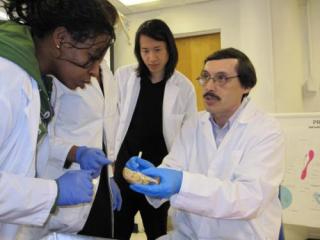
Dr. Kolchenko

Groundbreaking research leads to detection of smallest virus particle, implications for early treatment of disease

Vasily Kolchenko (great name, great mustache) and his team, by attaching a nano-antenna to a light-sensing device, have managed to detect the smallest virus particles.

Phys.org – “…Their work has made it possible, for the first time, to detect the smallest virus particle. Since even one viral particle can represent a deadly threat, the research likely will make an important contribution to ongoing research on early detection of such diseases as AIDS and cancer. Until the research team announced their discovery this year in Applied Physics Letters (July 27, 2012), no instrument or methodology had been successful in reliably and accurately detecting a single virus particle, which is in the size range of a nanoparticle. (About 80,000 nanoparticles side by side would have the same width as a human hair.) The research will potentially have an immense impact on the general public, aiding disease detection at its earliest stage when fewer pathogens are present and medical intervention can be most effective.”

Are Bacteria Making You Hungry?

I know defending against our nation’s proclivity towards baked goods isn’t necessarily an issue of biodefense, but it’s the holiday season, and as the pounds are added on, any and all scapegoats are appreciated (George Mason Biodefense is in no way condoning unhealthy eating habits. A balanced diet and frequent exercise are the best way to remain healthy).

Science Daily – “Over the last half decade, it has become increasingly clear that the normal gastrointestinal (GI) bacteria play a variety of very important roles in the biology of human and animals. Now Vic Norris of the University of Rouen, France, and coauthors propose yet another role for GI bacteria: that they exert some control over their hosts’ appetites. Their review was published online ahead of print in the Journal of Bacteriology.”

USAID Emerging Pandemic Threats Program Trains 1,500 in Infectious Disease Surveillance, Diagnostics and Outbreak Response and Identifies 200 Novel Viruses

Microbial and infectious disease experts from around the world came together earlier this month for the 20th annual meeting of the Institute of Medicine (IoM)’s Forum on Microbial Threats.

“Over the past three years, the PREDICT Project of the U.S. Agency for International Development’s (USAID) Pandemic Influenza and Other Emerging Threats (PIOET) program has trained 1,500 people in surveillance, diagnostics, and outbreak response; has discovered 200 novel viruses related to groups known to cause disease in humans; and has standardized animal sampling protocols as part of detecting and preventing pathogens of pandemic potential from spilling over from animal to human populations – and vice versa. These figures were presented by Stephen Morse, PhD, of Columbia University and Co-Director of the PREDICT Project during a panel…on “Disease Detection, Emergence and Spread: Tools and Approaches for Infectious Disease Surveillance and Detection” .

Why Paper Towels are Important

Using an air dryer in the bathroom is always better, right? Especially one of the automatic ones that you don’t have to touch? Wrong.  In doing your bit to stop the spread of flu this holiday season, consider reaching for the towel. From the Mayo Clinic:

“Hand hygiene has the potential to prevent diseases and reduce health care–associated infections. The proper drying of hands after washing should be an essential component of effective hand hygiene procedures. Most studies have found that paper towels can dry hands efficiently, remove bacteria effectively, and cause less contamination of the washroom environment. From a hygiene standpoint, paper towels are superior to air dryers; therefore, paper towels should be recommended for use in locations in which hygiene is paramount, such as hospitals and clinics. The provision of paper towels should also be considered as a means of improving hand hygiene adherence among health care workers. Our findings may have implications for health professionals and medical educators aiming to design effective programs to promote hand hygiene practices.”

Destroying Rinderpest: Former Director of Plum Island Comments

RInderpest
Rinderpest

Last week the World Organization for Animal Health (OIE) called for the destruction of remaining stocks of the eradicated cattle virus, Rinderpest. Commenting on the news is Dr. Roger Breeze, GMU Biodefense adjunct faculty, current President of the Centaur Science Group,  and former Director of the Plum Island Animal Disease Center.

Dr. Roger Breeze:

“In 2011, the developing world celebrated global eradication of Rinderpest, a lethal viral disease of cattle responsible for catastrophic outbreaks in Europe that started with the Mongol invasions, frame our emergency response to epidemics to this day, and were the direct triggers for establishment of the veterinary profession and the International Office of Epizootics (OIE, the World Organization for Animal Health). Beyond catastrophic were the consequences of the Great African Rinderpest epidemic that began when an invading Italian Army brought Rinderpest-infected cattle from India into Ethiopia in 1887. At least 90% of cattle died and the infection spread throughout Africa, depriving people of their food, transport, draft animals and family life-savings at a stroke and precipitating a severe famine, enormous mortality and wars that rippled through the continent for a decade.

Like smallpox, Rinderpest was eradicated with 20th century technologies – a live attenuated vaccine made in the developing world and simple immunological tests – backed by a surprisingly inexpensive but sustained international effort based on grass-roots capabilities and enthusiastic participation of the herdsmen most concerned. The world community that conceived, funded and sustained these efforts deserves enormous credit.

Now we face a different challenge – accidental or deliberate release of Rinderpest into a global cattle population that is totally susceptible and through much of Africa and Asia ill supported by veterinary surveillance services. Live attenuated Rinderpest vaccine strains and virulent challenge strains exist in laboratories and vaccine facilities formerly engaged in the global eradication campaign. The OIE and the United Nations Food and Agriculture Organization (FAO) are leading international efforts to destroy remaining stocks of Rinderpest virus or to transfer these to secure Biosafety level 3 laboratories so that unauthorized access to virus is prevented and any work is conducted under appropriate biological safety. Clearly this is something to be encouraged, although one wishes for a somewhat stronger verb. The OIE and FAO are also developing a contingency plan (as yet unpublished) for a vaccine bank and diagnostic support should an outbreak occur. This is also a wise investment.

But the OIE is the World Organization for Animal Health not Animal Biodefense and OIE and FAO both operate on shoestring budgets that do not allow for a global Rinderpest preparedness plan that can be sustained over decades to come. A deliberate attack on North American or European animal agriculture with native or synthetic Rinderpest virus would cause significant damage, although nothing like historic outbreaks (there is a saying that “a good barb wire fence will stop Rinderpest”). The tragedy would be a deliberate release that re-infected the developing world to reverse the major economic gains of the past 20 years and condemn the poorest of the poor to hunger, starvation and death. President Obama’s National Strategy for Biosurveillance and the National Strategy for Countering Biological Threats clearly set out what we as a nation need to work towards at home and abroad with our international partners to counter these natural and deliberate threats to people, animals and plants. Let’s finish the job with Rinderpest by ensuring a global preparedness capability that stands the test of time.”

The Pandora Report

Highlights include Russia quietly upping it’s chem/bio defense spending (*cough* Syria *cough*), the MSP discussing the BWC (breaking news: Cuba has complaints)(no offense Cuba), the bugs in your great great times 100 grandfather’s belly, a new journal article on immune escape and pandemic mortality, annnd how to win a million dollars (math. it’s always math). Happy Friday!

Credit: Al Arabiya News

Russia to Spend $183 million on Chemical, Bio Defense in 2013

Russia, possibly a little nonplussed by Assad’s suddenly revitalized interest in his WMD, is investing 5.6 billion rubles ($183 million) on bolstering their defenses against chemical and biological weapons (FYI: Syria is just over 600 miles south of Russia – for comparison, that’s less than the length of California). Make all the dual-use jokes you want, I think the Russians are on to something.

Ria Novosti –  “MOSCOW, December 11 (RIA Novosti) – Russia will spend over 5.6 billion rubles ($183 million) on improving defense against chemical and biological threats in 2013, a Defense Ministry official said on Tuesday. ‘The overall spend on measures to defend against chemical and biological threats in 2013 will be around 5.65 billion rubles,’ the head of Russia’s Nuclear, Chemical and Biological Defense (NBCD) department Maj. Gen. Yevgeny Starkov said.”

2012 Meeting of State Parties for the 1972 Biological Weapons Convention Concludes

Stay tuned for the Final Report.

“Thursday morning provided an opportunity for delegates to raise any further issues within the topics allocated to the MSP. The following countries took the floor: on cooperation and assistance: Republic of Korea, Algeria and Iran (national); on science and technology: Chile and the United Kingdom; on national implementation: Algeria, Japan and Chile; and on confidence-building measures: Japan. Most interventions followed up on themes that had been previously raised.”

Too Many Antibiotics? Bacterial Ecology That Lives On Humans Has Changed in Last 100 Years

Apparently the bugs living in our ancestors (of the ancient variety) were more similar to “non-human primates” than to your average American today. Why? Overuse of antibiotics, especially in the last century.

Science Daily – “A University of Oklahoma-led study has demonstrated that ancient DNA can be used to understand ancient human microbiomes. The microbiomes from ancient people have broad reaching implications for understanding recent changes to human health, such as what good bacteria might have been lost as a result of our current abundant use of antibiotics and aseptic practices…’The results support the hypothesis that ancient human gut microbiomes are more similar to those of non-human primates and rural non-western communities than to those of people living a modern lifestyle in the United States,’ says Lewis. ‘From these data, the team concluded that the last 100 years has been a time of major change to the human gut microbiome in cosmopolitan areas.’ ”

The age distribution of mortality due to influenza: pandemic and peri-pandemic

This study evaluates impact of “immune escape” on elderly mortality rates during pandemics, with immune escape here referring to the “stepwise increase in mortality among the oldest elderly.” It’s always interesting to see how pandemics affect specific age populations.

BMC Medicine – “In all influenza pandemics of the 20th century, emergent viruses resembled those that had circulated previously within the lifespan of then-living people. Such individuals were relatively immune to the emergent strain, but this immunity waned with mutation of the emergent virus. An immune subpopulation complicates and may invalidate vaccine trials. Pandemic influenza does not ‘shift’ mortality to younger age groups; rather, the mortality level is reset by the virulence of the emerging virus and is moderated by immunity of past experience. In this study, we found that after immune escape, older age groups showed no further mortality reduction, despite their being the principal target of conventional influenza vaccines. Vaccines incorporating variants of pandemic viruses seem to provide little benefit to those previously immune. If attack rates truly are similar across pandemics, it must be the case that immunity to the pandemic virus does not prevent infection, but only mitigates the consequences.”

Algorithms for Threat Reduction

For those of you so inclined, the Defense Threat Reduction Agency, in partnership with the National Science Foundation, has an “Algorithm for Threat Reduction” competition with a $1 million prize.

NSF – “This program solicits proposals from the mathematical sciences community in two main thrust areas: mathematical and statistical techniques for genomics, and mathematical and statistical techniques for the analysis of data from sensor systems.”

In case you missed it:

–  Why Assad Won’t Use His Chemical Weapons Foreign Policy
Syria Warns Opposition May Use WMD Al Arabiya News

This Week in DC: Events

Be sure to check out GMU’s event on Thursday, “The Nexus of Crime and Terrorism”, featuring the Defense Intelligence Agency’s Director of the Defense Combating Terrorism Center.

Seized drugs on the Mexico-US border (image credit: Tom Barry with CIP)

Tuesday, December 11, 2012

  1. Syria in Transition: An Insider’s View
    New America Foundation
    12:15-1:30PMWhile fears of chemical weapons and of an impending “failed state” dominate discussions on Syria, a narrative is being largely lost: civil leaders inside Syria who are taking matters into their own hands. Please join the New America Foundation’s Middle East Task Force for a conversation with Mohammed A. Ghanem, senior political advisor at the Syrian American Council, who has just returned from Syria. Ghanem will discuss how Syrian civilians are creating a government of their own and how this movement may impact the country’s future.
    RSVP on the event website.
  2. Afghanistan: Endgame or Persisting Challenge with Continuing Stakes?
    Brookings Institution
    2:00 – 3:00PMOn December 11, Foreign Policy at Brookings will host the launch of a new book, Aspiration and Ambivalence: Strategies and Realities of Counterinsurgency and State-Building in Afghanistan (Brookings, 2012), by Brookings Fellow Vanda Felbab-Brown. Aspiration and Ambivalence analyzes the past decade of U.S. and international efforts in Afghanistan and offers detailed recommendations for dealing with the precarious situation leading up to the 2014 transition and after. In her book, Felbab-Brown argues that allied efforts in Afghanistan have put far too little emphasis on good governance, concentrating too much on short-term military goals to the detriment of long-term peace and stability. Felbab-Brown will be joined by Ronald E. Neumann, president of the American Academy of Diplomacy and former U.S. Ambassador to Afghanistan (2005-07). Vice President Martin S. Indyk, director of Foreign Policy, will provide introductory remarks and moderate the discussion.
    Register here.

Wednesday, December 12

  1. Human Resource Development in New Nuclear Energy States
    Brookings Institution
    12:00 – 1:00PM
    On December 12, the Energy Security Initiative at Brookings will host a discussion of its latest research paper, ‘Human Resource Development in New Nuclear Energy States: Case Studies from the Middle East.’ Based on case studies from three countries in the Middle East, the paper offers a series of recommendations on human resource related risks for emerging market nations looking to enter the civil nuclear sector. Following a presentation of the report’s findings and recommendations, Senior Fellow Charles Ebinger, director of the Energy Security Initiative, will moderate a discussion with its authors.After the program, panelists will take audience questions.
    Register here.
  2. 6th Annual Terrorism Conference: Implications of the Arab Spring for Insurgencies, the Jihadist Movement and al-Qaeda
    PAY-TO-ATTEND ($115)
    The Jamestown Foundation
    8:30AM – 4:15PM

    Panels include “The Periphery and the Core: The Evolution of AQ and Its Affiliates”, “The Syrian Uprising: Militant Magnet and Regional Reactions,” and “AQ Affiliates and Jihadist Strategies: From North Africa to the Sahel,” with concluding remarks by GMU Adjunct Faculty General Michael Hayden.
    Purchase tickets here.

Thursday, December 13

  1. Missile Defenses and American Security
    American Foreign Policy Council
    9:00AM – 12:30PMFor three decades, the American Foreign Policy Council (AFPC) has played an important role in the U.S. foreign policy debate. Founded in 1982, AFPC is a non-profit organization dedicated to bringing information to those who make or influence the foreign policy of the United States. AFPC is widely recognized as a source of timely, insightful analysis on issues of foreign policy, and works closely with members of Congress, the Executive Branch and the policymaking community. It is staffed by noted specialists in foreign and defense policy, and serves as a valuable resource to officials in the highest levels of government.
    RSVP to  events@afpc.org 

  2. The Nexus of Crime and Terrorism: New Security Challenges in the 21st Century
    George Mason University Arlington Campus
    12:00- 2:00PMGeorge Mason University’s Terrorism, Transnational Crime, and Corruption center  will host a talk by David M. Cattler, director of the Defense Combating Terrorism Center (DCTC) at the Defense Intelligence Agency. Please call TraCCC at 703-993-9757 or e-mail traccc@gmu.edu to secure a seat.
  3. Toward More Effective Disaster Philanthropy
    Center for Strategic and International Affairs
    5:00-8:00PMFollowing a natural disaster, philanthropy plays a vital role in aiding affected communities and can have an equally critical role in building long term community resilience. As private entities, philanthropists can operate with flexibility across sectors and creativity that generates unique contributions across the lifecycle of disasters—from preparedness to recovery. Please join CSIS and the Irene W. and C.B. Pennington Foundation for an on-the-record panel discussion exploring how to move toward more effective disaster philanthropy.
    RSVP here.
  4. Export Controls Reform
    PAY-TO-ATTEND ($35 non-members)
    Washington International Trade Association
    8:30-10:30AM
    Many believe the current U.S. export control system, although crucial, has become a multi-layer unwieldy behemoth that no longer serves the national security of the United States. The cornerstone of the on-going Export Control Reform Initiative is to overhaul the control lists. Our expert panel will focus on the progress of revising the two control lists, the national security benefits of clearer control lists, the proposed structure of the revised United States Munitions List and the Commerce Control List, and the engagement and role of the Congressional oversight committees. The panel will also discuss the Export Control Reform Initiative’s prospects for the ultimate objectives of the ‘four singularities’: single licensing agency, single control list, single IT platform, and single primary export enforcement department.
    Register here (by COB Wednesday, December 12)

Friday, December 14

  1. Egypt on the Brink (Again)
    Washington Institute for Near East Policy
    12:00-2:00PM
    Nearly two years after throngs filled downtown Cairo to demand the ouster of Hosni Mubarak, tens of thousands are back demanding the ouster of his elected successor, Muhammad Morsi. For the ruling Islamists, winning the planned December 15 national referendum on a new constitution would be the turning point that ends the current crisis; for their opponents, the hastily scheduled referendum only stokes more fury at a democratic transition gone terribly awry.To discuss the fast-moving events in Egypt and their implications for U.S. policy and regional security, The Washington Institute will host a Policy Forum luncheon with Steven Cook, Shalom Cohen, and Eric Trager.
    Request an invitation, watch the live webcast, or follow on twitter.

Monday, December 17

  1. The World in 2013 – Admiral Mike Mullen and Jessica Mathews
    Carnegie Endowment for International Peace
    12:30-2:00PMHow will President Obama use American power in 2013? Will the United States ever restore its fiscal health? And how can Obama ensure the U.S. rebalance toward Asia succeeds?Join us for an in-depth conversation between Admiral Mike Mullen and Carnegie’s Jessica T. Mathews as they discuss the foreign policy landscape confronting the president in 2013.
    Register to attend here.

Charles Blair: Why Assad Won’t Use His Chemical Weapons

Check out GMU adjunct faculty member and Federation of American Scientists Senior Fellow Charles Blair’s comprehensive piece on Foreign Policy about Assad’s weapons.

“Since the Syrian uprising began in March 2011, concerns over the country’s chemical arsenal have largely reflected the fear that terrorists might steal them in the chaotic aftermath of Bashar al Assad’s overthrow. Military use against the Free Syrian Army seemed less likely, largely because the use of unconventional weapons would violate international law and norms. If it broke that taboo, the regime would risk losing Russian and Chinese support, legitimizing foreign military intervention, and, ultimately, hastening its own end. As one Syrian official said, “We would not commit suicide.”

But this week chemical anxieties shifted. President Barack Obama warned Syria that “[t]he use of chemical weapons is and would be totally unacceptable” — a comment echoed by Secretary of State Hillary Clinton and Secretary of Defense Leon Panetta, both of whom said that use of the arsenal would cross a “red line” for the United States. Despite these admonitions — and a barrage of reports that Syria is preparing to deploy its chemical arsenal — it remains doubtful that Damascus is at the point where the use of chemical weapons against rebels makes tactical or strategic sense.”

Read more here.

The Pandora Report

Highlights include Syria’s Chemical Weapons (will they won’t they?), Ebola for breakfast, stronger regulations for H5N1 research (blame the ferrets), first responders and zombies, the bacteria are planning our overthrow, and more Syria (hey at least it’s not Ebola). Happy Friday!

Why Assad Won’t Use His Chemical Weapons (and why you should still be worried)

FAS Fellow and GMU Adjunct Faculty Charles Blair (he’s brilliant) has an excellent piece in Foreign Policy on Syria’s  chemical weapons. Check it out below!

“Since the Syrian uprising began in March 2011, concerns over the country’s chemical arsenal have largely reflected the fear that terrorists might steal them in the chaotic aftermath of Bashar al Assad’s overthrow. Military use against the Free Syrian Army seemed less likely, largely because the use of unconventional weapons would violate international law and norms. If it broke that taboo, the regime would risk losing Russian and Chinese support, legitimizing foreign military intervention, and, ultimately, hastening its own end. As one Syrian official said, ‘We would not commit suicide.'”

Health Concerns Raised as Ugandans Add Primates to the Menu

Today’s holiday special is two sausages with eggs Benedict and Ebola.  All meals come with complimentary cup of coffee (no refills).

Voice of America – “Uganda’s recent flood of Congolese refugees is having unexpected side-effects: some Ugandans are adopting the Congolese custom of eating primates, a new trend that may be linked to outbreaks of Ebola and represents a potential threat to the country’s endangered chimpanzee population. According to sanctuary director Lily Ajarova, while primate consumption is not unusual in Africa, Uganda has no history of the practice. Although her team has yet to find Ugandans eating chimpanzees in particular, they fear that Ugandans who are known eat various primates may soon go the way of their chimp-eating neighbors to the west.”

Proposed H5N1 Research Reviews Raise Concerns (Paywall)

Should experiments which may result in the generation of potentially dangerous information be published? Should they be conducted at all? As a biodefense student, I tend to say yes, absolutely – exercise caution, but stringent secrecy seems to do more harm than good. It’s a slippery slope.

Science – “Researchers are giving a mixed reception to a draft U.S. government plan to do more stringent funding reviews of certain kinds of H5N1 avian influenza research—and perhaps even require some studies to be kept secret. The proposal, presented last week at a meeting of the National Science Advisory Board for Biosecurity, is the latest fallout from the controversy surrounding two studies in which scientists engineered the H5N1 virus and led to a voluntary moratorium on such potentially risky “gain-of-function” studies. The new proposal seeks to help biosecurity experts for funding agencies identify problematic experiments before they begin.”

First responders drill response to a “Night of the Walking Dead” scenario

zombie_0

Looks like DHS is finally wising and preparing for something of which we’re all actually afraid. All I’m saying is, CDC has been on this for years.  

Homeland Security Newswire – “DHS funds were approved to pay the $1,000 fee for a week-long conference at Paradise Point Resort and Spa in San Diego; the marquee event of the summit was its highly-promoted ;zombie apocalypse’ demonstration; Strategic Operations, a tactical training firm, was hired to put on a ‘zombie-driven show’ designed to simulate a real-life terrorism event; the firm performed two shows on Halloween, which featured forty actors dressed as zombies getting gunned down by a military tactical unit”

Did Bacteria Fuel World’s Worst Extinction?

For all the germaphobes out there, we give you reason to be afraid of the little suckers. And of all the inglorious ways to wipe out a planet – methane gas, I ask you.

LiveScience – “Nickel-eating bacteria may have worsened the world’s worst mass die-off by producing huge amounts of methane, a new study suggests. The study is the latest attempt to explain how most of the world’s ocean species died off in just a few hundred thousand years at the end of the Permian era, about 250 million years ago. The researchers presented their findings Tuesday (Dec. 4) here at the annual meeting of the American Geophysical Union.

Red Cross in touch with Syrian government on biological, chemical arms

(The Syrian situation from the NGO perespective) You know things are dire when the Red Cross starts making contingency plans. Has anyone else started uneasily refreshing their knowledge on the rumored extent of Syria’s BW cache?

Reuters – “The International Committee of the Red Cross (ICRC) has been in touch with the Syrian government about both biological and chemical weapons whose use is illegal under international humanitarian law, its president said on Thursday. The humanitarian agency is making “contingency planning” in the event that any chemical weapons are used, especially to protect its nearly 100 aid workers deployed in Syria, but remains focused on the wider needs of the civilian population.”

Predicting, preventing, and controlling pandemics

(Thanks to GMU Biodefense MS student Deborah Harden for passing this along)

“About 60 percent of infectious diseases are caused by viruses, bacteria, and other pathogens that make the jump to humans from other species; this includes some of the most devastating disease outbreaks of the past thirty years, including HIV/AIDS, Ebola, and SARS; despite the huge and rising toll of such diseases, many gaps remain in our understanding of how these “zoonoses” evolve, develop, and spread — gaps that must be filled if we are to succeed in preventing or at least reducing the impact of a next pandemic

About 60 percent of infectious diseases are caused by viruses, bacteria, and other pathogens that make the jump to humans from other species. This includes some of the most devastating disease outbreaks of the past thirty years, including HIV/AIDS, Ebola, and SARS. Despite the huge and rising toll of such diseases, many gaps remain in our understanding of how these “zoonoses” evolve, develop, and spread — gaps that must be filled if we are to succeed in preventing or at least reducing the impact of a next pandemic.

A new paper published in the Lancet by Stephen S. Morse, Ph.D., professor of Epidemiology at Columbia University’s Mailman School of Public Health, and colleagues, lays out a series of research and surveillance opportunities that could help bridge these gaps and move the global pandemic strategy from response to pre-emption and prediction. The paper, ‘Predicting and Preventing the Next Pandemic Zoonosis’, is part of a special Lancet series that explores the ecology, drivers, and dynamics of zoonoses with a view toward improving prediction of the next pandemic and reducing the human and economic costs.”

Read more here.

This Week in DC: Events

Anwar Al-Awlawki, notoriously adept in using youtube to spread al Qaeda's message
Anwar Al-Awlawki, notoriously adept in using youtube to spread al Qaeda’s message

Tuesday, December 4

  1. Security Challenges for Europe: Missile Defense, Nuclear Weapons and Conventional Weapons
    Johns Hopkins SAIS
    8:45AM- 1:00PM

    Policymakers and scholars will discuss this topic during two separate panels. Note: The comments of Brad Roberts, U.S. deputy assistant secretary of Defense, will be not for attribution.
    RSVP here.

  2. Countering Online Radicalization in America
    Bipartisan Policy Center
    10:00 – 11:00AM

    From Al Qaeda to white supremacists, the internet plays an increasingly important role in radicalizing homegrown and domestic terrorists. BPC’s Homeland Security Project will release its latest report, Countering Online Radicalization in America, which explains how online radicalization works and what needs to be done to counter it. Based on extensive research and dozens of interviews with experts and policymakers, it sets out a balanced and practical approach, which respects American values while protecting the homeland from terrorism. The co-chairs will outline their conclusions, and a panel discussion will follow.
    Register here.

  3. ‘Innovation Economics’ at the Center for Science and Technology Policy
    GMU Center for Science and Technology Policy & Information Technology and Innovation Foundation
    12:00-1:15PM

    Rob Atkinson will be hosting an event on Innovation Economics: The Race for Global Advantage at George Mason University’s Center for Science and Technology Policy (School of Public Policy), as part of the monthly seminar series that explores new ideas and work-in-progress with the Washington-area research community. It’s open and free to all interested researchers with a special invitation extended to graduate students.
    RSVP to David Hart atdhart@gmu.edu 

Wednesday, December 5

  1. The Next Phase of Hiring Reform at DoD: Innovative Strategies for Finding Top Talent
    National Press Club
    7:30-10:00AMHiring reform officially took flight in 2010 and strides have been made by defense and civilian agencies alike in reducing time to hire. Job announcements have become more concise and the federal government is becoming more applicant friendly. The next phase of hiring reform will have to go beyond these advancements to focus on candidates themselves – how to attract the best and brightest and how to select them from huge candidate pools.
    RSVP here.
  2. 2012 Defense Forum Washington: The Fiscal Cliff
    ($15 USNI Member/Government/Non-Profit, $25 Attendee)
    United States Navy Memorial & Naval Heritage CenterThe Fiscal Cliff: what does this mean for defense and national security?
    Register here.
  3. The Price of Freedom Denied: Religious Conflict in the 21st Century
    Johns Hopkins SAIS
    12:00 – 2:00PMBrian Grim, senior researcher and director of cross-national data at the Pew Research Center’s Forum on Religion and Public Life, will discuss this topic.
    RSVP to slee255@jhu.edu.
  4. The Last Refuge: Yemen, Al-Qaeda, and America’s War in Arabia
    New America Foundation
    12:15-1:45 PMOver the past few years, U.S. counterterrorism officials have frequently highlighted the blows America has dealt to al-Qaeda, especially those to its central command in Pakistan and Afghanistan. But officials also continue to warn about the persistent threat posed by al-Qaeda affiliates and sympathizers that have flourished in places such as Yemen and North Africa. Gregory Johnsen, a Ph.D. candidate at Princeton and one of the preeminent scholars of al-Qaeda in the Arabian Peninsula, examines the organization’s last strongholds in his new book The Last Refuge: Yemen, Al-Qaeda, and America’s War in Arabia. In a recent piece for the New York Review of Books, Robert Worth called Johnsen’s book, “an authoritative and deftly written account of al-Qaeda’s Yemeni incarnation.” Please join the New America Foundation’s National Security Studies Program for a conversation with Gregory Johnsen about The Last Refuge and the future of U.S. efforts to counter the violent ideology espoused by al-Qaeda supporters in Yemen.
    RSVP on at the website.
  5. National Security in an Era of Global Upheaval
    American Security Project
    12:30 – 1:30PM
    A conversation with National Journal Senior Correspondent James Kitfield to discuss politics, defense, and national security. Topics of discussion will include the following questions: What does a period of reset and retrenchment looks like for a superpower feeling overextended?What should America focus on, and what are the major challenges to our national security?
    RSVP to events@americansecurityproject.org.
  6. What Can Data Tell Us About Trends in Terrorism?
    New America Foundation
    3:00 – 4:ooPMThe first-ever Global Terrorism Index (GTI) provides a metric for policymakers to track terrorism and its related factors in order to inform a practical debate about the future of terrorism. It presents a new methodology to assess the countries which have been most impacted by terrorism and highlights the countries that have seen the largest growth and reduction in terrorism activity over the last 10 years.
    Register here.
  7. An Evening with the Palestinian Ambassador
    George Mason University – Arlington Campus
    7:30PM – 9:00PMPlease join the Center for World Religions, Diplomacy and Conflict Resolution as we welcome Palestinian Ambassador Areikat to come and speak to the S-CAR and Mason Community at the Arlington Campus. CRDC’s Co-Executive Director, Aziz Abu Sarah, will introduce the Ambassador, and Dr. Jamil Shami, President for the Middle East in Higher Education, Inc., will moderate the event.
    RSVP to  crdc@gmu.edu.

Thursday, December 6

  1. Transatlantic Risk Governance: New Security Risks
    Carnegie Endowment for International Peace
    9:00AM – 4:00PMBringing together an interdisciplinary group of scholars and experts from Germany and the United States, this workshop examines several new security risks in the transatlantic context. The workshop is part of a project on “New Systemic Risks: Challenges and Opportunities for Transatlantic Cooperation,” which examines the chances and impediments for transatlantic risk management. After analyzing economic and resource risks at workshops over the summer, this workshop focuses on new emerging challenges, such as geoengineering, space and cyber security, as well as unknown risks.
    Register here.

Friday, December 7

  1. Whither U.S. and EU Farm Policy?
    Johns Hopkins SAIS
    12:00 – 3:00PMTassos Haniotis, director of economic analysis, perspectives and evaluations, and director-general of agriculture and rural development at the European Commission, and Joe Glauber, chief economist at the U.S. Department of Agriculture, will discuss this topic.
    RSVP to saisag@jhu.edu.