Arenaviridae

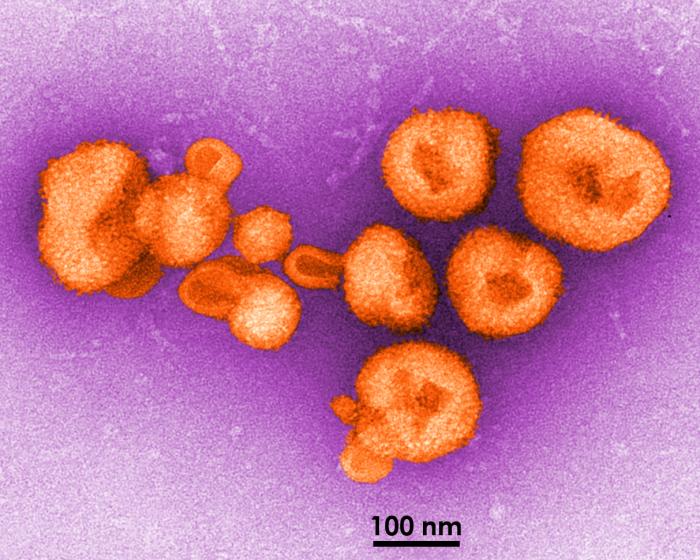
This transmission electron micrograph depicted eight virions (viral particles) of a newly-discovered virus, which was determined to be a member of the genus, Arenavirus. A cause of fatal hemorrhagic fever, it was confirmed that this virus was responsible for causing illness in five South Africans, four of whom died having succumbed to its devastating effects. Ultrastructurally, these round Arenavirus virions displayed the characteristic “sandy”, or granular capsid, i.e., outer skin, an appearance from which the Latin name, "arena", was derived. See PHIL 10838 for a black and white version of this image.  Other members of the genus Arenavirus, include the West African Lassa fever virus, lymphocytic choriomeningitis (LCM), and Bolivian hemorrhagic fever (BHF), also known as Machupo virus, all of which are spead to humans through their inhalation of airborne particulates originating from rodent excrement, which can occur during the simple act of sweeping a floor.

From the CDC: “This transmission electron micrograph depicted eight virions (viral particles) of a newly-discovered virus, which was determined to be a member of the genus, Arenavirus. A cause of fatal hemorrhagic fever, it was confirmed that this virus was responsible for causing illness in five South Africans, four of whom died having succumbed to its devastating effects.

Ultrastructurally, these round Arenavirus virions displayed the characteristic “sandy”, or granular capsid, i.e., outer skin, an appearance from which the Latin name, “arena”, was derived. See PHIL 10838 for a black and white version of this image.

Other members of the genus Arenavirus, include the West African Lassa fever virus, lymphocytic choriomeningitis (LCM), and Bolivian hemorrhagic fever (BHF), also known as Machupo virus, all of which are spread to humans through their inhalation of airborne particulates originating from rodent excrement, which can occur during the simple act of sweeping a floor.”

Image credit: CDC/Charles Humphrey

Nepal Moves To Ratify BWC

by Alena M. James

Last week the Nepalese Government, working with the United Nations Office for Disarmament Affairs, made efforts to develop strategies for the national implementation of the Biological Weapons Convention during the Workshop on National Implementation of the Biological Weapons Convention (BWC). With assistance from the United Nations Regional Centre for Peace and Disarmament in Asia and the Pacific, the BWC Implementation Support Unit, and with financial support from the European Union, the workshop on implementing the BWC was held in Katmandu February 20-21.

During the workshop individuals representing 12 agencies of the Nepalese Government, officials from the UNRCPD, members from the EU, and subject matter experts gathered to discuss topics which must be considered for Nepal to start the ratification process of the BWC.  Several topics discussed during the workshop included methods to enhance confidence-building measures by the state, treaty enforcement measures, the development of codes of conduct, and the establishment of biosafety and biosecurity standards. Dr. Jean Pascal Zanders, an international expert on CBRNs nonproliferation, and Yasmin Balci, a legal officer from VERTIC, a non-profit organization dedicated to advising states on the national implementation of BWC, provided their insight and expertise in helping Nepal’s agency representatives to initiate an effective trajectory towards ratification of the treaty.

Currently, there are 110 Signatory States to the BWC and 168 State Parties. However, ten signatory states have yet to ratify the treaty including Syria; which some allege as possibly having a BW program. Opening for signature in 1972, the BWC was the first treaty to outlaw a specific type of WMD. The treaty was enforced in 1975 and bans the production, stockpiling, and use of biological weapons. Its purpose is to prevent the proliferation and use of such weapons by members of the international community.

Since its inception, the BWC has faced a plethora of challenges especially with regards to its verification process. Unlike the NPT and the CWC, the BWC does not have a verification regime to ensure state compliance.  As a result, the BWC holds review conferences every five years to discuss challenges facing the BWC and mechanisms for improving verification protocol.  So far, the use of confidence building measures have been the primary tools used by the treaty to prohibit these weapons. There are six measures that BWC member states must adhere to which includes the declaration of past offensive and defensive programs, the declaration of vaccine production facilities, and the active exchange of scientific information between states.  The primary goal of the measures is to encourage all states to be both open and transparent regarding state supported scientific research and development operations.

The reliance on states voluntarily complying with the confidence building measures and the work-in-progress verification system of the BWC have been attacked by many critics as the BWC’s most fundamental weakness.  Despite this criticism, one aspect of the BWC that deserves applause is the collaborative efforts of the UN, the BWC Implementation Support Unit, and the EU aiding countries to move towards national implementation of the BWC. In the absence of an authorized verification regime, this collaborative group of intergovernmental organizations has stepped up by taking an active approach in getting countries to uphold their commitments to the BWC. The collaborative group has done so by making workshops such as those held in Kathmandu possible.

The workshop held in Nepal is one of several workshops hosted by the UNODA, the Support Unit, and the EU in the past few months to generate BWC compliance. These workshops are a part of the EU’s BWC Action project which sets out to provide human resources, logistical resources, financial resources, and equipment to states in order to reach universal compliance of the BWC.  On September 3, 2013, the collaborative group orchestrated the Regional Workshop on the National Implementation of the Biological Weapons Convention in South and South-East Asia.  Like the workshop held in Kathmandu, this workshop brought together a number of key individuals to discuss BWC implementation strategies.  In early December 2013, the UNODA  worked with United Nations Regional Centre for Peace and Disarmament in Africa (UNREC) to host two national workshops in the countries of Benin and Burkina Faso facilitating open dialogue regarding the implementation of the BWC.

While critics of the BWC point to the lack of a verification body as a weakness, it seems this appears to be promoting active participation by intergovernmental organizations like the EU to encourage states who have not ratified the BWT to do so.  Such active participation and international collaboration is exactly what the global community needs in order to promote international security against the threats of such WMDs.

In August 2013, the international community witnessed the alleged use of another type of WMD prohibited by the CWC. Syria, a then non-party member of the CWC, was accused of deploying chemical weapons on its own civilians.  The use of chemical weapons by the Syrian government has not yet been confirmed and speculations on the deployment of the chemical weapons by rebel forces continue to circulate. An analytical study executed by MIT professor Theodore Postol and former UN weapons inspector Richard Lloyd, suggests plausibility in the idea that the rebel forces fighting against the Bashar Al Assad regime may be responsible for using chemical weapons against civilians. Such a suggestion, if confirmed true, would exculpate the Syrian government.

As the international community’s investigation of chemical weapons deployment in Syria continues, there is already an important lesson that the Syrian case portrays. This lesson lies in the inability of the UN and the CWC’s verification regime, Organisation for the Prohibition of Chemical Weapons (OPWC), in identifying the perpetrators of the attacks. This ambiguity of the origin of the chemical weapons demonstrates a futuristic challenge that the international community could experience if a state not party to the BWC (or who has not yet ratified the treaty) faced alleged uses of biological weapons.  It is for this reason that the collaborative efforts of intergovernmental organizations like UNODA and the EU, must continue to facilitate open dialogue regarding universal compliance of the BWC. The workshops held by the UNODA in states that have not yet ratified the Biological Weapons Treaty provide an active approach that pushes to make universal compliance of this 42 year old treaty a reality.

The initial coverage on the Workshop on National Implementation of the Biological Weapons Convention (BWC) in Nepal can be found at unrcpd.org.

Photo credit.

This Week in DC: Events

Tuesday, March 4

Joint Subcommittee Hearing: Iran’s Support for Terrorism Worldwide
Date: March 4, 10:00am
Location: 2172 House Rayburn Office Building, Washington, DC 20515

Chairman Ted Poe (R-TX) says, “Iran is the world’s largest state sponsor of terrorism and a threat to peace and security not only in the Middle East, but around the globe. Using its Revolutionary Guard Corp, Iran funds, arms, trains, and commands terrorists worldwide. While it is most known for directing its proxy Hezbollah in Lebanon and Syria, Iran has also sponsored attacks in countries including India, Thailand, Georgia, Kenya, and even here at home in the United States. As the Administration negotiates with Iran over its nuclear program, we must not lose focus and forget Iran’s involvement in terrorism. This hearing will examine how to stop Iran’s proxy warfare.”

Chairman Ileana Ros-Lehtinen (R-FL) says, “The Administration has asked the American people to put a lot of faith in it as it continues to negotiate with Iran over Tehran’s nuclear program, yet it continues to keep the details of the Joint Plan of Action shrouded in secrecy. To make matters worse, the Administration is asking the American public to trust that it can ensure that Iran plays by the rules, but we have 35 years of overwhelming evidence that tells us that Iran is simply untrustworthy.  And while all of the focus of these negotiations has been on Iran’s nuclear program, what has gone largely ignored is just how dangerous the Iranian regime truly is. Iran is the world’s foremost state sponsor of terrorism and it seeks to harm the U.S. and our allies at every turn, yet the Administration carries on as if Iran’s nuclear program exists in a vacuum – as if it is unrelated to Iran’s terror activities. This hearing will serve as an important reminder of the dangers of dealing with the rogue regime in Iran, and why it is absolutely critical that Congress continue to press for increased sanctions against Tehran until it completely dismantles its entire nuclear program.”

Witnesses for this committee hearing include:

  • The Honorable Pete Hoekstra, Shillman Senior Fellow at The Investigative Project on Terrorism (Former Chairman of the U.S. House Permanent Select Committee on Intelligence)
  • Matthew Levitt, Ph.D., Director and Fromer-Wexler Fellow Stein Program on Counterterrorism and Intelligence at The Washington Institute for Near East Policy
  • Mr. J. Matthew McInnims, Resident Fellow at the American Enterprise Institute

Nuclear Abolition and the Catholic Peace Tradition
Date: March 4, 4:30 PM – 6:00 PM
Location: Third Floor Conference Room, Berkeley Center for Religion, Peace & World Affairs at Georgetown University, 3307 M Street, Washington, DC 20007

At this welcome event, Fr. Drew Christiansen, S.J. will explain his work in the Berkley Center’s new Church and the World Program in light of his life as a Jesuit “on the boundary” between the Church and world. In particular, he will discuss Georgetown’s Catholic Nuclear Threat Initiative and its parallel sources in Catholic social teaching and in US policy. He will trace the roots of recent Catholic advocacy for abolition of nuclear weapons in Catholic theology, the Church’s commitment since Pacem in Terris to the promotion of human rights, and the Vatican’s “diplomacy of conscience.” RSVP required

Thursday, March 6

PONI Lunch with Brig. Gen. Jim Dawkins
Date: March 6, 12pm-1:30pm
Location: Room C-115, Center for Strategic and International Studies, 1616 Rhode Island Avenue, NW, Washington, DC 20036

Please join the Project on Nuclear Issues for a lunch talk with Brigadier General Jim Dawkins, Jr. General Dawkins currently serves within the National Nuclear Security Administration’s Defense Programs as the Principal Assistant Deputy Administrator for Military Application (PADAMA). He is responsible for maintaining global nuclear deterrence through effective planning, maintenance, and enforcement of a safe, secure, and reliable nuclear weapons stockpile and its associated materials, capabilities, and technologies. In his role as PADAMA, he serves as a bridge between the National Nuclear Security Administration and the DoD on joint nuclear operational and infrastructural matters, engaging in frequent dialogue with the various military services concerning weapons issues specific to each service and supporting related programming and budget matters pertinent to the NNSA and the DOD.

General Dawkins was commissioned in 1989 from Air Force Officer Training School. He has commanded at the wing, group and squadron level. Prior to his current position, he was the commander, 5th Bomb Wing, Minot AFB, N.D.

General Dawkins will speak about his experiences across the nuclear enterprise and its challenges for the future at this off the record event. To attend, register here or contact Sarah Weiner at (202)741-3878 with questions.