
Welcome to this week’s Pandora Report! This issue highlights recent GMU biodefense research and publications, emerging insights on deterrence and coercive diplomacy, new developments in vaccine diplomacy and artificial intelligence governance, and key updates across biosecurity, chemical weapons policy, and global threat reduction efforts.
Interested in Terrorism and Complex Threat Landscapes? Join Counter Terrorism 2026!
The Schar School and HS Today will be hosting the Counterterrorism Summit 2026, a mission-focused convening that brings together government, law enforcement, academia, and the private sector to discuss emerging terrorist organizations, shifting technology adoption, critical infrastructure risks, transnational threat linkages and the role of innovation and AI in extremist operations.
Thinking about Getting a Master’s in Biodefense?
GMU’s Schar School of Policy and Government has an upcoming recruitment event:
Schar School Well-Represented at Intelligence Studies Consortium Conference
By Chris Quillen, PhD in Biodefense (’25)
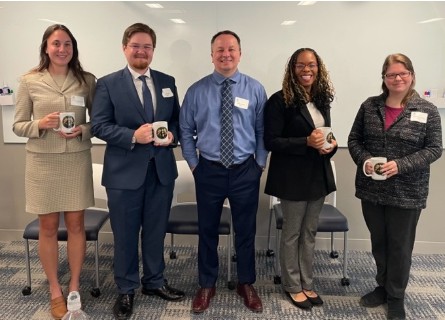
George Mason University’s Schar School made its presence known at the Intelligence Studies Consortium’s (ISC) Spring Conference on March 24-25, 2026. Established by the National Intelligence University in 2018, the Intelligence Studies Consortium brings together students from leading universities with intelligence-related programs including GMU. This year’s conference titled “The Intelligence Profession: Future Challenges and Opportunities” was hosted by Georgetown University’s School of Continuing Studies and featured a combination of keynote speakers, student and faculty panels, student and faculty poster sessions, networking opportunities, and a career fair. In addition to GMU, students and faculty from Embry-Riddle Aeronautical University, Georgetown University, Howard University, Indiana University, the Institute for World Politics, James Madison University, Johns Hopkins University, Mercyhurst University, National Intelligence University, Patrick Henry College, Soka University of America, the University of California-Merced, the University of New Hampshire, the University of Virginia, and Virginia Tech presented their research. In total, nearly 500 people representing 25 higher education institutions registered for the symposium which included 12 panels with 50 people and 33 poster sessions.
Faculty and students from the Schar School appeared throughout the conference. Chris Quillen, PhD Biodefense ’25, moderated the panel “Weapons of Mass Destruction, Counterterrorism, and Nation-States: A Case for Maintaining Vigilance” featuring two current students and one possible future student in Biodefense. Becca Earnhardt, PhD candidate in Biodefense, discussed the differences between traditional and internet biosurveillance, the utility of social media data during previous outbreaks, and lessons learned from the COVID-19 pandemic in her presentation on “Biosurveillance in the Age of Social Media.” Sandra Roshonda Thomas, MS student in Biodefense, argued “The Absence of Implementation in the National Biodefense Strategy is a National Security Risk.” Sam Rooker, currently at JMU and recently accepted into the Biodefense program for the fall of 2026, presented “DIY Doomsday: WMD Development as a Cottage Industry in an Interconnected Scientific Marketplace” analyzing the growing threat of commercial scientific technology use in WMD development drawing on his time as an intern for the Royal United Services Institute.
Ellen Laipson, the Director of the Master’s in International Security degree program and the Center for Security Policy Studies at GMU, moderated the panel on “The Analyst’s Edge: Innovation in Intelligence Tradecraft and Methodology” featuring two GMU students. Chris Quillen presented his research on his lessons learned from teaching the twin intelligence failures of the September 11th attacks and the failure to find WMD in Iraq in “Beyond the Classics: Keeping Intelligence Failure Case Studies Relevant.” Esha Doshi, a Master of Public Administration candidate and Northern Virginia Public Service Fellow at GMU, also presented on “Rebuilding Public-Private Partnerships and Trust.”
On the first day of the conference GMU students Mark Greene, Kevin Otwoma, Bryce Ricken, and Sara Slaughter presented “Netflix of Intelligence: Leveraging Emerging Technologies to Transform Intelligence Dissemination” during the Plenary Session on “Challenges Facing Intelligence Practitioners in the Evolving Landscape of Public-Private Partnerships and Intelligence Sharing.” Their presentation focused on “reimagining” how finished intelligence can be delivered to the customer using new technologies and addressed the pros and cons of the use of AI to tailor and package intelligence for the decision-maker.
Several Schar School graduate students also presented posters including Nick Kesler on “The Strategy Stack: An AI-Enabled Research Architecture for Strategic Coherence in an Era of Great Power Competition,” Yenting Lin on “Digital Propaganda: How China Uses Short-Form Videos to Undermine Taiwan’s Democratic Resilience,” and Kunj Malhotra on “Preparing the Intelligence Workforce for a Human–Machine Future: Building Readiness for AI‑Enabled National Security.”
George Mason University’s Biodefense PhD Student Publication Received Recognition
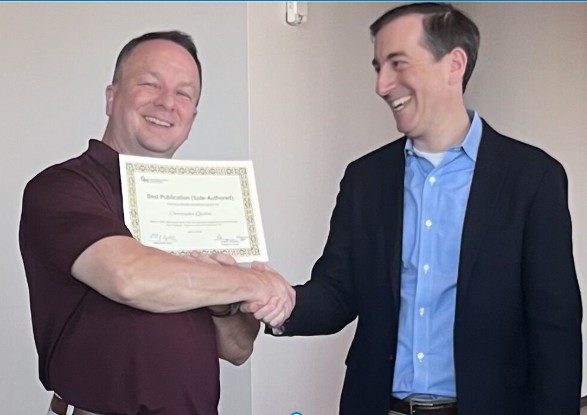
At the first annual Schar School PhD Awards held last week, recent Biodefense PhD graduate Christopher Quillen won for Best Publication (Sole-Authored) for his article “Dead Sheep Tell No Tales: Aum Shinrikyo’s Alleged Sarin Test in Australia Never Happened,” published in Studies in Conflict and Terrorism. In the article, Chris debunks the myth that Aum tested sarin on sheep at their ranch in Australia in the early 1990s. He found that Aum’s activities were more consistent with an intent to mine uranium in pursuit of nuclear weapons.
GMU Alumni Publishes Review on Coercing Syria on Chemical Weapons
Former PhD student of George Mason University’s Biodefense Program, Chris Quillen, recently published a review in Arms Control Today on the book, Coercing Syria on Chemical Weapons: A Case Study on Deterrence and Coercive Diplomacy by Matthew Moran, Wyn Q. Bowen, and Jeffrey W. Knopf, which assesses theories of deterrence and coercive diplomacy during the Syrian civil war. Quillen highlights that one of the book’s central arguments that traditional “resolve plus bombs” approaches, which are positions of threats of retaliation and occasional airstrikes, are insufficient to deter CW use and renunciation, emphasizing instead the importance of understanding motivations of the coerced and offering credible assurances if targets of coercion cooperate.
Biodefense Graduate Publishes on Vaccine Diplomacy in Global Health Governance
Olivia Parker, a 2024 graduate of the Biodefense M.S. program, recently published “Carrots, Sticks, and Dirty Tricks: Reevaluating Vaccine Diplomacy After the COVID-19 Pandemic,” in the fall 2025 issue of Global Health Governance. The article, based on her master’s capstone paper, argues that during the COVID-19 pandemic China, Russia, and the United States used vaccines as a tool to advance their pre-existing foreign policy goals, contra to the theory of ‘vaccine diplomacy’ as originally conceived by Dr. Peter Hotez. While Hotez’s theory may not be generalizable beyond the specific Cold War dynamics that inspired it, it presents an aspirational normative ideal for international vaccine sharing policy. Ms. Parker is currently a senior policy advisor with the National Security Commission on Emerging Biotechnology.
Further Reading:
- “Viruses allegedly stolen from high-security lab cause stir in Brazil,” Mariana Lenharo, Nature
- “What on earth is ‘vaccine beer’ and could it possibly work?” Julia Musto, The Independent
Stanford University’s New AI Index 2026 Annual Report Published
Stanford University’s Institute for Human-Centered AI has released the ninth edition of its AI report, titled The AI Index 2026 Annual Report. As AI systems continue to advance rapidly, the report raises key questions about the surrounding infrastructure needed to govern and evaluate these technologies, including governance frameworks, evaluation methods, education systems, and data infrastructure. This year’s edition examines how AI is being tested ambitiously across reasoning, safety, and real-world task performance. It also includes new estimates of generative AI’s economic value and emerging evidence of its impact on labor markets, along with an analytical framework on AI sovereignty and dedicated chapters on AI’s expanding role in science and medicine.
Further Reading:
- “Infinite Potential—Insights from the Viral Uplift Scenario,” Anton Shenk, Matt Chessen, Barbara Del Castello, Gregory Smith, Richard S. Girven, RAND
- “Human scientists trounce the best AI agents on complex tasks,” Nicola Jones, Nature
- “A biosecurity playbook for AI companies,” Lennart Justen, Substack
IN OTHER NEWS
Wildlife Trade and Zoonotic Disease Risk
- “Here’s how the wildlife trade is fueling disease outbreaks across the globe,” Brady Dennis, The Washington Post
- “Almost half of traded wildlife carries disease-causing pathogens,” Claudia Steiner, Nature
- “Wildlife trade drives animal-to-human pathogen transmission over 40 years,” Gippet et al., Science
- “How bad for humans is wildlife trade? A new study has answers,” Jonathan Lambert, NPR
- “Trafficked animals more likely to share pathogens with humans, says study,” Sarah Newey, The Telegraph
Chemical Weapons and State-Level Threats
- “OPCW Director-General calls for strengthened international efforts to end the Syrian chemical weapons dossier,” OPCW
- “‘Global efforts needed to eliminate former Syrian regime’s chemical weapons programme remnants’,” Qatar Tribune
- “Silent Killers, Not Signals: Why States Use Poison in Assassinations,” Naomi Rio and Glenn Cross, War on the Rocks
Governance, Public Health Leadership and International Coordination
- “Malaysia advances responsible use of life sciences through national RULS workshop,” World Health Organization (WHO)
- “Top CDC director pick Erica Schwartz tests White House political balancing act,” Dan Diamond and Lena H. Sun, The Washington Post

NEW: Webinar – Balancing Research Security and Open Science
From the Council of Canadian Academies: “In October 2025, the Council of Canadian Academies published their report, Balancing Research Security and Open Science. The report, commissioned by the Public Health Agency of Canada in collaboration with the Defence Research and Development Canada, offers an independent assessment of national and foreign efforts to promote research security and highlights potential strategies to safeguard national interests while preserving the openness that drives discovery, innovation, and prosperity.
The Centre for Biosecurity is hosting a webinar where members of the Expert Panel on Sensitive Research of Concern are invited to provide an overview of their findings, including measures to identify sensitive research, determine when it is of concern, and how to safeguard it throughout the phases of the research process.”
The English session will be held on April 15 at 2:00 PM EDT. The French session will be held on April 22 at 11:00 AM EDT. Learn more and register here.
NEW: Shared Risk, Shared Responsibility: Lessons from Canada on Allied Burden-Sharing in Global WMD Threat Reduction
From the Stimson Center: “Join the Stimson Center for a public fireside chat on global WMD proliferation challenges with senior officials from Global Affairs Canada, moderated by Stimson President and CEO Brian Finlay. The norms holding back the proliferation of weapons of mass destruction are under pressure from every direction: The use of chemical weapons has been documented on the battlefield in Ukraine, the full scope of the former Assad regime’s chemical weapons program in Syria is still being investigated, and global attention is focused on Iran’s highly enriched uranium stockpile. Particularly at the nexus of weapons of mass destruction (WMD) and chemical, biological, radiological, and nuclear (CBRN) security, rapid developments in disruptive technologies present heightened risks requiring deft management that does not jeopardize the many beneficial opportunities these technologies offer.
Canada has been a leading member of the Global Partnership Against the Spread of Weapons and Materials of Mass Destruction since the initiative’s founding nearly 25 years ago. Join the Stimson Center for a conversation that takes stock of that record: the lessons learned, the gaps exposed, and the hard questions about what allied burden-sharing in weapons of mass destruction threat reduction must look like in an era when the old assurances no longer hold.”
This hybrid event will be held on April 20 from 3:00 PM – 4:00 PM EDT. Learn more and register here.
NEW: External Review of Environmental, Biosafety, and Biosecurity Considerations for Synthetic Cell Research and Development: Report Release Webinar
From the National Academies: “Engineering biology holds great potential to transform biotechnology research to provide innovative solutions to critical challenges in health, agriculture, industry, and beyond. Scientists actively have worked to improve the design and creation of synthetic cells. Recent calls for increased predictability of designing cells that have desired functions upon their development highlight the pressing need to develop an actionable and contemplative approach to addressing environmental, safety, and security risks while maintaining research advancement and productivity. This study will analyze existing and needed approaches for assessing and reducing risks and maintaining benefits of synthetic cells to inform policy and protect public safety.”
This webinar will be held on April 29, from 1:00 PM – 2:00 PM EDT. Learn more and register here.
NEW: Biotechnology and Resilient Human Systems Workshop 2026
From the MIT Lincoln Laboratory: “The focus of the 2026 Biotechnology and Resilient Human Systems Workshop will be Preparing for Future Biological Effects. This two-day, in-person event will feature sessions highlighting the dual-use nature of biotechnology, building a resilient biosurveillance system, and developing broad medical countermeasures. The workshop will feature keynote presentations from leaders across the U.S. government highlighting critical national security challenges and opportunities created from advanced biotechnology and will also exhibit state-of-the-art research and innovations from the rapidly expanding biotechnology ecosystem.
Government and industry leaders, national security experts, UARCs, FFRDCS, national labs, entrepreneurs, and academic innovators will jointly discuss and showcase how to rapidly transition biotechnology-enabled technologies into operational capabilities that effectively address critical national security challenges.”
This in-person event will take place on June 2-3 in Lexington, MA. Learn more and register here.
International Conference CBRNe Research & Innovation
From CBRNE: “The last 40 years have demonstrated that both military and civilian populations could be exposed to highly hazardous CBRNE agents following conflicts, natural outbreaks and disasters, industrial incidents or terrorist attacks. Worldwide, researchers, responders and industrial capacities have been commited to provide adapted response to these challenges. The CBRNE Research & Innovation Conference includes workshops and demonstrations of innovative materials, technologies and procedures, according to the following themes: Detection (identification), Protection (decontamination, medical countermeasures), and risk & crisis management.
This event will take place in Arcachon, France, from May 19 – 21, 2026. Learn more and RSVP here.
GHS 2026
From GHS: “We’re excited to officially announce that the 4th Global Health Security Conference (GHS2026) will be held in Kuala Lumpur on the 9 – 12 June, 2026!”
“Building on the incredible momentum of GHS2024 in Sydney, we look forward to bringing together the global health security community once again – this time in one of Southeast Asia’s most vibrant and dynamic cities.”
“Registration and Call for Abstracts are now live!”
Learn more, submit abstracts, and register here.
Biosecurity Simulation Exercise (BSX 2026): Laboratory Incidents & Deliberate Biothreats
From the Asia Centre for Health Security: “This table-top simulation exercise aims to enhance inter-sectoral and inter-disciplinary preparedness for laboratory biosafety and biosecurity (LBB) and deliberate biothreat events (DBE). Through lectures, discussions, and structured, scenario-driven exercises, participants will explore decision-making to detect, risk-assess, and manage high-consequence biological incidents under conditions of incomplete information and unfolding events. Participants will collaborate in teams, building on expert perspectives to address issues in surveillance, diagnostics, public health response, security assessment, and risk communication.”
This in-person event will be held from August 27-28. Learn more and register here.

NEW: AIxBio Hackathon
From Apart Research: “The AIxBio Hackathon brings together researchers, engineers, biosecurity professionals, and AI safety enthusiasts to work on one of the most urgent intersections in safety: how AI is changing biological risk, and what we can build to stay ahead.
Over three days, participants will develop tools, prototypes, and research addressing real gaps in biosecurity infrastructure, from DNA synthesis screening and pandemic early warning systems to practitioner tools that don’t exist yet.”
This event will take place from April 24-26. Learn more and join here.
NEW: Threats to Security: The Nexus of AI & Biotechnology Research Workshop – Call for Abstracts
From the MIT Media Lab: “The convergence of artificial intelligence (AI) and biotechnology is rapidly reshaping the global innovation landscape, generating transformative opportunities across health, science, and industry. At the same time, this convergence introduces complex and evolving security challenges, particularly due to the dual-use nature of these technologies. Advances in AI-enabled biological research, ranging from computational genomics to automated laboratory systems, are accelerating discovery cycles and lowering barriers to entry, raising important questions for biosecurity, governance, and strategic stability.
For NATO and its Allies, these developments present a multidimensional challenge. Emerging risks include the potential misuse of AI-enabled tools to design or enhance biological agents, vulnerabilities in critical health and research infrastructures, and the growing role of AI in shaping information environments during biological crises. At the same time, uncertainty surrounding the feasibility, scalability, and detectability of such risks underscores the need for balanced, evidence-based assessments that avoid both underestimation and overstatement.
This Workshop is open to NATO Nations and will be conducted at NATO Unclassified.”
Submission deadline is April 26 at 11:59 PM CT. Learn more and apply here.
Council on Strategic Risks Mid-Career Biodefense Bootcamp Fellowship – Call for Applications
From CSR: “The Council on Strategic Risks (CSR) is announcing an open call for applications for our 2026 Mid-Career Biodefense Bootcamp, a unique fellowship opportunity that we will host in the United States.
Whether arising naturally, by accident, or through a deliberate effort to weaponize infectious diseases, biological threats pose grave risks to international security and stability. This is a highly dynamic time for biological risks, as we are witnessing an incredible pace of technological change against the backdrop of a shifting, dangerous global security landscape. Biological risks are as concerning as ever—and we are entering a new era in terms of the tools and approaches available to mitigate them. Informed by the unique experiences of its staff and years of collaboration across its expert networks, CSR’s work related to biological threats ties to a bold vision: making biological weapons the first category of weapons of mass destruction to be rendered obsolete in terms of their mass-destruction potential; and preventing any future infectious disease outbreaks from reaching pandemic scale. To achieve this goal, CSR is continuing to develop and cultivate creative solutions to address biological threats, including ways countries can effectively prepare for them.”
Applications are due on April 24. Learn more and apply here.
AIxBiosecurity Summer Fellowship 2026
From ERA: “ERA, in partnership with the Cambridge Biosecurity Hub, is launching our first 10-week, full-time AIxBiosecurity research fellowship dedicated to tackling biosecurity risks amplified by recent advances in frontier AI capabilities. This fully funded programme equips researchers to investigate ways to reduce extreme risks from engineered and natural biological threats amid rapidly advancing biotechnology and emerging AI capabilities. After a successful 2 month pilot programme, we’re excited to continue working with some of the top talent in AI and Biosecurity.”
Applications for the fellowship are now open, and the deadline to apply is April 27. Learn more and apply here.
Strengthening Biosecurity & Pandemic Preparedness Through Intergenerational Dialogue – Applications Open
From the Nuclear Threat Initiative (NTI): “As breakthroughs in artificial intelligence (AI) and biotechnology outpace global governance, the Nuclear Threat Initiative (NTI) and The Elders are launching a new intergenerational initiative to generate the ideas and leadership needed for a safer future against biological threats.
NTI and The Elders are pleased to invite applications for a high-level Intergenerational Dialogue that will focus on emerging technologies, pandemic preparedness, prevention, and response (PPR), and global biosecurity governance. This dialogue will bring together early career professionals with senior global leaders to explore how technological innovation can strengthen health security while reducing catastrophic biological risks.
Building on NTI’s Next Generation for Biosecurity project and The Elders’ leadership on pandemic prevention and global cooperation, this initiative will foster candid exchange across generations, elevate diverse perspectives, and generate forward-looking ideas to inform global advocacy and policy priorities.”
The application deadline is Sunday, May 3 at 11:59 PM ET. Learn more and apply here.
Developing a Maximum Containment Laboratory: BSL-4 Biosafety and Biosecurity Considerations – A Webinar
From the Asia Centre for Health Security: “Maximum containment laboratories, or BSL-4 labs, provide unique capacity for work on high consequence infectious disease (HCID) pathogens. To enhance national outbreak readiness, Singapore has been strengthening laboratory capability to include a maximum containment laboratory. During this webinar, Adj A/Prof Gladys Tan will share insights from the journey to develop such a lab and discuss biosafety and biosecurity risks that need to be recognized and mitigated.”
This virtual event will be held on May 7 from 5:30-6:30 PM Singapore Time (GMT +08:00). Learn more and register here.
The Global Congress on Chemical Security and Emerging Threats – Call for Abstracts
From INTERPOL: “The 6th Plenary Meeting of the Global Congress on Chemical Security & Emerging Threats will be in Panama City from 21-24 Sept 2026. The event brings together governments, industry, academia, & international orgs to strengthen chem security through collaboration & action. By providing a platform for multi-sector global cooperation and partnership, the Global Congress enables members to build relationships, exchange expertise, share important information on emerging threats and innovative best practices, and enhance capabilities.”
The call for abstracts is now open, and the applications are due by May 15. Learn more about the conference here and apply here.
Bio-attribution Challenge
From DARPA: “Translate your bio-attribution research into national security impact. In an era of unprecedented biological data generation, the ability to rapidly determine the origin of a biological event — whether natural, accidental, or intentional — is a critical component of national security and public health. To meet the challenge of finding the “needle in a haystack” within this data deluge, the Defense Advanced Research Projects Agency (DARPA) has launched the Bio-Attribution Challenge.
This virtual competition calls on innovators to develop a new generation of tools capable of analyzing petabyte-scale datasets in near real-time, far exceeding the capacity of current systems. The goal is to revolutionize how we identify and trace the source of biological sequences, ensuring a faster, more effective response to potential threats. Register for virtual competition to win a share of $180,000 in Prizes.”
The deadline to register is June 15. Learn more and register here.

