FAS President Dr. Charles Ferguson is giving the keynote speech at the VIP Global Net, LLC “Countering Nuclear and Radiological Threats” Symposium next week.
The symposium will bring together experts the government, academic, and industry spheres, including from the National Security Staff, Department of Homeland Security, Department of Defense, and the Department of Energy, to discuss the the policy, operations, acquisition, and technical challenges associated with nuclear and radiological threats facing the United States today.
The symposium seeks to generate productive and pragmatic dialogue amongst all stakeholders regarding the nuclear and radiological threats faced by the US today.
Nonproliferation Law and Policy Mr. Chris Bidwell, JD will also speak at the symposium.
About Charles Ferguson: Dr. Ferguson has been President of FAS since January of 2010. He brings to the symposium extensive experience in the nuclear and radiological field. Prior to FAS, Dr. Ferguson served as the s the project director of the Independent Task Force on U.S. Nuclear Weapons Policy, as the scientist-in-residence at the Monterey Institute’s Center for Nonproliferation Studies, and as a physical scientist at the Office of the Senior Coordinator for Nuclear Safety at the U.S. Department of State. He also authored the book, The Four Faces of Nuclear Terrorism, and was lead author of the award-winning report “Commercial Radioactive Sources: Surveying the Security Risks”.
For his complete bio, including recent publications and media appearances, please see here.
While we attempt to figure out who is using what in Syria, let’s stop and look at this very frightening (and quotidian) image of chemical weapons use in WWI. The below picture, showing the Russian trenches as a German gas attacks drifts in, was printed in the New York Times in 1919.
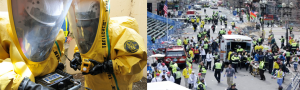
Don’t forget the Biodefense Brown Bag, “WMD” Terrorism? Ricin, Boston, and Beyond, is this Thursday at 1:30PM in the PIA Conference room! Join us for a discussion with the faculty and students from the GMU graduate program in Biodefense. What is ricin? How afraid should we be of bioterrorism? Does ricin count as WMD? What about the pressure cooker bombs used by the Boston bombers? Should the U.S. government really be prosecuting Tsarnaev for using WMD? What are WMD and why does the answer matter?
We will discuss these and other important questions – bring your lunch and bring your questions!
Does indoor residual spraying (IRS) for mosquitos discourage the use of bed nets, as some critics have alleged? A new paper from Pedro Carneiro and others using data from a randomized control trial in Eritrea finds the opposite: IRS actually encouraged net acquisition and use. Carneiro will present the findings and discuss the implications for the wider debate about under what conditions public health interventions crowd out private health investments.
Afghanistan is transitioning from a system in which government provides services to one in which government is the regulator of a changing public health care system and a new emerging private health sector. In the years since the Taliban era ended, the Government of Afghanistan has taken many steps to encourage the development of a market economy and in 2012 its Cabinet passed a law to regulate the private health sector.Since last year, Professor Forzley has been working as a consultant and legal advisor to assist the Afghanistan MoPH to implement the new law in accordance with rule of law and good governance principles. Her presentation will cover a background on Afghanistan, its health system and the new private sector, the main functions of the new law, how procedures and systems are being developed to reflect good governance principle and future planned work.
Thursday, May 9th
“WMD” Terrorism? Ricin, Boston, and Beyond
PIA Conference Room 251, Robinson Hall A, George Mason University
1:30 PM – 3:00PM
Bring your lunch and join us for a discussion on the ricin letters, Boston bombings, and the use of the word “WMD”.
…[T]he U.S. has now inherited one of Russia’s principal threats, Chechen terrorists. The Chechen connection to the Boston Marathon twin IED explosions has thrust U.S.-Russia counterterrorism cooperation back into the spotlight. Did the FBI drop the ball on intelligence provided by Russia on Tamerlan Tsarnaev in 2011 or have Putin’s autocratic actions against Russian dissidents undercut the credibility of his intelligence services? Or both?
On May 10, the Center for Northeast Asian Policy Studies and the Brookings-LSE Project on Internal Displacement will co-host a discussion featuring experts on natural disasters and disaster risk management from the United States and Asia. Panelists representing the private, public, and international sectors will seek to refine some of the topics considered at the Sendai Dialogue. They will identify the lessons learned from 3/11; how these lessons can be applied to overseas economic assistance programs, focusing on DRM; the specific challenges of disaster risk management among Asian countries; and how DRM can be integrated and mainstreamed into development assistance across different platforms.
After each panel, the speakers will take audience questions.
Highlights include the dangerous mixing of H5N1 and H1N1 in a vet lab, developments in the ricin case, the novel coronvirus kills five more, the NYPD’s upcoming bioterror drill, and combating MDR bacteria by giving doctors forms. Happy Friday!
There has been widespread outcry in the scientific community following publication of a Chinese research study in which the scientists recombined H5N1 with the highly infectious H1N1, in a veterinary laboratory. Look, there is gain-of-function research which contributes to vaccine development or a better understanding of the strain’s possible pathogenicity, and then there’s gain-of-function research which is just tempting fate. Even amongst those scientists who admired the difficulty of the experiment, there was criticism – “It’s a fabulous piece of virology by the Chinese group and it’s very impressive,” said Professor Wain-Hobson, a renowned virologist at the Pasteur Institute in Paris, “but they haven’t been thinking clearly about what they are doing. It’s very worrying.” It would be tremendously ironic to be wiped out by a strain of flu created with the purported intention of helping stop us being wiped out by the very same strain of flu.
The Independent – “Senior scientists have criticised the “appalling irresponsibility” of researchers in China who have deliberately created new strains of influenza virus in a veterinary laboratory.They warned there is a danger that the new viral strains created by mixing bird-flu virus with human influenza could escape from the laboratory to cause a global pandemic killing millions of people.”
“Lord May of Oxford, a former government chief scientist and past president of the Royal Society, denounced the study published today in the journal Science as doing nothing to further the understanding and prevention of flu pandemics.’They claim they are doing this to help develop vaccines and such like. In fact the real reason is that they are driven by blind ambition with no common sense whatsoever,’ Lord May told The Independent.”
Following the exoneration of Kevin Paul Curtis, the new suspect in the ricin letters is James Everett Dutschke. Dutschke will face a grand jury in the coming weeks. Investigators linked Dutschke to the case after discovering a dust mask containing traces of ricin and Dutschke’s DNA. For a full analysis of the ricin case, as well as the Boston bombings, and other “WMD” terrorism, check out the GMU Biodefense Brown Bag Event next Thursday.
USA Today – “Agents also revealed that the FBI was granted a search warrant for a location outside Dutschke’s home where he may have stored some of his possessions. Officials said they think a printer tied to the letters is at that location. Magistrate Judge S. Allan Alexander ruled that authorities had enough probable cause to send the case to a grand jury. It’s not clear when one would hear evidence in this case.”
The novel coronavirus hCoV-EMC killed another 5 people in Saudi Arabia, bringing the total number of fatalities to sixteen out of 23 total cases. Although similar to SARS, hCoV-EMC targets the kidney, causing rapid failure. However, unlike SARS, the virus does not appear to transmit well person-to-person.
Al Jazeera – “In a statement cited by the Saudi SPA agency late on Wednesday, the ministry said that all the deaths occurred in the Ahsaa province in the oil-rich eastern region of the kingdom, according to the AFP news agency. Known as novel coronavirus or hCoV-EMC, the virus was first detected in mid-2012 and is a cousin of Severe Acute Respiratory Syndrome (SARS), which triggered a scare 10 years ago when it erupted in east Asia, leaping to humans from animal hosts…the ministry gave no figures for how many people have been examined to see if they have the lethal disease”
The NYPD, in coordination with the Brookhaven National Laboratory, will conduct experiments involving “tracer gases” this summer to monitor their dissipation speed. It is hoped the experiments will lead to better bio- and chemical detection systems. Don’t ask us why the Russian news has the most detailed coverage of this story (joke, little joke).
RT– “The police will use roughly 200 detectors to monitor the gas. Dubbed the Subway-Surface Air Flow Exchange, the test will be the largest of its kind and organized in cooperation with the energy department’s Brookhaven National Laboratory. They’ll use perfluorocarbon tracer gases (PFTs), which are frequently used to measure potential sites for underground construction…’The NYPD works for the best but plans for the worst when it comes to potentially catastrophic attacks such as ones employing radiological contaminants or weaponized anthrax,’ police commissioner Ray Kelly said in a statement”
Apparently introducing extra paperwork is enough to deter doctors from prescribing antibiotics, resulting in a measurable decrease in drug-resistant bacteria in hospitals in just six months. However, by continues education and persuasion, the same decrease in drug-resistant bacteria can be seen within a year. Questions of suggesting extra paperwork as a viable reform measure aside, it makes some sense that the best the way to combat antibiotic resistance would be to start with the doctors.
Reuters – “For the new review, Davey and his colleagues searched medical research databases for high-quality studies that evaluated whether hospital programs to curb the number of antibiotics doctors prescribed worked, didn’t harm patients and reduced the number of drug-resistant bacteria detected or the number of antibiotic-related infections. In the 89 studies from 19 different countries the researchers found, three types of programs were evaluated…Overall, programs that restricted a doctor’s ability to prescribe antibiotics were 32 percent more effective in the first month than those that tried to persuade and educate…After six months, restrictive programs also did a better job at reducing drug-resistant bacteria and antibiotic-related infections, compared to the persuasive programs.”
When: Thursday, May 9th 1:3o – 3:00 PM
Where: Public and International Affairs Conference Room, Room 251, Robinson Hall A, GMU
Join us for Biodefense Brown Bag discussion with the faculty and students from the GMU graduate program in Biodefense. What is ricin? How scared should we be about bioterrorism? Does ricin count as WMD? What about the pressure cooker bombs used by the Boston bombers? Should the U.S. government really be prosecuting Tsarnaev for using WMD? What is WMD and why does the answer matter?
We will discuss these and other important questions – bring your lunch and bring your questions!
For more info email Siddha Hover, shover@masonlive.gmu.edu
This week’s image is brought to you via the ATCC 2013 photo contest. We give you – blood agar! (Twenty points if you can remember which bug prefers this most gruesome of mediums)
image via Marchesan at University of Michigan
Depicted above is “Black-pigmented Porphyromonas gingivalis in blood-agar plates”. This photograph sadly doesn’t look like it has a good chance of winning, but it’s up against some stiff competition (who knew HeLa cells were so cute?) Head over to the gallery and check out the other entries here.
Charles Blair, the Senior Fellow on State and Non-State Threats at the Federation of American Scientists and GMU Adjunct faculty member has been quoted extensively in the news on the unfolding situation in Syria. With President Obama discussing the possibility of US military intervention at this morning’s press conference, the implications of the use of chemical weapons by Assad are starting to ripple across the international community.
(Image credit: Freedom House)
In the last couple weeks Mr. Blair has been quoted, appeared, or penned pieces in CNN, the BBC, Reuters, the New Scientists, Russia TV Cross Talk, Voice of America, NPR, Foreign Policy, and the Christian Science Monitor (all available here). Here’s our favorite excerpt, from a CNN piece published today:
“The Obama administration’s distressing use of a ‘red line’ for tripping unspecified significant action contradicts its long-held belief that intervention in Syria would only make matters worse. In the context of ensuring Syria’s chemical arsenal remains in the custody of responsible parties, the limits to outside intervention are obvious. Absent a massive and prompt invasion by capable foreign forces to secure the hundreds or, more likely, thousands of tons of chemical warfare agents and armed chemical munitions scattered around the al-Assad regime’s shrinking areas of control, the West (including Israel) has limited military options.”
Highlights include the ricin letters case developments, a slew of H7N9 updates (chickens are the reservoirs, it’s popping up in Tawain, and it’s more lethal than previous strains), and we’re mutating H5N1 (again). Happy Friday!
A poultry market in rural China (image via Sonya/Flickr)
All charges have been dropped against Paul Kevin Curtis due to lack of evidence. A second person of interest, Everett Dutschke, has been identified and continues to cooperate with authorities. No charges have been brought against Dutschke, who maintains his innocence. Investigators have not disclosed any new information in the case.
USA Today – “A Mississippi man whose home and business were searched as part of an investigation into poisoned letters sent to the president and others has dropped out of sight in order to escape the news media spotlight, but is cooperating with authorities, a friend and his attorney said. Everett Dutschke, 45, had his home and former business in Tupelo, Miss., searched in connection with the letters, which allegedly contained ricin. They were sent last week to President Obama, Sen. Roger Wicker of Mississippi and earlier to an 80-year-old Mississippi judge, Sadie Holland.”
The first case of H7N9 outside mainland China was recorded this week, with a 53-year old Taiwanese man testing positive for the virus Wednesday. Three healthcare attendants treating the man have also developed “undiagnosed respiratory symptoms” fueling concerns about human-to-human transmission. However, with all evidence currently ruling out human-to-human transmission, it seems more plausible the workers are (understandably) more likely “worried well”. To date, the virus has caused 108 cases with 22 fatalities.
Wall Street Journal – “Taiwan reported the first case of a new form of avian flu found outside China’s mainland on Wednesday and said that three health-care workers who treated the patient had developed undiagnosed respiratory symptoms, raising concerns over the virus’s potential for spreading by human-to-human contact. At a news conference earlier in the day in Beijing, global health officials stressed that there had been no confirmed cases of transmission of the virus, called H7N9, between humans. However, they said, researchers were still struggling to understand how the virus was spread and hadn’t ruled out the possibility of human-to-human transmission.”
In his testimony before the WHO, one of the world’s top H7N9 experts has praised China’s response to the emergent flu strain while simultaneously cautioning against it’s lethality.
Post Bulletin – “A new strain of bird flu that emerged in China over the past month is one of the ‘most lethal’ flu viruses so far, worrying health officials because it can jump more easily from birds to humans than the one that started killing people a decade ago, World Health Organization officials said Wednesday. Scientists are watching the virus closely to see if it could spark a global pandemic but say there is little evidence so far that it can spread easily from human to human.”
Chickens have been identified as the reservoir of the new H7N9 strain of flu. China’s closing of its open-air poultry markets soon after the strain’s emergence has been accredited with the decrease in case numbers. However, scientists remain uncertain as to the strain’s exact mechanism of spread, as a number of cases have had no contact with poultry.
Reuters – “Chinese scientists have confirmed for the first time that a new strain of bird flu that has killed 23 people in China has been transmitted to humans from chickens. In a study published online in the Lancet medical journal, the scientists echoed previous statements from the World Health Organization (WHO) and Chinese officials that there is as yet no evidence of human-to-human transmission of this virus. The H7N9 strain has infected 109 people in China since it was first detected in March. The WHO warned on Wednesday that this strain is ‘one of the most lethal’ flu viruses and is transmitted more easily than the H5N1 strain of bird flu, which has killed hundreds around the world since 2003.”
In a study that will no doubt reignite the gain-of-function research debate, scientists have determined that a laboratory-mutated strain of H5N1 has a much stronger human-cell binding affinity than the wild-type virus. Should we be doing this research in the first place? Do the benefits of being more prepared for a pandemic outweigh the costs of potentially causing the pandemic?
Medical Express – “An international team of bio-researchers has found that a mutant strain of the H5N1 influenza virus (created in a lab) has a 200-fold preference for binding with receptors in human cells, over those found in birds. In describing their research and conclusions in their paper published in the journal Nature, the researchers suggest that the mutant variant is much more like the strains of viruses that caused pandemics in 1918, 1957 and 2009, than it was in its native state.”
Dr. Greg Koblentz, the Council on Foreign Relations Stanton Nuclear Fellow and GMU Biodefense’s Deputy Director, was recently featured in a number of pieces on Syria and Iran.
Dr. Koblentz was quoted in the French periodical, Le Point, in which he discussed the degree of independent confirmation needed to determine the use of chemical weapons, and the unique difficulties for doing so in Syria, due to the ongoing hostilities. Read the full article here (in French). He echoed these sentiments in a USA Today piece on Israeli intelligence regarding Syrian use of chemical weapons (available here).
“‘The size of Iran’s stockpile of 20 percent [highly enriched uranium] is worrisome because it is much easier to enrich 20 percent to 90 percent than five percent to 20 percent,’ says Gregory Koblentz, a nuclear security expert at the Washington-based Council on Foreign Relations. ‘So if Iran decided to build a bomb, it would be able to do so much more quickly if it is sitting on a large quantity of 20 percent than five percent Uranium-235.'”
Red blood cells vs Bacillus anthracis, now in technicolor! More from Microbiology & Immunology – “A newly developed drug, modeled after a bacteriophage, is less likely to encounter antibiotic resistance. The drug mimics cell-wall busting viral enzymes called lysins. Viral lysins appear to resist bacterial evolution that would render them ineffective over time. The new drug, dubbed Epimerox, was tested against Bacillus anthracis.”

 The symposium will bring together experts the government, academic, and industry spheres, including from the National Security Staff, Department of Homeland Security, Department of Defense, and the Department of Energy, to discuss the the policy, operations, acquisition, and technical challenges associated with nuclear and radiological threats facing the United States today.




 The Pandora Report