Synthetic biology has led to the creation of new products, markets, companies, and industries. At the same time, this technology poses potential risks to biosafety and biosecurity, as recently demonstrated by the synthesis of horsepox virus, a cousin of variola, the virus that causes smallpox. On January 29-30, 2018, the Department of Homeland Security (DHS) Science and Technology Directorate sponsored a workshop to discuss the evolving role of databases that contain genetic sequences of pathogens and toxins that pose safety or security concerns, termed “sequences of interest.” The workshop brought together stakeholders from government, industry, and academia to discuss the need for such databases, review current databases and those under development, explore potential applications and users of these types of databases, and consider the potential risks that they pose due to malicious or inadvertent misuse. Continue reading “Topics of Interest at the DHS Meeting on Sequences of Interest”
Category: Commentary
The Synthesis of Horsepox Virus and the Failure of Dual-Use Research Oversight
On January 19, 2018, the open access scientific journal PLOS One published an article that describes the de novo synthesis of horsepox virus, the first ever synthesis of a member of the orthopoxvirus family of viruses that includes the variola virus that causes smallpox. As I have written about before, this research crosses a red line in the field of biosecurity. Given the high degree of homology between orthopoxviruses, the techniques described in this article are directly applicable to the recreation of variola virus. The synthesis of horsepox virus takes the world one step closer to the reemergence of smallpox as a threat to global health security. That threat has been held at bay for the past 40 years by the extreme difficulty of obtaining variola virus which has been eradicated from nature and is only known to exist in two WHO-designated repositories.
The reemergence of smallpox would be a global health disaster. Prior to its eradication, smallpox killed an estimated 300 million people, more people than all the wars of the 20th century combined. Most of the world’s population is susceptible to this lethal and contagious disease since routine immunization against smallpox was discontinued after the success of the WHO’s global eradication campaign.
Continue reading “The Synthesis of Horsepox Virus and the Failure of Dual-Use Research Oversight”
GMU Biodefense Visits DARPA
By Janet Marroquin
One of the many advantages of being a student in the Schar School of Policy and Government at GMU is having the unique opportunity to go on a field trip to the Biological Technologies Office (BTO) of the Defense Advanced Research Projects Agency (DARPA)! Dr. Andrew Kilianski graciously arranged a visit to the facility, located less than a mile away from Founder’s Hall, for a portfolio briefing to provide insight to real-world application of the themes explored in his Biosurveillance class (BIOD 751 for those of you interested).
Team members supporting Col. Matthew Hepburn, one of the nine program managers at the BTO, briefed in great detail about the mission at DARPA, project selection and development, and the role that Scientific, Engineering, and Technical Assistance (SETA) team members play in the day-to-day operations of the Col. Hepburn’s BTO portfolio..
The mission at DARPA is consequential to its name: “creating breakthrough technologies and capabilities for national security.” Within the BTO, Program Managers strive to develop cutting-edge biotechonologies that are 10-15 years into the future and can provide innovative support to the military and civilians alike. These projects range from surveillance tools to diagnostics and therapeutics, using futuristic mechanisms such as a dialysis-like purification of pathogen-infected blood or unobtrusive nanoplatforms that continuously monitor the physiological state of the patient for the detection of infectious disease. For the Program Managers, the challenge is not envisioning the innovative biotechnology but rather the pre-emptively assessment of risk for these projects, which is particularly a problem for biologics. With increased innovation may come increased risk, hence the highly selective process in hiring each Program Manager and the assembly of their skilled teams.
Another challenge that comes to mind in thinking about cutting-edge biotechnology is addressing the dual-use dilemma. While BTO projects do not involve working with select agents or particular pathogens, the security implications of manipulating in vivo nanoplatforms or other platform technologies for nefarious purposes should be considered. Rapidly advancing technology demands a strong security policy that is prepared to address dual-use research intentionally being developed ahead of its time. Just as health risks are effectively evaluated by a highly skilled team of scientists, so should security risks be managed by a skilled team of biodefense experts.
As a biodefense student, it was exciting to witness the wonders at the BTO and to get a glimpse of the future in biotechnology. For those unable to visit DARPA in the near future, all of Col. Hepburn’s projects are open-source and descriptions are available on the BTO website. As I previously stated, the Schar School is full of unique opportunities to GMU students and to faculty alike, so as such, we should take full advantage!
Trump’s Biodefense Strategy: Naughty? Nice? M.I.A?
By Janet Marroquin
At the Aspen Security Forum this past July, homeland security adviser Thomas Bossert reassured the country that the White House would fill the void of a comprehensive biodefense strategy “as soon as we can.”
Under the Biodefense Strategy Act signed into law in December 2016, the Trump administration is required to produce a new strategy for biodefense as a joint endeavor by the secretaries of Defense, Health and Human Services, Homeland Security, and Agriculture. This congressional requirement solicited an initial briefing on the strategy no later than March 1, 2017 and a formal strategy due to Congress no later than 275 days after December 23, 2016. More than nine months past due, we may finally have been given a small sneak preview of biodefense policy within the US National Security Strategy. Unfortunately, as the year comes to a close, there is still no mention of an anticipated release date and biodefense experts are left wondering about the future contours of biodefense strategy.
Upon examination of the proposed FY 2018 federal budget, the initial outlook for biodefense did not look very good. The significant decrease in federal spending on public health agencies suggested a decrease in priority for public health and thus a decrease in health security. According to the Congressional Review Service, the proposed budget for the CDC in FY 2018 represents a decline of 17% from the estimated FY 2017 budget. Biodefense-related programs within the CDC all saw a negative trend in spending compared to the estimated budget allocated this year, regardless of previously rising or declining trends.
| Program | 2016 Budget
(in Million Dollars) |
2017 Estimated Budget (in million dollars) | 2018 Proposed Budget (in million dollars) |
| Emerging & Zoonotic Diseases | 582 | 585 | 514 |
| Public Health Scientific Services | 491 | 489 | 460 |
| Global Health | 427 | 435 | 350 |
| Public Health Preparedness & Response | 1413 | 1405 | 1266 |
| CDC-wide Activities | 411 | 274 | 105 |
Similarly, NIH saw a decline of 21.5% in federal spending for FY 2018, with the National Institute of Allergy & Infectious Diseases (NIAID) also experiencing a steep decline in funding despite a previously positive trend.
| Program | 2016 Budget (in million dollars) | 2017 Estimated Budget (in million dollars) | 2018 Proposed Budget (in million dollars) |
| NIAID | 4750 | 4907 | 3783 |
An important reform present in the proposed FY 2018 Federal budget is the call to dismantle the Academic Centers for Public Health Preparedness under the CDC and the distribution of its funds among state governments to support state-led public health preparedness. Interestingly, this action seems to contradict expert recommendations to the federal government for the development of a centralized approach to health security.
The initial budget proposal also called for closing the National Biodefense Analysis and Countermeasures Center (NBACC). Fortunately, it is Congress that controls the purse strings and has the last say in the finalized federal budget. Heavy lobbying by scientists and law-enforcement resulted in amendment of the proposal to reverse the September 2018 closure of NBACC, thus exhibiting the powers at play and illustrating the influence that various stakeholders have in biodefense policy.[1]
Furthermore, there is still some good news for the biodefense budget. In spite of the proposed cuts to NIH and the CDC funding, there is no proposed change in federal spending for BARDA and there is even an increase of about 3% on pandemic influenza programs, underscoring a support for public health emergency funds and DoD measures against biological threats.[2] It is also imperative to keep in mind that the proposed federal budget is only representative of priorities for the fiscal year 2018 and is not necessarily indicative of an overarching biodefense strategy. As such, non-fiscal factors must also be considered.
Recent U.S. participation in the Global Health Security Agenda confirms support for global health security, contrary to the proposed decrease in global health spending under the CDC for FY 2018. At the United Nations General Assembly, President Trump expressed approval of the GHSA in his remarks to African leaders, “we cannot have prosperity if we’re not healthy. We will continue our partnership on critical health initiatives.” On that note, Secretary of State, Rex Tillerson, praised the Agenda and extended support a few weeks prior to the GHSA Summit in Kampala, “while we’ve made tremendous progress since GHSA was launched in 2014, considerable work remains. That is why the United States advocates extending the Global Health Security Agenda until the year 2024.”
Biodefense scholars have expressed concern about the Trump Administration’s ability to develop an effective, coherent strategy in light of political division between and within parties, budget cuts to biodefense-related agencies, and the administration’s general anti-science attitude.[3] Though it remains unclear of what the Trump Administration will include in the new biodefense policy, recommendations from various advisory councils such as the President’s Council of Advisors on Science and Technology, the National Security Council, the Blue Ribbon Study Panel on Biodefense and the Presidential Advisory Council on Combating Antibiotic-Resistant Bacteria, all seem to have the following items on their holiday wish list for biodefense strategy:
- A single, centralized approach to biodefense (i.e. a federal council dedicated to coordinating efforts against biological threats)
- A comprehensive strategy that encompasses human and animal health (i.e. One Health)
- An interdisciplinary approach to health security, inclusive of all stakeholders (i.e. policy makers, scientists, health experts, etc.)
- Defense against both global and domestic biological threats
- A proactive policy preventing the misuse/abuse of advancing biotechnology
The new National Security Strategy supports an international, One Health approach to biosurveillance, biomedical innovation, and improved emergency response in “protecting the homeland and the American people”. Accordingly, the administration must now produce a biodefense strategy that effectively protects the American people from biological threats. May the force be with the secretaries of Defense, Health and Human Services, Homeland Security, and Agriculture in granting us a unified and comprehensive biodefense strategy!
REFERENCES
[1] Kirby, “The Trump’s administration’s misaligned approach to national biodefense,” 386.
[2] U.S. Department of Health and Human Services. Office of the Assistant Secretary for Preparedness and Response, “Fiscal Year 2018 Budget-in-Brief: Public Health and Social Services Emergency Fund,” Accessed December 17, 2017, https://www.phe.gov/about/ofpa/Documents/bib-2018.pdf
[3] Kirby, Reid, “The Trump’s administration’s misaligned approach to national biodefense,” Bulletin of the Atomic Scientists 73, no. 6 (November 2017), 382-383.
Blue Ribbon Study Panel on Biodefense. A National Blueprint for Biodefense: Leadership and Major Reform Needed to Optimize Efforts – Bipartisan Report of the Blue Ribbon Study Panel on Biodefense. Hudson Institute: Washington, DC, October 2015.
Hourihan, Matt and David Parkes. “Deep Cuts for NIH, Other Life Sciences in FY 2018 Budget Plan.” June 15, 2017. https://www.aaas.org/news/deep-cuts-nih-other-life-sciences-fy-2018-budget-plan
National biodefense strategy, U.S. Code 6 (2016), §104.
Watson, Crystal, Matthew Watson, Tara Kirk Sell. “Federal Funding for Health Security in FY2018.” Health Security 15, no. 4 (August 2017): 351-372. https://doi.org/0.1089/hs.2017.0047
U.S. Congress. Senate. Committee on Homeland Security and Governmental Affairs. Biodefense Strategy Act of 2016 (to Accompany S. 2967). 114th Cong., 2d sess., 2016. S. Rep. 114-306. I-12. https://www.congress.gov/114/crpt/srpt306/CRPT-114srpt306.pdf
U.S. Library of Congress. Congressional Research Service. Public Health Service Agencies: Overview and Funding (FY2016-2018), by C. Stephen Redhead, Agata Dabrowska, Erin Bagalman, Elayne J. Heisler, Judith A. Johnson, Sarah A. Lister, and Amanda K. Sarata. R44916. 2017.
U.S. Department of Health and Human Services. Office of the Assistant Secretary for Preparedness and Response. “Fiscal Year 2018 Budget-in-Brief: Public Health and Social Services Emergency Fund.” Accessed December 17, 2017. https://www.phe.gov/about/ofpa/Documents/bib-2018.pdf
Potential Role of Social Media in Combatting Antimicrobial Resistance
By Janet Marroquin
Experts from around the world have been sounding the alarm on the rise of antimicrobial resistance (AMR) for years, declaring that with the current trend, previously preventable diseases will claim up to 10 million deaths annually by 2050. As governments and international agencies take heed and create formal strategies to combat AMR, audiences outside of biology and medicine are starting to join in the conversation. NowThis, a popular video-based news outlet on social media, released a 90-second video dedicated to a “post-antibiotic apocalypse” on October 17th. In addition to introducing the rising trend of antimicrobial resistance, the video touches on stewardship, international efforts (or lack thereof) against AMR, and “phone apps that…could be a game changer.” The video is formatted as more of a fact-listing slideshow than a traditional news article and the data presented provides the viewer with a fair snapshot of the current AMR threat.
In this era of fake news, the credibility of articles circulating on social media can be dubious, particularly when citations are not readily available. Further investigation of the statistical data used in the video yielded mixed results. The widely circulated figure of 10 million deaths from previously preventable diseases per year by 2050 stemmed from the Review of Antimicrobial Resistance, a 2014 report published by a team of AMR experts at the request of then UK Prime Minister David Cameron. Since the publication of this report, this figure has been used by other experts, policy-makers, and news media to shed light on the extent of the current AMR threat. Such a strong prediction however, is bound to be met by skepticism. A PLOS article called into question the ability of scientists to realistically forecast the global impact of AMR in the decades to come. According to the article, the 10 millions annual deaths figure is erroneously used without the stated caveats and contextual informationwould reinforce its credibility. De Kraker, Stewardson, and Harbarth explain that the projections leading to the figure were based on four hypothetical scenarios that do not take into account disparities in public health across countries with varying degrees of economic status and urban development and that would likely affect the international impact of AMR in 2050. The authors conclude with the acknowledgement that current forecasting methods are still limited and calls for further research to develop improved models to estimate the anticipated global morbidity and mortality burden if AMR is left unchecked.
The video also stated that 85% of countries have started action plans to combat AMR, but only 5% have financed these plans. This data is most likely taken from a May 2017 WHO estimate that about 2/3 of member countries, in which 85% of world’s population resides, had completed or were in the process of developing their national action plans against AMR, a request set forth by the WHO Global Action Plan issued in 2015. It may be important to note the percentage of countries combating AMR rather than the proportion of the global population that they inhabit as many of the remaining countries without action plans have fragile infrastructures that cannot support AMR efforts, thus illustrating the need for the international community to join forces in a globalized effort to fight antibiotic resistance.
Although the dissection of the data used in the NowThis video revealed a few inconsistencies, the attention that a 90-second video can bring to various aspects of AMR to the general public is significant. As of November 6, 2017, the video has had 2.1M views and has been shared by 12,333 users on Facebook, retweeted by 175 users on Twitter, and has been featured on news sites. Interestingly, a few days after the release of the NowThis video, NBC News MACH published an online news article addressing the “post-antibiotic apocalypse.” The article described the development of alternatives to antibiotics such as bacteriocins, bacteriophages, pathogen genotyping, and addressing the need to combat AMR through novel drug development in light of the current antibiotic drought precipitating antibiotic resistance. In another instance of social media being used to in the fight against AMR, antimicrobial stewardship programs have used Facebook and Twitter to increase awareness of AMR amongst internal medicine residents. In case anyone else is interested in joining the Facebook and Twitter AMR campaigns, the CDC has even provided sample posts and messages to help spread the word. The power of social media is just beginning to be harnessed to raise awareness and promote healthy habits and antibiotic stewardship on a personal level.
Janet Marroquin is a first-year graduate student in the GMU Biodefense MS program. Janet graduated from the George Washington University with a Bachelor of Arts in Speech and Hearing Sciences with a premedical concentration. Her research interests include antimicrobial resistance, drug innovation program analysis, and infectious diseases. Janet hopes to use her medical interests to focus on emerging infectious disease preparedness in global health security.

Next Generation Global Health Security Network Reflections
We’re pleased to present the reflections from those attending the GHSA Ministerial Meeting in Kampala, Uganda. Next Generation Global Health Security Network Coordinator Jamechia D. Hoyle provides a comprehensive look at not only the meeting, but also the future of the GHSA. Following her reflections, you can also find thoughts and summaries from those NextGen and George Mason Global Health Security Ambassador Fellowship participants.
Jamechia D. Hoyle – Coordinator, Next Generation Global Health Security Network
On October 25-27th, the Ugandan Government hosted the 4th Global Health Security Agenda (GHSA) High-level Ministerial Meeting in Kampala, Uganda – the first Ministerial Meeting on the African continent. The meeting was called to order during a time where health security professionals were addressing a plague outbreak in Madagascar and a local Marburg outbreak in the host country, Uganda. This alone was a vivid reminder that health security must remain a priority.
Many high-level officials from the host country, including President Yoweri Museveni, welcomed delegates the Uganda and reaffirmed their commitment to health security. The conference was well attended by the member nations, the private sector, non-governmental organizations and the Next Generation. GHSA membership continues to expand with a noted increase to 63 member countries with the addition of Nigeria and the Philippines. Hopefully, the trend will continue until the GHSA membership mirrors the membership of the World Health Organization.
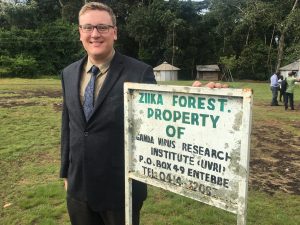 Please see the attachment for reflections from the wide array of participants in the GHSA Ministerial Meeting in Kampala, Uganda.
CARB-X: Fighting AMR through Public-Private Partnerships
By Nick Guerin
The world is fast approaching a day when our fundamental medicines are rendered ineffective by antimicrobial resistance (AMR). AMR kills hundreds of thousands every year with a potential for millions more in the coming decades if nothing is done. One possible protection against AMR is the development of new medical countermeasures (MCMs). The strategies to find the best MCMs crisscross multiple organizations and functions, namely through either public or private initiatives. However, such divided efforts create limitations that might best be overcome through comprehensive public-private collaborative efforts.
What is AMR?
The Centers for Disease Control and Prevention (CDC) defines antimicrobial resistance as “the ability of microbes to resist the effects of drugs – that is, the germs are not killed, and their growth is not stopped.”[1] Antibiotic use creates the inevitable spread of AMR; inadequate prescriptions, misuse, overuse, and other factors enable microbes that survive antibiotic use to spread their genetic traits (drug resistance) to later generations. In the United States, AMR causes 2 million infections and 23,000 deaths annually,[2] while globally AMR death rates surpass 700,000 deaths each year. By 2050, the global rate could climb to 10 million annually if no MCMs (countermeasures) are successful in stemming the threat.[3]
Past Approaches & Failures
The perils of AMR are well documented and understood, so what development and response capability should we expect to see? Governments and private organizations invest hundreds of millions of dollars and decades of man hours searching for the latest breakthrough against AMR. However, each has encountered limitations to their functional capabilities.
Private
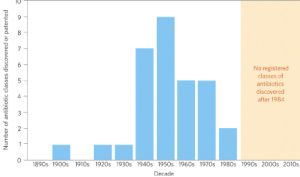
Private medical enterprises often find themselves at the forefront of medical innovation. The financial characteristics of antibiotic research motivate private sector AMR research and development. The current antibiotic market remains stocked with decades old drug developments or minute variations to existing antibiotics (see Figure 1).[i][4]
Despite the financial incentive, ambiguity over profit hinders antibiotic research in large pharmaceutical companies. For example, GlaxoSmithKline is closing in on producing one of the first new antibiotics in over thirty years. However, the company remains immensely uncertain over its ability to turn a profit due to repeated changes in AMR research demands, including greater requirements for broad-spectrum antibiotics. The economic uncertainty associated with developing new MCMs to combat AMR drove another major pharmaceutical company, AstraZeneca, out of the antibiotic market all together in 2016.[5]
Further financial disincentives impact MCM efforts against Gram-negative bacteria such as carbapenem-resistant Enterobacteriaceae (CRE), an AMR type public health officials label an issue of immediate concern. Only half of the roughly three dozen antibiotics in development by private initiatives are capable of fighting Gram-negative bacteria. Moreover, whereas the financial burden often hinders the largest of pharmaceutical companies, it outright prevents small biotech businesses from accumulating the necessary capabilities to confront these new biothreats.[6]
Public
The government prepares for the defense of the nation’s health from bioterrorism and natural outbreak events through the acquisition and stockpiling of MCMs. Unlike the private sector that acts based on profit seeking, the government can absorb the financial liabilities of broad funding approaches. The federal government coordinates MCM development and strategy through the interdepartmental Public Health Emergency Medical Countermeasures Enterprise (PHEMCE).
The PHEMCE primarily induces private MCM research through Project BioShield and the Biomedical Advanced Research and Development Authority (BARDA). Created in 2004, Project Bioshield sought to address the needs and concerns of the private sector for a stable and guaranteed market by creating artificial markets for MCM development.[7] However, after BioShield failed to achieve success, the government organized the PHEMCE in 2006 with BARDA specifically founded to address BioShield’s limitations. A primary goal of BARDA is to bridge the “Valley of Death” (See Figure 2),[ii] the gap between pre-clinical development in NIH and the final procurement funding from BioShield. Specifically related to the realm of antibiotics, BARDA removed restrictions that prevented research and development into broad-spectrum antimicrobial solutions. Despite being a successful program overall, BARDA still has room for improvement. Small businesses are awarded most BARDA contracts yet they often lack the capabilities necessary for AMR development.[8] As a result, BARDA is forced to implement repeated course corrections to sway large pharmaceutical companies into the high-risk world of AMR development.
Collaborative Partnerships
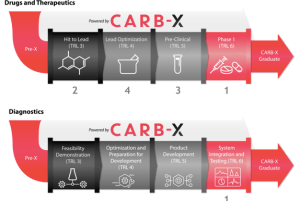
Active collaboration portends the best solution to gaps in private and public forms of AMR MCM research. Possibly the most complete and far reaching public-private collaboration in the field of AMR research is the Combating Antibiotic Resistant Bacteria Biopharmaceutical Accelerator(CARB-X), a large-scale cooperative program between multiple government agencies and leading private national and international biotech, pharmaceutical, and advanced research enterprises. Specifically designed to counter the gaps of individualized private and government efforts to combat AMR, CARB-X focuses on preclinical discovery development of AMR MCMs by using government and private biopharmaceutical research partners to identify and accelerate key antimicrobial products through the risk-sodden safety and efficacy testing phases that traditional market incentives obstruct[9] (See Figure 3 for CARB-X’s Process Snapshot).[iii]
BARDA’s partnership has already funded $30 million out of a possible 5-year, $250 million dollar contract, with accelerator partners like the AMR Centre funding $14 million out of a possible $100 million. In less than a year, CARB-X’s portfolio of nearly one dozen development partners created a pipeline of 11 products, four of which are already in the pre-clinical stage.[10] One of those, Tetraphase Pharmaceuticals’ TP-6076 novel antibiotic, has already moved to Phase 1 studies (See Figure 4 for the CARB-X Pipeline).[iv] While much remains to be done, the success of a truly start to finish private-public collaborative effort demonstrates the progress such programs are cable of in the highly stagnant field of antibiotic development.
We only need to look to our European allies to see how comprehensive models of collaborative agreements create turnarounds in AMR pharmaceutical production. The European Union sponsors its own large-scale public-private AMR partnership, the New Drugs for Bad Bugs program. A €650 million investment has nearly tripled the number of large European pharmaceutical companies engaged in AMR research (from 4 to 11). Concrete results of the public-private collaborations include the first ever AMR phage therapy trials and the operation of AMR detection networks similar to those in the U.S.[11]
AMR’s threat demands expedient solutions; the decade’s long wait for new antibiotics cannot continue. AMR poses one of the most difficult development requirements for these new MCMs, one that public and private sectors haven’t overcome on their own. Early progress in collaborative AMR solutions, both home and abroad, reveal that such efforts are the best way to fight the AMR threat.
References
[1] Centers for Disease Control and Prevention, “About Antimicrobial Resistance” https://www.cdc.gov/drugresistance/about.html
[2] CDC, “About Antimicrobial Resistance”
[3] Line Matthiessen, Richard Bergström, Shiva Dustdar, Pierre Meulien, and Ruxandra Draghia-Akli, “Increased Momentum in Antimicrobial Resistance Research,” The Lancet (British edition), (August 2016), pp. 865.
[4] Carolyn K. Shore and Allan Coukell, “Roadmap for Antibiotic Discovery,” Nature Microbiology, (May 2016), np. https://www-nature-com.mutex.gmu.edu/articles/nmicrobiol201683
[5] Stephanie Baker, “Why Superbugs Are Beating Big Pharma,” Bloomberg, (September 2016). https://www.bloomberg.com/news/articles/2016-09-21/inside-the-10-year-1-billion-battle-for-the-next-critical-antibiotic
[6] Natalie McGill, “As Antibiotic Resistance Rises, so do Research, Development.” The Nation’s Health, Vol. 46, Iss. 8 (October 2016), pp. 14.
[7] Robert Kadlec, “Renewing the Project BioShield Act What Has It Bought and Wrought?,” Center for New American Security, (January 2013), pp. 1-16. https://www.bio.org/articles/renewing-project-bioshield-act
[8] Jonathan Tucker, “Developing Medical Countermeasures: From BioShield to BARDA,” Drug Development Research, Vol. 70, Iss. 4 (June 2009), pp. 224–233.
[9] HHS Forges Unprecedented Partnership to Combat Antimicrobial Resistance,” Targeted News Service (July 2016)
[10] “HHS Forges Unprecedented Partnership”
[11] Matthiessen, Bergström, Dustdar, Meulien, & Draghia-Akli, “Increased Momentum,” pp. 865
[i] Figure 1: Timeline of Novel Antibiotic Discoveries
https://www-nature-com.mutex.gmu.edu/articles/nmicrobiol201683
[ii] Figure 2: Valley of Death https://sigs.nih.gov/RACD/Lists/Calendar/Attachments/8/NIH_CC_19Nov2013.pptx
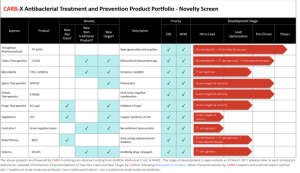
[iii] Figure 3: CARB-X Process http://www.carb-x.org/portfolio
[iv] Figure 4: CARB-X Product Pipeline http://www.carb-x.org/portfolio
Fostering an International Culture of Biosafety, Biosecurity, and Responsible Conduct in the Life Sciences
Second-year, GMU biodefense PhD candidate, and intern for the Department of Health and Human Services, Assistant Secretary for Preparedness and Response within the Office of Policy and Planning, Elise Rowe, is taking on the international role of biosafety! As part of the student internship program, all interns are required to work on an independent project and present to ASPR staff upon its completion. Elise will be presenting her project, titled “Fostering an International Culture of Biosafety, Biosecurity, and Responsible Conduct in the Life Sciences,” on Wednesday, April 5th at the Thomas P. O’Neil Jr. Federal Building from 2-3:30 pm.
The abstract for her project is below: Continue reading “Fostering an International Culture of Biosafety, Biosecurity, and Responsible Conduct in the Life Sciences”
ASM Biothreats 2017
 GMU Biodefense sent four graduate students to give you a “boots-on-the-ground” viewpoint for the 2017 ASM Biothreats conference. In our special edition post we have a full range of coverage for this three-day conference on biological threats and safety.
Zach Goble is looking at international collaboration against biological threats and the importance of recognizing foreign organizations for their help in aiding research endeavors. Next, he looks to the symposium on national bioterrorism emergency response. Pointing to the work done by different states and the proposed model by David Ladd, he emphasizes that these are definite steps in the right direction, but will need continued work.
Greg Mercer reviews the panel session “Predicting Emergence by Understanding the Past: Methods that Move Us Towards Predictive Biology“. In his overview of this panel on efforts to get ahead of the evolutionary curve, Greg discusses each speaker and their contributions to the field, as well as where they think the future will take us.
Stephen B. Taylor covers Dr. Fauci’s talk on pandemic preparedness and his experience throughout the years. In this overview, Dr. Fauci points to the unique challenges that followed each health crisis and how certain administrations responded. Stephen also takes us through the melioidosis panel regarding this neglected tropical disease. He notes the high cost of treatment and the inability for most endemic countries to support response and prevention efforts.
HyunJung (Henry) Kim– takes us on a journey through the FDA Animal Rule and its path to success. Henry uses this plenary sessions to discuss the PEP, PrEP, and Passive Transfer aspects of animal modeling.
Predicting Emergence by Understanding the Past: Methods that Move Us towards Predictive Biology
By Greg Mercer
I attended ASM BioThreats 2017’s panel “Predicting Emergence by Understanding the Past: Methods that Move Us towards Predictive Biology,” where a panel of researchers presented their recent efforts to get ahead of the evolutionary curve and anticipate new developments in infectious disease.
Marco Vignuzzi, of the Pasteur Institute, described his efforts to monitor, predict, and target RNA virus evolution. RNA viruses mutate constantly; any response to them must into account incremental changes and variations. Vignuzzi described a large population of many low-frequency mutants as a quasi-species or “cloud.” One can sequence the average genetic profile of this cloud, known as the “consensus sequence.” This population exists across a fitness landscape, ranging from well-adapted to poorly-adapted. The natural evolutionary tendency of a fast-mutating RNA virus is to “climb” this landscape to the highest possible fitness—this is the most successful disease. But Vignuzzi suggests that a virus could be artificially altered to undergo exactly the wrong mutations, making it less fit and causing it to die off. Exactly how to do this remains a mystery, but it’s an exciting possibility.
Barbara Han, of the Cary Institute of Ecosystem Studies, presented her research on machine learning for forecasting zoonotic disease. Han takes a macro-ecological approach to disease, focusing on hosts. Factors like biodiversity and population density affect disease rates, so understanding zoonotic diseases means collecting a great deal of information about the animals that carry them. This information tends to be collected based on specific concerns about animal reservoirs; Han noted that since bats are a suspected reservoir for Ebola and other diseases, there’s been a massive surge in surveillance. It turns out, though, that they carry fewer zoonoses than we might expect. Right now, Han is studying bats to try to identify instances where viruses might spill back into bat reservoirs from human populations, making outbreaks harder to stop. She is also working with data about the health of rodent populations, with the hypothesis that lower biodiversity in a particular area will put humans at a higher risk for a spillover.
David O’Connor, from the University of Wisconsin-Madison, is looking at viruses that aren’t on the radar yet, though maybe they should be. O’Connor examines animal species to find traits that make spillover events likely. Specifically, he presented the theory that simian arteriviruses might be to blame for the mysterious simian hemorrhagic fever. There’s not enough information to know for sure without another outbreak, but O’Connor argues that there is enough information at our disposal to begin to make predictions “to the left of the surveillance curve,” and target surveillance at diseases that aren’t yet a top threat, but could emerge as one.
 The Pandora Report