Commentary – Systematizing the One Health Approach in Preparedness and Response Efforts for Infectious Disease Outbreaks


By Michelle Grundahl, Biodefense MS Student

We can use a One Health approach to improve our next pandemic response to actually strengthen global health security – and we can choose to systemize and globalize right now.  One Health is a collaborative, multisectoral, and transdisciplinary approach — working at the local, regional, national, and global levels — with the goal of achieving optimal health outcomes recognizing the interconnection between people, animals, plants, and their shared environment. The objective of this workshop – offered by The Forum on Microbial Threats of the National Academies of Sciences, Engineering, and Medicine – was to confront our emerging health threats through systematizing and integrating the One Health approach. Systematizing is defined as arranging an organized system; to make systematic. Living through the current pandemic required us to perform outbreak detection and response to SARS-CoV-2, but prevention and preparedness is actually what we should be doing prior to outbreaks. Topics in this workshop included integrating One Health into existing coordination mechanisms (into national action plans for health security) and integrating animal and human health surveillance systems.  Essentially, this new paradigm in biodefense will create a framework across sectors and bring order among disparate expertise. The adopters of One Health are ready for the challenge.

Should we create a National Pathogen Surveillance and Forecasting Center for biological threats? Pandemic prediction, prevention, and policies are our next step in responding to the current SARS-CoV-2 pandemic. Medical countermeasures are useful during outbreaks but perhaps it would be better to truly mitigate global health threats, and even prevent them. We can achieve global health security through relationship building and lateral leadership. Two themes were repeated during the workshop: (1) future public-private collaboration must happen and (2) strong health systems are needed (globally and locally).

Day one of the workshop focused on the practices of existing programs and how these could improve the current model for global public health responses. The Africa CDC provided their lessons from COVID-19 and they stressed the continued importance of using a holistic approach to health threats. Specifically, the creation of a new framework for the African continent – Framework for One Health Practice in National Public Health Institutes – recognizes that other countries are frequently hampered by siloed health systems. The African Framework explains that the World Health Organization (WHO), the Food and Agriculture Organization of the United Nations (FAO), the World Organisation for Animal Health (OIE), and Sustainable Development Goals (SDGs) call for a One Health approach in order to comply with the 2005 International Health Regulations (IHR).

Back in the United States, we learned about the activities at Harris County (Texas) Public Health office. They explained their operational approach using One Health practices. An example given was the removal of old tires (mosquito breeding grounds) to combat Zika. Another was their response to Hurricane Harvey when they sheltered people and their pets together. Most recently, Harris County did surveillance of SARS-CoV-2 in pets.

On day two, the sessions tackled the urgency of a One Health approach and how it can be applied immediately. The development of a One Health workforce is one path forward. Dr. Lonnie King suggests that we should value a “T-shaped worker who has a deep understanding and high proficiency in one area with the skills to work collaboratively and respectfully across disciplinary lines for synergistic problem-solving.” In fact, USAID has a workforce project to do just this. An example, Africa One Health University Network (the latest effort in this USAID project) is creating a competent future workforce by developing multi-skilled students, who can work outside of silos. Universities can integrate systems thinking and encourage collaboration across disciplines. Woutrina Smith reminded the audience that social context is important, too; we cannot forget to incorporate the social sciences into traditional science to effectively create solutions using the data that we generate. Transdisciplinary thinking is essential.

Day three looked at the future of One Health with the experience of SARS-CoV-2 in mind. Biosurveillance using shared international data would create the ability to better forecast outbreaks. This will require cooperation through public-private partnerships, along with policy changes. The workshop suggested the goal of building a “broad, threat-agnostic global health system.”  This includes learning from the past to determine future capabilities. Collaboration across disciplines, sectors, and communities can enhance the detection of threats. Surveillance is key here. Realistically, it is unfeasible to collect and monitor all global health data.  Local, national, and international epidemiological surveillance systems are still needed though. They should be designed (and refined) with One Health in mind. The session on “Precision Epidemiology, Human Behavior, and the Future of One Health” (led by Jonathan Quick) discussed machine learning, which can sort through the massive amounts of data that we may begin to collect. Intelligence and national security applications of this surveillance data were not obviously addressed in this three-day event. Future conversations to address this sort of data will need to include scientists and intelligence professionals. Regardless, most agree now that global health security is national security.

Many of the topics of this workshop focused on current and future actions; which were reminiscent of the challenges listed in 2016’s Pandemic Prediction and Forecasting Science and Technology Working Group of the National Science and Technology Council. The major theme for this workshop was that collaboration is a must if we want to improve resilience to global health threats. Other groups (outside of this workshop) are collaborating and systemizing at the state level. On March 1st, New Jersey passed a bill (A-1992/S-347) for the ‘New Jersey One Health Task Force’ to operationalize One Health in the state. Looking forward, will we excel in our reaction to the next pandemic? Will we also create multisectoral preparedness that allows us to forecast, or prevent, the next pandemic?

There were many heavy hitters speaking at this NASEM workshop, including: Peter Daszak from EcoHealth Alliance; Laura Kahn from Princeton University; Casey Barton Behravesh, Director of the One Health Office at the US Centers for Disease Control and Prevention; John Nkengasong from the Africa Centres for Disease Control and Prevention; Jonna Mazet, Professor of Epidemiology and Disease Ecology and Executive Director of the One Health Institute School of Veterinary Medicine at University of California, Davis; Tracey McNamara from Western University of Health Sciences; Peter Rabinowitz from University of Washington; Lonnie King, Dean Emeritus for the College of Veterinary Medicine at The Ohio State University; and Jonathan Quick, Managing Director of the Pandemic Response, Preparedness, and Prevention Health Initiative at The Rockefeller Foundation.

Conspiracies, Contagion, and Convergence: Troubling Trends and COVID-19

By Stevie Kiesel, Biodefense PhD Student

For hundreds (if not thousands) of years, disease outbreaks have been accompanied by exaggerated or downright false claims of origin, spread, and treatment. Some of these claims are misinformation—incorrect information spread without an intent to mislead. For example, shortly after COVID-19 was declared a pandemic, claims that garlic could cure COVID-19 spread across social media. The majority of posters did not appear to have malicious intent in sharing this content, making these claims misinformation. On the other hand, disinformation is deliberately misleading or biased information. Far-right Telegram users planned to weaponize disinformation when they urged followers to spread inaccurate information about COVID-19 safety precautions via flyers in certain neighborhoods. While misinformation and disinformation are both dangerous, disinformation is more insidious. Throughout history, both mis- and dis-information have spread prolifically during pandemics. This article provides a brief history of conspiracy theories during pandemics, discusses some popular COVID-19 conspiracies, and examines a potential convergence of various communities spreading similar conspiracy theories.

Fear of disease occupies a special place in the human psyche—an invisible threat that can cause physical deterioration and possibly death. Though science has come a long way in understanding pathogens and the human body, even today “much remains unknown in medicine, creating fertile ground for fear.” While this is certainly true of the novel coronavirus SARS-CoV-2, conspiracy theories have accompanied disease outbreaks for millennia. Susceptibility to conspiracism is present in every country and can gain traction at any time, though it is more common around unprecedented events. Disease outbreaks are certainly one example, but the attacks of September 11th and the 2010 Deepwater Horizon industrial accident show that conspiracies often accompany newsworthy events.

The influenza pandemic of 1918 saw its fair share of myths, often aimed at rival countries. For example, the United States and United Kingdom initially linked the outbreak to intentionally adulterated aspirin from Bayer, a German company. These accusations reflected a post-World War I mistrust of Germany. Similarly, a rumor circulated throughout Brazil that the 1918 influenza virus was intentionally spread around the world by German submarines in an act of biological warfare. Though Americans often call this pandemic the Spanish flu, many countries had other regional names for it based on their particular prejudices. Conspiracy theories commonly lay blame on specific groups in an attempt to turn public opinion, even going so far as to claim that an outbreak is the result of biological warfare. For instance, a pernicious rumor in 14th century France claimed that a Muslim prince enlisted help from France’s Jewish population to bribe lepers to contaminate public water sources and kill Christians. A few hundred years later, conspiracy theories around yellow fever eventually led to the genre American Gothic. The father of American Gothic, Charles Brockden Brown, caught the disease himself, and though he recovered, others in his life did not survive it. His writings often used disease as a “conventional vehicle of terror.” His style was also deeply paranoid, including “hidden voices, secret societies…[and] fears of the Illuminati.” These themes, as well as a fearful fascination with the Illuminati, reverberated in American popular culture and religious life as yellow fever continued to spread.

Conspiracies accompany nearly every significant outbreak of disease. Some believed that the SARS outbreak of 2002 was caused by a virus created in a Chinese weapons lab (sound familiar?). During the H1N1 (swine flu) outbreak of 2009, rumors circulated that the World Health Organization and pharmaceutical companies conspired to manufacture the outbreak so that they could profit from vaccine distribution (a theme that appears with many outbreaks). And the current outbreak of novel coronavirus is a case study in how the internet and political tensions can exacerbate conspiracism in the United States.

Because SARS-CoV-2 is a novel virus, misinformation and disinformation have provided many people with answers where science could not yet do so. The World Health Organization labeled this phenomenon an “infodemic,” where technology and social media are used on a massive scale. While technology provides new mechanisms for keeping people safe and informed, it can also result in an overabundance of information, as well as the proliferation of incorrect and potentially harmful narratives. The pandemic has spawned countless conspiracy theories, but the most widespread can be generally grouped into four buckets:

  • Virus origins and spread. There is a great deal of theories about how the virus came into existence and how it is spread. Members of the Trump administration, as well as the former POTUS himself, have claimed that the Wuhan Institute of Virology is responsible for bioengineering SARS-CoV-2. Some adherents of this theory claim the virus was then intentionally released, while others say it escaped the lab accidentally. Another popular theory is that 5G networks are acting as super-spreaders for the virus. This theory has been linked to several acts of vandalism against 5G towers and an increased propensity for violence.
  • Preventative measures. Claims that preventative measures like mask wearing and social distancing are ineffective got a lot of traction on social media and were amplified by the Trump administration’s words and actions. This is not a uniquely American phenomenon: for example, Moldova’s former President was routinely photographed violating social distancing and mask mandates in his country. And in the US as well as Germany, the United Kingdom, and other countries, these preventative measures were met with angry protests by those who believe the lockdowns were a pretense for increased government control. And unfortunately, recent studies have proven that belief in COVID-19 conspiracy theories reduces willingness to engage in these preventative measures and protect communities.
  • Vaccines. No other preventative measure has spurred quite as many conspiracy theories as the COVID-19 vaccine. The theories range from mundane (the vaccine actually gives you COVID-19) to bizarre (the vaccine will alter your DNA) to absolutely wild (the vaccine contains a microchip that will allow Bill Gates to track your every movement and implement a New World Order). Others are simply concerned about the safety and effectiveness of the vaccine because they perceive the approval process as rushed and/or they mistrust the government and pharmaceutical companies. As of December 2020, only 60% of Americans surveyed said they intended to get the vaccine, while 20% said they were fairly certain they would under no circumstances get the vaccine.
  • Treatments. At the start of the pandemic, home remedies for COVID-19 were extremely popular on social media. Other bad information about COVID-19 cures came and went throughout 2020. Some of the most popular “cures” include garlic, saline nasal wash, exposure to high temperatures or sunlight, antibiotics, and hydroxychloroquine. None of these are effective against COVID-19.

Bad actors often encourage and amplify the spread of these narratives, twisting them for their own purposes. Extremists have latched onto many of these conspiracy theories and used them to recruit and radicalize followers. Social distancing, lockdowns, and online school and work have moved many people indoors, online, and looking for answers. When scientists, doctors, and public officials cannot provide the answers people are looking for, they become incredibly susceptible to messengers that claim to have a simple answer.

Conspiracism ebbs and flows, and though it is not a uniquely American phenomenon, we are currently living through a peak in what Richard Hofstadter has called the “paranoid style in American politics.” Understanding all the factors that have led to this crescendo is beyond the scope of this article, but political turmoil, increasing inequality, and a global pandemic play a significant role, exacerbated by the rapid spread of information and a waning trust in institutions. While much of the focus is on the political right, particularly given the recent siege of the Capitol, there is evidence of a convergence of conspiratorial thinking among those on both ends of the political spectrum, as well as those with few political beliefs who find answers in these ways of thinking. COVID-19 misinformation has been rampant on the right as well as within wellness and spirituality communities that are traditionally uninterested in politics or lean left. Liberal and leftist activists have also spread similar misinformation rooted in suspicion of pharmaceutical companies, the “medical industrial complex,” and the government.

The QAnon conspiracy is another recent example of this convergence. Declared a domestic terrorism threat by the FBI in 2019, adherents of the theory have been linked to at least a dozen alleged crimes. This statistic does not take into account any crimes committed during the Capitol siege, but QAnon adherents had a sizeable presence there. While many Q followers approve of Donald Trump because they believe that he has been trying to dismantle the deep state cabal of pedophiles and Satanists that run the US government, QAnon has appealed to people across the political spectrum. Though at its core, the QAnon conspiracy is based on an old antisemitic trope of the Blood Libel, the core belief has been laundered through movements such as #SaveOurChildren (claiming to be fighting child sex trafficking) and by social media influencers that put a gentle exterior on an extreme ideology. Much like multi-level marketing schemes, this rebranding targets potential marks by constructing a façade to hide the ugly reality and consequences. The subreddit QAnonCasualties is full of stories from former Q adherents as well as their friends and family. These stories show how conspiracism can consume someone’s life, leading them down a path to extremism that often ends in ostracism and sometimes even violence against their loved ones. The subreddit also shows the many different communities that can lead to Q, from churches to the wellness community to other conspiracy communities to right-wing politics and in countries outside the US.

Conspiracy theories and extremism will remain a potent threat for years to come, and currently disparate communities may converge in ways predictable or surprising. Conspiratorial thinking is often black and white, an “us versus them” mentality that can erode a person’s aversion to violence. Terrorist groups can (and have) taken advantage of this shift in mindset and used conspiracy theories as an opening to eventually introduce more extreme ideas. The Capitol siege and subsequent crackdown on inflammatory rhetoric on the major social media platforms may be pushing people toward sources such as Gab, Telegram, and Bitchute where extreme ideas flourish. The Biden administration has suggested several actions to combat the threat of domestic extremism, including a threat assessment and capacity-building to disrupt extremist networks. These are positive steps that must include experts outside of government and from a variety of disciplines, including those experienced in successful cult deprogramming and deradicalization. While promoters of and participants in extremist violence should be held fully accountable under the law for their actions, we should not lose sight of the structural and systematic failures that have made these conspiracy theories so appealing today.

Commentary – Incorporating One Health into Global Security: Educating the Public and Governments

By Maddie Roty, Biodefense MS Student

The Global Health Security Agenda Annual Ministerial Meeting, held 18-20 November 2020, focused on addressing gaps in global health security by promoting international and multidisciplinary engagement, coordination, and funding. Leading up to this event, there were side meetings addressing various topics related to global health. On 27 October, the United States Department of Agriculture (USDA) hosted the side meeting “Incorporating One Health into Global Security: Educating the Public and Governments.” One Health is an important topic that promotes a multisectoral approach needed to address global health security issues from climate change to zoonotic spillover events, and to improve the human and planetary conditions. Dr. Jennifer Rowland, an AAAS Science and Technology Policy Fellow at USDA, moderated two panels, one made up of One Health educators and the other of government officials with a role in One Health. The panels addressed how to educate students about One Health and how to implement One Health initiatives in US government agencies.

The One Health education panel included: Dr. Laura Kahn from Princeton University and the Founder of One Health Initiative; Dr. Deborah Thomson, Founder of OneHealthLessons.com; and Dr. Olga Pena, Mitacs Canadian Science Policy Fellow. Dr. Rowland asked each panelist a series of questions regarding the value of teaching students about One Health, how it helps support the goals of international organizations, and the challenges we face.

The most sobering point during this panel was made by Dr. Pena, who said “One Health disrupts human-centric views.” Too often, we are blinded to the interconnectedness of the human, plant, animal, and environmental conditions. What humans do affect the health of the rest of the planet, and what happens in Mother Nature affects the health of humans. Maintaining human-centric views will not only be harmful to the planetary condition but to humanity as well.

Sustainability is a challenge for One Health. Historically, the health sector has been reactive to threats, not proactive. Once a threat subsides, so does interest and funding. Dr. Thomson emphasized the best way to sustain efforts is to talk to the people who are most curious, most interested, and most willing to learn: children. If we want to change policies in the future, we need to reach the future politicians. For efforts to be sustainable, One Health education must also be tailored to the local community, traditions, and beliefs. Partnerships at the local level must be developed, and community leaders must be taught and empowered so they can continue teaching.

Unfortunately, providing education about One Health is challenging without the appropriate funding and resources. The panelists stated frustrations with finding funding for something as interdisciplinary as One Health, and even less funding for education because “education is not a product.” Building synergistic relationships that exchange funding for expertise, such as government agencies partnering with organizations and universities, is one way around this challenge, but it is not common enough to be a sufficient solution.

The One Health government panel included: Dr. Casey Barton Behravesh from CDC; Dr. Jane Rooney from USDA; and Mr. John Haynes from NASA. They answered a series of questions about how One Health is incorporated into the agencies, how agencies can work together, and how agencies can empower One Health work.

The most important takeaway from this panel was that One Health relies on partnerships. Despite the name, One Health is a team sport and no one person or one agency can accomplish its objectives. Like the education panel, this panel was concerned about funding and resources in the government for One Health, showing that interest and investment must come from the highest levels of government. In December 2017, there was an interagency workshop with subject matter experts and high-level agency voting members to come up with priority zoonotic diseases and generate recommendations on how to move One Health forward. Coronaviruses were on the list, and the workshop included suggestions for how to prepare for coronaviruses. Unfortunately, the resources were not there to follow through with the recommendations. Two years later, the COVID-19 pandemic has obviated the consequences of this lack of commitment and resources.

Of all the panel members in this meeting, Mr. Haynes impressed me the most, perhaps because he was the most surprising participant. Prior to the meeting, I had no understanding of how NASA would be involved in One Health, let alone serve as one of the leading agencies promoting the concept. Apparently, I was not alone; Mr. Haynes elaborated on how NASA attends public health and other medical conferences to raise awareness about what NASA is doing and how it should be incorporated into the health sector. NASA has an air and health quality applications program, and it has been very active during the COVID-19 pandemic. One program, for example, is modeling how the Saharan dust plume impacts public health, and specifically if the plume is associated with greater morbidity and mortality from COVID-19. There is no public health school in the United States that includes environmental remote sensing observations like those that this program offers in its curriculum. Mr. Haynes believes, and I am convinced, that this is a problem as most public health students and professionals have no idea these data are there and how valuable they can be for disease issues.

The main lessons from both panels were that One Health is extremely interdisciplinary and requires increased commitment and funding from educators, government agencies and leaders, and the public to protect the human and planetary conditions. The COVID-19 pandemic – occurring at the same time as compounding disasters like wildfires, hurricanes, and famines – show just how interconnected all of these issues are, and, hopefully, will stimulate increased and sustained dedication to One Health principles. 

Now more than ever, it is important to be actively engaged in global health security. If you would like to watch any of the side meetings or the Ministerial Meeting, click here.

Commentary – Recent Congressional Testimony: Worldwide Threats to the Homeland

By Stevie Kiesel, Biodefense PhD Student

As we gleaned very little useful information from the most recent presidential debate, it is worth taking a look at a more serious forum to understand how the US government perceives today’s most pressing threats. On September 17th, FBI Director Christopher Wray testified about “Worldwide Threats to the Homeland” to the House Committee on Homeland Security. Wray acknowledges the “unique and unprecedented challenges” brought about by COVID-19, as well as important “aggressive and sophisticated threats on many fronts,” but in his opening statement he focuses on five main topics: cyber, China, lawful access, election security, and counterterrorism. This article reviews the FBI Director’s depiction of these topics and provides additional characterizations of them, based on recent reports, legislation, and strategic guidance.

Wray discussed a “diverse array of threats from [US] cyber adversaries,” including state-sponsored cyber intrusions, economic espionage, and the increasing sophistication of cyber-crime. While Wray highlights ongoing work on cyber issues, he can only hope that these efforts will be enough before “we have some truly apocalyptic cyber crisis.” The Trump administration released a National Cyber Strategy in 2018, containing four pillars: protect the American people, the homeland, and the American way of life; promote American prosperity; preserve peace through strength; and advance American influence. These are the exact same pillars as the National Security Strategy released in 2017, tailored to address the cyber realm. The Government Accountability Office (GAO) released a report last month finding that since the National Cyber Strategy’s release, “it is still unclear which executive branch official is ultimately responsible for not only coordinating implementing of the strategy, but also holding federal agencies accountable once activities are implemented” (GAO-20-629). The constant jostling within federal agencies to determine who is ultimately responsible for emerging, high-priority threats is not a new theme. In just one relevant and timely example, the Department of Homeland Security (DHS) Office of Inspector General recently found that DHS is failing to coordinate efforts to defend against terrorism aimed at food, agriculture, and veterinary systems. The root cause? The DHS Countering Weapons of Mass Destruction Office (CWMD) is directed, via the Securing Our Agriculture and Food Act, to carry out the relevant program, but CWMD believes the DHS Secretary has not clearly delineated this authority to CWMD. Whether it is agroterrorism, cybersecurity, biotechnology, unmanned aerial systems, or the host of other fast-emerging threats the US faces, federal agencies need to improve their ability to absorb and act on a newly-assigned mission.

Wray also argues that “the greatest long-term threat to [the US’s] information and intellectual property and…economic vitality is the counterintelligence and economic espionage threat from China.” Understanding and countering this threat has become increasingly important in the wake of a Department of Justice indictment that found the Chinese government has sponsored hackers to target, in part, US labs working on COVID-19 vaccine research. Though the indictment is from July 2020, the two men had been involved in illicit cyber activities for more than a decade, targeting a wide range of industries in multiple countries. They most commonly targeted the high-tech manufacturing, engineering, software, pharmaceutical, and defense industries. Yet even as the US needs to take a firm stance on a host of issues related to China, the need to cooperate on issues such as biosecurity and infectious disease has never been greater. Rather than pulling out of international institutions such as the World Health Organization (WHO), the US should leverage international partnerships to increase transparency on health security issues and bring multilateral pressure to bear where appropriate.

A third issue of concern to Wray is lawful access, which refers to law enforcement’s inability to access data that utilizes end-to-end encryption, even with a warrant or court order. The Department of Justice and FBI have argued for years that this inability to access encrypted communications has led to a “decline in [law enforcement’s] ability to gain access to the content of both domestic and international terrorist communications.” Senator Lindsay Graham (R-SC) even introduced Senate Bill 4051, the Lawful Access to Encrypted Data Act, to make it easier for law enforcement agencies to access encrypted data. The bill was introduced in June 2020 and referred to the Committee on the Judiciary, where it now sits. Opponents of bills like this argue that the characterization of the issue as a balance between privacy and security is disingenuous, and, in fact, private, encrypted communications are a matter of security. Strong encryption serves many security functions: preventing cyber intrusions into critical services, protecting financial and health information from cyber criminals, and keeping constitutionally protected speech safe from abuses of power. An additional argument against lawful access is practical: if law enforcement is granted a way around encryption, that method will eventually be identified by nefarious cyber actors and exploited.

A fourth issue the Committee expressed great interest in is election security. The lead organization for election security is the Cybersecurity and Infrastructure Security Agency (CISA, formerly NPPD) within DHS. Wray characterized the FBI’s role as “working closely with…federal, state, and local partners, as well as the private sector, to share information, bolster security, and identify and disrupt any threats.” In a recent example of this collaboration, the FBI has worked with Facebook and Twitter to remove accounts created as part of a Russian disinformation campaign. In his testimony, Wray confirmed that Russia is primarily trying to influence the 2020 election through “malign foreign influence,” with fewer attempts to target election infrastructure than were seen in 2016. Russia is not the only actor targeting US elections; the National Counterintelligence Security Center Director recently stated that China and Iran were similarly looking to influence the election.

The FBI also recently issued guidance for the public on combating foreign influence in the election. This guidance focuses on applying critical thinking to information you see online before sharing it—by considering where information comes from and who is posting it and why before sharing that information. Additionally, in 2017, the FBI stood up the Foreign Influence Task Force to “counteract malign foreign influence operations targeting the United States.” The Task Force’s mission is to increase communication and coordination within the FBI and with its partners, through investigations and operations, information and intelligence sharing, and relationships with the private sector.

The final topic, and that which consumed most of Wray’s testimony before the Committee, was on counterterrorism. According to Wray, the greatest terrorist threat to the US today comes from “lone actors radicalized online who look to attack soft targets with easily accessible weapons.” The FBI distinguishes between two groups within this threat space: (1) domestic violent extremists (DVEs), whose ideological goals stem from domestic influences (e.g., racial bias, anti-government sentiment) and (2) homegrown violent extremists (HVEs), who are radicalized in the US but inspired ideologically by foreign terrorist organizations (e.g., the Islamic State). Wray points out that 2019 was the deadliest year for domestic extremist violence since 1995 and the Oklahoma City bombing that killed 168 people. The top threat from DVEs comes from what the FBI calls racially/ethnically motivated violent extremists, or RMVEs. While this moniker can apply to any flavor of racially or ethnically motivated extremism, in practice the threat is largely emanating from white supremacist ideologies. Though Wray provided clear and measured statements during the hearing, politicians’ grandstanding and attempts to score political points on this issue underscored how leaders’ rhetoric can only serve to inflame the issue of domestic violent extremism.

Commentary – Agri-Pulse’s Harvesting Perspectives: Agriculture and Food Policy Summit

By Michelle Grundahl, Biodefense MS Student

“We never could have imagined how the critical connections between food security and national security would be generating headlines when we first planned this Summit in 2019.”

– Sara Wyant, Agri-Pulse Editor and Founder

This virtual 2020 Ag & Food Policy Summit highlighted the links between food security and national security. We are reminded of Alfred Henry Lewis’s words, “There are only nine meals between mankind and anarchy.” This might be new information for some, but our intelligence community is well aware. To set the stage here, an issue in agricultural security is the misunderstanding of the term “food security” as food insecurity, and all definitions should include securing the food supply. Food security is national security. Food insecurity – resulting from a pandemic, a contaminated supply chain, an intentional biological attack, or an animal disease outbreak – can lead to national instability. Imagine the horror if an additional food supply problem arose while much of the US was panic buying groceries in March 2020. Sheltering-in-place is only possible if citizens have enough safe food with which to hunker down.

This event consisted of topics in food trade, farming practices, agricultural technology, biosecurity, food contamination, and national stability. Kip Tom, US Representative to the United Nations Agencies for Food and Agriculture, was the opening presenter. He led by saying that food insecurity can lead to civil unrest. Political conflict in food insecure countries is, unfortunately, very common. When the US intervenes with food aid in other countries, it is for the purpose of creating stability, but it is not simply for altruism. Early on in COVID-19, several industries were forced to shut down, creating food insecurity issues in many nations. Tom reminded the audience about the UN’s Sustainable Development Goals (SDG’s), which include goals to reduce hunger. He then explained that the European Union’s agroecology plan is an “ideological indulgence” for rich countries since some agroecology practices include manual labor instead of high production machinery. The methods of the EU (using agroecology and highly sustainable practices) are not as highly mechanized or efficient as implemented in the US. These practices could take years to implement, but could lead to local sustainable food supplies. Producing less food (and less efficiently) than the US is what seemed to be condemned here. Perhaps this is just our tendency as Americans to always want “bigger, more, faster.”

Tom suggested that the use of CRISPR, hybrid seeds, and similar technologies are the only path forward and he disparaged the EU for diverging. Helping farmers become more productive through innovation and technology, he insisted again, is the only way forward. Tom called upon the need for political will to uphold the environmental, social, and economic pillars of stability. William “Kip” Ward, a Retired US Army General who served as Commander of the United States Africa Command (USAFRICOM), is also concerned about stability. Stability is a key factor for the security of a nation. Creating stability always includes the food system, so unrest due to a lack of food security can lead to leadership instability. He explained that the national security of the US benefits when other nations are fed. 

As politics are certainly involved, Sonny Purdue, the Secretary of Agriculture, asserted the political side of trade and that feeding people requires technology and innovation. His statements seemed to echo Tom’s in that implementing agroecology (as in the EU and Africa) creates a national security risk to the US. Would US influence be diminished if these nations have food trade based on systems that the US is not using? Ted McKinney, the Under Secretary of Agriculture for Trade and Foreign Agricultural Affairs, remarked that having productive agriculture is important. He stated that our “Innovation Agenda” embraces technology, but it is being rejected by some countries and that the EU has “misguided” Africa with their ideas. It was implied that that there will be trade implications if other countries do not grow food at sufficient rate. My takeaway from this was that a slow rate of growth toward stability and sustainability in some countries might be too slow for an impatient US. If countries are growing just what they need, they will need to import less. Right now, the US produces more food than we need, putting us in a good trade position.

The US, and the world, needs the diversity of small and mid-sized farms, as well as major corporations. The current US paradigm of farm monocropping can be seen as a national security risk to some people. Creating huge farms of just one crop is “not natural.” A lack of biodiversity is not congruent with a healthy ecosystem, and McKinney’s opinion is that diverse American farms are an insurance policy. But McKinney also stated that we use less insecticides, fungicides, and pesticides when we use GMO seeds. While this might be technically true, Chef José Andrés, Founder of World Central Kitchen, might disagree.

Andres noted that patented seeds are a risk to the American people. If small farms cannot grow food for their local communities, especially after a major disaster, then they are not truly resilient. Natural seeds should be accessible to small farmers, because patented GMO seeds are costly. Having only patented seeds available causes the control of food production to be in the hands of just a few corporations. Andrés’ example is that the US primarily grows five crops, so we are at risk of an incident (intentional or natural) that compromises our ability to feed the population, let alone trade with the rest of the world. Corn, wheat, soybeans, cotton and hay seem to be what the US specializes in. His comments bring to mind the government’s suggested Victory Gardens of 1917 and 1942. During WWI and WWII, US citizens were encouraged to plant food as “war gardens” and “food gardens for defense.” This reduced pressure on the food supply.

Andrés went on to describe the challenges of the food boxes provided by the USDA in response to COVID-19. Andres was dismayed at the long lines and empty food banks. The chef said that when people are in need, they need food and water immediately.  Having US citizens wait in line for food, while some food was being destroyed (milk), was the result of inefficient delivery systems. Andres encouraged creativity, such as accepting SNAP subsidies at local restaurants (using local food), which could alleviate many supply chain issues.

The chef then stated his main concern that “at any moment, we could experience a terror attack on the American food supply.” Mike Conaway, a ranking member of the House Committee on Agriculture, had concerns with possible contamination of the food supply, too. He stated that the supply chain worked well during COVID-19 early on. People could get food, even if they had to buy items that they did not prefer or had to wait in long lines to get groceries. We need to maintain a secure supply chain. Conaway said that the US needs to consider our food security interests and rank them at the same level as our military defense interests and spending.

In the panel “Is the US food supply really secure? A closer look at the biggest challenges in agriculture biosecurity at home and abroad,” Everett Hoekstra, President of Boehringer Ingelheim Animal Health, reminded the audience that animal health and human health are intertwined, especially regarding the protein supply on which humans depend. Dr. Liz Wagstrom, the Chief Veterinarian of the National Pork Producers Council, reflected on biosecurity gaps. These gaps are on farms as well as at international borders and places in between. Considering that some diseases can cause severe economic and trade impacts, farms need to be ready for diseases like African Swine Fever. Another panelist, Dr. Alan Rudolph, Vice President for Research at Colorado State University, suggested using biosurveillance systems and a One Health approach to ecosystem science. We need One Health solutions for resiliency to future outbreaks as we rebuild our infrastructure after COVID-19.

Securing America’s farms and food systems will pave the way to viable strategies for food production beyond today’s systems. Defending the food supply will include supporting international systems. The world’s projected population growth will impact land use as people cause changes in land that affect whole ecosystems. Food security also includes supporting indigenous people’s right to eat and regulating the illegal wildlife trade. Considering the root causes of certain novel emerging infectious disease can inform improvements for the American food system.  For now, the focus should be on designing secure systems, ones that consider how even the smallest livestock – honeybees – supports an increasing population’s demand for protein.  In the biodefense of food, a wholistic bipartisan policy is needed if we want to sustain a stable world where we collaborate with nature and science. And where we can always have enough to eat.


Commentary – Event: Building Pandemic Preparedness and Resilience to Confront Future Pandemics

By Sally Huang, Biodefense PhD Student

With the current COVID-19 pandemic revealing major gaps in national readiness, the Bipartisan Commission on Biodefense brought together members of the legislative and scientific community for a virtual discussion on the need to increase and optimize resource investments to promote changes in US policy and strengthen national pandemic preparedness and response. Even as the nation continues to respond to the COVID-19 crisis, the various panelists unanimously acknowledged that the world will most likely face future pandemics. After having adapted to telework, decisionmakers are determined to enhance and enact new policies and guidelines to better position the nation to effectively respond to future infectious disease threats. Areas requiring the nation’s attention were addressed in three separate panel discussions; emerging biological threats and innovative technology for biodefense, emerging biological risks, and the future of biodefense. The recording of the virtual discussion held by the Commission, “The Biological Event Horizon: No Return or Total Resilience,” can be found here.

Representatives Susan Brooks (R-IN) and Diana DeGette (D-CO) discussed the responsibility the US has to its people to take advantage of lessons learned so far from the COVID-19 pandemic to integrate into pandemic preparedness and response policies. After all, as much as governments monitor indicators of possible biological attack, there is no set method to predict or foretell events of Mother Nature, “the world’s worst bioterrorist” and how it may further increase infectious disease threats. The US, operating from a privileged position as a world power, had a heightened belief of preparedness partly brought on by availability of advanced biotechnologies, but quickly realized the scope of their unpreparedness as private and public sectors were overwhelmed. The shock that resulted from COVID-19 demonstrates that the government not only has to invest meaningfully in CBRN programs, but also speaks to the need to translate scientific research into solutions in order to be well-equipped. For example, expanding and improving management of the Strategic National Stockpile and establishing a national forecasting system of infectious diseases analogous to the National Weather Service. This also includes revamping trainings and imparting institutions with flexible working styles in recognition that teleworking and digital platforms are transforming the working landscape. This is much needed for government institutions as COVID-19 caused a significant interruption in government operations and its ability to provide services to the people. More importantly, with the November election approaching, the nation requires clear leadership from the White House during this critical time to steer pandemic and biodefense progress in the right direction.

These policy additions and enhancements are also backed by advice given by experts, including Jaime Yassif, PhD, Sohini Ramachandran, PhD, and Nita Madhav, MSPH, about emerging biological risks. There is an evident need to close the gap between science and policy to enrich pandemic preparedness and foster a culture of cooperation, coordination, and resilience. As the panelists mention, numbers of infectious diseases will increase over time, meaning that complex contagion will inevitably become a reality the US and international community have to battle with. Thus, this further highlights the urgent need to fund interdisciplinary research to enhance analytical tools for infectious disease modeling and sheds light on the national forecasting suggestion brought up by the first set of panelists to better coordinate infectious disease analytics and information more efficiently. Proactive preparedness will help ensure proactive and effective reaction.

That being said, all the more reason to pay attention and invest strategically in the future of biodefense. Private and public sectors need to be effectively incorporated into a national strategy in order to improve foundational capabilities and compensate for the noticeable gaps during the COVID-19 pandemic. This includes enhancing and providing support to the supply chain, a critical building block for addressing America’s material needs. Additionally, analytic and scientific models should account for modern globalization trends and climate change effects to heighten awareness and response. The recent wildfires spreading across California, Oregon, and Washington serve as an example where unpredictable events have the potential to set up ideal conditions for further disease transmission. Not to mention, natural events cause ecological shifts that also contribute to a changed infectious disease landscape. Decisionmakers have no doubt that this feat will require a strong united front to address these concerns.

The recommendations raised during this virtual discussion led to congressional members underscoring the significance of the Apollo Project for Biodefense. Noted as a vital step to building the nation’s resilience, this initiative will examine the nation’s track record of dealing with infectious diseases, and assess how to better invest and coordinate science and technology efforts and innovation. Extending the ambitions, values, and characteristics of the original Apollo mission,—with the goal of landing the first humans on the moon, to the current COVID-19 pandemic—the legislative and scientific community are hopeful that the bipartisan Apollo Project for Biodefense will champion public and private sector partnership, and galvanize public support to achieve prevention and mitigation of infectious disease threats. Legislative and scientific communities are optimistic that this initiative will push the country in the right direction to better understand, prepare for, and anticipate future pandemics.

This three-paneled virtual discussion echoes the notion that positive policy change in the realm of infectious diseases is a dynamic and all-inclusive process in which various sectors have to participate and cooperate, and integrate expert advice with legislative detail to properly enact long-term change. Even from a virtual distance, it is clear that members of the legislative and scientific community are ready to take collaborative action to ensure that the world doesn’t come to another standstill in the face of future pandemics. As the country continues to struggle and recover from the COVID-19 pandemic, the right policies governed by suitable leadership will determine a nation’s future plan, response, and resilience towards infectious diseases. While the Apollo Project for Biodefense emphasizes a united and hopeful front, the panelists are aware that a great deal of coordination is still required before strategies can be translated into action. There will have to be steadfast commitment from various sectors and stakeholders in order to foster preparedness, resilience, and response during this opportune window of time.

Commentary – Homeland Defense & Security Information Analysis Center: Department of Homeland Security Countering Weapons of Mass Destruction Office

By DeeDee Bowers, Biodefense MS Student

The Homeland Defense & Security Information Analysis Center (HDIAC) hosted a webinar presented by Colonel Jeremiah Aeschleman, US Army, on the Department of Homeland Security’s (DHS) new Countering Weapons of Mass Destruction Office (CWMD). President Trump signed into law the Countering Weapons of Mass Destruction Act of 2018 giving rise to the DHS CWMD office. The DHS CWMD Office was created to coordinate federal efforts to plan, detect, and protect against chemical, biological, radiological, and nuclear (CBRN) threats. DHS CWMD was founded on the motto “100% focus, 0% margin of error.” As Colonel Aeschleman pointed out, our enemies only have to be right once to have a devastating effect while CWMD protective measures must be constantly effective. It is with this mindset that the DHS CWMD Office set up a list of goals to achieve in Fiscal Years 2020-2024, including other entities such as WMD risk assessment offices and projects like Securing the Cities with which they collaborate. The following are some of the goals set by DHS CWMD.

The first goal is to “anticipate, identify, and access current and emerging WMD threats.” This goal is focused on the collection of intelligence from partners such as the National Biosurveillance Integration Center (NBIC), the Radiation and Nuclear Terrorism Risk Assessment (RNTRA), the Biological Terrorism Risk Assessment (BTRA), and the Chemical Terrorism Risk Assessment (CTRA). The work done with the intelligence community is ad hoc.

The second goal for DHS CWMD presented by Colonel Aeschleman is to “strengthen detection and disruption of CBRN threats to the homeland.” This goal will be achieved in partnership with programs such as Securing the Cities (STC), BioWatch, Rapid Capabilities Office (RCO), Mobile Detection Deployment Program (MDDP), and the National Targeting Center (NTC). These partnerships extend to state, local, tribal, and territorial (SLTT) governments. SLTT partnerships help with operations such as large-scale radiological detection that directly communicate with local law enforcement for immediate notification and response in the affected areas. SLTT partnerships also allow for the CWMD Office to have a greater effect while still abiding by the Posse Comitatus Act (PCA). US Northern Command defines PCA as prohibiting the armed forces “from performing domestic law enforcement activities [such as] direct participation in a search, seizure, arrest, or other similar activity unless participation in such activity by such member is otherwise authorized by law.” By working with SLTT governments, the federal government trains personnel and provides equipment for the SLTT entities to monitor threats. The DHS CWMD office provides MX908 devices to law enforcement agencies such as Customs and Border Protection (CBP). The MX908 is a durable and portable high-pressure mass spectrometer for agencies such as CBP to use in the field to detect dangerous and life-threatening chemicals (e.g. Fentanyl). Lastly, the partnership with NTC provides information concerning ongoing behaviors using special algorithms. These algorithms determine baseline behaviors, human or otherwise, in order to monitor the environment and situational climates in order to recognize when an abnormal event is underway. When an abnormal event occurs, the appropriate entity or personnel is notified to respond.

The last goal of DHS CWMD highlighted by Colonel Aeschleman was to “synchronize homeland counter-WMD and health-security planning and execution.” This goal includes the partnerships with the Chief Medical Officer (CMO) and Global Nuclear Detection Architecture (GNDA). The GNDA is designed as a deterrent to let enemies know the United States’ borders possess radiation monitoring and, if caught with prohibited radiological devices, there will be consequences. With the aforementioned goals followed by the DHS CWMD Office, they have had major accomplishments in 2020.

Despite being a new DHS office, in 2020, they have implemented enhanced screening at 15 airports for COVID-19 as well as worked with NBIC on early assessments of COVID-19. Programs such as the STC expanded to six new cities bringing the total up to 13 major cities with new technologies for CBRN detection. In the future, they intend on holding an exercise to place all mission essential tasks in good standing with quality control standards. Lastly, DHS CWMD has published its Countering Unmanned Systems Armed with WMD (CUS-WMD) Strategy. The publication is a framework to detect and strategize prevention of hostile actors possessing agricultural drones armed with CBRN weapons for easy dissemination. While the DHS CWMD office appears to place their talents in counterterrorism, they realize these may not be the only threats. Counterterrorism is threaded within the fabric of CWMD; however, they also focus on terrorist-styled attacks and nation state threats to protect the American people.

Commentary – Mass Attacks in Public Spaces: An Assessment by the United States Secret Service

By Stevie Kiesel, Biodefense PhD Student

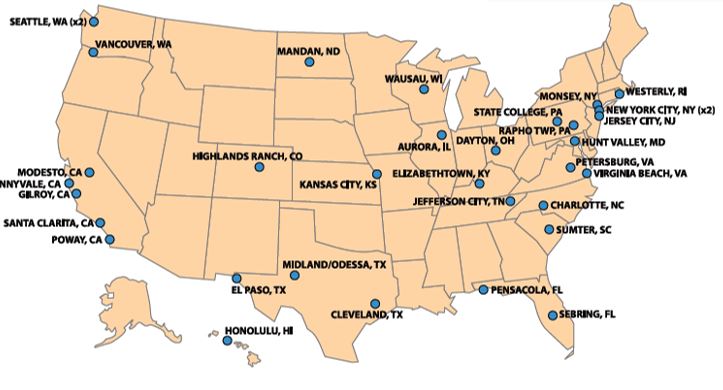
Locations of Mass Attacks in Public Spaces in the United States, 2019

In 2019, 108 people were killed and 178 injured in 34 mass attacks conducted on US soil. In the middle of the coronavirus pandemic that has already killed 200,000 Americans, this death toll may seem to pale in comparison. However, much like with COVID-19, fairly simple measures could have a significant effect on the death toll. This article reviews recent US Secret Service assessments of mass casualty attacks in public spaces, discusses recommended measures to prevent some attacks, and suggests improvements for future reports.

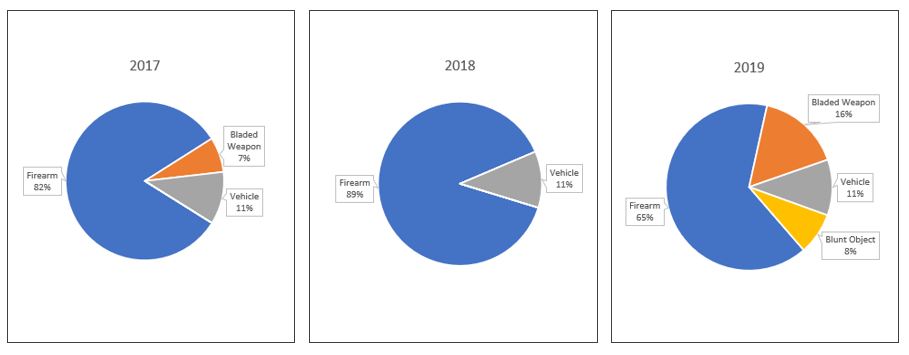
Since 2017, the Secret Service’s National Threat Assessment Center published an annual report on mass attacks carried out in public or semi-public spaces (2017 report, 2018 report, 2019 report). The Secret Service defines a mass attack as an incident “in which three or more persons, not including the perpetrator, were harmed during a targeted attack in a public or semi-public space.” 2017 saw the highest numbers of deaths and injuries from 28 total mass attacks (147 deaths and 700 injuries). The October 1 shooting at a Las Vegas music festival drew these numbers sharply upward – in that incident alone, 58 were killed and 546 were injured. Additionally, two shooting incidents and two vehicle-ramming incidents in that year caused higher casualties than average for these types of attacks. In contrast, 2018 saw 27 mass attacks with 91 deaths and 107 injuries, and 2018 saw 34 mass attacks with 108 deaths and 178 injuries. In both of these years, the incidents with the highest numbers of casualties involved mass shootings. Figure 1 below shows weapons types used by year.

Figure 1: Breakdown of Weapons Types for 2017, 2018, and 2019

These reports identify important similarities among the attackers, as well as potential indicators that an attack may have been forthcoming. For example, each report highlights how these attacks were very often preceded by a significant stressful event in the attacker’s life, such as divorce, death in the family, unemployment, and/or financial hardship. Additionally, many attackers struggled with substance abuse and/or mental health conditions. Each report found that a majority of attackers elicited concern from others in their life, to the extent that these people felt concerned for their own or others’ safety. Many attackers also had some sort of criminal record; a history of domestic violence was fairly common.

This personalized analysis of the attackers leads to several actionable conclusions to potentially reduce the occurrence of and casualties associated with mass attacks in public spaces. The latest report offers five recommendations:

  1. Establish threat assessment programs for commonly targeted areas, such as schools and workplaces
  2. Enforce existing firearms laws – the majority of mass attacks in the US are carried out with illegally owned firearms
  3. Provide crisis intervention, drug treatment, and mental health treatment
  4. Recognize the risk of crime and violence, based on criminal histories (particularly violent criminal histories)
  5. Encourage reporting of concerning behavior

While these recommendations would likely have some impact, many focus entirely on the individual’s personal situation (recent hardships, stressors, and issues with drugs and mental health) and fail to incorporate the role that extremist ideology can play in many of these attacks. In 2019, FBI Director Christopher Wray highlighted the “evolving and persistent terrorism threat to the homeland,” in which “the greatest threat we face in the homeland emanates from self-radicalized lone actors, of any ideology, who look to attack soft targets with easily accessible weapons.” This depiction is in line with many other threat assessments conducted in recent years.

The 2019 report begins to tackle the issue of ideology, highlighting the rising threat of misogynistic extremism such as the incel movement. However, no other ideologies are discussed here. Also, in this section, the report describes the hyperconnected nature of the internet’s potential to radicalize, allowing “those with fringe or extremist ideologies to converge and promote their beliefs to a wider audience.” The report specifically calls out the message board 8kun as a hub for this type of content, particularly among the far right. Simply mentioning incel ideology without discussing white supremacy, neo-Nazism, and other forms of extremism, and just mentioning 8kun while saying nothing about Telegram, BitChute, and the many other dark corners of the internet where extremists congregate, makes this section seem woefully incomplete, more of a suggestion of areas for future research than an assessment informed by the 34 mass attacks carried out that year.

These annual assessments could be greatly improved by analyzing the attackers’ ideologies, their affiliations (online or in real life) with extremist groups, and their online presence. In particular, clearing up definitional ambiguity around ideological affiliations could provide much needed clarity going forward. Assessing the importance of ideology for each attack is composed of two steps: (1) determining if the perpetrator had any history of association with extremist ideologies and (2) determining whether the extremist ideology had any impact on the attack itself. For example, the 2018 report finds that only two of 27 total attackers were motivated by an ideology: “one was motivated by anti-abortion beliefs while the other was motivated by anti-Semitic beliefs.” But the report also notes that

[W]hile only two of the attackers were primarily motivated by an ideology, nearly one-third of the attackers appeared to have subscribed to a belief system that has previously been associated with violence. Often the attackers’ beliefs were multifaceted and touched on a range of issues, including white supremacy, anti-Semitism, conspiracy theories, sovereign citizens, animal rights, and the incel movement.

The nature of extremism today is multidimensional, decentralized, and highly connected; one attacker may be active in many online extremist communities, including those that glorify mass shooters and seek to gain the next “high score” in terms of fatalities when they conduct their own attacks. For future reports, the Secret Service should determine a methodology for identifying the attackers’ ideological affiliations, as well as the level of impact these ideologies had on the attack itself. Making this information public will provide important context to the rising threat of violent extremism in the US.

Commentary – Captivating Conflagration: Arson as a Terrorist Tactic

By Stevie Kiesel, PhD Student

In 2018, the deadliest, most destructive wildfire in California’s history tore through the state. The Camp Fire killed 85 and caused an estimated $16.5 billion in damage. The towns of Concow and Paradise were nearly completely destroyed. Not even a year later, Australia experienced an uncharacteristically destructive bushfire season that ultimately killed 34 people, burned nearly 50 million acres, and destroyed almost 6,000 buildings. The fires also wrought devastating impacts on the environment, and cleanup costs alone have exceeded $5 billion.

The most extreme terrorist groups aspire to achieve this level of death and destruction. It therefore comes as no surprise that jihadist groups, such as the Islamic State and its affiliates, have touted these fires and others in their propaganda. A video released earlier this month by the Islamic State’s Al-Hayat Media Center describes arson as a highly effective, low-skill attack with great potential for damage and psychological impact, highlighting the California wildfires as an example for how death tolls in large fires “sometimes exceed the number of those lost in major strikes by the mujahideen in which they used guns and explosives.” Voice of Hind, an online magazine published by an Islamic State affiliate in India, has encouraged adherents to use fire as a comparatively simple means of attack to “annihilate the disbelievers.” Jihadist publications and videos have touted the use of fire for years, from the Islamic State publication al-Naba (as well as their now-defunct magazine Rumiyah) to Al Qaeda’s magazine Inspire. In 2019, the Islamic State claimed responsibility for widespread crop fires that caused a great deal of damage in Iraq and Syria.

The use of arson for terrorist purposes is not a new phenomenon, nor is it limited to jihadists. Extremists on the far right and the far left, as well as special interest extremists, have used arson to send political messages for years. In a recent example from April 2020, John Michael Rathbun was charged with attempted arson after trying to use gasoline to start a fire at a Jewish assisted living center in Massachusetts. Rathbun was active on white supremacist internet forums—so active, and so lax about what he was posting, that his attack was discovered after he posted his plans on a public calendar on Telegram. Similarly, in 2019 far-right extremist Tristan Morgan accidentally set himself on fire while attempting to burn down the Exeter Synagogue in the United Kingdom. Despite the tactical errors in these cases, the threat of arson terrorism should be taken seriously. Arson has a long history of being used to terrorize black neighborhoods, businesses, and churches in the United States. Even when no lives are lost, the psychological and economic impact of these attacks can be severe.

Environmental and animal rights extremists also have a history of arson attacks. Arson was particularly appealing to their ideology because they wanted to destroy facilities or machinery that they felt were doing harm, but they did not necessarily want to harm humans or animals. For example, the Earth Liberation Front advocated a tactic called “monkeywrenching,” which refers to sabotage and property destruction against industries that they perceive to be damaging the environment. Common monkeywrenching tactics include arson, sabotaging logging and construction equipment, and tree spiking. The Earth Liberation Front has claimed responsibility for a number of fires, the most destructive being the 1998 fire at a Colorado ski facility, which reportedly caused $12 million in damage. Other special interest groups that have a history of engaging in arson include the Animal Liberation Front (animal rights) and the Coalition to Save the Preserves (environmental protection). Anti-abortion extremists have also conducted arson attacks, though organizationally they would be considered lone wolf attacks rather than attacks affiliated with a specific group.

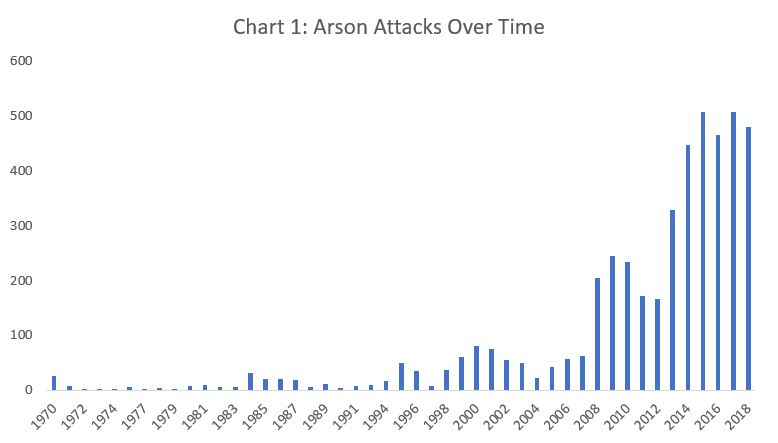
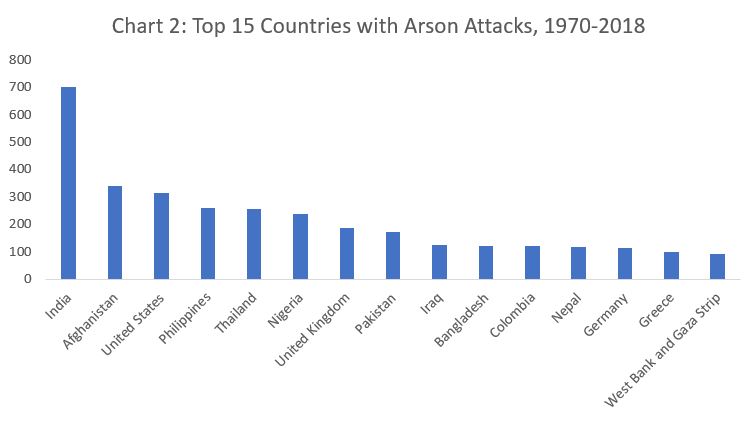
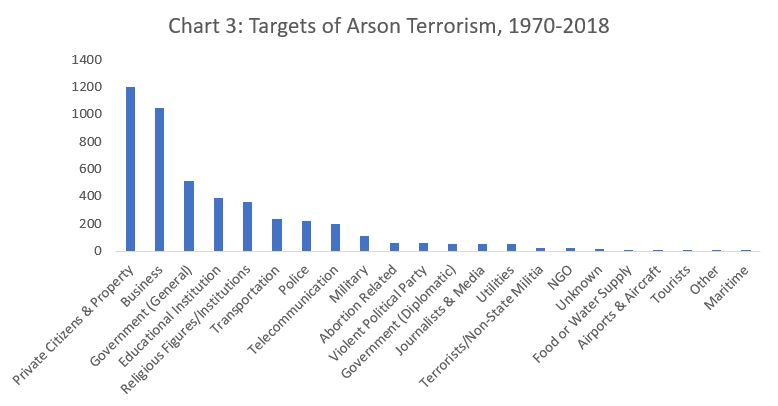
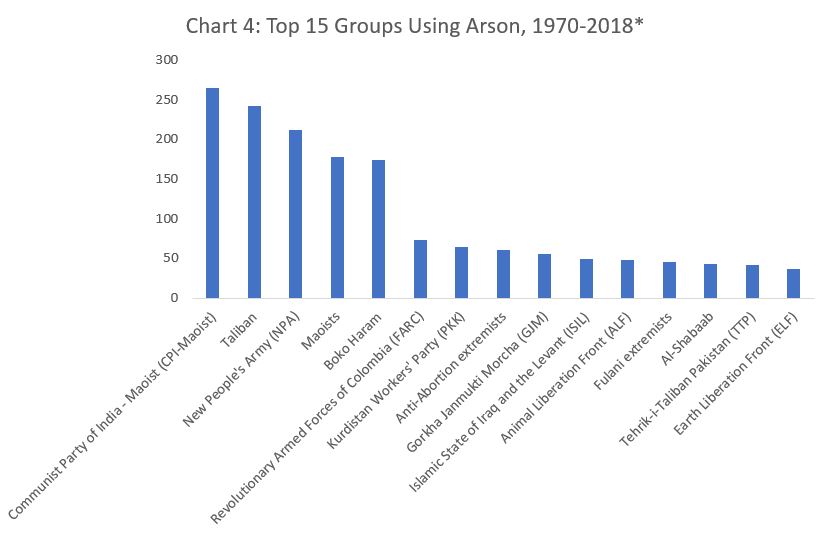
While these cases demonstrate clear interest and intent to weaponize fire by a wide range of terrorist groups, a more systematic look at arson as a terrorist tactic is possible by using the Global Terrorism Database developed by the National Consortium for the Study of Terrorism and Responses to Terrorism (START) at the University of Maryland. This database, whose information is publicly available from 1970 through 2018, captures arson as a unique weapon type. The four charts below show some interesting trends about arson use throughout history.

Charts compiled by author using data from the START Global Terrorism Database.

*Note that for Chart 4 (Top 15 Groups Using Arson, 1970-2018), the top result was an unknown group (n=1,792) followed by the groups listed in the chart.

Arson is an attractive tactic for many types of terrorist groups. Fire can be incredibly destructive in terms of lives lost, property and economic damages, and psychological impact. Arson is a low-cost and low-skill tactic, and elements of nature (such as high winds) can be used as a force multiplier. Additionally, arson can function as just one element of a complex attack, with a potential for “ambushes (luring), intentional depletion of resources (diversion), and follow-on or secondary attacks.” Large fires are also incredibly appealing to terrorist groups with apocalyptic or accelerationist ideologies, such as jihadist and extreme right-wing groups.

The COVID-19 pandemic has already had a significant impact on terrorism. Because of ongoing public safety measures and many people’s discomfort with crowded areas at the moment, typical soft targets for terrorist attacks are not as plentiful as before the pandemic. Arson may become a more attractive method to terrorists during this time because fires can drive people out of their homes and, much like a virus, once started, fire can spread far and leave devastation in its path. Another worrying development that has accelerated during the pandemic is the rise and increased reach of conspiracy theories. These theories can be incredibly radicalizing, particularly when people are spending more time at home and online while suffering anxiety over the pandemic and the economy. One example of a conspiracy theory whose adherents have committed arson attacks: the theory that 5G cellphone towers are somehow responsible for the COVID-19 pandemic. This theory has led to more than 70 arson attacks on cell phone towers, which can put people’s lives at risk if the towers are damaged and access to emergency services is disrupted. Such attacks on critical infrastructure have not gone unnoticed, particularly on white supremacist messaging boards. As COVID-19 forces terrorists to adapt, the potential for arson attacks should not be ignored.

Commentary – COVID-19 Data and Modeling: Applications and Limitations

By Stevie Kiesel, Biodefense PhD Student

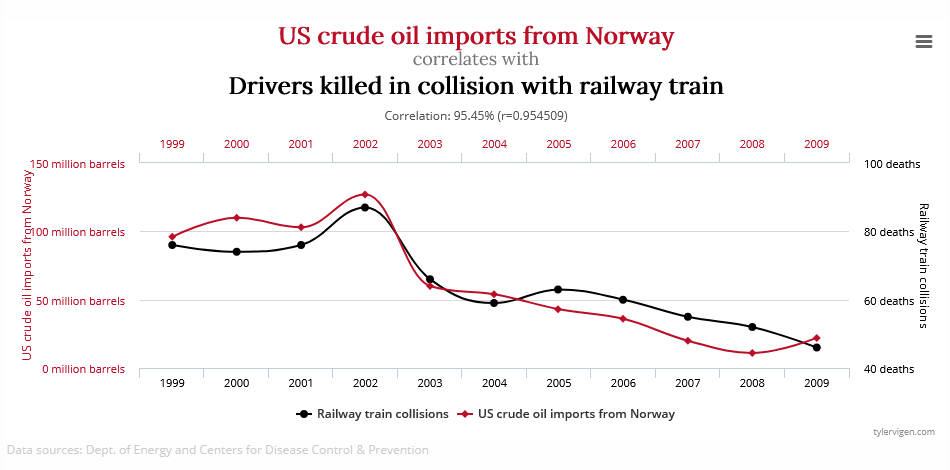
Did you know that since 1999 data has shown a strong correlation between the amount of crude oil the US imports from Norway and the number of drivers killed in collisions with railway trains? When the US imports more oil, more drivers are killed in these collisions. Don’t take my word for it, the proof is in this chart, backed by data from the Department of Energy and the Centers for Disease Control and Prevention!

This correlation, of course, is just a coincidence between two unrelated variables. Even though the source data is legitimate, correlation in this case does not equal causation. This image comes from a website called Spurious Correlations, which parses publicly available data to show these types of meaningless, but visually captivating, graphics.

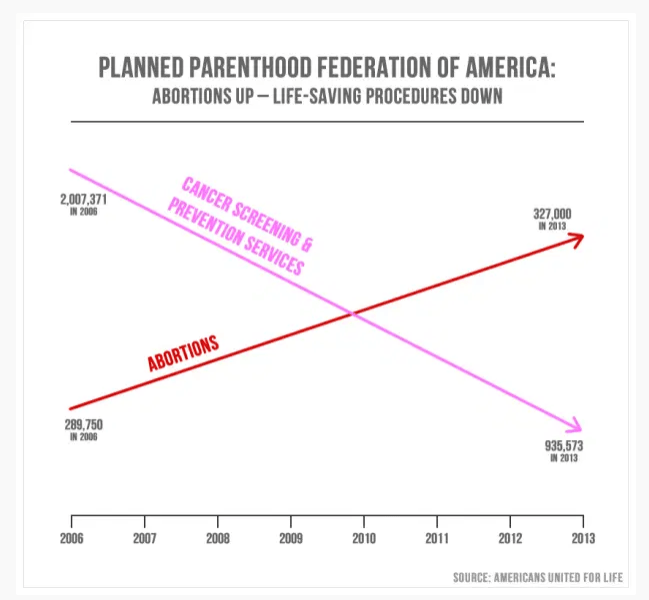
Analyzing data helps us better understand so many questions about the world, but data can also be misinterpreted or intentionally misused to promote a particular agenda. The ways that data can be misrepresented are virtually endless, from a misleading y-axis to inappropriate scaling to cherry-picking what data to include. For an egregious example of bad chart-making, take a look at this comparison of prevention services and abortions conducted by Planned Parenthood, presented by former Utah Representative Jason Chaffetz in 2015.

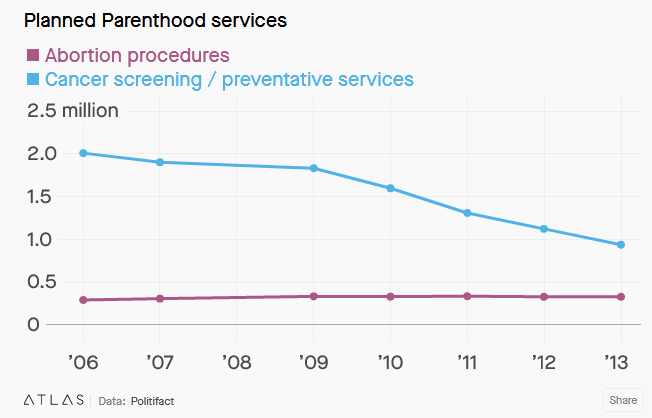
The Congressman explained his chart by saying it shows “the reduction in breast exams and…the increase in abortions.” And while those general trends may be accurate, in what universe is 935,573 cancer screenings a smaller number than 327,000 abortions? This is the kind of visual trickery you can get up to when you decide a y-axis isn’t necessary. The chart below shows the same data plotted in a more traditional (and accurate) way:

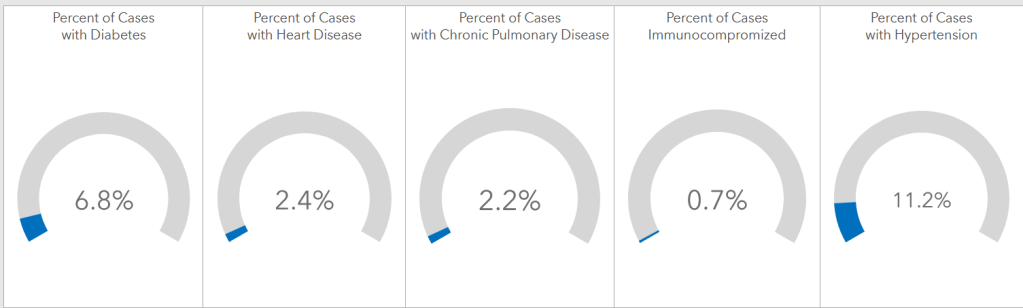
Politicians, media organizations, your uncle on Facebook – anyone can manipulate data and create a snazzy graphic to drive home their particular message. With the ongoing COVID-19 pandemic, such data skewing can be particularly dangerous, obscuring important trends and leading to counterproductive policy decisions. Such is the case even when bad visuals are not malicious. Take for example this visual from the Arkansas Department of Health, which is trying to make some kind of point about COVID-19 cases and preexisting health conditions:

The choice to present the data as semi-circles is curious – it is assumed, but not stated, that these percentages are out of 100. Plotting these statistics on a bar graph, perhaps with a y-axis that goes from 0 to 10% rather than 0 to 100%, would allow readers to see more nuanced differences between these conditions. These graphics also lack the “so what.” A case refers to a person who is presumptively or confirmed positive for COVID-19. A comparison of the cases, hospitalizations, and deaths among the various conditions would provide much more useful insights about how other health issues impact the severity of the disease and a patient’s likelihood of surviving it.

Fortunately, while some in our government are misreading or misrepresenting COVID-19 data, other institutions are working to gather and analyze data in a systematic and defensible way. Toward this end, the Government Accountability Office (GAO) recently published a Technology Assessment GAO-20-635SP, COVID-19 Data Quality and Considerations for Modeling and Analysis. This assessment was undertaken to provide policymakers with context on the proper use and limitations of COVID-19 data and models. This report is a useful explanatory tool for understanding how data is gathered, aggregated, contextualized, presented, and updated.

 The Centers for Disease Control and Prevention (CDC) relies on public health surveillance data that originate with health care providers, hospitals, and laboratories and then are reported up to the CDC through local public health agencies and state health departments. Reporting requirements are established at state and local levels, and notification to the CDC is voluntary. A standardized case definition for COVID-19 was not developed until April 5, 2020. Because of these factors as well as local variations (availability of tests and testing centers, contact tracing capabilities, etc.), data consistency is a challenge. Data completeness is another big challenge causing an undercount of the true number of cases (see page 7 of the GAO report). Lack of resources, asymptomatic or mild cases not seeking medical care, and timeliness of test results can all present challenges to obtaining complete COVID-19 data.

Another challenge comes from the failure to systematically collect demographic data. Local and state reporting requirements for this information were inconsistent until June 4, 2020, when the Department of Health and Human Service released new guidance that requires additional demographic data (race, ethnicity, age, and sex) to be reported with COVID-19 test results beginning August 1, 2020. Therefore, even though preliminary evidence suggests demographic disparities in the case load and severity of COVID-19, these data have only begun to be systematically provided for analysis.

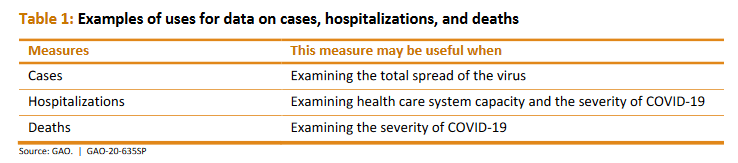
The GAO report also provides helpful guidance on when to use certain measures and certain types of analyses. For example, this table shows when to use data on cases versus hospitalizations versus deaths:

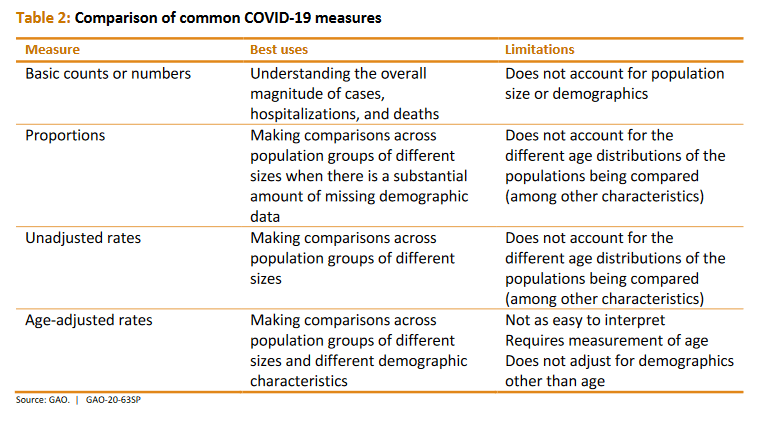
And this table highlights common methods for contextualizing data, when each method is most appropriate, and their respective limitations:

The report finishes with several recommendations to improve data collection, analysis, and reporting. First, researchers should examine deaths due to other or unspecified respiratory diseases (including pneumonia and the flu) during the pandemic to determine if some COVID-19 deaths had been miscategorized by analyzing whether higher-than-expected number of non-COVID-19 respiratory deaths were recorded during the pandemic. Second, researchers should examine higher-than-expected deaths from all causes during the pandemic (also called “excess deaths”), also to help address the issue of potential undercount of COVID-19 deaths. Third, in the longer term when data become available, researchers should compare higher-than-expected numbers of deaths from other causes to deaths from COVID-19 to get a better sense of the magnitude of deaths caused by COVID-19. And fourth, while efforts to improve forecasting model accuracy should continue, policymakers and researchers must understand that “during the outbreak of a new disease, models can be most helpful early in the response, but are most limited by a lack of data. Later in the outbreak, more data become available, but there is less time to implement an optimal response for ending the outbreak” (GAO report, page 26).