Worth Reading: Informative Research on the Islamic State

By Erik Goepner

“The sobering fact is that the United States has no good military options in its fight against ISIS. Neither counterterrorism, nor counterinsurgency, nor conventional warfare is likely to afford Washington a clear-cut victory against the group. For the time being, at least, the policy that best matches ends and means and that has the best chance of securing U.S. interests is one of offensive containment: combining a limited military campaign with a major diplomatic and economic effort to weaken ISIS and align the interests of the many countries that are threatened by the group’s advance.”

From Audrey Kurth-Cronin’s “ISIS is Not a Terrorist Group” in Foreign Affairs. Full article available at http://www.foreignaffairs.com/articles/143043/audrey-kurth-cronin/isis-is-not-a-terrorist-group


“The United States and Europe already have effective measures in place to greatly reduce the threat of terrorism from jihadist returnees and to limit the scale of any attacks that might occur. Those measures can and should be improved—and, more importantly, adequately resourced. But the standard of success cannot be perfection. If it is, then Western governments are doomed to fail, and, worse, doomed to an overreaction which will waste resources and cause dangerous policy mistakes.”

From Daniel Byman & Jeremy Shapiro’s “Be Afraid. Be A Little Afraid: The Threat of Terrorism from Western Foreign Fighters in Syria and Iraq” in the Brookings Institution’s Foreign Policy Paper series. Full paper available at http://www.brookings.edu/research/papers/2015/01/western-foreign-fighters-in-syria-and-iraq-byman-shapiro


Finally, for a good general overview, take a look at “The Islamic State” by Zachary Laub and Jonathan Masters; a Council on Foreign Relations Backgrounder available at http://www.cfr.org/iraq/ islamic-state/p14811.

Bourbon, Heartland, and Ticks

By Greg Mercer

The Centers for Disease Control and Prevention recently announced that it has identified the mysterious virus that killed a man in Kansas last spring.  Dubbed the Bourbon virus—after its location in Bourbon County, Kansas—it is an RNA virus in the genus Thogotovirus, according to the researchers who identified the virus.  Thogotovirus includes at least 6 distinct viruses, although only one, the Aransus Bay virus, occurs in the U.S. (but does not infect humans).  Of the genus, only two other viruses are known to infect humans, and the only fatality was the one caused by Bourbon.  Both are spread to humans through ticks.  Ticks are also the vector for the Heartland virus and Lyme disease.

The patient in Kansas experienced nausea, weakness, and diarrhea, followed by fever, anorexia, headache, and other symptoms after being bitten by ticks while working outside.  He was initially treated for tick borne illness with doxycycline, which proved ineffective.  Upon being admitted to the hospital, he was tested for Rocky Mountain spotted fever, Lyme disease, and ehrlichiosis, and treated with broad-spectrum antimicrobial drugs.  Despite treatment, the patient experienced widespread organ failure and died 11 days after becoming ill.  The researchers identified the Bourbon virus in samples through plaque reduction neutralization, originally used to test for Heartland virus antibodies.  Sequencing and analysis then identified the Bourbon virus as a member of Thogotovirus.

The paper from the researchers who identified the virus, linked above, is well worth reading for a look at how emerging viruses are studied and identified, and the challenges of dealing with the first case of a new virus.

The Heartland virus was first detected in 2012, causing fever, fatigue, headaches, muscle aches, and stomach sickness.  Most patients required hospitalization, with most fully recovering.  The CDC has since identified eight cases in Missouri and Tennessee.  Due to the low number of cases, the virus is still not well understood, but all of the patients became sick between May and September, and likely became infected while outdoors.

While researchers assert that the current methods of transmission for both Bourbon and Heartland are unknown, they note that exposure to ticks may be a potential method.  The researchers advise avoiding tick bites as a potential method of preventing infection. The CDC page for avoiding ticks lists guidelines, including using insect repellant recognized by the Environmental Protection Agency and wearing long sleeves and pants outside.

The CDC lists 14 other diseases spread by ticks.  Most recognizable among them is Lyme disease, a common disease to hear about during warm weather.  Interestingly, the CDC tick page also notes the discontinuation of the Lyme disease vaccine in 2002 by its producer, due to lack of demand.  Since the vaccine’s effect diminishes over time, those vaccinated before 2002 are likely no longer protected against Lyme.

It’ll be tick season soon enough so, be generous with that insect repellant!

Image Credit: André Karwath

Assessing the War on Terror

By Erik Goepner

Reports from The Heritage Foundation suggest there have been 64 Islamist-inspired terror attempts on U.S. soil since 9/11. Of those, only four were carried out, with nearly all of the remaining 60 foiled by law enforcement and a handful thwarted by less intelligent means. From a defending the homeland perspective, things look good.

Their report goes on to say, however, that the number of terror plots have increased over time. Why the terrorists have increased their efforts is subject to much debate. Some contend the U.S. efforts in Iraq from 2003-2011 were inadequate, possibly not muscular enough. Others point to metastasizing local grievances in Iraq, Syria, Afghanistan, Libya, and so on, whether those be religious, tribal, etc. Still others think the U.S. has unwittingly fueled the terrorists recruiting efforts. As an example, bin Laden expressed outrage when Saudi Arabia looked to the U.S. for help after Saddam Hussein invaded Kuwait in 1990, and his call for the “infidels” to leave the land of Muhammad was a consistent refrain until he himself departed the land. Since 9/11, however, America’s presence within Muslim lands increased, with more than two and a half million American service members having fought in Iraq and Afghanistan.

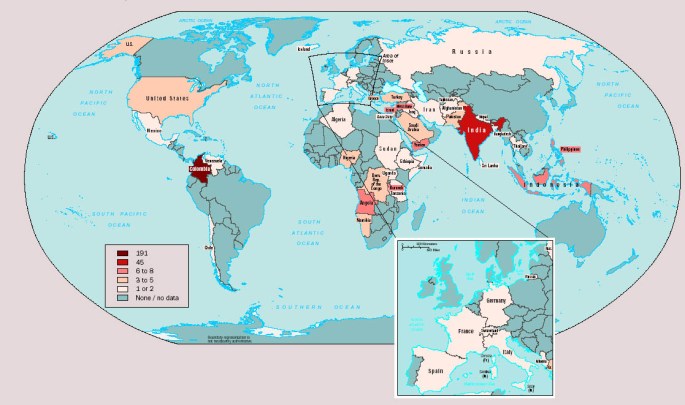
Globally, the numbers suggest that a large U.S. military presence in Iraq and Afghanistan, while killing a large number of terrorists, may have helped the terrorists recruit more than they lost. Department of State reports and information from Stanford University’s Mapping Militant Organizations project indicate the number of Foreign Terrorist Organizations (FTOs) has increased by 52% since 2000, while the number of Islamic-inspired FTOs jumped by 185%.

2000 2013
Number of Foreign Terrorist Organizations (FTOs) 29 54
Number of Islamic-inspired FTOs 13 37
Estimated number of fighters in Islamic-inspired FTOs 32,200 110,500

Similarly, the number of fighters in those Islamic-inspired groups, impossible to know with precision, is estimated to have risen 243%.

The terrorists’ production rate has likewise increased. In the 12 years before 9/11, there were an average of 3,207 terrorist attacks across the globe each year. Since then, there have been an average of 4,283 attacks per year.[1] And those attacks have become more lethal. In their 2001 Patterns of Global Terrorism report, the Department of State observed that the 3,547 killed by terror attacks was the highest ever recorded in a year. In 2013, the number killed reached 17,891.

One potential question for the public and our elected leaders: do we want visible, muscular U.S. leadership in the war on terror or do we want to win? Both may not be possible.

Image Credit: U.S. Department of State


[1] See the Global Terrorism Database at http://www.start.umd.edu/gtd/.

The CIA’s New Hats: Some Thoughts on John Brennan’s Reorganization Plan

By Greg Mercer

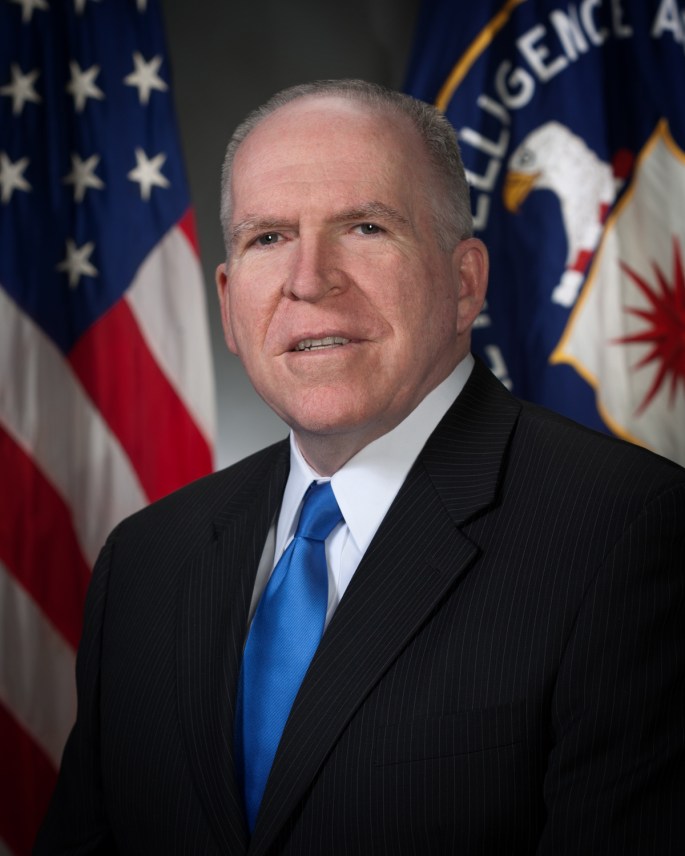
In March, CIA Director John Brennan announced his plan for restructuring the Central Intelligence Agency in his “Blueprint for the Future”—the unclassified version of which is available on the CIA’s website.  The plan, structured as a memo to CIA personnel, provides a broad overview of the coming administrative changes proposed by Brennan’s Study Group.  Brennan identifies two key areas of national security that prompted the changes: “The first,” Brennan says, “is the marked increase in the range, diversity, complexity, and immediacy of issues confronting policymakers; and the second is the unprecedented pace and impact of technological advancements.”  New issues and new technology seem like pretty common themes in Washington these days.  Let’s look at what Brennan plans to do about them.

To respond to these policy areas, the memo outlines four themes: enhancing talent and human capital, addressing the digital revolution, modernizing the business process, and integrating capabilities to address mission areas.  I’ll talk mostly about the digital and integration themes here.

Probably the most radical change is the addition of a new directorate to address the rapidly expanding need for cyber offense and defense capabilities.  This is where the new Directorate of Digital Innovation comes in.  This is the largest change to the CIA’s structure since the creation of the Office of the Director of National Intelligence by the Intelligence Reform and Terrorism Prevention Act of 2004.  Brennan doesn’t go into detail about the specific operations of the new directorate beyond “overseeing… standards of our digital tradecraft.”  “Digital tradecraft” is a vague, amorphous term that can broadly refer to any number of activities within the cyber domain, all of which would likely be highly classified.  Generally, though, “tradecraft” means “spycraft.”

U.S. Cyber Command (USCYBERCOM)—a joint military command co-located at Fort Meade, Maryland, with the National Security Agency (NSA), the primary signals intelligence agency—represents the bulk of U.S. cyber presence right now.  The CIA’s history of covert actions and the existence of a military cyber command raise concern over whether the U.S. is developing simply cyber defenses or cyberwarfare capabilities.  The best evidence for the latter is the Stuxnet computer worm, discovered in 2010, which targeted Iranian nuclear equipment and is largely attributed—at least partially—to the U.S.  The creation of a new CIA directorate devoted entirely to cyber activities is a response to the overwhelming academic and industry consensus that the cyber domain poses imminent threats to the U.S. However, the new directorate isn’t unique, given the existence of USCYBERCOM and the NSA, and might represent the condensing of existing CIA cyber activities into a single structure.  It is hard to glean any details about the CIA’s cyber intentions moving forward, but the new directorate is a major organizational change and a huge signal that the government is continuing to respond to the rise of the cyber domain.

Speaking of consolidating activities, Brennan also announced the creation of new Missions Centers and changes to existing directorates.  Citing the need to address varying threats and U.S. national security interests, Brennan explained that Mission Centers, each led by an Assistant Director, will incorporate activities from across the agency to address a specific topic.  Functionally, this seems to mean that Brennan intends to close the long-standing divide between analysis and covert action that has defined the CIA since its inception, and he has announced administrative changes to support this.  The National Clandestine Service, which runs all of the CIA’s undercover activities, will be renamed the Directorate of Operations, and the Directorate of Intelligence will become the Directorate of Analysis.  While these seem like minor name changes, they reflect the greater forces at play—Brennan intends for the directorates to train quality operatives and analysts to contribute to the Mission Centers.  The Assistant Directors will have “accountability and responsibility for the delivery of excellence in their respective occupations across all of the Centers.” This setup seems to be modeled on the National Counterterrorism Center or the Bin Laden unit, crosscutting organizations within the intelligence community that combined strengths from many disciplines.  This will, however, take a great deal of proactive administrative attention to ensure that cooperation and coordination are paramount.  Shared missions are powerful motivator, but they are often not enough to convince large organizations to coordinate successfully.  This will take time and a great deal of work at every level.

A focus on personnel runs throughout the memo.  While it might not seem this way to current graduate students and job seekers, the CIA has historically had major problems attracting qualified, competent employees, especially following the fall of the Soviet Union, when the agency found itself flooded with Soviet experts and woefully unprepared to address the host of new threats and interests around the world.  The CIA has had a long and often sordid history (I highly recommend Tim Weiner’s Legacy of Ashes for a comprehensive look), and often found itself the target of harsh criticism by Congress and the presidency, but Brennan seems to be targeting major, long-standing flaws with his reform plan.  This is a laudable, noble pursuit, and I hope it has a positive impact.  The intelligence community usually sees its soul searching come after major failures or during times of national crisis.  Coming on the tail of revelations about U.S. interrogation programs, these changes seem to aim to fix the system before disaster strikes again (though it is certainly accurate to call the decade-plus of detention and interrogation abuses a disaster).  Let’s hope Brennan’s plan is sound.

Image Credit: CIA

Yemen: A Snapshot from the Global War on Terror

By Erik Goepner

The remaining cadre of American military personnel pulled out of Yemen last week following the evacuation of U.S. Embassy staff in February. Six months earlier, President Obama hailed the U.S.-Yemen partnership as a model worthy of emulation in the fight against the Islamic State. For a decade and a half, America has expended substantial effort in the war on terror, yet the results which followed were often unanticipated and problematic.

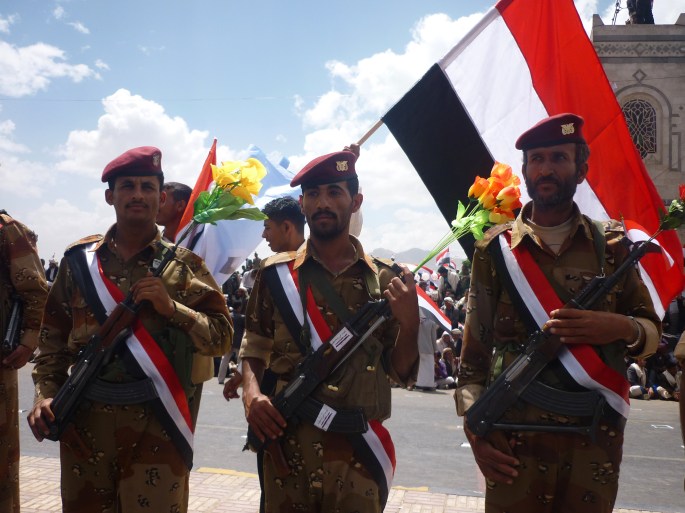
In 2013, President Obama hosted President Hadi at the White House and thanked him for Yemen’s strong cooperation in countering terror, specifically mentioning the success enjoyed in pushing al Qaeda back in the Arabian Peninsula. If the Sunni-comprised AQAP was pushed back, it now looks like that vacuum has been filled by a different terrorist organization, this one Shia dominated. These Houthi rebels, predominately from Yemen’s north, have been in conflict with the Yemeni government for the past 11 years.

Iran appears responsible for at least part of their success. Reports indicate Iran has provided some level of assistance to the Houthi rebels—possibly arms, funds, and training. A senior Houthi advisor denied any arms support, but agreed they were otherwise working with Iran as “part of a shared vision in ‘confronting the American project’” in the region.

By some analysts count, the fall of Sana’a into the hands of Houthi rebels represents yet another victory in the making for Iran. They point to Beirut, Damascus, Baghdad, and now Sana’a as the fourth Arab capital to politically ally itself with the Persian state.

No doubt there is much history yet to unfold, but to date, America’s war on terror has delivered a number of unanticipated outcomes: a five-fold increase in global terror attacks, two on-going civil wars in the nations America invaded, and an ever-increasing Iranian influence in the region.

Image Credit: Ibrahem Qasim

Better Resolution in Microscopy

By Jonathon Marioneaux

For centuries, light microscopes have helped biologists understand the inner workings of the cell by using the unique properties light and how it bends when traversing through different mediums.  The first light microscope led to the discovery of cells and ushered in a new era of biology: microbiology. Since that time, new technological advances have helped push the boundaries of cell anatomy to ever smaller structures and better resolution of those structures.  Several types of microscopes include the scanning electron microscope, transmission electron microscope, florescent microscope, bright field microscope, laser capture micro-dissection microscope, multifocal plane microscope, and x-ray microscope; each one with its unique capabilities.

Traditional optical or light microscopes take advantage of a light source to illuminate a specimen from behind allowing the viewer to see the object. However, the greatest limitation is the resolution of a microscope itself.  The resolution is the ability to differentiate between two objects in a viewing plane and is directly dependent on the wavelength used for viewing.  For example, a light microscope can only view objects to a resolution of 1250 times (theoretical limit 0.250 micrometers) whereas the scanning electron microscope has a limit of 1 nanometer.  As mentioned, this difference is based on the type of wavelength used for viewing, and in the optical microscope this is directly dependent on the type of light used; ultraviolet light achieves a better resolution than infrared.  Another problem with light microscopes is the material must be transparent to the wavelength, the best medium is dependent on the sample, however, oil or water are the most common.

Fei Chen and colleagues have shown that light microscopes can now achieve a higher resolution then previously thought due to a new technique called Expansion Microscopy.  This technique takes advantage of polyelectrolyte gels hydrolyzing in the presence of water homogenized throughout a specimen.  In their work, the researchers showed that a fixed permeabilized brain tissue can be infused with polyelectrolyte gel triggered by an ammonium persulfate accelerator, tetramethylethylenediamine accelerator and digested with tissue-polymer composite protease and can swell 4.5 times without distortion. As the polyelectrolyte gel is mostly water optical microscopes can resolve cellular structures.  The researchers showed that structures such as microtubules, dendrites, and mossy fiber boutons in the dentate were observable in high resolution.

To further increase the resolution of the new technique, the researchers attached fluorescently labeled proteins to the gel matrix and infused the cell before hydrolyzing it.  As the radical hydrolyzing occurred the florescent tags were bound in the matrix and allowed specific regions of the cell to be analyzed in more detail and higher resolution then without the tags.  The tags were created using a specific oligonucleotide sequence on a protein corresponding to an antibody which was then bound to either green florescent protein or yellow florescent protein.  The florescent antibodies also allow for macrostructures to be seen in more refined structural detail then previously possible.

This new technique is still in its infancy and will take advantage of further advancements in both the physical expansion of polyelectrolyte gel and diffraction-limited microscopes.  However, this new technology will allow light microscopes to see smaller cellular structures in finer detail then previously possible in fixed cell microscopy.  Microscope technology continues to advance far beyond the simple refraction lens used to discover the cell.

Image Credit: Erwin94


Chen, F., Tillberg, P., & Boyden, E. (2015). Expansion Microscopy. Science, 347(6221), 543-548.

CIA Purchase of Iraqi CW: Background and Context

By Greg Mercer

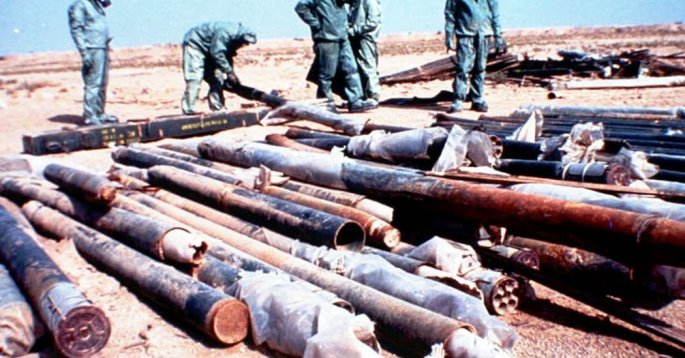
Recently, a CIA program to buy and destroy chemical weapons in Iraq has come to light.   The New York Times reports that from 2005 to 2006, Operation Avarice saw the purchase and destruction of 400 chemical weapon rockets originally developed by the Hussein regime in the 1980s.  Reports vary on the contents of the rockets, which may have contained either degraded chemical components or still-active sarin.  The Times article states that, in cooperation with the Army 203rd Military Intelligence Battalion, the CIA station in Baghdad made the purchase from a single Iraqi seller and destroyed the weapons.

These events notably fall outside of the findings of the Iraq Survey Group (ISG), the 2003 Department of Defense-led fact finding mission.  The ISG released a final report in 2004 detailing Iraqi WMD-related activities from 1991 to 2003. However, ongoing conflict in Iraq has led to further encounters with remnants of Hussein’s WMD programs.

An October 2014 article detailed claims made by veterans that military personnel had been exposed to sulfur mustard during the destruction of seized Iraqi chemical weapons near Taji.  The Times’ CJ Chivers places the number of service members exposed to chemical weapons at no fewer than 17, and asserts that they received inadequate healthcare.  His investigation led to the Pentagon acknowledging that hundreds of service members had been exposed to chemical weapons and had received insufficient treatment.

A May 2004 Fox News article reported that a 155mm artillery shell used as part of a roadside bomb in Iraq was found to have contained sarin, and two service members were treated for mild symptoms of exposure.  While the shell contained three liters of sarin, it was a binary system, where separate chemical compounds are mixed to form the weapon agent.  Due to its use as an improvised explosive and failure to combine, the agent was not potent enough to be lethal.  The article notes that a different shell containing mustard gas was found in a similar setup.  However, this shell also did not detonate, and the chemical agent was found by the ISG to be inactive due to improper storage.

In July 2004 the Washington Post reported that warheads found in Iraq by Polish forces, originally believed to be chemical weapons dating back to the Iran-Iraq war (which saw the use of chemical weapons by both sides), did not, in fact, contain chemical agents.  The warheads were reportedly purchased, not confiscated, rockets, though this point was disputed by an unnamed senior intelligence official, who said that the U.S. had been told that the rockets were found alongside other conventional weapons.  Chemical weapons or not, the episode demonstrates the severity with which international forces in Iraq treated claims of insurgents and terrorists possessing or seeking unsecured Hussein-era weapons.

It’s important to note that these brushes with chemical weapons involved agents dating to before 1991.

Chemical weapons were not the only illicit goods seized in Iraq.  In 2005, the Associated Press reported that 550 metric tons of yellowcake uranium had been sold to Canadian uranium producer Cameco Corp. for use as nuclear fuel.  The U.S. conducted a top-secret airlift operation of 37 flights to move the uranium from Baghdad to Montreal.  The uranium was a remnant of Hussein’s nascent nuclear weapons program.  Yellowcake uranium is an intermediate product of uranium processing, not weapons-grade material.  It can either be smelted into fuel rods for use in nuclear reactors for power production, or enriched into U-235 via gas centrifuge.  Low-enriched uranium (up to 20% U-235) is also used in nuclear reactors, but highly-enriched uranium (90%) is used in nuclear weapons.


Image Credit: The New York Times

Readings on the Islamic State

By Erik Goepner

What ISIS Really Wants” by Graeme Wood, The Atlantic

A provocative and interesting article, Wood suggests that while much of what the Islamic State does makes no sense to a Western mind, their actions are, largely, sensible “in light of a sincere, carefully considered commitment to returning civilization to a seventh-century legal environment, and ultimately to bringing about the apocalypse.”

Wood goes on to assert that the Islamic State is, as they claim, Islamic. He yields the point that IS has attracted some psychopaths, but that the preaching of IS results from “coherent and even learned interpretations of Islam.”

Of particular interest to policy makers, Wood argues that ignoring IS’ “intellectual genealogy” will promote U.S. responses that inadvertently strengthen the group. Similarly, he cautions against assuming that if religious ideology does not matter much in Washington, it must not matter in Iraq and Syria.

What is the State of Islamic Extremism: Key Trends, Challenges and Implications for U.S. Policy?

Testimony before the House Armed Services Committee, 13 February, by Lt Gen (ret) Flynn, Dr. Lynch, professor at George Washington, and William Braniff, Executive Director National Consortium for the Study of Terrorism and Responses to Terrorism.

Of note, Mr. Braniff referenced scholarly research that suggests one of the critical predictors of increased terrorist group lethality is competition among terrorist groups. Each group attempts to “outbid” the others in terms of attacks.

Image Credit: Mo Riza

The So-Called Islamic State

By Greg Mercer

Ever since al Qaeda in Iraq rebranded itself as the Islamic State in Iraq and the Levant in 2013 and split from al Qaeda at large, there has been some confusion as to how exactly to refer to the entity. The extremist group’s growing paramilitary force is attempting to create an independent state governed by a Wahhabist ideology. It has been referred to as the Islamic State, IS, ISIS, and ISIL, with no convention appearing to have emerged, and there has been just as much coverage about the debate surrounding this nomenclature vacuum.

The Associated Press, writing in June of 2014, notes that the Arabic name Al-Dawla Al-Islamiya fi al-Iraq wa al-Sham translates to the Islamic State of Iraq and al-Sham, and that al-Sham, which encompasses the Middle East from southern Turkey to Egypt, and is also referred to as “the Levant.” Based on this interpretation, the AP argues that “ISIL” is both the most accurate translation and a clear indication of the group’s aims, as “Islamic State in Iraq and Syria” implies that the group is interested in only two countries. Finally, they note that ISIL is the abbreviation used by the United Nations.

Ishaan Tharoor, writing for the Washington Post in June of 2014, notes that ISIL is used by the State Department and President Obama. However, he points out that the translation leading to ISIL might not be infallible. Citing Hassan Hassan, he notes that “the Levant” might be considered an outdated term, and that “Greater Syria” can be used to refer to the area in question, in which case the Islamic State of Iraq and Greater Syria, and thus ISIS, could be appropriate. He also notes that ISIS is attractive for the way it rolls off the tongue. Tharoor says that the difference between ISIS and ISIL is not as politically charged as, for example, the difference between “Burma” and “Myanmar.”

In September of 2014, Ian Black, writing for The Guardian (which uses ISIS as its in-house standard), noted the sordid history of Islamic State names, and explained that the French government had offered up the term “Daesh,” the Arabic acronym for Al Dawla al-Islamyia fil Iraq wa’al Sham, and which is disliked by Islamic State supporters for notably leaving out the “Islamic” signifier. CNN covered this policy as well.

”You have to name things correctly,” French Foreign Minister Laurent Fabius told Christiane Amanpour. “They are not a state… they are not representative of Muslims.”

Fabius noted that using the term, which is disliked by extremists for its pronunciation similar to Arabic words for “trample,” or “crush,” is an appropriate response to the group’s brutality. Daesh, then, is a much more politically charged name than IS, ISIS, or ISIL, chosen not just for accuracy, but also for the connotation that it carries for the enemy. It also, notably, leaves out “Islamic,” an attractive option for those who desire to make it clear that these extremists are not representative of Islam or Muslims.

Among this debate though, there is an underlying solidarity. The news of France’s refusal to use Islam-based names came alongside their addition to the forces conducting strikes against targets in Iraq. President Obama might have used a different term than France, but he did so in praising France’s military actions.

Referring to the term Daesh, Army Lt. Gen. James Terry said, “Our partners, at least the ones that I work with, ask us to use that, because they feel that if you use ISIL, that you legitimize a self-declared caliphate. … They feel pretty strongly that we should not be doing that.”

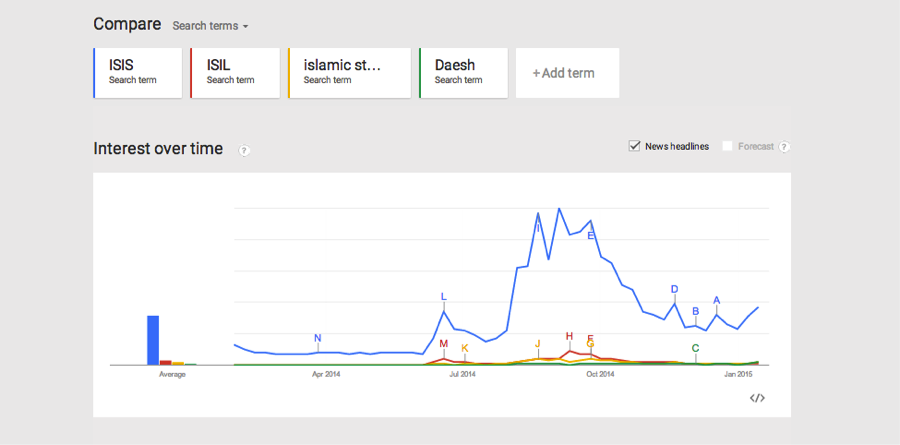
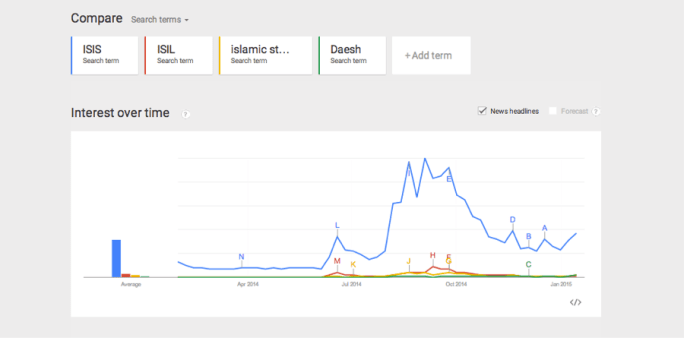
A Google Trends search for ISIS, ISIL, Islamic State, and Daesh reveals the overwhelming popularity for ISIS among Google searches:
ISIS GoogleGoogle

While some of the searches for ISIS can be attributed to it being a word with other connotations (an Egyptian goddess, for instance), the search volumes for all of the terms appear to spike at the same times, indicating major news events, with a much higher volume of searches containing ISIS than the other names. While this might not indicate which is the most popular among governments or news outlets, it shows that ISIS seems to be the name of choice for Google users, and the general public.

Regardless of the naming conventions that they adopt, many countries see a common threat in Iraq and Syria.


(Image Credit: Wikimedia Commons)

There is a Pattern Here: The Case to Integrate Environmental Security into Homeland Security Strategy

By Jonathon Marioneaux

Recent reports of extreme weather related events, massive industrial catastrophes with hazardous materials, and critical resource shortages have begun to highlight the need to incorporate climate change as part of the national security strategy and its effects on emergency preparedness.  In their article, Dr. Ramsay and Dr. O’Sullivan argue that changing climate and human influences are becoming more important to homeland security and must be increasingly factored into national and international security assessments. The authors argue that the term ‘Environmental Security’ should be placed among homeland security factors because of its immense reach and potential impact upon the nation and its infrastructure.  However, the role of environmental security is not simply localized to a region or country; the global impact of climate change, resource scarcity, and certain industrial disasters have global impacts that will disproportionately affect less developed nations who are not able to cope as quickly or efficiently.  Finally, these impacts must be incorporated into strategic planning more effectively in order to cope with future global security challenges.

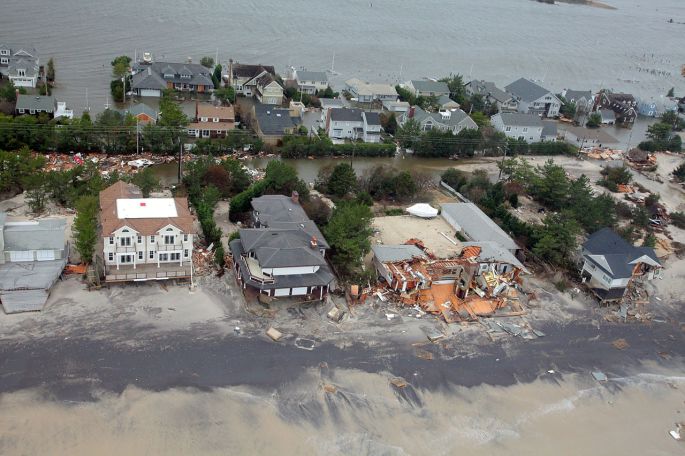
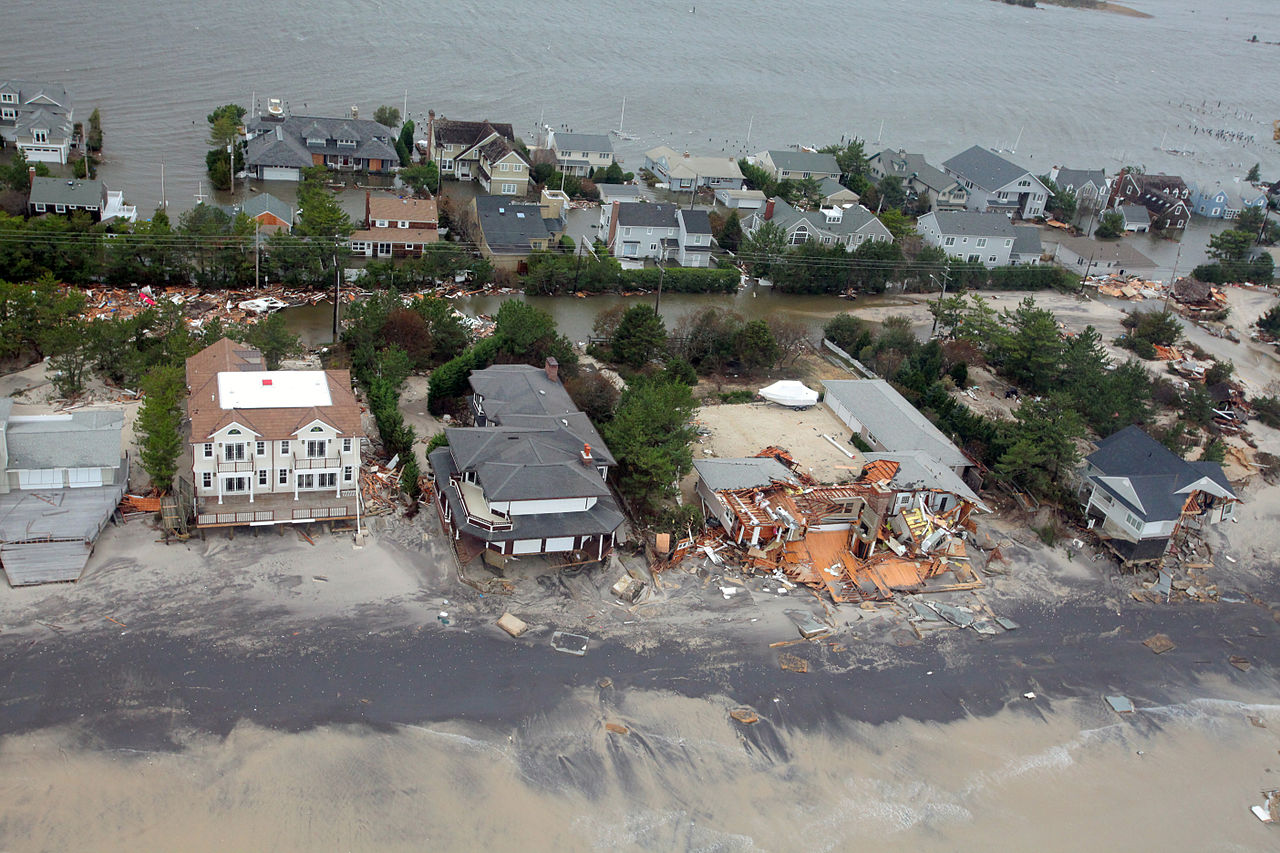
The authors begin by laying out the factors that might impact regional security such as rising sea levels, increased storm intensity, increased droughts and floods, and increased spread of disease and explain why they are a security threat.  For example, the authors state that global sea level rise has increased from 0.02 inches per year from 1950 to 2009, however it has increased 0.08 inches per year along the Atlantic Coast.  This is a security concern as large numbers of people and pieces of critical infrastructure are located in close proximity to coastlines with little to no protection.  To provide further evidence, hurricane Sandy smashed into the Northeast and the above discussed increased sea level helped make it the most expensive natural disaster in modern history. A second example is drought that has plagued the Southeast and Western parts of the nation pushing water resources to record lows.  The result has been increased State and Municipal tensions over increasingly scarce water supplies in regions with rapidly growing populations. The resulting experiences have shown the need to increase local, regional, and federal preparedness to weather related disasters, which will continue to worsen in the future.

The authors also explain why industrial accidents and resource shortages should be factored into the national security equation.  Certain industrial accidents—such as the BP New Horizon spill in the Gulf of Mexico—have the power to influence the economy and, by extension, the physical security of regions or nations by rendering an area inhabitable or economically unsustainable. Increased resource scarcity has already been identified as a factor for political instability and will continue to be so in the future.  The authors referenced food scarcity that triggered some Arab Spring revolutions in certain Middle Eastern countries and pushed existing politicians from power and installed new regimes. Finally, increasing environmental concerns have the potential to lead to increasing levels of regional instability and failed states that will only be exacerbated by continuing climate change.

Some steps are already being taken to address these issues such as the Quadrennial Defense Review and intelligence assessments; however more still needs to be done to fully implement environmental security into the national security apparatus. Recent events have shown that increasing environmental security is imperative to increasing both national and international security because global climate changes are not limited by borders and neither are the outcomes.

Image Credit: Wikimedia Commons


Ramsay, J., & O’Sullivan, T. (2013). There’s a Pattern Here: The Case to Integrate Environmental Security into Homeland Security Strategy. Homeland Security Affairs, 9(6).