The Pandora Report

Highlights include: patenting viruses pt. II, BioWatch Gen 3 or the lack thereof, West Nile, Dengue detection, and US live hog imports restricted as PEDV rages. Happy Friday!

Why a Saudi Virus Is Spreading Alarm

A less discussed aspect of studying novel microorganisms is the corporate red tape often involved. We talked about this a couple weeks ago, but the most recent case of this is the patenting (or at least, creating of a Material Transfer Agreement) of the MERS virus by Ron Fouchier’s Dutch laboratory. Under the MTA, all labs who request samples of the virus are contractually bound not to develop vaccines or products without first asking for permission from the Dutch lab. As you can imagine, this creates extra hurdles for Saudi scientists trying to stem the virus’ spread across Saudi Arabia. Lest one believe this is simply “the way things are done” in virology, China released samples of its H7N9 virus to open source sites within a month of the first case being identified.

Council on Foreign Relations – “But impeding an effective response is a dispute over rights to develop a treatment for the virus. The case brings to the fore a growing debate over International Health Regulations, interpretations of patent rights, and the free exchange of scientific samples and information. Meanwhile, the epidemic has already caused forty-nine cases in seven countries, killing twenty-seven of them…’The virus was sent out of the country and it was patented, contracts were signed with vaccine companies and anti-viral drug companies, and that’s why they have a MTA [Material Transfer Agreement] to be signed by anybody who can utilize that virus, and that should not happen,’ [Saudi Arabia’s deputy health minister] Memish said.”

Autonomous Detection Sought For BioWatch Surveillance Systems

BioWatch Gen 3 is currently on the back burner, as officials explore alternative options (analysis of alternatives, or AoA). Everyone agrees that some form of detection is necessary, everyone agrees that 24 hours is too long of a lag time, and everyone definitely agrees that local and state health officials need to be involved, but not everyone agrees that the current funding proposals for BioWatch are feasible. Does anyone else feel like this is a disaster waiting to happen?

Homeland Security Newswire – “Options for upgrading the Department of Homeland Security’s (DHS) BioWatch biosurveillance program monitoring systems for biological agents to autonomous detectors is continuing to be explored — and the department plans eventually to do so in collaboration with state and local officials. But DHS currently has no formal program to produce the next generation of BioWatch monitoring technology, said BioWatch Program Manager Michael Walter in remarks at the National Academies of Science (NAS) Tuesday.”

West Nile Virus Logs Deadliest Year After Hotter Summer

Last year was a bad year for West Nile, with 286 deaths and 5,674 cases. The CDC is closely monitoring the number of cases as we enter the peak season (July through September), as reasons for last year’s large case number remains unclear. However, a warmer, wetter summer is thought to be a big part of it.

Bloomberg –  “While there are only six reported cases of the virus this year through June, according to the CDC’s website, more than 90 percent of infections from last year occurred between July and September.’West Nile virus is going to be a factor in the U.S. every year now,’ Marc Fischer, a medical epidemiologist with the CDC’s arboviral diseases branch, said in a telephone interview. ‘People need to take precautions and protect themselves.'”

The ‘Gold’ Standard: A Rapid, Cheap Method of Detecting Dengue Virus

Scientists are using gold nanoparticles to develop cheap, quick diagnostics for detecting dengue. While we understand this is very important in terms of helping reduce the spread of a globally present (50-100 million cases annually) and deadly virus, we also are a little pleased by the “gold” standard pun.

Science Daily – “The development of an easy to use, low cost method of detecting dengue virus in mosquitoes based on gold nanoparticles is reported in BioMed Central’s open access journal Virology Journal. The assay is able to detect lower levels of the virus than current tests, and is easy to transport and use in remote regions…Researchers from the University of Notre Dame, USA, used a DNAzyme linked to gold nanoparticles which recognises a short sequence of the viral RNA genome common to all four types of Dengue. Once bound, adding magnesium and heating to 37C causes the DNAZyme to cut the RNA leaving the gold nanoparticles free to clump together. This aggregation can be easily seen as a red to clear/colourless colour change.”

USDA working for removal of Mexican restrictions on live hog imports

The USDA is scrambling to get restrictions on US live pigs lifted by Mexico, following an outbreak of porcine epidemic diarrhea virus (PEDV). The outbreak of PEDV has spread to 13 states in couple weeks since the virus’ first emergence.

Reuters – “A spokeswoman for the department’s Animal and Plant Health Inspection Service said on Thursday the agency has sent Mexico information requested in connection with the outbreak of Porcine Epidemic Diarrhea Virus, a swine virus deadly to young pigs never before seen in North America. She did not state what information had been requested.”
A virus by any other name?

Naming new viruses is a surprisingly tricky, often hotly-contested process, and choosing a name for emergent viruses often has significant ramifications. For instance, the original misnomer of the 2009 H1N1 pandemic – swine flu – resulted in millions of dollars of losses for the American pork industry.  Other, equally unhelpful names for the virus included “Mexican flu”.

Read more in this interesting piece in Pacific Standard Magazine on the long and often circuitous process of virus naming.

Excerpt: “Human disease is littered with examples of fractious, sometimes furious rows over what emerging pathogens are called. Some 30 years ago, when the human immunodeficiency virus, or HIV, was discovered, it was named “GRID,” or “gay-related immune deficiency,” helping to spread the slur ‘the gay plague’. It was not until it became clear the sexually transmitted virus was also infecting heterosexuals and haemophiliacs, that GRID was replaced with the more accurate HIV. More recently, the scientific ‘H1N1’ was the name that stuck for the pandemic flu strain that swept the world in 2009/2010 after earlier suggestions proved too sensitive. An Israeli health minister objected to ‘swine flu’ on religious grounds and ‘Mexican flu’ caused offense to a nation.”

Image of the Week

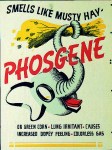
These posters date to WWI, where chemical weapons were first introduced and widely used. The posters were developed to educate soldiers to detect certain smells, giving them a few (often unhelpful) seconds warning in which they could put their gas masks on. Click the images for larger pictures.

Ricin: The Very Poor Man’s Toxic Terror Weapon

GMU Biodefense is pleased to announce the launch of its Backgrounder series. The Backgrounder, produced by GMU Biodefense faculty and affiliate research scientists, aims to concisely present fundamental knowledge on critical CBRN issues. Our first Backgrounder, produced by Dr. Alexander Garza, aims to put the true nature of the ricin threat into perspective, while also providing a general overview of US programs of detection and response.

Excerpt:

Within the past three months at least five letters containing the toxin ricin have been mailed to local and Federal government officials and a non-profit gun control organization.  To date no one has become ill from the effects of the toxin in the letters and yet the media tends to conflate the threat posed by these primitive ricin preparations with highly lethal ricin weapons developed by state actors.  There is no debate that ricin is a formidable toxin.  To truly appreciate the risk to individuals and the public at large, however, the threat posed by “ricin letters” must be placed in context with attention to the amount of toxin, its purity, the means of delivery and how it stacks up to other chemical and biological threats.  With this sudden spike in the use of ricin as a weapon of terror, this is an opportune time to review its history, capacity as a terrorist weapon, its toxic properties and countermeasures developed by the United States.  This review will put the threat and risk of ricin into perspective as well as give a broad look at US programs towards combating ricin as a terrorist weapon.”

Read the full brief here.

The Pandora Report

Highlights include BioWatch’s murky future, MERS in hospitals, norovirus at Yellowstone, the WHO simplifying its alert mechanisms, and ricin in Spokane. Happy Friday!

BioWatch Gen-3 may be too costly, CDC official says

The beleaguered BioWatch program faced congressional hearings this week. Congress has refused to authorize the $40 million President Obama requested for the program, citing ongoing concerns over rising costs and program efficacy. House Energy and Commerce Subcommittee on Oversight and Investigations chairman Murphy expressed skepticism on the program’s ability to detect pathogens, claiming that the United States is  less prepared to handle a bioterrorist attack today than it was five years ago (we disagree, but to each their own we suppose). We do agree, however, that cutting funding for public heath departments is definitely not helping preparedness.

BioWatch Gen 2 in NY

Fierce Markets – “Once the technology is rolled out, it’s unclear what the burden would be on public health agencies at all levels of government, Merlin said during the hearing, held by the House Energy and Commerce subcommittee on oversight and investigations. Rep. Tim Murphy (R-Pa.), the subcommittee chairman, said he was concerned about the cost of BioWatch, especially considering the cuts to public health agencies in recent years. At the state and local level, more than 46,000 health department jobs have been lost since 2008.”

Investigation Follows Trail of a Virus in Hospitals 

The mechanism of infection with the Middle Eastern Respiratory Virus is being carefully examined, with useful and interesting results. According to a recent study by the New England Journal of Medicine, it takes approximately 5.2 days for prodromal symptoms to appear in the average person following infection with MERS. The study also revealed that one person was able to infect seven others. While some scientists believe the virus may be less pathogenic than originally believed, public health officials continue to monitor it closely.

New York Times – “A detailed investigation of the viral illness first detected last year in Saudi Arabia has revealed the chilling ease with which the virus can spread to ill patients in the hospital — and its ability to infect some close contacts like hospital staff and family members who were in good health…The apparently high death rate from the disease has worried health experts. More than half of the confirmed cases have been fatal. However, it is possible that milder cases have gone undetected and that the disease is not as deadly as it may initially appear, said Dr. Trish M. Perl, an author of the new report, and a senior hospital epidemiologist and professor of medicine at Johns Hopkins University, who traveled to Saudi Arabia to investigate the outbreak.”

Virus sickens 200 at Yellowstone, Grand Teton parks

Summer is finally here (almost) which naturally means norovirus is busy ruining all sorts of vacation plans. This time it’s campers at Yosemite and Grand Teton parks, with almost 200 campers and park employees. Norovirus is notoriously  contagious, and is able to remain infectious as a fomite for months on door handles and common spaces.

Reuters – “The rare health advisory, tied to a suspected outbreak of the highly contagious norovirus, comes in the early weeks of a season that drew about 6 million people to the parks last year. A tour group visiting Yellowstone, home to the Old Faithful geyser, first complained June 7 of symptoms linked to norovirus, the most common cause of acute gastroenteritis in the United States, according to the federal Centers for Disease Control and Prevention.”

WHO simplifies pandemic alert system

After receiving severe criticism for its management of the 2009 H1N1 pandemic, the World Health Organization has revised its pandemic alert system. Within the new systems, the focus of the alert has shifted from raw numbers to potential risk. The new system uses just four phases, ranging from interpandemic to transition (post pandemic) to describe pandemic progression in place of the prior seven.

Courier Mail – The WHO announced H1N1 swine flu had reached pandemic proportions on June 11, 2009, first sparking panic-buying of vaccines and then anger when it turned out the virus was not nearly as dangerous as first thought. Swine flu killed more than 18,449 people and affected some 214 countries and territories, but the world had been bracing for far worse, and governments stuck with millions of unused vaccine doses were especially upset. In March 2011, a WHO evaluation committee called on the organisation to simplify its description of a pandemic to make it more precise and consistent and to assess the risks and severity of a pandemic.

Spokane man charged with sending ricin-laced letters

Matthew Ryan Buquet of Spokane, Washington has been charged with “developing and sending poison-laced letters”  (ricin is a toxin, but moving along) to President Obama, the CIA and others. Rather than have us wax lyrical about the nature of the ricin threat, check out Charles Blair of FAS and GMU  excellent piece on the subject here.

The Spokesman Review – “Federal prosecutors Wednesday charged a 38-year-old Spokane man with developing and sending poison-laced letters to President Barack Obama and a federal judge in Spokane.The court documents say Matthew Ryan Buquet produced ricin, an illegal biological toxin, and mailed the substance in threatening letters between April 29 and May 14. He was arrested May 22 after agents raided his Browne’s Addition apartment. He is jailed without bond on the charges as the case unfolds.”

Blair on Recent Radiological Plot

FAS Senior Fellow on State and Non-State Threats and GMU Adjunct Faculty member Charles Blair published a piece yesterday on the recent plot by suspected white supremacists to construct and use a radiological device. Discussing the seriousness of the threat, Blair states,

“However, much like this year’s troika of ricin-laced letters addressed to government facilities (including one to the CIA) and public officials (all three incidents targeted President Obama at his White House address), this most recent plot reveals the historical rarity and non-lethality of non-state actors and their behaviors with radiological weapons and agents. While the potential for catastrophe posed by terrorist use of chemical, biological, radiological, and nuclear (CBRN) weapons deserves ongoing and serious attention, recent events remind us how public apprehension is sometimes founded more in fear than reality; indeed, reactions based on fear are capable of far more disruption than the physical reality of the event itself. The role of science-based organizations such as the Federation of American Scientists is to educate the public about the real risks.”

Read the full piece, “Radiological Ray Gun: More Buck Rogers Fantasy than Risk to Real People”, here.

Image of the Week

This week’s image comes to us via the American Society for Microbiology, and is credited to NIAID. Pictured below is an SEM of a dead yeast particle undergoing phagocytosis.

(image credit: NIAID)


(image via Freedom House)

Dr. Koblentz interviewed by CFR on Syria

Dr. Gregory Koblentz, GMU Biodefense Deputy Director and Stanton Nuclear Security Fellow  was interviewed by the Council on Foreign Relations regarding the most recent developments in Syria. Last week, US intelligence confirmed Syrian President Bashar al Assad’s use of chemical weapons on the Syrian rebels. Speaking on the differences between prior claims of chemical weapons use and these most recent assessments, Dr. Koblentz stated,

“There are two major differences between this intelligence assessment and the one released back in April. In the earlier assessment, the Obama administration reported that the intelligence community had “varying degrees of confidence” that the Assad regime had used chemical weapons, indicating disagreement within agencies on the reliability of the evidence. In this updated version, the intelligence community now reports that it has a ‘high confidence’ that the Assad regime used chemical weapons.

The second difference is that this report provides more details on the types of evidence underlying this new assessment: ‘multiple, independent streams of information,’ including ‘reporting regarding Syrian officials planning and executing regime chemical weapons attacks; reporting that includes descriptions of the time, location, and means of attack; and descriptions of physiological symptoms that are consistent with exposure to a chemical weapons agent.'”

The detailed and timely interview also discusses the next steps for the UN, as well as implications and possible courses of action available to the United States. Read the full interview on the CFR website here.

The Pandora Report

It’s been a slower week for biodefense news – highlights include ricin – barely lethal?, MERS update, the Australia Group and Syria, stopping bacterial cell division, and the ongoing H1N1 outbreak in Venezuela. Happy Friday!

Ricin: Barely Lethal?

GMU Adjunct Faculty member and FAS Senior Fellow for State and Non State Threat Charles Blair comments on the true nature of the ricin threat in his thought-provoking column with the Bulletin of the Atomic Scientists.

Bulletin of the Atomic Scientists – “The June 7th arrest of actress Shannon Richardson for allegedly sending ricin-tainted letters to New York Mayor Michael Bloomberg and President Barack Obama comes after two other ricin-related incidents earlier this year. In May, five letters testing positive for the toxin were mailed from Spokane, Washington, with one each bound for an Air Force base, a local judge, and the Central Intelligence Agency, and two addressed to the White House. All were intercepted and authorities arrested a suspect. In April, another alleged perpetrator PDF mailed letters containing ricin to a US senator, a Mississippi judge and, once again, the White House. In short, more individuals have used ricin in the past three months than in any three-month period ever before. So what explains ricin’s growing use? The answer is two-fold.First, though the toxin is difficult to weaponize for mass casualty attacks, it is relatively easy to produce on a small scale. The ease of acquisition and manufacture strengthens the allure of the poison for those seeking revenge or public attention. Second, ricin exerts a strong cultural pull on its users.”

MERS has potential to cause pandemic, WHO says

The WHO has issued health alerts for MERS, H7N9, and H5N1 in recently released guidance based on lessons learned from the H1N1 2009 pandemic. The case number for MERS continues to grow, with another two fatalities in the last day. The source of the virus is still unknown.

NBC News – “The United Nations agency, which issued new, long-awaited guidance to countries on influenza pandemics, said the world was also in the same “alert phase” for two human strains of bird flu – H5N1, which emerged a decade ago, and H7N9, first detected in China in March. ‘International concern about these infections is high, because it is possible for this virus to move around the world. There have been now several examples where the virus has moved from one country to another through travelers,’ the WHO said of MERS, which causes coughing, fever and pneumonia.”

Chair of Australia Group Comments on Syrian Chemical Weapons Use

(image courtesy of Freedom House)

The Australia group is a informal consortium of states participating in voluntary export controls of materials which may be used to develop biological or chemical weapons. In a statement released following the conclusion of the Group’s annual Plenary meeting, the Group called on all states to participate in similar voluntary export control to prevent the further or future proliferation of weapons materials.

Press Release – “Australia Group members are gravely concerned by the growing body of evidence pointing to the use of chemical weapons and by the danger of more and larger-scale use. The threat of chemical weapon use on the people of Syria underlines the necessity for the complete eradication of chemical weapons for all time and for the universalisation of the CWC…The Australia Group underlined that the use of chemical weapons under any circumstances is unacceptable and against the legal norms of the international community. The Group urged support for the UN mission to investigate all allegations of chemical weapon use in Syria”.

Compound Freezes Bacteria Mid-Division

Developing antibiotics is unsurprisingly a pretty trick affair, with the complexity of bacterial cell division being a big part of the difficulty. Researchers at the University of Wisconsin, Madison, have found a molecule capable of throwing a figurative wrench in bacterial division. The discovery of the molecule, an enzyme inhibitor named divin, may help develop more effective antibiotics.

Chemical and Engineering News – “When a bacterium divides in two, it enlists a cast of more than a dozen proteins to help. The proteins assemble at the dividing line, arriving either in an early phase or a late one. And basically, that’s where biologists’ understanding stops…To help solve the mystery, Weibel and colleagues searched for small molecules that could gum up the works of these division proteins. Using a high-throughput screening process, they found divin, a weak inhibitor of an enzyme called MipZ that coordinates where the cell splits in two. The researchers tested divin’s effect on cell division by treating Caulobacter crescentus bacteria with the molecule. They saw something they’d never seen before: The cell starts to divide, but the two daughter cells never separate.”

H1N1 flu cases rise sharply in Venezuela

Venezuela’s H1N1 outbreak continues apace, with a sixty percent increase in case numbers in the last week.  The total numbers of laboratory confirmed cases is now at 1,138.  However, throughout May Venezuelan health authorities vaccinated nearly three million people, leading local health authorities to describe the situation as “under control”.

China Daily – “The report covering the week of May 26 to June 1 showed an increase of 414 cases, with the most affected states located along the northern coast and western Venezuela. The H1N1 virus first appeared in 2009 in Venezuela, infecting about 900 people and causing eight deaths. In Venezuela, test methods now are short of quickly determining whether a patient has been infected by the virus, but the country reportedly has a good reserve of medicine needed to combat the disease.”

Image of the Week

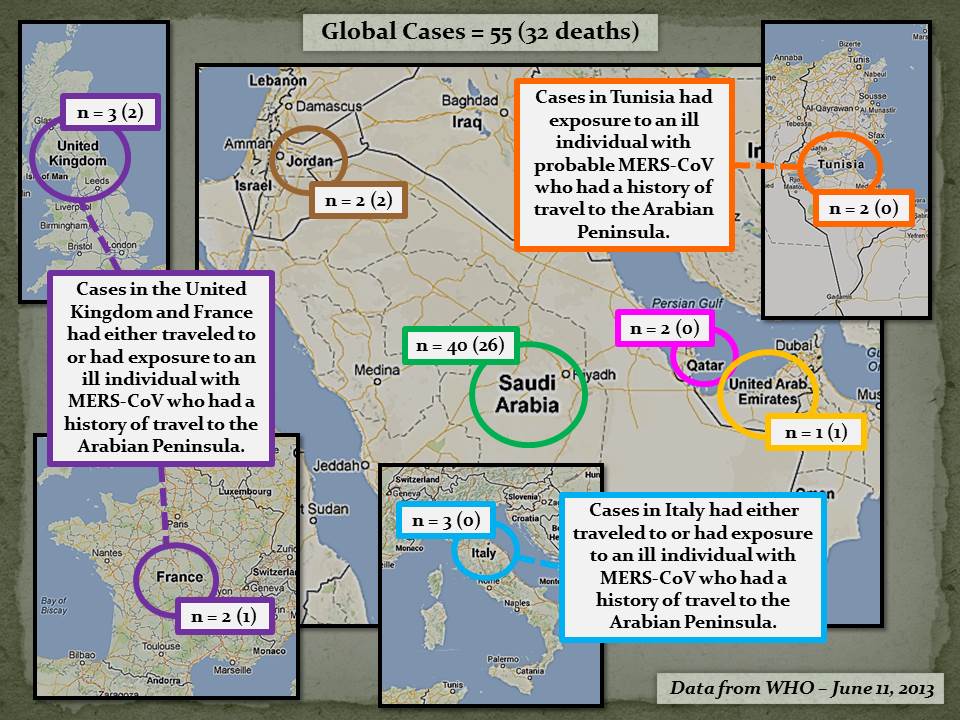
Another case of the Middle Eastern Respiratory Syndrome (MERS) has appeared in France in the last 24 hours, bringing the total number of laboratory confirmed cases worldwide to 56. Health officials are particularly anxious to maintain surveillance of the virus ahead of the annual Muslim pilgrimage to Mecca this October, which is expected to bring over three million travelers from around the world to the Saudi Arabian city.

(image via California Department of Public Health)
n = number of cases for each country, with fatalities included in parentheses  (image via California Department of Public Health)