Welcome to this week’s Pandora Report! This issue highlights lessons from a contested logistics wargame on integrating biodefense into military planning, Australia’s response to its first mainland H5N1 detection and the continued spread of New World screwworm, a new tool to strengthen chemical weapons nonproliferation, and a review challenging the use of “gain-of-function” as a category for identifying research of biosecurity concern.
When the Supply Chain Becomes the Battlefield — Biodefense Lessons from the Contested Logistics Wargame
By Sandra Roshonda Thomas, current MS Biodefense student and Founder of Thomas Strategy Consulting
The United States’ national security strategy has long been shaped by decades of policy passed down by different administrations in response to changing geopolitical threats. Wargames and tabletop exercises were born out of the necessity to look at issues and concerns. Many military exercises have focused on asymmetric warfare, irregular actors, and counterterrorism operations. While that emphasis was not misplaced, it has also created an institutional blind spot: planning for crises in which great-power conflict and biological emergencies occur simultaneously. These two threats do not occupy a separate strategic lane. They share the same physical infrastructure, decision-making systems, and industrial supply chains. Crucially, the logistics enterprise required to sustain joint military operations in a contested Pacific or European theater is the same enterprise needed to surge medical countermeasures, evacuate casualties, and shore up public health infrastructure during a biological emergency. The Contested Logistics Wargame II (CLW-II), hosted by Thomas Strategy Consulting, was among the first structured exercises to formally and deliberately place these two worlds — defense logistics and health security —within the same strategic framework. What it revealed deserves the full attention of the biodefense community.
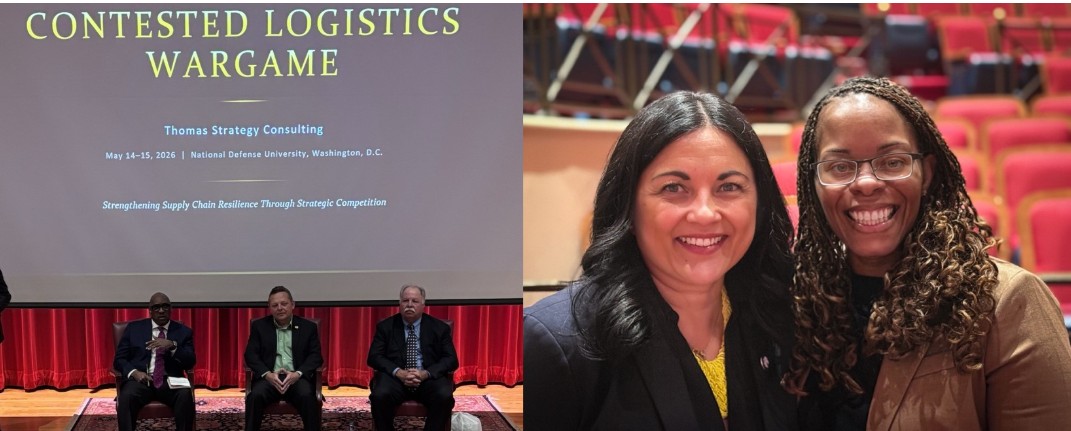
From May 14-15, 2026, CLW-II convened at the National Defense University (NDU) in Washington, D.C., marking the second iteration of a wargaming series built specifically to stress-test joint logistics assumptions under near-peer adversary pressure. Far from a conventional tabletop, this structured, scenario-driven wargame brought together a diverse cohort of participants across the national security enterprise: senior leaders and operators from the Departments of War and Defense (DoD), defense industry partners, interagency officials, and academia. Most notably, CLW-II also integrated health and medical sector professionals into the design, intentionally bringing underrepresented equities directly into core defense planning.
The exercise unfolded across five sequential turns, each escalating in complexity and building upon prior assumptions and outcomes. This structure approximated the cognitive and institutional demands of an actual crisis, forcing participants into a simulated high-pressure environment. The scenario’s final state presented a deliberate intersection of challenges: management of active military operations alongside an emerging biological incident affecting homeland infrastructure and the military health system. This dual-stress design was a consequential architectural choice — a recognition that the most dangerous crises are not the ones we plan for in isolation, but the ones that arrive when we least expect them.
Situating CLW-II within the current policy landscape reveals why its findings are so critical for the biodefense community. The DoD relies on the United States Transportation Command (USTRANSCOM), a functional, unified command that provides air, land, and sea transportation to the force in times of need. This dependence reflects decades of forced optimization for the army forces rather than a deliberate strategic preference. This optimization has bred a significant vulnerability. Commercial logistics networks are primary targets for sophisticated adversaries in the opening phases of conflict, and they are equally vulnerable to the shocks accompanying large-scale public health emergencies. The COVID-19 pandemic made this vulnerability undeniable: medical supply chains that appeared adequate under normal operating conditions collapsed under the strain of a global health emergency that was not even paired with active military conflict. CLW-II exposed a planning gap that the biodefense community has long suspected but rarely examined at the operational level: the near-total absence of integrated planning frameworks that treat military logistics and medical countermeasure distribution as components of a single, unified enterprise. Today, these planning functions exist in siloed domains, governed by disparate local, state, and federal authorities, and supported by separate resource streams — an arrangement that may be administratively convenient but is operationally untenable when both demands materialize simultaneously. The wargame demonstrated this friction across multiple turns, forcing players to manage massive, concurrent civilian and military medical demands.
From a biodefense perspective, the most consequential design element of CLW-II was what exercise architects called the “health resilience layer” — a scenario injection that transformed the final turn from a conventional contested logistics problem into something considerably more complex and revealing. Set at Day +8 of the scenario timeline, this turn confronted participants with simultaneous adversary attacks on CONUS airport facilities across multiple cities alongside an emerging biological incident, placing acute stress on both homeland defense logistics and the military health system. The demands were not sequential. Teams could not address the military logistics problem first and then pivot to the public health emergency; in this scenario — as in reality — the two crises fed on each other, competing for the same finite resources, legal authorities, and decision-making bandwidth. The biological component exposed several previously unexamined gaps at the civil-military interface. When military logistics infrastructure is already degraded by adversary action, who holds legal and operational authority over medical countermeasure distribution? How does the Defense Logistics Agency coordinate with civilian public health authorities — the Centers for Disease Control and Prevention (CDC), state health departments, and regional emergency management — if the airports and distribution nodes that both entities rely upon are simultaneously under kinetic or non-kinetic attack? These are not hypothetical questions engineered for academic discussion. They are live planning gaps with life-or-death consequences that CLW-II made visible and discussable at an unprecedented level of operational specificity.
Although structured wargaming is not traditionally recognized as a standard biodefense methodology, the community has a profound stake in the findings of CLW-II. Traditional public health preparedness often relies on a deeply flawed foundational assumption: that the military logistics infrastructure and commercial supply chains required for emergency distribution will remain largely intact and available during wartime. CLW-II inverts this assumption entirely. It challenges the institutional tendency to relegate medical equities to the periphery of defense planning by exposing a stark reality: stockpiling countermeasures is a meaningful preparedness investment, but it is only half the battle. A robust inventory becomes functionally irrelevant if the distribution networks required to move these life-saving commodities from storage to communities are compromised by an adversary. As currently designed, the Strategic National Stockpile (SNS) relies on a secure domestic transit infrastructure that may not exist in a near-peer conflict. Furthermore, the assumption that military assets and capabilities will be available to support civilian public health operations during a simultaneous crisis requires an urgent, systematic re-examination. CLW-II did not resolve these deep systemic vulnerabilities, but it created conditions under which they could no longer be avoided. For the future of wargaming, this type of scenario needs to be tested, and policies need to be developed.
Beyond its immediate policy implications, CLW-II offers a broader methodological argument for the biodefense research and education community. While our field is anchored by rigorous modeling and careful policy analysis, structured wargaming introduces a fundamentally different layer of insight. By placing decision-makers under escalating pressure and forcing real-time resource allocation choices against an actively adaptive opponent, wargaming surfaces the cognitive friction, institutional seams, authority ambiguities, and communication breakdowns inherent to crisis management — vulnerabilities that static analysis and consensus-driven tabletops fail to capture. The operational friction revealed in CLW-II’s final turn, as teams struggled to reconcile competing authorities amidst collapsing assumptions, yielded knowledge that no traditional policy paper could replicate. As both the founder of Thomas Strategy Consulting and a current Master’s student in Biodefense at the Schar School of Policy and Government at George Mason University (GMU), I see a clear need for this approach. There is a compelling case for integrating structured wargaming into both the research agenda and graduate curricula of biodefense programs, particularly on topics that sit at the precarious intersection of health security and national defense logistics. The methodological investment is modest; the analytical return is significant.
The findings of CLW-II yield three urgent, policy-forward recommendations for the biodefense community, policymakers, and academia. First, the United States requires a joint DoD–HHS–DHS planning framework that explicitly integrates medical countermeasure logistics into contested military logistics doctrine. Treating these as parallel tracks rather than components of a single enterprise —sharing physical infrastructure, transit assets, and decision-making authorities— is a profound strategic liability that current iterations of the National Biodefense Strategy fail to adequately rectify. Second, future exercises must expand the participation of health sector professionals, including medical logistics specialists, public health planners, and biodefense scholars. In my experience from being at the Pentagon, high-level wargaming historically glosses over logistics, and the medical field is sidelined even further. Excluding these experts leaves defense planning products with dangerous blind spots; after all, the contested sustainment crisis is fundamentally a health security problem, and it should be treated as such.
Lastly, academic institutions like GMU’s Biodefense program, along with peers across the national biodefense academic community, should engage directly with the CLW series and similar defense wargaming venues, not merely as observers but as active contributors and researchers. The intersection of logistics resilience and health security is an emerging field that urgently needs voices trained in both disciplines to bridge the analytical and institutional gap that CLW-II exposed. The exercise demonstrated something that the biodefense community should inscribe in its collective planning consciousness: when the supply chain becomes the battlefield, biodefense is no longer a separate domain — it is the center of gravity.
Australia Locks Down for Bird Flu
By Margeaux Malone, Pandora Report Associate Editor
As Australia responds to its first detection of H5N1 bird flu on the mainland, Agriculture Minister Julie Collins provided reassurance that the country is well prepared, pointing to investments in national response arrangements: “We take the risks of H5 bird flu seriously which is why our government has invested more than $113 million to strengthen our nation’s preparedness. Australia’s response is designed to manage the risks of H5 bird flu, to protect poultry production, and reduce impacts on wildlife and communities.”
Minimizing the impact of bird flu on wildlife is a critical goal for the country following devastating outbreaks in Australia’s sub-Antarctic territories. Research from Heard Island, about 2500 miles south-west of Australia, estimates that H5N1 has killed roughly 13,000 of 17,000 southern elephant seal pups since last August. Researchers also confirmed King and gentoo penguins and Antarctic fur seals tested positive. Environment Minister Murray Watt called the deaths “sobering” and warned against complacency as the virus moves to the mainland.
Meanwhile, commercial poultry producers have acted quickly to increase biosecurity. Inghams Group, one of Australia’s largest poultry companies, locked down all its Western Australian farms and processing sites and banned non-essential access, even though its operations sit almost 700 km from the detection site. The company is also seeking approval to house free-range flocks indoors to further mitigate against any potential risks.
Screwworm Spreads in Texas as Other States Tighten Restrictions
The New World screwworm outbreak has grown to 31 confirmed cases nationwide as of July 1 (21 active, 10 inactive). Texas accounts for 30 of them, alongside one now-inactive case in New Mexico, and officials have quarantined parts of 21 Texas counties. The most recent cases include sheep, cattle, and the state’s first infected dog.
Several states, including New Jersey, Maine, Missouri, and Minnesota, have responded by tightening import requirements for pets and domestic animals to prevent introduction of the parasite. Restrictions vary including requirements for certificates of veterinary inspection prior to arrival, quarantine periods, and treatment with EPA- or FDA-approved external parasite products. Texas localities are acting pre-emptively too. Blanco County has issued a local disaster declaration despite having no confirmed cases itself, though neighboring Gillespie County confirmed an infected goat in early June. A county judge noted the measure gives officials more flexibility and will allow them to move more quickly if a case is identified. For instance, the county could utilize its own property for animal disposal to support local producers.
The USDA marked the opening of the new sterile fly production plant in southern Mexico on June 27, with the goal of producing an additional 30 million sterile flies within 8 weeks and 100 million by this fall to help slow the spread.
Further Reading:
- “Project Launched on Use of Nuclear Technique to Target New World Screwworm Outbreak in Central America, Mexico and the United States,” The International Atomic Energy Agency
- “A U.S.-Mexico Partnership Beat Screwworms Once. Why Are They Back?” Mark Dent, Texas Monthly
- “Animal quarantines on standby as Nepal battles rising cases of bird flu,” Gopal Sharma, Reuters
- “H9N2, H5N1, and H5N2 Are All Being Monitored for Human Risk — Here Is the Honest State of Avian Flu in 2026,” Joseph James, Medical Daily
- “Wisconsin egg production cut in half as farms struggle with avian flu, higher expenses,” Hope Kirwan, Wisconsin Public Radio
New Chemical Weapon Nonproliferation Tool Unveiled
Dr. Stefano Costanzi at American University has released CMF-CW (Chemical Match Finder for Chemical Weapons Control Lists) to enhance efforts to prevent the proliferation of chemical weapons. The complexity and variability of chemical nomenclature, as well as the vastness of chemical space, can make it challenging and time-consuming to determine whether a given substance is covered by these lists. CMF-CW is a free, publicly available web application that helps users determine whether a chemical name or another text-based input – such as a text string representing a chemical structure or a chemical database identifier – corresponds to a substance covered by chemical-weapons-related control lists. CMF-CW uses these inputs to check against the Chemical Weapons Convention Schedules, the Australia Group Chemical Weapons Precursors list, and the Wassenaar Arrangement Munitions List 7. It then reports whether the corresponding substance matches any of the entries in these control lists. In addition to the application itself, the website includes help pages and video presentations explaining what the CMF-CW does, how to use it, and how it works. Free webinars for those interested in learning more about CMF-CW will be held on June 30, July 1, and July 2. If you would like to participate, please fill out this form and indicate the date of your choice. A webinar link will be sent to you once your registration has been confirmed. Spaces are limited and available on a first-come, first-served basis.
Review Challenges Use of “Gain-of-Function” as a Biosecurity Category
A new review in Frontiers in Bioengineering and Biotechnology argues that the term “gain-of-function” is an unreliable proxy for identifying research of biosecurity concern. After reviewing over 20,000 publications referencing gain-of-function research, the authors found that the vast majority involved non-microbial studies, such as human genetics and cancer biology, while only 15 papers met the federal criteria for dangerous gain-of-function (DGoF) research. Conversely, most research that would qualify as DGoF never used the term “gain of function” at all. The authors conclude that oversight should focus on the biological functions of sequences of concern—rather than terminology—to better identify genuinely high-risk research and improve the consistency of biosecurity governance.
IN OTHER NEWS
AI, Biotechnology, and Biosecurity
- “Researchers caught in the crossfire as companies and government grapple over AI safety,” Celina Zhao, Science
- “Towards a Common Standard for Evaluating Frontier AI Safeguards against Biological Misuse,” Bhuvana Sudarshan and Luca Righetti, GovAI
- “Can LLM Agents Select and Engage with Biological Tools?” Jeffrey Lee, Alyssa Worland, Kyle Brady, Grant Ellison, Henry Alexander Bradley, Christopher Rodriguez, Casey O. Barkan, Sunishchal Dev, Dawid Maciorowski, Jordan Despanie, et al., RAND
- “BioSecBench-Refusal,” Edwin H. Wintermute, Harmon Bhasin, Christina M. Agapakis, Dianzhuo Wang, Evan Seeyave, Arjun Banerjee, Daniel Fulop, Matthew C. Watson, Adam J. Meyer, Sandrine Boissel, Jens H. Kuhn, Rishi Jain, Noah D. Taylor, Helena Shomar, Patrick M. Boyle, and Kenny Workman, LatchBio
- “Joint Service Program Delivers Genetic Intelligence for the Modern Battlefield,” Nicholas E. M. Pasquini, U.S. Naval Research Laboratory
- “Congress and Trump’s policies on research risks wouldn’t have prevented recent lab incidents. Here’s what to do,” Sumnima Singh and Anemone Franz, Bulletin of the Atomic Scientists
- “New world-leading lab to be built at secretive UK research site,” Ministry of Defense and Dan Jarvis MBE MP, GovUK
- “A Chemically Defined Synthetic Cell Capable of Growth and Replication,” Nathaniel J. Gaut, Christopher Deich, Brock Cash, Tanner Hoog, Aaron E. Engelhart, Katarzyna P. Adamala, Biotic
- “This Cell Feeds, Grows and Reproduces. And It’s Manmade.” Carl Zimmer and Marco Hernandez, NY Times
- “Synthetic biology researchers think they’ve made a cell. Is it alive?” Matthew Herper, StatNews
- “In 1950, Australia used a virus as a biological weapon against millions of rabbits; scientists just decoded how they fought back, using DNA from a rabbit that once belonged to Charles Darwin,” Team Global, Global Desk, The Economic Times
Ebola Outbreak in the Democratic Republic of Congo
- “Ebola cases in Congo reach highest first-month total of any outbreak, WHO says,” Emma Farge and Ayen Deng Bior, Reuters
- “Africa CDC chief says the continent needs to invest its own funds in Ebola response, vaccine,” Samuel Getachew and Evelyne Musambi, WP
- “Construction of US-backed Ebola quarantine unit in Kenya is stopped,” Stephanie Soucheray, CIDRAP
- “How Bad Could the Ebola Outbreak Get? Here Are 5 Key Factors.” Stephanie Nolen, Samuel Granados, Amy Schoenfeld Walker, Carl Zimmer and Apoorva Mandavilli, NY Times
- “The Ebola Outbreak’s Central Mystery: Where Did This Virus Come From?” Carl Zimmer, NY Times
- “As Ebola deaths top 300, African officials meet to boost regional readiness,” Chris Dall, CIDRAP
- “Chaotic Push to Train Staff for US Ebola Outbreak Facility Alarms Health Workers,” Jessica Nix, Bloomberg
- “Congo’s Ebola outbreak has most cases in first month of any African outbreak, WHO says,” Reuters
- “US CDC raises Ebola outbreak response to highest level,” Ahmed Aboulenein, Reuters
- “Witchcraft and WhatsApp: The fight to contain Ebola misinformation,” Ben Farmer, The Telegraph
- “Marburg outbreak is reported in Uganda, threatening to complicate Ebola response in region,” Helen Branswell, StatNews
Vaccines, Immunization, and Public Health
- “Covid vaccine study the acting CDC director blocked is published in an outside journal,” Aria Bendix, NBC News
- “FDA panel backs first-of-its-kind flu vaccine using mRNA technology,” Lauran Neergaard and Matthew Perrone, WP
- “Scores Fall Ill at Air Force Base After Hegseth Makes Flu Vaccine Optional,” Greg Jaffee and Maggie Haberman, NY Times
- “Military services again requiring recruits to get flu shots as Air Force outbreak grows,” Jade Cobern, Luis Martinez, Mary Kekatos, and Steven Beynon, ABC News
- “Military Leaders Sought Vaccination Program Weeks Before Flu Outbreak Hit Base,” Greg Jaffe, NY Times
- “US tops 2,100 measles cases so far this year, putting it on track to surpass 2025 total,” Chris Dall, CIDRAP
- “U.S. Poised to Lose Measles Elimination Status as Utah Outbreak Nears One-Year Mark,” Jennifer Calfas, Wall Street Journal
- “New CDC Leaders Vow to Boost Skeleton Staff Left After DOGE Cuts,” Jessica Nix, Bloomberg
- “New ACIP charter could allow RFK Jr. to further restrict vaccine access, critics say,” Liz Szabo, CIDRAP
- “Proposed CDC science office could tighten political control at agency,” Chelsea Cirruzzo, StatNews
- “New Disease Threats Follow Trump Administration’s Health Program Cuts,” Stephanie Armour, KFF Health News
- “I Was an NIH Program Official. Here’s What a Peer Reviewer Doesn’t See.” Elizabeth M. Ginexi, Medpage Today
Chemical Weapons
- “U.S. Military Races to Create Protective Troop “Shield” Against Chemical Weapons,” Melissa Myers, Digital Visual Information Distribution System
- “Russia approved secret China military training at top level, sources say,” Reuters
- “MKUltra: Declassification Task Force Should Focus on Real Secrets, Not Conspiracy Theories,” National Security Archive
Supporting Responsible Innovation of Synthetic Cells: Biosafety, Biosecurity, and Environmental Considerations 2026
In a new consensus study report, the National Academies of Sciences, Engineering, and Medicine (NASEM) examines the opportunities and governance challenges posed by advances in synthetic cell research. The report finds that while many biosafety, biosecurity, and environmental risks associated with synthetic cells are comparable to those of existing chemical and microbial systems, their novel architectures, engineered capabilities, and expanding applications may introduce new uncertainties for risk-benefit evaluation and oversight. To support responsible innovation, the report outlines a coordinated national biotechnology governance strategy that includes strengthening the scientific evidence base for risk assessment, modernizing biosafety and biosecurity oversight, and promoting transparency, public engagement, and international collaboration.

NEW: Jessica T. Mathews New Voices Conference
From Carnegie Endowment: “Rising great power tensions, the end of arms control, renewed proliferation risks, and the expansion of nuclear energy all underscore the urgency of this moment. Developing the new ideas, skills, and perspectives needed to manage nuclear dangers into the future requires engaging talented individuals from a variety of backgrounds and disciplines.
The Nuclear Policy Program at the Carnegie Endowment for International Peace is pleased to be hosting its third Jessica T. Mathews New Voices conference on Wednesday, July 8, 2026. The conference will be held in person at Carnegie’s headquarters in Washington, D.C., with the keynote available for registered participants online.
This one-day event for interns, students, and young professionals will provide substantive policy discussions with guest speakers, opportunities for networking and mentorship, and an interactive nuclear session.”
This event will take place on Wednesday, July 8, from 9:00 AM – 5:00 PM (EDT). Learn more and register here.
NEW: Data and Situational Awareness for Medical and Public Health Preparedness and Response: A Workshop Series
From the National Academies: “The Forum on Medical and Public Health Preparedness for Disasters and Emergencies workshop series will explore how medical, public health, emergency management, and critical infrastructure data are collected, integrated, analyzed, and translated into real-time information to support timely, coordinated decision-making before, during, and after disasters and emergencies.”
Sessions of the workshop series will take place on July 16, July 21, and July 28, followed by a capstone session on September 23. Learn more and register here.
NEW: Tracking Health Security Progress and Building Resilience in Africa – A Webinar
From the Nuclear Threat Initiative (NTI): “The world is shifting from a period of urgent health actions to one of vast growing neglect, even as biological threats continue to rise. Against this backdrop, the 2026 Africa Health Security Index shows great progress has been made across the continent – but substantial gaps remain.
Join NTI, the Brown University Pandemic Center, Economist Enterprise, and the Science for Africa Foundation for a discussion of the findings and recommendations of the 2026 Africa Health Security (AHS) Index, an independent assessment of health security capacities in Africa.
This webinar will convene global experts and policymakers to discuss how the AHS Index can shape policy decision-making and drive meaningful action to strengthen health security capacities and improve preparedness for future epidemics and pandemics.”
This webinar will take place on July 29 from 3:30 – 5:00 PM EAT (8:30 AM – 10:00 AM ET). Learn more and register here.
Preparing for a Future of AI-Enabled Biology
From the National Academy of Medicine (NAM): “Artificial intelligence (AI) is transforming the life sciences, including how researchers study biology, develop vaccines and treatments, and detect disease outbreaks. While these advances could improve public health and preparedness, they also raise important questions about safety, security, and the possibility of misuse.
To better understand these issues, the National Academy of Medicine, in collaboration with the National Academies of Sciences, Engineering, and Medicine and with support from the Coalition for Epidemic Preparedness Innovations (CEPI), will convene a two-day workshop on preparing for the future of AI-enabled biology.
The workshop will bring together experts from public health, medicine, biotechnology, artificial intelligence, biosecurity, government, and industry to explore how AI-enabled biological risks may evolve over the next decade.”
This hybrid event will take place on August 11-12, 2026. Learn more and register here.
Ninth Session of the Working Group on the Strengthening of the Biological Weapons Convention
From the United Nations Office for Disarmament Affairs (UNODA): “We will convene the Ninth Session of the Working Group on the Strengthening of the Biological Weapons Convention (BWC). Chaired by Ambassador Frederico S. Duque Estrada Meyer of Brazil, the meeting will bring together State Parties, international organizations, academic institutions, and civil society representatives to continue discussions on strengthening the Convention and advancing efforts to address biological threats. Public sessions will be webcast through UN Web TV, and side events are expected throughout the week.
This event will take place from August 17-21 at the Palais des Nations in Geneva, Switzerland. Learn more and register by July 31 here.
Biosecurity Simulation Exercise (BSX 2026): Laboratory Incidents & Deliberate Biothreats
From the Asia Centre for Health Security: “This table-top simulation exercise aims to enhance inter-sectoral and inter-disciplinary preparedness for laboratory biosafety and biosecurity (LBB) and deliberate biothreat events (DBE). Through lectures, discussions, and structured, scenario-driven exercises, participants will explore decision-making to detect, risk-assess, and manage high-consequence biological incidents under conditions of incomplete information and unfolding events. Participants will collaborate in teams, building on expert perspectives to address issues in surveillance, diagnostics, public health response, security assessment, and risk communication.”
This in-person event will be held from August 27-28. Learn more and register here.
Training Course on ‘Biotechnology Innovation and Biosecurity’
From the International Centre for Genetic Engineering and Biotechnology (ICGEB) and the Biological Weapons Convention Implementation Support Unit: “This training focuses on strengthening capacities in biosecurity, biosafety, and biological risk management in the context of rapid advances in biotechnology with an integrated, interdisciplinary approach to manage biothreats at the intersection of humans, animals, plants and the environment. It addresses the governance, technical, and operational dimensions of preventing, detecting, and responding to biological threats, while promoting responsible and peaceful scientific research and innovation in accordance with article X of the Biological Weapons Convention (BWC).”
This in-person event will be held from October 12 – 16 in New Delhi, India. Learn more and apply here.

