
This week’s Pandora Report includes program news, updates on H5N1 and the pandemic agreement negotiations, and coverage of Africa CDC’s new mpox clinical trial and Ukrainian reporting on alleged Russian chemical weapons use.
All-BIOD Panel at the Tucker Symposium on Chemical and Biological Weapons
On November 13-14, the Center for Nonproliferation Studies (CNS) at the Middlebury Institute for International Studies hosted the 13th Annual Jonathan B. Tucker Symposium. The symposium is held in honor of Jonathan Tucker who dedicated his career to fighting the scourge of chemical and biological weapons. The first panel of the symposium was composed of two alumni of the Biodefense Graduate Program at the Schar School of Policy and Government: Yong-Bee Lim, Biodefense PhD ’21, and Minh Ly, MS Biodefense ’21. Dr. Lim, who is the Deputy Director of the Converging Risks Lab at the Council for Strategic Risks, gave a presentation on “Technology Democratization and its Implications for CBW Safety and Security: Lessons Learned from Engagement with Non-Traditional Communities.” Ly, who is a Research Fellow at CNS, served as the moderator. In his talk, Dr. Lim discussed his research on the Do-It-Yourself Biology community: a grassroots, decentralized community drawn together by a shared passion for biological experimentation, fostering innovation, and a desire to democratize access and use of life sciences materials, equipment, knowledge, and tools. While often discussed as a potential biosecurity threat in policy circles, Dr. Lim’s research found that much of the conventional wisdom on this community is oversimplified or incorrect. Dr. Lim’s talk concluded with three key lessons learned from his engagement with the community: 1) there is often a gap between perception and reality about biorisks that can lead to improper metrics and incorrect assessments that complicate policy formulation and implementation; 2) as the life sciences are practiced by more people, it is imperative to positively engage and receive buy-in from these communities on addressing biorisk issues; and 3) preventing and countering CBW will be increasingly difficult in a world where definitions for key terms such as biosecurity, democratization, and terrorism are either changing or have no global consensus.

Biodefense Program Bowling Party at the White House
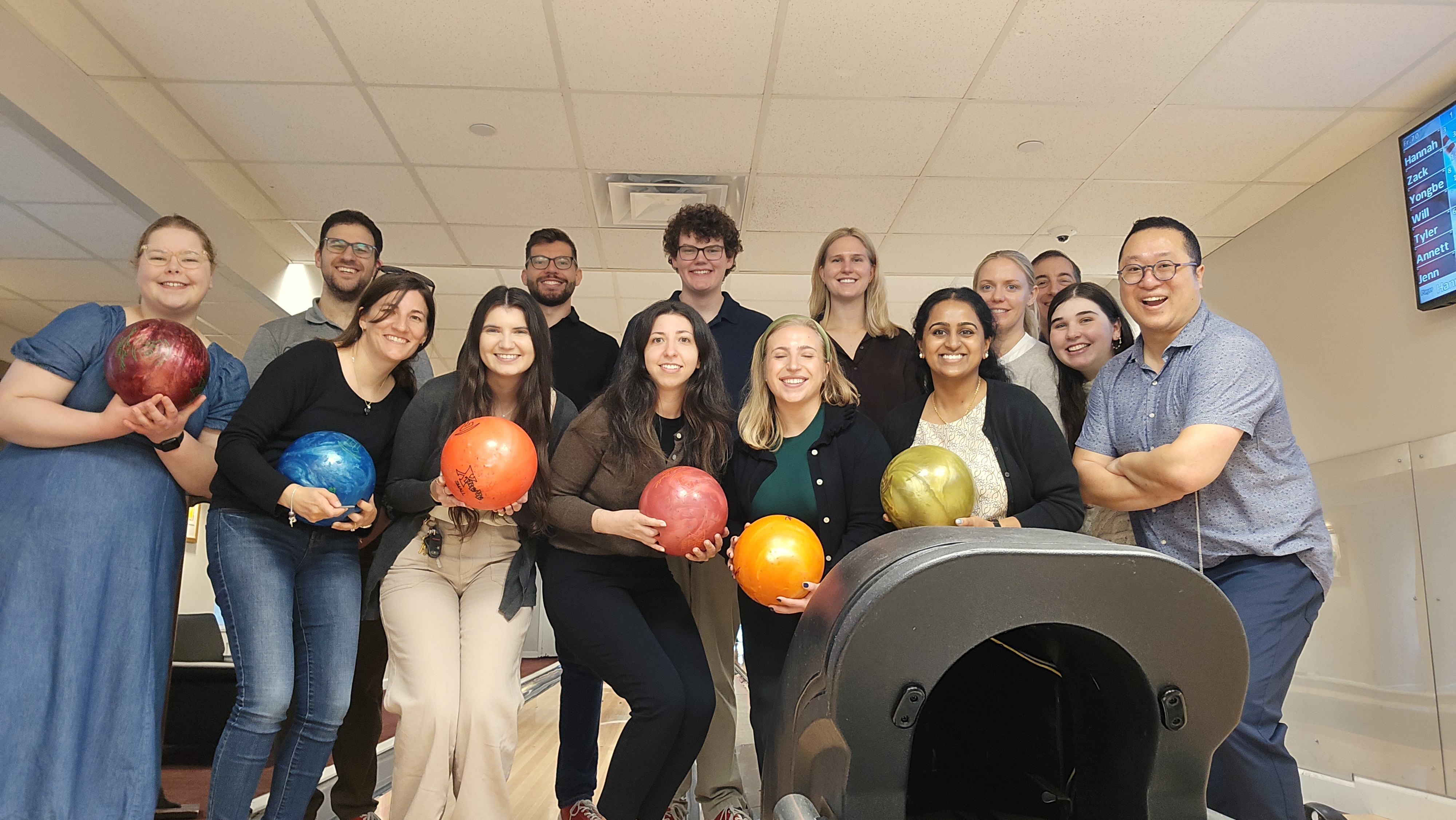
On November 7, a group of students, faculty, and alumni from the Biodefense Graduate Program at the Schar School of Policy and Government went bowling at the Harry S. Truman Bowling Alley in the Eisenhower Executive Office Building. Competition was fierce, but friendly, between Team Smallpox, Team Anthrax, Team Plague, and Team Ebola. In between strikes, spares, and gutter balls, the group enjoyed coffee, pastries, and lively conversations. Biodefense master’s student Tyler Smith won a fall-themed White House challenge coin for achieving the highest score. Team Smallpox, composed of MS Biodefense students Will MacDonald and Tyler Smith, Biodefense PhD student Annette Prieto, and Biodefense PhD alum Jen Osetek, emerged victorious and walked away with more White House merch. “This was an amazing experience,” said Annette, who works as a Technical Analyst at RAND, “The fun and friendly competition we shared in such an iconic setting made for an unforgettable day and helped build bonds that will extend beyond the lanes.” Program director Gregory Koblentz was rusty but managed to throw one strike and two spares after a healthy infusion of caffeine. The bowling party was graciously hosted by Biodefense PhD student Katherine Dammer who is Special Assistant for Global Health Security and Biodefense at the National Security Council.


Avian Influenza Updates
Canada Reports First Domestically Acquired Human H5N1 Case
The Public Health Agency of Canada (PHAC) confirmed the country’s first domestically acquired human case of avian influenza (caused by H5N1) earlier this week. On November 9, the Office of the Provincial Health Officer for British Columbia reported that a BC teenager was hospitalized and tested presumptive positive for H5N1. On November 13, PHAC’s National Microbiology Laboratory in Winnipeg confirmed the test result and that genomic sequencing indicated that the virus is related to the H5N1 viruses circulating in poultry in British Columbia. Provincial officials are conducting an investigation and are taking actions like contact tracing, testing, and offering antiviral medication to contacts. No further cases have been identified at this time, and it is not clear how the teenager was infected.
PHAC says that the risk to the general public remains low at this time, but the risk is higher for those with unprotected exposure to infected animals. Importantly, the genotype of H5N1 avian influenza in US dairy cattle is not the same as the one confirmed in the domestically acquired human case in BC. No cases of avian influenza have been reported in Canadian dairy cattle, and there is no evidence of its presence in Canadian milk samples.
CDC Calls for Expanding Testing
Federal health officials called for more testing of farmworkers after a CDC study showed that 7% of those tested in Michigan and Colorado had antibodies indicative of a previous H5N1 infection. Only one of the eight workers reported working with infected cows, despite all eight of them doing so. CDC explained in a statement that “…there are two primary ways that workers in the United States have been infected with H5N1 virus: via exposure to infected poultry during culling activities, and through exposure to infected dairy cows, including while caring for sick cows, or when working in a milking parlor, the area on the farm where cows are milked.”
Based on this, the agency has updated its existing recommendation on actions to prevent exposures to H5N1 infected animals, including:
- “Decreasing human exposure through One Health control strategies and biosecurity to limit H5N1 virus infections in animals.”
- “Enhancing personal protective equipment (PPE) guidance to more clearly detail what PPE is appropriate for exposure risk levels (high, medium, and low) in farming and poultry culling operations, alongside more robust worker training on proper use of PPE.”
- “Identifying exposed workers and providing appropriate testing as well as post-exposure prophylaxis (i.e., efforts to limit spread of disease), and treatment (e.g., antivirals).”
- “Offering testing to asymptomatic workers with a high-risk exposure who reported not wearing relevant PPE or who experienced a PPE breach or failure.”
- “Increasing outreach and education with farm workers, employers, and advocacy groups to stress and ensure understanding of these messages and strategies.”
The CDC has also updated recommendations for testing and offering oral antiviral medications. This includes the recommendation that asymptomatic workers with a PPE-unprotected, high-risk exposure to sick animals be offered oseltamivir. The statement explains that a high-risk exposure “could include an unprotected splash in the face with raw cow milk from an infected or potentially infected cow, or not using recommended PPE during activities to depopulate poultry at a poultry farm with known H5N1.” The recommendations also include offering influenza A(H5) testing to asymptomatic workers who have had a high-risk exposure to animals infected with H5N1, whether or not that worker chooses to begin PEP.
The Pandemic Agreement Will Not Be Ready by December
Co-chairs of the World Health Organization’s (WHO) Intergovernmental Negotiating Body (INB), Ambassador Anne-Claire Amprou and Precious Matsoso, explained at a media briefing earlier this week that the pandemic agreement will not be adopted at a special World Health Assembly next month as initially thought. They indicated that this was because countries need “more time,” though the INB is already in its 12th meeting following 32 months of negotiations. Ambassador Amprou said at the briefing, “Today, member states agreed we need to conclude the agreement as soon as possible and continue negotiations into 2025 with the goal of concluding the agreement by the next WHA scheduled in May 2025, so we are moving in the right direction with a strong political commitment by member states.”’
Africa CDC Launches Mpox Drug Trial
The Africa CDC recently announced the launch of a trial of the antiviral drug brincidofovir as a treatment for mpox. Brincidofovir, sold under the brand name Tembexa, is a prodrug of cidofovir and is currently approved in the United States to treat smallpox. The trial, “The MpOx Study in Africa (MOSA),” will evaluate the safety and efficacy of brincidofovir with the drug’s developer, Emergent BioSolutions, announcing that it will be conducted and sponsored by PANTHER-the pandemic preparedness platform for health and emerging infectious response.
The trial was announced shortly after the total number of cases of mpox in this outbreak surpassed 50,000. Jean Kaseya, MD, Director General of Africa CDC, said in a statement “Africa is not just responding to the Mpox outbreak; we are leading the charge by spearheading research and development for Mpox therapeutics…The MpOx Study in Africa is a groundbreaking step toward developing an effective treatment that will save lives. This goes beyond research—it’s about African ownership and leadership in tackling our continent’s health challenges through essential research.”
Ukrainian General Staff Reports 323 Uses of Russian CW Use in October
Ukraine’s General Staff reported on November 8 that it had detected 323 Russian uses of CW on the battlefield in October. This brings the total to 4,613 uses reported by Ukraine since Russia’s full-scale invasion in 2022. An August investigation from the Kyiv Independent showed that Russia’s use of CW is growing, with some Ukrainian soldiers reporting dealing with up to six attacks daily. The United Kingdom announced sanctions against relevant Russian units last month, and the US Department of State cited Russian use of chloropicrin against Ukrainian troops in its announcement of more than 280 sanctions against individuals and entities tied to Russia earlier this year.

Emerging Infectious Diseases-“Vol 30, No. 14 Supplement – Reports from the US Department of Defense Global Emerging Infections Surveillance Program”
David M. Brett-Major writes in this issue of CDC’s Emerging Infectious Diseases‘ introduction, “This supplement contains new technical outputs and perspectives from the Global Emerging Infections Surveillance (GEIS) program within the Department of Defense (DoD). GEIS develops, invests in, disseminates, and integrates information from health surveillance activities conducted by military, academic, public health, and other partners. GEIS-funded researchers from around the world provide novel surveillance data that are used to update the military and civilian outputs from this long-standing initiative.”
“Trump Administration’s Chance to Lead on Pandemic Preparedness”
Syra Madad discusses the incoming administration’s opportunity to leverage lessons learned from the COVID-19 pandemic in this piece from the Belfer Center, writing in part “As the Trump administration prepares to take office, it faces a pivotal moment to leverage hard-earned lessons from the COVID-19 pandemic and build a more resilient, pandemic-prepared nation. The challenges of managing the first year of COVID-19 exposed critical vulnerabilities in our fragmented public health infrastructure and decentralized healthcare system. The administration is now uniquely positioned to prioritize pandemic preparedness as a matter of national security. This proactive approach is more important than ever, particularly given the current threat posed by H5N1 avian influenza, which is spreading rapidly among wild birds – among other species and causing outbreaks in U.S. poultry and dairy herds. Recent human cases among farmworkers exposed to infected livestock further underscore the urgency of this threat.”
“Cyberattacks on Healthcare: A Global Threat That Can’t Be Ignored”
Vibhu Mishra wrote this piece discussing UNSC’s interest in protecting healthcare infrastructure against cyberattacks for UN News: “An alarming surge in ransomware attacks is putting the world’s healthcare infrastructure at critical risk, endangering patient safety and destabilising health systems, the head of the UN World Health Organization (WHO) warned on Friday, as the Security Council convened to discuss strategies to counter the growing threat.”
Read more here and read the WHO Director-General’s remarks from the meeting here.
“Robust Biosecurity Measures Should Be Standardized at Scientific Cloud Labs”
Jeffrey Lee and Barbara Del Castello recently authored this commentary piece for the RAND Corporation. In it, they discuss clous labs and argue that “By adopting comprehensive security measures, including routine evaluations and monitoring via artificial intelligence (AI), the scientific community, ideally through a consortium, can harness the full potential of cloud labs while ensuring safe and secure research environments.”
“The U.S. Could Soon Face a Threat ‘More Powerful’ Than Nuclear Weapons”
Ashish K. Jha, Matt Pottinger and Matthew McKnight discuss the implications of rapid advancement in synthetic biology and how to achieve bioweapons deterrence in this Washington Post opinion piece. They point to the importance of superior intelligence gathering and analysis, writing that “For deterrence to work, Washington and its allies must have a robust, pervasive system for tracking and, where possible, eliminating highly dangerous research around the world.” However, they explain that the primary challenge to expanding and improving US BIOINT efforts is not technology, but resolve, with Congress having recently watered down the Biden administration’s budget request for pandemic prevention and biosurveillance efforts outlined in the 2023 Biodefense Posture Review remaining underfunded. They conclude that BIOINT alone won’t deter adversaries, but that all necessary elements of bioweapons deterrence depend on world-class BIOINT.
“Developing Guardrails for AI Biodesign Tools”
From NTI: “The integration of artificial intelligence (AI) with the life sciences offers tremendous potential benefits to society, but advances in AI biodesign tools also pose significant risks of misuse, with the potential for global consequences.”
“AI biodesign tools (BDTs) are technologies that enable the engineering of biological systems. These tools are trained on biological data and are developed to provide insights, predictions, and designs related to biological systems. BDTs have the potential to drive progress in the development of new therapeutics and are likely to have a significant impact across the broader bioeconomy, including in agriculture, health, and materials science. However, there are risks BDTs could be misused to design dangerous pathogens, and few safeguards exist to ensure that the benefits of these technologies can be realized safely and securely.”
“Innovative strategies are needed to reduce the risks associated with potential misuse of biological design tools without significantly hindering beneficial uses. This report identifies a number of strategies, referred to as guardrails, that could be developed to safeguard BDTs against misuse.”
Read the report here.
What We’re Listening To🎧
Build the Base Podcast-Tracy Frost and Dr. Kate Sixt, DoD Research and Engineering OUSD
“In this episode of Building the Base, Lauren Bedula and Hondo Geurts sit down with Tracy Frost, Director of Technology Industrial Innovation Base, and Dr. Kate Sixt, Principal Director for Biotechnology at the Department of Defense. The conversation explores the revolutionary intersection of biotechnology and national security, diving into how the DoD is leveraging bio-manufacturing to strengthen domestic supply chains and innovate defense capabilities. From converting waste products into valuable materials to creating new pathways for manufacturing critical components, the discussion reveals how public-private partnerships are reshaping America’s industrial base.”

One Health and the Politics of COVID-19 Book Launch
The Writer’s Center is hosting a book launch for Dr. Laura Kahn’s new book, One Health and the Politics of COVID-19 (blurb below) on November 23 at 2 pm EST in Bethesda, MD. Learn more and RSVP here.
“One Health and the Politics of COVID-19 unpacks the mysteries of COVID-19’s origins to impart important lessons for future outbreaks. The One Health concept recognizes the interconnected links among the health of humans, animals, plants, and the environment. By comparing the history, science, and clinical presentations of three different coronaviruses—SARS-CoV-1, MERS, and SARS-CoV-2 (COVID-19)—Kahn uncovers insights with important repercussions for how to prepare and avoid future pandemics. The One Health approach provides a useful framework for examining the COVID-19 pandemic. Understanding the origins of this zoonotic disease requires investigating the environmental and molecular biological factors that allowed the virus to spread to humans. The book explores the many ways in which the wild animal trade, wet markets, and the camel industry contributed to the spread of the earlier SARS-CoV-1 and MERS coronaviruses. For SARS-CoV-2 (COVID-19), Kahn examines the biosafety, biosecurity, and bioethics implications of gain-of-function research on pandemic potential pathogens. This book is a must read to understand the geopolitics of the COVID-19 pandemic.”
Enhancing the Resilience of Healthcare and Public Health Critical Infrastructure
From NASEM: “Healthcare and public health infrastructure, technology, and operations are rapidly changing and are increasingly interdependent and interconnected. Threats to the nation’s critical social and physical infrastructure systems are also rapidly evolving and highly complex—posing potentially new or growing risks of disruption and challenging the assumptions used to design and protect these systems.”
“The National Academies Forum on Medical and Public Health Preparedness for Disasters and Emergencies will host a hybrid public workshop to explore strategies, policies, and innovative actions to improve the resilience of healthcare and public health (HPH) critical infrastructure to impacts from disasters and other emergencies.”
This event will take place in DC on December 9 and 10. Register here.
Resilience in the Face of Global Risks
From CSR: “The Council on Strategic Risks (CSR) cordially invites you to our first annual CSR symposium, Resilience in the Face of Global Risks, scheduled for Tuesday, December 10, 2024. This is the first event bringing together all three of CSR’s institutions—the Center for Climate & Security, the Converging Risks Lab, and the Janne E. Nolan Center on Strategic Weapons—to engage with leaders across our mission sets.”
“The United States and its allies face a complex global security landscape where systemic risks like climate and ecological crisis, nuclear proliferation, and biological threats are blending with war, geopolitical competition, and human insecurity in new and profound ways. While there has been tremendous leadership—and meaningful progress—across these overlapping risk areas, they require persistent innovation in community building to meet the modern risk landscape.”
“The symposium will dive into the progress our communities have made—and how our passionate communities can better work together to help shape the future.”
“In addition to a keynote address, guests will hear from panels, take part in breakout sessions showcasing important issues and new ideas, plus engage with thought leaders between sessions. It will be a widely attended gathering, free to attendees.”
“As we enter a new year with an exceptionally dynamic security environment, we hope CSR’s December event will inspire and build a stronger community across professionals dedicated to anticipating and addressing the world’s greatest risks. We appreciate your consideration and hope you will be able to join us on the 10th of December.”
RSVP here.
2024 CBD S&T Conference
From DTRA: “The CBD S&T Conference brings together the most innovative and influential chemical and biological defense community members from around the globe to share insights and collaborate on the emerging chem-bio threats of tomorrow.”
“Join the Defense Threat Reduction Agency’s (DTRA) Chemical and Biological Technologies Department in its role as the Joint Science and Technology Office (JSTO) for Chemical and Biological Defense, an integral component of the Chemical and Biological Defense Program, as we Focus Forward to uncover novel concepts and examine groundbreaking discoveries within the chem-bio defense landscape.”
“The 2024 CBD S&T Conference will be held at the Broward County Convention Center, December 2–5, 2024.”
Learn more and register here.
Health Security Intelligence: Managing Threats Risks and Hazards Post-Covid 19
“As the acute impact of the COVID-19 pandemic recedes, many unaddressed questions remain for Australia about how to better prepare for the next likely health threat, risk or hazard.”
“In addition to how we enhance national public health capacity, what are the important lessons we can learn from the pandemic from national security and biosecurity perspectives?”
“Given the likelihood of another pandemic at some point, an increasingly uncertain geo-political order and the potential exploitation of biotechnology by bad actors how does Australia and its allies better prepare for a future of increasingly complex health security and biological security threats, risks and hazards?”
“This event is for all health security intelligence stakeholders (policy-makers, national security staff, scientists, researchers and clinicians) who work across the one health continuum and national security agencies.”
“It will introduce participants to Charles Sturt’s extensive research agenda across the one health biosecurity, health and biological security and discuss both their national security and scientific implications. You will hear briefings from key researchers across both STEM and social sciences disciplines working on assessing key health security threats, risks and hazards relevant to your work.”
This event will take place in-person and over livestream on December 4 from 2-4 pm AEDT. Learn more and register here.

NEW: “New Public Health Cybersecurity Readiness Survey Set to Boost Preparedness Against Cyber Threats”
“The co-chairs of the Joint Public Health Cybersecurity Task Group of the Healthcare and Public Health Sector Coordinating Council (HSCC) published a special announcement letter announcing the launch of the Public Health Cybersecurity Readiness Survey. The move aims to enhance the cybersecurity preparedness of state, local, tribal, and territorial (SLTT) public health agencies. Participants can expect the anonymous survey to take about 15 minutes to complete, and it will be open until Monday, Dec. 2, 2024.”
Read more and access the survey here.
The Schar School is Hiring!
The Schar School of Policy and Government at George Mason University is hiring a tenure-track assistant professor. Expertise in international security, national security, homeland security, emergency management, artificial intelligence, cybersecurity, the defense industrial base, or transnational crime and corruption will be regarded positively. Candidates whose work focuses on climate security, technological change, and the future of warfare, or domestic extremism are also encouraged to apply, as are candidates with regional expertise. Details can be found here: https://listings.jobs.gmu.edu/jobs/assistant-professor-fairfax-va-virginia-united-states-other.
US AI Safety Institute Issues RFI on Responsible Development of Chem-Bio Models
From AISI: “The U.S. Artificial Intelligence Safety Institute (U.S. AISI), housed within the U.S. Department of Commerce’s National Institute of Standards and Technology (NIST), released a Request for Information seeking insight from stakeholders regarding the responsible development and use of chemical and biological (chem-bio) AI models.”
“Input from a broad range of experts in this field will help the U.S. AISI to develop well-informed approaches to assess and mitigate the potential risks of chem-bio AI models, while enabling safe and responsible innovation.”
“Respondents are encouraged to provide concrete examples, best practices, case studies, and actionable recommendations where possible. The full RFI can be found here.”
“The comment period is now open and will close on December 3, 2024, at 11:59PM Eastern Time. Comments can be submitted online at www.regulations.gov, under docket no. 240920-0247.”



 The Pandora Report