The Pandora Report 11.22.13

Highlights this week include dengue in New York, detecting ricin, a suspected al Qaeda biological weapons expert, the evolution of flu, and polio and the Taliban. Happy Friday, and have a bacteria-free Thanksgiving!

‘Locally-Acquired’ Dengue Fever Case Reported In New York

For the first time, a locally-acquired case of dengue fever has popped up in the state of New York. The infected individual had not left the region at any point during the incubation period. This suggests that the probable route of infection was a mosquito which had taken a blood meal from an infected person before biting the New York patient. The patient has made a full recovery. However, this case highlights the truly global nature of infectious disease today. Dengue  is considered a “neglected disease” by the WHO, meaning its research on its treatment and cure receive comparatively less funding. This is especially unfortunate as the virus, which is considered “pandemic-prone” causes an estimated 100 million infections every year in 100 different countries. It’s easy to dismiss dengue as a disease which affects other people in far-flung parts of the world, but this simply isn’t the case anymore.  The prevalence of international travel means relative geographical isolation is no longer the protective boundary it once was.

Global Dispatch – “‘Given the recent introduction of Aedes albopictus into New York State and the high level of travel in New York to areas of the world endemic for dengue, it is not surprising that a locally acquired case of dengue has been found in the state,’ said State Health Commissioner, Nirav R. Shah, M.D., M.P.H. ‘This finding emphasizes the need for physicians to be aware of signs and symptoms of diseases common in tropical countries, but may occasionally present themselves in New York.'”

Army Scientists Improve Methods to Detect Ricin

The CDC has sponsored research on decontaminating ricin. While the utility of spending large amounts of money on vaccine development against certain pathogens can sometimes be questionable, decon is an area of real importance that is under-researched. A letter containing ricin may not kill a lot of people, but its particles can linger for a very long time at each of the mail facilities it traveled through.

Military News – “The paper, which is entitled, ‘Surface Sampling of a Dry Aerosol Deposited Ricin,’ examines swab materials commonly used to sample biological threat agents from surfaces. The paper documents his studies, which demonstrates the need for accurate dissemination techniques to effectively evaluate sampling technologies in an environment mimicking the ‘real-world’ environment where the toxin may be present.”

Israel Holding Suspected al-Qaida Bio Weapons Expert

Israel is currently in a bit of a bind over it’s holding of a suspected biological weapons expert. According to court documents released this week,  Samer Hilmi Abdullatif al-Barq was trained as a microbiologist in Pakistan, had military training in Afghanistan, and eventually was recruited by Ayman al-Zawahiri into the al Qaeda weapons program. Israeli courts have yet to try al-Burq, due to lack of sufficient evidence, but his actions in the area, including attempted recruitment of others into al Qaeda, render him too dangerous to release. Moreover, attempts to release him into the custody of neighboring states have been politely declined. It’s clearly a complicated case.

New York Times – “In a document presented to the court, the military prosecutors described Mr. Barq as an operative in the global Qaeda organization with ‘a rich background in the field of nonconventional weapons, with an emphasis on the biological field,’ having studied microbiology in Pakistan. The prosecutors argued that Mr. Barq’s release at this time to the West Bank, where he is a resident, would constitute ‘a point of no return in the development of a significant global jihadist infrastructure in the area.'”

Scientists zero in on flu virus defenses

A recent study published in the journal Science details novel research on the hemagglutinin protein (HA) of the H3N2 flu strain. The work examined mutations in the protein between 1968 and 2003 which prompted structural changes.  In doing so, researchers were able to pinpoint changes in seven key amino acids that prompted evolutionary change in the virus.  Better understanding the virus’ points and methods of evolution could help in the creation of more efficacious vaccines.

ABC Australia – “The researchers confirmed their findings by engineering changes to these seven amino acids and testing the antibody response to the new virus in ferrets. Importantly, the amino acids singled out by Barr and colleagues are close to the site on the HA protein that binds to host cells. This limits the number of amino acid substitutions that are possible as many changes will alter the protein’s structure, interfering with the virus binding process. ‘The virus can evolve in a number of different directions,” says Barr. “If we can narrow that down to a small number of directions then we’ve got a better chance of trying to work out which particular virus might be the one which is going to turn up in a year’s time.'”

The Surge

Wired has an excellent long-form piece on polio vaccinations and the Taliban. The six-part article is interactive, and includes audio interviews, photo galleries, and infographics on why eradicating polio is so important and so challenging. Obviously, we highly recommend it!

Excerpts – “The virus typically infects only the mucosal tissues of the gastrointestinal system for a few weeks, where the immune system clears it before any harm is done. After that, the infected person would be immune to future infections from the same strain. However, in less than 1 percent of infections, the virus attacks the central nervous system and causes paralysis. Typically this affects just the legs. But in 5 to 10 percent of paralytic cases (that is, 0.05 percent of total infections), polio paralyzes the breathing muscles, meaning that without artificial respiration the patient will suffocate. All this explains why polio is so difficult to annihilate. For every one person who actually gets sick, nearly 200 are carrying the virus and infecting others…

“[T]he math of cost-benefit analyses runs aground when it comes to eradication campaigns, because the benefits, in theory, are infinite. That is: No one will ever die from—or spend a dime on vaccinating against—smallpox for the remainder of human history, barring a disaster involving one of the few lingering military stockpiles. According to a 2010 study, polio eradication would generate $40 billion to $50 billion in net benefits by 2035.”

(image:  Sgt. Mike R. Smith, National Guard Bureau)
DTRA’s Chem Bio division develops highly sensitive bio-agent detector

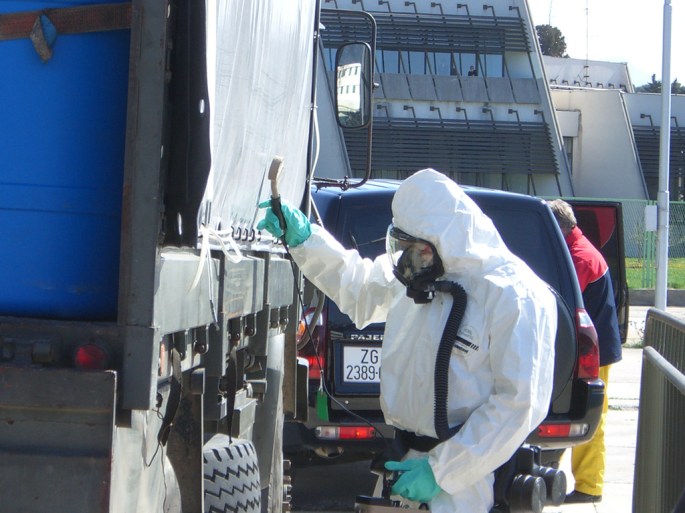
The Defense Treat Reduction Agency through its collaborative Ruggedized Antibody Program project, has developed a bio-agent detector 1000x more powerful than currently used ELISA methods.

From DVIDS– ” This technology has demonstrated exquisite analytical and clinical sensitivity, as well as a broad dynamic range. The combination of these two technologies will robustly increase the Department of Defense’s diagnostic armamentarium. This could lead to warfighters being able to detect lower levels of the toxin, therefore decreasing false negatives in environmental samples and earlier discovery in the course of clinical intoxication. SdAbs are recombinant ligand binding antibody fragments derived from the unusual structure of native antibodies found in camels and llamas. These unique heavy chain binding elements offer many desirable properties such as their small size (~15 kDa) and thermal stability, which makes them attractive alternatives to conventional monoclonal antibodies.”

Read more here.

 (image courtesy of DTRA)

The Pandora Report 9.6.13

Highlights: The Syrian BW “threat”, MERS vaccine, Nipah, biological weapons in the Philippines, and al Shabaab contributing to polio. Happy Friday!

On Not Falling Prey to Syrian Biological Weapons Alarmism

There have been a lot of articles (starting with the WaPo, and snowballing to the Telegraph, VoR, etc) discussing the “emerging threat” of Syrian biological weapons. Before the rumors grow and plant seeds, we strongly recommend you take a moment to check out Dr. Ben Ouagrham-Gormely’s excellent rebuttal. Here’s an excerpt from her piece:

“A September 5 Washington Post article raises concern that Syria might resort to biological weapons in retaliation for a Western military strike. The article states that intelligence reports indicate that Syria engaged in bioweapons development in the 1970s and 80s and since then has maintained a “dormant capability,” which some experts interviewed by the Post believe can easily be reactivated to produce biological weapons. it is important to inject a little bit of reality in regard to the question of whether or not Syria might be able to successfully reactivate a “dormant program” and effectively develop and use biological weapons.”

Read the full post here.

MERS Vaccine Passes First Test

The confirmation of another two cases of the Middle Eastern Respiratory Virus in the last week, bringing the global total to 110 cases and 52 fatalities, has the scientific community scrambling to develop a viable vaccine. Now researchers at Loyola Marymount University, working in conjunction with the Erasmus lab in Rotterdam (the same lab who refused to play nice in sharing the MERS genome), have developed a candidate vaccine which can be used in case of a pandemic. However, while the candidate has passed the first pre-clinical trials, if proven efficacious in humans  it would still be at least a year before the vaccine would be ready for production.

Medical Xpress – “The starting point for the new vaccine was a related virus known as Modified Vaccinia virus Ankara (MVA). MVA is an attenuated strain of the virus that causes smallpox, and has been used for more than 30 years for the manufacture of smallpox vaccine. Indeed, MVA is at the heart of a worldwide effort to design and generate vaccines not only against viral pathogens but also against cancers. In this context, MVA serves as the carrier for specific antigens that elicit the production of protective antibodies in the immunized host. MERS-CoV is known to bind to human cells via its so-called spike (S) protein, which is exposed on the surface of its membrane envelope. Sutter and his team therefore used molecular biological methods to introduce the gene for the MERS S protein into the MVA genome.”

Bats spreading deadly virus, Stanford scientist warns

If there’s one thing we’ve learned here at GMU Biodefense, it’s stay good and far away from bats. Whether it’s rabies or MERS, the creatures of the night are bastions for all sorts of nasty diseases.  Now it looks like Pteropus bats in Bangladesh are in the “villain of the week” spotlight. A researcher at Stanford University is voicing concerns over the bats, which range across South East Asia, spreading the deadly virus Nipah.

Stanford News – “Among Nipah’s worrisome traits: Many strains are capable of limited person-to-person transmission, and it is a ribonucleic acid (RNA) virus, which has the highest known rate of mutation among biological agents. If a more efficient human-adapted strain developed, it could spread rapidly in highly populous South Asia before spilling into other regions. The global community must do a better job of estimating and managing the risk, Luby said. That will require stepped-up study of how the virus is transmitted, closer observation of infected people and consideration of vaccinations for at-risk communities.”

Military claims NPA has ‘biological weapons’; Reds laugh off claim

Moving away from the existence, or lack thereof, of Syrian BW, a rebel leader in the Philippines has been accused by the government of using biological weapons. According the Filipino government,  the device in question tested positive for both Enterobacter cloacae and Streptococcus agalacteiae. The government claims the rebels smeared the unexploded landmines with feces. The rebels deny the claims outright. We’ll leave it there.

Inquirer Mindanao – “The military insisted Thursday that the New People’s Army now uses ‘biological weapons’ to further its goal of toppling the government. In a press statement, the Eastern Mindanao Command based here said laboratory examination of unexploded land mines seized from NPA camps in Southern Mindanao showed the presence of ‘deadly toxin’ and bacteria ‘not usually found in steel rebars and nails used as shrapnel.’ The NPA unit operating in the region laughed off this claim, calling it ‘malicious and wildly concocted military propaganda.'”

Somalia: Polio Widespread in Regions Under Al-Shabaab Control

Polio eradication is a bit of a soapbox around here, maybe because as a planet we’ve been so close for so long and because it’s often security issues which hamper efforts. For those of you who have managed to miss our various rants, all but three states – Nigeria, Afghanistan, and Pakistan – have eradicated the virus. Somalia, despite its numerous failings, worked extremely hard to become polio-free in 2007. The news that the terrorist organization al-Shabaab, which controls large swathes of Southern Somalia, is refusing to allow supplies into territory it controls, while also telling local populations that the vaccine causes AIDS and sterility, is infuriating.

All Africa – “Al-Shabaab’s refusal to allow the supply of the polio vaccine in areas under its control is causing panic among residents at a time when aid workers are struggling to contain an outbreak of the crippling virus.’The polio outbreak plaguing Somalia has spread despite significant efforts to curb the disease,’ the United Nations Office for the Co-ordination of Humanitarian Affairs (OCHA) said in a statement August 15th, adding that insecurity is hampering efforts to contain the virus. Six years after Somalia was declared free of the virus, at least 105 cases have been confirmed in the country, the ‘worst outbreak in the world in a non-endemic country’, according to OCHA.

(image: Hakan Dahlstrom/Flickr)