Pandora Report 9.27.14

This week the round up includes concern of growing antibiotic resistance, MERS CoV transmission, and of course, an Ebola update.

Have a great weekend (and don’t forget to get your flu shot)!

White House Orders Plan for Antibiotic Resistance

On Thursday, President Obama signed an executive order to form a government task force and presidential advisory council to address antibiotic-resistant germs. The order calls for new regulations of antibiotic use in hospitals and urges the development of new antibiotics. Scientists at MIT are looking at creating a new class of antibiotic that targets and destroys resistance genes within bacteria.

WTOP—“According to the Centers for Disease Control and Prevention, antibiotic-resistant infections are linked to 23,000 deaths and 2 million illnesses in the United States annually. The impact to the U.S. economy is as high as $20 billion, the White House said, or more, if you count lost productivity from those who are sickened. And the problem is worsening.”

Camels are Primary Source of MERS-CoV Transmission 

A study designed by scientists from Colorado State University and NIH’s National Institute of Allergy and Infectious Disease has transmitted a strain of MERS CoV from human patient to camels. The camels developed a respiratory infection and showed high levels of virus in nasal secretions for up to a week after the infection. Though the camels recovered quickly, the nasal secretions could be the source of transmission to people who handle these animals.

Business Standard—“The researchers theorized that vaccinating camels could reduce the risk of MERS-CoV transmission to people and other camels; NIAID and others are supporting research to develop candidate vaccines for potential use in people and camels.”

This Week in Ebola

This week, the CDC estimated that there could be 500,000 to 1.4 million cases of Ebola by January if the outbreak continues unchecked. Meanwhile, a professor teaching at Delaware State University is telling Liberians that the U.S. Department of Defense, among others, has manufactured Ebola and warns them that doctors are not actually trying to treat them. Claims like this make it even more difficult for those on the ground to relay accurate information about the virus. However, a reverend in Monrovia is working to spread awareness of proper hand washing and social distancing within his congregation and alumni from a State Department funded exchange program help to spread news of the virus throughout neighborhoods. Unsurprisingly, the Ebola outbreak has essentially crippled the fragile Liberian health system which means people are dying from routine medical problems.

Stories You May Have Missed


Image Credit: Wikimedia

Pandora Report 8.17.14

Another 12 hours at Dulles Airport on Friday and, fortunately, no new travel alerts. This week we look at TB detecting rats, an experimental Chikungunya vaccine, and the latest from West Africa.

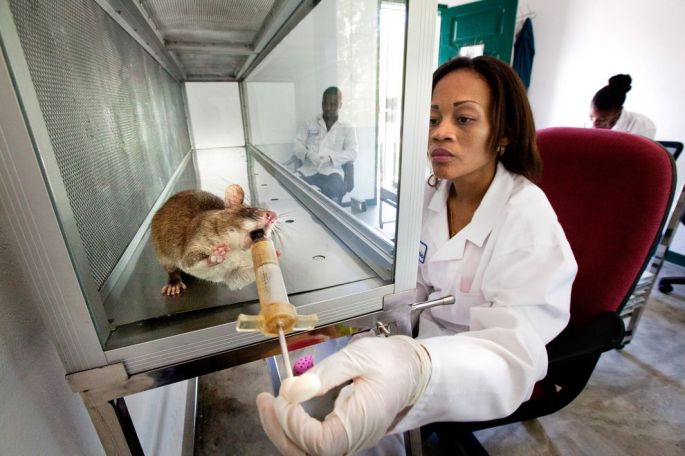
Giant Rats Trained to Sniff Out Tuberculosis in Africa

APOPO, the Belgian nonprofit organization known for using rats to sniff out land mines, has been training the African giant pouched rat to detect tuberculosis since 2008 in Tanzania and 2013 in Mozambique. The trained rats are used in medical centers in Dar es Salaam and Maputo to double check potential TB samples. The rats are unable to differentiate between standard and drug-resistant strains of the disease however, the cost of training and maintenance of the rats is significantly cheaper than the new GeneXpert rapid diagnostic tests.

National Geographic—“‘What the rats are trained to do is associate the smell of TB with a reward, so it’s what they call operative conditioning,’ [Emilio] Valverde [manager of the APOPO Mozambique TM Program] said.

It is the same principle applied to detecting land mines, only the rats are trained to recognize the scent of specific molecules that reflect the presence of the tuberculosis germ—not the explosive vapor associated with land mines.”

Experimental Chikungunya Vaccine Shows Promise

Chikungunya, of course, is one of the diseases included in the CDC’s travel alerts, and this week we learned of a promising vaccine for the disease that causes fever and intensely painful and severe arthritis. After the vaccine’s first human trials, the next step is to test in more people and more age groups, including populations where the virus is endemic. The trial leader said that it could be more than five years before a finished vaccine could be offered to the public.

CBS News—“‘This vaccine was safe and well-tolerated, and we believe that this vaccine makes a type of antibody that is effective against chikungunya,’ said trial leader Dr. Julie Ledgerwood, chief of the clinical trials program at the U.S. National Institute of Allergy and Infectious Diseases.”

WHO: Ebola Outbreak Vastly Underestimated

The news from West Africa seems to be getting worse and worse. Earlier in the week there was good news when a new quarantine center opened in Liberia. Then two days later, that same center was destroyed and looted. All of this comes, too, when the World Health Organization has said there is evidence that numbers of cases and deaths are far lower than the actual numbers and MSF has said that the outbreak will take at least six months to get under control.

Al Jazeera—“‘Staff at the outbreak sites see evidence that the numbers of reported cases and deaths vastly underestimate the magnitude of the outbreak,’ the organization said.

‘WHO is coordinating a massive scaling up of the international response, marshaling support from individual countries, disease control agencies, agencies within the United Nations system, and others.’”

Image Credit: James Pursey, APOPO

Measles making a comeback through unvaccinated individuals

By Chris Healey

Unvaccinated individuals are promoting the spread of measles in the United States.

In a public statement on February 21, health officials said seven of fifteen confirmed measles cases in a 2014 California outbreak were reported in individuals who never received a measles vaccine. Health officials have not determined the vaccination status of 6 cases in the outbreak but it is known that in two cases the patients received the vaccine. Over 39,000 cases of measles were reported in California before the measles vaccine was licensed in 1963. In 2005, a record low of four cases were reported.

This outbreak in California is part of a measles resurgence facilitated by rising numbers of unvaccinated individuals. Similar measles trends have been reported across the U.S. According to the CDC, the average number of U.S. measles cases from 2001 to 2010 was 69.  In 2013, there were 189 cases.

Measles vaccines are delivered in one of two products produced by Merck– M-M-R II and ProQuad. Both are live-attenuated vaccines, which uses viruses incapable of replication as the pharmacologically-active ingredient. Health experts consider live-attenuated vaccines the most effective of all vaccine types. The measles vaccine schedule recommended by the CDC is 99% effective in conferring immunity.

Vaccination of children after measles vaccine licensure was credited with the elimination of measles in the U.S. in 2000. Measles occurs in the U.S. when individuals are exposed abroad and return to the country.  Health officials said three cases in the California outbreak recently traveled to the Philippines. Two traveled to India. Other cases had contact with individuals who traveled abroad.

A growing number of individuals are choosing not to vaccinate their children. Vaccination avoidance has been fueled by unsubstantiated claims of vaccines causing autism in children. The CDC maintains there is no evidence to support a relationship between vaccination and autism. In fact, a recent study published in The Journal of Pediatrics showed no causal link between vaccination and autism.

The CDC’s website states symptoms of measles include fever, cough, inflammation of the mucous membrane, conjunctivitis and a characteristic maculopapular rash. Symptomatic individuals have a chance of developing acute encephalitis and subacute sclerosing panencephalitis, or SSPE, a degenerative disease of the central nervous system. SSPE causes seizures, behavioral problems and intellectual deterioration.

Measles has a fatality rate ranging from one to three deaths for every 1000 cases in the U.S.

Unvaccinated individuals should consult their doctor about receiving a measles vaccine.


Photo Credit: CDC/ Amanda Mills

The Pandora Report 9.27.13

Highlights include MERS, more MERS, Marburg & Ebola, chemical weapons antidotes, universal vaccine. Happy Friday!

Saudi Efforts to Stop MERS Virus Faulted

Saudi Arabia is being accused both of withholding information and conducting incomplete epidemiological investigations on MERS. While health officials have been careful to collect as much information as possible from infected individuals, they have been accused of neglecting to interview healthy contacts of infected patients. Such interviews are critical to determining possible routes of transmission. Saudi officials have vehemently denied these accusations, arguing it’s impossible to withhold what they don’t know.

Wall Street Journal – “‘It’s very difficult to give all the details to the people when we don’t know all the details,’ Ziad Memish, the deputy health minister, said last week at his office in Riyadh, the Saudi capital. ‘”Where’s it coming from? We don’t know. How is it transmitted? We don’t know.'”

Middle Eastern Respiratory Syndrome Update

Speaking of MERS, the CDC has updated its epi information on the virus. According to this week’s Morbidity and Mortality Weekly Report, there are now 130 cases, of which 45% of were fatal. While cases have occured in eight countries, all infected patients had recently visited or resided in just four countries – Jordan, Qatar, Saudi Arabia, and the UAE. Also of note, just over a fifth of cases (21%) were asymptomatic. No new information on mvectors, reservoirs, or route of infection.

CDC –  “To date, the largest, most complete clinical case series published included 47 patients; most had fever (98%), cough (83%), and shortness of breath (72%). Many also had gastrointestinal symptoms (26% had diarrhea, and 21% had vomiting). All but two patients (96%) had one or more chronic medical conditions, including diabetes (68%), hypertension (34%), heart disease (28%), and kidney disease (49%). Thirty-four (72%) had more than one chronic condition (7). Nearly half the patients in this series were part of a health-care–associated outbreak in Al-Ahsa, Saudi Arabia (i.e., a population that would be expected to have high rates of underlying conditions) (8). Also, the prevalence of diabetes in persons aged ≥50 years in Saudi Arabia has been reported to be nearly 63% (9). It remains unclear whether persons with specific conditions are disproportionately infected with MERS-CoV or have more severe disease.”

New Marburg & Ebola Theraputics?

Tekmira Pharmaceuticals Corporation has developed a Marburg treatment which protects non-human primates from the virus completely (100%), even if administered 24 hours after post infection. This is very exciting. The company has also received funding to undertake a similar Ebola treatment, with Phase I clinical trials set to begin early next year.

Street Insider – “In a presentation entitled ‘Medical Countermeasures for Filovirus Infection: Development of siRNA Therapeutics Under the Animal Rule’ data were presented that showed successful anti-viral therapy with the application of Tekmira’s LNP technology to hemorrhagic fever viruses, including multiple strains of the Ebola and Marburg viruses. Newly presented data resulting from a collaboration between Tekmira and the University of Texas Medical Branch (UTMB) showed 100% survival in non-human primates infected with the Angola strain of the Marburg virus in two separate studies. In the first study, 100% survival was achieved when dosing at 0.5 mg/kg TKM-Marburg began one hour after infection with otherwise lethal quantities of the virus. Dosing then continued once daily for seven days. In the second study, 100% survival was achieved even though treatment did not begin until 24 hours after infection.

Scientists at UNC-Chapel Hill, Wake Forest work on antidotes to nerve gas

The Defense Threat Reduction Agency has awareded UNC-Chapel Hill a $4.47 million grant to develop antidotes to nerve gas. While the timing of the award may seem a little reactionary, apparently discussions on the project began over a year ago. Researchers are hoping to create an adhesive bandage, pre-loaded with the antidote which would be administered through tiny needles in the bandage itself. The advantage of a bandage over an injected serum is self-administration – no medical professional would be needed to administer it.

Charlotte Observer – “‘We can load them up with antidotes to nerve agent, including enzymes that combat nerve agent,’DeSimone [a professor of chemistry at UNC-CH and chemical engineering] said. ‘The idea was to put them directly into a dissolvable microneedle that’s painless – just a patch – and rapidly get them into the bloodstream’ Such a device could be used by the military or civilians during an attack, when poison gas can kill within minutes. The patch could be easily disseminated and transported, DeSimone said, and would have a long shelf life.

Researchers Move Step Closer to Universal Seasonal Flu Vaccine

It’s nearly flu season again, and for many of us that means shots. For scientists, it means hoping their predictions as to which strain of flu will strike are right, and that the vaccine in the shots is actually useful. Making things easier for everyone, scientists at the Imperial College of London have determined a “blueprint” for a single vaccine against all types of influenza. Scientists there have found that by boosting CD8 killer T cells, rather than trying to trigger antibody production, the vaccines are significantly more effective.

Voice of America – “’Such a vaccine would induce T cells that would be able to recognize new viruses that have not even been identified yet. In other words, future pandemic strains. In that sense, it’s a universal vaccine. And it will be different to existing vaccination where currently every year a new vaccine has to be developed, which is why we are always one step behind…'”

(image courtesy of CIDRAP)