Meet Your 2014 Summer Program Faculty: Charles Blair

In preparation for the GMU Summer Program in International Security, this week we will highlight the course directors. Remember, EARLY BIRD REGISTRATION ENDS MAY 15! Register by May 15 to save $300 on a three-day course and $200 on a two-day course. Use the links below for more details including registration.  Questions? Comment to this post or email spis@gmu.edu.



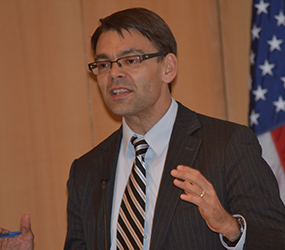
Headshot_BlairCharles P. Blair is a Washington, D.C.-based university instructor, researcher, writer, and thinker specializing in terrorism and the history, technical underpinnings, and potential futures of Weapons of Mass Destruction. He is the director for two courses in the Summer Program in International Security: 21st Century Terrorism: Emerging Trends and Evolving Tactics which runs July 14-16 and Terrorism Analysis: Quantitative and Qualitative Research Methodologies and Tools which runs July 17-18.

Since visiting Moscow as a student in 1985, Blair has worked on issues relating to globalization and the diffusion and diversification of WMD in the context of the rise of mass casualty terrorism incidents. He teaches graduate-level classes on terrorism and the technology of WMD at Johns Hopkins University and George Mason University and is a columnist for the Bulletin of the Atomic Scientists.

Recent works include: “Terrorist Nuclear Command and Control,” which was completed under the auspices of the Department of Homeland Security; a two-year DHS-backed study which investigated the U.S. extreme right-wing and radiological and nuclear terrorism; “Target Sochi: The threat from the Caucasus Emirate,”; and  “Barely Lethal: Terrorists and Ricin.”

Mr. Blair is a Senior Fellow on State and Non-State Threats at the Federation of American Scientists. Before joining FAS, he has worked at the National Consortium for the Study of Terrorism and Responses to Terrorism (START), the James Martin Center for Nonproliferation Studies, the National Nuclear Security Administration, the Anti-Defamation League, and the Center for Terrorism and Intelligence Studies.

Click here to register for 21st Century Terrorism: Emerging Trends and Evolving Tactics.
Click here to register for Terrorism Analysis: Quantitative and Qualitative Research Methodologies and Tools

Meet Your 2014 Summer Program Faculty: Charles Ferguson

In preparation for the GMU Summer Program in International Security, this week we will highlight the course directors. Remember, EARLY BIRD REGISTRATION ENDS MAY 15! Register by May 15 to save $300 on a three-day course and $200 on a two-day course. Use the links below for more details including registration.  Questions? Comment to this post or email spis@gmu.edu.


ferguson

Dr. Charles D. Ferguson, President of the Federation of American Scientists (FAS), is the course director for this summer’s CBRN Weapons: Science & Policy in the Summer Program in International Security. This course will run July 7-9.

With more than twenty years’ experience in policy and national security, Dr. Ferguson has researched and written extensively on energy policy, nuclear nonproliferation, missile defense, and prevention of nuclear and radiological terrorism. His publications include 2011’s Nuclear Energy: What Everyone Needs to Know, The Four Faces of Nuclear Terrorism (with William Potter) in 2005, and the report Commercial Radioactive Sources: Surveying the Security Risks, which was the first in-depth, post-9/11 study of the “dirty bomb” threat. This report won the 2003 Robert S. Landauer Lecture Award from the Health Physics Society.

Dr. Ferguson has worked as the Philip D. Reed senior fellow for science and technology at the Council on Foreign Relations (CFR), consulted with Sandia National Laboratories and the National Nuclear Security Administration on improving the security of radioactive sources, and as a physical scientist in the Office of the Senior Coordinator for Nuclear Safety at the U.S. Department of State. He graduated with distinction from the United States Naval Academy, served in the U.S. Navy as a nuclear engineering officer, and earned a PhD in physics from Boston University. He has previously taught as an adjunct professor at Georgetown University and the Johns Hopkins University.

Click here to register for CBRN Weapons: Science & Policy.

GMU Faculty Member and NRC Chairwoman Allison Macfarlane Nominated to New Term

Congratulations to GMU PIA Faculty Member Allison Macfarlane on her nomination to a second term as Nuclear Regulatory Commission Chairwoman!

“President Barack Obama has nominated Nuclear Regulatory Commission Chairman Allison Macfarlane to a new five-year term. Macfarlane, a geologist, took over the agency last summer after its former chairman, Gregory Jaczko, resigned amid complaints about an unyielding management style that fellow commissioners and agency employees described as bullying. Macfarlane was initially named to a one-year term that expires in June. Obama named her Thursday to a new five-year term. The appointment requires approval by the Senate.”

Read more here.

Bragging About Our Students

StartSmallCongratulations to our brilliant Biodefense MS Students, Alan Muhammet and Justin Ludgate! Both these brains have secured internships with START (National Consortium for the Study of Terrorism and Responses to Terrorism).

Alan Muhammet is an intern analyst and Justin Ludgate is a Spring Semeseter intern in the Special Projects Division of START, where he works on the Chemical/Biological Adversaries project.

Here’s a brief synopsis of the organization for those of you not as familiar as you should be:

“The National Consortium for the Study of Terrorism and Responses to Terrorism—better known as START – is a university-based research center committed to the scientific study of the causes and human consequences of terrorism in the United States and around the world.

Headquartered at the University of Maryland, START supports research efforts of leading social scientists at more than 50 academic and research institutions, each of whom is conducting original investigations into fundamental questions about terrorism, including:

  • Under what conditions does an individual or a group turn to terrorism to pursue its goals? What is the nature of the radicalization process?
  • What attack patterns have different terrorists demonstrated during the past forty years? How has terrorist behavior evolved? And, what does this indicate about likely future terrorist activity?
  • What impact does terrorism and the threat of terrorism have on communities, and how can societies enhance their resilience to minimize the potential impacts of future attacks?

START experts apply a range of research methods to the exploration of these questions in order to deliver findings based on the best available open-source evidence and data. At the heart of START’s work are the principles that the research it is conducting must be both scientifically rigorous and directly relevant to homeland security professionals.

START is committed to the widespread dissemination of its research findings not only to homeland security professionals, but also to students of all levels and to the general public. START has developed educational materials and programs specifically designed for instructors and students at the secondary, university, and graduate school levels. Educational resources available through START include relevant lesson plans, a syllabi repository, and a range of unique data sources that can be integrated into an array of courses to deepen students’ understanding of the dynamics of terrorism. START also has internships and funding opportunities available to undergraduate and graduate students engaged in terrorism research.”

Read more here.

Job Posting: Opening in the Office of Policy and Planning at ASPR in HHS

Our colleague at HHS ASPR, Diane DiEuliis, asked me to share the following job announcement. It is a director-level policy position in the office of Policy and Planning at ASPR. The person would be responsible for working through the National Health Security Strategy, among other ASPR frameworks. In addition, the person would also do quite a bit of interagency management, as well as state and local collaboration, on all preparedness and response policy issues.

Please contact her directly if you have any questions. Her contact information is 202-260-6119 or diane.dieuliis@hhs.gov.

Job listed here: (HHS) DE-13-825710


2013 Pandemics, Bioterrorism, and International Security Summer Course!

Following up on last year’s tremendously popular course, this year’s Pandemics, Bioterrrorism, and International Security three-day short course will be held on the George Mason Campus, from July 22-24, 2013.

Click Here to visit the official GMU web site for more information and to register.

Course Description

This three-day, non-credit short-course is designed to introduce participants to the challenges facing the world at the intersection of biodefense and public health. Private and public organizations face a number of challenges in the biosecurity domain. A bioterrorist attack is both a public health emergency and a criminal act whose perpetrators need to be apprehended. Likewise, pandemics can affect not just public health, but also public safety and national security. The causes and consequences of these risks extend far beyond any one nation’s borders. Pandemics and bioterrorist attacks will also confront government agencies and the private sector with the need to make high-impact decisions with limited information during a rapidly evolving situation. Further complicating this domain is the dual-use nature of biology: the knowledge and skills developed for legitimate scientific and commercial purposes can be misused by those with hostile intent. Research with dangerous pathogens and the development of dual-use biotechnologies poses a dilemma for policy-makers and researchers who seek to maximize the benefits of such research while minimizing the risks. Thus, public health, law enforcement and national security agencies, pharmaceutical and biotech industries, and the academic life sciences community need to establish new priorities, such as developing new types of expertise, adopting new types of risk assessment and risk management strategies, and learning to collaborate with each other.

Implementing these new priorities will require substantial organizational learning and change. But large organizations have deeply embedded professional norms and organizational culture that make them resistant to change, even during times of crisis. Each organization responds with its own routines, and its own distinctive view of “the threat,” which dilutes new initiatives, encourages stovepiping, and impedes effective collaboration. These organizational tendencies grow even more pronounced during times of declining budgets. Thus, while the need for collaboration is great, the potential for differing organizational styles to produce conflict is high.

The 1976 swine flu scare, 2001 anthrax letter attacks, 2003 smallpox immunization campaign, SARS and avian influenza outbreaks, and 2009 influenza pandemic provide rich case studies of how elite organizations have struggled to address novel biological threats, make high-impact decisions with limited information, and work effectively with new partners. The lessons from these cases are broadly applicable to both public and private organizations seeking to address current and emerging biosecurity risks.

Course features

  • Continuing Education Units (CEUs) will be awarded by George Mason University
  • Syllabus and reading materials
  • Dinner after first day of course
  • Lunch and breaks on all days
  • Certificate of attendance
  • Membership in the exclusive course group, Pandemics, Bioterrrorism, and International Security, on LinkedIn

Fall Newsletter!

The George Mason Biodefense Department Fall Newsletter is out and should be waiting for you in your inbox. If it is not, you are not receiving any Mason emails, and Peg and Amanda are both very cross with you. While we don’t condone the bouncing back of emails, we do want you to see the Newsletter, so check it out here (and clean your inbox out!)


New Biodefense Facebook Page!

The GMU Biodefense Facebook page is officially up, and available at http://www.facebook.com/gmu.biodefense! For those of you that don’t check your mason email as often as you should, the Facebook page will be the place to go for useful information like job and internship opportunities, workshops, study resources, and biodefense news, as well as department updates and events. It will also be the place to go for less useful things (it’s Facebook, c’mon) like reviews of tangentially-related “science” movies (Prometheus is on DVD everyone) and the occasional zombie apocalypse infographic.

All you have to do is visit the page, click the “like” button, and its posts will automatically pop-up in your newsfeed! Anyone can suggest edits as well, so if you feel anything is lacking, please let us know. And if you’re tired of trying to explain to friends, family members, and coworkers what exactly it is you’re studying, we highly recommend sharing the page in a status update! So, head over to the page and like us now!

Obama Nominates Mason Professor for NRC Seat

We are excited to spread the good word that Professor Allison Macfarlane, professor in Mason’s Environment Science and Policy and a member of the Biodefense faculty, has been nominated by President Obama to head the Nuclear Regulatory Commission, the nation’s lead nuclear safety agency.
Known to Biodefense students from her course, BIOD 760 National Security Technology & Policy, Professor Macfarlane recently served as a member of Obama’s Blue Ribbon Commission on America’s Nuclear Future. We are excited for her and look forward to hearing some great stories when she returns to Mason down the road.
Read more here