
Its getting pretty cold outside, right? So what better way to spend your Sunday than catching up on all the best stories of the week! This week we’ve got Wikipedia as a predictive took for the spread of disease, a catchy new name for Chikungunya, MERS CoV in Saudi Arabia, some stories you may have missed, and, of course, an Ebola update.
How Wikipedia Reading Habits Can Successfully Predict the Spread of Disease
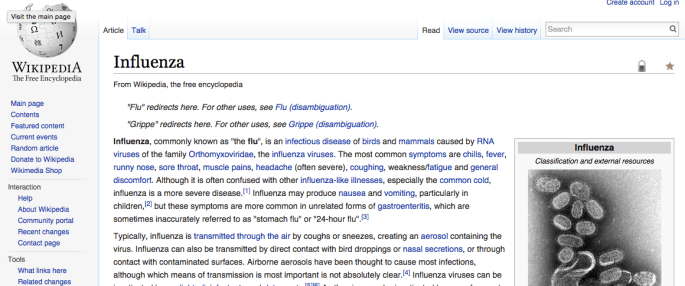
In my absolute favorite story of the week, researchers have identified a link between the spread of disease and the corresponding page hits of those diseases on Wikipedia. No, the Internet isn’t giving people E-bola, but page views seem to have a predictive effect on infectious disease spread. During the three-year study, looking at readers’ habits, the researchers could predict the spread of flu in the U.S., Poland, Thailand, and Japan, and dengue in Brazil and Thailand at least 28 days before those countries’ health ministries.
The Washington Post—“Official government data—usually released with a one- or two-week lag time—lagged four weeks behind Wikipedia reading habits, according to Del Valle; people, she said, are probably reading about the illnesses they have before heading to the doctor.”
As Chikungunya makes it way through the Americas, awareness of the disease becomes more important—including the creation of a catchy nickname! The vector, transmissibility, and symptoms are similar to Dengue and with Chikungunya being relatively new to the western hemisphere, a story like this one may be helpful in putting a human face on a growing problem.
The Atlantic—“It might be parochial to call Chikungunya a “vacation virus”; however, as Americans prepare to hit the Caribbean beaches in the coming winter months, awareness campaigns are ramping up. Last week, the travel section of the New York Times ran a feature on Chikungunya highlighting how tourism agencies and organizations are both downplaying the scope of the outbreak and advising simple measures to deal with the virus. (Avoid mosquitos.)”
MERS Cases on the Rise in Saudi Arabia
Since September 5, there have been 38 new cases of MERS-CoV in Saudi Arabia, bringing the total number of cases in Saudi Arabia to 798. The WHO said that due to the non-specific symptoms of MERS, it is critical that health care facilities consistently apply standard precautions with all patients regardless of their initial diagnosis. Furthermore, until more is understood about MERS, immunocompromised individuals should practice general hygiene measures, like hand washing, and avoid close contact with sick animals. Nearly one third of the new cases were reported by patients who had recently had close contact with camels.
Outbreak News Today—“The continued increase in cases prompted Anees Sindi, deputy commander of the Command and Control Center (CCC) to say, “MERS-CoV is active and we need to be on full alert.” In addition, the Saudi Arabia Ministry of Health launched a new public information campaign in Taif in response to the recent spike in new cases of MERS-CoV in the region. Medical professionals will be made available at public locations with the aim of educating citizens on the need to avoid unprotected contact with camels because of the risk of infection with MERS-CoV, underlining the crucial role of the community in preventing the spread of the disease in the Kingdom.”
This Week in Ebola
Ebola is on the rise again in Sierra Leone bringing the number of deaths to 5,147 and cases to 14,068. It appears that the virus is finding new pockets to inhabit including villages outside the Liberian capital and in Bamako, the capital of Mali (eclipsing earlier success in that country at containment.) Despite these new infections outside of Monrovia, Liberian President Ellen Johnson Sirleaf has ended the state of emergency in that country. Unsurprisingly, the epidemic has imposed a financial burden on the affected countries including losses in agricultural trade and the service industries. Elsewhere in Africa, Ugandan health officials have declared the country free of an Ebola-like Marburg virus. Stateside, a new report from the CDC outlines steps taken in Dallas to prevent further virus spread and a third Ebola patient headed to the bio containment unit at the Nebraska Medical Center for treatment. Finally, 80 U.S. Military personnel helping to fight Ebola in Liberia returned home this week, and though none are displaying symptoms, they will be monitored for 21 days at Joint Base Langley-Eustis in Virginia.
Stories You May Have Missed
- Quite a few stories on ricin this week. The Georgetown University student who had ricin in his dorm was sentenced to a year (and a day) in prison and two militia group members in Georgia were sentenced to 10 years each for conspiring to produce ricin.
- Are you looking to get a jump-start on your holiday shopping? com has a “Case-E Ebola Nurse Action figure” that looks suspiciously like Kari Hickox. Get yours for only $29.99!
- Lots more this week about S. Military exposure to chemical weapons in Iraq including the story of the veterans who discovered it and why the NYT piece is important.
- On Tuesday, the WHO and European partners will hold a twitter chat on antibiotic resistance. Tweet your questions to @WHO_Europe using the hashtag #EAAD and then join for the live event from 1-2pm CET.
- Discovery had an interesting piece on the 10 steps it takes from disease to spread from bats to humans.
Image Credit: Wikipedia


 The Pandora Report