
GMU Biodefense Adjunct Professor and Federation of American Scientist Senior Fellow on State and Non-State Threats Charles Blair was interviewed by MSNBC’s Rachel Maddow yesterday on Syrian chemical weapons use. Blair discussed the difficulty of ascertaining, as outsiders, whether or not the claims of chemical weapons use against the Syrian rebels are legitimate. Watch the full interview below.

The Pandora Report 8.23.13
Highlights this week include MERS in tomb bats, H7N9 and its lurking cousins, Ebola of CCHF?, the history of CW and BW, and nanotech. Happy Friday!
Reservoir of MERS may be Egyptian Tomb Bat. Yes tomb bat, as in, mummies, curses, and tomb bats.
Researchers may have uncovered the reservoir of the recently emerged Middle Eastern Respiratory Syndrome virus (MERS). Scientists took DNA samples from 96 bats living at an abandoned site just 12 kilometers from the MERS index case. Once the DNA samples were sequenced, the scientists involved discovered that the fecal pellet of one bat species, the Egyptian tomb bat, shared a 182-nucleotide snippet of DNA with MERS. It’s possible that more of viral genome was present; however, when the frozen bat samples were clearing US customs, the customs officers opened and left the samples out, at room temperature, for two days (don’t even get us started on all the things wrong with that situation). Still, this latest development brings us a step closer to understanding the virus and its mechanism of action.
Science Magazine – “Sequencing the nucleic acids isolated from the samples yielded a clue: The fecal pellet of the insect-eating Egyptian tomb bat (Taphozous perforatus) contained a piece of viral RNA identical to that of the virus isolated from the patient in Bisha, the scientists reported online in Emerging Infectious Diseases yesterday…Still, the finding is another interesting piece in the MERS puzzle, says Marion Koopmans, an infectious diseases researcher at the National Institute for Public Health and the Environment in the Netherlands, who was not involved in the work. She points out that the fragment is not only short but also comes from one of the least variable parts of the viral genome, so the full genomes of bat and human virus could still differ significantly. Nonetheless, the finding ‘points at bats as a reservoir for this virus,’ Koopmans writes in an e-mail.”
China bird flu analysis finds more virus threats lurking
Scientists in China have analyzed other strains of H7 flu, and have determined that several of the strains are capable of jumping to humans. A couple strains have already been shown to successfully infect ferrets. It’s thought that H7N9, like other pandemic strains of avian influenza, began in water fowl, was transmitted to domestic poultry, reassorted with H9N2, and then infected people. The moral of the story? Other avian pandemics may be waiting in the wings (pun only slightly intended).
Reuters – “To trace the evolution of H7N9 and its path into humans, researchers led by Maria Huachen Zhu and Yi Guan of the University of Hong Kong conducted field surveillance around the main H7N9 outbreak region and mapped out, or sequenced, genetic codes of a large number of bird flu viruses they found…They also found another previously unrecognized H7N7 virus strain had emerged and is circulating in poultry in China. In experiments testing this strain, they discovered it has the ability to infect ferrets – an animal model often used by scientists to find out more about what flu might do in humans – suggesting it could jump into people in future.”
Deadly Hemorrhagic Fever Appears in Uganda
Local health officials are scrambling to identify a small outbreak of hemorrhagic fever in Uganda, with conflicting reports seperately identifying the causative virus as Crimean-Congo Hemorrhagic Fever (CCHF) and Ebola. Four patients have been hospitalized, with a fifth already dead from the virus. In a disturbing complication, one patient has apparently “escaped from the hospital” following collection of blood samples, prompting understandable fears of exacerbation of the virus’ spread. Both CCHF and Ebola are highly pathogenic, causing body pain, severe hemorrhaging, and death.
Daily Monitor – “Efforts to verify with the Health ministry whether the disease is Ebola or the Crimean- Congo haemorrhagic fever were futile as the officials did not answer our telephone calls. ‘The four patients have been put in isolation for close monitoring,’ Dr Otto said. The district health officer said the first patient at the hospital presented symptoms similar to that of Ebola which prompted him to take blood samples to Entebbe. Dr Otto urged the public to remain calm, saying a medical team was on the ground to handle the situation.
Scientific American In-Depth Report: The Specter of Chemical and Biological Weapons
Scientific American just put up a good overview of both recent developments in and the broad history of chemical and biological warfare. The pieces included are more chem-heavy (unsurprisingly), but it’s still a good refresher, especially with Syria apparently escalating again. Take a moment to check it out.
Nano Breakthrough For Navy Lab; Tiny Sensors To Detect Explosives, Bio Weapons, Rotten Food
Researchers at the Naval Research Laboratory want to use nanowires to detect everything from biological weapons to spoilt food. For the first time, researchers were able to overcome the difficulty associated with creating the wires. Until now, nanowires have had to be grown, making mass production extremely difficult. However, researchers have found a way to etch the wires, rather than grow them, making embedding them in uniforms or refrigerators possible.
Breaking Defense – “‘The big thing with getting to this point is finding a way to produce this in a scaleable and reproducible fashion,’ principal investigator Christopher Field told me… Basically, the Navy scientists etch a cluster of nanowires and put a small amount of power pulsing through them. When a molecule from an explosive’s gas or a chemical weapon brushes against the nanowires this disrupts the charge. Then scientists analyze the disruption to discover what caused it.”
(image courtesy of Marie and Alistair Knock/Taraji Blue/Flickr)

Blair on Syrian Chemical Weapons
Charles Blair, GMU Biodefense Adjunct Professor and the Senior Fellow on State and Non-State Threats at the Federation of American Scientists, was quoted extensively in the Washington Post’s piece yesterday on Assad’s possible use of chemical weapons against the rebels.
Speaking on the grisly effects of nerve agents, Blair explained, “There’s muscle twitching. Then, as the muscle twitching gets more and more spasmodic, mucus comes out of the nose and mouth and you basically go into convulsions on the ground. People don’t survive this.”
Syrian President Bashar al-Assad is accused of using nerve agent, possibly sarin, on sleeping civilians in the suburbs of Damascus. UN Inspectors have not yet been granted access to the areas of the alleged attack. Estimates of the death toll range from 136 to 1300, with no way for outside validation.
For information on a potential US response to a chemical weapons attack, see our CBRN Policy Brief, “Is the US Prepared for a Chemical Attack?“, by Dr. Alex Garza, GMU Biodefense Affiliate Research Scientist and former Assistant Secretary for Health Affairs and Chief Medical Officer at the Department of Homeland Security.
(image courtesy of Syria Freedom House)
Image of the Week: Psychedelic Bacterial Colonies

This beautiful image is of P. vortex, a bacteria species discovered in the ’90s by Eshel Ben-Jacob and his colleagues at the University of Tel Aviv. In an attempt to better understand the new species, Ben-Jacob tweaked various growth conditions, like temperature, light exposure, or nutrient consistency, and recorded the bacteria’s response. He soon found that the colony responded as a unit, resulting in distinctive patterns of movement and growth. Add a little dye, and boom – bacterial art.
Our favorite quote: “‘The bacteria have to maintain order, but they also have to maintain flexibility, so that when conditions change they can better adapt to the environment,’ says Ben-Jacob. ‘We have an affinity for things that have the combination of the two, order and disorder. If you analyze classical music, it is the same thing. The things that we really like and are captivated by are things that have this mixture.'”
To learn more and check out some of his other work, see here.
Eastern Equine Encephalitis confirmed in Maryland horse
A horse in Worcester County, Maryland has tested positive for Eastern equine encephalitis (EEE), a mosquito-bourne virus which can be fatal to horses and cause serious disease in humans. Although the County is spraying for mosquitoes, horse owners in the area are strongly encouraged to discuss vaccinations with their veterinarians.
The US averages 15 cases of EEE a year, usually within southern and eastern states. Symptoms of EEE in humans include fever, vomiting, photophobia (fear of light), and headache, with siezures, coma and eventual death possible as secondary symptoms. The case fatality in humans can be as high as 60%, with survivors often experiencing severe brain damage.
For more information of the Worcester case, see here.
(image courtesy of CDC)

This Week in DC: (a few) Events
The highlight of this week’s meager offerings is Wednesday’s MERS talk, which is available via webcast for those of you in distant locales.
Tuesday, August 20
Al Qaeda and its Affiliates: On Life Support or an Imminent Threat?
Foundation for Defense of Democracies
12:00PM – 1:30PM
Twelve years after the September 11, 2001 terrorist attacks, and more than two years after Osama bin Laden was killed, how great of a threat is al Qaeda to the U.S. homeland and America’s interests abroad? Has the instability in Iraq, Syria, Yemen and throughout Africa allowed al Qaeda to grow in size and power? How should the latest threats against America’s diplomatic facilities, paired with the recent prison breaks in Pakistan, Iraq, Libya and elsewhere impact U.S. counterterrorism strategy? Please join FDD for a conversation with Eli Lake, Thomas Joscelyn, and Cliff May.
Wednesday, August 21
Leveraging Defense Community Resources for the Next Generation of Threats
NextGov’s Cybersecurity Series
7:30AM – 9:30AM
With new cybersecurity legislation and slashed defense budgets, federal and corporate plans for protecting Defense infrastructure are subject to serious alterations. How will these upcoming changes affect your day-to-day operations? Hear from leading DoD voices and policy experts and learn: what cyber vulnerabilities are taking priority on the Department of Defense’s agenda; how the Department of Defense best leverages public-private partnerships to fend off the most critical threats, and which sectors of the Defense Industrial Base are most heavily affected by budget cuts.
Insights from the Front Lines of the Middle East Respiratory Syndrome (MERS) Outbreak
UPMC Center for Health Security
10:00AM – 12:00PM
Dr. Ziad Memish, Deputy Minister of Health for Public Health, Kingdom of Saudi Arabia,will discuss Saudi Arabia’s effort to control and respond to the MERS-CoV outbreak.
(image courtesy of Dell/Flickr)

The Pandora Report 8.16.13
Highlights this week: MERS in India, Ebola!, new swine flu, a universal flu vaccine?, and not mad cow. Happy Friday!
Middle Eastern Respiratory Syndrome (MERS) Reaches India
With a population of over 1.2 bilion people, India has understandably been on high alert for Middle Eastern Respiratory Virus. Last week a 40-year-old man who had just returned from Saudi Arabia became the country’s first case. The patient spent three day in his home in Vashi, a small town less than two hours south of Mumbai, before being admitted into the local hospital. No word yet on whether he has a family or close relatives living with him, but no new cases have been detected.
Times of India – “In the first suspected case of the Middle East Respiratory Syndrome Coronavirus (MERS-CoV) in the city, a Vashi resident has been quarantined at Kasturba Hospital in Chinchpokli. The 40-year-old man was admitted to the hospital’s ward 30, meant for infectious diseases, on Wednesday afternoon with complaints of fever and a progressing pneumonia (inflammation of lungs). The patient had returned to India on August 12 after spending 35 days in Saudi Arabia.”
Scientists Reveal How Deadly Ebola Virus Assembles
Just when you thought you knew Ebola, its proteins go and change shape on you. Scientists have discovered that the molecule responsible for the virus’ release of virions (VP40) is capable of changing shape to perform new functions. This is a big deal, as up until now, proteins were generally believed to only be possible of forming one shape – one shape, one function. Researchers will be able to use this surprising piece of information to build antivirals tailored specifically to the VP40’s different shapes, enabling them to selectively target different points in the virus’ assembly. Which would be nice, because Ebola is scary.
Science Daily – “The results, five years in the making, revealed the Ebola VP40 protein exists as a dimer, not as a monomer as previously thought, and it rearranges its structure to assemble filaments to build the virus shell or “matrix” to release countless new viruses from infected cells. The study showed the protein also rearranges itself into rings in order to bind RNA and control the internal components of the virus copied inside infected cells. This “shape-shifting” or “transformer” behavior explains how the Ebola virus can control a multi-step viral lifecycle using only a very limited number of genes.”
New swine flu virus found by University of Hong Kong researchers
Scientists at the University of Hong Kong have unearthed a new influenza virus, nimbly dubbed porcine parainfluenza virus 1(PPIV-1), in 386 pig carcasses collected from slaughterhouses around Hong Kong. Despite the virus’ close similarity to existing human flu viruses, as long as meat is thoroughly cooked there is no immediate health threat to us. The stability of the virus’ genome suggested its primary host is pigs, in which it is also found to cause respiratory symptoms. However, study researchers have called for greater surveillance of imported animals – Hong Kong imports 3,000 pigs from mainland China daily – as well as a more thorough investigation into the virus’ source.
South China Morning Post – “But a top researcher behind the study, microbiologist Yuen Kwok-yung, warned it might mutate and jump from pigs to humans. ‘The new virus is closely related to some human influenza viruses,’ Yuen said. ‘We should watch for possible cross-species transmission from pigs to humans, just as in the case of [human] swine influenza H1N1 and the Nipah virus.'”
Universal Flu Vaccine: Pandemic Viruses May Give Clues
The best safeguard for beating the newest pandemic flu seems to be having lived through a couple already. According to new research, individuals who had been exposed to both the 1957 H2N2 and the 1977 H1NI pandemic influenza viruses had higher levels of broadly neutralizing antibodies. These antibodies are better able to target the flu viruses’ “stalk” portion (rather than their “head”) which remains relatively conserved across strains. Before you start counting the number of times you’ve been laid up with the flu (or smartly got a flu shot), antibodies produced against seasonal flu won’t confer the same protection. For some reason, our body tends to produce antibodies against the “head” portion of regular winter flu viruses. However, researchers hope that by creating a seasonal flu shot which tricks your immune system into thinking it’s facing a pandemic virus, a universal flu vaccine may be possible.
Live science – “Levels of broadly neutralizing antibodies increased modestly over time in the study participants, and were highest among those who’d been exposed to more than one pandemic. Levels of broadly neutralizing antibodies were 3.8-fold higher in those who had been exposed to both H2N2 and H1N1, compared with those exposed to only H1N1, the study found. The finding suggests a strategy for making a universal flu vaccine: create a vaccine that contains flu viruses with very different heads, but highly similar stalks, Miller told LiveScience.”
New virus could help rule out mad cow
We don’t spend a lot of time talking about pathogens which affect exclusively agricultural and food security here at the Pandora Report, which isn’t to say they’re not critically important. Scientists have discovered and successfully characterized an astrovirus which produces symptoms similar to bovine spongiform encephalopathy (BSE), more commonly known as mad cow disease. Although the new virus is not zoonotic, researchers can use its sequenced genome to develop a quick an easy diagnostic test capable of ruling out BSE. Currently, testing for BSE and other neurological diseases in cattle is very cost and labor intensive.
Futurity – “’Neurologic disease in cattle can be difficult to diagnose because there are a number of different causes, and pre-mortem sampling and analyses can be cumbersome and/or expensive,’ says corresponding author Patricia Pesavento, a veterinary pathologist in the University of California, Davis School of Veterinary Medicine…’Understanding the role of this virus is crucial for veterinarians as well as for the dairy and beef cattle industries,’ she says. ‘Additionally, finding new viruses helps us identify other, more remote viruses because it builds our knowledge of both the depth and breadth of viral family trees.'”
(image courtesy of Axel Drainville/Flickr)
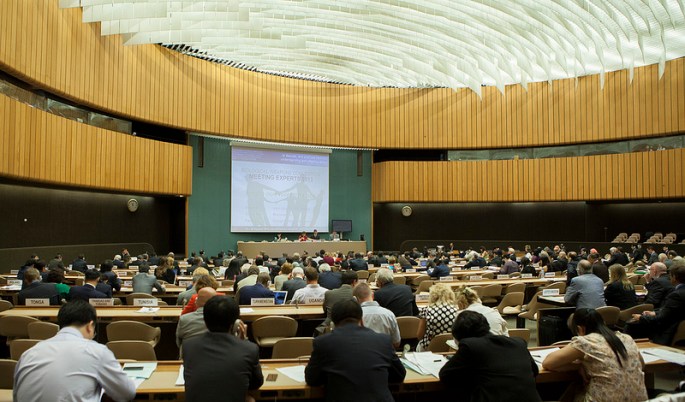
2013 Biological Weapons Convention Meeting of Experts underway
The 2013 Biological Weapons Convention (BWC) Meeting of Experts is in its penultimate day at the Palais des Nations in Geneva. The biennial meetings, which began in 2007 following the Sixth Review Congress, bring together stakeholders from State Parties, NGOs, research institutions, and the sciences for collaboration both on the treaty itself and issues of importance to it. Agenda items for this year’s meeting include bolstering cooperation and assistance, particularly under Article X of the BWC, increasing the dismally low participation in the annual Confidence-building Measures (CBM), increasing national implementation of the treaty, and examining germane developments in scientific research.
A full list of all official documents, including papers submitted by State Parties, is available here (our favorite is the UK & Northern Ireland’s aptly titled paper, “We Need to Talk About Compliance“). The meetings, which began on Monday, will conclude tomorrow.
(Image courtesy of the US Mission Geneva/Flickr)
Image of the Week: Bacteria and Lightbulbs
Three enterprising students from the University of Wisconsin, Madison are trying to create a light bulb powered entirely by E.coli. “But, wait!” You might say. “E.coli doesn’t bioluminesce!” In order to overcome this slight hurdle, the students plan on inserting a strip of DNA into the bacteria’s genome which will enable the bug to glow in the dark. The light bulb itself will contain the modified bacteria, the necessary growth medium, and a set of specific microbes capable of recycling light to provide nutrients and eliminate waste – all of which together would produce a bulb which glows without electricity, aptly dubbed Biobulb (pictured below).

Read more and fund the upstart project here!
(image courtesy of Cohn/Zaikan/Beckman, University of Wisconsin, Madison)

Mexico joins Australia Group
For those of you unfamiliar with the name, the Australia Group is an informal consortium of countries seeking to restrict unintentional transfer of dual-use chemical/biological materials, through participation in voluntary export controls. The group arose in 1984, following Iraq’s ability to purchase chemical weapons components through legitimate international channels. The Australia Group fills a critical niche internationally, helping to prevent the unintentional proliferation of WMD components. The group has since expanded from its 15 founding members to include 42 countries and the European Union, with Mexico joining yesterday as its 42 member.
From the press release:
In warmly welcoming Mexico to the Group, the other Australia Group members recognised the Government of Mexico’s steadfast efforts to bring Mexico’s export control system fully into line with AG common control lists and guidelines, and its determination to contribute even more effectively to the global effort to prevent the proliferation of CBW in the security interests of all members of the international community. Mexico has also underlined its continuing commitment to WMD non-proliferation and to strengthening international standards for best practice export controls.
In joining the Group, the Government of Mexico said it would contribute constructively to the achievement of the Group’s objectives and to support its principles, in the interest of disarmament, global security and non-proliferation. As an AG Participant, Mexico would also promote the fulfilment of international obligations created under the Biological Weapons Convention (BWC), the Chemical Weapons Convention (CWC) and UN Security Council Resolution 1540, among others.
Read the full release here.
(image via Kate Sheets/Flickr)
 The Pandora Report