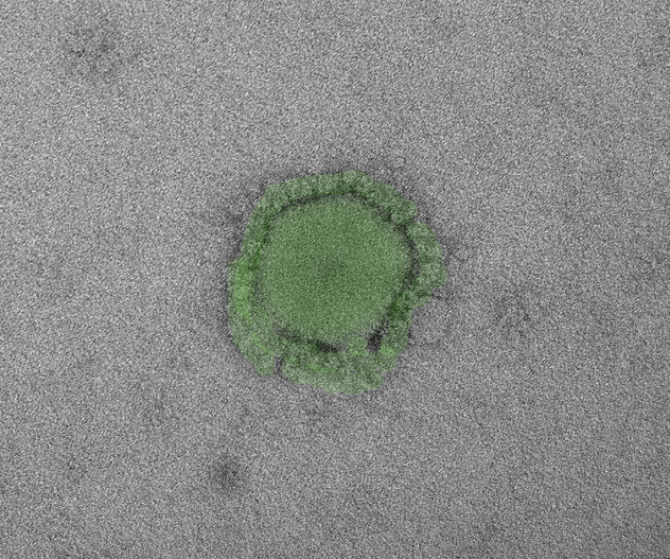
This week’s image depicts the vacuole of a Vero cell, within which Coxiella burnetii, the bacteria which causes Q fever, is growing. Infection with just one of those green bacterium can cause Q fever in humans, an often asymptomatic disease which can occasionally result in respiratory symptoms, enlarged liver and spleen, and rarely, death. Q fever is found throughout the world, and is transmitted to humans primarily through interaction with contaminated livestock.
Qatar announces new Mers case
Qatar just confirmed it’s second case of Middle Eastern Respiratory Syndrome (MERS) virus in just a week. The patient is a 29-year old male, who is believed to have become infected with the virus following interaction with an infected individual. The patient is in intensive care in Doha, and is listed as in critical condition. It is unknown whether the newest patient had underlying health conditions which rendered him immunocompromised.
Read more here.
(image of MERS virus via Cynthia Goldsmith/Azaibi Tamin/CDC with false color added)
In-depth: Defending against Chemical Weapons
As the death toll continues to mount from Assad’s alleged use of chemical weapons on the Syrian rebels, we thought it’s high time for a refresher on our own chemical weapons defense. What would the US do if a terrorist group released toxic gas on American soil? Before you dismiss it as unlikely, remember that nearly twenty years ago the Japanese cult and terrorist group Aum Skinrikyo released the chemical agent sarin on the Tokyo subway, killing thirteen, injuring nearly 50, and causing temporary symptoms in a thousand other rush-hour commuters. The Japanese health system successfully processed the 5,500 people who rushed hospitals on the day of the attack, and the contaminated subway line was up and running by the next morning. Would we be as well prepared?
Read our CBRN Policy Brief, “Is the US Prepared for a Chemical Attack” and understand our current mechanisms of response. The Brief is written by Dr. Alexander Garza, GMU Biodefense Affiliate Research Scientist and former Assistant Secretary for Health Affairs and Chief Medical Officer at the Department of Homeland Security. Dr. Garza’s Policy Brief analyzes federal government preparedness, in terms of prevention, detection, and response, to a chemical weapons attack on US soil.
Full brief available here.
(image courtesy of Bernd Daub/Flickr)
This week in DC: Slightly more events
We cast a slightly broader net this week. We’re especially interested in the Brookings Institution’s discussion of the next steps in US-Russian foreign policy (Wednesday).
Monday, August 26
1) Extended Deterrence And Strategic Stability In Northeast Asia
Stimson Center
9:00am – 10:30am
With the simultaneous emergence of a nuclear-armed North Korea and a China that is modernizing and diversifying its nuclear posture, extended deterrence and strategic stability are under new stress in Northeast Asia. How these new challenges are managed will affect the credibility of U.S. extended deterrence in other regions, including Europe.
2) Environmental Stress & Middle Eastern Instability
Stimson Center
1:00pm-2:30pm
The discussion will explore perspectives from U.S. development and research communities on the roles that rising pressures on natural resources and the emerging impacts of climate change can potentially play in contributing to political unrest and economic instability across the Middle East. As case studies, speakers will examine the interplay between state fragility and environmental issues in Syria and Yemen.
Tuesday, August 27
China’s Rise to Global Economic Power: What Does it Mean for the United States?
Wilson Center
2:30pm – 4:00pm
The Chinese economy’s ability to emerge from the global financial crisis seemingly unscathed while the United States slowly climbs out of recession bolsters a widespread image of a strong People’s Republic of China (PRC) rising against the backdrop of a declining United States of America. China’s economic growth in recent years, however, has slowed down, raising the question of whether it is foreordained that China will become the world’s premier economic power. Frank Lavin, former U.S. Under Secretary of Commerce, will be at the Wilson Center to offer his thoughts on China’s rapid emergence as a major economic and political force. He will argue that China’s continued growth in power and affluence will bring challenges, but not a new Cold War. Nor is it likely to be linear.
Wednesday, August 28
1) A New Look at American Foreign Policy: A Series of Discussions
Heritage Foundatin
12:00pm – 1:00pm
American foreign policy is in flux. Libertarian-minded conservatives are joining liberals in their critiques of military interventions, defense budgets and the surveillance practices of the National Security Agency. “Neo” conservatives like John McCain are lining up with liberals in denouncing libertarian conservatives as “isolationists.” Liberals and conservatives alike are unhappy with the Obama Administration’s tepid support for humanitarian interventions in Syria and its failure to advance human rights abroad – normally touchstones of liberal internationalism. Are fundamental ideological changes in American foreign policy afoot? Join us for this first in a series of discussions regarding this question, what the dangers and opportunities are and whether they afford an opportunity to take a “new look” at American foreign policy.
2) The U.S.-Russia Relationship: What’s Next?
Brookings Institution
2:00pm – 3:30pm
While President Obama intends to travel to St Petersburg for the G20 summit on September 6 and 7, there has been no word on whether there will be a bilateral meeting with President Putin on the margins of the summit. Clearly, U.S.-Russian relations have entered troubled times. On August 28, the Center on the United States and Europe will host a panel discussion to address these developments and future prospects for the bilateral relationship between Washington and Moscow. Brookings Senior Fellows Clifford Gaddy, Steven Pifer and Angela Stent will take part. Brookings Visiting Fellow Jeremy Shapiro will moderate. Following opening comments, the panelists will take questions from the audience.
3) Salon 101: Exploring Opposing Perspectives in Egypt
International Peace & Security Institute
2:00pm-5:00pm
Exploring Opposing Perspectives in Egypt: Since the deposition of President Morsi, unrest in Egypt has dominated international news. The outpouring of public sentiment, mass rallies and protests, and conflicting ideologies have left observers scrambling for answers. In a situation characterized by extreme tension, charged opinions, and a lack of clear-cut responses, this Salon 101 event will bring together topic experts to grapple with participants for a way forward in Egypt’s current political crisis.
Blair discusses Syrian CW use on Rachel Maddow Show
GMU Biodefense Adjunct Professor and Federation of American Scientist Senior Fellow on State and Non-State Threats Charles Blair was interviewed by MSNBC’s Rachel Maddow yesterday on Syrian chemical weapons use. Blair discussed the difficulty of ascertaining, as outsiders, whether or not the claims of chemical weapons use against the Syrian rebels are legitimate. Watch the full interview below.
The Pandora Report 8.23.13
Highlights this week include MERS in tomb bats, H7N9 and its lurking cousins, Ebola of CCHF?, the history of CW and BW, and nanotech. Happy Friday!
Reservoir of MERS may be Egyptian Tomb Bat. Yes tomb bat, as in, mummies, curses, and tomb bats.
Researchers may have uncovered the reservoir of the recently emerged Middle Eastern Respiratory Syndrome virus (MERS). Scientists took DNA samples from 96 bats living at an abandoned site just 12 kilometers from the MERS index case. Once the DNA samples were sequenced, the scientists involved discovered that the fecal pellet of one bat species, the Egyptian tomb bat, shared a 182-nucleotide snippet of DNA with MERS. It’s possible that more of viral genome was present; however, when the frozen bat samples were clearing US customs, the customs officers opened and left the samples out, at room temperature, for two days (don’t even get us started on all the things wrong with that situation). Still, this latest development brings us a step closer to understanding the virus and its mechanism of action.
Science Magazine – “Sequencing the nucleic acids isolated from the samples yielded a clue: The fecal pellet of the insect-eating Egyptian tomb bat (Taphozous perforatus) contained a piece of viral RNA identical to that of the virus isolated from the patient in Bisha, the scientists reported online in Emerging Infectious Diseases yesterday…Still, the finding is another interesting piece in the MERS puzzle, says Marion Koopmans, an infectious diseases researcher at the National Institute for Public Health and the Environment in the Netherlands, who was not involved in the work. She points out that the fragment is not only short but also comes from one of the least variable parts of the viral genome, so the full genomes of bat and human virus could still differ significantly. Nonetheless, the finding ‘points at bats as a reservoir for this virus,’ Koopmans writes in an e-mail.”
China bird flu analysis finds more virus threats lurking
Scientists in China have analyzed other strains of H7 flu, and have determined that several of the strains are capable of jumping to humans. A couple strains have already been shown to successfully infect ferrets. It’s thought that H7N9, like other pandemic strains of avian influenza, began in water fowl, was transmitted to domestic poultry, reassorted with H9N2, and then infected people. The moral of the story? Other avian pandemics may be waiting in the wings (pun only slightly intended).
Reuters – “To trace the evolution of H7N9 and its path into humans, researchers led by Maria Huachen Zhu and Yi Guan of the University of Hong Kong conducted field surveillance around the main H7N9 outbreak region and mapped out, or sequenced, genetic codes of a large number of bird flu viruses they found…They also found another previously unrecognized H7N7 virus strain had emerged and is circulating in poultry in China. In experiments testing this strain, they discovered it has the ability to infect ferrets – an animal model often used by scientists to find out more about what flu might do in humans – suggesting it could jump into people in future.”
Deadly Hemorrhagic Fever Appears in Uganda
Local health officials are scrambling to identify a small outbreak of hemorrhagic fever in Uganda, with conflicting reports seperately identifying the causative virus as Crimean-Congo Hemorrhagic Fever (CCHF) and Ebola. Four patients have been hospitalized, with a fifth already dead from the virus. In a disturbing complication, one patient has apparently “escaped from the hospital” following collection of blood samples, prompting understandable fears of exacerbation of the virus’ spread. Both CCHF and Ebola are highly pathogenic, causing body pain, severe hemorrhaging, and death.
Daily Monitor – “Efforts to verify with the Health ministry whether the disease is Ebola or the Crimean- Congo haemorrhagic fever were futile as the officials did not answer our telephone calls. ‘The four patients have been put in isolation for close monitoring,’ Dr Otto said. The district health officer said the first patient at the hospital presented symptoms similar to that of Ebola which prompted him to take blood samples to Entebbe. Dr Otto urged the public to remain calm, saying a medical team was on the ground to handle the situation.
Scientific American In-Depth Report: The Specter of Chemical and Biological Weapons
Scientific American just put up a good overview of both recent developments in and the broad history of chemical and biological warfare. The pieces included are more chem-heavy (unsurprisingly), but it’s still a good refresher, especially with Syria apparently escalating again. Take a moment to check it out.
Nano Breakthrough For Navy Lab; Tiny Sensors To Detect Explosives, Bio Weapons, Rotten Food
Researchers at the Naval Research Laboratory want to use nanowires to detect everything from biological weapons to spoilt food. For the first time, researchers were able to overcome the difficulty associated with creating the wires. Until now, nanowires have had to be grown, making mass production extremely difficult. However, researchers have found a way to etch the wires, rather than grow them, making embedding them in uniforms or refrigerators possible.
Breaking Defense – “‘The big thing with getting to this point is finding a way to produce this in a scaleable and reproducible fashion,’ principal investigator Christopher Field told me… Basically, the Navy scientists etch a cluster of nanowires and put a small amount of power pulsing through them. When a molecule from an explosive’s gas or a chemical weapon brushes against the nanowires this disrupts the charge. Then scientists analyze the disruption to discover what caused it.”
(image courtesy of Marie and Alistair Knock/Taraji Blue/Flickr)
Blair on Syrian Chemical Weapons
Charles Blair, GMU Biodefense Adjunct Professor and the Senior Fellow on State and Non-State Threats at the Federation of American Scientists, was quoted extensively in the Washington Post’s piece yesterday on Assad’s possible use of chemical weapons against the rebels.
Speaking on the grisly effects of nerve agents, Blair explained, “There’s muscle twitching. Then, as the muscle twitching gets more and more spasmodic, mucus comes out of the nose and mouth and you basically go into convulsions on the ground. People don’t survive this.”
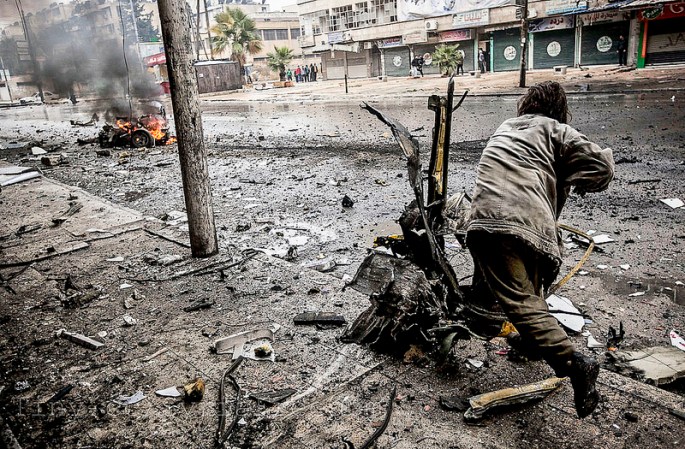
Syrian President Bashar al-Assad is accused of using nerve agent, possibly sarin, on sleeping civilians in the suburbs of Damascus. UN Inspectors have not yet been granted access to the areas of the alleged attack. Estimates of the death toll range from 136 to 1300, with no way for outside validation.
For information on a potential US response to a chemical weapons attack, see our CBRN Policy Brief, “Is the US Prepared for a Chemical Attack?“, by Dr. Alex Garza, GMU Biodefense Affiliate Research Scientist and former Assistant Secretary for Health Affairs and Chief Medical Officer at the Department of Homeland Security.
(image courtesy of Syria Freedom House)
Image of the Week: Psychedelic Bacterial Colonies

This beautiful image is of P. vortex, a bacteria species discovered in the ’90s by Eshel Ben-Jacob and his colleagues at the University of Tel Aviv. In an attempt to better understand the new species, Ben-Jacob tweaked various growth conditions, like temperature, light exposure, or nutrient consistency, and recorded the bacteria’s response. He soon found that the colony responded as a unit, resulting in distinctive patterns of movement and growth. Add a little dye, and boom – bacterial art.
Our favorite quote: “‘The bacteria have to maintain order, but they also have to maintain flexibility, so that when conditions change they can better adapt to the environment,’ says Ben-Jacob. ‘We have an affinity for things that have the combination of the two, order and disorder. If you analyze classical music, it is the same thing. The things that we really like and are captivated by are things that have this mixture.'”
To learn more and check out some of his other work, see here.
Eastern Equine Encephalitis confirmed in Maryland horse
A horse in Worcester County, Maryland has tested positive for Eastern equine encephalitis (EEE), a mosquito-bourne virus which can be fatal to horses and cause serious disease in humans. Although the County is spraying for mosquitoes, horse owners in the area are strongly encouraged to discuss vaccinations with their veterinarians.
The US averages 15 cases of EEE a year, usually within southern and eastern states. Symptoms of EEE in humans include fever, vomiting, photophobia (fear of light), and headache, with siezures, coma and eventual death possible as secondary symptoms. The case fatality in humans can be as high as 60%, with survivors often experiencing severe brain damage.
For more information of the Worcester case, see here.
(image courtesy of CDC)
This Week in DC: (a few) Events
The highlight of this week’s meager offerings is Wednesday’s MERS talk, which is available via webcast for those of you in distant locales.
Tuesday, August 20
Al Qaeda and its Affiliates: On Life Support or an Imminent Threat?
Foundation for Defense of Democracies
12:00PM – 1:30PM
Twelve years after the September 11, 2001 terrorist attacks, and more than two years after Osama bin Laden was killed, how great of a threat is al Qaeda to the U.S. homeland and America’s interests abroad? Has the instability in Iraq, Syria, Yemen and throughout Africa allowed al Qaeda to grow in size and power? How should the latest threats against America’s diplomatic facilities, paired with the recent prison breaks in Pakistan, Iraq, Libya and elsewhere impact U.S. counterterrorism strategy? Please join FDD for a conversation with Eli Lake, Thomas Joscelyn, and Cliff May.
Wednesday, August 21
Leveraging Defense Community Resources for the Next Generation of Threats
NextGov’s Cybersecurity Series
7:30AM – 9:30AM
With new cybersecurity legislation and slashed defense budgets, federal and corporate plans for protecting Defense infrastructure are subject to serious alterations. How will these upcoming changes affect your day-to-day operations? Hear from leading DoD voices and policy experts and learn: what cyber vulnerabilities are taking priority on the Department of Defense’s agenda; how the Department of Defense best leverages public-private partnerships to fend off the most critical threats, and which sectors of the Defense Industrial Base are most heavily affected by budget cuts.
Insights from the Front Lines of the Middle East Respiratory Syndrome (MERS) Outbreak
UPMC Center for Health Security
10:00AM – 12:00PM
Dr. Ziad Memish, Deputy Minister of Health for Public Health, Kingdom of Saudi Arabia,will discuss Saudi Arabia’s effort to control and respond to the MERS-CoV outbreak.
(image courtesy of Dell/Flickr)