2016 NDAA: Helicopters, Counters for Unconventional Warfare, and a Bunch of Ships

By Greg Mercer

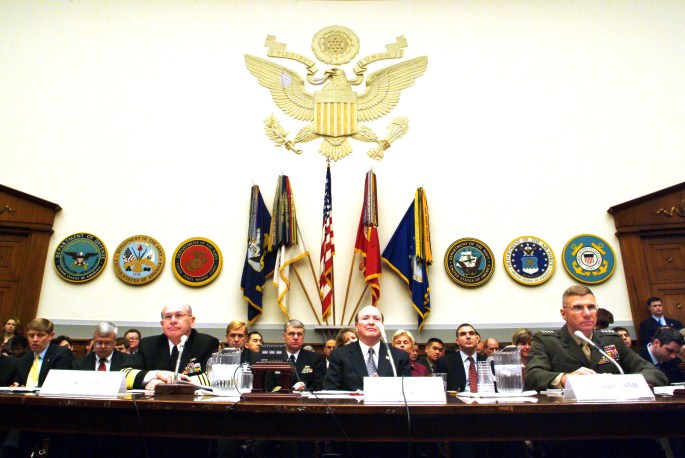
Every fiscal year, Congress passes the National Defense Authorization Act (NDAA), a piece of comprehensive legislation that funds the Department of Defense and the national security programs operated by the Department of Energy. Since the military is extraordinarily expensive to maintain, and Congress famously “holds the purse strings”, the NDAA is a catalyst for major changes and reforms, and the process of authoring and passing it can tell us a lot about the gap between Congressional and military priorities. The NDAA is going through the House markup process (House first, then Senate, because it’s a financial bill), with subcommittee markups taking place this week and the Full Committee Markup taking place Wednesday, April 29 (Rayburn House Office Building Room 2118 at 10 AM if you’re really interested). The process has already highlighted some trends that will have a major impact in FY16.

Defense News reports that the Armed Services Emerging Threats and Capabilities subcommittee has requested that the Pentagon replace some helicopters. The subcommittee requested that the Pentagon create a plan to replace existing AH-6 and MH-6 “Little Bird” helicopters within 90 days of the NDAA’s passage and to indicate how they plan to do so with “anticipated funding requirements… for development and procurement of an A/MH-6 replacement platform.” A/MH-6s are commonly used by special operations forces, so it’s no surprise that the Emerging Threats and Capabilities subcommittee would be concerned about the future of Special Forces aviation.

The subcommittee also notes that they are concerned about the “unconventional warfare capabilities and threats” posed by Russia and Iran. The proposed legislation defines this as: “…activities conducted to enable a resistance movement of insurgency to coerce, disrupt, or overthrow a government or occupying power by operating through or with an underground, auxiliary, or guerrilla force in a denied area.” Clearly, this refers to the ongoing crisis in Ukraine and Russian aggression, as well as the involvement of Iran in combatting ISIL forces in Iraq, which has seen Iran training and equipping as many as 30,000 troops and deploying missiles.

Finally, the subcommittee touches upon a trendy, favorite topic, expressing concern about DOD’s cyber capabilities. It requests a briefing on the process of identifying and remedying current vulnerabilities by February 1, 2016, and a briefing on the DOD’s cyber mission force and whether it can meet its intelligence collection and analysis needs but November 1, 2016.

Elsewhere, Defense News also reports that the Navy’s FY16 budget requests have generally enjoyed support from the Seapower and Projection Forces subcommittee. The subcommittee approved requests for building three new Littoral Combat Ships (a program which has seen controversy in the past), two destroyers, two attack submarines, the completion of a new amphibious ship, continued construction on two new aircraft carriers, procurement of new Tomahawk cruise missiles, and the development of an unmanned, carrier-based jet.

The NDAA will remain dynamic and likely controversial as it works its way through the legislative process. Its position at the center of DOD’s operations for the upcoming year makes the NDAA perennially attractive to those in Congress and the Administration who seek reform or procurement changes. I’ll try to offer more as the process continues.

Image Credit: U.S. Navy

Week in DC: Events

April 27, 2015

Insurgency in the Middle East and Its Threat to the United States
Date: April 27, 9:00 am
Location: Elliott School of International Affairs, Lindner Family Commons, Room 602, 1957 E Street NW, Washington DC

Event Schedule:
9:00-9:15: Welcome
9:15-10:30: “Understanding Civil War, Insurgency and Terrorism in Today’s Middle East”

  • Jon B. Alterman, Senior Vice President, Center for Strategic and International Studies
  • Kathleen Gallagher Cunningham, Associate Professor, University of Maryland
  • Dafna H. Rand, Deputy Director of Studies, Center for a New American Security
  • Joseph K. Young, Associate Professor, American University

10:45-12:00: “Understanding the Threat to the United States and Europe from Returning Jihadists”

  • Tricia Bacon, Professorial Lecturer, American University
  • Dorle Hellmuth, Assistant Professor, Catholic University
  • Christopher A. Kojm, Visiting Professor of the Practice of International Affairs, GWU
  • Thomas M. Sanderson, Codirector, Transnational Threats Project, CSIS (invited)

RSVP here.

The Future Postponed
Date: April 27, 9:00 am
Location: Information Technology and Innovation Foundation, AAAS Auditorium, 1200 New York Ave NW, Washington DC

MIT, led by VP for Research Maria Zuber and former Science Dean Marc Kastner and four faculty, will come to Washington for an event hosted by AAAS (and cohosted by AAU, APLU, The Science Coalition and ITIF) to present a major new MIT report called “The Future Postponed” on April 27th.

Register here.

Ebola Outbreak and Response: Assessment of Initial U.S. Actions
Date: April 27, 12:00 pm
Location: Heritage Foundation, Lehrman Auditorium, 214 Massachusetts Ave NE, Washington DC

The 2013-2014 outbreak of Ebola in West Africa ravaged the countries of Guinea, Liberia and Sierra Leone, shocked the international community and claimed over 10,000 lives. As an aggressive and extremely lethal disease, Ebola spread quickly and demonstrated that there is no such thing as “just in time preparedness,” once again reminding the international community vulnerable regions remain highly susceptible to pandemics and other various public health crises.

The United States is not immune. We were reminded of this reality once cases of Ebola were detected domestically. In the aftermath of the West African outbreak and international spread, The Heritage Foundation established a task force to identify observations and findings and offer recommendations for how the U.S. can better respond to future crises. This report examines the U.S. response to Ebola in West Africa as well as domestically and offers recommendations aimed at improving the quality, speed and efficiency of future American-led responses to natural disasters, pandemics and acts of bioterrorism.

Join our panelists for a discussion on the report’s findings and specifically how to improve the United States’ ability to respond to future public health crises.

Click here to attend in person or watch live online.

Countdown to Zero Day: Stuxnet and the Launch of the World’s First Digital Weapon
Date: April 27, 6:00 pm
Location: Elliott School of International Affairs, Room 602, 1957 E Street NW, Washington DC

The Institute for Science and International Security (ISIS) and the George Washington University’s Elliott School of International Affairs invite you to an event titled “Countdown to Zero Day: Stuxnet and the Launch of the World’s First Digital Weapon,” with Kim Zetter, an award-winning journalist for Wired, who has been covering cybersecurity for more than a decade.

In January 2010, inspectors with the International Atomic Energy Agency noticed that centrifuges at an Iranian uranium enrichment plant were failing at an unprecedented rate. The cause was a complete mystery. Six months later, a computer security firm in Belarus stumbled upon a virus infecting computers in Iran. It took four months of analysis, but eventually researchers realized they had discovered the world’s first digital weapon. Stuxnet, the weapon, was unlike any other virus or worm built before. Rather than simply hijacking targeted computers or stealing information from them, it escaped the digital realm to wreak physical destruction on equipment controlled by computers — in this case, centrifuges at a nuclear facility in Iran that were being used to enrich uranium.

At this event, Zetter will tell the story behind the cyber virus that sabotaged Iran’s nuclear efforts and explain how its existence has ushered in a new age of warfare.

RSVP here.

April 28, 2015

U.S. Civil Drone Policy
Date: April 28, 10:00 am
Location: Center for Strategic and International Studies, 1616 Rhode Island Ave NW, Washington DC

The development of new technologies for unmanned flight and microelectronics in the last two decades has led to an explosion in civil unmanned aerial systems (UAS, commonly known as drones) activity in the U.S. From a few hobbyists flying small, technically limited model aircraft in the 1990s, the field has grown to thousands of individuals and corporations looking to employ a variety of UAS models for security awareness, disaster response, logistics and delivery, agriculture, communications, spectral and thermal analysis, and aerial photography, among many other functions.

CSIS will hold a public event focusing on practical policy strategies to manage commercial, public and private UAS in U.S. airspace, while supporting innovation, and protecting privacy and personal freedom.

Register here.

Defeating the Jihadists in Syria: Competition before Confrontation
Date: April 28, 11:00 am
Location: Atlantic Council, 1030 15th Street NW, 12th Floor, West Tower, Washington DC

Since August 2014, the US-led coalition air campaign against the Islamic State of Iraq and al-Sham (ISIS) has successfully inflicted casualties on ISIS and weakened its oil revenues. In a new Atlantic Council report, “Defeating the Jihadists in Syria: Competition before Confrontation,” Faysal Itani acknowledges these positive yet limited results, but also presents the unintended consequences of this air campaign and US policy options given local Syrian realities.

Itani details how coalition efforts accelerated the rise of the Nusra Front, an al-Qaeda affiliate, and the near-collapse of nationalist rebel forces. He proposes a US strategy to assist nationalist insurgents to defeat ISIS and the Nusra Front–by enabling them to compete with and contain jihadist groups, and ultimately confront them. Please join us for a conversation about the author’s findings with expert commentators.

Register here to attend in person or here to watch live online.

Personal Stories from the Frontlines of War and Peace
Date: April 28, 2:00 pm
Location: United States Institute of Peace, 2301 Constitution Ave NW, Washington DC

From Iraq to Burma, from Peru to Yemen, from Nicaragua to Nepal, the personal stories of widows, children, workers, and soldiers often are lost in the cacophony of war.  Please join the U.S. Institute of Peace on Tuesday, April 28, for a discussion and launch of “Speaking Their Peace: Personal Stories from the Frontlines of War and Peace,” a book that tells the extraordinary stories of “ordinary” people from eleven conflict zones. NPR’s Michel Martin moderates a discussion with the book’s author, Colette Rausch, and two members of the team that captured these memorable interviews.

With a foreword by the Dalai Lama, the book collects interviews with 80 ordinary citizens – a taxi driver, a nun, a machinery worker, a mother — from conflict zones all over the world. Their accounts illuminate the intensely personal experience of war, the uncertain transition to peace, and the aspirations that survive despite it all.

National Public Radio’s Michel Martin will moderate a discussion with Rausch, the acting vice president for Governance, Law and Society at USIP, and Najla Elmangoush and Khitam Al-Khaghani, who have lived and worked in conflict zones and were a part of the team that conducted interviews. A photo exhibit will feature images taken during Rausch’s travels and her meetings with interviewees.

Audience members also will have an opportunity to record their own 30-second messages of what peace means to them for a “Speak Your Peace” video. The event will be followed by a reception and book-signing session. Learn more about “Speaking Their Peace” and read excerpts from the book. Join the conversation on Twitter with #SpeakPeace.

Register here to attend this event.

Govern Like Us: U.S. Expectations of Poor Governments
Date: April 28, 4:30 pm
Location: Johns Hopkins School of Advanced International Studies, Rome Auditorium, 1740 Massachusetts Ave NW, Washington DC

Thirteen years after the U.S. invasion of Afghanistan, the project to transform the way Afghanistan is governed has largely failed. Some think the U.S. and its partners did not try hard enough. Some blame Afghan elites for their corruption and lack of political will. Some continue to press for reforms to build a government that provides public goods and services to everyone, under the rule of law, and subject to democratic accountability. But is this a possibility for the poorest governments? Dr. Thomas will discuss her new book.

For more information or to RSVP email here.

April 29, 2015

Deterrence Instability and Nuclear Weapons in South Asia
Date: April 29, 12:30 pm
Location: The Stimson Center, 1211 Connecticut Ave NW, 8th Floor, Washington DC

Deterrence in South Asia is becoming less stable with the passage of time and an increase in nuclear weapon capabilities. India and Pakistan have not addressed basic issues in dispute, nor have they agreed to set them aside. In 2015, the two countries are no closer to resolving their differences than they were seven years ago, after members of Lashkar-e-Taiba carried out attacks against Mumbai landmarks.

The Stimson Center is publishing a collection of essays, “Deterrence Instability and Nuclear Weapons in South Asia,” edited by Michael Krepon, Joshua T. White, Julia Thompson, and Shane Mason. These essays by Manoj Joshi, Shashank Joshi, Michael Krepon, Jeffrey D. McCausland, Rasul Bakhsh Rais, Sarang Shidore, and Joshua T. White and Kyle Deming clarify how doctrinal, strategic, and technological developments contribute to growing deterrence instability in South Asia. Taken together, these chapters point to serious challenges associated with increased nuclear dangers unless leaders in India and Pakistan work to resolve their grievances, or consider measures to mitigate their costly and risky strategic competition.

RSVP here.

Subcommittee Hearing: ISIS: Defining the Enemy
Date: April 29, 2:00 pm
Location: U.S. House Committee on Foreign Affairs, 2172 Rayburn House Office Building, Washington DC

The Subcommittee on Terrorism, Nonproliferation, and Trade will host two panels to discuss ISIS. Panel I will include the Honorable Robert Ford, Senior Fellow at The Middle East Institute and Former U.S. Ambassador to Syria; and Walid Phares, Ph.D., Co-Secretary General of the Transatlantic Parliamentary Group on Counterterrorism.

Panel II will include Ms. Maryam Rajavi, President-Elect of the National Council of Resistance of Iran (Appearing via teleconference).

Subcommittee Hearing: Progress and Challenges in the Western Balkans
Date: April 29, 2:00 pm
Location: U.S. House Committee on Foreign Affairs, 2200 Rayburn House Office Building, Washington DC

The Subcommittee on Europe, Eurasia, and Emerging Threats will hear two panels of testimony related to the Western Balkans. Panel I will include Mr. Hoyt Brian Yee, Deputy Assistant Secretary at the Bureau of European and Eurasian Affairs of the U.S. Department of State, and Ms. Susan Fritz, Acting Assistant Administrator in the Europe and Eurasia Bureau at the U.S. Agency for International Development.

Panel II will include Mr. Ivan Vejvoda, Senior Vice President of Programs at the German Marshall Fund of the United States, and The Honorable Joseph J. DioGuardi, President of the Albanian American Civic League
(Former Member of Congress).

The U.S.-China Relationship in an Evolving Global Economic Order
Date: April 29, 3:00 pm
Location: Center for Strategic and International Studies, 1616 Rhode Island Ave NW, 2nd Floor Conference Room, Washington DC

Recent developments such as the establishment of new institutions like the AIIB have raised broader questions about the U.S. and China’s roles in global economic governance. What are the problems in the global economy that the U.S. and China agree and disagree on? To what extent are existing institutions addressing those problems and where is there a need for new approaches? Can the U.S. and China find a way to work cooperatively on these issues, which will have a major impact on the prosperity of both countries and the rest of the world? Please join us for a stimulating discussion of these issues with top experts from China and the U.S. The event will finish with a keynote address by Under Secretary Nathan Sheets, the senior official at the U.S. Treasury responsible for the S&ED.

RSVP here.

April 30, 2015

In Search of a Syria Strategy
Date: April 30, 12:00 pm
Location: Cato Institute, Hayek Auditorium, 1000 Massachusetts Ave NW, Washington DC

The rise of ISIS and the spread of the Syrian civil war to Iraq have led to renewed discussions of U.S. intervention. Though Washington is regularly bombing ISIS targets, there is little in the way of viable on-the-ground support, and a much-vaunted U.S. training campaign for moderates has had difficulty finding acceptable trainees. Many of America’s allies are complicit in funding extremist groups within Syria, even if they oppose ISIS itself, while the White House continues to equivocate on whether it will negotiate with the Assad regime. America’s goals in Syria are unclear, and there is a broad consensus that the current U.S. approach — loosely defined as ‘degrading and destroying’ ISIS — is murky at best.

What is the United States trying to accomplish in Syria? Are its goals achievable with current strategies? Join our panelists as they discuss how we reached this point, and the extent to which the U.S. should or should not be involved in the ongoing conflict.

Register here.

Subcommittee Hearing: Regional Impact of U.S. Policy Towards Iraq and Syria
Date: April 30, 2:00 pm
Location: U.S. House Committee on Foreign Affairs, 2172 Rayburn House Office Building, Washington DC

The Subcommittee on the Middle East and North Africa will hear testimony from Seth G. Jones, Ph.D., Director, International Security and Defense Policy Center at the RAND Corporation, General Jack Keane, USA, Retired, Chairman of the Board at the Institute for the Study of War, and Tamara Cofman Wittes, Ph.D., Director of the Center for Middle East Policy at Brookings.

May 1, 2015

Strengthening Fragile States: Causes and Solutions
Date: May 1, 2:00 pm
Location: Center for International Private Enterprise, 1211 Connecticut Ave NW, Suite 700, Washington DC

Fragile states drive a disproportionate share of the world’s instability, violence and poverty. People living in these countries suffer from weak or dysfunctional institutions, social divisions, corruption, poor governance, a lack of protection of rights, and large informal sectors. These problems not only cause instability within a country, but create tensions regionally and sometimes globally.

Join us May 1, 2-4pm, as the Center for International Private Enterprise hosts a discussion on Strengthening Fragile States: Causes and Solutions. Our panel will discuss the roots of fragile states and how to strengthen them. Specifically, they will discuss:

  • Lessons learned from the Arab Spring.
  • Root causes of fragile states.
  • How to foster institutions and improve governance through transparency and accountability in the public and private sectors.
  • Comparing fragile states with functional ones.
  • The importance of building democratic institutions.
  • Spillover effects regionally from fragile states.
  • Private sector participation in the democratic process to strengthen states.
  • Corruption and fragile states.

Register here.

Freedom

By Erik Goepner

Promoting democracy, particularly in Muslim-majority countries, has been a cornerstone of America’s war on terror since the early days after 9/11. To many Americans, including our policy makers, democracy is virtually synonymous with liberty and freedom. Not everyone shares this perspective. Some view democracy as incompatible with freedom and liberty.

After perceived initial successes in Afghanistan, President Bush frequently spoke of America’s responsibility to help free other peoples.[1] In 2003, he spoke of a “new policy, a forward strategy of freedom in the Middle East.”[2] The President’s State of the Union addresses delivered during his two presidencies reached a crescendo in 2005, when he mentioned “democracy,” “liberty,” “freedom” or some variant thereof 46 times. The following year, the White House’s National Security Strategy celebrated the “extraordinary progress in the expansion of freedom, democracy, and human dignity” that had had occurred over the past four years in Afghanistan, Iraq, and elsewhere.

Such concepts are interwoven throughout our nation’s history, whether declaring our independence or stating that all men are created equal and endowed by their Creator with the unalienable rights to life, liberty, and the pursuit of happiness. We elect our leaders. We have the right to assemble and to protest. We have an active press and we enjoy the right to worship (or not) as we please. Give me liberty or give me death. Live free or die. It is no wonder, then, that for Americans, the words democracy, liberty, and freedom may often substitute one for another.

Other perspectives, however, while endorsing the concepts of liberty and freedom, reject democracy. Sayyid Qutb, an early member of the Muslim Brotherhood, outlined such a perspective in his provocative book, Milestones. Written in 1964, two years before the Egyptian government executed him, Qutb argued that freedom and liberty were antithetical to democracy. He asserted that Americans were ignorant and rebellious, as evidenced by our legislating of rules for collective behavior and our perceived right to “choose a way of life…without regard to what Allah has prescribed.” God, he said, is the Regent, while the faithful followers are to be his vice regents. How, then, he argued, could the vice regent legislate on issues that the Regent had already decreed as good or bad? For Qutb, Western democracy was the enslavement of one man over another. By encouraging the vice regent to elect human leaders who would then fashion laws in opposition to the will of the Regent, democracy would keep the people in darkness. Only the equivalent of a Muslim theocracy, he argued, offered people the opportunity to be truly free and sufficiently liberated to pursue life.

Polls suggest a majority of Muslims prefer democracy, seeing it as complementary to freedom and liberty. Recent democratic victories, however, for groups such as the Muslim Brotherhood and Hamas raise interesting dilemmas. Some argue that, absent pre-existing democratic institutions and culture, democratic elections can be used effectively by illiberal groups to trap their countries into undemocratic futures, while others see a decidedly brighter short-term future for Islamic democracy.

Image Credit: Bluszczokrzew


[1] See Bob Woodward’s Plan of Attack.
[2] See Mark Katz’ Leaving without Losing.

Week in DC: Events

April 20, 2015 

Operation United Assistance: The U.S. Military’s Relief Efforts in West Africa
Date: April 20, 8:30am
Location: The Stimson Center, 1211 Connecticut Ave NW, 8th Floor, Washington DC

The spread of Ebola through West Africa was a vivid demonstration of the outsized threat global health crises pose to international stability and security. The lessons learned from the earliest days of the outbreak point us toward improving our response to the next crisis. High among those lessons must be a clearer understanding of how — and how quickly — assistance could move to the worst stricken regions. The absence of a deliberate planning process for transportation and logistics proved an enormous barrier to effectively deploy essential equipment and personnel where it was most needed.

The ability of the international community, individual governments, private companies, and civil society to rally and stop the spread of the disease was largely due to the deployment of the US military to West Africa to coordinate response logistics, training, and engineering support, in support of the U.S. Agency for International Development (USAID).  Among lessons learned from the Ebola outbreak is that building capacity for a coordinated response to global health emergencies is essential to preventing and combatting these threats.

Please join us at the Stimson Center for a discussion on strengthening global health response with US Army Major General Gary Volesky, the commander of the US military’s efforts to combat Ebola in West Africa.

RSVP here.

Politics of a Nuclear Deal: Former U.S. & Iranian Officials Debate
Date: April 20, 9:30am
Location: United States Institute of Peace, 2301 Constitution Ave NW, Washington DC

Iran and the world’s six majors powers now face a June 30 deadline for converting a blueprint into a final nuclear deal. A unique panel of former U.S. and Iranian officials will assess the status of the talks and the political dynamics that will determine the fate of any agreement in Washington and Tehran. Join us for the discussion on April 20 at the U.S. Institute of Peace.

This event is the fourth in the Iran Forum series hosted by a coalition of eight think tanks, including USIP, the Woodrow Wilson Center for Scholars, RAND, the Arms Control Association, the Center for a New American Security, the Stimson Center, Partnership for a Secure America, and the Ploughshares Fund. Join the conversation on Twitter with #IranDeal.

Register here.

Implementing Cooperative Threat Reduction: The Private Sector’s Role in CTR
Date: April 20, 12:00pm
Location: Elliott School of International Affairs, 1957 E Street NW, Washington DC

Please join Dr. Ighor Uzhinsky of Orbital ATK for a lunchtime discussion of the private sector’s engagement with the implementation of the Cooperative Threat Reduction (CTR) Program, also known as the Nunn-Lugar Program. CTR was created for the purpose of securing and dismantling weapons of mass destruction and their associated infrastructure in the former states of the Soviet Union. Founded by Senators Sam Nunn (D-GA) and Richard Lugar (R-IN) through the passage of the Soviet Threat Reduction Act in November 1991, the program aimed to address the large nuclear arsenals inherited by former Soviet states Russia, Ukraine, Belarus, and Kazakhstan after the Soviet Union’s collapse. Dr. Uzhinsky will focus on the experience of the private sector in implementing CTR through examination of several cooperative programs in the areas of defense conversion and dismantlement of strategic missile delivery systems.

This event is part of the Nuclear Policy Talks series. Lunch will be provided.

RSVP here.

Ukrainian Energy Reforms and European Gas Supply
Date: April 20, 2:00pm
Location: Center for Strategic and International Studies, 1st Floor Conference Room, 1616 Rhode Island Ave NW, Washington DC

The CSIS Energy and National Security Program is pleased to host Alan Riley, Professor of Law at the City Law School with City University in London, to discuss the status of reforms to the Ukrainian energy sector and to provide an update on the European Union’s antitrust case against Gazprom. Following the ousting of Viktor Yanukovych in early 2014, a pro-reform and pro-Western government emerged. Despite the Russian annexation of Crimea and ensuing conflict in eastern Ukraine, much hope is placed in the new Ukrainian government’s ability to institute wide-ranging domestic reforms, particularly in the energy sector. Nonetheless, concrete, effectual changes have yet to materialize.

Simultaneously, the EU is looking to move ahead with its antitrust case against Russian gas giant Gazprom anti-competitive business practices. A well-known authority on both subjects, Professor Riley will provide an overview of the progress being made and the hurdles undermining energy reform in Ukraine as well as the status of the antitrust proceedings against Gazprom. Following Mr. Riley’s presentation, Ambassador Richard Morningstar, Founding Director of the Atlantic Council’s Global Energy Center, former Ambassador to the European Union and former Special Envoy for Eurasian Energy, will provide comments on the issues addressed.Edward Chow, Senior Fellow with the CSIS Energy and National Security Program, will moderate.

Register here.

A Special Talks @ Pulitzer: Filmmaker Carl Gierstorfer and ‘The Rise of the Killer Virus’
Date: April 20, 5:00pm
Location: Pulitzer Center, 1779 Massachusetts Ave NW, Suite 615, Washington DC

Ukrainian energy sector and to provide an update on the European Union’s antitrust case against Gazprom. Following the ousting of Viktor Yanukovych in early 2014, a pro-reform and pro-Western government emerged. Despite the Russian annexation of Crimea and ensuing conflict in eastern Ukraine, much hope is placed in the new Ukrainian government’s ability to institute wide-ranging domestic reforms, particularly in the energy sector. Nonetheless, concrete, effectual changes have yet to materialize.

Simultaneously, the EU is looking to move ahead with its antitrust case against Russian gas giant Gazprom anti-competitive business practices. A well-known authority on both subjects, Professor Riley will provide an overview of the progress being made and the hurdles undermining energy reform in Ukraine as well as the status of the antitrust proceedings against Gazprom. Following Mr. Riley’s presentation, Ambassador Richard Morningstar, Founding Director of the Atlantic Council’s Global Energy Center, former Ambassador to the European Union and former Special Envoy for Eurasian Energy, will provide comments on the issues addressed. Edward Chow, Senior Fellow with the CSIS Energy and National Security Program, will moderate.

RSVP here.

April 21, 2015

New Counterterrorism Strategies in Pakistan
Date: April 21, 9:30am
Location: Carnegie Endowment for International Peace, 1779 Massachusetts Ave NW, Washington DC

Following the December 2014 terror attack on an army-run school in Peshawar that killed 150, 132 children among them, the Pakistan government issued a National Action Plan (NAP), its latest counterterrorism and counterinsurgency strategy. With extremist violence claiming thousands of lives, cross-border attacks undermining security in neighboring Afghanistan, and the risk of a Pakistan-based terror attack on India simmering discontent, Islamabad’s efforts to combat terrorism are vital for both domestic security and regional stability. Samina Ahmed and Mark Schneider will discuss this latest approach and how NAP’s success or failure could shape Pakistan’s relations with India and Afghanistan, and impact U.S. national security interests in the region. Carnegie’s Frederic Grare will moderate.

Register onsite.

The Syrian Humanitarian Crisis: What Is to Be Done?
Date: April 21, 9:30am
Location: Washington Court Hotel, Springwood Room, 525 New Jersey Ave NW, Washington DC

The Middle East Policy Council invites you and your colleagues to our 80th Capitol Hill Conference. Live streaming of this event will begin at approximately 9:30 a.m. on Tuesday, April 21st and conclude at noon. A questions and answers session will be held at the end of the proceedings. Refreshments will be served.

Watch live online here.

Current State of Syrian Refugees in Turkey
Date: April 21, 10:00am
Location: SETA Foundation at Washington DC, 1025 Connecticut Ave NW, Suite 1106, Washington DC

The civil war has driven 6.5 million Syrians from their country; nearly 2 million now reside in Turkey. While Turkish refugee camps have garnered much attention due to their quality, the majority of Syrian refugees reside outside the camps. In urban areas, the government, aid agencies and NGOs struggle to meet the needs of an-ever growing number of refugees. Please join us for a panel discussion on the refugee crisis in Turkey and its impact on social, political and economic dynamics in the country.

Register here.

Is the American Century Over?
Date: April 21, 10:00am
Location: Woodrow Wilson International Center for Scholars, 1300 Pennsylvania Ave NW, 6th Floor Conference Room, Washington DC

Join us for a conversation with the author of Is the American Century Over?, Joseph S. Nye, as he argues that America’s superpower status may be tempered, but is definitely not over.

For more than a century, the United States has been the world’s most powerful state. Now some analysts predict that China will soon take its place. Does this mean that we are living in a post-American world? Will China’s rapid rise spark a new Cold War between the two titans?

In this compelling essay, world renowned foreign policy analyst, Joseph Nye, explains why the American century is far from over and what the U.S. must do to retain its lead in an era of increasingly diffuse power politics.

RSVP here.

Book Launch—Underestimated: Our Not So Peaceful Future
Date: April 21, 11:30am
Location: The Stimson Center, 1211 Connecticut Ave NW, Washington DC

Underestimated: Our Not So Peaceful Nuclear Future critically examines the key assumptions and driving forces behind today’s global nuclear nonproliferation activity. Please join author Henry Sokolski, Ambassador Robert Gallucci, and former Undersecretary of Defense Dov Zakheim for a luncheon and panel discussion to review findings from the book and discuss current trends in nuclear security.

RSVP here.

Military Balance 2015 Launch in Washington DC
Date: April 21, 2:00pm
Location: International Institute for Strategic Studies, 2121 K Street NW, Suite 801, Washington DC

The US launch of The Military Balance 2015 will take place at IISS-US on April 21. The Military Balance 2015 contains region-by-region analysis of the major military and economic developments affecting defense and security policies, and the trade in weapons and other military equipment. Detailed entries describe the military capabilities of 171 countries, displaying key equipment inventories and defense economics. Comprehensive tables detail arms orders and deliveries, major training activities and international comparisons of defense expenditure and military personnel.

Register here.

Building Peace in Libya: A Conversation with Wafa Bugaighis
Date: April 21, 3:00pm
Location: Carnegie Endowment for International Peace, 1779 Massachusetts Ave NW, Washington DC

As the conflict between Libya’s political factions drags on, its humanitarian and economic crisis deepens. Meanwhile, the Islamic State is exploiting the vacuum wrought by the fighting and the absence of coherent, capable institutions. What are the prospects for a ceasefire and the formation of an inclusive, sustainable government? Wafa Bugaighis, the charge d’affaires and highest-ranking diplomat at the Libyan Embassy in Washington, will offer her vision for ending the war and discuss how the international community can help rebuild Libya. Carnegie’s Frederic Wehrey will moderate.

Register onsite.

Does Russian Nationalism Have a Future after Ukraine?
Date: April 21, 3:30pm
Location: Woodrow Wilson International Center for Scholars, 1300 Pennsylvania Ave NW, 5th Floor Conference Room, Washington DC

Russian nationalism has been the victim of what is the essential tragedy of the Russian people: the Russian state tried to become an empire before the Russian people became a nation, and as a result, at no point has the country been a nation state. And while pro-Kremlin radical nationalists are increasingly important in Russian politics, their nationalist agendas have been largely co-opted by the state. The speakers will discuss the crisis facing Russian nationalists and what the future may hold for them.

RSVP here.

Is Authoritarianism Staging a Comeback?
Date: April 21, 5:00pm
Location: Atlantic Council, 1030 15th Street NW, 12th Floor, West Tower, Washington DC

The past few years have marked the beginning of a tumultuous period for global governance. Across the world, we have seen threats to international order and a disruption of longstanding political norms and values as authoritarians get smarter and persist undeterred. With authoritarianism on the rise in many of the world’s most strategically important regions, new questions emerge regarding the diffusion of power, the rise of sometimes violent nonstate actors, and the future role of the nation-state. Developing an appropriate strategy for the advancement of human rights and the support of nonviolent civil resistance movements is thus proving to be one of the most challenging policy dilemmas for the United States and other democracies.

On April 21, the Atlantic Council will be hosting a public discussion of these challenges in recognition of the release of its forthcoming publication, Is Authoritarianism Staging a Comeback? This discussion will feature multiple leading experts on nonviolent civil resistance and authoritarian states, and will explore the range of issues and case-studies examined within this book of essays.

Atlantic Council CEO and President Mr. Frederick Kempe will begin by moderating a discussion on countering authoritarianism between Dr. Peter Ackerman, Dr. Paula Dobriansky, and Mr. Damon Wilson. This will be followed by a discussion of the issues raised in the book itself, featuring Adm. Dennis Blair (USN, Ret.), Dr. George A. Lopez, and Dr. Regine Spector, moderated by Dr. Mathew Burrows and Dr. Maria J. Stephan.

Register here.

April 22, 2015

Examining U.S.-Israel Relations at a Time of Change in the Middle East
Date: April 22, 10:30am
Location: Center for American Progress, 1333 H St NW, 10th Floor, Washington DC

The U.S.-Israel relationship has been a centerpiece of U.S. Middle East strategy and a main pillar of Israel’s national security strategy for decades. But political relations between the two countries during the past six years have seen some turbulence, even as security cooperation deepens and they continue to share common interests and values at a time of change and uncertainty in the Middle East.

On April 22, please join the Center for American Progress, the Center for a New American Security, and the Israel Institute to take stock of where we are at this crucial stage in U.S.-Israel relations, featuring two expert panels. The first panel will discuss the management of U.S.-Israel relations, and the second will focus on the main issues under discussion between the two states.

RSVP here to attend in person or watch live online.

April 23, 2015

Do Color Revolutions Really Happen?
Date: April 23, 12:00pm
Location: Elliott School of International Affairs, Voesar Conference Room, 1957 E Street NW, Suite 412, Washington DC

The current crisis in Ukraine is firmly rooted in the Orange Revolution and in associated Western beliefs that Ukraine could be wrested from no additional costs Russia and included in Western trade and security structures. The tragic outcome reflects more than the West’s shallow understanding of the dangers involved in pushing Russia into a value-based security order. Even more profoundly, it illustrates how poorly social science has grasped the preconditions for implementing profound institutional change via outside agency. Given the uniformly negative experience of a host of different “color revolutions,” it may be time to rethink the Western agenda of fixing things.

RSVP here.

The Authoritarian Resurgence: China, Russia, Saudi Arabia, and Venezuela
Date: April 23, 12:00pm
Location: National Endowment for Democracy, 1025 F Street NW, Suite 800, Washington DC

Russia, Venezuela, China, and Saudi Arabia are among the most influential authoritarian states that are seeking to reshape the international order. These regimes may disagree on many things, but they share the objective of obstructing the advance of democracy and weakening the influence of democratic principles in the world. The established democracies have been slow to recognize the increasingly determined challenge from today’s authoritarians, perhaps because they hope that these regimes will be undone by their flaws. But given the resilience that the authoritarians have displayed so far, it would be imprudent for the democracies to underestimate the seriousness of the dangers that they pose. Based on articles that appear in the January 2015 and April 2015 issues of the Journal of Democracy, Javier Corrales, Andrew J. Nathan, Lilia Shevtsova, and Frederic Wehrey will discuss the multifaceted challenges presented by these regimes.

Register here.

Pandora Report 4.19.15

Sunday has to be the biggest brunch day of the week, so it is only fitting that our lead story looks at the many (delicious and nutritious) uses of maple syrup. We also look at Dengue fever in Brazil, missteps in the U.S. fight against Ebola, and other stories you may have missed.

Once you’re updated, get out there and enjoy the rest of your weekend and the beautiful weather! Have a great week!

Syrup Extract Found to Make Antibiotics More Effective Against Bacteria

It seems like we look at growing antibiotic resistance every week here at Pandora Report. This week, researchers at McGill University in Montreal reported that a “concentrated extract of maple syrup makes disease-causing bacteria more susceptible to antibiotics.” This finding suggests that combining the extract with antibiotics could increase their effectiveness and lead to lower antibiotic usage overall. Honestly, is there anything maple syrup can’t make better?!

Infection Control Today—“‘We would have to do in vivo tests, and eventually clinical trials, before we can say what the effect would be in humans,” [Professor Nathalie] Tufenkji says. “But the findings suggest a potentially simple and effective approach for reducing antibiotic usage. I could see maple syrup extract being incorporated eventually, for example, into the capsules of antibiotics.’”

Brazilian Teams on Alert because of Dengue Fever Outbreak

Brazilian soccer teams are on high alert because of a dengue fever outbreak that has already affected some of the country’s top teams. This week three players were diagnosed with the mosquito borne disease, which normally takes about two weeks to recover from. Players have been forced to use insect repellent during games and practices and health officials have been asked to check fields and training centers for mosquito breeding sites.

USA Today—“Cases of dengue fever have increased significantly across Brazil this year, with most of them reported in Sao Paulo state. Brazil’s health ministry said there have been more than 460,000 cases of the disease in the country in 2015, which accounts for almost 5,000 cases a day. More than 130 people have died so far this year, the ministry said.”

Empty Ebola Clinics in Liberia Are Seen as A Misstep in U.S. Relief Effort

After spending hundreds of millions of dollars and deploying 3,000 U.S. troops to build Ebola treatment centers (E.T.C.) in Liberia, the facilities have largely sat empty. Only 28 Ebola patients have been treated at the 11 E.T.C.s built by the U.S. military. Nine of the centers never had a single Ebola patient. Looking back, the emphasis on building E.T.C.s had far less of an impact than the “inexpensive, nimble measures taken by residents to halt the outbreak.”

The New York Times—“Had the Americans and other donors been more flexible, critics and some officials contend, the money could have been put toward rebuilding Liberia’s shattered health care system—or backing the efforts of local communities—instead of focusing on treatment centers that would scarcely be used.”

Stories You May Have Missed


Image Credit: Dvortygirl

New from the Biodefense Faculty

On this #FacultyFriday, we’ve got recent publications and appearances from two George Mason Biodefense faculty members.


Dr. Gregory Koblentz appeared on CBC Radio’s The Current to disucuss the recent Canada-India uranium deal. Listen to the whole segment here.


Charles Blair reflects on the Oklahoma City bombing as the 20th anniversary of the event nears.

Often erroneously explained away as psychopathic, Timothy McVeigh actually comported with psychologist and terrorism expert Clark R. McCauley’s finding that, “the best documented generalization is negative; terrorists do not show any striking psychopathology.” Though abhorrent, McVeigh’s actions are certainly intelligible. Examined extensively by psychiatrist John Smith in the months after the attack, McVeigh was judged as sane—“not delusional.” When asked why McVeigh “would commit such a terrible crime,” Smith concluded that “it was a conscious choice on his part, not because he was deranged … or misinterpreting reality … but because he was serious.”

His entire piece in the Bulletin of Atomic Scientists can be found here.

#tbt GMU’s Person of the Year 2014

We all remember that Time Magazine awarded the Ebola Fighters their Person of the Year, right?

Well, George Mason President Angel Cabrera recognized Audrey Ferguson, an Ebola fighter who attended GMU, as his Mason Person of the Year. This is what he had to say about Audrey:

I was delighted, and not surprised, that one of our alumni was among the many unsung heroes who “risked, persisted and sacrificed” to save lives.  And I loved the piece of Mason Pride that she found and shared with us from the heart of Liberia.

When Audrey first came to Mason, she intended to study global affairs. Then she decided to pursue nursing and minor in global affairs, a combination not possible at many other institutions. It’s great that Mason enabled her to pursue both interests and helped prepare her for the important work that she is doing in our community and around the world.

Read Dr. Cabrera’s post here.

Worth Reading: Informative Research on the Islamic State

By Erik Goepner

“The sobering fact is that the United States has no good military options in its fight against ISIS. Neither counterterrorism, nor counterinsurgency, nor conventional warfare is likely to afford Washington a clear-cut victory against the group. For the time being, at least, the policy that best matches ends and means and that has the best chance of securing U.S. interests is one of offensive containment: combining a limited military campaign with a major diplomatic and economic effort to weaken ISIS and align the interests of the many countries that are threatened by the group’s advance.”

From Audrey Kurth-Cronin’s “ISIS is Not a Terrorist Group” in Foreign Affairs. Full article available at http://www.foreignaffairs.com/articles/143043/audrey-kurth-cronin/isis-is-not-a-terrorist-group


“The United States and Europe already have effective measures in place to greatly reduce the threat of terrorism from jihadist returnees and to limit the scale of any attacks that might occur. Those measures can and should be improved—and, more importantly, adequately resourced. But the standard of success cannot be perfection. If it is, then Western governments are doomed to fail, and, worse, doomed to an overreaction which will waste resources and cause dangerous policy mistakes.”

From Daniel Byman & Jeremy Shapiro’s “Be Afraid. Be A Little Afraid: The Threat of Terrorism from Western Foreign Fighters in Syria and Iraq” in the Brookings Institution’s Foreign Policy Paper series. Full paper available at http://www.brookings.edu/research/papers/2015/01/western-foreign-fighters-in-syria-and-iraq-byman-shapiro


Finally, for a good general overview, take a look at “The Islamic State” by Zachary Laub and Jonathan Masters; a Council on Foreign Relations Backgrounder available at http://www.cfr.org/iraq/ islamic-state/p14811.

Week in DC: Events

April 13, 2015 

Iraq Under Abadi: Bridging Sectarian Divides in the Face of ISIS
Date: April 13, 9:00am
Location: American Enterprise Institute, 1150 Seventeenth Street NW, Twelfth Floor, Washington DC

At the request of Iraqi Prime Minister Haider al-Abadi, US warplanes began airstrikes against ISIS positions in Tikrit on March 25. But ISIS isn’t the only challenge standing in the way of a stable, unified, democratic Iraq. How should the United States approach Iranian influence in Iraq? Can Iraq ever achieve a true power-sharing democracy in spite of the sectarian divides between Kurds, Sunnis, and Shi’ites?

A day before Abadi meets with President Obama in Washington, please join us for a panel discussion on the future of America’s strategic partnership with Iraq. Experts with extensive regional experience will address the ISIS threat, growing Iranian influence, an economy hamstrung by low oil prices, and looming Kurdish separatism.

RSVP here.

Big Data for Defense and National Security: Maintaining the U.S. Technological Edge
Date: April 13, 11:00am
Location: Government Executive

With posting, tweeting, and streaming, the average American knowledge worker creates 1.8 million megabytes of data a year, enough to fill 9 CD-ROMS a day. But the big data revolution has just begun. There will be 44 times as much digital information in 2020 (35 ZB) as there was in 2009 (.8 ZB) according to IDC.

The national security community is a pioneer in the use of big data to achieve mission objectives but the analytics space is growing as quickly as the volume of digital data, itself. This session will focus on using big data analytics to maintain the U.S. technological edge and gaining advantage over adversaries. Join the discussion to learn:

  • What is the future of big data analysis biometrics relating to defense and national security?
  • How do we translate the insights into operational relevance?
  • What can be done to mitigate the risks of false positives?
  • Can we balance data collection for the purpose of national security with privacy concerns?

Share your questions during the live viewcast using: #NatSecData

Register here to watch live online.

The Iran Nuclear Deal
Date: April 13, 11:00am
Location: Carnegie Endowment for International Peace, 1779 Massachusetts Ave NW, Washington DC

What are the short and long-term obstacles to finalizing and sustaining a nuclear deal with Iran, and how would a U.S.-Iran nuclear détente impact ongoing conflicts and long-standing alliances in the Middle East? Join the Carnegie Endowment for International Peace for two panels discussing the nuclear deal and its regional implications.

Register here.

The Newburgh Sting and the FBI’s Production of the Domestic Terrorism Threat
Date: April 13, 12:00pm
Location: Cato Institute, 1000 Massachusetts Ave NW, Washington DC

Since 2001 the Federal Bureau of Investigation has led a vigorous hunt for domestic terrorists. The results have been mixed. Several attacks have occurred, though not with the apocalyptic results officials predicted. Authorities have stopped other domestic terrorists and, arguably, manufactured more. Through informants and undercover agents, the FBI has essentially organized fake terrorist plots, some ensnaring individuals so inept that they seemed incapable of succeeding in terrorism without government assistance.

One such case is featured in The Newburgh Sting, a 2014 documentary that aired on HBO. The film uses the FBI’s own secret recordings to show how an undercover informant induced four men to join a plot to blow up a Bronx synagogue and attack a nearby U.S. military base. The presiding judge said the government “came up with the crime, provided the means, and removed all relevant obstacles,” thus making a terrorist out of a man “whose buffoonery is positively Shakespearean in scope.”

Please join us for a discussion with The Newburgh Sting’s creator, featuring segments of the film, along with experts from Cato and Amnesty. They will discuss why these sorts of investigations occur and what harm they might cause.

Register here to attend in person or here to watch live online.

Lunch Panel on Iran Deal: Some Answers, More Questions
Date: April 13, 12:00pm
Location: JINSA, 1307 New York Ave NW, Washington DC

The recently announced Iran-P5+1 framework agreement raises as many questions as it answers – both political and technical – when it comes to securing an acceptable final deal that prevents a nuclear-capable Iran. The Iran Task Force at JINSA’s Gemunder Center for Defense and Strategy will hold a lunch panel event on April 13, 2015, to discuss its report assessing the outcome of negotiations thus far and next steps for the Administration and Congress.

Register here.

Cracking Down on Militancy in Pakistan
Date: April 13, 3:30pm
Location: Atlantic Council, 1030 15th Street NW, 12th Floor, West Tower, Washington DC

Pakistan experienced a ‘Pearl Harbor’ moment last December, when militants attacked the Army Public School in Peshawar. Some say the attack caused a key shift in media and government attitude toward militant factions. However, real directional change had already occurred within the Pakistani Army in June 2014, after it reoriented its objectives and dropped the notion of “good” and “bad” Taliban. The internal dynamics of Islamist militant factions have been in flux for some time amid the changing landscape. What paths are militant groups – such as Jammat-al-Ahraar, Lashkar-e-Taiba, Lashkar-e-Jhangvi, and even core Al Qaeda and the resurgent Islamic State of Iraq and al-Sham – pondering, given the current climate? Hamid will discuss the militancy challenges facing Pakistan.

April 14, 2015

A Different Route to Countering Violent Extremism: What Works?
Date: April 14, 9:30am
Location: United States Institute of Peace, 2301 Constitution Ave NW, Washington, DC

From Paris to northeastern Nigeria to Burma, violent extremism has emerged as a critical threat to peace and stability. Military and police responses make headlines, but many governments, civil society organizations and individuals also are doing painstaking work to build resilience, support alternative narratives, reduce underlying divisions and ultimately counter the allure of militant groups. State Department Counselor on Counterterrorism and Preventing Violent Extremism, Eric Rosand, joins the Conflict Prevention and Resolution Forum on Tuesday, April 14, at the U.S. Institute of Peace for a discussion of the results of these efforts, and how to build on effective approaches.

RSVP here.

A Discussion on the FBI 9/11 Review Commission Report
Date: April 14, 10:00am
Location: Elliott School of International Relations, 1957 E Street NW, City View Room, Washington DC

In 2013 Congress directed the Federal Bureau of Investigation to establish a commission to carry out a “comprehensive external review of the implementation of the recommendations related to the FBI” that were proposed by the 9/11 Commission in 2004. That new review commission was convened in late 2013 and released its final report last month, available at this link.

The report examines a range of issues related to the FBI’s counterterrorism and intelligence roles, including such issues as how the FBI addresses emerging threats; the FBI’s relationships with key federal, state, and local partners; and the role of intelligence analysts at the Bureau.

The GW Center for Cyber & Homeland Security (CCHS) is convening a roundtable discussion to assess the findings and recommendations of the report, with participation by Bruce Hoffman, Georgetown University, and Ambassador Tim Roemer, two of the three Commissioners who led the Review; John Gannon, the Executive Director of the Review; and Mark Giuliano, the Deputy Director of the Federal Bureau of Investigation. The discussion will be moderated by Christian Beckner, Deputy Director of CCHS, and the event will include time for participant Q&A.

Register here.

Everything You Ever Wanted to Know About U.S. Sanctions on Russia * (*but were afraid to ask)
Date: April 14, 12:00pm
Location: Georgetown University, 37th and O Street NW, Edward B. Bunn, S.J. Intercultural Center, Washington DC

The BMW Center invites you to “Everything You Ever Wanted to Know About U.S. Sanctions on Russia*  (*but were afraid to ask)” with Adam Smith from the United States Treasury.

U.S. sanctions on Russia are among the most complicated and most consequential economic measures the United States has ever imposed – Russia is by far the largest, most connected economy ever targeted, and the sanctions bring with them unique challenges to the U.S., our closest allies, and the global economy. The result has been a sanctions regime unlike any other, requiring the development of innovative economic tools and intensive US-EU and US-G7 diplomacy.

Adam’s lecture will provide an overview of the mechanics of U.S. sanctions, how new sanctions tools have been developed to address Russian aggression, the ways in which these measures have been deployed in coordination with sanctions imposed by other states and the EU, and the impacts we have been seen.

Register here.

Setting the Stage for Peace in Syria
Date: April 14, 12:00pm
Location: Atlantic Council, 1030 15th St NW, 12th Floor, Washington DC

After four years of conflict, the prospect of a stable Syria continues to be bleak, with a diplomatic solution nowhere in sight and military steps lacking in international support. In their report titled, Setting the Stage for Peace in Syria: The Case for a Syrian National Stabilization Force, authors Hof, Kodmani, and White present a new way forward – one that takes President Obama’s train and equip program to the next level forging a Syrian ground force which could constitute the core of the future Syrian Army. The force would have the military mission of defeating any combination of enemies obstructing the stabilization of the country and the establishment of legitimate, inclusive governance in all of Syria. How can this force change the dynamics of the conflict on the ground and how can the international community help build it? What other elements need to be in place to make this force an effective part of a broader resolution of the conflict? Please join us for a discussion of these and other questions focusing on this new report.

At the Hariri Center, Ambassador Frederic Hof specializes in the conflict in Syria. Bassma Kodmani is Cofounder and Executive Director of the Arab Reform Initiative, a consortium of policy analysis institutes that mobilize research capacity to advance democratic change in Arab countries.  Jeffrey White is a Defense Fellow at the Washington Institute specializing in the military and security affairs of the Levant.

RSVP here.

Subcommittee Hearing: Yemen Under Attack by Iranian-Backed Houthis
Date: April 14, 2:00pm
Location: U.S. House Committee on Foreign Affairs, 2172 Rayburn House Office Building, Washington DC

The Subcommittee on the Middle East and North Africa hosts the following witness: The Honorable Gerald M. Feierstein, Principal Deputy Assistant Secretary, Bureau of Near Eastern Affairs, U.S. Department of State.

April 15, 2015

Hearing: Confronting Russia’s Weaponization of Information
Date: April 15, 10:00am
Location: U.S. House Committee on Foreign Affairs, 2172 Rayburn House Office Building, Washington DC

Chairman Royce on the hearing: “For years, Putin has used the Russian media to consolidate power at home and divide societies abroad.  The strategies employed today by the Kremlin are highly sophisticated and well-funded with an estimated annual budget of more than $600 million.  Russia’s media machine has polluted the media environment, the truth is lost, listeners don’t know whom to believe, and fear divides society.  Unfortunately, the U.S. has been slow to respond to this challenge and the agency charged with leading the effort – the Broadcasting Board of Governors – has a well-documented history of dysfunction.  We need to reform the BBG if we are to have a chance against this ‘weaponization’ of information.”

Moving Cybersecurity Innovations from the Research Lab to the Marketplace
Date: April 15, 12:00pm
Location: Association of Public and Land Grant Universities, 1307 New York Ave NW, Washington DC

The Cyber Security Division (CSD) within the Department of Homeland Security’s Science & Technology Directorate has successfully transitioned over 30 of its research efforts since 2004 into commercial and government use. These results include a number of start-up firms, new products, and open source projects. Established in 2012 with White House support, the Transition to Practice (TTP) Program is tasked with spreading the CSD methodology for tech transition to other federal organizations conducting cybersecurity research. TTP provides a structured process for taking research results, validating them through testing and pilots with partners, and working with an appropriate private sector entity on development and commercialization. The program currently has over 20 technologies in the pipeline for transition. Mr. Michael Pozmantier, manager of the TTP, will speak about the program’s methodology, success stories and lessons learned, and his perspective on technology transfer based on the TTP’s notable track record.

Register here.

Subcommittee Hearing: The Continuing Threat of Neglected Tropical Diseases
Date: April 15, 2:30pm
Location: U.S. House Committee on Foreign Affairs, 2172 Rayburn House Office Building, Washington DC

The subcommittee on Africa, Global Health, Global Human Rights, and International Organizations host the following witnesses: Ariel Pablos-Méndez, M.D., Assistant Administrator, Bureau for Global Health, U.S. Agency for International Development; Peter J. Hotez, M.D., President, Sabin Vaccine Institute; and Mr. Nicholas Kourgialis, Vice President, Eye Health, Helen Keller International.

Crime and Counterterrorism in Karachi
Date: April 15, 3:00pm
Location: Project for Study of the 21st Century, 1333 H Street NW, Washington DC

Drawing on his time as a police officer and counterterrorism official in Karachi, Omar Hamid discusses the nexus of crime, militancy and corruption in Pakistan’s most populous city. With ever more people living in ever more crowded metropolises, will it ever be possible to maintain the rule of law? And from half a world away, what hope does Washington ever have of influencing events on the ground?

Register here.

Russia and the West: A New Cold War
Date: April 15, 3:00pm
Location: International Institute for Strategic Studies, 2121 K Street NW, Washington DC

Are Russia and the NATO embarking on a new Cold War? Since the Ukraine crisis intensified with Russia’s annexation last year of Crimea, this question has been covered intensively in the IISS journal Survival: Global Politics and Strategy. In the February-March 2015 issue, Georgetown associate professor Matthew Kroenig argued that NATO needed to face reality by preparing for such a struggle, including planning ‘for the development and deployment of a new generation of sub-strategic nuclear weapons to Europe.’ In the April-May issue Brookings Fellow Jeremy Shapiro, in a commentary co-authored with IISS Senior Fellow Samuel Charap, argued on the contrary that a new Cold War ‘would be hugely dangerous and costly,’ and to avoid it the US should be prepared for ‘negotiations on a revised regional order in Europe.’

Please join both authors as they present their arguments in a session chaired by Survival Editor Dana Allin.

Register here.

Russian Media and Ukraine’s Domestic Politics
Date: April 15, 3:30pm
Location: Woodrow Wilson International Center for Scholars, 1300 Pennsylvania Ave NW, Washington DC

The Russian state increasingly uses state-controlled television as a means of propaganda both within its own borders and abroad. Using precinct-level electoral returns and survey data, Leonid Peisakhin will discuss how exposure to Russian television impacted Ukrainian voters in the 2014 presidential and parliamentary elections.

Register here.

April 16, 2015

Next Generation Nuclear Energy: Cooperation Between Korea and the United States
Date: April 16, 8:30am
Location: Capitol Visitor Center, East Capitol Street and 1st Street NE, Washington DC

On Thursday, April 16 the Global America Business Institute (GABI) in collaboration with the Korea Economic Institute of America (KEI) will host a hill briefting on the ‘Next Generation Nuclear Energy: Cooperation Between Korea and the U.S.’

If you have any questions, please contact Mr. Mark Olson here. The venue is subject to change.

RSVP here.

Assessing U.S. Sanctions: Impact, Effectiveness, Consequences
Date: April 16, 8:45am
Location: Woodrow Wilson International Center for Scholars, 1300 Pennsylvania Ave NW, 6th Floor, Washington DC

The unfolding crisis in Ukraine has the United States and its European allies struggling to find a way to respond to Russia’s actions and continuing violation of Ukrainian sovereignty. To date, that response is centered on calibrated but escalating sanctions against Russia. Once again, American reliance on sanctions as an essential foreign policy tool is on display.

The deployment of sanctions as the primary response directed at a foreign government has ample precedent in modern American foreign policy. Given the importance and likely duration of the conflict in Ukraine, this is an important moment to examine the impact, effectiveness, and consequences of U.S. and U.S.-led sanctions as a policy tool. Past and current examples of sanctions, including Iran, South Africa, Cuba and others will provide important context for understanding the role that sanctions play in American statecraft.

RSVP here.

The Iran Nuclear Negotiations: Critical Issue
Date: April 16, 12:00pm
Location: Heritage Foundation, Lehrman Auditorium, 214 Massachusetts Ave NW, Washington DC

The nuclear negotiations between Iran and the P5 plus 1 have entered a crucial phase ahead of the March 30 deadline for a framework agreement. A distinguished panel of experts will examine some of the key issues involved in the negotiations and assess some of the pitfalls that must be avoided if an acceptable agreement is to be reached by the June 30th deadline for a final agreement.

Register here to attend in person.

U.S.-Japan-Australia Security Cooperation: Prospects and Challenges
Date: April 16, 12:00pm
Location: The Stimson Center, 1211 Connecticut Ave NW, 8th Floor, Washington DC

In the last several years, the trilateral security relationship among the United States, Japan, and Australia has quickly emerged as one of the most robust “minilateral” cooperative relationships that the United States has with its allies. Much of this is due to the degree to which security relations between the non-US participants – Japan and Australia in this case – have deepened. Today, Japan and Australia are growing to be each nation’s most important security partner following the United States. The US-Japan-Australia trilateral security relationship is also unique in its strong inclination to engage in preserving and buttressing the existing international order in the region. The trilateral relationship has the potential to become a foundation for engagement with other countries in activities that build regional peace and stability. For these reasons, Stimson Center’s latest publication US-Japan-Australia Trilateral Cooperation: Prospects and Challenges dedicates its attention to the US-Japan-Australia trilateral security relationship and seeks to serve as an introduction to the evolving and dynamic trilateral security relations among Washington, Canberra, and Tokyo.

RSVP here.

Reform in Ukraine and What Kyiv Can Learn from the Baltic Experience
Date: April 16, 1:00pm
Location: Atlantic Council, 1030 15th Street NW, 12th Floor, West Tower, Washington DC

Please join the Atlantic Council for a conversation with the former Prime Minister of Lithuania, Mr. Andrius Kubilius, and Dr. Anders Aslund, Senior Fellow at the Peterson Institute for International Economics, on how the Lithuanian experience can inform Ukraine’s economic reform process.

Continued Kremlin aggression in Ukraine’s east has forced Ukraine into war on two fronts: a military war to secure its borders, and an economic war to secure its future stability. Last month, the International Monetary Fund (IMF) approved $17.5 billion in financial assistance to Ukraine. The IMF package aims to stabilize Ukraine’s finances, restore growth, and support modernization. The new Ukrainian government, under President Petro Poroshenko, is determined to implement IMF reforms, but reformers face challenges left behind by the Soviet legacy and years of mismanagement of the country’s finances. The Baltic States faced similar, seemingly insurmountable, economic challenges in the early 1990s. Today, the Baltics are the emblematic example of successful post-Soviet transformation. Can Ukraine repeat the Baltic economic miracle?

Mr. Kubilius was Prime Minister of Lithuania from 1999 to 2000 and again from 2008 to 2012. This year, he will join Ukraine’s International Advisory Council for Reforms. Dr. Aslund, Swedish economist, is a leading thinker on economic transformation in Eastern Europe. In a conversation moderated by Ambassador John Herbst, Director of the Dinu Patriciu Eurasia Center and former Ambassador to Ukraine, Mr. Kubilius and Dr. Aslund will discuss the Ukrainian economy and how the transatlantic alliance can support Ukraine’s reform process. Damon Wilson, Executive Vice President of the Atlantic Council, will deliver welcoming remarks.

This event is open to press and on the record.

Register here.

Options for Dealing with North Korea: More Patience or Engagement?
Date: April 16, 2:00pm
Location: Korea Economic Institute, 1800 K Street NW, Suite 1010, Washington DC

The United States and South Korea find themselves at a crossroads in managing policy towards North Korea. With the Six Party Talks dormant and a growing concern that North Korea is advancing its nuclear program unchecked, there is much distrust on the peninsula. At the same time, economic engagement has faced challenges with North Korea continuing to make unilateral changes at the Kaesong Industrial Complex.

Please join KEI for a discussion with the Honorable Stephen Bosworth and Dr. Marcus Noland on economic and diplomatic options for the United States and South Korea in dealing with North Korea.

RSVP here.

The State of Healthcare and Women’s Rights in Libya
Date: April 16, 4:00pm
Location: O’Neill Institute for National and Global Health Law, 550 First Street NW, Washington DC

Working as CEO and Deputy Director General of the Benghazi Medical Center, one of Libya’s two biggest tertiary healthcare centers, for the last four years, Dr. Laila Bugaighis is one of a few women executive leaders working in the public healthcare sector in Libya.  Her achievements have led to her official nomination to minister of health more than once.

She grew up between Libya and Austria, spent a gap year studying political economics in the USA before pursing her medical education in Libya. In 2001 Dr. Bugaighis went on to train and finish her postgraduate studies in the UK to become a member of the Royal College of Obstetricians and Gynecologists of London. She returned to Libya in 2006 and started working as consultant and Senior Lecturer at the University of Benghazi Medical School. She started her advocacy for reform, ending corruption, and saving women from violence and death. In 2010 she presented results of a four-year Audit, which looked into the failure of reducing maternal deaths in Libya, at an International British Conference, and pushed for the recommendations for reducing maternal mortality in Libya.

Dr. Bugaighis is a member of the Scientific Committee for Reproductive Health of Libya, and a member of the Libyan-EU initiative for healthcare systems reform. In 2012 she reached out to the Global Health arm of Harvard and MGH to link healthcare centers and improve standards and quality in her country. In March 2011 she founded the National Protection Against Violence Committee, which aimed to implement a comprehensive program for gender-based violence in Libya. The Committee, which she chaired, was later incorporated into the Ministry of Health. She also chaired the violence cluster of the United Nations Mission in Libya in 2011, and was invited by the University of Toronto Law School in February 2013 to join a panel of experts on Gender Based Violence in Libya and Syria.

She is co-founder of Al Tawafuk Al Watani, a political NGO working to raise awareness.

Register here.

Unconventional Methods for Assessing Unconventional Threats
Date: April 16, 6:00pm
Location: George Mason University, 1202 Merten Hall, 4400 University Drive, Fairfax, VA

Dr. Gary Ackerman is the Director of the Unconventional Weapons and Technology Division at the National Consortium for the Study of Terrorism and Responses to Terrorism (START). Prior to taking up his current position, he was Research Director and Special Projects Director at START and before that the Director of the Weapons of Mass Destruction Terrorism Research Program at the Center for Nonproliferation Studies in Monterey, California.

His research encompasses various areas relating to terrorism and counterterrorism, including terrorist threat assessment, radicalization, terrorist technologies and motivations for using chemical, biological, radiological, and nuclear (CBRN) weapons, and the modeling and simulation of terrorist behavior. He is the co-editor of Jihadists and Weapons of Mass Destruction (CRC Press, 2009), author of several articles on CBRN terrorism and has testified on terrorist motivations for using nuclear weapons before the Senate Committee on Homeland Security.

Dr. Ackerman received an M.A. in International Relations from Yale University and a Ph.D. in War Studies from King’s College London.

The Future of Global Health
Date: April 16, 6:30pm
Location: The Hamilton, 600 14th Street NW, Washington DC

Hosted by Global Health Council and the Global Health Fellows Program II, The Future of Global Health 2015 is an event for global health unlike any other. It is a unique opportunity to step outside the usual panel discussion format and engage in meaningful conversation with peers and potential mentors.

The goal of TFGH15 is to foster connections and increase knowledge through conversations among new and established members of the global health community. This year’s event will focus on the global health workplace – the challenges, solutions and skills needed to advance progress on the global health issues of our time. The breadth of sectors – private, non-profit, government, academic and donor – will be represented among the event’s discussion group leaders, mentors and attendees.

This unconference features small group discussions and one-on-one conversation opportunities with senior global health professionals.

Tickets are available here for $30.

April 17, 2015

Honeypots and Sticky Fingers: The Electronic Trap to Reveal Iran’s Illicit Cyber Network
Date: April 17, 2:00pm
Location: American Enterprise Institute, 1150 17th Street NW, Washington DC

The West has severely underestimated Iran’s cyberwarfare capabilities. Despite sanctions, the Islamic Republic has managed to build a sophisticated information technology (IT) infrastructure, and new intelligence indicates that the Iranian regime may be maintaining front companies in the West to obtain cyber technology. How can the United States and its allies enhance their security and combat Iran in cyberspace?

We invite you to join AEI and the Norse Corporation for a groundbreaking discussion on the Iranian cyber threat and the key findings from their joint report analyzing Iran’s IT infrastructure and malware activity. General Keith Alexander, former commander of US Cyber Command and former director of the National Security Agency, will deliver a keynote address. At the end of the event, attendees will have the opportunity to explore the report’s data firsthand at interactive workstations.

Register here.

Lessons Learned from the Ebola Response Enhancing Global Health Security
Date: April 17, 3:00pm
Location: The Stimson Center, 1211 Connecticut Ave NW, 8th Floor, Washington DC

In 2011 the WHO International Health Regulations (IHR) review committee warned that, “the world is ill-prepared to respond to a severe influenza pandemic or to any similarly global, sustained and threatening public-health emergency.” Three years later the spread of Ebola in West Africa was a vivid demonstration of shortcomings in global health security.

Stimson and the Government of Finland invite you to join us to discuss the lessons learned from the 2014 Ebola outbreak. We will highlight the activities of Global Health Security Agenda partner countries in the affected West African countries, their efforts to rebuild health systems, and their lessons from the crisis. We will also discuss the role of civil society and private industry to the Ebola response. We will draw lessons learned from international organizations as we consider how the Global Health Security Agenda can best contribute to the strengthening of common capacities to prevent, detect, and respond to the threat of infectious diseases in the future.

RSVP here.

Pandora Report 4.11.15

It’s a public health weekend here at Pandora Report as we check out stories on TB and Polio. We also have other stories you may have missed.

Have a great week and see you back here next weekend!

Ancient Hungarian Crypt Offers Clues to Tuberculosis Origins

As one of the leading infectious disease killers, Tuberculosis, a bacterial infection, holds interest for scientists who disagree over the origins of the human disease. However, a new study in Nature Communications uses a cutting-edge approach called metagenomics to analyze corpses that were naturally mummified in a Hungarian crypt. Of 14 genomes found in eight of the corpses, researchers discovered that multiple strains were circulating in Hungary in the 18th century when these people died.

The Toronto Star—“‘All the historic genomes belonged to lineages that we see today,” said senior author Dr. Mark Pallen, a professor of microbial genomics at the University of Warwick. “So TB hasn’t changed much in 200 years … (and) it turns out that the most common ancestor of the Euro-American lineage that all our (tuberculosis) genomes belonged to dates back to late Roman times.’”

Polio, Cancer—One Nemesis May Counter the Other

Tomorrow, April 12, is the 60th anniversary of when Dr. Jonas Salk’s polio vaccine was declared to be effective. Today, as the world inches closer to full polio eradication, interesting news highlighted on “60 Minutes” looks at the polio virus’ ability to kill another lethal illness—Cancer. A genetically engineered strain of polio virus appears to thwart lethal brain cancer tumors.

The Huffington Post—“The modified polio virus seems to deactivate the cancer tumor’s ability to defeat immune capacities. Freed up, the immune system works at defeating the tumor. Miraculously, the immunotherapy workings spare healthy tissues, while killing cancer cells.”

Stories You May Have Missed

Image Credit: Pudelek