Welcome to this week’s Pandora Report! This issue examines Russia’s biological weapons legacy and the unanswered questions surrounding a laboratory worker’s death, alongside the latest developments in H5N1 avian influenza in wildlife and dairy cattle. It also explores U.S. pandemic preparedness, the future of biodefense policy, and emerging biological risks at the intersection of artificial intelligence and biotechnology.
📣 Interested in Graduate Study in Public Policy, Biodefense, or International Security?
The Schar School of Policy and Government is hosting a series of upcoming virtual information sessions for prospective master’s and PhD students. These interactive sessions offer a direct opportunity to learn about curriculum structure, career pathways in biodefense and policy, and the student experience at George Mason University.
Reading Russia’s Silence: A Summary of the Atlantic Council’s “Russia’s Bioweapons Legacy and the Plague Scare”
By Melissa Skoog, MPH, Biodefense Certificate Student, GMU | Molecular Biology & Diagnostic Genetics
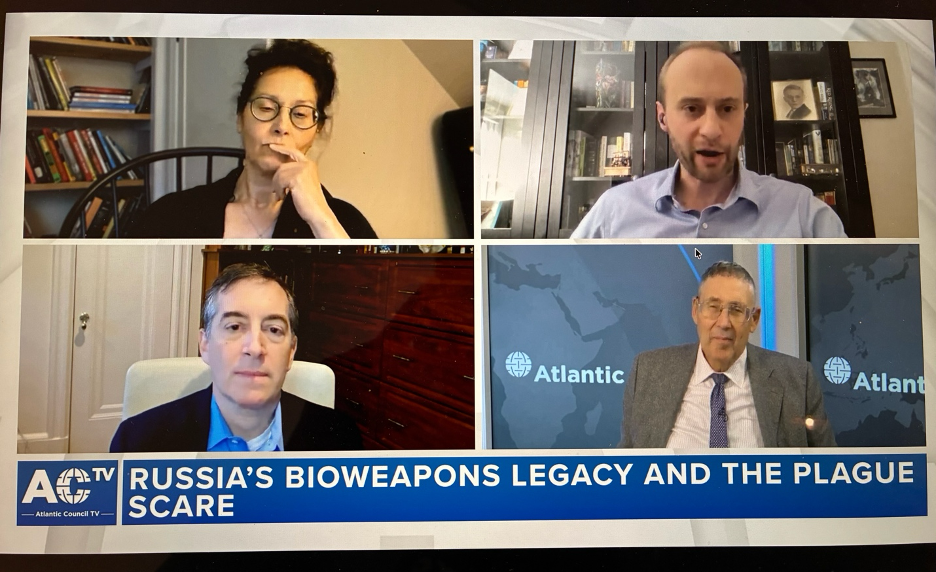
On Monday, October 19, the Atlantic Council’s Eurasia Center and Bipartisan Commission on Biodefense hosted the virtual event “Russia’s Bioweapons Legacy and the Plague Scare.” The panel examined the death of a laboratory technician at the Irkutsk Anti-Plague Research Institute of Siberia and the Far East, against the backdrop of Russia’s offensive biological weapons program. Russian authorities attributed her death to pneumonia of unknown origin. Even so, nearly 200 people were placed under medical observation. (For earlier Pandora Report coverage, see Russia’s Plague Lab Mystery.)
The discussion was moderated by John Herbst, Senior Director of the Eurasia Center at the Atlantic Council and former US Ambassador to Ukraine and Uzbekistan. The featured experts were Dr. Gregory D. Koblentz, Associate Professor and Director of the Biodefense Graduate Program at George Mason University’s Schar School of Policy and Government; Dr. Sonia Ben Ouagrham-Gormley, Associate Professor and Deputy Director of the Biodefense Graduate Program at George Mason; and Dr. Kevin Esvelt, Associate Professor at the MIT Media Lab and Director of the Sculpting Evolution Group. A full recording of the event is available on YouTube.
Koblentz opened the event by noting that while Moscow rejected any connection to plague and had early online mentions of the disease taken down, authorities isolated nearly 200 contacts and tested them repeatedly before formally telling the World Health Organization (WHO) that the woman had died of pneumonia of undetermined etiology. The central questions, he said, remain unanswered. If plague killed her, what laboratory mishap caused the exposure? If it was ordinary pneumonia, what justified such an aggressive and sweeping response? And was the secrecy merely a reflection of a police state under Putin, or an indication of something more troubling?
Ben Ouagrham-Gormley, who has studied anti-plague facilities in several post-Soviet states, traced the laboratory network to the Tsarist era, when it was created to counter endemic and imported cases of plague, tularemia, cholera, and hemorrhagic fevers. Though built for public health, its expertise drew it into Soviet biodefense projects, giving the institutes a genuine dual-use role as they developed diagnostics, vaccines, and countermeasures to protect soldiers and civilians. She warned that this past reveals little about the institutes today: after the Soviet collapse, their budgets shrank, and their workforce fell by as much as 80 percent. Buildings and equipment deteriorated, and most attempts at commercialization failed. Judging any institute’s current capabilities requires knowing which skills survived and whether Moscow is investing enough for it to recover.
Esvelt argued that the goal should be reducing overall public risk, which means rebuilding the trust eroded during COVID-19 by sharing information promptly. He noted that the majority of laboratory accidents do not pose an epidemic risk to the public, because most pathogens that are researched are not easily transmissible from human to human. However, because a young, healthy adult so rarely dies of pneumonia, he concluded that an infection contracted in the lab is the likeliest cause, and that Russia should have disclosed the pathogen and the safeguards it was putting in place.
Koblentz urged the audience to distinguish the Irkutsk case from Russia’s weapons program. Russia inherited the world’s largest biological weapons enterprise in 1991, keeping three military-run biological weapon facilities. Moscow started upgrading these facilities roughly ten years ago and began constructing a second BSL-4 laboratory about two years ago, none of which it has declared under the Biological Weapons Convention (BWC). He said it is these activities that warrant greater attention from the current administration and NATO.
Ben Ouagrham-Gormley added that, unlike the nuclear field, biology often has no clear line distinguishing beneficial research from weapons development, and that the BWC requires the adoption of a means of verification to shed light on Russian activities.
Esvelt noted that current sequencing technology means that Moscow is all but certain to know the lab tech’s cause of death, forcing outside observers to deduce it from Russia’s actions, which he judged did not match a routine plague case. In the United States, plague is easily treated with antibiotics for patients and their contacts. Lab staff are generally immunized, and labs know their strains’ antibiotic resistance profile. Given Russia’s silence, he cautioned, a weapons-related explanation, including an engineered strain, cannot be ruled out.
Koblentz offered a more likely explanation. Vaccine protection can be incomplete, and often laboratory staff do not realize they have been exposed by a breach in biosafety. since it is currently flu season in Siberia, the technician may have mistaken early symptoms for influenza, reaching the hospital only after the disease had outpaced antibiotics, which sanctions have made scarcer in Russia. The heavy-handed public health response, he contended, looks more like a police state responding to an embarrassment than evidence of something more sinister. Koblentz advised tempered analysis rooted in facts, plausible explanations and cautioned against speculation.
Ben Ouagrham-Gormley furthered the Russian contextualization of the scenario, noting that both the disease’s evolution and the government’s response are consistent with plague. She urged that judgments be grounded in existing evidence before turning to worst-case scenarios.
During the Q&A, Esvelt cautioned that currently biodefense lag behind what modern biotechnology makes possible. Ben Ouagrham-Gormley countered that strengthening the BWC and norms against biological weapons is a more constructive, positive route to address such events. Koblentz assessed Western preparedness as being insufficient and added that stronger BWC norms, while desirable, may be unrealistic under Putin. He continued that the West must therefore pair defense with deterrence, anchored in the ability to attribute outbreaks to their source, which requires investing in the kind of pathogen analysis that Esvelt conducts. He closed by arguing that the most effective step Washington could take to prompt Russian reporting to the WHO would be for the United States to rejoin to the organization.
Further Reading:
- “Putin, Plague, and America’s Biodefense Gap,” Ryan Kane, RealClearDefense
- “Washington Reportedly Limits Funding to Key WMD Verification Agencies,” Andrea Stricker, Foundation for Defense of Democracies (FDD)
- “SA and Kazakhstan reveal sharply contrasting paths to biological weapons dismantlement,” Andrea Uhlig, Wilmot James and Brendan Beng, Daily Maverick
Avian Flu Caused Death of Beloved Eagle
By Margeaux Malone, Pandora Report Associate Editor
Necropsy results released October 14 by the California Department of Fish and Wildlife showed that highly pathogenic avian influenza (HPAI) was the primary cause of death for Jackie, a beloved bald eagle watched by livestream viewers online for more than a decade. Jackie and her mate, Shadow, occupied a nest in Big Bear Valley, California, for years. A nest camera installed in 2015 by the nonprofit Friends of Big Bear Valley let viewers worldwide follow the pair as they raised eaglets. Jackie, about 14, died in August after weeks of treatment at the Ojai Raptor Center in California.
Her care team was surprised by the diagnosis, as the presentation of her illness was atypical for HPAI. The virus caused a severe stomach ulcer, an unusual complication that led to internal bleeding, anemia, and bacterial sepsis. Pathologists at San Diego Zoo Wildlife Alliance found chronic disease in the ventriculus, the muscular part of a bird’s stomach, along with inflammation and blood clots in her heart and major blood vessels. Brodifacoum, a common anticoagulant rodenticide was identified on a toxicology screen of her liver, but necropsy findings suggested it did not cause her illness and death. West Nile virus and heavy metals, including lead, were also ruled out. The USDA’s National Veterinary Services Laboratories confirmed the infection, and Jackie’s remains were cremated to prevent further spread. Fortunately, Shadow, who remains in Big Bear, and the pair’s final eaglets together have shown no signs of illness. Eagles and other raptors are often exposed to HPAI through contact with infected birds or by consuming infected prey.
First Washington Dairy Cattle Cases Bring Human Infection
Last week’s Pandora Report reported that Washington state confirmed its first cases of HPAI in dairy cattle in early October. Since then, additional cases have been detected, bringing the state’s total number of new confirmed cases to 8 in the last 30 days. Now, a dairy worker has tested positive as well, the first human case of H5N1 in the United States this year.
The worker has mild illness and is isolating at home. Health officials are contacting close contacts, offering testing, and supplying protective equipment to affected farms. Public risk still remains low, and human-to-human transmission has never been documented in the US. Pasteurized milk and dairy products remain safe, though raw milk should be avoided. Officials recommend seasonal flu vaccination for people with animal exposure. The last confirmed human case of H5N1 in the US was in February 2025, though Washington detected the first ever human case of H5N5 globally last November.
Further Reading:
- “Bird flu detected on Macquarie Island in southern elephant seal and gull samples,” Australian Broadcasting Corporation
- “New JRC laboratory method strengthens Europe’s early‑warning system for bird flu,” Joint Research Centre
- “Bird Flu on Utah Mink Farm Raises Biosecurity Questions,” Niel M. Vora, Think Global Health
GMU Biodefense Alum Calls for Modernizing U.S. Pandemic Preparedness
In a new commentary for the Center for Strategic and International Studies (CSIS), Sophia Hirshfield, a George Mason University Biodefense MS alumna and CSIS Associate Fellow, coauthors an analysis with Paul Friedrichs, Senior Fellow at RAND, marking the 25th anniversary of the 2001 anthrax attacks. The authors argue that the United States remains insufficiently prepared for evolving biological threats and urge Congress to reauthorize and modernize the Pandemic and All-Hazards Preparedness Act (PAHPA). Their recommendations include strengthening biosurveillance, clarifying federal agency responsibilities during biological emergencies, improving oversight of AI-enabled biological risks, and investing in medical countermeasures and public health preparedness.
IN OTHER NEWS
U.S. Public Health Policy, Research Funding, and Vaccines
- “The State of Global Health Funding: October 2026,” Angela Apeagyei (Micah), Hans Elliott, Drew DeJarnatt, Carolyn Shyong, Katherine Leach-Kemon, Joseph L. Dieleman, Think Global Health
- “Kennedy Pledged to Advance Anti-Vaccine Group’s Agenda. Here’s What He Is Doing.” Christina Jewett, NY Times
- “A Lab-Leak Story You Haven’t Heard,” Tom Bartlett, The Atlantic
- “McDonald’s, Subway and Taco Bell Fail to Meet Antibiotic Reduction Commitments,” Natasha Gilbert, Sentient
- “NIH sees 7,400 fewer grants during fiscal year 2026 than in previous year,” Stephanie Soucheray, CIDRAP
- “Meet the researchers leaving the US because of Trump’s funding cuts and politicization of science,” Adithi Ramakrishnan, AP News
- “CDC lags in hiring behind other health agencies after DOGE cuts, union says,” Arthur Jones II, Rachel Scott, Ely Brown, and Mark Nichols, ABC News
Ebola Outbreaks and Global Health Preparedness
- “Nigeria’s first ebola case in a decade spurs appeal for help,” Janice Kew and Nduka Orjinmo, Bloomberg
- “Nigeria confirms Ebola case in Abuja as woman who arrived from Uganda tests positive,” Ope Adetayo, AP News
- “Ebola: Kenya cases rise to 8, spreads to 8th Congo province,” Kieran Burke, DW
- “Kenya’s Ebola cases hit 8, with no community transmission yet,” Evelyne Musambi, AP News
- “WHO scales up Ebola readiness in 22 countries across three continents,” United Nations
- “Ebola cases in Kenya highlight US failures amid Trump cuts to key services,” Melody Schreiber, The Guardian
AI, Biotechnology, and Biosecurity
- “AI capabilities mean America needs a Manhattan Project for biodefense,” César de la Fuente, Washington Post
- “Managing Biological Risks from General-Purpose AI Models under the EU AI Act,” GovAI
- “An update on independent evaluators,” Anthropic
- “Response to Anthropic’s update on independent evaluators,” SecureBio
- “Bio-Responsibility Initiative,” LinkedIn

NEW: Hiding in Plain Sight: Mpox and the Cost of Neglecting Known Threats
Friday, October 30 | 9:00 – 10:15 am ET
From the Independent Panel: “For decades, mpox caused sporadic outbreaks in parts of West and Central Africa, but the disease was largely neglected by the international community. That neglect later produced not one, but two international emergencies. Today the virus has spread worldwide, with multiple variants now established in the human population. Through research and conversations with those working on mpox, the report seeks to answer how this happened and, more importantly, what it will take to prevent the same failures in future.”
Biosecurity & Pandemic Preparedness: Why We Need a Stronger Health Emergency Workforce
Friday, October 23 | 11:00 am ET
From the Pandemic Center Biosecurity Game Changer Fellows: “The current Ebola outbreak and other recent health emergencies have highlighted the critical role of a well-prepared health emergency workforce in preventing and responding to biological threats. This seminar will explore approaches to strengthening health emergency workforces, including workforce capacity, surge preparedness, coordination, and leadership, while drawing on practical lessons to support preparedness and response.”
Biomanufacturing for Defense & Security Summit
October 27-28 at the National Harbor, MD
From Diversified Solutions Incorporated (DSI Groups): “This event will bring together senior thought leaders and stakeholders from across DoW, Military Research Labs, Federal Government, Commercial Industry, & Academia to discuss how each are advancing biomanufacturing to enhance national security objectives, produce critical materials for defense applications, and strengthen the overall U.S. bioindustrial manufacturing base. Biomanufacturing is crucial for U.S. national security because it enables domestic production of critical materials, medicines, and defense supplies, reducing reliance on foreign adversaries, which in turn creates resilient supply chains for the military and economy.”
Milbank Quarterly Webinar – State Policy Levers for Infectious Disease Control
Thursday, October 29 | 1:00 – 2:00 pm ET
From Milbank Memorial Fund: “Major infectious disease outbreaks in 2026, including a multi-state measles surge, the iceberg lettuce-linked cyclosporiasis outbreak, and the hantavirus outbreak, underscore the importance of infectious disease control infrastructure. Join us for a Milbank Quarterly webinar with the authors of two articles about state infectious disease policy from our special issue, Disease Burden, Mortality, and Life Expectancy in the United States: What Can State Policymakers Do to Meet the Challenges?”
Frontiers in Synthetic Biology: SpudCells, Mirror Life and Societal Implications
Thursday, October 29, 3:00 PM ET
From the Consortium on Law and Values: “Advances in cell engineering and synthetic biology offer enormous potential benefits, while raising ethical and policy issues. SpudCell, the first synthetic cell that can grow and reproduce, built from non-living chemicals, was developed by a team at the University of Minnesota. Scientists have cautioned against creating organisms with molecules that are mirror images of the biological components of known life, as existing organisms would have no immune defenses. Join three experts on synthetic biology, biosecurity, and bioethics to explore how to realize the promise of synthetic biology while controlling potential risks.”
Understanding Zoonotic Disease Risk in Violent and Conflict-Affected Places: Where Do We Go from Here? – A Talk
Friday, October 30 | 11:00 am – 12:00 pm ET
From Johns Hopkins: “The next pandemic will likely be caused by a zoonotic pathogen and will likely emerge in a place affected by conflict and violence. As such, disease spillover and spread will likely be affected by informal and extralegal economies, population displacement, distrust between people and governmental authorities, and failing health and disease surveillance systems. This talk will discuss findings and lessons learned from collaborative, interdisciplinary research on zoonotic disease risk among pastoralists in eastern Ethiopia and gather feedback on remaining questions and potential next steps.”
AI, Biosecurity, and Pandemic Preparedness in the Global South
Monday, November 2, from 8:00-9:30 AM ET
Medical Events Global is hosting a free 90-minute virtual workshop examining how artificial intelligence and emerging technologies are reshaping biological risk and what preparedness requires in the Global South. The panel will explore where biological risks are concentrated, the capabilities of AI-enabled biological design, operational preparedness, and approaches to governance. Confirmed speakers include Alex Kyabarongo, BIOD MS student at George Mason University, along with Rahul Nagvekar of Stanford University’s Department of Genetics and Adam Abdullahi of the Institute of Human Virology Nigeria and Harvard T.H. Chan School of Public Health.
After NSCEB: What Comes Next for U.S. Biotech Policy
Tuesday, November 17 | 2:00 – 6:00 pm ET
From the National Security Commission on Emerging Biotechnology (NSCEB): “The Commission’s authority ends December 31. What it built is the beginning. Carrying it forward takes Congress, industry and capital. In April 2025, the Commission called for $15 billion over five years to secure American leadership in biotechnology. Join Commission leadership, members of Congress, founders and investors for an afternoon on who carries that work into 2027.”