Pandora Report 2.9.2024

Happy Lunar New Year from the Pandora Report! This week’s edition includes this year’s batch of CBRN and global health security-themed Valentine’s Day cards, coverage of theopening of the CDC’s new regional center in Tokyo, Japan, and new publications.

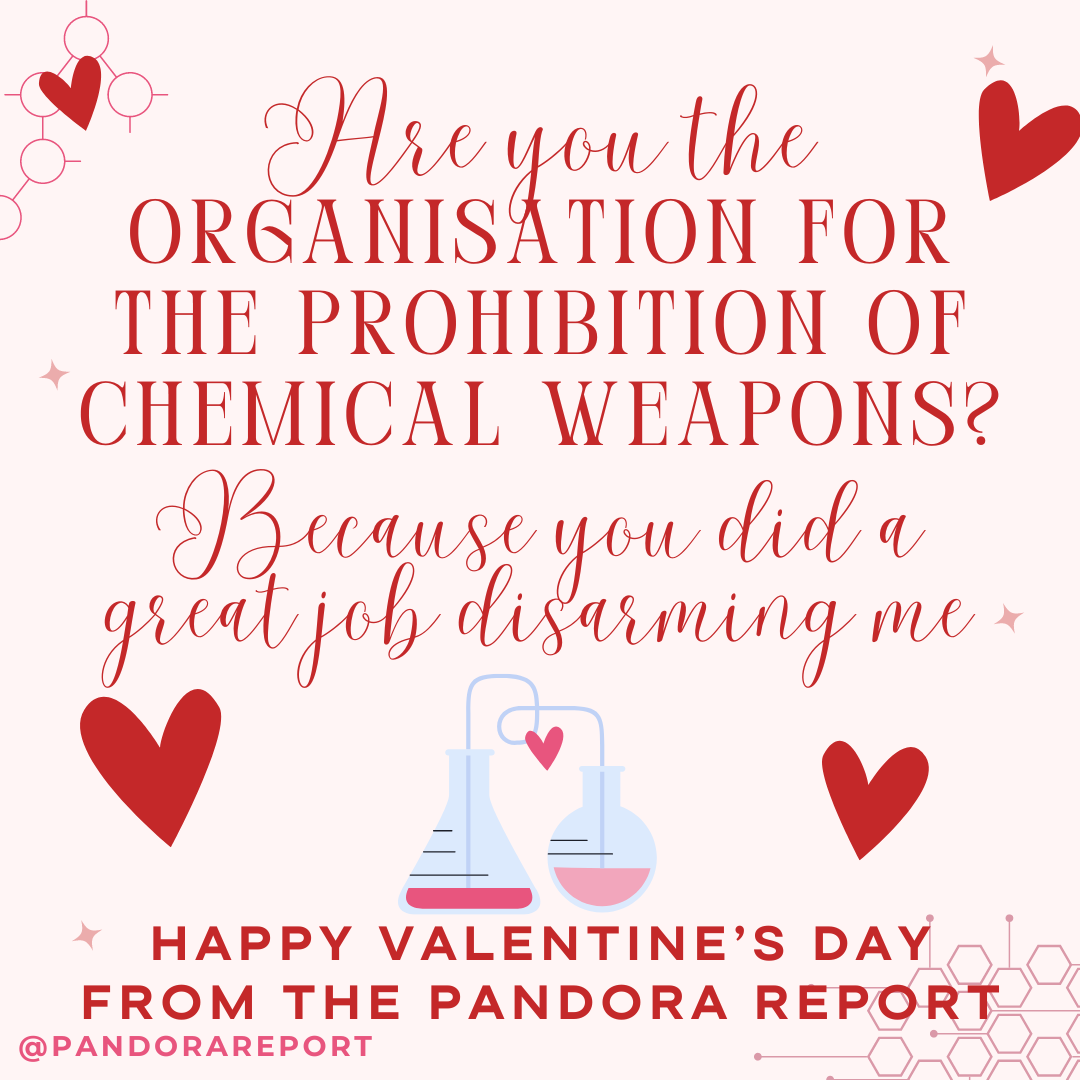
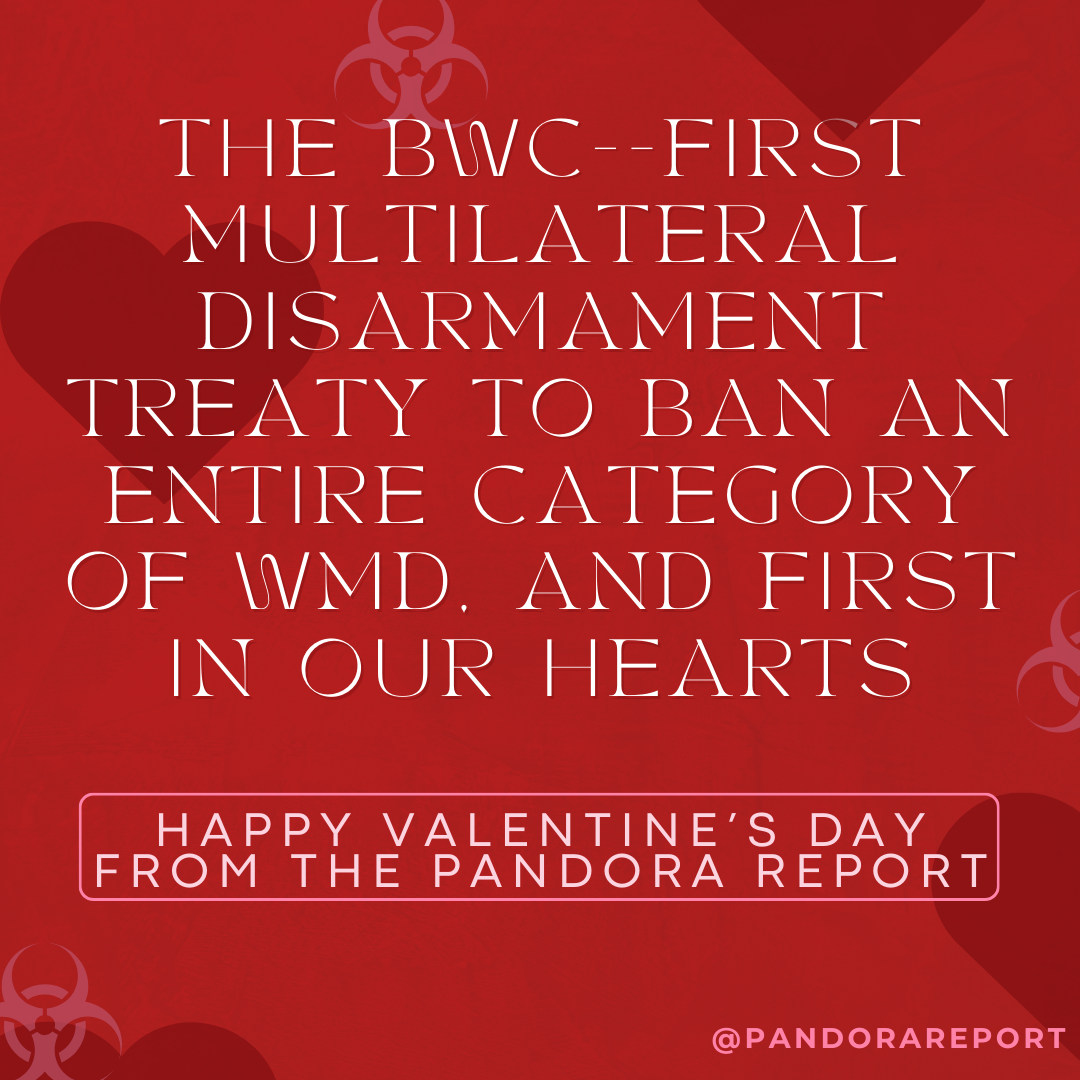
Pandora Report Valentine’s Day Cards 2024

It’s that time of year again! Download and share the Valentine’s Day cards below with friends and that special someone!

CDC Opens New East Asia and Pacific Regional Office

This week, the US Centers for Disease Control and Prevention opened its new CDC East Asia and Pacific (EAP) regional office in Tokyo, Japan. In a statement, CDC Director Mandy Cohen said “America’s safety and security is dependent on the strong linkages between countries around the world…CDC’s East Asia and Pacific regional office will address health security – globally and in the region – by focusing on cooperation in advanced threat detection, laboratory networks, response capacities, and other platforms and systems for rapid response to ongoing and emerging public health threats.”

CDC says that priorities for the office include “Expanding CDC’s core global health security capacity by building stronger collaboration and partnerships in the East Asia and Pacific region,” “The ability to detect public health threats and respond quickly, and,” “Knowledge and information exchange between CDC and the region.”

In its statement, the organization explained that “Through this office, CDC will focus on identification, response, and mitigation of health threats in international settings to rapidly respond to outbreaks at their source and prevent spread to and within the U.S. Expanding government and nongovernment partnerships will help CDC build the trust and transparency needed for the rapid exchange of data, and it will also strengthen core global health security capacities. Partnering to train a global workforce to prevent, detect, and respond, and sharing scientific expertise will strengthen programs and people to prevent emerging threats.”

J. Stephen Morrison and Mitchell Wolfe recently authored a commentary piece for CSIS discussing the new office, writing in part “CDC’s new East Asia and Pacific office will unquestionably advance U.S. national interests. It will strengthen preparedness against future dangerous outbreaks and improve the health status of the region’s citizens while contributing to U.S. foreign policy and geopolitical goals. It will accomplish those goals principally through enlarged health diplomacy, new partnerships, and deepened alliances backed by CDC’s wide technical expertise.”

“MATCH ‘2.0’” and “Automating Strategic Chemical Trade Control Enforcement”

The Stimson Center recently released its MATCH ‘2.0’ Proof-of-concept and a video covering challenges customs officers face in identifying proliferation-controlled chemicals. The Center explains that “The Monitoring and Tracking Chemicals (MATCH) proof-of-concept is a prototype software system that demonstrates how distributed ledger technology (DLT) can make the process of regulatory compliance more efficient for the global chemical industry and support national authorities in identifying and reconciling discrepancies in declared transfers of commonly traded dual-use chemicals. These “dual-use” chemicals have both peaceful commercial and industrial uses but are also precursors to chemical weapons and subject to export controls and reporting requirements under the Chemical Weapons Convention.”

“The MATCH platform supports a fictional ecosystem of chemical industry participants, national authorities, and a “World Authority.” Industry participants report quantities of transferred dual-use chemicals to their respective national authorities. National authorities aggregate these reported quantities of chemical trade for their subsequent annual declaration to an international regulator referred to as the “World Authority.” In MATCH’s fictional ecosystem, the World Authority loosely represents the real-world Organisation for the Prohibition of Chemical Weapons (OPCW).”

Biodefense Graduate Program Director Gregory Koblentz serves as a consultant on this project.

“Attributing Biological Weapons Use Strengthening Department of Defense Capabilities to Investigate Deliberate Biological Incidents”

From the RAND Corporation: “The White House has given the U.S. Department of Defense (DoD) a lead role in U.S. efforts to strengthen the United Nations Secretary-General’s Mechanism for Investigation of Alleged Use of Chemical and Biological Weapons (UNSGM). In 2022, a White House report highlighted the importance of determining the facts related to the attribution of alleged use of biological weapons (BW), including toxin weapons. That 2022 report aimed to outline the U.S. government’s approach to counter the full range of possibly catastrophic biological incidents, whether natural, accidental, or deliberate, and outlines goals and objectives for strengthening the biodefense enterprise. It also identifies priorities and target areas for each mission objective during a biological incident.”

“In this report, the authors examine issues related to the attribution of BW use and identify areas in which DoD could enhance its capabilities to (1) support U.S. investigative capabilities into alleged uses of biological and toxin weapons and (2) strengthen international efforts, specifically United Nations mechanisms, to hold state and nonstate actors accountable for BW use.”

This report was co-authored by Biodefense MS alumna Annette Prieto.

“Doomsday or Business as Usual? Artificial Intelligence, Machine Learning, and CBRN Threats”

Dan Kaszeta recently published this article in European Security & Defence: “Chemical, biological, radiological, and nuclear (CBRN) threats are potential sources of disaster in modern life. Enemies might be able to use them for some sort of advantage, terrorists could use them for havoc, and accidents could cause disruption, property loss, and death. The same could be said of the broad field of artificial intelligence and machine learning. This expanding field has intersected that of CBRN in both practical and theoretical ways. There are areas for concern. But how concerned should we really be? And is often the case, concern can also bring opportunity. As this new aspect of modern life will be with us from now on, it is worth examining some of the more prominent ways in which AI and machine learning may penetrate in CBRN defence and security.”

“WHO Benchmarks for Strengthening Health Emergency Capacities”

The WHO recently published this report: “Benchmarking is a strategic process often used by businesses and institutes to standardize performance in relation to the best practices of their sector. The World Health Organization (WHO) and partners have developed a tool with a list of benchmarks and corresponding suggested actions that can be applied to implement the International Health Regulations 2005 (IHR) and strengthen health emergency prevention, preparedness, response and resilience capacities.”

“The first edition of the benchmarks was published in 2019 to support countries in developing, implementing and documenting progress of national IHR or health security plans (e.g. national action plan for health security (NAPHS), national action plan for emerging infectious diseases, public health emergencies and health security and other country level plans for health emergencies). The tool has been updated to incorporate lessons from COVID-19 and other health emergencies, to align with the updated IHR monitoring & evaluation framework (IHR MEF) tools and the health systems for health security framework, and to support strengthening health emergency prevention, preparedness, response and resilience (HEPR) capacities and the Preparedness and Resilience for Emerging Threats (PRET) initiative.”

“The benchmarks support implementation of IHR and HEPR capacities and are broad in nature to improve health security and integrate multisectoral actions at national and subnational levels, where appropriate. The benchmark actions are designed to provide guidance for capacity development to move up capacity levels as measured by the IHR MEF, including voluntary external evaluation such as the Joint External Evaluation (JEE) tool and the States Parties Self-assessment annual reporting tool (SPAR). Other assessment tools including the Performance of Veterinary Services (PVS) Pathway (from the World Organisation for Animal Health (WOAH)), the Dynamic Preparedness Metric (DPM), Universal Health and Preparedness Review (UHPR) and readiness assessments can also measure improvements in capacity, with the ultimate goal to sustain an optimal level of prevention, preparedness, response and resilience for health emergencies in the country.”

“The Origin and Implications of the COVID-19 Pandemic: An Expert Survey”

From the Global Catastrophic Risk Institute: “Exactly how the COVID-19 pandemic began remains a topic of considerable scientific and political debate. However, the opinions expressed in the debate have thus far come from an ad hoc mix of experts and commentators who have spoken up. Therefore, a research team led by the Global Catastrophic Risk Institute (GCRI) and Nemesys Insights conducted a rigorous survey of global expert opinion. The anonymous survey included 168 virologists, infectious disease epidemiologists, and other scientists from 47 countries in a geographic sample of both developed and developing countries. This is the first-ever systematic study of expert opinion on the origin of COVID-19.”

“While expert opinion does not necessarily match the underlying truth, carefully obtained expert opinion can indicate the current state-of-the-art thinking on a topic and the extent of consensus across experts. The survey results correspond to the beliefs expressed by the 168 experts who participated in the study.”

“The survey is summarized in a main report and detailed in a methodological and analytical annex.”

“Harassment in Public Health is Real. Here’s How to Respond.”

Samuel R. Mendez recently authored this piece for Harvard Public Health in which they explain in part, “We don’t have specific data on how common such incidents are today, which reveals the lack of a systematic response within U.S. public health. However, we can be sure that this problem won’t go away on its own. A study led by Johns Hopkins researchers found that in 2021, a quarter of Americans believed it was OK to threaten a public health official. And, in the third year of the pandemic, children’s hospitals across the country endured a sharp jump in online harassment, with Boston Children’s Hospital facing bomb threats. Though anyone in public health might experience harassment, we can’t ignore racism, transphobia, and gender-based discrimination in a field with a workforce that is 79 percent women and 46 percent BIPOC and includes an increasing number of people who identify outside the gender binary.”

“WHO Reports Outline Responses to Cyber-Attacks on Health Care and the Rise of Disinformation in Public Health Emergencies”

The WHO recently released this piece summarizing its recent reports that aim to identify ways to “strengthen health security through operational solutions.” The piece explains, “The first report, Examining the threat of cyber-attack on health care during the COVID-19 pandemic highlights the far-reaching real-life impacts of cyber-attacks on health care. During the COVID-19 pandemic, health information technology (IT) infrastructure was increasingly targeted by cyber-attacks, at times hindering hospitals from delivering timely care when it was needed most. To restore IT systems and retrieve stolen data, health care facilities paid substantial ransoms. These attacks prompted law enforcement agencies to issue warnings about the threat of cyber-attacks to the health sector.”

And later “The second report, Understanding disinformation in the context of public health emergencies: the case of COVID-19, reflects on different approaches to counter disinformation.  Disinformation, unlike misinformation, is created with malicious intent to sow discord, disharmony, and mistrust in targets such as government agencies, scientific experts, public health agencies, private sector, and law enforcement. In other words, disinformation is a weaponization of information.”

“Countering Disinformation Effectively: An Evidence-Based Policy Guide”

Jon Bateman and Dean Jackson recently published this policy guide with the Carnegie Endowment for International Peace: “Disinformation is widely seen as a pressing challenge for democracies worldwide. Many policymakers are grasping for quick, effective ways to dissuade people from adopting and spreading false beliefs that degrade democratic discourse and can inspire violent or dangerous actions. Yet disinformation has proven difficult to define, understand, and measure, let alone address.”

“Even when leaders know what they want to achieve in countering disinformation, they struggle to make an impact and often don’t realize how little is known about the effectiveness of policies commonly recommended by experts. Policymakers also sometimes fixate on a few pieces of the disinformation puzzle—including novel technologies like social media and artificial intelligence (AI)—without considering the full range of possible responses in realms such as education, journalism, and political institutions.”

“This report offers a high-level, evidence-informed guide to some of the major proposals for how democratic governments, platforms, and others can counter disinformation. It distills core insights from empirical research and real-world data on ten diverse kinds of policy interventions, including fact-checking, foreign sanctions, algorithmic adjustments, and counter-messaging campaigns. For each case study, we aim to give policymakers an informed sense of the prospects for success—bridging the gap between the mostly meager scientific understanding and the perceived need to act. This means answering three core questions: How much is known about an intervention? How effective does the intervention seem, given current knowledge? And how easy is it to implement at scale?”

“Biotech is the New Focus in U.S.-China Tech Rivalry”

Allison Snyder recently authored this piece providing an overview of Congress’ efforts to hamper Chinese biotech companies’ operations in the US (which we covered previously here). Snyder provides insight into the consequences this may have in other countries and in the US government research world, writing in part “Moving too fast to lock out Chinese biotech tools risks disrupting U.S. research efforts and bioproduction because BGI and its affiliates are so deeply embedded in NIH-funded clinical trials and approved therapies, TD Cowen analysts wrote in a research note this week.”

“US Industry Leaders Repeat Calls to Reinstate Security Programme”

Rebecca Trager recently published this piece in Chemistry World covering the expiration of the CFATS program. She explains in part, “Over the lifespan of CFATS, the CISA had identified more than 10 individuals with possible ties to terrorism, and given that rate of vetting Murray said CISA likely would have identified at least one individual as a known or suspected terrorist in the last six months. Murray also pointed to good data showing that CFATS made a difference in getting chemical facilities better prepared to handle security incidents, with plants introducing multiple security measures as part of the approval process.”

“Global Terrorism Threat Assessment 2024”

CSIS’s Transnational Threats Project recently published this report and a corresponding spoken-word summary: “Terrorism is no longer the leading international threat to the United States or its top defense priority, but challenges related to violent extremism remain. The threat from Salafi-jihadist groups such as al Qaeda and the Islamic State has declined, and ethnonationalist threats are largely contained. However, a broader patchwork of violent far-right and far-left extremist ideologies has become more prominent on the global stage. Meanwhile, terrorism continues to overlap in significant ways with strategic competition, especially via Iran’s support to terrorist groups like Hamas and Hezbollah.”

What We’re Listening To 🎧

The BWC Global Forum: Biotech, Biosecurity & Beyond Episode 11-Gene Synthesis Screening

From Johns Hopkins Center for Health Security: “In this episode, we discuss the role of international screening efforts in protecting against the misuse of synthetically manufactured genetic materials. Rapid expansion in the capacity, affordability, and accessibility of gene synthesis—the ability to assemble genetic sequences from scratch—enables anyone with an internet connection to order custom genomes from vendors around the world. In the absence of consistent national or global regulatory frameworks, the responsibility falls on gene synthesis companies and researchers themselves to ensure that these services are not being misused to produce dangerous pathogens or their components. The International Gene Synthesis Consortium (IGSC) is an industry organization that supports the development and implementation of screening protocols for gene synthesis orders and customers to mitigate the risk of this misuse, in order to facilitate the broadest use of these technologies for peaceful purposes.”

EBRC In Translation

EBRC In Translation is a podcast working to bring you conversations with leaders in the world of Engineering Biology. The show is the official podcast of the Engineering Biology Research Consortium Student and Postdoc Association and is hosted by a rotating cast of graduate students and postdocs…”

NEW: Artificial Intelligence and Automated Laboratories for Biotechnology: Leveraging Opportunities and Mitigating Risks

From the National Academies’ Board on Life Sciences: “Please join us April 3-4, 2024 for a hybrid workshop on the opportunities and mitigation of risks of the use of artificial intelligence and automated laboratories (i.e., self-driving labs) for biotechnology.”

“The workshop will consider opportunities to leverage AI and laboratory automation capabilities for discovery and development, explore methods and approaches to identify, track, and forecast the domestic and international development of such technologies, and convene experts across sectors to highlight recent advances and explore implications for the development and use of these technologies.”

Learn more and register here.

Introducing IBBIS: Safeguarding Bioscience and Biotechnology for a Safer Future

“The Nuclear Threat Initiative (NTI) is launching the International Biosecurity and Biosafety Initiative for Science (IBBIS) during an official side event at the 2024 Munich Security Conference. IBBIS is a new, independent organization based in Geneva that will work with global partners to strengthen biosecurity norms and develop innovative tools to uphold them. IBBIS will help reduce the risk of catastrophic events that could result from deliberate abuse or accidental misuse of bioscience and biotechnology so they can flourish, safely and responsibly.”

“NTI Co-Chair and CEO Ernest J. Moniz will moderate a senior-level panel discussion featuring: Weiwen Zhang, director, Center for Biosafety Research and Strategy, Tianjin University; James Diggans, head of biosecurity, Twist Bioscience; Luciana Borio, venture partner, ARCH Venture Partners and senior fellow for global health, Council on Foreign Relations; and Piers Millett, executive director, IBBIS. Amandeep Gill, UN Secretary General’s Envoy on Technology, will provide recorded remarks.”

This in-person event will take place at Literaturhaus München on Thursday, February 15. Learn more and RSVP here.

Enhancing the Global Food System’s Resilience to Biological Threats

“This virtual event, hosted by the Scowcroft Institute of International Affairs at Texas A&M, will take place on February 20, 1:00-2:30 PM [EST].”

“A year after the Biden Administration’s National Security Memorandum on Strengthening the Security and Resilience of United States Food and Agriculture (NSM-16), Scowcroft is convening stakeholders from across industry, academia, and government to identify the policies and technologies needed to safeguard the world’s food system against biological threats. Planned topics include microbial food production, AI-enabled crop disease surveillance, and genomic engineering to improve plant disease resistance, among others.”

“For more details, find a draft agenda here

Speakers include:

  • David Stiefel, National Security Policy Analyst, National Security Division, USDA and former Director for Biodefense on the National Security Council
  • Nils Justen, Policy Analyst, National Security Commission on Emerging Biotechnology (NSCEB)
  • Shannon Nangle, CEO and Co-Founder, Circe Biosciences 
  • Seth Murray, Professor Butler Chair, Soil and Crop Sciences, Texas A&M University
  • Yiping Qi, Professor, Plant Sciences and Landscaping, University of Maryland”

Register here.

The Advancing Threat Agnostic Biodefense Webinar Series

From PNNL: “Join us as we welcome Dr. Tony Goldberg, professor in the School of Veterinary Medicine at the University of Wisconsin-Madison. His talk, titled “Assessing the Zoonotic Risk of Pre-emergent Viruses” will be Tuesday, February 20, at noon PT.

“Exploration of the “virosphere” is in its golden age. The sheer number of new viruses discovered daily, and the fact that most cannot be cultured, creates enormous uncertainty about where to allocate attention and resources. It is not an intractable problem, however, to distinguish those few viruses that are likely to emerge as zoonoses from the many others that are not. This talk describes two diametric approaches to addressing this problem.”

Learn more and register here.

Presidential Advisory Council on Combating Antibiotic-Resistant Bacteria Public Meeting

“The 24th PACCARB public meeting will be held virtually on February 22, 2024. This will be the second of two meetings to address the task provided to the PACCARB by the Secretary of HHS to address antimicrobial resistance globally. The focus of the meeting will be on international implementers and the gaps, challenges, and opportunities they see to combat AMR globally – specifically focusing on low- and middle-income countries. Current times are tentative and subject to change.”

This event will take place on February 22, at 9 am. Submit public comments and register to attend here.

GP Nonproliferation and Strategic Trade Hub Virtual Launch & Demo  

“The Strategic Trade Research Institute (STRI) invites you to participate in the Global Partnership Nonproliferation and Strategic Trade Hub Virtual Launch and Demo event taking place on February 27, 2024, from 9:00-10:00 am EST.”

“Please join us to learn about the main features of the Hub, how to use it, and how it can be useful and impactful for nonproliferation and export control professionals. The event will feature Andrea Viski, Director of STRI, as well as introductory remarks from the Hub’s sponsor, the United Kingdom’s Counter-proliferation and Arms Control Center (CPACC).”

Learn more and register here.

International Conference, CBRNE Research & Innovation

“The last 40 years have demonstrated that both military and civilian populations could be exposed to highly hazardous CBRNE agents following conflicts, natural outbreaks and disasters, industrial incidents or terrorist attacks.”

“Worldwide, researchers, responders and industrial capacities have been commited to provide adapted response to these challenges.”

“Building on the success of the first 5 International Conferences « CBRNE Research and Innovation » which took place in Antibes (2015), Lyon (2017), Nantes (2019), on line (2021) and Lille (2022), we want to give you a new opportunity to build up or strengthen collaborative networks in Strabourg (March 19th – 21rst 2024).”

“The CBRNE R&I Conference is specifically devoted to scientific updates, responders’ feedbacks and expression of needs. It also includes workshops and demonstrations of innovative materials, technologies and procedures, according to the following themes: DETECTION – IDENTIFICATION, PROTECTION – DECONTAMINATION, MEDICAL COUNTERMEASURES, RISKS & CRISIS MANAGEMENT.”

“Looking forward to your proposals for communication and to welcoming you at Strasbourg in March 2024!”

Learn more here.

Registration for GHS 2024 Now Open

Registration is now open for the Global Health Security 2024 conference in Sydney, Australia. This iteration will take place 18-21 June, 2024. The call for abstracts is also still open. “The mission of the Global Health Security conference is to provide a forum where leaders, researchers, policy-makers, and representatives from government, international organisations, civil society, and private industry from around the world can engage with each other, review the latest research and policy innovations, and agree solutions for making the world safer and healthier. To that end, our mission is to help foster a genuinely multidisciplinary community of practice that is committed to working collaboratively to enhance global health security and eliminate disease, irrespective of its origin or source.”

SBA.3 International Synthetic Biology, and Biosecurity Conference in Africa

“Join us for the SBA.3 International Synthetic Biology and Biosecurity Conference in Africa, a groundbreaking event that brings together experts, researchers, and enthusiasts in the field of synthetic biology. This in-person conference will take place at the Laico Regency Hotel from Wed, Jul 17, 2024 to Friday, Jul 19, 2024.”

“Get ready to dive into the exciting world of synthetic biology and explore its potential applications in Africa. From cutting-edge research to innovative solutions, this conference offers a unique opportunity to learn, network, and collaborate with like-minded individuals.”

“Discover the latest advancements, trends, and challenges in synthetic biology through engaging keynote speeches, interactive workshops, and thought-provoking panel discussions. Immerse yourself in a vibrant atmosphere where ideas flow freely and new connections are made.”

“Whether you’re a seasoned professional or just starting your journey in synthetic biology, this conference provides a platform to expand your knowledge, exchange ideas, and contribute to the growth of the field in Africa.”

“Don’t miss out on this extraordinary event that promises to shape the future of synthetic biology and biosecurity in Africa. Mark your calendars and join us at the SBA.3 International Synthetic Biology and Biosecurity Conference in Africa!”

Learn more and register here.

High School and College Student Internship: Data Analytics for Elite Young Scholars – Biology and Medical Science Experience

“The Young Scholars Research Program is tailored for high-achieving high school and undergraduate students aspiring to delve into the realms of biology or medical science, with a strong focus on advanced data analytics. Participants will have the unique opportunity to collaborate with esteemed faculty members from GMU, forming interdisciplinary teams comprising 3 to 4 individuals encompassing both high school and undergraduate students.”

“At the outset of the program, students will be assigned to specific team projects based on their indicated preferences. Each team is expected to produce two significant outputs by the program’s conclusion. Firstly, a final paper showcasing their research findings will be published on the Center for Biomedical Science & Policy (CBSP) website and the Schar School Young Scholars Journals Webpage. Secondly, teams will present their projects at a conference where students have the chance to compete for prizes.”

“Throughout the program, participants will engage in hands-on research projects employing a variety of methodologies. This may include but is not limited to, biostatistics utilizing R or Stata, data visualization employing QGIS or ArcGIS, and network visualization using tools like Gephi. The comprehensive nature of the program ensures a rich and immersive experience for students passionate about advancing their understanding and skills in the fields of biology and medical science.”

Learn more here.

Agricultural Bioterrorism Protection Act of 2002; Biennial Review and Republication of the Select Agent and Toxin List

“In accordance with the Agricultural Bioterrorism Protection Act of 2002, we are proposing to amend and republish the list of select agents and toxins that have the potential to pose a severe threat to animal or plant health, or to animal or plant products. This Act requires the biennial review and republication of the list of select agents and toxins and the revision of the list as necessary. This action would implement findings from the biennial review for the list. The biennial review was initiated within 2 years of the completion of the previous biennial review. In addition, we are proposing to add definitions for several terms; codify policies regarding the role of responsible officials and alternate responsible officials, conclusion of patient care, and annual internal inspections; and revise or clarify provisions related to validated inactivation procedures and viable select agent removal methods, recordkeeping, non-possession of select agents and toxins, electronic Federal Select Agent Programs, registration, Tier 1 enhancements, and exclusion of naturally infected animals. We are also proposing to add requirements for reporting discoveries of select agents and toxins, provisions regarding effluent decontamination system, biosafety provisions for facility verification requirements for registered biosafety level 3 and animal biosafety level 3 laboratories, a new requirement related to restricted experiments, and to correct editorial errors. These proposed changes would economically benefit producers, research and reference laboratories, and State and Federal oversight agencies, while also maintaining adequate program oversight of select agents and toxins.”

Read more and submit comments here.

Pandora Report 2.2.2024

This week’s Pandora Report covers newly introduced legislation that could ban foreign biotech companies like BGI Group from doing business in the US, OpenAI’s evaluation of large language model-aided biological risks, interesting new publications, upcoming events, and multiple announcements.

BGI Group, Other Foreign Biotech Companies Targeted by New US Bills

Recently, members of the House Select Committee on the CCP and the Senate Homeland Security and Governmental Affairs Committee introduced legislation that would ban foreign adversary bioetchnology companies from doing business in the United States, including BGI Group. This follows years of warnings from the Intelligence Community that Chinese companies are amassing American genetic information, threatening national security. As we discussed in 2022, “Early in the pandemic, as the US struggled to build testing capacity and states could not run their own tests in their state labs, BGI Group (formerly known as Beijing Genomics Institute) targeted US state governments with cheap tests that promised to rapidly increase their capacity. The problem, however, was that BGI is known to have used its NIFTY test, a prenatal test used by pregnant people globally, to collect data in collaboration with the People’s Liberation Army, the military wing of the CCP.”

The Pentagon explicitly acknowledged BGI Group’s collaboration with the PLA in 2021, and five subsidiaries and affiliates of the company have since been sanctioned by the US Department of Commerce. However, according to NBC News, “The U.S. National Counterintelligence and Security Center reacted to the Reuters report by warning that “non-invasive prenatal testing kits marketed by Chinese biotech firms serve an important medical function, but they can also provide another mechanism for the People’s Republic of China and Chinese biotech companies to collect genetic and genomic data from around the globe,” the center said.”

BGI Group responded, stating in part “BGI fully embraces the bill’s premise of protecting Americans’ personal data. Unfortunately, this legislation will succeed only in driving BGI out of the US and will not accomplish its stated goal. Rather, the bill will further strengthen the effective market monopoly held by one company that controls more than 90 percent of the market, resulting in increased healthcare costs and limited access to technologies and services.”

The company further denied that it is controlled by the PRC government, CCP, or PLA, emphasizing that it is a privately owned company. However, PRC data security laws implemented in recent years ensure the government is able to access data collected by private Chinese companies and those doing business with Chinese citizens.

Check out our March 2023 reporting on the US Department of Commerce’s addition of three BGI Group subsidiaries to the Entity List.

Open AI Announces Blueprint for LLM-Aided Biological Threat Creation

OpenAI, the organization responsible for ChatGPT, announced this week that it is developing a blueprint for “evaluating the risk that a large language model (LLM) could aid someone in creating a biological threat,” following recent concerns that the platform and others like it could aid potential bioterrorists.

The company explained in a statement that “In an evaluation involving both biology experts and students, we found that GPT-4 provides at most a mild uplift in biological threat creation accuracy. While this uplift is not large enough to be conclusive, our finding is a starting point for continued research and community deliberation.”

Read more about OpenAI’s evaluation and blueprint here.

“Who Are Iran-Backed Militia Groups Targeting U.S. Bases in the Middle East?”

Schar School faculty member Mahmut Cengiz for Homeland Security Today: “Iran-backed militia groups have increasingly targeted the United States (U.S.) military bases and facilities in the Middle East after Hamas’s October 7th terrorist attacks. The U.S. airstrikes continuously retaliate from these groups and target their facilities. The most recent one took place on January 24th and targeted the facilities of Kataib-s Hezbollah in Iraq. However, these militia groups used an uncrewed aerial system and attacked the Tower 22 U.S. military outpost in Jordan on January 27, 2023, killing three U.S. service members and wounding 40 others. The Islamic Resistance in Iraq (IRI) claimed responsibility for this attack.”

“The operational capacity of Iran-backed militia groups has threatened U.S. interests in the region, given the fact that these groups recently seem to be more capable and organized than even jihadist terrorist groups in Iraq, Yemen, and Syria. This article uses the Global Terrorism Trends and Analysis Center (GTTAC) Records of Incidents Database (GRID) and examines active terror groups backed by Iran in the Middle East.”

Read more here.

“NTI Begins Scoping New International AI-Bio Forum”

From NTI: “Significant advances in artificial intelligence (AI) in recent years offer tremendous potential benefits for modern bioscience and bioengineering by supporting the rapid development of vaccines and therapeutics, enabling the development of new materials, fostering economic development, and helping fight climate change. However, AI-bio capabilities—AI tools and technologies that enable the engineering of living systems—also could be accidentally or deliberately misused to cause significant harm, with the potential to cause a global biological catastrophe.”

“To reduce biosecurity risks that arise at the intersection of AI and the life sciences, NTI | bio convened experts in the fields of synthetic biology, machine learning, bioinformatics, and international security policy on January 11, 2024 to outline steps toward establishing an international AI-Bio Forum.”

Read more here.

“Towards Risk Analysis of the Impact of AI on the Deliberate Biological Threat Landscape”

Matthew E. Walsh recently authored this article: “The perception that the convergence of biological engineering and artificial intelligence (AI) could enable increased biorisk has recently drawn attention to the governance of biotechnology and artificial intelligence. The 2023 Executive Order, Executive Order on the Safe, Secure, and Trustworthy Development and Use of Artificial Intelligence, requires an assessment of how artificial intelligence can increase biorisk. Within this perspective, we present a simplistic framework for evaluating biorisk and demonstrate how this framework falls short in achieving actionable outcomes for a biorisk manager. We then suggest a potential path forward that builds upon existing risk characterization work and justify why characterization efforts of AI-enabled tools for engineering biology is needed.”

“Lessons from Kazakhstan for 2024: On the Front Lines of Nuclear and Biological Risks”

From CSR: “The paper starts with a section on Kazakhstan’s past and current roles regarding nuclear risks, and continues with a section on its past and current roles regarding biological risks. Each section starts with a summary of the Soviet weapons of mass destruction legacy that Kazakhstan inherited upon independence. We then provide an overview of Kazakhstan’s decision to relinquish and eliminate these legacies, followed by a discussion of the nation’s unique current roles regarding the NPT and IABS. In each of these sections, we include pertinent background to show why progress in 2024 is central to the international community, remaining confident that existing norms and agreements will persist and be implemented as intended.”

“We then conclude the paper with brief recommendations on how Kazakhstan can leverage its past decisions and current leadership roles to drive such progress, summarized here. First, Kazakhstan and other nations playing key roles in the NPT process should elevate the urgency of reducing the role of nuclear weapons. There is also an opportunity to parse how this might be pursued, in particular in calling for an end to tactical nuclear weapons as one concrete step. Second, Kazakhstan should continue the push within the NPT forum for a nuclear weapons database and universal reporting template to encourage trust and mitigate miscalculation risks. Third, Kazakhstan should continue to pursue the IABS in the manner it has over the past year: driving dialogue on the most important ways such an entity could augment the existing international system and begin filling some of its gaps, and scoping what an achievable launch of the IABS would look like. Finally, while Kazakhstan is presently playing unique leadership roles, no single nation can make progress alone. We hope that all nations will cooperate in advancing concrete steps for the 2026 NPT Review Conference and help perpetuate positive discourse regarding a future IABS.”

“Addressing Misconceptions About Biological and Chemical Weapons and Related Legal Frameworks”

From VERTIC: “This webpage and the related report form the primary outputs of a project undertaken by VERTIC in 2022 and 2023, funded by the UK Chemical and Biological Weapons, Counter Proliferation and Arms Control Centre of the Foreign, Commonwealth and Development Office. The main purpose of this resource is to disprove misconceptions about chemical and biological weapons and related international instruments. It addresses misconceptions about biological and chemical weapons and related legal frameworks that VERTIC staff have identified through interactions with states over 20 years’ work on these treaties, and from other sources such as the media. Each misconception is broken down into an explanation of the misconception and its implications, and how to address it. The misconceptions are then disproved through factual and legal discussions, supported by expert commentary.”

Countering WMD Journal

From USANCA: “Published semi-annually, this edition of the Countering WMD Journal includes articles from authors across the CWMD community on a range of topics relevant to professionals in this field. We would like to publicly acknowledge all the effort put forth by the contributors to the 27th Edition.”
 
“Among the articles published in the 27th Edition are “The CWMD ‘Operational Void” by Mr. Paul Sigler and Maj. James Bowen, “Avoiding Strategic Miscalculation” by Maj. Kirk Shoemaker, and “A Unique Solution to Nuclear Reactor Parameter Centralization: Streamlining the Search and Analysis of WMD Reactors of Concern” by Cadet Aaron Calhoun and Cadet Matthew Eckert. New sections in this edition of the journal include book reviews and “Journal Article Watch” by Dr. Jeffrey Rolfes, which spotlights policy and scientific research of interest to the CWMD community.”

“Protein Design Meets Biosecurity”

From Science: “The power and accuracy of computational protein design have been increasing rapidly with the incorporation of artificial intelligence (AI) approaches. This promises to transform biotechnology, enabling advances across sustainability and medicine. DNA synthesis plays a critical role in materializing designed proteins. However, as with all major revolutionary changes, this technology is vulnerable to misuse and the production of dangerous biological agents. To enable the full benefits of this revolution while mitigating risks that may emerge, all synthetic gene sequence and synthesis data should be collected and stored in repositories that are only queried in emergencies to ensure that protein design proceeds in a safe, secure, and trustworthy manner.”

Read this editorial here.

WHO Releases Draft Decision on Strengthening Laboratory Biological Risk Management

The WHO recently uploaded this draft decision proposed by the EU and the US.

“Integrating Veterinary Diagnostic Laboratories for Emergency Use Testing during Pandemics”

Hodges et al. recently published this article in Emerging Infectious Diseases: “The SARS-CoV-2 pandemic showed limitations in human outbreak testing. Veterinary diagnostic laboratories (VDLs) possess capabilities to bolster emergency test capacity. Surveys from 26 participating VDLs found human SARS-CoV-2 testing was mutually beneficial, including One Health benefits. VDLs indicated testing >3.8 million human samples during the pandemic, which included some challenges.”

“ASPR TRACIE 2023 Year in Review”

From ASPR TRACIE: “In September 2023, ASPR TRACIE celebrated our eighth anniversary; by the end of 2023, we cumulatively tallied nearly 2 million visits to our website and responded to close to 12,000 TA requests (while maintaining a 99% user satisfaction rating). For close to four years, we have addressed a surge of COVID-19- specific TA requests (over 3,000 TA were related to COVID-19), maintained 20 COVID-19-specific resource collections, and created/refreshed nearly 100 resources to help our stakeholders make their way through this unprecedented challenge. As communities grappled with concurrent disasters and mass casualty incidents, our team worked hard to ensure our website remained available 24/7 and our materials were supportive and timely.”

Read more here.

“An Open Letter to World Leaders: Now Is the Time to Lead and Achieve an Ambitious, Legally-Binding Pandemic Accord”

A recently signed letter from “more than 40 senior representatives from The Elders, The Global Preparedness Monitoring Board, The Independent Panel, Pandemic Action Network, The Panel for a Global Public Health Convention and Spark Street Advisors”: “Therefore, our Chairs, leaders, and members of the Secretariat have come together for the first time to sign this open letter to world leaders.

“They outline the need for leadership, urgency and commitment to conclude a pandemic accord that goes well beyond business as usual, and guarantees the equitable access, finance and accountability needed to make COVID-19 the last pandemic of such devastation.”
“Their call represents their ongoing commitment to continue to advocate for a world protected from pandemics, and their knowledge that business as usual will absolutely not do.”

Read more here.

“The Pipeline for Pandemic Products is Bare. Here’s Why It Matters”

Jenny Lei Ravelo recently published this article in Devex: “One of the key concepts born out of the COVID-19 pandemic is the 100 Days Mission, an initiative endorsed by the Group of Seven major economies and the Group of 20 industrialized and emerging-market nations whose goal is to have effective diagnostics, treatments, and vaccines within 100 days of a public health emergency declaration.”

“But a new report reveals serious gaps in the clinical pipeline for diseases with pandemic potential, and limited investments in their research and development over the years.”

“There are no approved treatments and very few in clinical trials for diseases with high fatality rates, such as Marburg and Nipah. There are also no diagnostics in late-stage clinical development for Zika and SARS.”

Read more here.

“Why Drug Resistance is Becoming One of Our Biggest Global Health Security Blind-Spots”

Manica Balasegaram recently authored this piece for the World Economic Forum, writing in part “Antimicrobial resistance (AMR) is already one of the biggest global killers, with nearly 5 million deaths a year. Yet, few people know what it is, let alone the threat it poses to them. One reason for this is its insidious nature. AMR likely won’t hit us hard and fast like a pandemic; instead we’ll see a steady rise in cases of treatable infections becoming once again untreatable, with even minor infections or medical procedures becoming life-threatening.”

“In time, the 23-year global increase in life expectancy we have experienced thanks to antibiotics could be steadily reversed. Given that all this could be prevented, perhaps one of the things that makes drug resistance now one of our greatest global health security threats is the very fact that too few people view it as one.”

“Knowledge Is Power in the Fight Against Synthetic Opioids”

From DHS S&T: “The Department of Homeland Security’s (DHS) Homeland Security Investigations recently announced in its Strategy for Combating Illicit Opioids that the agency has seized more than 54,000 pounds of fentanyl and interdicted over 2.2 million pounds of synthetic drug precursor chemicals over the last five years. Still, overdose deaths continue to rise, and the ways opioids reach users constantly evolve.”

“The Science and Technology Directorate (S&T) is working with partners at every government level on opioid detection and is curtailing the illicit flow of fentanyl into the country, both cornerstones of the Biden Administration’s Unity Agenda Strategy for defeating the overdose epidemic. S&T’s Chemical Security Analysis Center (CSAC), the preeminent national laboratory dedicated to identifying and assessing chemical threats, has been researching opioids since its establishment in 2006 and currently has a number of efforts focusing on combating the threat that synthetic opioids pose.”

Read more here.

What We’re Listening To 🎧

Poisons and Pestilence Bonus Episode: The French Connection with Etienne Aucouturier

“In this episode, we examine the development of the French CBW programme  post WW-2″.

NEW: Enhancing the Global Food System’s Resilience to Biological Threats

“This virtual event, hosted by the Scowcroft Institute of International Affairs at Texas A&M, will take place on February 20, 1:00-2:30 PM [CST].”

“A year after the Biden Administration’s National Security Memorandum on Strengthening the Security and Resilience of United States Food and Agriculture (NSM-16), Scowcroft is convening stakeholders from across industry, academia, and government to identify the policies and technologies needed to safeguard the world’s food system against biological threats. Planned topics include microbial food production, AI-enabled crop disease surveillance, and genomic engineering to improve plant disease resistance, among others.”

“For more details, find a draft agenda here

Speakers include:

  • David Stiefel, National Security Policy Analyst, National Security Division, USDA and former Director for Biodefense on the National Security Council
  • Nils Justen, Policy Analyst, National Security Commission on Emerging Biotechnology (NSCEB)
  • Shannon Nangle, CEO and Co-Founder, Circe Biosciences 
  • Seth Murray, Professor Butler Chair, Soil and Crop Sciences, Texas A&M University
  • Yiping Qi, Professor, Plant Sciences and Landscaping, University of Maryland”

Register here.

NEW: The Advancing Threat Agnostic Biodefense Webinar Series

From PNNL: “Join us as we welcome Dr. Tony Goldberg, professor in the School of Veterinary Medicine at the University of Wisconsin-Madison. His talk, titled “Assessing the Zoonotic Risk of Pre-emergent Viruses” will be Tuesday, February 20, at noon PT.

“Exploration of the “virosphere” is in its golden age. The sheer number of new viruses discovered daily, and the fact that most cannot be cultured, creates enormous uncertainty about where to allocate attention and resources. It is not an intractable problem, however, to distinguish those few viruses that are likely to emerge as zoonoses from the many others that are not. This talk describes two diametric approaches to addressing this problem.”

Learn more and register here.

NEW: Introducing IBBIS: Safeguarding Bioscience and Biotechnology for a Safer Future

“The Nuclear Threat Initiative (NTI) is launching the International Biosecurity and Biosafety Initiative for Science (IBBIS) during an official side event at the 2024 Munich Security Conference. IBBIS is a new, independent organization based in Geneva that will work with global partners to strengthen biosecurity norms and develop innovative tools to uphold them. IBBIS will help reduce the risk of catastrophic events that could result from deliberate abuse or accidental misuse of bioscience and biotechnology so they can flourish, safely and responsibly.”

“NTI Co-Chair and CEO Ernest J. Moniz will moderate a senior-level panel discussion featuring: Weiwen Zhang, director, Center for Biosafety Research and Strategy, Tianjin University; James Diggans, head of biosecurity, Twist Bioscience; Luciana Borio, venture partner, ARCH Venture Partners and senior fellow for global health, Council on Foreign Relations; and Piers Millett, executive director, IBBIS. Amandeep Gill, UN Secretary General’s Envoy on Technology, will provide recorded remarks.”

This in-person event will take place at Literaturhaus München on Thursday, February 15. Learn more and RSVP here.

NEW: Presidential Advisory Council on Combating Antibiotic-Resistant Bacteria Public Meeting

“The 24th PACCARB public meeting will be held virtually on February 22, 2024. This will be the second of two meetings to address the task provided to the PACCARB by the Secretary of HHS to address antimicrobial resistance globally. The focus of the meeting will be on international implementers and the gaps, challenges, and opportunities they see to combat AMR globally – specifically focusing on low- and middle-income countries. Current times are tentative and subject to change.”

This event will take place on February 22, at 9 am. Submit public comments and register to attend here.

NEW: SBA.3 International Synthetic Biology, and Biosecurity Conference in Africa

“Join us for the SBA.3 International Synthetic Biology and Biosecurity Conference in Africa, a groundbreaking event that brings together experts, researchers, and enthusiasts in the field of synthetic biology. This in-person conference will take place at the Laico Regency Hotel from Wed, Jul 17, 2024 to Friday, Jul 19, 2024.”

“Get ready to dive into the exciting world of synthetic biology and explore its potential applications in Africa. From cutting-edge research to innovative solutions, this conference offers a unique opportunity to learn, network, and collaborate with like-minded individuals.”

“Discover the latest advancements, trends, and challenges in synthetic biology through engaging keynote speeches, interactive workshops, and thought-provoking panel discussions. Immerse yourself in a vibrant atmosphere where ideas flow freely and new connections are made.”

“Whether you’re a seasoned professional or just starting your journey in synthetic biology, this conference provides a platform to expand your knowledge, exchange ideas, and contribute to the growth of the field in Africa.”

“Don’t miss out on this extraordinary event that promises to shape the future of synthetic biology and biosecurity in Africa. Mark your calendars and join us at the SBA.3 International Synthetic Biology and Biosecurity Conference in Africa!”

Learn more and register here.

Policy Frontiers: Realizing the Benefits, Managing the Risks of Artificial Intelligence-Driven Biotechnology

From the Center for Health Security: “The conversation will delve into the impact and implementation of the President’s AI Executive Order related to the convergence of AI and biotechnology, challenges and opportunities that still need to be addressed, and Congress’ role in governance of these rapidly evolving technologies.”

“The panel, moderated by Dr. Inglesby, will examine AI in the life sciences and health security, both the potential for advances in pandemic preparedness as well as what needs to be done now to guard against potentially consequential risks of accidents or misuse.”

“A reception including hors d’oeuvres and beverages will follow the program. This is a great opportunity for you to network and engage in meaningful conversations on this timely topic.”

This event will take place on February 8 at 5 pm EST. RSVP here.

ICYMI: CNS Seminar on the Intersection of Artificial Intelligence and WMD Nonproliferation

From CNS: “On January 24, 2024, the James Martin Center for Nonproliferation Studies (CNS) convened a timely seminar to address the intersection of artificial intelligence (AI) and weapons of mass destruction (WMD) nonproliferation.”

“The seminar showcased the wide range of CNS expertise and its collaborative relationships with industry. Dr. Sarah Shoker from Open AI spoke about ongoing efforts to evaluate the potential exploitation of frontier models by nefarious actors seeking WMD capabilities. Dr. Ian Stewart, Head of the CNS DC office, demonstrated how one can leverage cutting-edge AI tools to streamline nonproliferation workflows while Steven de la Fuente discussed how AI approaches can enhance and expedite open-source data collection and imagery analysis. Pivoting to risks, Dr. Allison Berke, Director of the Chemical and Biological Weapons Nonproliferation Program, presented her research assessing the potential dangers of AI-enabled bio-design technologies, which could allow nefarious actors to engineer novel toxins. CNS Scientist-in-Residence Dr. Ferenc Dalnoki-Veress explored classroom applications of AI tools to enhance arms control pedagogy and research through AI agent-based simulations. Dr. Ian Stewart closed out the speaker session by examining emerging policy and governance challenges.”

Read more here.

WEBINAR: State Department 2023 Global Terrorism Data: Trends & Warnings

From Homeland Security Today: “Join HSToday for a Law Enforcement-only analysis of global terrorism trends from 2023 and threat forecasts for 2024. The Department of State’s yearly Annex of Statistical Information Reports uses The Global Terrorism Trends and Analysis Center (GTTAC) database.”

“Dr. Mahmut Cengiz, a senior data analyst at GTTAC since 2018, will discuss terrorism trends from 2023 and areas of concern for law enforcement in the United States (US). More specifically, his analyses will focus on HAMAS and Iran-backed terror groups targeting American facilities in the Middle East, Al Qaeda- and ISIS-affiliated organizations actively involved in terrorist attacks worldwide, increasing far-right terrorism and emerging lone actor threats in the US and Europe. The Terrorism, Transnational Crime and Corruption Center (TraCCC) is the first center in the United States devoted to understanding the links among terrorism, transnational crime and corruption, and to teach, research, train and help formulate policy on these critical issues. TraCCC is a research center within the Schar School of Policy and Government at George Mason University. TraCCC also houses the innovative and highly-respected Anti-Illicit Trade Institute (AITI).”

This event will take place on February 8 at 2 pm EST. Learn more and register here.

GP Nonproliferation and Strategic Trade Hub Virtual Launch & Demo  

“The Strategic Trade Research Institute (STRI) invites you to participate in the Global Partnership Nonproliferation and Strategic Trade Hub Virtual Launch and Demo event taking place on February 27, 2024, from 9:00-10:00 am EST.”

“Please join us to learn about the main features of the Hub, how to use it, and how it can be useful and impactful for nonproliferation and export control professionals. The event will feature Andrea Viski, Director of STRI, as well as introductory remarks from the Hub’s sponsor, the United Kingdom’s Counter-proliferation and Arms Control Center (CPACC).”

Learn more and register here.

International Conference, CBRNE Research & Innovation

“The last 40 years have demonstrated that both military and civilian populations could be exposed to highly hazardous CBRNE agents following conflicts, natural outbreaks and disasters, industrial incidents or terrorist attacks.”

“Worldwide, researchers, responders and industrial capacities have been commited to provide adapted response to these challenges.”

“Building on the success of the first 5 International Conferences « CBRNE Research and Innovation » which took place in Antibes (2015), Lyon (2017), Nantes (2019), on line (2021) and Lille (2022), we want to give you a new opportunity to build up or strengthen collaborative networks in Strabourg (March 19th – 21rst 2024).”

“The CBRNE R&I Conference is specifically devoted to scientific updates, responders’ feedbacks and expression of needs. It also includes workshops and demonstrations of innovative materials, technologies and procedures, according to the following themes: DETECTION – IDENTIFICATION, PROTECTION – DECONTAMINATION, MEDICAL COUNTERMEASURES, RISKS & CRISIS MANAGEMENT.”

“Looking forward to your proposals for communication and to welcoming you at Strasbourg in March 2024!”

Learn more here.

Registration for GHS 2024 Now Open

Registration is now open for the Global Health Security 2024 conference in Sydney, Australia. This iteration will take place 18-21 June, 2024. The call for abstracts is also still open. “The mission of the Global Health Security conference is to provide a forum where leaders, researchers, policy-makers, and representatives from government, international organisations, civil society, and private industry from around the world can engage with each other, review the latest research and policy innovations, and agree solutions for making the world safer and healthier. To that end, our mission is to help foster a genuinely multidisciplinary community of practice that is committed to working collaboratively to enhance global health security and eliminate disease, irrespective of its origin or source.”

High School and College Student Internship: Data Analytics for Elite Young Scholars – Biology and Medical Science Experience

“The Young Scholars Research Program is tailored for high-achieving high school and undergraduate students aspiring to delve into the realms of biology or medical science, with a strong focus on advanced data analytics. Participants will have the unique opportunity to collaborate with esteemed faculty members from GMU, forming interdisciplinary teams comprising 3 to 4 individuals encompassing both high school and undergraduate students.”

“At the outset of the program, students will be assigned to specific team projects based on their indicated preferences. Each team is expected to produce two significant outputs by the program’s conclusion. Firstly, a final paper showcasing their research findings will be published on the Center for Biomedical Science & Policy (CBSP) website and the Schar School Young Scholars Journals Webpage. Secondly, teams will present their projects at a conference where students have the chance to compete for prizes.”

“Throughout the program, participants will engage in hands-on research projects employing a variety of methodologies. This may include but is not limited to, biostatistics utilizing R or Stata, data visualization employing QGIS or ArcGIS, and network visualization using tools like Gephi. The comprehensive nature of the program ensures a rich and immersive experience for students passionate about advancing their understanding and skills in the fields of biology and medical science.”

Learn more here.

Agricultural Bioterrorism Protection Act of 2002; Biennial Review and Republication of the Select Agent and Toxin List

“In accordance with the Agricultural Bioterrorism Protection Act of 2002, we are proposing to amend and republish the list of select agents and toxins that have the potential to pose a severe threat to animal or plant health, or to animal or plant products. This Act requires the biennial review and republication of the list of select agents and toxins and the revision of the list as necessary. This action would implement findings from the biennial review for the list. The biennial review was initiated within 2 years of the completion of the previous biennial review. In addition, we are proposing to add definitions for several terms; codify policies regarding the role of responsible officials and alternate responsible officials, conclusion of patient care, and annual internal inspections; and revise or clarify provisions related to validated inactivation procedures and viable select agent removal methods, recordkeeping, non-possession of select agents and toxins, electronic Federal Select Agent Programs, registration, Tier 1 enhancements, and exclusion of naturally infected animals. We are also proposing to add requirements for reporting discoveries of select agents and toxins, provisions regarding effluent decontamination system, biosafety provisions for facility verification requirements for registered biosafety level 3 and animal biosafety level 3 laboratories, a new requirement related to restricted experiments, and to correct editorial errors. These proposed changes would economically benefit producers, research and reference laboratories, and State and Federal oversight agencies, while also maintaining adequate program oversight of select agents and toxins.”

Read more and submit comments here.

Pandora Report 1.26.2024

This week covers the updated Doomsday Clock time, new HHS cybersecurity performance goals for the health sector, a podcast episode with our own Sonia Ben Ouagrham-Gormley covering her work on barriers to biological weapons, new publications, and more!

Bulletin of the Atomic Scientists Science and Security Board Leaves Doomsday Clock at 90 Seconds to Midnight

The Bulletin of the Atomic Scientists Science and Security Board recently announced that it left the Doomsday Clock at 90 seconds to midnight this year, based on threats like nuclear risk, climate change, biological threats, and disruptive technologies. In its statement, the board said in part “Ominous trends continue to point the world toward global catastrophe. The war in Ukraine and the widespread and growing reliance on nuclear weapons increase the risk of nuclear escalation. China, Russia, and the United States are all spending huge sums to expand or modernize their nuclear arsenals, adding to the ever-present danger of nuclear war through mistake or miscalculation.”

“In 2023, Earth experienced its hottest year on record, and massive floods, wildfires, and other climate-related disasters affected millions of people around the world. Meanwhile, rapid and worrisome developments in the life sciences and other disruptive technologies accelerated, while governments made only feeble efforts to control them.”

In its in-depth explanation of biological risks that factored into this decision, the board explains that “The revolution in the life sciences and associated technologies continues to accelerate and expand in scope, enabling an increasing number of individuals, in groups and alone, to pose threats arising from both accidental and deliberate misuse. During the past six months, the potential for artificial intelligence tools to empower individuals to misuse biology has become far more apparent.”

The same sidebar also explains that “Two other types of biological risks remain causes for concern: accidental release of organisms from laboratories and naturally occurring infectious diseases, especially those with pandemic potential. Deforestation, urbanization, and climate change continue to destabilize microbe-host relationships and facilitate the emergence of infectious diseases. Meanwhile, high-biosafety-level laboratories have proliferated around the world, as has risky research motivated by interests in controlling these diseases. Despite the importance of understanding and countering naturally occurring biological threats, it isn’t clear that all of these high-biosafety-level laboratories or high-risk experiments are needed for achieving these goals. As the number of laboratories and amount of risky research increases, and the failure to standardize safe laboratory practices and to institute adequate research oversight persists, the risk of accidental release of dangerous pathogens worsens.”

HHS Announces New Voluntary Performance Goals, Resources for Health Sector Cybersecurity

This week, the Department of Health and Human Services announced via the Administration for Strategic Preparedness and Response (ASPR) that it is releasing “voluntary health care specific cybersecurity performance goals (CPGs) and a new gateway website to help Health Care and Public Health (HPH) sector organizations implement these high-impact cybersecurity practices and ease access to the plethora of cybersecurity resources HHS and other federal partners offer.”

The statement further explained “As outlined in the recent HHS Health Care Sector Cybersecurity concept paper, HHS is publishing the CPGs to help health care organizations, and health care delivery organizations in particular, prioritize implementation of high-impact cybersecurity practices. The HPH CPGs are designed to better protect the healthcare sector from cyberattacks, improve response when events occur, and minimize residual risk. HPH CPGs include both essential goals to outline minimum foundational practices for cybersecurity performance and enhanced goals to encourage adoption of more advanced practices.”

Read more here.

“Sonia Ben Ouagrham-Gormley on Barriers to Bioweapons”

From Hear This Idea: “Sonia Ben Ouagrham-Gormley is an associate professor at George Mason University and the deputy director of their biodefense program. Sonia has written extensively on the proliferation and non-proliferation of bioweapons, being one of the key voices to have emphasized the challenges that organizations, tacit knowledge, and other factors have caused for states and terrorists that have attempted to acquire weapons of mass destruction.”

“In this episode we talk about:

  • Misconceptions around the ease of bioweapon production — how and why bioweapons programs face unique challenges compared to nuclear weapons programs
  • The crucial role of tacit knowledge in bioweapons production
  • Will AI make bioweapons much easier to develop, or will human expertise remain a major bottleneck?
  • Case studies of bioweapons programs, illustrating the practical difficulties and failures encountered even by well-resourced state actors.
  • (How) has Biological Weapons Convention prevented bioweapon proliferation?
  • Do global political trends point towards proliferation, even without AI?”

“How Reliable is ISIS’s Claiming Responsibility for Deadly Attacks in Iran?”

Schar School associate professor Mahmut Cengiz recently authored this piece for Homeland Security Today, in which he writes in part “These discrepancies related to the twin blasts bring up a question of how reliable ISIS is when the group claims responsibility for terrorist attacks. Terrorist groups aim to take credit when a group spokesperson, on behalf of the organization,  states that the group is the perpetrator of the attack. They tend to claim responsibility for attacks—targeting state institutions and the military rather than civilians— when they aim to gain publicity and when the backlash from the government is not likely. As opposed to terrorist attacks that claimed most responsibility in the 1980s and 1990s, every one of seven attacks has been recorded claiming responsibility since 2018. According to the Global Terrorism and Trends Analysis Center (GTTAC) Records of Incidents Database (GRID), the attacks by ISIS and its affiliated organizations steadily increased from 2018 to 2022. They conducted 873 attacks in the first ten months of 2023. Contrary to increasing attacks, its attacks of claiming responsibility slightly increased between 2018 and 2020 and dropped in 2021 and 2022. ISIS groups claimed responsibility in its 161 attacks. “

“Beyond Borders, Beyond Biases: Building a Biosecure Future with Diverse Voices”

Aparupa Sengupta, Senior Program Officer for Global Biological Policy and Programs at NTI, discusses the importance of diversity and inclusion in biosafety and biosecurity governance in this piece for NTI. She writes in part “At NTI, we believe the greatest risk of these catastrophic effects is from the accidental or intentional misuse of a bio-engineered agent. Therefore, we focus on developing stronger biosafety and biosecurity policies and practices to protect against these manmade risks. This work requires global cooperation and shared responsibility, and an understanding that diverse perspectives and experiences are essential. Without them, we will face widening knowledge gaps and international resentment, ultimately sabotaging our ability to collectively address bio threats.”

“Recently, the Center for Security and International Studies (CSIS) published a report recommending actions to strengthen global biosafety and biosecurity. As someone with more than 15 years of experience working in the interface of science, technology, and biosafety/security, I endorse all eight recommendations in the report but suggest adding a ninth one to the list: “Prioritize diversity and inclusion for effective global biosafety and biosecurity governance.”’

“Did China Keep the COVID Virus Sequence Secret for Weeks?”

Matt Field breaks down questions surrounding China’s sharing of the SARS-CoV-2 genetic sequence in the early days of COVID-19 in this piece for the Bulletin of the Atomic Scientists: “In outbreak response, speed is critical as authorities seek to quickly determine the cause of a disease and prevent it from spreading. A new report is now raising fresh questions about China’s early response to COVID-19. The Wall Street Journal revealed Wednesday that a researcher in Beijing attempted to upload the genetic sequence SARS-CoV-2, the virus that causes COVID, to a US-based public database about two weeks before the Chinese government publicized the pathogen’s sequence, a lag that potentially robbed scientists and health officials of valuable time.”

“Investigating the Potential Strategic Implications of COVID-19 for Biological Weapons Pursuit: A New Expert Simulation”

Ackerman et al. recently published this article in Health Security: “To investigate the impact of the COVID-19 pandemic on the strategic decisionmaking of leaders with respect to biological weapons, this study employed a prospective simulation technique called Asynchronous Strategic Dynamics Red Teaming. Using an immersive, multimedia simulation conducted remotely and asynchronously, the effort engaged 240 carefully selected and curated expert participants in either biological weapons or the countries of interest (as well as 60 naïve participants). Across our sample of 30 countries, simulated interest in pursuing some type of biological weapons program (defensive or offensive) remained low to moderate. While such interest increased after the simulated onset of the COVID-19 pandemic, it was limited overall, with only a handful of states showing salient increases in offensive biological weapon interest. When directly referencing why their countries might have changed their post-COVID-19 interest in biological weapons, the most commonly cited reasons were: (1) COVID-19 demonstrated the power of biological weapons to disrupt societies and cause large-scale economic harm, and (2) the pandemic revealed either the state’s own or its rivals’ vulnerability to diseases like COVID-19, as well as an inability to efficiently respond and contain such diseases. In sum, despite a global pandemic with massive consequences, the simulation revealed that most states are not likely to dramatically change their strategic posture regarding pursuit of offensive biological weapons.”

“Catalogue of Civil Society Assistance for BWC States Parties”

From the Stimson Center: “The Catalogue of Civil Society Assistance to States Parties annually highlights the contributions of civil society to the BWC and States Parties and to the enhancement of biological safety and security. From Ottawa to Hamburg, there are civil society assistance programs across the world that are available to support the implementation of the BWC. The catalogue includes organization and project descriptions and points of contact for each program, which aims to facilitate stronger connections between civil society and State Parties in need of assistance.”

“The Operational Risks of AI in Large-Scale Biological Attacks”

New from RAND: “The rapid advancement of artificial intelligence (AI) has far-reaching implications across multiple domains, including concern regarding the potential development of biological weapons. This potential application of AI raises particular concerns because it is accessible to nonstate actors and individuals. The speed at which AI technologies are evolving often surpasses the capacity of government regulatory oversight, leading to a potential gap in existing policies and regulations.”

“In this report, the authors share final results of a study of the potential risks of using large language models (LLMs) in the context of biological weapon attacks. They conducted an expert exercise in which teams of researchers role-playing as malign nonstate actors were assigned to realistic scenarios and tasked with planning a biological attack; some teams had access to an LLM along with the internet, and others were provided only access to the internet. The authors sought to identify potential risks posed by LLM misuse, generate policy insights to mitigate any risks, and contribute to responsible LLM development. The findings indicate that using the existing generation of LLMs did not measurably change the operational risk of such an attack.”

“Implementing The Bioeconomy Executive Order: Lessons Learned And Future Considerations”

Nazish Jeffrey breaks down the Federations of American Scientists’ Bioeconomy EO Tracker in this piece, writing “With the U.S. bioeconomy valued at over $950 billion and predicted to steadily increase, the potential for significant economic impact is unmistakable. To leverage this economic opportunity, the 2022 Bioeconomy Executive Order (EO) took a significant step towards addressing the complexities of the bioeconomy and creating a whole-of-government approach. The scope of the EO was vast, assigning around 40 tasks to many different federal agencies, in order to create a national framework to leverage bio-based innovations for sustainable economic growth.”

“To track the numerous tasks assigned by the EO, the Federation of American Scientists have put together a living Bioeconomy EO tracker to monitor the progress of these tasks, enhance accountability and to allow stakeholders to stay informed on the state of the U.S. bioeconomy as it evolves. This FAS tracker was inspired by the initial tracker created by Stanford University when the EO was first published.”

“Public Health Preparedness: HHS Emergency Agency Needs to Strengthen Workforce Planning”

In this new Government Accountability Office report, GAO recommends that “ASPR (1) establish specific goals and performance measures to use for its new hiring office once it is fully operational, (2) develop tailored strategies for recruiting and hiring human capital staff for the new office, (3) identify the critical areas that need workforce assessments and develop plans to implement them, and (4) conduct an agency-wide workforce assessment. HHS neither agreed nor disagreed with the first two recommendations and agreed with the last two recommendations. GAO believes actions are needed to address all of the recommendations.”

Read more here.

“Dissecting Pandemic-Prone Viral Families Volume 2: The Paramyxoviridae”

Amesh A. Adalja covers the Paramyxoviridae family in this volume of Johns Hopkins Center for Health Security’s Dissecting Pandemic-Prone Viral Families,” writing in part “Paramyxoviridae is a large viral family that contains many once common and wellknown human pathogens, such as measles and mumps, as well as other pathogens that pose concerns for their potential to cause epidemic or pandemic disease.1″

“This family of viruses infects a wide variety of species, ranging from reptiles to rodents and fish to birds. While diseases such as measles and mumps cause little morbidity and mortality in advanced societies today—because of high levels of vaccine-induced immunity—other members of this viral family have considerable burdens of infection with attendant morbidity and mortality risks. Also, within this family, there is one genus of consequence – Henipavirus – that has already been responsible for a number of serious emerging infectious diseases. The table below summarizes key genera and viruses of this family.1”

“The Overlooked Bacterial Pandemic”

Moriel et al. recently published this work in Seminars in Immunopathology: “The COVID-19 pandemic had a significant economic and health impact worldwide. It also reinforced the misperception that only viruses can pose a threat to human existence, overlooking that bacteria (e.g., plague and cholera) have severely haunted and shaped the course of human civilization. While the world is preparing for the next viral pandemic, it is again overlooking a silent one: antimicrobial resistance (AMR). This review proposes to show the impact of bacterial infections on civilization to remind the pandemic potential. The work will also discuss a few examples of how bacteria can mutate risking global spread and devastating outcomes, the effect on the global burden, and the prophylactic and therapeutic measures. Indeed, AMR is dramatically increasing and if the trend is not reversed, it has the potential to quickly turn into the most important health problem worldwide.”

“Etymologia: Ring Vaccination”

Sharma et al. recently published this short piece covering ring vaccination’s etymology in Emerging Infectious Diseases: “Ring Vaccination [rɪŋ-væk-sɪ′-neɪ-ʃn] Ring vaccination (expanding ring, surveillance and containment) is a public health measure designed to prevent spread of disease from infected persons to others. This approach targets persons who have had close contact with confirmed or suspected cases and are at a higher risk of infection by vaccinating them first (Figure).”

Read more here.

“Russian Military Thought and Doctrine Related to Non-strategic Nuclear Weapons: Change and Continuity”

William Alberque tackles Russian nuclear doctrine in this report for the International Institute for Strategic Studies: “Russian nuclear doctrine, especially regarding its large stockpile of non-strategic nuclear weapons, has become one of the most pressing issues in Euro-Atlantic security. This report aims to build an understanding of Russia’s strategic nuclear weapons doctrine through empirical research, including by examining the continuities and discontinuities in doctrine across time, through the Cold War, to the collapse of the Soviet Union, to Russia’s annexation of Crimea, and in Russia’s ongoing war on Ukraine.”

Global Partnership Against the Spread of Weapons and Materials of Mass Destruction Newsletter

The Global Partnership Against the Spread of Weapons and Materials of Mass Destruction’s newsletter is published quarterly and is available for subscription here. This quarter’s edition focuses on Italy’s upcoming Global Partnership presidency, the Partnership’s 2023 Programming Annex, featured articles, community updates, and more.

“UNITAD – Key Investigations as UN Mechanism Reaches Its Final Reporting Year”

Sam Biden covers the work of the UN Investigate Team to Promote Accountability  Crimes Committed by Da’esh/ISIL (UNITAD), providing an overview of its key investigations in the last two years in this piece for the Human Security Centre. This includes UNITAD’s work on biological and chemical weapons, under which Biden explains in part, “2023 marked a significant stride in the relentless pursuit of accountability for ISIL’s chemical and biological weapons program. The investigation during this reporting period yielded substantial evidence from earlier inquiries strategies regarding the production and delivery of the weapons themselves. These key lines of inquiry harnessed new collaborations with technical experts, including those from the Mine Action Service, provided essential insights into a wide array of attacks. UNITADs work extended to collecting and preserving evidence linked to 12 attacks yet continued to focus on gathering further evidence from the 2016 attack on Tazah Khurmatu. This ultimately led to the collection of new battlefield evidence and files, shedding light on ISIL’s operations in Kirkuk and implicating specific persons of interest. A comprehensive report focused on the 2016 attack on Tazah Khurmatu was shared with the Iraqi judiciary, encapsulating critical findings from the ongoing investigation.”

ICYMI-“Event Summary: U.S.–UK Strategic Dialogue on Biosecurity”

“On January 16, the Council on Strategic Risks (CSR) hosted senior government leaders for the launch of the U.S.–UK Strategic Dialogue on Biosecurity at the historic National Academy of Sciences Building in Washington, D.C.”

“Building upon decades of partnership between the two countries, the Strategic Dialogue is a core component of the Atlantic Declaration—the new bilateral economic partnership established in 2023 to adapt, reinforce, and reimagine the U.S.-UK alliance for the challenges of the twenty-first century. Following the event, the U.S. National Security Council and the UK Cabinet Office released a joint statement outlining the Strategic Dialogue’s intent, including coordination to uphold global norms and commitments to lead on innovation in biotechnology and biosecurity.”

Read more here.

NEW: AI Rewards, Risks, and the Future of Biosecurity by Design (Pandemic Center Webinar)

From the Brown School of Public Health: “On January 24th at 1:00 PM EST the Pandemic Center will host a webinar titled AI Rewards, Risks, and the Future of Biosecurity by Design.”

“This event will bring together experts in biosecurity, global health, and pandemic prevention and response. Together, they will discuss the relationship between AI and biosecurity, with a focus on benefits, risks, and pragmatic solutions.”

“This event will be hosted and moderated by Beth Cameron, PhD, Professor of the Practice and Senior Advisor to the Pandemic Center.”

Learn more and register here.

NEW: Kazakhstan’s Actions to Address Nuclear and Biological Risks

From the Cargenie Endowment for International Peace: “Upon the 1991 collapse of the Soviet Union, Kazakhstan found itself in possession of the world’s fourth-largest nuclear weapons stockpile and the former union’s most significant biological weapons factory. Kazakhstan’s subsequent decision to return and dismantle these weapons has solidified its position as a leader in nuclear and biological risk reduction. For the last thirty years, Kazakhstan’s actions have served as a core model for regional and international security.”

“Please join the Carnegie Endowment and the Council on Strategic Risks for a hybrid panel on Kazakhstan’s increasingly global role in the changing threat landscape of weapons of mass destruction. The discussion will feature Kazakhstan’s Ambassador to the United States of America Yerzhan Ashikbayev, the Honorable Andrew Weber, and Dr. Toghzan Kassenova. It will be moderated by Shannon Green, senior fellow at the Council on Strategic Risks.”

This event will take place on January 30 at 1:30 pm EST. Learn more and RSVP here.

NEW: WEBINAR: State Department 2023 Global Terrorism Data: Trends & Warnings

From Homeland Security Today: “Join HSToday for a Law Enforcement-only analysis of global terrorism trends from 2023 and threat forecasts for 2024. The Department of State’s yearly Annex of Statistical Information Reports uses The Global Terrorism Trends and Analysis Center (GTTAC) database.”

“Dr. Mahmut Cengiz, a senior data analyst at GTTAC since 2018, will discuss terrorism trends from 2023 and areas of concern for law enforcement in the United States (US). More specifically, his analyses will focus on HAMAS and Iran-backed terror groups targeting American facilities in the Middle East, Al Qaeda- and ISIS-affiliated organizations actively involved in terrorist attacks worldwide, increasing far-right terrorism and emerging lone actor threats in the US and Europe. The Terrorism, Transnational Crime and Corruption Center (TraCCC) is the first center in the United States devoted to understanding the links among terrorism, transnational crime and corruption, and to teach, research, train and help formulate policy on these critical issues. TraCCC is a research center within the Schar School of Policy and Government at George Mason University. TraCCC also houses the innovative and highly-respected Anti-Illicit Trade Institute (AITI).”

This event will take place on February 8 at 2 pm EST. Learn more and register here.

AI Executive Order Report Card Reviewing the First 90 Days

“On October 30, 2023, the Biden Administration issued a call to action outlining a host of requirements and deliverables for U.S. government agencies on artificial intelligence. The executive order touched on a range of AI-relevant issues, including testing and evaluation of new AI systems, developing a healthy and capable U.S. AI workforce, and ensuring U.S. competitiveness in the years to come.”

“Join CSET researchers on January 31, 2024, for a discussion of what the U.S. Government has accomplished so far, what have we learned, and what’s left to do to complete the EO’s ambitious goals.”

This online event will begin at 12 pm EST. Learn more and register here.

GP Nonproliferation and Strategic Trade Hub Virtual Launch & Demo  

“The Strategic Trade Research Institute (STRI) invites you to participate in the Global Partnership Nonproliferation and Strategic Trade Hub Virtual Launch and Demo event taking place on February 27, 2024, from 9:00-10:00 am EST.”

“Please join us to learn about the main features of the Hub, how to use it, and how it can be useful and impactful for nonproliferation and export control professionals. The event will feature Andrea Viski, Director of STRI, as well as introductory remarks from the Hub’s sponsor, the United Kingdom’s Counter-proliferation and Arms Control Center (CPACC).”

Learn more and register here.

International Conference, CBRNE Research & Innovation

“The last 40 years have demonstrated that both military and civilian populations could be exposed to highly hazardous CBRNE agents following conflicts, natural outbreaks and disasters, industrial incidents or terrorist attacks.”

“Worldwide, researchers, responders and industrial capacities have been commited to provide adapted response to these challenges.”

“Building on the success of the first 5 International Conferences « CBRNE Research and Innovation » which took place in Antibes (2015), Lyon (2017), Nantes (2019), on line (2021) and Lille (2022), we want to give you a new opportunity to build up or strengthen collaborative networks in Strabourg (March 19th – 21rst 2024).”

“The CBRNE R&I Conference is specifically devoted to scientific updates, responders’ feedbacks and expression of needs. It also includes workshops and demonstrations of innovative materials, technologies and procedures, according to the following themes: DETECTION – IDENTIFICATION, PROTECTION – DECONTAMINATION, MEDICAL COUNTERMEASURES, RISKS & CRISIS MANAGEMENT.”

“Looking forward to your proposals for communication and to welcoming you at Strasbourg in March 2024!”

Learn more here.

Registration for GHS 2024 Now Open

Registration is now open for the Global Health Security 2024 conference in Sydney, Australia. This iteration will take place 18-21 June, 2024. The call for abstracts is also still open. “The mission of the Global Health Security conference is to provide a forum where leaders, researchers, policy-makers, and representatives from government, international organisations, civil society, and private industry from around the world can engage with each other, review the latest research and policy innovations, and agree solutions for making the world safer and healthier. To that end, our mission is to help foster a genuinely multidisciplinary community of practice that is committed to working collaboratively to enhance global health security and eliminate disease, irrespective of its origin or source.”

Pandora Report 1.19.2024

This week’s Pandora Report covers the United States’ designation of the Houthis as a Specially Designated Global Terrorist group, a new strategic dialogue between the United States and the United Kingdom to combat biological threats, and more.

Houthis Added to US List of Specially Designated Global Terrorist Groups

The US Department of State announced this week that Ansarallah, commonly known as the Houthis, has been designated as a Specially Designated Global Terrorist group. This will enter into effect on February 16. In the press statement on the designation, the Department said “Since November, the Houthis have launched unprecedented attacks against international maritime vessels in the Red Sea and Gulf of Aden, as well as military forces positioned in the area to defend the safety and security of commercial shipping.  These attacks against international shipping have endangered mariners, disrupted the free flow of commerce, and interfered with navigational rights and freedoms.  This designation seeks to promote accountability for the group’s terrorist activities.  If the Houthis cease their attacks in the Red Sea and Gulf of Aden, the United States will reevaluate this designation.”

“The Houthis must be held accountable for their actions, but it should not be at the expense of Yemeni civilians.  As the Department of State moves forward with this designation, we are taking significant steps to mitigate any adverse impacts this designation may have on the people of Yemen.  During the 30-day implementation delay, the U.S. government will conduct robust outreach to stakeholders, aid providers, and partners who are crucial to facilitating humanitarian assistance and the commercial import of critical commodities in Yemen.  The Department of the Treasury is also publishing licenses authorizing certain transactions related to the provision of food, medicine, and fuel, as well as personal remittances, telecommunications and mail, and port and airport operations on which the Yemeni people rely.”

Mahmut Cengiz, an Assistant Professor at George Mason University, published an in-depth overview of the group and their previous designation on the list for Homeland Security Today just before the State Department’s announcement. In addition to outlining the organization’s connection to Iran and other Iranian-backed terrorist organizations, Cengiz covers previous attacks by the Houthis and the complicated situation in Yemen, writing “The civil war in Yemen has morphed into proxy wars for states and their surrogate organizations to pursue their interests. Much like the ongoing civil war in Syria that involves many parties, the Yemeni conflict involves several states (Iran and Saudi Arabia) and non-state actors – including surrogate organizations for the states, terrorist organizations, and rebel groups. Several of them are Houthis, Al Qaeda In the Arabian Peninsula (AQAP), ISIS’s affiliate in Yemen, the Southern Transitional Council backed by UAE, and the southern separatist groups. This diverse mix of participants makes it difficult to determine which states and groups are involved and what they hope to achieve by inserting themselves into the Yemeni civil war.”

Cengiz concludes his piece with a warning about the organization and the threat it poses to Yemeni civilians and broader security concerns, writing “To conclude, given the capacity of the Houthis to commit violent acts and the involvement of regional powers in the conflict in Yemen, it would not be wrong to conclude that the Yemeni conflict and the death of innocent Yemeni civilians will continue. Houthis will be a strong pawn in the game played by Tehran and serve the interests of its regime in the region. The United States removed Houthis from the list of FTOs due to humanitarian concerns in 2021, but its growing threat in the region has pushed Houthis to knock on the door of the terrorist list.”

United States and United Kingdom Announce Strategic Partnership to Tackle Biological Threats

The governments of the United States and the United Kingdom announced the creation of a new strategic dialogue on biological security this week. The White House said in a press release, “Building on the June 10, 2021 New Atlantic Charter and the June 8, 2023 Atlantic Declaration on Economic Security, the U.S. National Security Council and the UK Cabinet Office announced a new Strategic Dialogue on Biological Security during a launch event today.”

“Underpinned by the UK Biological Security Strategy and the U.S. National Biodefense Strategy, this Strategic Dialogue reflects a shared ambition to bolster future heath and economic resilience against a growing and diverse spectrum of biological threats.”

“The Strategic Dialogue reaffirms both nations’ commitment to increase collaboration in the following ways:

  • Develop a shared understanding of research and development (R&D) needs at the onset of new disease outbreaks, allowing for improved responsiveness by shaping global R&D efforts and supporting early technology assessments.
  • Adopt a One Health approach to biosurveillance and biological threat detection, in support of international efforts to develop stronger and more interconnected global surveillance capabilities.
  • Pursue the development of new tools and methodologies for microbial forensics and attribution.
  • Promote responsible innovation in the biotechnology, health, and life sciences sectors, shaping global norms and standards on biosafety and biosecurity while simultaneously protecting burgeoning bio-economies.
  • Facilitate the development of next-generation vaccines and therapeutics, in line with the 100-Days Mission vision supported by G7 leaders in Carbis Bay in 2021 and reaffirmed at the 2023 G7 Summit in Hiroshima.
  • Strengthen coordination of efforts to counter biological threats, including developing joint measures to address Biological and Toxin Weapons Convention compliance.”

The Cabinet Office added in its own press release, “Announced as part of a joint statement by the UK Cabinet Office and White House National Security Council, the Strategic Dialogue builds on the UK’s position as a global thought-leader on biological security and strengthens our commitment to work with like-minded partners to build international consensus and collaboration towards strengthened global resilience and threat deterrence.”

“In further efforts to strengthen the UK’s biosecurity capabilities, the Deputy Prime Minister Oliver Dowden also announced a £2 million uplift for the Guy’s and St Thomas’ Respiratory Metagenomics Project, which uses genetic sequencing to detect pathogens and improve patient outcomes while providing crucial data sources to support surveillance of new and emerging diseases.”

Scientists Are Exploring How Chrysalis-Based “Living Bioreactors” May Accelerate Production of New Vaccines

A recent news update from the Coalition for Epidemic Preparedness Innovations explains that “Scientists in Spain are to investigate whether moth chrysalises infected with an insect virus known as a baculovirus could act as ‘living bioreactors’ in a new rapid vaccine production technique to help protect people faster from pandemic threats.”

The piece continues, explaining “In a project funded with a CEPI award of up to $3.14 million, researchers at Algenex, a Spanish biotech company, will further develop their chrysalis-based baculovirus vaccine platform technology, known as CrisBio®. The aim of the project is to conduct a pre-clinical proof of concept study for a vaccine against influenza, and to demonstrate CrisBio’s potential application for rapid and large-scale human vaccine production.”

“By enabling swift scalability and early large-scale production of viral antigens needed for vaccines, Algenex’s CrisBio® technology could bypass the need for smaller, iterative bioreaction processes and regulations, potentially expediting vaccine production timelines. The CEPI-Algenex partnership supports the 100 Days Mission – a goal embraced by leaders of the G7 and G20 to reduce new vaccine development timelines to 100 Days in response to a potential pandemic disease threat.”

Learn more here.

“What to Know About JN.1, the Latest Omicron Variant”

Aliza Rosen and Melissa Hartman cover all things JN.1 with Andy Pekosz in this piece from Johns Hopkins SPH: “In early November 2023, the JN.1 variant caused less than 5% of COVID-19 cases in the U.S. Now it is estimated to cause more than 60% of them. Virologists including Andy Pekosz, PhD, a professor in Molecular Microbiology and Immunology, are paying attention.”

“Here, Pekosz explains what virologists are seeing, what this new variant means for case rates and treatments, and why it’s so important for more people to get the updated COVID-19 vaccine rolled out this fall.”

Read more here.

“How Much Less to Worry About Long COVID Now”

Katherine J. Wu tackles the still present threat of Long COVID in this piece for The Atlantic, writing in part, “Compared with the worst days of the pandemic—when vaccines and antivirals were nonexistent or scarce, when more than 10,000 people around the world were dying each day, when long COVID largely went unacknowledged even as countless people fell chronically ill—the prognosis for the average infection with this coronavirus has clearly improved.”

“In the past four years, the likelihood of severe COVID has massively dropped. Even now, as the United States barrels through what may be its second-largest wave of SARS-CoV-2 infections, rates of death remain near their all-time low. And although tens of thousands of Americans are still being hospitalized with COVID each week, emergency rooms and intensive-care units are no longer routinely being forced into crisis mode. Long COVID, too, appears to be a less common outcome of new infections than it once was.”

“Global Risks Report 2024”

From the World Economic Forum: “The Global Risks Report explores some of the most severe risks we may face over the next decade, against a backdrop of rapid technological change, economic uncertainty, a warming planet and conflict. As cooperation comes under pressure, weakened economies and societies may only require the smallest shock to edge past the tipping point of resilience.”

ICYMI: “The Panzootic Spread of Highly Pathogenic Avian Influenza H5N1 Sublineage 2.3.4.4b: A Critical Appraisal of One Health Preparedness and Prevention”

From WHO: “With the world gradually recovering from the COVID-19 pandemic, it is important to think forward when it comes to prevention of infectious disease outbreaks originating from the animal world.”

“There has been a huge body of work on the early detection and response to emerging disease outbreaks following spillover of animal viruses to humans, but far less focus on primary prevention. Primary prevention starts before the first cases of human illness occur, but its implementation is challenging. It requires a focus on understanding underlying principles of disease emergence, and the prevention of spillovers through a One Health approach across human, animal and environmental health sectors. Therefore, in addition to the public health concerns that are currently already widely addressed, One Health requires a focus also on biodiversity conservation and environmental impacts, wildlife health, and livestock production and consumption, and both wild and domestic animal health and welfare concerns. The recent unprecedented shift in the ecology of highly pathogenic avian influenza (HPAI) illustrates this need.”

Read here.

“New NIH Chief Opens Up About Risky Pathogens, Postdoc Salaries and the Year Ahead”

Nature interviewed Monica Bertagnolli in this recent piece for Nature News focused on how the new NIH head plans to make progress in such a challenging political environment. The introduction explains: “Monica Bertagnolli took charge of the US National Institutes of Health (NIH) — the world’s largest public funder of biomedical research — in November, giving the agency a permanent director for the first time in nearly two years. Her predecessor, Francis Collins, was known for his agency-wide initiatives on genomics and precision medicine, but Bertagnolli says she would like to make her mark by advancing health-care delivery and transforming how researchers use and share data, among other things.”

“However, the US presidential election this year could usher in a new government, meaning that Bertagnolli might have only a limited time to accomplish her goals. And researchers say she faces other challenges: trust in science took a hit during the COVID-19 pandemic, congressional investigations continue into the NIH’s response to the massive outbreak and the agency’s US$47-billion budget is likely to remain stagnant in 2024.”

Read more here.

“A Potential CFATS-trophe”

Joseph Gedeon demonstrates pun mastery in this edition of Politico’s cybersecurity newsletter covering Congress’ failure to re-authorize the Chemical Facility Anti-Terrorism Standards. Gedeon writes in part, “It’s been about six months since the nation’s chemical security shield vanished, and now industry and agency officials are banding together today to push Congress to restore the regulation as part of this year’s must-pass spending bills.”

“And in the shadow of a war threatening expansion in the Middle East, anxieties are mounting about the vulnerability of the nation’s potentially weaponizable materials sitting overexposed — all which could be within reach for some of America’s foreign adversaries.”

Gedeon by explaining some challenges CFATS faced, writing “While the program is important, it needs some updates “to justify its monumental historical price tag,” Brian Harrell, CISA’s former assistant director for infrastructure security under the Trump administration, told POLITICO’s Matt Berg. CFATS was last approved with a $74 million budget.”

“Harrell adds that the threat of terrorism is overhyped since there haven’t been any major disasters at such facilities or other high-risk places that don’t use the program.”

‘“The idea that the lack of a terrorist screening database is putting the country at risk is a stretch given that other critical sectors screen without this tool just fine.”’

Read more here.

“Alarm Sounded Over Declining US Radiation Professional Workforce”

David Kramer recently published this article in Physics Today covering the decline of interest in different radiation specialties, including health physics, radiation biology, medical physics and radiology, nuclear engineering, and radiochemistry. Kramer explains in his introduction, “The exact size of the professional radiation workforce is hard to determine, in part because of its fragmentation among different fields and its sometimes ambiguous definitions and qualifications. The JACMP review, which took the authors seven years to complete on a pro bono basis, includes estimates that vary in fidelity depending on the field; some of the radiation specialties do not keep figures at all.”

Read more here.

The Bull Dog DetectiveL William J. Flynn and America’s First War Against the Mafia, Spies, and Terrorists

Jeffrey D. Simon recently published this book covering the life of William J. Flynn, the former Director of the Bureau of Investigation (the predecessor to the FBI): “America in the early twentieth century was rife with threats. Organized crime groups like the Mafia, German spies embedded behind enemy lines ahead of World War I, package bombs sent throughout the country, and the 1920 Wall Street bombing dominated headlines. Yet the story of the one man tasked with combating these threats has yet to be told. The Bulldog Detective: William J. Flynn and America’s First War Against the Mafia, Spies, and Terrorists is the first book to tell the story of Flynn, the first government official to bring down the powerful Mafia, uncover a sophisticated German spy ring in the United States, and launch a formal war on terrorism on his way to becoming one of the most respected and effective law enforcement officials in American history.”

“Long before Eliot Ness and the Untouchables went after Al Capone and the Italian mob in Chicago, Flynn dismantled the first Mafia family to exist in America. Next stop for the indefatigable crime fighter would be Chief of the Secret Service where he would set his crosshairs on the country’s most notorious currency counterfeiters. Coined “the Bulldog” for his tenacity, Flynn’s fame soared as he exposed Kaiser Germany’s sophisticated spy and sabotage ring on the cusp of America’s entry into World War I. As the Director of the Bureau of Investigation (the forerunner of the FBI), the Bulldog would devise the first counterterrorist strategy in U.S. history. In this riveting biography, author Jeffrey D. Simon brings to life the forgotten saga of one of America’s greatest crime and terrorist fighters. Exquisitely researched, The Bulldog Detective finally uncovers the important legacy of this fascinating man who will now no longer be lost in history.”

What We’re Watching 🍿

New Video Series on Promoting Chemical Security

New from the Stockholm Peace Research Institute: “SIPRI is pleased to launch a new video series that explores ways of strengthening the global regime to promote chemical security. The series features interviews with chemical weapons experts.”

“The interviews were conducted during an expert workshop at SIPRI in Stockholm in November 2023, which was part of a project on strengthening the norm against chemical weapon use and promoting the effective implementation of the 1993 Chemical Weapons Convention (CWC). The event was convened to facilitate dialogue among stakeholders in the CWC regime, officials and experts from relevant fields of expertise.”

“The workshop, undertaken with support from the Norwegian Ministry of Foreign Affairs, discussed the status of the CWC regime, including challenges and opportunities in the contemporary security environment. The workshop considered how stakeholders can strengthen the normative and legal dimensions of the regime and enhance national implementation including by bolstering the work of the Organisation for the Prohibition of Chemical Weapons (OPCW). The workshop also considered the difficulties presented by fast-moving scientific and technological developments in chemistry and explored the role of the newly opened OPCW Centre for Chemistry and Technology in this context.”

“The findings of the project will be presented in a paper being published by SIPRI early this year.”

Learn more and watch here.

NEW: 2024 Respiratory Trends: Navigating the Threat of RSV, Influenza, and COVID-19

From Bluedot: “As we enter the new year, concerns are echoing from health officials about the growing triple threat: the combined surge of COVID-19, influenza, and respiratory syncytial virus (RSV). The US Centers for Disease Control and Prevention sounded the alarm with a notable uptick in emergency room visits attributed to COVID-19 and influenza. At the same time, RSV infections remain a significant threat, especially to vulnerable groups such as infants and the elderly.”

“As hospital visits rise, how concerned should we be?”

“Understanding the latest respiratory disease trends is critical to safeguarding public health.”

“Join Andrea Thomas, PhD, DVM, Head of Epidemiology, Anindita Marwah, MPH, Sr. Epidemiologist, and Josephine De Leon, MMASc, Enablement Specialist in Epidemiology, as they navigate the respiratory season and provide insights on:

  • Current respiratory patterns and predictions for the upcoming season
  • The trends that pose the greatest risk and deserve your focus
  • The role COVID-19 is playing and variants of concern
  • Key risk factors and strategies for an optimized approach”

This event will take place on Wednesday, January 24, at 11 am ET. Register here.

NEW: International Pandemic Preparedness Secretariat to Host Launch Event for Third Annual Implementation Report

From IPPS: “On Wednesday the 24th of January 2024, the IPPS will host a launch event to explore the findings of the third 100 Days Mission annual implementation report. This report is a ‘pulse check’ for how close the world is to achieving the 100 Days Mission, which outlines the progress made in 2023, the barriers to action, and opportunities to overcome them, including leveraging investments that are complementary to tackling other global health issues.”

“This event will:

1. Publicly launch the third implementation report for the 100 Days Mission, sharing its key findings and areas for action in 2024;

2. Explore and explain how the 100 Days Mission can be implemented at the global, regional and national level;

3. Convene partners from all sectors for practical discussions on implementing proposed 2024 priorities”

Learn more and register here.

NEW: Beyond the SCIF: Biosecurity and the Weaponization of Artificial Intelligence

From the Ronald Reagan Institute: “The rapid, global spread of the COVID-19 virus exposed the fragility of pandemic warning systems and response mechanisms in America and around the world. Our lack of preparedness for the next biosecurity threat leaves us vulnerable to adversaries pursuing biological weapons programs, especially with access to advanced capabilities like artificial intelligence and machine learning.”

“While AI promises to accelerate breakthroughs in science and public health, it also threatens to democratize technology that can make it easier to create and use deadly bioweapons. To prove a point, scientists have tasked large language models and other AI software to pull from massive amounts of open-source data and invent lethal novel pathogen strains in a matter of hours. As this technology and other powerful tools like gene editing proliferate, our biodefense is increasingly at risk—both at the hands of strategic competitors like China in its race for AI and biotech dominance and from non-state actors that can now harness technology to design bioweapons without sophisticated bioengineering expertise.”

“The House Permanent Select Committee on Intelligence and the Ronald Reagan Institute’s National Security Innovation Base Program will gather a panel of experts for “Beyond the SCIF: Biosecurity and the Weaponization of Artificial Intelligence” to discuss the threats to our biosecurity posed by technologies like AI, the state of our biodefense, and what concrete actions policymakers can take in light of these new vulnerabilities.”

“The panel will be moderated by Congressman Brad Wenstrup, OH-02, who serves on the House Permanent Select Committee on Intelligence and Chairs the Select Subcommittee on the Coronavirus Pandemic, and will feature panelists Mr. Hirsh Jain, Head of Public Health at Palantir Technologies; Dr. Michelle Rozo, Vice Chair of the National Security Commission on Emerging Biotechnology; Senator Jim Talent, Former Vice Chair of the Commission on the Prevention of Weapons of Mass Destruction Proliferation and Terrorism and Advisory Board Member of the RRI National Security Innovation Base Program; and the Hon. Ken Wainstein, Under Secretary for Intelligence and Analysis at the Department of Homeland Security.”

This event will take place on Thursday, January 25, at 11 am ET. Learn more and register here.

NEW: GP Nonproliferation and Strategic Trade Hub Virtual Launch & Demo  

“The Strategic Trade Research Institute (STRI) invites you to participate in the Global Partnership Nonproliferation and Strategic Trade Hub Virtual Launch and Demo event taking place on February 27, 2024, from 9:00-10:00 am EST.”

“Please join us to learn about the main features of the Hub, how to use it, and how it can be useful and impactful for nonproliferation and export control professionals. The event will feature Andrea Viski, Director of STRI, as well as introductory remarks from the Hub’s sponsor, the United Kingdom’s Counter-proliferation and Arms Control Center (CPACC).”

Learn more and register here.

“When Medicine Stops Saving Us: The Antimicrobial Resistance Crisis”

“Interim Dean Abel Valenzuela and the UCLA Division of Social Sciences present an exclusive screening of a new documentary from the team behind the award winning NETFLIX documentary, RESISTANCE. This genre-bending short film, HOLOBIOME, features the harrowing story of UCLA graduate Bradley Burnam’s personal encounter with a deadly superbug. Through a variety of creative elements, HOLOBIOME examines the need for innovation in AMR and questions the overall human relationship with infectious disease and the microbial world. The screening will be followed by an interdisciplinary panel discussing the looming AMR crisis through the lenses of sociology, public policy, industry, and public health.”

This event will be moderated by Biodefense PhD Program alumna Jomana Musmar. It will take place on January 22, at 5 pm PST. Learn more and register here.

AI Executive Order Report Card Reviewing the First 90 Days

“On October 30, 2023, the Biden Administration issued a call to action outlining a host of requirements and deliverables for U.S. government agencies on artificial intelligence. The executive order touched on a range of AI-relevant issues, including testing and evaluation of new AI systems, developing a healthy and capable U.S. AI workforce, and ensuring U.S. competitiveness in the years to come.”

“Join CSET researchers on January 31, 2024, for a discussion of what the U.S. Government has accomplished so far, what have we learned, and what’s left to do to complete the EO’s ambitious goals.”

This online event will begin at 12 pm EST. Learn more and register here.

International Conference, CBRNE Research & Innovation

“The last 40 years have demonstrated that both military and civilian populations could be exposed to highly hazardous CBRNE agents following conflicts, natural outbreaks and disasters, industrial incidents or terrorist attacks.”

“Worldwide, researchers, responders and industrial capacities have been commited to provide adapted response to these challenges.”

“Building on the success of the first 5 International Conferences « CBRNE Research and Innovation » which took place in Antibes (2015), Lyon (2017), Nantes (2019), on line (2021) and Lille (2022), we want to give you a new opportunity to build up or strengthen collaborative networks in Strabourg (March 19th – 21rst 2024).”

“The CBRNE R&I Conference is specifically devoted to scientific updates, responders’ feedbacks and expression of needs. It also includes workshops and demonstrations of innovative materials, technologies and procedures, according to the following themes: DETECTION – IDENTIFICATION, PROTECTION – DECONTAMINATION, MEDICAL COUNTERMEASURES, RISKS & CRISIS MANAGEMENT.”

“Looking forward to your proposals for communication and to welcoming you at Strasbourg in March 2024!”

Learn more here.

Registration for GHS 2024 Now Open

Registration is now open for the Global Health Security 2024 conference in Sydney, Australia. This iteration will take place 18-21 June, 2024. The call for abstracts is also still open. “The mission of the Global Health Security conference is to provide a forum where leaders, researchers, policy-makers, and representatives from government, international organisations, civil society, and private industry from around the world can engage with each other, review the latest research and policy innovations, and agree solutions for making the world safer and healthier. To that end, our mission is to help foster a genuinely multidisciplinary community of practice that is committed to working collaboratively to enhance global health security and eliminate disease, irrespective of its origin or source.”

Pandora Report 1.12.2024

This week’s Pandora Report covers the passing of Graham Pearson, the winners of the 2023 Arms Control Person(s) of the Year contest, growing global COVID-19 case counts, the launch of ERINHA’s INTERCEPTOR project, and more.

Graham Pearson Dead at 88

Famed British scientist, civil servant, and author of The UNSCOM Saga: Chemical and Biological Weapons Non-Proliferation, Graham Pearson, died this month at the age of 88.

An obituary written by his cousin, Oliver Pickering, explains “Arising from a growing interest in arms control, which led him while still in post to work on verification methods to enforce the Biological Weapons Convention, in 1996 he joined Bradford University’s Department of Peace Studies as an honorary visiting research fellow in international security. His skills as an organiser, analyser and writer, helped by his boundless energy and genial personality, involved him in numerous meetings designed to strengthen the BWC, including in Geneva during Pugwash conferences on science and world affairs. He published widely in the field of chemical and biological weapons. Subsequently a visiting professor, he was made a DUniv of Bradford in 2018.”

Read more here.

2023 Arms Control Person(s) of the Year Winner Announced

The Arms Control Association announced the winners of its annual Arms Control Person of the Year contest. This year’s winners are the workers and technicians at the US Army Pueblo Chemical Depot in Colorado and the Blue Grass Army Depot in Kentucky. According to the Association’s press release, “The workers and technicians at the two chemical stockpile depots were nominated for their successful and safe completion of eliminating the last vestiges of the United States’ once-enormous declared stockpile of lethal chemical munitions as required by the 1997 Chemical Weapons Convention…Under the supervision of the U.S. Army’s Office of Assembled Chemical Weapons Alternatives, the last mustard gas munition was destroyed in June at Pueblo; Blue Grass destroyed the last missile loaded with Sarin nerve agent in July. The elimination program cost an estimated $13.5 billion.”

Read more here.

WHO Director-General Says Holiday Gatherings and JN.1 Variants Responsible for Increcased COVID-19 Cases Globally

WHO Director-General Tedros Adhanom Ghebreyesus told reporters Wednesday that a combination of holiday gatherings and the global spread of the JN.1 variant led to increased transmission of COVID-19 last month. Ghebreyesus said in a statement from Geneva, “Although 10,000 deaths a month is far less than the peak of the pandemic, this level of preventable deaths is not acceptable.”

The Director-General further added that it is “certain” cases are on the rise in places that have failed to report cases in a call to governments to increase surveillance and provide access to treatments and vaccines. The US CDC now estimates that the JN.1 variant is responsible for over 44% of COVID-19 cases nationally.

VOA explained in their article on the topic that, “Maria Van Kerkhove, technical lead at WHO for COVID-19, cited an increase in respiratory diseases across the globe due to the coronavirus but also flu, rhinovirus and pneumonia. “We expect those trends to continue into January through the winter months in the northern hemisphere,” she said, while noting increases in COVID-19 in the southern hemisphere — where it’s now summer…While bouts of coughs, sniffling, fever and fatigue in the winter are nothing new, Van Kerkhove said this year in particular, “We are seeing co-circulation of many different types of pathogens.”‘

European Research Infrastructure on Highly Pathogenic Agents Announces INTERCEPTOR Project

ERINHA recently announced the launch of its INTERCEPTOR project in a statement explaining, “INTERCEPTOR, short for INTERnational Cooperation of high containment research infrastructures: from Epidemic Preparedness TO Response, is a groundbreaking initiative led by the European Research Infrastructure on Highly pathogenic Agents (ERINHA) in collaboration with key high containment laboratories (HCLs) from Europe and around the world.”

“Emerging infectious diseases (EIDs) pose a global catastrophic risk, transcending borders and threatening humanity, akin to climate change and biodiversity loss. The recent COVID-19 pandemic underscored the critical importance of global cooperation, research coordination, and the sharing of data and expertise in effectively preparing for and responding to EIDs. Despite these lessons, significant challenges persist, hindering seamless cooperation among HCLs.”

“ERINHA, in partnership with other leading institutions, has taken a bold step to address these challenges by initiating the INTERCEPTOR project. The project’s consortium aims to establish and strengthen interactions with HCL research infrastructures worldwide, with a primary focus on enhancing pandemic preparedness and response capacities.”

DTRA, US Army Developing Treatment to Combat BW Threat Posed by Tularemia and Other Bacterial Agents

Researchers with the Defense Threat Reduction Agency, the United States Army Medical Research Institute of Infectious Diseases, and Walter Reed Army Institue of Research are working together to develop new antibiotics to treat tularemia as well as anthrax, plague, glanders, and melioidosis. “The partnered institutions seek to address increasing antibiotic resistance among these common bacteria, aiming to counteract the threat of antibiotic-resistant pathogens, both naturally occurring and those possibly engineered for malicious purposes,” according to Army Technology

Read more about this collaboration and the history of tularemia as a biological agent in this piece by Andrew Salerno-Garthwaite.

“Fifty-Five Hours of Risk: The Dangerous Implications of Slow Attack Attribution”

Schar School adjunct professor JD Maddox recently published this article with West Point’s Modern War Institute in which he discusses the delayed attribution of the Islamic State’s dual suicide bombings in Kerman, Iran, earlier this month. He writes in part, “While the United States was not the target of the Islamic State’s physical attacks in Kerman, it was a target of intentional information releases, and the United States’ narrative vulnerability was on full display. Immediately after the attacks, a notorious US-based social media account claiming expertise in open-source intelligence alleged that the supreme leader of Iran ordered the Iranian military to stand down, and the posting attracted nearly seven hundred thousand views by the end of the first day, with thousands of likes and reposts—demonstrating the uncritical acceptance of unchecked information. Meanwhile, anti-Israel accounts on social media were quick to conflate Israel’s actions against Hamas with Israel’s purported attacks in Kerman, and the posts remained online even after Islamic State attribution. Furthermore, op-eds by activist anti-Israel publications like Tasnim News and the Tehran Times appeared after the attack, blaming Israel and the United States for the bombings. Posts like these are the kernels of misinformation from which deliberate disinformation campaigns can be grown.”

“The Evolving Landscape of U.S. Economic Security: The Confluence of Trade, Technology, and National Security”

Schar School adjunct professor Andrea Viski recently published this article in the Korea Economic Institutes journal, Korea Policy: “This paper examines the current evolution of U.S. economic security discourse to demonstrate the implications, challenges, and shortcomings of U.S. economic security tools and the catalyzing impact of technology. While component economic security considerations are broad and encompass issues from natural disaster planning to cybersecurity, this paper focuses specifically on the impact of trade and technology in the economic security context. It discusses the main influences and features of U.S. economic security policy as it relates to trade, technology, and the security of the supply chain. The paper includes sections on evolving notions of the dual-use concept; the need to manage and respond to technology flows with more effective strategies, and new foreign policy efforts and tools to strengthen economic security. The paper focuses on the trends forging the path for the United States to define economic security so closely with national security, and in exploring these trends, it delineates how the United States has implemented policies and adopted, reoriented, or created new policy tools designed to strengthen economic security. The paper also explores why the rapid evolution of emerging technologies has played such a defining role. Finally, the paper examines the effectiveness of the U.S. approach to economic security and its challenges and offers insights into how it can be strengthened in the future”

“ASPR Looks Back at 2023”

Dawn O’Connell, Assistant Secretary for Preparedness and Response, reflects on the last year at her agency in this piece, writing in part “We don’t have quiet, slow years at ASPR. We have years that require us to move quickly, to innovate often, and to get the most out of our teams and resources. 2023 was no exception. Looking back, I want us to remember the great work we did on behalf of the American people as we helped our country prepare for, respond to, and recover from public health emergencies and disasters. In 2023, great work happened throughout ASPR, here are some highlights…”

“National Security Commission on Emerging Biotechnology Interim Report”

The National Security Commission on Emerging Biotechnology (NCSEB) recently released an interim report following its first year of work. The report’s executive summary explains in part, “Continued U.S. leadership in biotechnology development is not guaranteed. Researchers, inventors, and investors agree that there are significant policy and investment roadblocks that could hinder biotechnology growth and innovation in the United States. One such roadblock is U.S. Government oversight for biotechnology, which needs to be clarified and streamlined. Another roadblock is a lack of both physical infrastructure and the workforce required to operate it. An investment in both human capital and physical infrastructure is critical to continued U.S. leadership in biotechnology. This investment need not come just from government but should draw on both public and private sources of funding, as did the CHIPS and Science Act.”

“After Grilling Fauci on COVID Origins, House Republicans Want to Consider New Rules for Foreign Research”

Sarah Owermohle details the outcome of a recent closed-door briefing during which House GOP members grilled former NIAID Director, Anthony Facui, in this article for STAT News. She explains, “That included lengthy interrogations about federal oversight of foreign labs that received U.S. funding, including the Wuhan Institute of Virology, a Chinese research establishment that has been central to unproven theories that the virus was leaked from a lab rather than spread to humans from animal contact. In April 2020, President Trump ordered the National Institutes of Health to terminate a coronavirus-focused research project by EcoHealth Alliance based at the Wuhan lab…GOP lawmakers told STAT they were unsatisfied by Fauci’s answers on those grants and the agency’s requirements for funding infectious disease research abroad.”

She continues later in the piece, writing “Those potential improvements include a “better vetting process” for grantees working with labs outside the U.S., and ways to hold them to higher biosafety requirements like properly ventilated spaces, Griffith said.”

“Global Health Security and Diplomacy in 2024: Lead, Leverage, and Elevate”

Hillary H. Carter and Thomas J. Bollyky recently published this piece in Think Global Health discussing key ways to improve human and environmental health in 2024. They focus on turning the themes of lead, leverage, and elevate from “buzzwords to action,” discussing leading through partnerships, leveraging investments for global health security, and elevating health security as a foreign policy priority. They write in their conclusion, “If cooperation, coordination, collaboration, and communication are the cornerstones of efforts to strengthen global health security in 2024 and beyond, diplomacy can harness humanity’s collective potential to meet the health security challenges of the days and years ahead.”

“Interpreting the Biological Weapons Convention – What Are “Necessary Measures” Under Article IV of the Convention?”

Sally Longworth recently published this report with the Swedish Defence Research Agency. She explains in her summary, “Article IV of the Biological Weapons Convention 1972 (BWC) requires States Parties to implement national implementation measures to prohibit and prevent the development, production, stockpiling, retention, acquisition, transfer, and use of biological agents, toxins and weapons in violation of the Convention. No definition of “national implementation measures” is included in the treaty, but there has been over 50 years of State practice in implementing this obligation, which can provide guidance on how States Parties interpret the obligations under Article IV. The Final Declarations agreed by consensus by States Parties at the Convention Review Conferences held every five years are particularly useful tools in understanding what measures are required and what, if any, development there has been in interpreting Article IV. Using legal methods to interpret international treaties, this memo first analyses the obligations set out in Article IV and then considers the interpretative value of the Final Declarations in relation to the BWC. It goes on to highlight a number of measures identified by the States Parties considered necessary in the implementation of the obligations contained in Article IV and important developments in what must be covered.”

“STCE Implementation Guide 2023 Version”

From the World Customs Organization: “The Strategic Trade Control Enforcement Implementation Guide has been the backbone of the STCE programme since its inception in 2016. The latest update of the Guide is currently available in English, and it contains, among other things, updated HS codes of strategic commodities, as well as new Annexes on Post Control Audit and Investigations. Other language versions will follow in 2024.”

NEW: Advancing Threat Agnostic Biodefense Webinar Series

From PNNL: “Join us as we welcome Dr. Betsy Pugel, Planetary Protection Group Lead at the NASA Goddard Space Flight Center. Her talk, titled “Planetary Protection and the Interaction Potential for Fragments Returned to the Earth’s Biosphere from Asteroid or Cometary Material” will be Tuesday, January 16, at noon PT.”

“Is there evidence to ponder the re-evaluation of threats from Unrestricted Earth Returns? When NASA returns samples from planetary bodies, those extraterrestrial samples can be subject to containment if the environment may support life as we currently know it. The temperature, presence of water, and levels of ionizing and non-ionizing radiation present may support that life and so, interaction potential between those extraterrestrial samples and Earth are reduced by taking containment or sterilization measures, known as Restricted Earth Return.”

Register here.

“When Medicine Stops Saving Us: The Antimicrobial Resistance Crisis”

“Interim Dean Abel Valenzuela and the UCLA Division of Social Sciences present an exclusive screening of a new documentary from the team behind the award winning NETFLIX documentary, RESISTANCE. This genre-bending short film, HOLOBIOME, features the harrowing story of UCLA graduate Bradley Burnam’s personal encounter with a deadly superbug. Through a variety of creative elements, HOLOBIOME examines the need for innovation in AMR and questions the overall human relationship with infectious disease and the microbial world. The screening will be followed by an interdisciplinary panel discussing the looming AMR crisis through the lenses of sociology, public policy, industry, and public health.”

This event will be moderated by Biodefense PhD Program alumna Jomana Musmar. It will take place on January 22, at 5 pm PST. Learn more and register here.

AI Executive Order Report Card Reviewing the First 90 Days

“On October 30, 2023, the Biden Administration issued a call to action outlining a host of requirements and deliverables for U.S. government agencies on artificial intelligence. The executive order touched on a range of AI-relevant issues, including testing and evaluation of new AI systems, developing a healthy and capable U.S. AI workforce, and ensuring U.S. competitiveness in the years to come.”

“Join CSET researchers on January 31, 2024, for a discussion of what the U.S. Government has accomplished so far, what have we learned, and what’s left to do to complete the EO’s ambitious goals.”

This online event will begin at 12 pm EST. Learn more and register here.

International Conference, CBRNE Research & Innovation

“The last 40 years have demonstrated that both military and civilian populations could be exposed to highly hazardous CBRNE agents following conflicts, natural outbreaks and disasters, industrial incidents or terrorist attacks.”

“Worldwide, researchers, responders and industrial capacities have been commited to provide adapted response to these challenges.”

“Building on the success of the first 5 International Conferences « CBRNE Research and Innovation » which took place in Antibes (2015), Lyon (2017), Nantes (2019), on line (2021) and Lille (2022), we want to give you a new opportunity to build up or strengthen collaborative networks in Strabourg (March 19th – 21rst 2024).”

“The CBRNE R&I Conference is specifically devoted to scientific updates, responders’ feedbacks and expression of needs. It also includes workshops and demonstrations of innovative materials, technologies and procedures, according to the following themes: DETECTION – IDENTIFICATION, PROTECTION – DECONTAMINATION, MEDICAL COUNTERMEASURES, RISKS & CRISIS MANAGEMENT.”

“Looking forward to your proposals for communication and to welcoming you at Strasbourg in March 2024!”

Learn more here.

Registration for GHS 2024 Now Open

Registration is now open for the Global Health Security 2024 conference in Sydney, Australia. This iteration will take place 18-21 June, 2024. The call for abstracts is also still open. “The mission of the Global Health Security conference is to provide a forum where leaders, researchers, policy-makers, and representatives from government, international organisations, civil society, and private industry from around the world can engage with each other, review the latest research and policy innovations, and agree solutions for making the world safer and healthier. To that end, our mission is to help foster a genuinely multidisciplinary community of practice that is committed to working collaboratively to enhance global health security and eliminate disease, irrespective of its origin or source.”

Pandora Report 1.5.2024

Happy New Year! This week covers reports of over 450 chemical attacks by Russia since the invasion of Ukraine in 2022, the fifth anniversary of DHS’ CWMD Office, and several recent publications.

Ukraine Reports Hundreds of Chemical Attacks by Russia Since Start of Invasion

In late December, the Kyiv Post published an article explaining a post from Ukraine’s Armed Forces Support Forces Command, which “claims that Russian troops have conducted 465 chemical attacks in Ukraine since the initiation of the full-scale invasion, with over 80 such attacks in December 2023, including one grenade containing a new, unknown chemical agent…The command notes an escalating trend in the use of such weapons by Russian forces, highlighting eight chemical attacks on Dec. 19 alone.”

The article continues, explaining “The commonly used weapons include grenades like K-51, RGR, and Drofa-PM gas hand grenades dropped from unmanned aerial vehicles (UAVs). Additionally, improvised explosive devices equipped with irritant substances and artillery shelling containing chemically dangerous substances are being employed.”

“The report mentions that 28 cases involving dangerous chemicals were documented and forwarded for investigative actions as part of criminal proceedings by groups of radiation, chemical, and biological intelligence from the military units of the Support Forces Command, working in collaboration with the Security Service of Ukraine (SBU).”

In case you missed it: Last summer, the Royal United Services Institute published an article on this topic, exploring the reported limited use of riot control agents and broader deployment of CW by Russia could mean in this war. The piece offers insight into Russia’s potential ogic in using these kinds of weapons in Ukraine, making it helpful in understanding this latest reporting.

DHS Celebrates Five Years of the Countering Weapons of Mass Destruction Office

In late December, the Department of Homeland Security celebrated the fifth anniversary of the founding of the Countering WMD Office. In an email update from the Department, Assistant Secretary for the Countering Weapons of Mass Destruction Office, Mary Ellen Callahan, was quoted saying “The threat of weapons of mass destruction terrorism is real. Five years ago, in the face of a dynamic, evolving threat environment, legislators recognized that the U.S. needed a more holistic approach to countering chemical, biological, radiological, and nuclear threats to the Homeland…By authorizing CWMD, the legislators enabled us to enhance and coordinate the chemical, biological, radiological, and nuclear detection efforts of federal, state, local, tribal, and territorial governments to improve preparedness and response capabilities throughout the United States. We look forward to continuing this essential mission to protect the American people.”

The update further explained “Congress established the CWMD Office in 2018 to elevate, consolidate, and streamline DHS efforts to protect the Homeland from weapons of mass destruction (WMD) and chemical, biological, radiological, and nuclear (CBRN) threats. CWMD serves as the DHS nexus for WMD and CBRN coordination, which includes providing direct financial and operational support nationwide to government and industry partners for full-time biological detection, illicit nuclear material detection, training, and exercises. Additionally, as part of the President’s Executive Order on AI signed in October 2023, President Biden tasked CWMD with helping to evaluate and mitigate the potential for AI to be used to develop WMDs, such as through AI-enabled misuse of synthetic nucleic acids to create biological weapons. The President directed the CWMD Office to evaluate the potential for AI to lower the barriers to entry for developing WMD and to develop a framework to evaluate and stress test synthetic-nucleic acid screening, creating a standardized set of expectations for third parties that audit AI systems to prevent the risk of abuse and proliferation by malicious actors.”

Defense Dossier Issue 38: “Pandemic Preparedness and Biodefense”

The American Foreign Policy Council’s December Defense Dossier is focused on biodefense and pandemic preparedness, featuring an article-“Parsing the Great Gain of Function Debate”-co-authored by Biodefense PhD Program alumni Yong-bee Lim and Saskia Popescu. It also includes other articles like “China’s Evolving Thinking About Biotechnology,” and “Understanding the Cyberbiosecurity Threat.” Read here.

“Virology-the Path Forward”

Rasmusen et al. recently published this commentary article in the Journal of Virology. They write in their abstract, “In the United States (US), biosafety and biosecurity oversight of research on viruses is being reappraised. Safety in virology research is paramount and oversight frameworks should be reviewed periodically. Changes should be made with care, however, to avoid impeding science that is essential for rapidly reducing and responding to pandemic threats as well as addressing more common challenges caused by infectious diseases. Decades of research uniquely positioned the US to be able to respond to the COVID-19 crisis with astounding speed, delivering life-saving vaccines within a year of identifying the virus. We should embolden and empower this strength, which is a vital part of protecting the health, economy, and security of US citizens. Herein, we offer our perspectives on priorities for revised rules governing virology research in the US.”

“Interpreting the Biological Weapons Convention – What Are “Necessary Measures” Under Article IV of the Convention?”

Sally Longworth recently published this report with the Swedish Defence Research Agency. She explains in her summary, “Article IV of the Biological Weapons Convention 1972 (BWC) requires States Parties to implement national implementation measures to prohibit and prevent the development, production, stockpiling, retention, acquisition, transfer, and use of biological agents, toxins and weapons in violation of the Convention. No definition of “national implementation measures” is included in the treaty, but there has been over 50 years of State practice in implementing this obligation, which can provide guidance on how States Parties interpret the obligations under Article IV. The Final Declarations agreed by consensus by States Parties at the Convention Review Conferences held every five years are particularly useful tools in understanding what measures are required and what, if any, development there has been in interpreting Article IV. Using legal methods to interpret international treaties, this memo first analyses the obligations set out in Article IV and then considers the interpretative value of the Final Declarations in relation to the BWC. It goes on to highlight a number of measures identified by the States Parties considered necessary in the implementation of the obligations contained in Article IV and important developments in what must be covered.”

“Vision, Needs, and Proposed Actions for Data for the Bioeconomy Initiative”

The National Science and Technology Council recently released this report from the Interagency Working Group on Data for the Bioeconomy. Its executive summary explains in part, “To realize a thriving bioeconomy, the Data Initiative identifies strategic investments and opportunities to leverage and build upon existing resources. The goal is to create an interwoven data fabric that connects data with the infrastructure and computational resources necessary to analyze, synthesize, and use those data for the widest audience. This vision depends on creation and adoption of community-driven standards, both for data and for repositories to enable interoperability and integration; training and education to build the bioeconomy data workforce of tomorrow; efforts to limit and mitigate security risks; and ongoing coordination to ensure efforts keep pace with transformations in data science, computing, biotechnology and biomanufacturing. While additional data are needed, government coordination and investment in infrastructure are also needed to make best use of the existing and anticipated data.”

Furthermore, in identifies seven Core Action areas the Data Initiative indicates requires “consistent whole-of-government coordination and investments”:

  1. Dedicated long-term funding mechanisms for data and computational resources and infrastructure;
  2. Standards to establish common best practices that foster and strengthen a shared U.S. bioeconomy data ecosystem;
  3. Biodata Catalog to identify extant data and metadata;
  4. Security practices and policies that secure the data landscape while supporting innovation;
  5. Workforce to drive U.S. leadership in the bioeconomy of the future;
  6. Strategically Targeted Areas for Rapid Transformation (START) to determine viability and impact and chart a course for larger investments; and
  7. Coordination of intergovernmental investments, efforts, and resources.

“FACT SHEET: Biden-⁠Harris Administration Releases Global Health Security Partnerships Annual Progress Report Demonstrating Results from United States Investments”

The White House recently released this fact sheet along with the release of its Global Health Security Partnerships Annual Progress Report. The fact sheet explains in its introduction, “The Biden-Harris Administration continues to prioritize global health security as a critical component of national biodefense.  The COVID-19 pandemic, as well as HIV/AIDS, Ebola, mpox and other outbreaks in recent years, has demonstrated the catastrophic impacts infectious diseases can have on health, economies, and societies, regardless of where they start.  The United States partners with countries around the world to build stronger global health security capacity – the ability to prevent, detect, rapidly respond to, and recover from new and emerging public health threats and prevent their spread across borders. Partnering with countries to stop infectious disease threats at their source, including by strengthening equitable health systems in their own countries and across regions, effectively protects the health of Americans and people across the world.”

“Exploring Actions for Epidemic and Pandemic Preparedness”

The National Academies recently released this Proceedings of a Symposium-in Brief: “Investing in pandemic preparedness ahead of disease outbreaks can greatly reduce the toll of epidemics and pandemics when they occur. Although several tools exist for assessing pandemic preparedness at an epidemiological and operational level, less information and fewer approaches are available to guide the prioritization of preparedness investments at the country level. The National Academies of Sciences, Engineering, and Medicine held an international, virtual symposium series in May and June 2023 to explore possible strategies for evidence-based prioritization of global health capabilities to prepare for future epidemics and pandemics. Speakers and participants discussed assessment tools for national action planning; country and organizational decision-making about funding priorities; effective approaches for disease surveillance and risk communication; governance structures that support robust and reliable systems for global health investments; and specific actions for tools and resource prioritization for preventing and preparing for future epidemics and pandemics. This publication summarizes the presentation and discussions of the symposium.”

“America Should Be More Like Operation Warp Speed”

Gary Hamel and Michele Zanini recently published this Ideas piece in The Atlantic focused on how OWS offers lessons for the rest of the government in achieving goals. They write in their introduction, “The U.S. government can achieve great things quickly when it has to. In November 2020, the Food and Drug Administration granted emergency-use authorization to the Pfizer-BioNTech vaccine for COVID-19. Seven days later, a competing vaccine from Moderna was approved. The rollout to the public began a few weeks later. The desperate search for a vaccine had been orchestrated by Operation Warp Speed, an initiative announced by the Trump administration that May. Developing, testing, manufacturing, and deploying a new vaccine typically takes a decade or more. OWS, which accomplished the feat in months, belongs in the pantheon of U.S. innovation triumphs, along with the Manhattan Project and the Apollo moon-landing program. It’s a case study in how the U.S. government can solve complex, urgent problems, and it challenges the narrative that public institutions have lost their ability to dream big and move fast.”

“Why the World Needs Its Own Immune System”

Atul Gawande, USAID’s Assistant Administrator for Global Health, recently published this opinion piece in The New York Times. He writes in part, “This is now the pattern: one emergency after another, often overlapping, diverting focus away from longer-term public health goals. And there’s no sign of this letting up. Displacement and activities like deforestation have increased contact between humans and wildlife — and thus the incidence of animal diseases leaping to humans. (The Ebola virus, for example, has been linked to bats as a possible source of spread.) The risk of outbreak-causing laboratory accidents is a significant concern as labs proliferate and safety measures lag. On average, between 1979 and 2015, more than 80 laboratory-acquired infections were reported per year, several involving transmission beyond those initially infected, and underreporting is rife. The growing field of synthetic virology has simultaneously generated lifesaving new treatments (mRNA vaccines, for example) and made it easier for bad actors to turn infectious diseases into weapons of mass destruction.”

“But we can break the pattern. Longer-range investment in local preparedness for such events — in building what I think of as a global immune system — could reduce the threat these crises pose and even reduce dependence on foreign aid to weather them. As dangers rise, so can our capacity to get ahead of them. With the right strategy, we could use the mishaps, malefactors and shocks we face to strengthen our capacity to adapt. This is not about developing resilience (the ability to recover from crisis) or robustness (the ability to resist crisis). It is about developing what the writer Nassim Nicholas Taleb has called antifragility — the ability to become stronger from crisis.”

“The OPCW and Civil Society: Considerations on Relevant Themes and Issues”

Alexander Ghionis recently published this working paper for CBWNet. He explains in its executive summary, “This paper explores some key elements of the relationship between the Organisation for the Prohibition of Chemical Weapons (OPCW) and civil society, with the specific and limited aim of supporting ongoing discussions being held within the OPCW regarding options and mechanisms to enhance that relationship. The paper is designed to be practical, providing readers from State Parties, the Technical Secretariat, civil society, and other stakeholders, with some initial perspectives, ideas, and considerations that could inform discussions.”

The paper addresses “The composition and focus of accredited civil society organisations (CSOs); How CSOs have engaged with the OPCW so far and what alternative modes of engagement may be beneficial; and, What foundational aspects can strengthen the relationship between the OPCW and civil society moving forward.”

“The Altered Nuclear Order in the Wake of the Russia-Ukraine War”

Rebecca Davis Gibbons, Stephen Herzog, Wilfred Wan, and Doreen Horschig recently published this research paper with the American Academy of Arts & Sciences. They explain in their executive summary: “On February 24, 2022, Russia invaded nonnuclear-armed Ukraine and leveraged threats with its nuclear arsenal as a “shield” to deter third-party intervention. The well-publicized horrors on the ground in Ukraine are, unfortunately, not the only consequences of Russia’s full-scale invasion of its neighbor. The war is having unmistakable effects on how governments, scholars, and the public think about nuclear arms. Not only has Moscow reintroduced the world to the often-unsavory realities of nuclear deterrence, but its suspension of the New Strategic Arms Reduction Treaty (START) and deratification of the Comprehensive Nuclear-Test-Ban Treaty (CTBT) have been setbacks for arms control and disarmament. Meanwhile, vulnerable states around the globe may be further incentivized to develop nuclear weapons or seek protection from nuclear-armed patrons to avoid being invaded like Ukraine.”

“Given these changing geopolitical circumstances, how might the Russian war on Ukraine affect the global nuclear order? The authors in this publication conclude that the United States and the broader international community must now more seriously engage with alternatives to traditional arms control, nonproliferation, and disarmament endeavors. Specifically, the authors discuss the increasing prominence of approaches such as the Treaty on the Prohibition of Nuclear Weapons (TPNW)—popularly known as the Nuclear Ban—and risk reduction measures. They assess whether these initiatives can have an impact in reducing nuclear dangers. Additionally, they examine temptations for states to pursue more forceful counterproliferation measures and describe the risks of doing so.”

NEW: “When Medicine Stops Saving Us: The Antimicrobial Resistance Crisis”

“Interim Dean Abel Valenzuela and the UCLA Division of Social Sciences present an exclusive screening of a new documentary from the team behind the award winning NETFLIX documentary, RESISTANCE. This genre-bending short film, HOLOBIOME, features the harrowing story of UCLA graduate Bradley Burnam’s personal encounter with a deadly superbug. Through a variety of creative elements, HOLOBIOME examines the need for innovation in AMR and questions the overall human relationship with infectious disease and the microbial world. The screening will be followed by an interdisciplinary panel discussing the looming AMR crisis through the lenses of sociology, public policy, industry, and public health.”

This event will be moderated by Biodefense PhD Program alumna Jomana Musmar. It will take place on January 22, at 5 pm PST. Learn more and register here.

NEW: AI Executive Order Report Card Reviewing the First 90 Days

“On October 30, 2023, the Biden Administration issued a call to action outlining a host of requirements and deliverables for U.S. government agencies on artificial intelligence. The executive order touched on a range of AI-relevant issues, including testing and evaluation of new AI systems, developing a healthy and capable U.S. AI workforce, and ensuring U.S. competitiveness in the years to come.”

“Join CSET researchers on January 31, 2024, for a discussion of what the U.S. Government has accomplished so far, what have we learned, and what’s left to do to complete the EO’s ambitious goals.”

This online event will begin at 12 pm EST. Learn more and register here.

International Conference, CBRNE Research & Innovation

“The last 40 years have demonstrated that both military and civilian populations could be exposed to highly hazardous CBRNE agents following conflicts, natural outbreaks and disasters, industrial incidents or terrorist attacks.”

“Worldwide, researchers, responders and industrial capacities have been commited to provide adapted response to these challenges.”

“Building on the success of the first 5 International Conferences « CBRNE Research and Innovation » which took place in Antibes (2015), Lyon (2017), Nantes (2019), on line (2021) and Lille (2022), we want to give you a new opportunity to build up or strengthen collaborative networks in Strabourg (March 19th – 21rst 2024).”

“The CBRNE R&I Conference is specifically devoted to scientific updates, responders’ feedbacks and expression of needs. It also includes workshops and demonstrations of innovative materials, technologies and procedures, according to the following themes: DETECTION – IDENTIFICATION, PROTECTION – DECONTAMINATION, MEDICAL COUNTERMEASURES, RISKS & CRISIS MANAGEMENT.”

“Looking forward to your proposals for communication and to welcoming you at Strasbourg in March 2024!”

Learn more here.

Registration for GHS 2024 Now Open

Registration is now open for the Global Health Security 2024 conference in Sydney, Australia. This iteration will take place 18-21 June, 2024. The call for abstracts is also still open. “The mission of the Global Health Security conference is to provide a forum where leaders, researchers, policy-makers, and representatives from government, international organisations, civil society, and private industry from around the world can engage with each other, review the latest research and policy innovations, and agree solutions for making the world safer and healthier. To that end, our mission is to help foster a genuinely multidisciplinary community of practice that is committed to working collaboratively to enhance global health security and eliminate disease, irrespective of its origin or source.”

Vote: 2023 Arms Control Person(s) of the Year Nominees

“Since 2007, the independent, nongovernmental Arms Control Association has nominated individuals and institutions that have, in the previous 12 months, advanced effective arms control, nonproliferation, and disarmament solutions and raised awareness of the threats posed by mass casualty weapons.”

“In a field that is often focused on grave threats and negative developments, the Arms Control Person(s) of the Year contest aims to highlight several positive initiatives—some at the grassroots level, some on the international scale—designed to advance disarmament, nuclear security, and international peace, security, and justice.”

“Voting will take place between Dec. 8, 2023, and Jan. 11, 2024. The results will be announced on Jan. 12, 2024. Follow the discussion on social media using the hashtag #ACPOY2023.”

Learn about the nominees and vote here.

Pandora Report 12.22.2023

Happy first day of winter! This week we are covering updates on Russia’s actions in Ukraine, anthrax outbreaks in parts of Africa, efforts to get the Pandemic and All-Hazards Preparedness Act reauthorized, and OpenAI’s plan to manage threats posed by its AI platforms. This is the last issue of the Pandora Report for 2023. We will see you next year but, until then, have a happy rest of the holiday season!

Russia Tear Gases Ukrainian Forces

Recent reporting from CNN explained that, in addition to using wave after wave of convicts-turned-recruits, Russia has increasingly begun to use CS gas on Ukrainian forces: “Those fighting in besieged Ukrainian trenches say they now face another threat: the use of gas as a weapon. Nine incidents have been recorded in recent weeks in this area, one Ukrainian combat medic told CNN, in which a caustic and flammable gas had been dropped by drones onto Ukrainian lines, causing one fatality. The gas is used to cause panic and followed by conventional shelling or drone attacks, soldiers impacted said…A Ukrainian intelligence official told CNN the substance deployed by the Russians was a form of CS gas.”

CS (chlorobenzylidenemalononitrile) gas, commonly referred to colloquially as tear gas, is used as a riot control agent. According to the CDC, these agents “…are chemical compounds that temporarily make people unable to function by causing irritation to the eyes, mouth, throat, lungs, and skin.” Use of these agents in war is prohibited under the Chemical Weapons Convention.

The same CNN report later explained that “Two soldiers who survived a gas attack showed CNN medical reports indicating they had been poisoned. “At first I saw smoke,” one told CNN. “We ran out from the trench and the gas suddenly caught fire. The trench was in flames. This gas burns, blinds you, you can’t breathe, shoots down your throat immediately. We didn’t even have a second.”‘

“The alleged use of chemical agents on the battlefield marks another sign of the brutality and mendacity of Russia’s renewed fight for the terrain it lost. Ukraine had hoped for greater advances during the summer toward the Azov Sea, yet now must defend its minor gains.”

Russian Troops Reportedly Dying from “Mouse Fever”

Russian troops in Ukraine’s Kharkiv region are reportedly suffering an outbreak of “mouse fever,” a hemorrhagic fever. Ukraine’s Main Directorate of Intelligence of the Ministry of Defence of Ukraine (HUR) recently reported that “dissatisfaction is growing in the units of the Russian occupation army due to inadequate provision of winter clothing and a complete lack of medical care,” likely contributing to the rapid spread of this disease.

The Kyiv Post also explained that HUR reports that complaints about the outbreak on the front lines fell on deaf ears, with Russian leadership viewing them as “…another manifestation of attempts to avoid combat operations.” HUR has also reported that the disease initially presents with flu-like symptoms, and that it is a viral disease transmitted to humans from rodents via contact with bodily fluids. As the same Kyiv Post article explains, “Symptoms of mouse fever include severe headache, fever up to 40 degrees, rashes and redness, low blood pressure, hemorrhages in the eyes, nausea, and vomiting several times a day. The disease also affects the kidneys, a person infected with mouse fever experiences intense low back pain and will have serious difficulty urinating.”

HUR’s reporting on the outbreak did not identify a specific pathogen, though it did suggest this could be hemorrhagic fever with renal syndrome (HFRS), driving online speculation that this outbreak was caused by a hantavirus despite some outlets reporting it was caused by the bacterial rat-bite fever. The WHO explains that HFRS is “…an acute interstitial nephropathy characterized by high fever and varying degrees of renal insufficiency and hemorrhage. HFRS is caused by viruses belonging to the old world lineage of the Hantavirus genus of the family Bunyaviridae.”

The WHO further explains that “Various haemorrhagic fevers with a very similar syndrome have been reported throughout Europe and Asia, notably HFRS in the former Soviet Union, Songo fever in China, epidemic nephritis or epidemic haemorrhagic fever in Eastern Europe and Japan, and Hantaan virus in Korea. Several rodents and other small mammals harbor hantaviruses, and in urban areas, where rodent control is feasible, efforts can be made to reduce contact between humans and rodent excreta.”

Regardless of what is causing this outbreak, this is a tale as old as time. War and disease go hand-in-hand, highlighting the importance of maintaining sanitary practices, particularly when turning to trench warfare. Russia’s military has historically struggled with maintaining sanitary conditions, as noted by Amnesty International in the late 1990s and Russia’s own inspectors in the early 2010s, all of which has conicided with persistent challenges in professionalizing the military and maintaining supply lines during the current conflict.

Five African Countries Report Anthrax Outbreaks

The WHO has confirmed that five countries in eastern and southern Africa are experiencing outbreaks of anthrax, with at least 20 related deaths reported since the start of 2023. There are currently over 1,160 presumed anthrax cases in Kenya, Malawi, Uganda, Zambia, and Zimbabwe, though only 35 have been confirmed by laboratory testing. Zambia is currently fighting its largest anthrax outbreak since 2011, with nine of its ten provinces impacted. Though experts say this all is not unusual nor unreasonable, it is notable that, in Uganda, many of the presumed cases have tested negative for anthrax, potentially indicating a different disease is circulating.

The WHO explained in its December 11 press release on the matter that, “The outbreaks are presenting varied patterns in the affected countries. In Kenya, three deaths have been reported this year compared with zero fatalities from over 200 suspected cases in 2022. While the disease is endemic in animals in Malawi, the country reported its first ever human case this year. Human anthrax cases have been reported in three districts in Uganda, with 13 deaths compared with two deaths in 2022. The high case fatality ratio is due to patients reporting late to health facilities. In Zimbabwe, human cases have been reported every year since 2019, underscoring the need for stronger preventive actions.”

“Joint multidisciplinary teams have deployed at country level to support assessments, identify gaps and take measures to strengthen the outbreak response. WHO is also working closely with the Food and Agriculture Organization of the United Nations (FAO), United Nations Environment Programme and World Organisation for Animal Health to coordinate response in the affected countries leveraging the One Health Platforms…The outbreaks are likely being driven by multiple factors, including climatic shocks, food insecurity, low risk perception and exposure to the disease through handling the meat of infected animals.”

115 Organizations Urge Congress to Reauthorize PAHPA

A list of 115 organizations is formally calling on Congress to reauthorize the bipartisan Pandemic and All-Hazards Preparedness Act (PAHPA), according to a press release from the Senate Health, Education, Labor and Pensions (HELP) Committee. PAHPA expired on September 30 and has yet to be reauthorized by Congress, though the HELP Committee did pass legislation to reauthorize it in a 17-3 vote this summer.

The HELP Committee explained in its statement “Congress first enacted PAHPA in 2006, largely to address the failures of the federal response following Hurricane Katrina. The legislation sought to support states, local governments, and hospitals so they would be better prepared for future emergencies. It established the Office of the Assistant Secretary for Preparedness and Response (ASPR) and the Biomedical Advanced Research and Development Authority (BARDA). It also made improvements to the National Disaster Medical System and other resources to improve medical surge capacity during an emergency. PAHPA was previously reauthorized on a bipartisan basis in 2013 and 2019.”

A list of the 115 organizations involved is available at the link above.

OpenAI Unveils Plan for Managing AI Dangers

OpenAI, the company perhaps most famous for its ChatGPT chatbot, recently announced how it plans to prepare for what it believes to be potential threats posed by the technology it develops. A recent article from The Washington Post explains the plan, reading “OpenAI’s “Preparedness” team, led by MIT AI professor Aleksander Madry, will hire AI researchers, computer scientists, national security experts and policy professionals to monitor the tech, continually test it and warn the company if it believes any of its AI capabilities are becoming dangerous. The team sits between OpenAI’s “Safety Systems” team, which works on such existing problems as infusing racist biases intoAI, and the company’s “Superalignment” team, which researches how to ensure AI doesn’t harm humans in an imagined future where the tech has outstripped human intelligence completely.”

“The preparedness team is hiring national security experts from outside the AI world who can help OpenAI understand how to deal with big risks. It is beginning discussions with organizations, including the National Nuclear Security Administration, which oversees nuclear technology in the United States, to ensure the company can appropriately study the risks of AI, Madry said.”

“The team will monitor how and when OpenAI’s tech can instruct people to hack computers or build dangerous chemical, biological and nuclear weapons, beyond what people can find online through regular research. Madry is looking for people who “really think, ‘How can I mess with this set of rules? How can I be most ingenious in my evilness?’”

“Dr. Jomana Musmar, MS, PhD – Designated Federal Officer and Executive Director – PACCARB”

Check out this conversation with Biodefense PhD Program alumna Jomana Musmar on the Progress, Potential, and Possibilities YouTube channel: “Dr. Jomana Musmar, MS, PhD, is the Designated Federal Officer and Executive Director of the Presidential Advisory Council on Combating Antibiotic Resistant Bacteria ( https://www.hhs.gov/ash/advisory-comm… ), and Senior Public Health Advisor within the Office of Infectious Diseases and HIV/AIDS Policy ( https://www.hhs.gov/oidp/index.html ), at the U.S. Department of Health and Human Services (HHS).”

“The Presidential Advisory Council on Combating Antibiotic-Resistant Bacteria ( PACCARB – https://www.hhs.gov/ash/advisory-comm… ) is a US federal advisory committee that provides advice, information, and recommendations to the U.S. Secretary of Health and Human Services (HHS Secretary). The council supports and evaluates U.S. government activities focused on fighting antimicrobial resistance (AMR) in human health, animal health, and environmental health. Using this One Health approach, members of the PACCARB have expertise from a range of backgrounds, including academia, industry, public health, advocacy, veterinary, and agricultural production.”

“Dr. Musmar has been managing the PACCARB since its establishment in 2015, during which time she has hosted 24 public meetings and overseen the development of seven reports providing recommendations on a range of issues related to antimicrobial-resistance (AMR) for both human and animal health.”

“Dr. Musmar has over 10 years of Federal Advisory Committee experience, with a focus on the areas of public health, biodefense, and AMR. Her graduate degrees include a Master’s in Biomedical Science Policy from Georgetown University School of Medicine and a Doctorate in Biodefense and Homeland Security from George Mason University.”

“The Health Security Outcomes of APEC and the Biden-Xi Dialogue”

Recent Biodefense MS grad Sophie Hirshfield just published this piece for CSIS, addressing key global health questions following the APEC summit and Biden-Xi meeting. She explains in her introduction, “From November 14 to 16, leaders from the 21-member Asia-Pacific Economic Cooperation (APEC) group met in San Francisco to discuss promoting trade and economic growth across the Pacific region. On the sidelines of the forum, Presidents Joe Biden and Xi Jinping convened for their first in-person meeting in a year. While the meetings provided an opportunity to keep public health priorities on the diplomatic agenda, they led to few meaningful new commitments on U.S.-China health security cooperation.”

“Public Health Agencies Are Using AI Chatbots to Ease Workloads. Is It a Good Idea?”

Biodefense PhD Student Kimberly Ma recently published this piece with The Bulletin of the Atomic Scientists. In it, she explains in part, “There’s a real risk that large-language models like ChatGPT contribute to online disinformation and misinformation. In a call earlier this year for the safe and ethical use of AI, the World Health Organization (WHO) worried that AI responses “can appear authoritative and plausible to an end user” but be “completely incorrect or contain serious errors, especially for health-related” matters. Similarly, the organization warned AI may be “misused to generate and disseminate highly convincing disinformation in the form of text, audio or video content that is difficult for the public to differentiate from reliable health content.” Just as media organizations have been caught publishing AI-generated content riddled with inaccuracies, public health workers need to ensure they are not accidentally producing well-intentioned deliverables with critical errors. And in an environment when adversarial countries, antivaxxers, and politicians operate individually or in networks to spread disinformation online, public health agencies will be up against bad actors with the same technology they have.”

“Preparing for the Next Pandemic Response Through Strengthened Collaboration”

Donnel Harvin, a member of the Schar School faculty, recently co-authored this white paper for NEMA: “This report synthesizes the insights from the National Emergency Management Association (NEMA) Pandemic Workshop hosted in June of 2023. The Centers for Disease Control and Prevention (CDC) funded the project. The workshop brought together emergency management directors and state public health officers from eight states to discuss their collaborative response to the COVID-19 pandemic in the very early phases of the response, January 2020 – January 2022. The particular focus was on the identification of friction points, successes, and opportunities for increased collaboration. Federal partners were invited to discuss issues with federal integration into state COVID-19 response efforts. The discussions highlighted a range of complex issues encompassing roles and authorities, data collection and sharing, equity concerns, and communication, with an emphasis on state and local levels as well as rural and urban experiences.”

“Advancing Governance Models for Frontier for AIxBIO: Key Takeaways and Action Items from the Johns Hopkins Center for Health Security Metting with Industry, Government, and NGOs, 29 November 2023”

Johns Hopkins Center for Health Security recently published a “…summary of high-level findings that identify concrete next steps needed following its recent convening of leading AI labs, executive branch officials, and biosecurity experts…” that “was informed by discussions during a not-for-attribution meeting hosted by the Center. The meeting was attended by around 50 participants, including those from 6 different leading AI companies as well as government officials from the White House and several government agencies with responsibility for managing potential AIxBio risks.”

The report calls for “…the creation of an ongoing public-private forum to facilitate the sharing of important information related to biosecurity risks; a regulatory framework that defines mandatory practices, reporting, and oversight of highly capable AI models; and a legal accountability framework to incentivize developers and deployers of models to adequately address emergent risks.”

“Generative AI and Weapons of Mass Destruction: Will AI Lead to Proliferation?”

Ian Stewart unpacks potential proliferation threats posed by LLMs in this Medium post, writing in part “Large Language Models (LLMs) caught popular attention in 2023 through their ability to generate text based on prompts entered by the user. LLMs have also proven capable of generating code, summarizing text, and adding structure to unstructured text, among others. There remain questions around the real-world usefulness of LLMs in many domains, particularly given some of the difficulties in solving limitations of LLMs such as hallucination. Nonetheless, some have raised concerns about the ability of LLMs to contribute to nuclear, chemical and biological weapons proliferation (CBRN). Put simply, could a person learn enough through an interaction with an LLM to produce a weapon? And if so, would this differ from what the individual could learn by scouring the internet?”

“Poll: Voters Support Bringing EU-Style AI Regulations to the US, Prioritizing Safety Over Speed in Research”

New from the Artificial Intelligence Policy Institute: “A new poll conducted by the Artificial Intelligence Policy Institute (AIPI) shows that the American public supports the passage of the European Union’s AI Act by nearly a 4:1 margin, and 64% support similar regulation in the United States.”

“The survey showed strong public support for a slowdown of AI research and skepticism of tech companies; respondents decisively back federal regulation that curbs rapid AI research and development by private companies. By a 2:1 margin, respondents agree that it is the role of the government to make sure companies don’t go too fast when developing AI models. 75% say the government should restrict what private companies can do when training AI models.”

“AIPI also surveyed public opinion on risky research initiatives across AI development and dangerous virus research—particularly relevant as scientists and the federal government look to revise guidelines on potential pandemic pathogens. 83% of the public is in agreement that the federal government should implement renewed oversight protocols on research experiments using dangerous viruses. When prompted about AI being in such research, 68% say that we should be concerned that bad actors could use AI to create biological weapons.”

“Shaping the Future US Bioeconomy Through Safety, Security, Sustainability, and Social Responsibility”

Attal-Juncqua et al. recently published this article in Trends in Biotechnology: “Biomanufacturing practitioners and researchers describe the norms that should govern the growing, global field, to include safety, security, sustainability, and social responsibility. These ‘4S Principles’ should be broadly adopted so that the future of the field may provide the greatest benefits to society.”

“Stability of Pathogens on Banknotes and Coins: A Narrative Review”

Meister et al. recently published this article in the Journal of Medical Virology: “For the prevention of infectious diseases, knowledge about potential transmission routes is essential. Pathogens can be transmitted directly (i.e. respiratory droplets, hand-to-hand contact) or indirectly via contaminated surfaces (fomites). In particular, frequently touched objects/surfaces may serve as transmission vehicles for different clinically relevant bacterial, fungal, and viral pathogens. Banknotes and coins offer ample surface area and are frequently exchanged between individuals. Consequently, many concerns have been raised in the recent past, that banknotes and coins could serve as vectors for the transmission of disease-causing microorganisms. This review summarizes the latest research on the potential of paper currency and coins to serve as sources of pathogenic viral, bacterial, and fungal agents. In contrast to the current perception of banknotes and coins as important transmission vehicles, current evidence suggests, that banknotes and coins do not pose a particular risk of pathogen infection for the public.”

What We’re Watching 🍿

The Biological Weapons Convention and the Need for a Compliance and Verification Mechanism

New from the Geneva Center for Security Policy: “The GCSP’s Head of Arms Control and Disarmament speaks to three experts on biological security from King’s College London about the start of discussions by the States Parties to the Biological Weapons Convention (BWC) on compliance and verification. They discuss why a compliance and verification mechanism is needed, what can be learned from the previous verification efforts in other contexts, and what has changed in how verification is done since this was last discussed in the BWC framework over 20 years ago. The experts also discuss what the key elements of any mechanism will need to be, what are the most important bio security incidents, and how countries are working on their preparedness to respond to such incidents. The GCSP will be following the discussions in the BWC closely and stands ready to be a platform to bring together all stakeholders to generate new thinking to strengthen the BWC to respond to today’s bio security challenges.”

What We’re Listening To 🎧

PODCAST | Rethinking Our Defense Against Unknown Biothreats

“Dr. Harshini Mukundan, Program Manager and Scientist for Chemical and Biological Technologies at the Office of National and Homeland Security, Lawrence Berkeley National Laboratory, and visiting Scientist at Los Alamos National Laboratory sat down with host and AAAS STPF fellow Adejare (Jay) Atanda to discuss her research on pathogen agnostic disease detection and diagnostics, why this is important for biodefense against unknown biothreats, the role of technological innovations in pathogen agnostic detection and diagnostics, limitations of existing technological tools, and the vital importance of public-private partnerships in transforming this field. This conversation also covered the challenges women, people of color and immigrants face as scientists, the importance of mentorship in mitigating these challenges and her own mentorship and advocacy work to educate young girls about STEM careers as a AAAS IF/THEN STEM Ambassador and guest on CBS’s “Mission Unstoppable” among other efforts.”

Listen here.

Poisons and Pestilence: 20 Bonus Episode: No Fire No Thunder with Alastair Hay

Check out this episode with Alastair Hay, discussing his work as a toxicologist as it relates to the prohibition of chemical weapons.

61st ISODARCO Course: Nuclear Order and International Security after Ukraine

“The war in Ukraine has had an enormous impact on global security, reviving nuclear fears, undermining the prospects for arms control, and shattering many of the norms and constraints that were the foundation of European security.  ISODARCO 2024 will examine the global nuclear order in light of the Ukraine war, focusing on the states, the policies and the technologies that will shape the future in a much more difficult environment.  How will we cope with this more dangerous world?”

This course will take place January 7-14, 2024, at the University of Trento. Learn more and register here.

International Conference, CBRNE Research & Innovation

“The last 40 years have demonstrated that both military and civilian populations could be exposed to highly hazardous CBRNE agents following conflicts, natural outbreaks and disasters, industrial incidents or terrorist attacks.”

“Worldwide, researchers, responders and industrial capacities have been commited to provide adapted response to these challenges.”

“Building on the success of the first 5 International Conferences « CBRNE Research and Innovation » which took place in Antibes (2015), Lyon (2017), Nantes (2019), on line (2021) and Lille (2022), we want to give you a new opportunity to build up or strengthen collaborative networks in Strabourg (March 19th – 21rst 2024).”

“The CBRNE R&I Conference is specifically devoted to scientific updates, responders’ feedbacks and expression of needs. It also includes workshops and demonstrations of innovative materials, technologies and procedures, according to the following themes: DETECTION – IDENTIFICATION, PROTECTION – DECONTAMINATION, MEDICAL COUNTERMEASURES, RISKS & CRISIS MANAGEMENT.”

“Looking forward to your proposals for communication and to welcoming you at Strasbourg in March 2024!”

Learn more here.

Registration for GHS 2024 Now Open

Registration is now open for the Global Health Security 2024 conference in Sydney, Australia. This iteration will take place 18-21 June, 2024. The call for abstracts is also still open. “The mission of the Global Health Security conference is to provide a forum where leaders, researchers, policy-makers, and representatives from government, international organisations, civil society, and private industry from around the world can engage with each other, review the latest research and policy innovations, and agree solutions for making the world safer and healthier. To that end, our mission is to help foster a genuinely multidisciplinary community of practice that is committed to working collaboratively to enhance global health security and eliminate disease, irrespective of its origin or source.”

Vote: 2023 Arms Control Person(s) of the Year Nominees

“Since 2007, the independent, nongovernmental Arms Control Association has nominated individuals and institutions that have, in the previous 12 months, advanced effective arms control, nonproliferation, and disarmament solutions and raised awareness of the threats posed by mass casualty weapons.”

“In a field that is often focused on grave threats and negative developments, the Arms Control Person(s) of the Year contest aims to highlight several positive initiatives—some at the grassroots level, some on the international scale—designed to advance disarmament, nuclear security, and international peace, security, and justice.”

“Voting will take place between Dec. 8, 2023, and Jan. 11, 2024. The results will be announced on Jan. 12, 2024. Follow the discussion on social media using the hashtag #ACPOY2023.”

Learn about the nominees and vote here.

Pandora Report 12.15.2023

This week covers the FDA’s ongoing investigation into contaminated applesauce, the passing of Gao Yaojie-an activist responsible for bringing to light the extent of China’s AIDS epidemic-, and more.

Biodefense MS Graduates Riley Flynn and Sophie Hirshfield at GMU’s 2023 Winter Commencement Ceremony

FDA Leadership Says Tainted Applesauce Pouches May Have Been Intentionally Contaminated

Cinnamon applesauce pouches available Weis, WanaBanana, and Schnucks have been pulled from shelves after they were found to be contaminated with lead. Dozens of children in the United States have been sickened by the tainted products. Now, the FDA’s Deputy Commissioner for Human Foods, Jim Jones, says they may have been intentionally contaminated.

In an interview with Politico, Jones said “We’re still in the midst of our investigation. But so far all of the signals we’re getting lead to an intentional act on the part of someone in the supply chain and we’re trying to sort of figure that out.” All of the pouches in question were linked to a manufacturing facility in Ecuador that the FDA is currently inspecting.

‘“My instinct is they didn’t think this product was going to end up in a country with a robust regulatory process,” Jones said. “They thought it was going to end up in places that did not have the ability to detect something like this.”’

Politico further explained that “The FDA continues to investigate a number of theories for how the pouches became contaminated, and has not drawn any conclusions about the way the lead was added, why or by whom. The FDA says it currently believes the adulteration is “economically motivated.” That generally refers to ingredients being altered in order to make products appear higher in value, often so companies can produce a cheaper item and sell it at an elevated price.”

“The agency and the Centers for Disease Control and Prevention have collaborated with state and local health authorities as well as Ecuadorian authorities to trace the origin of the cinnamon in the applesauce pouches, which is believed to be the source of the lead contamination. More than 60 U.S. children under the age of 6 have tested positive for lead poisoning after consuming the pouches — some at levels more than 500 times the acceptable threshold for lead, according to The Washington Post.”

Gao Yaojie, Chinese Physician and Self-Exiled AIDS Activist, Dead at 95

Gao Yaojie, a gynecologist and well-known AIDS activist, died on December 10 in New York City. Gao, formerly based in China’s Henan province, was famous for her work to expose the outbreak of HIV/AIDS in the country in the 1990s and 2000s. The outbreak was large in scale and primarily driven by the country’s Plasma Economy, which arose because of restrictions on foreign imports of blood products in the 1990s. This resulted in blood plasma donation becoming a way for rural populations to make money in government-supported plasma donation centers. However, unsafe practices like repeated use of unsterilized needles and pooling multiple donors’ blood during the plasmapheresis allowed HIV to spread widely.

Because of the Chinese government’s efforts to suppress reporting on this epidemic, poor rural populations were left largely unaware of the dangers of plasma donation and the public in general was unaware of the severity of the crisis. Gao was one of the first to speak publicly about the outbreak, helping draw the attention of media outlets. She later told documentary filmmakers about her motivations for doing this, saying, “My driving thought is: how can I save more people from dying of this disease? We each only live one life.”

It is estimated that at least one million Chinese were infected with HIV during this epidemic, highlighting the importance of Gao’s and others’ bravery. For this, she garnered praise from the United Nations, several Western organizations, and even Hillary Clinton. This rising fame led to her being placed under house arrest in 2007, with about 50 police preventing her from traveling to the United States to accept an award recognizing her work. In response to this, she told NPR “I think they feel I got in the way of their political achievements and their official careers…Otherwise, why would they put me under house arrest? What law did I break to warrant mobilizing all these police?”

NPR further explained her activities later in life in their article on her passing, writing: “Despite pressure from Henan provincial authorities to stop publicizing the AIDS crisis, she continued her work, using all the proceeds from her books and pamphlets to support AIDS families, especially children orphaned by the disease or the many suicides that it caused.”

“Restrictions on her movement began hindering in work in China, however, and in 2009, she abruptly fled to the US, after fearing she would be put under house arrest again. Many admirers continued to visit her apartment in West Harlem, including a group of young Chinese students who kept her company in the loneliness of exile.”

‘”Many Chinese regarded her as a hero, and when they came to New York, if they didn’t know how to contact her , [sic] they would ask me. I would ask them for an email written in Chinese and would forward it to her. So far as I know, she always wrote back to those people and welcomed them to come visit,” remembers Andrew Nathan, a political science professor at Columbia University who handled much of Gao’s affairs in New York.”

“The Biological and Toxin Weapons Convention in 2023: Glimmers of Progress Set Against a Troubled Geopolitical Landscape”

Experts at CSR’s Nolan Center, including Biodefense PhD Program alumna and current faculty member Saskia Popescu, recently authored this blog post focused on the BWC’s potential for success in verification, universalization and effective implementation in Africa, and the creation of an International Agency for Biological Safety. They explain in their introduction: “For nearly two decades, efforts to strengthen the Biological and Toxin Weapons Convention (BWC) were in stasis, with opportunities missed and States Parties unable to agree to definite action. States Parties arrived at the Review Conference last year facing a growing biological weapons threat—augmented by rapidly converging complimentary technologies—coupled with a status quo in the BWC that was insufficient for the task. Yet nations drove a breakthrough: the consensus achieved at last year’s Review Conference proved that action is still possible despite the challenging international security environment.”

“In a world in which biological threats and vulnerabilities are exceedingly complex, there is a critical need to reinforce relationships among global experts, national governments, and civil society. Over the past two weeks, these stakeholders have met to identify, examine, and develop specific and effective measures to strengthen the Convention. An unwavering theme throughout the Meeting of States Parties underscored that preparedness and resilience are investments, rather than costs, reinforcing the deterrence by denial efforts CSR continues to promote. Although the challenging international security environment continues to hinder progress there are glimmers of genuine progress across several fronts…”

“Biosecurity in the Americas: Regional Threat Assessment”

A new from UMD’s START, co-authored by Biodefense MS Program alumna Alexandra Williams: “This publication, currently available in Spanish, provides a breadth and depth of focuses as a high-level assessment of the Central and South America regions and introduction to key topics as:

  1. The needed expansion of understanding of the differences and areas of collaboration between the concepts of biosafety and biosecurity,
  2. Existing international obligations to biosecurity through the BWC and UNSC Resolution 1540,
  3. How biosecurity applies to and may differ in application across a variety of facility types that engage in biological research or production, whether private or public laboratories, agricultural or university-based facilities,
  4. Biosecurity risks that include proliferation, bioterrorism, agroterrorism, and biocrime,
  5. The five pillars and mechanisms of biosecurity,
  6. Lastly, the application of biosecurity in the Central and South American regions.”

“NTI|Bio Convenes Workshop on Disincentivizing State Bioweapons Development and Use”

From NTI: “A week ahead of the Biological Weapons Convention (BWC) Working Group meetings in Geneva, Switzerland, NTI | bio convened a workshop on “Disincentivizing State Bioweapons Development and Use.” This two-day workshop on November 29 and 30 brought together academics, diplomats, biosecurity experts, and government policy makers to begin developing a cross-disciplinary thought and practice community to explore and develop potential disincentivizing solutions. Current thinking and policy on disincentivizing bioweapons acquisition and use is underdeveloped—especially by comparison with the nuclear security field.”

‘“We launched this effort because we see the need for more rigorous thinking on effective approaches to making bioweapons unattractive to nation-states,” said NTI | bio Vice President Jaime Yassif. “NTI’s goal is to bridge theory and practical policy-relevant approaches to develop new ideas that can invigorate international efforts to reduce biological threats.”’

Biodefense Graduate Program Director Gregory Koblentz and Associate Professor Sonia Ben Ouagrham-Gormley both participated in this workshop. Read more about it here.

“Great Powers and the Norms of the BW Prohibition Regime”

A new working paper from CBWNet: “The United States of America and the Soviet Union were instrumental in creating the biological weapons prohibition regime more than 50 years ago. This has left the regime with a big gap in its normative structure related to the verification of treaty compliance. The working paper by Alexander Kelle and Eva Siegmann analyses great power involvement in several areas of regime implementation and concludes that none of the great powers, including China, has supported the addition of declaration and inspection norms. While recent US and Chinese initiatives could still lead to a strengthening of the regime in different areas, Russian policies, most notably false accusations against the US and others, threaten to undermine the regime.”

“AI and Biorisk: An Explainer”

A new explainer from Georgetown’s CSET: “Recent government directives, international conferences, and media headlines reflect growing concern that artificial intelligence could exacerbate biological threats. When it comes to biorisk, AI tools are cited as enablers that lower information barriers, enhance novel biothreat design, or otherwise increase a malicious actor’s capabilities. In this explainer, CSET Biorisk Research Fellow Steph Batalis summarizes the state of the biorisk landscape with and without AI.”

“Bio X AI: Policy Recommendations For A New Frontier”

Jeffrey et al. discuss the work of the Federation of American Scientists’ Bio x AI Policy Development Sprint in this piece, explaining in their introduction: “Artificial intelligence (AI) is likely to yield tremendous advances in our basic understanding of biological systems, as well as significant benefits for health, agriculture, and the broader bioeconomy. However, AI tools, if misused or developed irresponsibly, can also pose risks to biosecurity. The landscape of biosecurity risks related to AI is complex and rapidly changing, and understanding the range of issues requires diverse perspectives and expertise. To better understand and address these challenges, FAS initiated the Bio x AI Policy Development Sprint to solicit creative recommendations from subject matter experts in the life sciences, biosecurity, and governance of emerging technologies. Through a competitive selection process, FAS identified six promising ideas and, over the course of seven weeks, worked closely with the authors to develop them into the recommendations included here. These recommendations cover a diverse range of topics to match the diversity of challenges that AI poses in the life sciences. We believe that these will help inform policy development on these topics, including the work of the National Security Commission on Emerging Biotechnologies.”

“Push to Improve Biosecurity in the Age of Genetic Engineering”

Wilmot James recently authored this opinion piece for Business Day, explaining in part “The possibility of using AI to develop bioweapons raises additional concerns, and remains uncharted territory. While the intersection of AI and biotechnology holds immense potential for positive applications in healthcare, research and diagnostics, it also poses risks if misused. AI algorithms could be employed to analyse vast genetic data sets and identify specific sequences for manipulation. This could accelerate the process of genetic engineering, allowing for the creation of more efficient and potentially harmful pathogens…To safeguard against such threats, multilateral and public-private sector agreements and regulations to govern the ethical use of AI in science, emphasising the prohibition of bioweapon development, should be established, with strong oversight committees responsible for assessing the ethical implications at the intersection of AI and biotechnology. These committees should include experts in AI, virology, bioethics and global health security.”

“Sounding the Alarm on Anti-Science”

Margaret Winchester provides background and overview of Peter Hotez’s latest book-The Deadly Rise of Anti-Science-in this piece for Health Affairs: “In his book, The Deadly Rise of Anti-Science, Hotez, professor and dean of the National School of Tropical Medicine at Baylor College of Medicine, and co-director of the Center for Vaccine Development at Texas Children’s Hospital, paints a bleak picture of public science denial during the pandemic, embedded in historic context. He tells the story of systematic anti-science efforts from his view in the trenches—and as a personal target for anti-science activists. This book, and his commentary in our December issue of Health Affairs on global lessons from COVID-19, highlight the very real effects of this movement, including lives lost, undermined public health efforts, foregone vaccinations, social schisms, and more, that will be felt for generations to come. As he writes, “anti-science now kills more Americans than global terrorism, or other deadly societal forces and social determinants.” Drawing from multiple sources, he estimates that approximately 200,000 people needlessly died in the US after COVID-19 vaccines became widely available.”

EU vs Disinfo Disinformation Review

The most recent edition of EU vs Disinfo’s Disinformation Review is now available and features multiple sections focused on Russia’s continued use of alleged US biological weapons laboratories as a bogeyman. Be sure to check it out for fantastic lines such as “If the only tool that you have is a hammer, everything looks like a biolab,” and “At a staged event, Putin mumbled out an announcement to veterans and the wider public that his regime would continue to rule over Russia after an orchestrated ritual not to be confused with an event known as an ‘election’ in the free world.”

2023 State of the Bioeconomy

From BIOISAC: “We have a lot to celebrate as we close 2023 and just over 12 months since the Executive Order calling for a safe, secure bioeconomy. Join us as we recap the activity, publications, outcomes, and – we will of course share a glimpse of the “behind the scenes” conversations from our 3 regional events and our one-day “Closing the Knowledge Gaps” event, our two-day table top training and the resulting “Going Viral: Bioeconomy Defense TTX” report, and, of course, the industry-demanded outputs from our hardware/software device security workgroup report and supplements, “Fortifying the Bioeconomy” as well as the Bioeconomy Security Questionnaire and Instrument Disposal Guide. We also have a lot left to do! We plan to share a few of our goals for 2024 and our upcoming regional events schedule.”

“Join us December 19th at 2pm Eastern-US for a live discussion.” Register here.

Presidential Advisory Council on Combating Antibiotic-Resistant Bacteria (PACCARB) Virtual Meeting

“The Presidential Advisory Council on Combating Antibiotic-Resistant Bacteria (PACCARB) provides advice, information, and recommendations to the U.S. Secretary of Health and Human Services (HHS Secretary). The council supports and evaluates U.S. government activities focused on fighting antimicrobial resistance (AMR) in human health, animal health, and environmental health. Using this One Health approach, members of the PACCARB have expertise from a range of backgrounds, including academia, industry, public health, advocacy, veterinary, and agricultural production.”

“The PACCARB was established under Executive Order 13676 and included in the Pandemic and All-Hazards Preparedness and Advancing Innovation Act of 2019 (PAHPAIA). Since 2019, the President has given authority to the HHS Secretary as the primary recipient of PACCARB recommendations. Additional information on the authority and activities of the PACCARB can be found on the About Us page in the charter.”

“As a federal advisory committee, the PACCARB looks to engage with the public and all AMR stakeholders. The council holds several public meetings every year both in-person and live streamed on the HHS.gov website. These meetings are open to anyone with an interest in combating AMR. See how to get involved!”

This virtual meeting will take place on December 20 from 9-4 EST. Learn more here.

61st ISODARCO Course: Nuclear Order and International Security after Ukraine

“The war in Ukraine has had an enormous impact on global security, reviving nuclear fears, undermining the prospects for arms control, and shattering many of the norms and constraints that were the foundation of European security.  ISODARCO 2024 will examine the global nuclear order in light of the Ukraine war, focusing on the states, the policies and the technologies that will shape the future in a much more difficult environment.  How will we cope with this more dangerous world?”

This course will take place January 7-14, 2024, at the University of Trento. Learn more and register here.

International Conference, CBRNE Research & Innovation

“The last 40 years have demonstrated that both military and civilian populations could be exposed to highly hazardous CBRNE agents following conflicts, natural outbreaks and disasters, industrial incidents or terrorist attacks.”

“Worldwide, researchers, responders and industrial capacities have been commited to provide adapted response to these challenges.”

“Building on the success of the first 5 International Conferences « CBRNE Research and Innovation » which took place in Antibes (2015), Lyon (2017), Nantes (2019), on line (2021) and Lille (2022), we want to give you a new opportunity to build up or strengthen collaborative networks in Strabourg (March 19th – 21rst 2024).”

“The CBRNE R&I Conference is specifically devoted to scientific updates, responders’ feedbacks and expression of needs. It also includes workshops and demonstrations of innovative materials, technologies and procedures, according to the following themes: DETECTION – IDENTIFICATION, PROTECTION – DECONTAMINATION, MEDICAL COUNTERMEASURES, RISKS & CRISIS MANAGEMENT.”

“Looking forward to your proposals for communication and to welcoming you at Strasbourg in March 2024!”

Learn more here.

Registration for GHS 2024 Now Open

Registration is now open for the Global Health Security 2024 conference in Sydney, Australia. This iteration will take place 18-21 June, 2024. The call for abstracts is also still open. “The mission of the Global Health Security conference is to provide a forum where leaders, researchers, policy-makers, and representatives from government, international organisations, civil society, and private industry from around the world can engage with each other, review the latest research and policy innovations, and agree solutions for making the world safer and healthier. To that end, our mission is to help foster a genuinely multidisciplinary community of practice that is committed to working collaboratively to enhance global health security and eliminate disease, irrespective of its origin or source.”

WHO Announces Proposed Members of Technical Advisory Group on Response Use of the Life Sciences and Dual-Use Research

The WHO recently announced its proposed membership of its Technical Advisory Group on Responsible use of the life sciences and dual-use research (TAG-RULS DUR). According to WHO, “As per WHO processes, there will be now a two-week public consultation period for WHO to receive feedback on the proposed TAG-RULS DUR members and set in place the modalities for the TAG-RULS DUR’s first meeting, which is planned to take place following this consultation period…The final membership to the TAG-RULS DUR is subject to the above-mentioned public consultation period and relevant WHO practices and procedures.”

The proposed membership and instructions for providing commentary on the individuals included are both available here.

Vote: 2023 Arms Control Person(s) of the Year Nominees

“Since 2007, the independent, nongovernmental Arms Control Association has nominated individuals and institutions that have, in the previous 12 months, advanced effective arms control, nonproliferation, and disarmament solutions and raised awareness of the threats posed by mass casualty weapons.”

“In a field that is often focused on grave threats and negative developments, the Arms Control Person(s) of the Year contest aims to highlight several positive initiatives—some at the grassroots level, some on the international scale—designed to advance disarmament, nuclear security, and international peace, security, and justice.”

Voting will take place between Dec. 8, 2023, and Jan. 11, 2024. The results will be announced on Jan. 12, 2024. Follow the discussion on social media using the hashtag #ACPOY2023.”

Learn about the nominees and vote here.

Pandora Report 12.08.2023

This week includes coverage of updates to Japan’s End User List, the Taliban’s newly declared war on polio, Biomemory’s $1k DNA storage cards, new publications, upcoming events, and more.

Japan Revises End User List, Includes 101 Chinese Organizations and Institutions

Japan’s Ministry of Economy, Trade, and Industry has revised the country’s End User List, which provides “…exporters with information on foreign entities for which concern cannot be eliminated regarding involvement in activities such as the development of weapons of mass destruction (WMDs) and other items, for the purpose of enhancing the effectiveness of the catch-all control on cargos and other loads relating to WMDs and other items.”

The updated list, which takes effect on Monday, now includes 706 organizations in 15 countries and regions, according to Nikkei. This is an increase of 36 over last year’s list and, notably, it includes the China Academy of Engineering Physics (CAEP)-the main center for Chinese research on and manufacturing of nuclear weapons. Seven total Chinese entities were added to the list, about 90% of which are thought to be involved in missile development. Nikkei notes that “Many universities, academies and research institutes are also listed, which reveals the extent of Xi Jinping’s Military-Civilian Fusion policy. Machine tools produced by Japanese companies and others are suspected of being used by the CAEP, according to a Nikkei investigation.”

223 Iranian organizations and institutions are on the list, in addition to 153 North Korean ones, and 101 each from China and Pakistan. Nikkei further explains that “Japan aims to prevent the outflow of civilian technology that could be diverted to military use. Exporters are required to get approval from the Minister of Economy, Trade and Industry to export products to the listed organizations unless it is clear that the materials will not be used to develop WMDs such as nuclear weapons or missiles.”

“The economy ministry makes the list to enhance the effectiveness of its “catch-all” control system, which obliges exporters to apply for an export license for goods that may be used for the development of WMDs even if the goods are not subject to export restrictions under international agreements. The list has been issued since catch-all controls were introduced in April 2002 and is revised about once a year. It is not an embargo list.”

Taliban Announces Polio Eradication Campaign

Naturally acquired polio remains endemic in just two countries today- Afghanistan and Pakistan- in part because, as Radio Azadi explains, “Islamic militants often target polio-vaccination teams, falsely claiming the vaccination campaigns are a Western conspiracy to sterilize children.” During its 20-year struggle to regain power, the Taliban often banned door-to-door vaccination efforts. In 2021, nationwide door-to-door polio vaccinations were allowed to resume after the Taliban and the United Nations/World Health Organization reached an agreement.

Now, as explained by a recent article in The Washington Post, the Taliban is “declaring war” on polio in an apparent complete reversal of its previous stance. The article explains “Vaccinators in the country’s northeast, the center of the poliovirus outbreak, search cars for unvaccinated children at roadside checkpoints manned by Taliban soldiers. With no deadly attacks on public health campaigners reported in Afghanistan this year, they also feel increasingly comfortable venturing into remote virus hot spots that were previously far beyond their reach.”

The country’s health ministry announced the continuation of its annual polio vaccination campaign in March of this year, marking the second year the program has continued to operate under the Taliban’s rule. The ministry indicated it aimed to reach approximately 9 million children with the campaign, as Afghanistan and neighboring Pakistan continue to struggle with endemic polio due in large part to accessibility difficulties, displacement, regional instability, and concerns about external interference. Pakistan suspended its anti-polio drive in multiple districts this year after police escorting vaccination teams were repeatedly attacked.

French Start-Up Announces Sales of DNA Storage Cards, BIO-ISAC Joins DNA Data Storage Alliance Amid Growing Interest, Concerns

Multiple news outlets have covered the French start-up Biomemory‘s release of $1,000 pairs of DNA cards that promise a “minimum” 150-year lifespan of data storage. The Verge’s Emma Roth explains “DNA has emerged as a theoretical alternative to hard drives, SSDs, and other forms of digital data storage, namely because of its impressive lifespan. Science estimates the technology could potentially last hundreds of thousands of years if stored in a cool, dry environment. That’s a heck of a lot longer than the lifespan of your average hard drive, which typically tops out at around five years.”

However, Biomemory’s cards currently offer just one kilobyte of storage, or about one email according to Wired. The data stored on the card is retrieved by mailing the cards to Eurofins Genomics, who then return the stored information using strings of DNA’s nucleotide bases-adenine (A), cytosine (C), guanine (G) and thymine (T). Users can then use Biomemory’s DNA translation feature to decode the stored information. The card is not returned afterward. The company expects to begin shipping orders from its waitlist in January.

‘”The launch of our DNA Cards represents a significant milestone in the evolution of data storage technology,” Erfane Arwani, CEO of Biomemory, said about the pioneering development. “After years of talk about the potential of molecular computing, we are incredibly proud to bring the first DNA data storage product to market, that not only pushes the boundaries of innovation but also aligns with our commitment to environmental sustainability and efficiency.”‘

This news has coincided with the announcement that the Bioeconomy Information Sharing and Analysis Center, an international organization that aims to address threats unique to the bioeconomy, has joined the DNA Data Storage Alliance. The organization explained in a statement: “This year BIO-ISAC created the Genomic Data Workgroup, informing the National Cybersecurity Center of Excellence at National Institute of Standards and Technology efforts to launch the Cybersecurity Framework Profile for Genomic Data and the forthcoming text on the Privacy Framework Profile for Genomic Data. Prioritizing workgroup efforts to apply and implement this work, BIO-ISAC pursued membership and presentation opportunities with aligned organizations and audiences.”

“Today, BIO-ISAC joins more than 40 members of the DNA Data Storage Alliance, in hopes of creating a future with safe, secure data storage systems and processes for genetic data at all stages of its lifecycle.”

“Founded in 2020, the DNA Data Storage Alliance was built to create and promote an interoperable storage ecosystem based on DNA as a data storage medium. The organization seeks to educate the public and raise awareness about this emerging technology and its vast power to preserve our digital legacy. As the methods of commercially viable DNA storage become better understood, the Alliance will consider recommending the creation of specifications and standards (e.g., encoding, reliability, retention, file systems) which enable end-users to add interoperable DNA-based storage solutions to their existing storage hierarchies.”

On a more fun note, Biomemory’s homepage does include a DNA Translate feature at the bottom which shows users how lines of text may be converted to strings of As, Cs, Gs, and Ts, so we tested it out: AGAGAGACAGTCTCACAGTCAGAGACTCACACAGAGACACAGTCACAGAGTCTGTCAGTCAGACAGTCTGTGAGTGACTCAGTCACAGACTCACACAGAGACTCAGTCAGAGAGTGACACAGTCTGTGAGTGACTCAGTGAGACACTCACACAGTCTCAGAGTGACTGACTCACACAGTGAGACAGTCTCACAGTCAGAGACTCACACAGTCACTCAGTCAGAGAGTGACTGAGTGAGACACTCACACAGTCTGTCAGTCAGAGAGTGCCGAAGTGACTGAGTCTGACAGTCAGAGAGTGAGACAGTGAGACAGTCAGAGAGTGACTCCCGAACAG

The page lacks a feature allowing users to translate their string of nucleotide bases back to regular text, so take our word for it: The Pandora Report is the best newsletter!

WHO Weekly Epidemiological Record One Health-Focused Issue

“The Weekly Epidemiological Record (WER) serves as an essential instrument for the rapid and accurate dissemination of epidemiological information on cases and outbreaks of diseases under the International Health Regulations and on other communicable diseases of public health importance, including emerging or re-emerging infections.”

The most recent issue is focused on One Health and includes pieces on incorporating One Health into the international political agenda, the Collaboration on One Health between WHO, FAO, WOAH, and UNEP, and more.

“Henry Kissinger Supported Wars and Coups. He Also Played a Little-Known Role in Eliminating Bioweapons”

Matt Field recently authored this piece about the late Henry Kissinger in The Bulletin of the Atomic Scientists, writing in part: “By the late 1960s, incidents with chemical weapons—including an accident with VX nerve agent in Utah that killed some 6,000 sheep—had focused Congress’s attention on the US chemical and biological warfare operation. Internationally, there were efforts to begin arms control negotiations around these weapons of mass destruction. And Kissinger led internal government deliberations over what to do with the US program. At one point, according to Tucker and Mahan, Kissinger, unhappy with a policy paper that contained both arguments in favor and against retaining biological weapons, produced his own paper that cut the points in favor of the offensive program. He included his personal recommendation to restrict the US program to biological defense, which involves the development of countermeasures such as vaccines.”

“Insights from BARDA Industry Day 2023”

Tanima Sinha, Director of Life Science Product Development and Government Contracts at the Biomedical Advanced Research and Development Authority (BARDA), recently authored this post covering BARDA Industry Day 2023 and upcoming insights from the conference that will be made available. She explains in part, “Here we will take a quick glimpse at ASPR (Administration for Strategic Preparedness and Response) and BARDA’s programs to enhance the nation’s biomedical industrial base and supply chain capacity. The COVID-19 pandemic brought to light the inadequate availability of essential medical needs. In response to these deficiencies, the USG/ HHS (Health and Human Services) (Health and Human Services) is expanding the public health industrial base through innovative solutions.”

Fortifying the Bioeconomy

From BIO-ISAC: “Standardizing tools for assessing, remediating, and disposing of hardware and software instruments has been a recurring problem in our sector, reducing our ability to operate in a safe, secure way. Earlier this year, BIO-ISAC took action to address this need.”
Fortifying the Bioeconomy, an in-depth resource about shared responsibility in hardware and software lifecycle management, is now available. This resource includes additional materials including a standardized vendor questionnaire and  an instrument disposal guide.”

“We hope these materials guide industry and offer us a safe, secure path forward for our nation’s labs, biomanufacturers, growers, and innovators.”

Access here.

“Country Reports on Terrorism 2022”

Country Reports on Terrorism 2022 is submitted in compliance with Title 22 of the United States Code, Section 2656f (the “Act”), which requires the Department of State to provide to Congress a full and complete annual report on terrorism for those countries and groups meeting the criteria of the Act.”

This report includes “Chapter 3 — The Global Challenge of Chemical, Biological, Radiological, or Nuclear Terrorism,” explaining the status of CBRN materials and expertise as terrorist threats and the United States’ efforts to counter them in 2022.

“New Information Tool on Nuclear Weapons Seeks to Identify the Next Arms Control Strategies”

Andrew Facini recently authored this piece for The Bulletin of the Atomic Scientists discussing the Council on Strategic Risks’ recently-launched Nuclear Weapons System Project. He explains, “For those of us seeking to cultivate nuclear policies geared toward enhancing strategic stability, the current trend reflects a worrying loss of perspective—a forgetting of the hard-earned lessons of the Cold War. To help put today’s trends in their historical context, a team of the Council on Strategic Risks (CSR) developed a new visualization tool and information system that maps every type of nuclear weapon fielded by the five nuclear weapons states (P5) under the Nuclear Non-Proliferation Treaty (NPT)—China, France, Russia, the United Kingdom, and the United States—from their inception to present day.”

What We’re Listening To 🎧

Technologically Speaking Podcast Ep. 6, Science is Messy

New from the Department of Homeland Security: “Host John Verrico sits down with Dr. Nick Bergman, director of S&T’s National Biodefense Analysis and Countermeasures Center (NBACC). Dr. Bergman is a bit of a germaphobe, but it’s hard not to be when you run a Biosecurity Level 4 lab that studies pathogens for which no vaccine or treatment exists. Hear an insider’s perspective of the COVID pandemic, find out how NBACC regularly helps the FBI, and meet a guy living a “pretty typical life” of helping save us all from superbugs.”

Listen here.

What We’re Watching🍿

Biosecurity

New from the Dutch Ministry of Health, Welfare and Sport: “This film provides an introduction into eight pillars of good practice for biosecurity, that are important when implementing biosecurity control measures.”

“These control measures are necessary to protect high-risk biological materials against theft or misuse by malicious parties.”

“The biosecurity aspects in these eight pillars of good practice are explained, which can help you to implement biosecurity within your organisation. This film is focussed on organisations that work with high risk biological materials.”

The short film is available in Dutch, English, and English with Russian subtitles.

Mitigating Arboviral Threats and Strengthening Public Health Preparedness

“Arboviruses are a broad group of viruses that are spread by arthropods, such as ticks and mosquitoes. Diseases caused by arboviruses, like dengue, chikungunya, Zika, and yellow fever, present a significant public health burden and threaten billions of people worldwide. Despite the global recognition of the devastating health and economic impacts of these diseases, the need persists for improved integration of mitigation efforts into public health systems and environmental and urban planning.”

“The National Academies Forum on Microbial Threats will conduct a two-day workshop that will identify lessons learned from previous outbreaks, outline current arbovirus surveillance capacities, and describe novel approaches to arbovirus mitigation. The workshop will include perspectives from researchers, public health practitioners, and environmental management experts from across the globe.”

This event will take place on December 12 and 13. Learn more here.

Presidential Advisory Council on Combating Antibiotic-Resistant Bacteria (PACCARB) Virtual Meeting

“The Presidential Advisory Council on Combating Antibiotic-Resistant Bacteria (PACCARB) provides advice, information, and recommendations to the U.S. Secretary of Health and Human Services (HHS Secretary). The council supports and evaluates U.S. government activities focused on fighting antimicrobial resistance (AMR) in human health, animal health, and environmental health. Using this One Health approach, members of the PACCARB have expertise from a range of backgrounds, including academia, industry, public health, advocacy, veterinary, and agricultural production.”

“The PACCARB was established under Executive Order 13676 and included in the Pandemic and All-Hazards Preparedness and Advancing Innovation Act of 2019 (PAHPAIA). Since 2019, the President has given authority to the HHS Secretary as the primary recipient of PACCARB recommendations. Additional information on the authority and activities of the PACCARB can be found on the About Us page in the charter.”

“As a federal advisory committee, the PACCARB looks to engage with the public and all AMR stakeholders. The council holds several public meetings every year both in-person and live streamed on the HHS.gov website. These meetings are open to anyone with an interest in combating AMR. See how to get involved!”

This virtual meeting will take place on December 20 from 9-4 EST. Learn more here.

61st ISODARCO Course: Nuclear Order and International Security after Ukraine

“The war in Ukraine has had an enormous impact on global security, reviving nuclear fears, undermining the prospects for arms control, and shattering many of the norms and constraints that were the foundation of European security.  ISODARCO 2024 will examine the global nuclear order in light of the Ukraine war, focusing on the states, the policies and the technologies that will shape the future in a much more difficult environment.  How will we cope with this more dangerous world?”

This course will take place January 7-14, 2024, at the University of Trento. Learn more and register here.

International Conference, CBRNE Research & Innovation

“The last 40 years have demonstrated that both military and civilian populations could be exposed to highly hazardous CBRNE agents following conflicts, natural outbreaks and disasters, industrial incidents or terrorist attacks.”

“Worldwide, researchers, responders and industrial capacities have been commited to provide adapted response to these challenges.”

“Building on the success of the first 5 International Conferences « CBRNE Research and Innovation » which took place in Antibes (2015), Lyon (2017), Nantes (2019), on line (2021) and Lille (2022), we want to give you a new opportunity to build up or strengthen collaborative networks in Strabourg (March 19th – 21rst 2024).”

“The CBRNE R&I Conference is specifically devoted to scientific updates, responders’ feedbacks and expression of needs. It also includes workshops and demonstrations of innovative materials, technologies and procedures, according to the following themes: DETECTION – IDENTIFICATION, PROTECTION – DECONTAMINATION, MEDICAL COUNTERMEASURES, RISKS & CRISIS MANAGEMENT.”

“Looking forward to your proposals for communication and to welcoming you at Strasbourg in March 2024!”

Learn more here.

Registration for GHS 2024 Now Open

Registration is now open for the Global Health Security 2024 conference in Sydney, Australia. This iteration will take place 18-21 June, 2024. The call for abstracts is also still open. “The mission of the Global Health Security conference is to provide a forum where leaders, researchers, policy-makers, and representatives from government, international organisations, civil society, and private industry from around the world can engage with each other, review the latest research and policy innovations, and agree solutions for making the world safer and healthier. To that end, our mission is to help foster a genuinely multidisciplinary community of practice that is committed to working collaboratively to enhance global health security and eliminate disease, irrespective of its origin or source.”

“Biodefense Budget Breakdown: Data Visualization of U.S. Biodefense Investments”

New from Council on Strategic Risks: “In recent years, U.S. strategies and policies have advanced greatly in addressing biological risks from all sources. We at CSR have marked several areas of progress through writings and analysis: the beginning of a pivot toward pathogen-agnostic approaches, requiring annual exercises on biological risks, and the creation of the Biodefense Council within the Department of Defense, and more…In September, CSR launched a scorecard process to track signs of implementation of stronger U.S. biodefense and biosecurity policies. CSR’s Biodefense Budget Breakdown will accompany the scorecard, tracking trends in resources and investments.”

“Before the launch of this tool, no publicly-accessible resource provided a detailed analysis of the total budget across the federal biodefense enterprise. By creating the Biodefense Budget Breakdown, we hope to provide a robust and user-friendly resource for the government, key stakeholders, and the general public.”

“This tool is intended to provide focused analyses of the biodefense budget, with multiple interfaces to understand and analyze the federal biodefense portfolio. This tool starts with the cumulative U.S. biodefense totals for each fiscal year dating back to 2019, progresses to agency-specific drill-downs, and culminates with a detailed line item index for biodefense budgets across key agencies. This tool reports biodefense investments across three steps in the budget cycle: requested (R), enacted (E), and actual (A) levels of funding.”

Call for Applications: Ecological Security Fellowship

“The Council on Strategic Risks is pleased to announce a call for applications for its Ecological Security Fellowship, a key part of its broader Ecological Security Program.”

“Tackling complex, converging risks arising from ecological degradation requires the development of resilient leaders spanning international, national, state, and local levels. This program will familiarize participants with novel ways of conceptualizing the security risks posed by ecological disruption driven by human activities, climate change, and other stressors. Participants will acquire expertise and build professional development through networking with experts and practitioners in different areas of ecological security.”

Learn more and apply here.

Pandora Report 12.01.2023

This week covers a wide range of topics, including chemical weapons, indictments for those involved in running the illegal laboratory in Reedley, CA, and more. Several new publications follow, as well new upcoming events and newly-available resources in the announcement section.

George Mason University’s Biomedical Laboratory Receives $12 Million in Funding from NIH

From GMU: “Farhang Alem, Interim Director of the Biomedical Research Laboratory, Institute for Biohealth Innovation, and Aarthi Narayanan, Professor, Biology, will receive more than $12 million from the National Institute for Health to support development of Mason’s Biomedical Research Laboratory, advancing the university’s research capabilities for infectious diseases.”

“George Mason University’s Biomedical Laboratory (BRL) is one of 12 Regional Biocontainment Laboratories (RBLs) established through the National Institute of Allergy and Infectious Diseases. The BRL offers Biosafety Level 3 (BSL-3) facilities that conduct cutting edge pathogen research and serve as resources to rapidly address emerging infectious disease outbreaks.”

“Funding will support a number of facility improvements including the implementation of a comprehensive BSL-3 facilities preventative maintenance and upgrade plan to ensure continuity of operations, compliance with federal regulations, and a safe and secure facility. Funding will also enhance safety and quality of BSL-3 laboratory practices and create two new research cores in high containment.”

Read more here.

DOD Chemical and Biological Defense Program Celebrates 30th Anniversary

The Department of Defense recently reached the 30-year anniversary of the formation of its Chemical and Biological Defense Program. “Congress created the DOD wide chemical and biological defense program in November 1993, after a government report noted U.S. forces were not sufficiently prepared to address Iraq’s chemical and biological warfare capabilities…Prior to the creation of the program under the Office of the Secretary of Defense, the military services were each responsible for developing their own chemical and biological defense capabilities.” 

Read more about the program here.

OPCW Adopts Measures Aimed at Ensuring Compliance with CW Ban in Syria and Elsewhere

The OPCW announced the adoption of new measures aimed at addressing non-compliance with the CWC yesterday, the Day of Remembrance for all Victims of Chemical Warfare. In a statement, the OPCW explained: “The Twenty-Eighth Session of the Conference of the States Parties to the Chemical Weapons Convention (CWC) today adopted a decision titled “Addressing the Threat from Chemical Weapons Use and the Threat of Future Use”, brought forward by 48 countries.”

“The Conference decided that the continued possession and use of chemical weapons by the Syrian Arab Republic, and its failures to submit an accurate and complete declaration and to destroy all its undeclared chemical weapons and production facilities, have caused serious damage to the object and purpose of the Chemical Weapons Convention.”

“In adopting the decision, States Parties condemned “in the strongest possible terms the use of chemical weapons by anyone, under any circumstances, emphasising that any use of chemical weapons anywhere, at any time, by anyone, and under any circumstances is unacceptable and contravenes international norms and standards”. States Parties reaffirmed their determination to continue to take action to address threats related to chemical weapons in Syria and elsewhere.”

“Today’s decision seeks to implement for the first time Paragraph 3 of Article XII of the Convention, which refers to measures States Parties can take in order to ensure compliance.”

Read more here.

Syrian Network for Human Rights Statement On the Day of Remembrance For All Victims of Chemical Warfare

The Syrian Network for Human Rights released its statement yesterday on the Day of Remembrance for all Victims of Chemical Warfare, highlighting CW attacks perpetrated by the Assad regime and the ongoing struggle for victims to hold the regime accountable. The statement is available below.

2023 OPCW-The Hague Award Recipients Announced

OPCW Director-General Amb. Fernando Arias and the Mayor of the Municipality of The Hague, Mr. Jan van Zanen, announced last week the three recipients of the 2023 OPCW-The Hague Award. These recipients are the Spiez Laboratory in Switzerland, Dr. Syeda Sultana Razia at the Bangladesh University of Engineering and Technology, and Mr. Hubert K. Foy at the African Centre for Science and International Security in Ghana.

‘“All three of these recipients have demonstrated that everyone has a role to play in ridding the world of chemical weapons and preventing their re-emergence,” said OPCW Director-General, Ambassador Fernando Arias. “We must together strive to continue to ensure that toxic chemicals are never used as instruments of harm and that our populations are protected.”’

Read more about the recipients and their work here.

NTI, NextGen, iGEM, SynBio Africa, GHSN, and 80,000 Hours Announce Winners of 7th Annual Next Generation for Biosecurity Competition

The winners of the Seventh Annual Next Generation for Biosecurity Competition were recently announced. They are Gupreet Dhaliwal, Ph.D. candidate in Synthetic Biology and Immunology at the University of Cambridge, Askar Kleefeldt, Ph.D. candidate in Synthetic Biology at the MRC Laboratory of Molecular Biology and the University of Cambridge, and Alexandra Klein, Ph.D. candidate in Science, Technology, Engineering and Public Policy at the University College London and research assistant at the Centre for the Study of Existential Risk, University of Cambridge.

“In their winning paper, Biosecurity-By-Design to Safeguard Emerging Bioeconomies: Integrating Biosecurity Considerations into the Full Biotechnology Innovation and Development Pipeline, the team proposes a ‘biosecurity-by-design’ approach to ensure that biosecurity is integrated into every stage of the life science research and development pipeline, especially project conceptualization. The three authors outline a set of recommendations to achieve this goal, including fostering a culture of responsibility among scientific communities through the adoption of the Tianjin Biosecurity Guidelines for Codes of Conduct for Scientists as a global standard in emerging bioeconomies. The authors emphasize the importance of engaging with the private sector and encourage governments to incentivize biosecurity in product design by using levers such as market access regulations or reputational rewards through seals of approval. The authors also propose that States Parties at the Biological Weapons Convention adopt a systematic review mechanism for science and technology to raise awareness of emerging biotechnology risks. Overall, these recommendations aim to make biosecurity an integral part of biotechnology innovation while allowing the bioeconomy to flourish.”

Read more here.

No Cost COVID-19 Tests Available in United States Again

The US Government is once more offering four at-home viral tests delivered via the US Postal Service. Those who did not order any in September can order up to eight of them during this round. Order tests at COVIDtests.gov.

ICYMI: Select Committee on the CCP Releases Report on Reedley Lab, DOJ Announces Indictment of Operator

Last month “Chairman Mike Gallagher (R-WI) of the House Select Committee on the Chinese Communist Party unveiled a report on its investigation into the illegal People’s Republic of China-tied biolab discovered in Reedley, CA. The members were joined by Rep. Jim Costa (D-CA), whose district includes Reedley, CA, Former Speaker Kevin McCarthy (R-CA), Rep. Dan Newhouse (R-WA), and Rep. Neal Dunn (R-FL).”

According to the report, the Committee’s main findings were:

  • “The illegal biolab was run by a PRC citizen who is a wanted fugitive from Canada with a $330 million Canadian dollar judgment against him for stealing American intellectual property.
  • This PRC citizen was a top official at a PRC-state-controlled company and had links to military-civil fusion entities.
  • The illegal biolab received millions of dollars in unexplained payments from PRC banks while running the illegal biolab.
  • The illegal biolab contained thousands of samples of labeled, unlabeled, and encoded potential pathogens, including HIV, malaria, tuberculosis, and Covid.
  • The illegal biolab also contained a freezer labeled “Ebola,” which contained unlabeled, sealed silver bags consistent with how the lab stored high risk biological materials. Ebola is a Select Agent with a lethality rate between 25-90%.
  • The biolab contained nearly a thousand transgenic mice, genetically engineered to mimic the human immune system. Lab workers said that the mice were designed “to catch and carry the COVID-19 virus.”
  • After local officials who discovered the lab sought help from the CDC and others, the CDC refused to test any of the samples.” 

Meanwhile, the Department of Justice announced a three-count indictment against operators of the lab, saying in a press statement “A federal grand jury returned a three-count indictment today against Jia Bei Zhu, aka Jesse Zhu, Qiang He, and David He, 62, a citizen of China who formerly resided in Clovis, charging him with distributing adulterated and misbranded medical devices in violation of the federal Food, Drug, and Cosmetic Act and for making false statements to the Food and Drug Administration (FDA), U.S. Attorney Phillip A. Talbert announced.”

“According to court documents, between January 2020 and March 2023, through the companies Universal Meditech Incorporated (UMI) and Prestige Biotech Incorporated (PBI), Zhu sold hundreds of thousands of COVID-19 test kits to companies throughout the United States. UMI and PBI were based in Fresno and Reedley and did not obtain pre-market approval, pre-market clearance, emergency use authorization, or other applicable exemption from the FDA as was required. UMI and PBI received millions of dollars for the sales of the test kits.”

“When questioned by FDA officials, Zhu made several false statements to them, including that (1) his name was Qiang “David” He, (2) he was hired by UMI as a COVID-19 consultant in 2021, (3) he was hired by PBI just a couple of weeks prior to meeting with the FDA to communicate with government agencies on PBI’s behalf, and (4) he did not know anything about the manufacturing or distribution histories for UMI or PBI.”

“This case is the product of an investigation by the FDA Office of Criminal Investigations with assistance from the Federal Bureau of Investigation and the California Department of Public Health – Food and Drug Branch. Assistant U.S. Attorneys Joseph D. Barton, Arelis M. Clemente, and Henry Z. Carbajal III are prosecuting this case.”

“Why AI-Assisted Bioterrorism Became a Top Concern for Open AI and Anthropic”

Louise Matsakis covers the now constant concern about the potential for AI to aid in bioterrorism, explaining in her introduction “In the spring of 1995, U.S. lawmakers were becoming concerned that material uploaded to the nascent internet might pose a threat to national security. The Oklahoma City bombing had happened several weeks earlier, drawing attention to publications circulating online like The Big Book of Mischief, which included instructions on how to build homemade explosives.”

“Worried the information could be used to orchestrate another attack, then-Senator Dianne Feinstein pushed to make publishing bomb recipes on the internet illegal. The effort sparked a national debate about “Open Access vs. Censorship,” as one newspaper headline put it at the time.”

“Nearly 30 years later, a similar debate is now unfolding about artificial intelligence. Rather than DIY explosives, some U.S. officials and leading AI companies say they are increasingly worried that large language models could be used to develop biological weapons. The possibility has been repeatedly cited as one reason to be cautious about making AI systems open source.”

Matsakis interviewed George Mason’s Sonia Ben Ouagrham-Gormley as well in writing this piece, writing ‘“With new technologies, we tend to project in the future as though their development was linear and straightforward, and we never take into consideration the challenges and the contingencies of the people using them,” said Sonia Ben Ouagrham-Gormley, an associate professor at George Mason University who has interviewed former scientists in both the U.S. and Soviet Union’s now-defunct biological weapons programs.”

And later: “Ben Ouagrham-Gormley said her research has shown that achieving each of these steps requires employing different, highly-trained experts, including people who specialize in the exact type of pathogen being used. An AI model might be able to replace some of their work in the future, but she argued it can’t replicate the hands-on wisdom that comes from working in a laboratory.”

‘“This kind of tacit knowledge exists everywhere, but in the bio field, it’s really important because of the fragility of the raw material,” Ben Ouagrham-Gormley said.”

“Artificial Intelligence and Synthetic Biology Are Not Harbingers of Doom”

David Bray provides an optimistic outlook on the potential of AI and synthetic biology in this policy memo for the Stimson Center. Bray writes, “Contrary to many people’s fears, artificial intelligence (AI) can be a positive force in advancing biological research and biotechnology. The assumption that AI will super-empower the risks that already exist for the misuse of biotech to develop and spread pathogens and fuel bioterrorism misses three key points. First, the data must be out there for either an AI or a human to use it. Second, governments stop bad actors from using bio for nefarious purposes by focusing on the actors’ precursor behaviors. Third, given how wrong large language models (LLMs) often are and their risk of hallucinations, any would-be AI intended to provide advice on biotech will have to be checked by a human expert. In contrast, AI can be a positive force in advancing biological research and biotechnology — and insights from biology can power the next wave of AI for the benefit of humankind. Private and public-sector leaders need to make near-term decisions and actions to lay the foundation for maximizing the benefits of AI and biotech. National and international attention should focus on both new, collective approaches to data curation and ensuring the right training approaches for AI models of biological systems.”

“Going Viral: Bioeconomy Defense”

This report from Johns Hopkins’ Applied Physics Lab summarizes the findings of a May tabletop exercise:

“The May tabletop exercise at APL revealed four key areas of action to ensure a safe and secure bioeconomy.

Trust in lab equipment performance and data is foundational to the bioeconomy. Recommendations include developing digital security standards for lab equipment, hardening waypoints at each step in the data life cycle, and introducing a system of tiered levels of compliance.

Awareness of vulnerabilities, cyber and physical, and the steps for prevention and intervention are needed. Recommendations include additional exercises to strengthen intra-agency coordination and training and extending this activity to private sector companies.

Responsibility for responding to threats in the bioeconomy, and the roles for each team member, need to be defined with a process workflow, using a shared responsibility model, and teams need regular training opportunities to practice.

Preparedness is lacking, and threat-mitigation strategies specific to the bioeconomy need to be identified, tested and distributed. The exercise pushed the limits of participants’ traditional threat-mitigation strategies and identified the need for assessments of critical infrastructure and functions, cross-domain training, and the establishment of policies and procedures for an inter-agency group to rapidly respond to threats.”

“Security Considerations At the Intersection of Engineering Biology and Artificial Intelligence”

New from the Engineering Biology Research Consortium: “This white paper describes three areas at the intersection of engineering biology and artificial intelligence that may yield significant security concerns: de novo biological design, closed-loop autonomous laboratories, and natural language Large Language Models. It describes each area, identifies potential security concerns, and offers ideas for the potential mitigation of those concerns, ultimately calling for an international forum to continually address this evolving issue.”

“Pascale Ferrier and the Threat of Bioterror”

Markus K. Binder recently published this piece in NCT’s CBNW: “Drawing upon the START CBRN Data Suite and other research, Markus Binder considers the five ricin bio-attacks directed at the U.S. President and other officials that have taken place since 2013 to assess what, if anything, they can tell us about bioterrorism.”

“Americans’ Trust in Scientists, Positive Views of Science Continue to Decline”

New work from the Pew Research Center has found that “…the share of Americans who say science has had a mostly positive effect on society has fallen and there’s been a continued decline in public trust in scientists.”

“Overall, 57% of Americans say science has had a mostly positive effect on society. This share is down 8 percentage points since November 2021 and down 16 points since before the start of the coronavirus outbreak.”

“About a third (34%) now say the impact of science on society has been equally positive as negative. A small share (8%) think science has had a mostly negative impact on society.”

Read the report here.

“A Systematic Review Of COVID-19 Misinformation Interventions: Lessons Learned”

Smith et al. recently published this article with Health Affairs: “Governments, public health authorities, and social media platforms have employed various measures to counter misinformation that emerged during the COVID-19 pandemic. The effectiveness of those misinformation interventions is poorly understood. We analyzed fifty papers published between January 1, 2020, and February 24, 2023, to understand which interventions, if any, were helpful in mitigating COVID-19 misinformation. We found evidence supporting accuracy prompts, debunks, media literacy tips, warning labels, and overlays in mitigating either the spread of or belief in COVID-19 misinformation. However, by mapping the different characteristics of each study, we found levels of variation that weaken the current evidence base. For example, only 18 percent of studies included public health–related measures, such as intent to vaccinate, and the misinformation that interventions were tested against ranged considerably from conspiracy theories (vaccines include microchips) to unproven claims (gargling with saltwater prevents COVID-19). To more clearly discern the impact of various interventions and make evidence actionable for public health, the field urgently needs to include more public health experts in intervention design and to develop a health misinformation typology; agreed-upon outcome measures; and more global, more longitudinal, more video-based, and more platform-diverse studies.”

“Coffee As a Dietary Strategy to Prevent SARS-CoV-2 Infection”

Wu et al.‘s recent article in Cell & Bioscience offers further validation for coffee drinkers (as if we needed it): “Background: To date, most countries lifted the restriction requirement and coexisted with SARS-CoV-2. Thus, dietary behavior for preventing SARS-CoV-2 infection becomes an interesting issue on a daily basis. Coffee consumption is connected with reduced COVID-19 risk and correlated to COVID-19 severity. However, the mechanisms of coffee for the reduction of COVID-19 risk are still unclear.”

“Results: Here, we identified that coffee can inhibit multiple variants of the SARS-CoV-2 infection by restraining the binding of the SARS-CoV-2 spike protein to human angiotensin-converting enzyme 2 (ACE2), and reducing transmembrane serine protease 2 (TMPRSS2) and cathepsin L (CTSL) activity. Then, we used the method of “Here” (HRMS-exploring-recombination-examining) and found that isochlorogenic acid A, B, and C of coffee ingredients showed their potential to inhibit SARS-CoV-2 infection (inhibitory efficiency 43–54%). In addition, decaffeinated coffee still preserves inhibitory activity against SARS-CoV-2. Finally, in a human trial of 64 subjects, we identified that coffee consumption (approximately 1–2 cups/day) is sufficient to inhibit infection of multiple variants of SARS-CoV-2 entry, suggesting coffee could be a dietary strategy to prevent SARS-CoV2 infection.”

“Conclusions: This study verified moderate coffee consumption, including decaffeination, can provide a new guideline for the prevention of SARS-CoV-2. Based on the results, we also suggest a coffee-drinking plan for people to prevent infection in the post-COVID-19 era.”

“WHO: ‘Collective Action’ Needed to Effectively Reduce Antimicrobial Resistance”

CIDRAP’s Chris Dall covers WHO officials’ answers to questions about AMR in this piece written in recognition of World AMR Awareness Week. Dall explains “Encouraging the medical community, world leaders, and other stakeholders to do their part in staving off that grim future is one of the goals of World AMR Awareness Week, a global campaign of the World Health Organization (WHO) this week aimed at raising public awareness and promoting practices that help mitigate the threat posed by drug-resistant infections…CIDRAP News recently submitted a series of questions to WHO officials about the themes of this year’s World AMR Awareness Week, their assessment of the progress that countries have made in addressing AMR, and the challenges that lay ahead. Responses were provided by Sarah Sheppard, the WHO’s communications lead for Medicines, Health Products & AMR.”

“The World’s Chemical-Weapons Stockpiles Are Gone – But a New Challenge Looms”

Peter J. Hotchkiss, science policy adviser to the OPCW’s Scientific Advisory Board, recently published this World View piece with Nature. He explains in part, “In 2019, the OPCW’s 193 member states decided unanimously, for the first time in history, to add compounds to the schedules, the lists of chemicals that are regulated under the convention. The four entries comprise toxic nerve agents with no known civilian use: three cover phosphorus-based agents (in the ‘novichok family’), and the fourth is a family of carbamates, another kind of nerve agent. The convention already prohibited using these (or any chemical) to intentionally kill or harm people through toxicity. Now, their production, transfer and storage are subject to stringent verification by the OPCW, through declarations and on-site inspections.”

“Yet some states have been reticent to share data on these chemicals with the OPCW. The lack of information on the newly scheduled chemicals is in jarring contrast to what we have on other weapons listed in the convention and on their precursors. To ensure the health and safety of staff members during inspections, the OPCW needs the best understanding of these chemicals’ properties, the types of personal protective equipment and medical countermeasures that are effective against them and the analytical methods for detecting them. These data would also help us to provide the best information and training to all member states, ensuring that they are prepared in the event that any of these chemicals are used as a weapon.”

“29 Morally Bankrupt Governments, Headed by Russia, Voted Against the OPCW’s Resolutions”

The Syrian Network for Human Rights recently released this report “…emphasizing that many states worldwide must bring cases against the Syrian regime before the International Criminal Court (ICC) over the regime’s repeated violations of the Chemical Weapons Convention (CWC).”

“In the 15-page report, SNHR notes that the Syrian regime has carried out 184 chemical attacks since ratifying the Convention in September 2013. The report outlines the decisions adopted by the Organization for the Prohibition of Chemical Weapons (OPCW), identifying the states that voted against those decisions, or in other words the states that support the continuation of the Syrian regime’s chemical weapons program. Through this action, it notes, these states are, in effect, encouraging the regime to use weapons of mass destruction – chemical weapons – and emboldening it to carry out more chemical weapons attacks against the Syrian people.”

“Scientific Experts Provide Key Recommendations on Biotoxin Analysis to the OPCW”

“The Scientific Advisory Board (SAB) of the Organisation for the Prohibition of Chemical Weapons (OPCW) endorsed a report outlining key recommendations on biotoxin analysis and investigations of their alleged use as weapons submitted by a SAB Temporary Working Group (TWG) earlier this year.”

“Biotoxins are toxic chemicals produced by living organisms, which vary widely in properties such as structure, size, and mechanisms of toxicity. Some biotoxins can  be more toxic than traditional nerve agents. There are two biotoxins subject to stringent verification measures under the Chemical Weapons Convention – ricin and saxitoxin – with many others also posing safety and security concerns.” 

“The risk of misuse of biotoxins as weapons requires the OPCW to be prepared to conduct various investigations and missions related to their alleged use. To ensure the Organisation’s readiness to do so, the TWG’s report makes critical recommendations to the OPCW…”

Read more here.

“2023 Catalogue of Civil Society Activities Supporting the Chemical Weapons Convention”

The Stimson Center recently released its 2023 Catalogue of Civil Society Activities Supporting the Chemical Weapons Convention, “a catalogue of civil society capacity-building, assistance, and/or research programs supporting the Chemical Weapons Convention (CWC). The catalogue highlights all interested parties, including the CWC States Parties, the Organisation for the Prohibition of Chemical Weapons (OPCW), the Global Partnership Against the Spread of Weapons and Materials of Mass Destruction, international organizations, and industry stakeholders, civil society’s contributions to strengthen reducing the threat of chemical weapons and promoting the peaceful use of chemistry. By providing a uniform product, interested parties will be able to easily identify programs, experts, and organizations that support the CWC and related chemical weapons nonproliferation instruments.”

“Emerging and Re-Emerging Chemical Threats (Part 2)”

MRIGlobal continues their discussion of CW threats with “Chemical Threats on the Battlefield and Home Front” in this blog post, explaining in part “Today’s conflicts around the world highlight the current and pressing need for continued research to help ensure the safety of anyone in danger. And though we touched on “Emerging and Re-emerging Chemical Threats” earlier in the year, because emerging and re-emerging chemical threats pose an ever-present challenge to both warfighters and civilians, we are revisiting the topic to share additional expertise. To learn more, we visited with Cristina Youngren and Evan Durnal, subject matter experts in MRIGlobal’s Integrated Defense Solutions division.”

“What Does a French Arrest Warrant Mean for Normalization With Assad?”

Julia Neumann discusses what France’s arrest warrants for Bashar al-Assad and several associates mean in practice and for regional normalization in this piece for Syria Direct.

“Why Cheap Drones Pose a Significant Chemical Terrorism Threat”

Zachary Kallenborn recently published this piece with The Bulletin of the Atomic Scientists, writing in part “Relatively cheap drones are becoming a mainstay of conflicts, from the war in Ukraine to the Israel-Hamas conflict in Gaza. Though drones were once the purview of rich and powerful militaries, it’s now possible to use cheap consumer drones in battle. With a few tweaks, they can whistle past even sophisticated air defenses. As Al-Bared’s case highlights, they may also present a significant chemical terrorism threat. Drones can be equipped with sprayers to deliver chemical weapons, or they could be used in an attack on a chemical plant. They could also provide critical attack support, helping with reconnaissance to plan out and conduct an attack, monitor law enforcement response, and create propaganda to highlight terrorist activities.”

“Stanford Emerging Technology Review: Reporting on Key Technology Areas and Their Policy Implications”

“Emerging technologies are transforming societies, economies, and geopolitics. This moment brings unparalleled promise and novel risks. In every era, technological advances buoy nations that develop and scale them—helping to save lives, win wars, foster greater prosperity, and advance the human condition. At the same time, history is filled with examples where slow-moving governments stifled innovation in ways policymakers never intended, and nefarious actors used technological advances in ways that inventors never imagined. Technology is a tool. It is not inherently good or bad. But its use can amplify human talent or degrade it, uplift societies or repress them, solve vexing challenges or exacerbate them. These effects are sometimes deliberate but often accidental.”

“The stakes of technological developments today are especially high. Artificial intelligence (AI) is already revolutionizing industries, from music to medicine to the military, and its impact has been likened to the invention of electricity. Yet AI is just one among many technologies that are ushering in profound change. Fields like synthetic biology, materials science, and neuroscience hold potential to vastly improve health care, environmental sustainability, economic growth, and more. We have experienced moments of major technological change before. But we have never experienced the convergence of so many technologies with the potential to change so much, so fast.”

The Stanford Emerging Technology Review (SETR) is the first product of a major new Stanford technology education initiative for policymakers. Our goal is to help both the public and private sectors better understand the technologies poised to transform our world so that the United States can seize opportunities, mitigate risks, and ensure that the American innovation ecosystem continues to thrive.”

ICYMI: FBI Director Statement Before the House Committee on Homeland Security

FBI Director Christopher Wray delivered this statement to the House Committee on Homeland Security last month, highlighting the work of his agency across several mission areas, including emerging technologies and counter WMD. Wray explained in part of this statement that, “In addition to fighting terrorism, countering the proliferation of weapons-of-mass-destruction materials, technologies, and expertise, preventing their use by any actor, and securing nuclear and radioactive materials of concern are also top national security priority missions for the FBI. The FBI considers preventing, mitigating, investigating, and responding to weapons of mass destruction (“WMD”) terrorism a “no-fail” mission because a WMD attack could result in substantial injuries, illness, or loss of lives, while yielding significant social, economic, political, and other national security consequences. In collaboration with federal, state, local, tribal, territorial, and other partners, the FBI integrates complementary efforts to counter WMD terrorism. An example of this collaboration is the FBI-led Weapons of Mass Destruction Strategic Group. This interagency crisis action team spans more than 15 departments and agencies to coordinate the federal government’s response to WMD threats and incidents. Alongside the FBI, the Department of Homeland Security maintains the largest footprint on the strategic group.”

Read the full statement here.

NEW: Looking Ahead in Ukraine: What Could Increase the Risk of Escalation?

“As U.S. lawmakers debate the question of continued defense and humanitarian aid to Ukraine, the Ukrainian fight to expel Russian invaders continues with no end in sight. The stalemate on the front lines in Ukraine masks continued intense fighting and demands for resources on both sides that may drive longer-term changes—on the battlefield, inside Russia, and beyond. This could lead to further escalation, including the potential to turn the conflict into a wider war. Understanding which circumstances and policies may risk escalation in Ukraine is paramount: not only are decisions about supporting Ukraine critical to the long-term trajectory of the conflict but also the United States confronts a broad set of challenges across the globe.”

“Please join RAND’s National Security Research Division on Tuesday, December 5, 2023, 9:30 – 11:00 am ET, for a moderated panel discussion about which circumstances or policies may risk escalation in Ukraine—either deliberate or inadvertent—and the potential triggers and restraining factors likely to shape Russian escalation decisions in particular.”

“Missy Ryan, a national security reporter at the Washington Post, will moderate the discussion.”

Learn more and register here.

NEW: Threat Agnostic Biodefense Webinar: Assessing the Zoonotic Risk of Pre-Emergent Viruses

From PNNL: “Exploration of the “virosphere” is in its golden age. The sheer number of new viruses discovered daily, and the fact that most cannot be cultured, creates enormous uncertainty about where to allocate attention and resources. It is not an intractable problem, however, to distinguish those few viruses that are likely to emerge as zoonoses from the many others that are not. This talk describes two diametric approaches to addressing this problem. The first approach involves a field-to-lab investigative methodology that, when combine with biologically informed predictive computational models, can assess the zoonotic risk of viruses that have not yet been identified in humans. The second approach relies on the power of modern methods in anthropology and ethnography to identify zoonotic transmission pathways, even before the identification of any pathogens that might traverse those pathways. A unifying example is simian hemorrhagic fever virus and its relatives in the family Arteriviridae, which cause important animal diseases but have never been documented to infect humans. Both approaches identify these viruses as high-risk pre-emergent zoonoses.”

Learn more and register for this December 6 event here.

NEW: Bio & Beer

“As a rising global leader in the bioeconomy, investments in the future STEM workforce are critical in order to secure the U.S.’s position as a world resource for biohealth technology and innovations. Join us and our three guest speakers as we discuss the importance of a diverse, skilled STEM workforce to address rapidly increasing industry demand. We will also talk about training and other opportunities designed to prepare individuals for STEM careers. Enjoy an evening of networking, drinks, and fun!”

Learn more and RSVP here.

Meeting the Moment: Biodefense Policy, Procurement, and Public Health

From the Bipartisan Commission on Biodefense: “As the Nation continues to endure the consequences of recent pandemics, and with continued interest in biological weapons by nation states and other enemies, the federal government has an opportunity to address vulnerabilities in the biodefense enterprise. At this meeting, titled Meeting the Moment: Biodefense Policy, Procurement, and Public Health, the Commission intends to further explore : (1) biodefense policies and activities at the Department of Defense; (2) federal stockpile evaluation and decision-making for smallpox medical countermeasures; (3) needed authorities of the Department of Health and Human Services, including the Centers for Disease Control and Prevention; and (4) biodefense leadership.”

This meeting will take place on December 5, from 10:30 am until 4 pm ET. Register here.

2023 EPA International Decontamination Research and Development Conference-“Advancing Preparedness through Science and Collaboration”

“The clean-up of chemical, biological, or radiological (CBR) contamination incidents and natural disasters is a critical challenge for the United States. Understanding how to characterize and remediate affected areas of environmental contamination and waste is necessary for daily life to return.”

“The Decon Conference is designed to facilitate presentation, discussion, and further collaboration of research and development topics focused on an all-hazards approach to remediate contaminated indoor and outdoor areas, critical infrastructure, water distribution systems, and other environmental areas/materials.”

“This conference is free and open to the public. Content and presentations are geared towards the emergency response community, including local and state emergency managers, homeland security officials, first responder coordinators, private sector industry, risk managers, educators in the field of emergency management, and others.”

This event will take place December 5-7 in Charleston, SC. Learn more and register here.

Mitigating Arboviral Threats and Strengthening Public Health Preparedness

“Arboviruses are a broad group of viruses that are spread by arthropods, such as ticks and mosquitoes. Diseases caused by arboviruses, like dengue, chikungunya, Zika, and yellow fever, present a significant public health burden and threaten billions of people worldwide. Despite the global recognition of the devastating health and economic impacts of these diseases, the need persists for improved integration of mitigation efforts into public health systems and environmental and urban planning.”

“The National Academies Forum on Microbial Threats will conduct a two-day workshop that will identify lessons learned from previous outbreaks, outline current arbovirus surveillance capacities, and describe novel approaches to arbovirus mitigation. The workshop will include perspectives from researchers, public health practitioners, and environmental management experts from across the globe.”

This event will take place on December 12 and 13. Learn more here.

Presidential Advisory Council on Combating Antibiotic-Resistant Bacteria (PACCARB) Virtual Meeting

“The Presidential Advisory Council on Combating Antibiotic-Resistant Bacteria (PACCARB) provides advice, information, and recommendations to the U.S. Secretary of Health and Human Services (HHS Secretary). The council supports and evaluates U.S. government activities focused on fighting antimicrobial resistance (AMR) in human health, animal health, and environmental health. Using this One Health approach, members of the PACCARB have expertise from a range of backgrounds, including academia, industry, public health, advocacy, veterinary, and agricultural production.”

“The PACCARB was established under Executive Order 13676 and included in the Pandemic and All-Hazards Preparedness and Advancing Innovation Act of 2019 (PAHPAIA). Since 2019, the President has given authority to the HHS Secretary as the primary recipient of PACCARB recommendations. Additional information on the authority and activities of the PACCARB can be found on the About Us page in the charter.”

“As a federal advisory committee, the PACCARB looks to engage with the public and all AMR stakeholders. The council holds several public meetings every year both in-person and live streamed on the HHS.gov website. These meetings are open to anyone with an interest in combating AMR. See how to get involved!”

This virtual meeting will take place on December 20 from 9-4 EST. Learn more here.

61st ISODARCO Course: Nuclear Order and International Security after Ukraine

“The war in Ukraine has had an enormous impact on global security, reviving nuclear fears, undermining the prospects for arms control, and shattering many of the norms and constraints that were the foundation of European security.  ISODARCO 2024 will examine the global nuclear order in light of the Ukraine war, focusing on the states, the policies and the technologies that will shape the future in a much more difficult environment.  How will we cope with this more dangerous world?”

This course will take place January 7-14, 2024, at the University of Trento. Learn more and register here.

International Conference, CBRNE Research & Innovation

“The last 40 years have demonstrated that both military and civilian populations could be exposed to highly hazardous CBRNE agents following conflicts, natural outbreaks and disasters, industrial incidents or terrorist attacks.”

“Worldwide, researchers, responders and industrial capacities have been commited to provide adapted response to these challenges.”

“Building on the success of the first 5 International Conferences « CBRNE Research and Innovation » which took place in Antibes (2015), Lyon (2017), Nantes (2019), on line (2021) and Lille (2022), we want to give you a new opportunity to build up or strengthen collaborative networks in Strabourg (March 19th – 21rst 2024).”

“The CBRNE R&I Conference is specifically devoted to scientific updates, responders’ feedbacks and expression of needs. It also includes workshops and demonstrations of innovative materials, technologies and procedures, according to the following themes: DETECTION – IDENTIFICATION, PROTECTION – DECONTAMINATION, MEDICAL COUNTERMEASURES, RISKS & CRISIS MANAGEMENT.”

“Looking forward to your proposals for communication and to welcoming you at Strasbourg in March 2024!”

Learn more here.

Registration for GHS 2024 Now Open

Registration is now open for the Global Health Security 2024 conference in Sydney, Australia. This iteration will take place 18-21 June, 2024. The call for abstracts is also still open. “The mission of the Global Health Security conference is to provide a forum where leaders, researchers, policy-makers, and representatives from government, international organisations, civil society, and private industry from around the world can engage with each other, review the latest research and policy innovations, and agree solutions for making the world safer and healthier. To that end, our mission is to help foster a genuinely multidisciplinary community of practice that is committed to working collaboratively to enhance global health security and eliminate disease, irrespective of its origin or source.”

Council on Strategic Risks Launches the Nuclear Weapon Systems Project

“How states view the roles and relevance of nuclear weapons is changing. While these perspectives have been dynamic since the dawn of the atomic age, the changes occurring today and drivers of these changes are particularly worrisome—in particular given that they seem to be on the cusp of reversing a period heavily characterized by arms control agreements, reductions in global arsenals, and advances in international cooperation to reduce nuclear weapons risks.” 

“CSR’s core nuclear policy work to address this challenging time has focused largely on qualitative approaches to reducing the risks of nuclear miscalculations, uses of these weapons, arms racing behavior, and other dangerous trends. Going beyond numbers of weapons—which has been a major policy focus given numerical limitations in past nuclear treaties—a qualitative view of the nuclear weapons landscape is done through the lens of the nuclear capabilities nations seek, and associated policies and postures. This can help to show where multiple nations might find areas for potential cooperation that would be mutually beneficial. It can also help to show where nations currently possess the capabilities they claim to need, and thereby in what ways cooperative or unilateral measures of restraint are the most appropriate.”

“In order to facilitate this work by CSR and by others, we are launching The Nuclear Weapon Systems Project to help visualize how the types of nuclear capabilities fielded in the world have evolved since the advent of these weapons.”

“This project seeks to document and characterize every deployed nuclear weapons system that NPT-recognized nuclear states have developed in history. More than just a list of bombs, missiles, and artillery shells, the resulting dataset illustrates a complex story of risks, strategies, and lessons learned—and lost. We consider this data to be a living resource, and encourage outside contributions and feedback.”

Read more here.

“Georgetown Global Health Center Launches First Open-Access Wildlife Disease Database”

Georgetown University Medical Center’s Center for Global Health Science and Security recently announced “the launch of a first-of-its-kind wildlife disease database — a system for collecting records of viruses, bacteria, fungi, parasites, etc. — designed to support an early warning system for potential viral emergence. The Pathogen Harmonized Observatory, or PHAROS, is open to the global community and free to access.”

“Scientists in GHSS’ Verena program, a collaborative institute comprising a global team of scientists, designed PHAROS to advance research and education around viral emergence — the process of viruses jumping from animals to humans. Verena co-founder and director Colin Carlson, PhD, says most platforms designed to track diseases in wild animals are very limited and are developed only in response to a major outbreak, such as birds dying off suddenly due to avian flu.”

‘“Our goal is to build a data sharing system that lets us eventually predict pandemics like the weather,” Carlson says. “When we collect data on wildlife viruses, it gets published in journals and then lost forever, because it isn’t ever standardized or compiled. After COVID, there’s no excuse to keep working that way.”’

Texas A&M Research Assistant Professor (Pandemic Preparedness/Biosecurity) Openings

Texas A&M University’s Scowcroft Institute of International Affairs is seeking up to two Research Assistant Professors with expertise in pandemic preparedness and/or biosecurity. The Research Assistant Professor will be in the Scowcroft Institute of International Affairs, Bush School of Government & Public Service, and will work with the Pandemic Preparedness & Biosecurity Policy Program. Responsibilities include teaching graduate courses, conducting research, and writing policy-relevant publications on biosecurity, global health security, bio and agro-defense, federal life sciences policy, one health, biotechnology, or related policy topics. 


Learn more and apply here.