GMU Biodefense is pleased to announce the launch of its Backgrounder series. The Backgrounder, produced by GMU Biodefense faculty and affiliate research scientists, aims to concisely present fundamental knowledge on critical CBRN issues. Our first Backgrounder, produced by Dr. Alexander Garza, aims to put the true nature of the ricin threat into perspective, while also providing a general overview of US programs of detection and response.
Excerpt:
“Within the past three months at least five letters containing the toxin ricin have been mailed to local and Federal government officials and a non-profit gun control organization. To date no one has become ill from the effects of the toxin in the letters and yet the media tends to conflate the threat posed by these primitive ricin preparations with highly lethal ricin weapons developed by state actors. There is no debate that ricin is a formidable toxin. To truly appreciate the risk to individuals and the public at large, however, the threat posed by “ricin letters” must be placed in context with attention to the amount of toxin, its purity, the means of delivery and how it stacks up to other chemical and biological threats. With this sudden spike in the use of ricin as a weapon of terror, this is an opportune time to review its history, capacity as a terrorist weapon, its toxic properties and countermeasures developed by the United States. This review will put the threat and risk of ricin into perspective as well as give a broad look at US programs towards combating ricin as a terrorist weapon.”
Highlights include BioWatch’s murky future, MERS in hospitals, norovirus at Yellowstone, the WHO simplifying its alert mechanisms, and ricin in Spokane. Happy Friday!
The beleaguered BioWatch program faced congressional hearings this week. Congress has refused to authorize the $40 million President Obama requested for the program, citing ongoing concerns over rising costs and program efficacy. House Energy and Commerce Subcommittee on Oversight and Investigations chairman Murphy expressed skepticism on the program’s ability to detect pathogens, claiming that the United States is less prepared to handle a bioterrorist attack today than it was five years ago (we disagree, but to each their own we suppose). We do agree, however, that cutting funding for public heath departments is definitely not helping preparedness.
BioWatch Gen 2 in NY
Fierce Markets – “Once the technology is rolled out, it’s unclear what the burden would be on public health agencies at all levels of government, Merlin said during the hearing, held by the House Energy and Commerce subcommittee on oversight and investigations. Rep. Tim Murphy (R-Pa.), the subcommittee chairman, said he was concerned about the cost of BioWatch, especially considering the cuts to public health agencies in recent years. At the state and local level, more than 46,000 health department jobs have been lost since 2008.”
The mechanism of infection with the Middle Eastern Respiratory Virus is being carefully examined, with useful and interesting results. According to a recent study by the New England Journal of Medicine, it takes approximately 5.2 days for prodromal symptoms to appear in the average person following infection with MERS. The study also revealed that one person was able to infect seven others. While some scientists believe the virus may be less pathogenic than originally believed, public health officials continue to monitor it closely.
New York Times – “A detailed investigation of the viral illness first detected last year in Saudi Arabia has revealed the chilling ease with which the virus can spread to ill patients in the hospital — and its ability to infect some close contacts like hospital staff and family members who were in good health…The apparently high death rate from the disease has worried health experts. More than half of the confirmed cases have been fatal. However, it is possible that milder cases have gone undetected and that the disease is not as deadly as it may initially appear, said Dr. Trish M. Perl, an author of the new report, and a senior hospital epidemiologist and professor of medicine at Johns Hopkins University, who traveled to Saudi Arabia to investigate the outbreak.”
Summer is finally here (almost) which naturally means norovirus is busy ruining all sorts of vacation plans. This time it’s campers at Yosemite and Grand Teton parks, with almost 200 campers and park employees. Norovirus is notoriously contagious, and is able to remain infectious as a fomite for months on door handles and common spaces.
Reuters – “The rare health advisory, tied to a suspected outbreak of the highly contagious norovirus, comes in the early weeks of a season that drew about 6 million people to the parks last year. A tour group visiting Yellowstone, home to the Old Faithful geyser, first complained June 7 of symptoms linked to norovirus, the most common cause of acute gastroenteritis in the United States, according to the federal Centers for Disease Control and Prevention.”
After receiving severe criticism for its management of the 2009 H1N1 pandemic, the World Health Organization has revised its pandemic alert system. Within the new systems, the focus of the alert has shifted from raw numbers to potential risk. The new system uses just four phases, ranging from interpandemic to transition (post pandemic) to describe pandemic progression in place of the prior seven.
Courier Mail – The WHO announced H1N1 swine flu had reached pandemic proportions on June 11, 2009, first sparking panic-buying of vaccines and then anger when it turned out the virus was not nearly as dangerous as first thought. Swine flu killed more than 18,449 people and affected some 214 countries and territories, but the world had been bracing for far worse, and governments stuck with millions of unused vaccine doses were especially upset. In March 2011, a WHO evaluation committee called on the organisation to simplify its description of a pandemic to make it more precise and consistent and to assess the risks and severity of a pandemic.
Matthew Ryan Buquet of Spokane, Washington has been charged with “developing and sending poison-laced letters” (ricin is a toxin, but moving along) to President Obama, the CIA and others. Rather than have us wax lyrical about the nature of the ricin threat, check out Charles Blair of FAS and GMU excellent piece on the subject here.
The Spokesman Review – “Federal prosecutors Wednesday charged a 38-year-old Spokane man with developing and sending poison-laced letters to President Barack Obama and a federal judge in Spokane.The court documents say Matthew Ryan Buquet produced ricin, an illegal biological toxin, and mailed the substance in threatening letters between April 29 and May 14. He was arrested May 22 after agents raided his Browne’s Addition apartment. He is jailed without bond on the charges as the case unfolds.”
FAS Senior Fellow on State and Non-State Threats and GMU Adjunct Faculty member Charles Blair published a piece yesterday on the recent plot by suspected white supremacists to construct and use a radiological device. Discussing the seriousness of the threat, Blair states,
“However, much like this year’s troika of ricin-laced letters addressed to government facilities (including one to the CIA) and public officials (all three incidents targeted President Obama at his White House address), this most recent plot reveals the historical rarity and non-lethality of non-state actors and their behaviors with radiological weapons and agents. While the potential for catastrophe posed by terrorist use of chemical, biological, radiological, and nuclear (CBRN) weapons deserves ongoing and serious attention, recent events remind us how public apprehension is sometimes founded more in fear than reality; indeed, reactions based on fear are capable of far more disruption than the physical reality of the event itself. The role of science-based organizations such as the Federation of American Scientists is to educate the public about the real risks.”
Read the full piece, “Radiological Ray Gun: More Buck Rogers Fantasy than Risk to Real People”, here.
This week’s image comes to us via the American Society for Microbiology, and is credited to NIAID. Pictured below is an SEM of a dead yeast particle undergoing phagocytosis.
Dr. Gregory Koblentz, GMU Biodefense Deputy Director and Stanton Nuclear Security Fellow was interviewed by the Council on Foreign Relations regarding the most recent developments in Syria. Last week, US intelligence confirmed Syrian President Bashar al Assad’s use of chemical weapons on the Syrian rebels. Speaking on the differences between prior claims of chemical weapons use and these most recent assessments, Dr. Koblentz stated,
“There are two major differences between this intelligence assessment and the one released back in April. In the earlier assessment, the Obama administration reported that the intelligence community had “varying degrees of confidence” that the Assad regime had used chemical weapons, indicating disagreement within agencies on the reliability of the evidence. In this updated version, the intelligence community now reports that it has a ‘high confidence’ that the Assad regime used chemical weapons.
The second difference is that this report provides more details on the types of evidence underlying this new assessment: ‘multiple, independent streams of information,’ including ‘reporting regarding Syrian officials planning and executing regime chemical weapons attacks; reporting that includes descriptions of the time, location, and means of attack; and descriptions of physiological symptoms that are consistent with exposure to a chemical weapons agent.'”
The detailed and timely interview also discusses the next steps for the UN, as well as implications and possible courses of action available to the United States. Read the full interview on the CFR website here.
It’s been a slower week for biodefense news – highlights include ricin – barely lethal?, MERS update, the Australia Group and Syria, stopping bacterial cell division, and the ongoing H1N1 outbreak in Venezuela. Happy Friday!
GMU Adjunct Faculty member and FAS Senior Fellow for State and Non State Threat Charles Blair comments on the true nature of the ricin threat in his thought-provoking column with the Bulletin of the Atomic Scientists.
Bulletin of the Atomic Scientists – “The June 7th arrest of actress Shannon Richardson for allegedly sending ricin-tainted letters to New York Mayor Michael Bloomberg and President Barack Obama comes after two other ricin-related incidents earlier this year. In May, five letters testing positive for the toxin were mailed from Spokane, Washington, with one each bound for an Air Force base, a local judge, and the Central Intelligence Agency, and two addressed to the White House. All were intercepted and authorities arrested a suspect. In April, another alleged perpetrator PDF mailed letters containing ricin to a US senator, a Mississippi judge and, once again, the White House. In short, more individuals have used ricin in the past three months than in any three-month period ever before. So what explains ricin’s growing use? The answer is two-fold.First, though the toxin is difficult to weaponize for mass casualty attacks, it is relatively easy to produce on a small scale. The ease of acquisition and manufacture strengthens the allure of the poison for those seeking revenge or public attention. Second, ricin exerts a strong cultural pull on its users.”
The WHO has issued health alerts for MERS, H7N9, and H5N1 in recently released guidance based on lessons learned from the H1N1 2009 pandemic. The case number for MERS continues to grow, with another two fatalities in the last day. The source of the virus is still unknown.
NBC News – “The United Nations agency, which issued new, long-awaited guidance to countries on influenza pandemics, said the world was also in the same “alert phase” for two human strains of bird flu – H5N1, which emerged a decade ago, and H7N9, first detected in China in March. ‘International concern about these infections is high, because it is possible for this virus to move around the world. There have been now several examples where the virus has moved from one country to another through travelers,’ the WHO said of MERS, which causes coughing, fever and pneumonia.”
The Australia group is a informal consortium of states participating in voluntary export controls of materials which may be used to develop biological or chemical weapons. In a statement released following the conclusion of the Group’s annual Plenary meeting, the Group called on all states to participate in similar voluntary export control to prevent the further or future proliferation of weapons materials.
Press Release – “Australia Group members are gravely concerned by the growing body of evidence pointing to the use of chemical weapons and by the danger of more and larger-scale use. The threat of chemical weapon use on the people of Syria underlines the necessity for the complete eradication of chemical weapons for all time and for the universalisation of the CWC…The Australia Group underlined that the use of chemical weapons under any circumstances is unacceptable and against the legal norms of the international community. The Group urged support for the UN mission to investigate all allegations of chemical weapon use in Syria”.
Developing antibiotics is unsurprisingly a pretty trick affair, with the complexity of bacterial cell division being a big part of the difficulty. Researchers at the University of Wisconsin, Madison, have found a molecule capable of throwing a figurative wrench in bacterial division. The discovery of the molecule, an enzyme inhibitor named divin, may help develop more effective antibiotics.
Chemical and Engineering News – “When a bacterium divides in two, it enlists a cast of more than a dozen proteins to help. The proteins assemble at the dividing line, arriving either in an early phase or a late one. And basically, that’s where biologists’ understanding stops…To help solve the mystery, Weibel and colleagues searched for small molecules that could gum up the works of these division proteins. Using a high-throughput screening process, they found divin, a weak inhibitor of an enzyme called MipZ that coordinates where the cell splits in two. The researchers tested divin’s effect on cell division by treating Caulobacter crescentus bacteria with the molecule. They saw something they’d never seen before: The cell starts to divide, but the two daughter cells never separate.”
Venezuela’s H1N1 outbreak continues apace, with a sixty percent increase in case numbers in the last week. The total numbers of laboratory confirmed cases is now at 1,138. However, throughout May Venezuelan health authorities vaccinated nearly three million people, leading local health authorities to describe the situation as “under control”.
China Daily – “The report covering the week of May 26 to June 1 showed an increase of 414 cases, with the most affected states located along the northern coast and western Venezuela. The H1N1 virus first appeared in 2009 in Venezuela, infecting about 900 people and causing eight deaths. In Venezuela, test methods now are short of quickly determining whether a patient has been infected by the virus, but the country reportedly has a good reserve of medicine needed to combat the disease.”
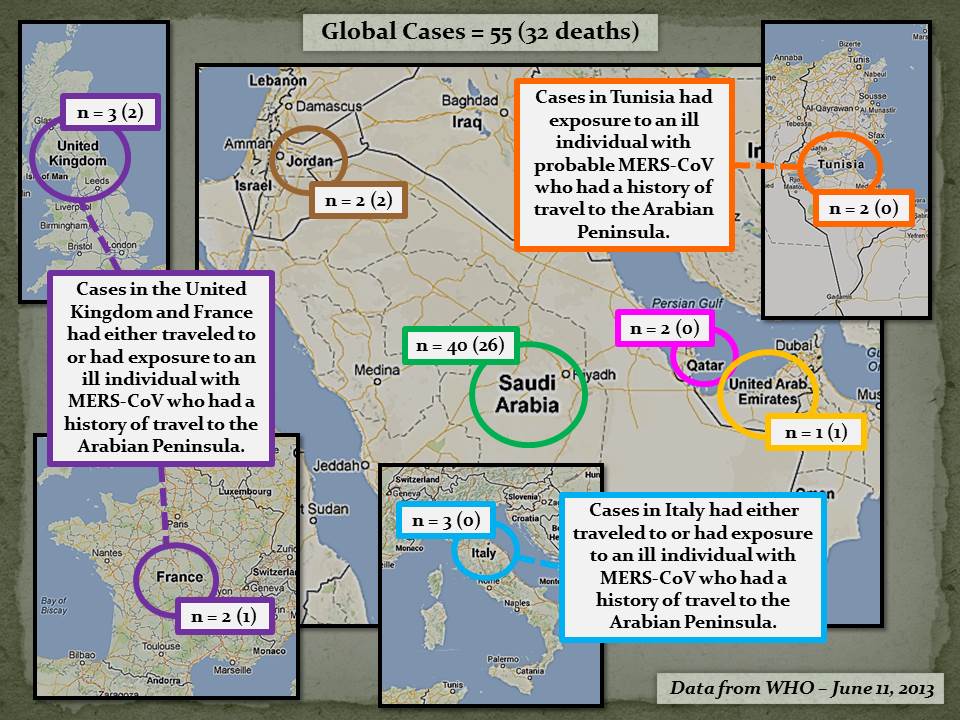
Another case of the Middle Eastern Respiratory Syndrome (MERS) has appeared in France in the last 24 hours, bringing the total number of laboratory confirmed cases worldwide to 56. Health officials are particularly anxious to maintain surveillance of the virus ahead of the annual Muslim pilgrimage to Mecca this October, which is expected to bring over three million travelers from around the world to the Saudi Arabian city.
n = number of cases for each country, with fatalities included in parentheses (image via California Department of Public Health)
Last week, in what has become an annual rite of passage since 1982, Cuba was placed on the U.S. State Department’s list of state sponsors of terrorism. Despite this, there are growing calls for Cuba to be taken off the list. Join us for a discussion and look at the arguments to be made for Cuba’s removal.
Open to the public; however, seating is limited. To RSVP, please send name and affiliation to the Americas Program at americas@csis.org.
This meeting is co-sponsored by the Middle East Program at the Woodrow Wilson Center and the U.S.Institute of Peace.
Some experts predicted that the ‘Arab spring’ rebellions would widen the strategic, political, and even ideological gap between Arab states undergoing dramatic change and those defending the status quo. In fact, no such clear breach has occurred. Instead, Dr. Adeed Dawisha, distinguished professor of political science at Miami University, argues that sectarian tensions and economic constraints have dampened the potentially ‘incendiary’ effect of the Arab political revolts. Please join us at USIP for an engaging discussion on these dynamics in the Middle East with Dr. Dawisha, the State Department’s Dafna Rand, and USIP’s Daniel Brumberg on June 12, from 10:00am to 11:30am.
This weekend’s meeting between Presidents Barack Obama and Xi Jinping at the former Annenberg Estate in California presents the two leaders with an opportunity to address a wide range of pressing issues, from flash points in the Korean peninsula to climate change and the global economy. To China’s leaders, this meeting will contribute to the development of a “new kind of great power relationship,” a concept that has been heavily promoted in recent months in state media and official pronouncements. On June 12, the John L. Thornton China Center at Brookings will host Madame Fu Ying, the spokeswoman for the China’s National People’s Congress (NPC) and the chair of the NPC’s Foreign Affairs Committee.
Two years after the Arab uprisings began, many countries in the Middle East and North Africa are undergoing complex political, social and economic transformations. Arab countries in transition are trying to articulate economic reform agendas amidst tumultuous internal developments and a challenging external environment. The divergent economic interests of governments and civil society groups further complicate the reform process. Alongside these near-term obstacles to economic stability, the region must contend with the medium-term challenges of diversifying their economies, creating jobs, and generating more inclusive growth. On June 13, New America Foundation’s Middle East Task Force will host Adnan Mazarei, the Deputy Director of the IMF’s Middle East and Central Asia Department, to discuss the region’s economic performance in 2012 and expectations for 2013.
The rivalry between India and Pakistan has proven to be one of the world’s most intractable international conflicts. In his new book, Shooting for a Century (Brookings Press, 2013), Brookings Senior Fellow Stephen P. Cohen explores the origins and costs of India-Pakistan hostility, various explanations of why the dispute endures, past and current efforts to normalize the relationship, as well as the consequences of nuclearization. He argues that the prospects for normalization are poor, but because of the stakes and urgency, it is a process deserving of bilateral effort and greater world attention. Cohen also outlines suggestions as to how the rivalry might end, as well as the approach he believes the United States should take vis-à-vis the rivalry. On June 14, the India Project at Brookings will host the launch of Shooting for a Century with a discussion on present and past ties between India and Pakistan, prospects for normalization, as well as what role, if any, the U.S. should play.
The ability of the Seattle area to detect its recent ricin letters was due entirely to a regional bioterrorism lab, the same lab which is now at risk of closure. Local officials were quick to point out that without the local lab, the suspicious substance would have had to be shipped to a different lab nearly 10 hours away. “If you have an instance where you have possible exposure minutes and hours count,” said the local Sheriff, Ozzie Knezovich. Bioterrorism labs are critical points of first response.
KXLY – “With just one full time employee the lab costs $170,000 to operate each year. It serves not only Spokane but bioterrorism services for all of Eastern Washington and North Idaho. In the last seven years its tested more than 70 samples including the suspicious backpack found at the Martin Luther King Jr. Day Unity March in 2011. State Representative Marcus Riccelli from Spokane said its not just the high profile cases we hear about, but the tests that come back negative that justify keeping the lab. However the most recent work done at the lab in the Ricin investigation is the perfect example of why these local officials keeping the lab open is worth fighting for.”
Why isn’t H7N9 ravaging across the planet? Or MERS, for that matter? Not for want of capability. Dr. Anthony Fauci, Director of the National Institute of Allergy and Infectious Diseases, conducted a study examining the genomes of past pandemic flu strains. The results? It turns out that since 1957, all our most virulent pandemic strains have evolved from the 1918 Spanish ( H1N1) strain. Which isn’t to say the H7N9 can’t still mutate.
NPR – “Here’s a sobering thought: Wild birds — including city pigeons and ubiquitous Canada geese — carry 170 different types of bird flu. You know, all those viruses with the Hs and Ns in their names, like H1N1 and H5N1. Only a dozen of these viruses have infected humans so far, but many of those have been deadly, and three of them have caused global flu pandemics.Does every bird flu that leaps into people have the potential to turn into the next “big one” that spreads rapidly around the world?”
The WHO recently reported another death from the Middle Eastern Respiratory Syndrome (MERS), bringing the total number of case fatalities to 31. With just 55 total cases, there is no question of the virus’ virulence. In fact, the Obama Administration has declared the virus a public health emergency – not due to fears of a significant outbreak, but so as to speed up testing and diagnostic capabilities. However, there has been significant recent debate surrounding the virus’ pandemic potential. While significant mutations leading to easier transmission remain possible, MERS in its current form does not seem to pose a significant pandemic threat.
USNWR – “‘Anytime there is a new virus that has the potential to kill people, we ought to take it seriously,’ said Dr. Marc Siegel, an associate professor of medicine at NYU Langone Medical Center in New York City. But while Siegel believes the virus’s spread should be tracked and studied, he doubts it will ever become a real threat. ‘Fear is the biggest virus going,’ he said. ‘The amount of concern is already outweighing the risk. People have seen Contagion too many times.'”
While not as attention-grabbing as MERS or H7N9 (bacteria always get the shaft), the rise of antibiotic-resistant bacterial infections is a growing concern. One of the ongoing difficulties in developing new drugs is lack of sufficient financial incentives – antibiotics tend to be less profitable than drugs for more common concerns (high blood pressure, etc).
NPR – “[The Obama Administration is] investing tens of millions in private drug companies to foster new germ-killing drugs. It’s setting up a new research network to develop new antibiotics. And, most controversially, federal health officials are pushing to loosen up the approval process for new antibiotics targeted at patients with life-threatening infections and dwindling treatment options. ‘Where we’re talking about life-threatening illnesses, you can do much less study and get those drugs out there — if in fact they’ll be limited to those kinds of uses,’ Dr. Janet Woodcock, the chief drug official at the Food and Drug Administration, tells Shots.”
News because it’s not Ebola. Last week, the UN announced six suspected cases of Ebola in the DRC, with three fatalities. However, following testing at the National Institute of Biomedical Research in Kinshasa, Ebola was ruled out, despite symptoms including severe hemorrhaging. Possibly yellow fever?
Channel News Asia – “A senior health ministry official in the Democratic Republic of Congo on Monday ruled out an Ebola outbreak in the northeast of the country, after possible cases were reported by United Nations staff. OCHA [UN Office for the Coordination of Humanitarian Affairs] had announced suspect cases recorded between May 1 and May 12 at Mongo in the Bas-Uele district of the northeastern Orientale province, about 240 kilometres (150 miles) from Isiro, where the last Ebola outbreak killed 34 people out of 62 confirmed cases between May and November 2012.”
Dr. Steve Medley, recent GMU Biodefense PhD graduate, has co-authored his first paper with GMU professor Dr. Monique Van Hoek and others, entitled “Transfer and Reaerosolization of Biological Contaminant following Field Technician Servicing of an Aerosol Sampler”. The paper was published in the journal Bioterrorism and Biodefense. Dr. Medley is working on two other papers with Dr. Van Hoek.
The entire paper is available through open access, but here’s an excerpt:
“Aerosol contaminants deposited on a surface are transferred by two primary means–direct surface contact and reaerosolization. When a surface contaminated with deposited aerosol is contacted, a portion of the particulate material will be transferred. The amount transferred is dependent upon several factors, with amount of pressure applied, static charge, moisture levels, contact frequency, contact motion, particle size and surface roughness being among the most significant [1]. Once particles are transferred to the clothing and/or gloves of a person, deposited particles may reaerosolize by several mechanisms, such as vibration and air flow [2]. As mentioned, physical characteristics of the surface and particles, as well as the environmental conditions, will affect reaerosolization potential. With the multitude of variables, it is difficult to predict the amount (or fraction) of contaminant that will be transferred.”








 The Pandora Report