
This week is a big one! We kick off congratulating Biodefense MS alumna Aurelia Berisha for her work as a Presidential Management Fellow before getting into recent updates on the Biden administration’s pandemic policy, China distancing itself from UN efforts to study wet markets and other high-risk locations in Asia, and more. There are also plenty new publications and upcoming events in this issue, including a book talk hosted by the Schar School covering Lessons From the COVID War: An Investigative Report.
Biodefense Alumna Lands Prestigious Presidential Management Fellowship
“Aurelia Berisha has always been interested in public service to have an opportunity to make a positive difference in the community and other people’s lives. Now, she has that opportunity in her new role as a Program and Management Analyst at the United States Department of Agriculture (USDA) through the highly competitive Presidential Management Fellowship (PMF) program.”
“Berisha, a native of Chesapeake, Virginia, graduated from George Mason University in 2017 with her bachelor of science degree in biology and worked for a few years as a medical technologist. After the onset of the Covid-19 pandemic, Berisha became interested in strengthening biosafety and biosecurity in the U.S. and enrolled in the Schar School of Policy and Government’s highly ranked Master of Biodefense program, from which she graduated in 2021. While taking classes at Mason Square, Berisha heard about the PMF Program through several professors, including biodefense adjunct professors Ashley Grant and Andrew Kilianski, who encouraged her to apply.”
Read more about Aurelia’s PMF placement and time in the Biodefense MS program here on the Schar School site.
President Biden Signs Bill Ending COVID-19 Emergency
President Biden signed a bill immediately ending the COVID-19 national emergency this week. Previously Biden indicated he planned to extend both the national and public health emergencies until May 11. However, House Republicans soon thereafter pushed bills to end both emergencies immediately. The new law from this week only ended the national emergency despite recent statements from the White House saying these proposals “would be a grave disservice to the American people,” that would “create wide-ranging chaos and uncertainty throughout the health care system.”
Politico explains that “Despite this, Biden told Senate Majority Chuck Schumer last month that he did not plan to veto it — marking the second time in recent weeks that the president has signaled opposition to a Republican-sponsored bill, only to later decline to veto it.”
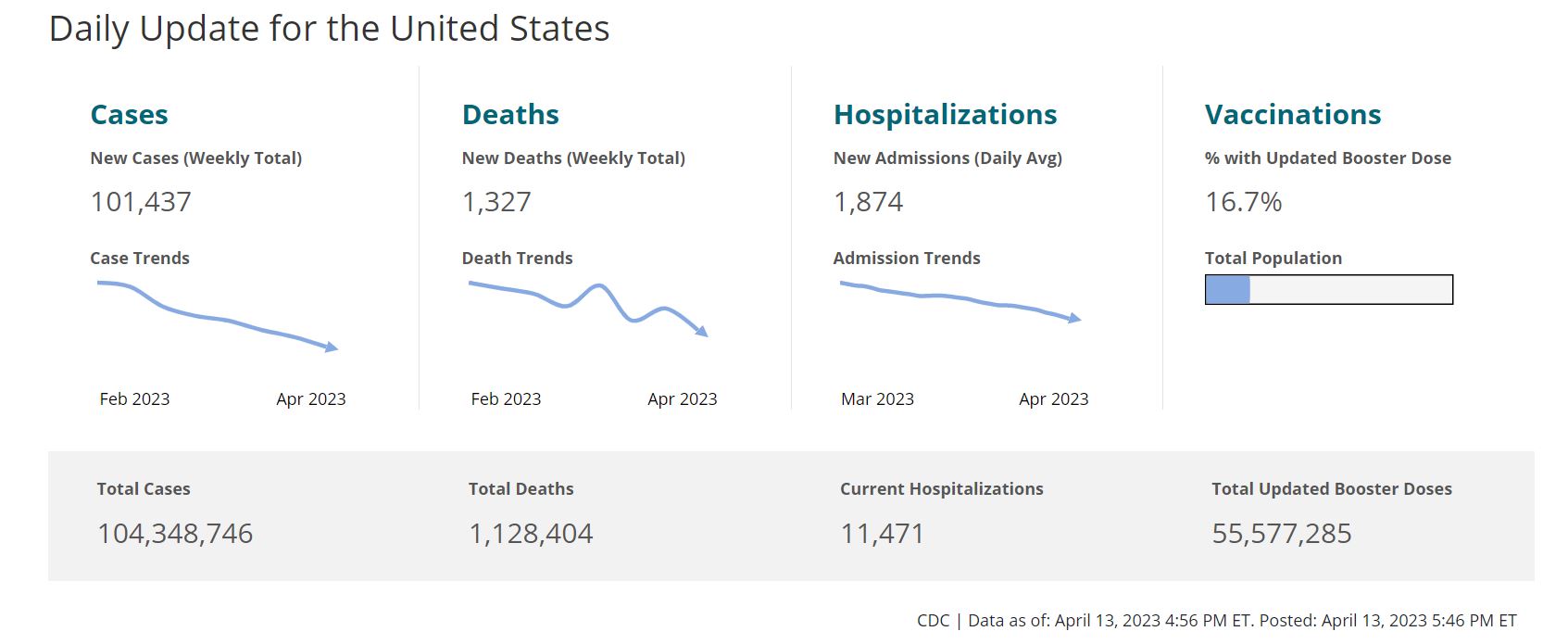
However, in the last week, 101,437 new cases of COVID-19 were reported in the United States, along with 1,327 new deaths and 1,874 new hospitalizations. With just 16.7% of the American population fully vaccinated with updated boosters, the pandemic is not over and there is a major risk in pulling federal funding for things like these boosters. With the US short about 80,000 public health professionals and the administration dragging its feet on standing up the Congressionally-instructed pandemic response office, it is hard to see the utility in ending these emergencies now.
In better news, the Biden administration is launching a $5 billion+ program aimed at accelerating the development of new coronavirus vaccines and treatments to address future challenges with COVID-19 and other coronaviruses. Dan Diamond writes of the initiative in the Washington Post ““Project Next Gen” — the long-anticipated follow-up to “Operation Warp Speed,” the Trump-era program that sped coronavirus vaccines to patients in 2020 — would take a similar approach to partnering with private-sector companies to expedite development of vaccines and therapies. Scientists, public heath experts and politicians have called for the initiative, warning that existing therapies have steadily lost their effectiveness and that new ones are needed.”
“Officials note that several coronavirus-driven outbreaks in the past two decades, including severe acute respiratory syndrome coronavirus in 2002 and Middle East respiratory syndrome in 2012, have spurred worries about the potential for future health crises related to the viruses. That said, a universal coronavirus vaccine could take years to develop; researchers have sought unsuccessfully for decades to create such a vaccine against influenza.”
China Sits Out On UN Wet Market Survey Project
This week, Reuters reported that the United Nations told the outlet that China will not be participating in a project to survey wet markets and other facilities across Asia considered to be at high risk of spreading infectious diseases. This was despite long-running talks with Beijing about engagement in the project. The article explains “Four Asian countries – China, Thailand, Vietnam and Laos – were initially selected for the survey by the scientific advisory committee of the project, called the Safety across Asia For the global Environment (SAFE), because they host multiple facilities presenting risks of animal-to-human disease transmission, the UN official said.”
While China’s National Forestry and Grasslands Administration initially showed interest and engaged in talks about the project, the organization has since withdrawn and refused to answer media questions about the project. Importantly, “China’s public security organs have handled more than 70,000 criminal cases involving wild animals from 2020-2022, confiscating 1.37 million wild animals in the process, state news agency Xinhua has reported.”
WHO Makes Progress on Draft Pandemic Accord
In a recent press release, the WHO said “Countries of the World Health Organization have mapped out how negotiations on a global accord on pandemic prevention, preparedness and response will move forward with a view to presenting a draft accord for approval by the World Health Assembly in May 2024.”
“Ending Thursday, discussions on the draft pandemic accord took place during the fifth meeting of the Intergovernmental Negotiating Body (INB), which includes WHO’s 194 countries…Countries agreed to keep a window open for additional written proposals until 22 April and that those proposals will be compiled with all others made over recent weeks into a package that will be made available to all drafting group participants.”
“In parallel with the pandemic accord negotiations, governments are also discussing more than 300 amendments to the International Health Regulations (2005) (IHR) in an effort to strengthen those regulations and make the world safer from communicable diseases while ensuring greater equity in the global response to public health emergencies.”
“Governments have been working to ensure consistency and alignment across the INB and IHR processes. The proposed IHR amendments will also be presented to the World Health Assembly in 2024, and would together, with a future pandemic accord, provide a comprehensive, complementary, and synergistic set of global health agreements.”
“Economic Security and the U.S. Department of Homeland Security”
This new RAND Corporation Perspective was co-authored by Dr. Daniel Gerstein, an alumnus of the Biodefense PhD program and current Schar School adjunct professor, and Douglas Ligor. They write in their summary “The U.S. Department of Homeland Security’s (DHS’s) contributions to U.S. economic security and, by extension, the economy itself are often misunderstood and undervalued. The country’s economic prosperity depends increasingly on the flow of goods and services, people and capital, and information and technology across U.S. borders — both visible and invisible.”
“The challenges the United States faces from an interconnected world have never been more significant. As witnessed during the coronavirus disease 2019 (COVID-19) pandemic, the American public has been affected greatly, and many of these challenges are rooted in previously unforeseen vulnerabilities to the U.S. economy. To ensure its economic security now and in the future, the United States should ensure both continued global economic leadership and security of its key economic advantages. To this end, the United States must continue to lead in trade, technology, information systems, innovation, human capital acquisition (through both education and immigration), and travel. These are all areas in which DHS is uniquely postured to support, facilitate, and promote U.S. economic leadership.”
“DHS plays a crucial role in proactively identifying and addressing the harmful influence on U.S. economic actors or sectors that would result in a geopolitical disadvantage to the United States and limit U.S. persons, companies, or entities from prospering in the global economy. This Perspective describes DHS’s role in supporting economic security now and into the future. It begins by describing the evolving strategic environment and concludes by examining DHS’s critical role in economic security.”
“Research with Exotic Viruses Risks a Deadly Outbreak, Scientists Warn”
In this feature for the Washington Post, David Willman and Joby Warrick discuss ongoing fears about the risks posed by seeking out viruses that may one day be able to spread in human populations, starting first with recounting concerns about research in Southeast Asia in the 2010s. They then write “Three years after the start of the coronavirus pandemic, a similar reckoning is underway among a growing number of scientists, biosecurity experts and policymakers. The global struggle with covid-19, caused by the novel coronavirus, has challenged conventional thinking about biosafety and risks, casting a critical light on widely accepted practices such as prospecting for unknown viruses.”
“A Post examination found that a two-decade, global expansion of risky research has outpaced measures to ensure the safety of the work and that the exact number of biocontainment labs handling dangerous pathogens worldwide, while unknown, is believed by experts to bein the thousands.”
They also feature Dr. Gregory Koblentz, Director of the Biodefense Graduate Program at George Mason, and his work with the Global Biolabs project: “Global Biolabs, the advocacy group, found that nearly 1 in 10 BSL-4 labs operating in other countries score poorly in international rankings for lab safety. In some cases, labs were constructed without local regulations or meaningful oversight of the handling of dangerous pathogens, or “even a well-established culture of responsible research,” said Gregory Koblentz, a co-author of the Global Biolabs report and the director of the biodefense graduate program at George Mason University’s Schar School of Policy and Government.”
“Most countries lack the sophisticated controls needed to prevent dangerous viruses or bacteria from being misused or diverted for illicit purposes, he said. “This is a major blind spot in global surveillance for future biological threats,” Koblentz said.”
“Expanding on Future Biological Weapons Convention Verification: An Interview with Dr. Piers Millett”
The Council on Strategic Risks’ Dr. Dan Reagan interviews Dr. Piers Millett, Executive Director, International Biosecurity & Biosafety Initiative for Science, in this piece covering the future of the BWC and its verification. Reagan writes in part “Across the biodefense community, there was a significant sense of uneasiness heading into the Ninth Review Conference of the Biological Weapons Convention (BWC), held in Geneva at the end of 2022. This was largely due to the stalled progress of previous review conferences, coupled with the current state of affairs shaped by Russian disinformation and concerns about non-compliance. Luckily, the result of the conference was generally positive, and there is renewed focus on how verification of compliance with the convention might be pursued in the future. To prepare for the Tenth Review Conference, a working group was established to address seven topics, including “measures on compliance and verification.”’
“The last time the BWC significantly addressed the technical aspects of verification was the 1991-1994 Ad Hoc Group of Governmental Experts to Identify and Examine Potential Verification Measures. The result was the VEREX Report, which offered potential measures for on-site and off-site verification, emphasizing that multiple measures would be needed for an effective review of compliance. Between 1995-2001, the Ad Hoc Group worked on drafting a binding resolution for verification within the BWC, which ultimately was shuttered after rejections in 2001 by the President George W. Bush administration.”
“Along the way, multiple experts have been working to develop ideas for how verification could be pursued. In a recent article, Feasibility of On-Site Verification, experts across academia, private industry, and non-government organizations addressed the modern considerations for a potential BWC verification protocol. In our efforts at the Council on Strategic Risks to raise the profile of such work, I recently spoke with co-author Dr. Piers Millett, who currently serves as the Executive Director of the International Biosecurity & Biosafety Initiative for Science (IBBIS).”
“What’s a Chemical Weapon? A Global Weapons Treaty Could Use Some Clarity”
Lennie Phillips addresses some points of confusion regarding the CWC in this piece for the Bulletin of the Atomic Scientists, writing in part “What is a chemical weapon? The Chemical Weapons Convention (CWC), the international treaty banning chemical weapons, recognizes that chemicals have both beneficial and malign uses and takes a nuanced approach to defining chemical weapons and their use. It is within these nuances that, in many cases, non-governmental groups have claimed use of chemical weapons against them or the people they represent. Are these claims based on ignorance of what is classed as use of chemical weapons? Are they indeed cases where chemical weapons have been used or merely attempts to grab headlines? Conversely, have the alleged perpetrators used chemicals for reasons that wouldn’t violate the treaty, or have they hidden within in the middle of the treaty’s nuances and masked deliberate use of chemical weapons, perhaps on the pretense that there is a gray area?”
“Reconciling Discrepancies in the International Trade of Dual-use Chemicals: The Potential of Blockchain Technology”
This recent issue brief from the Stimson Center discusses how blockchain technology may help address discrepancies in declared quantities of dual-use chemicals transferred internationally: “Under Article VI of the Chemical Weapons Convention, States Parties are required to submit an annual declaration to the Organisation for the Prohibition of Chemical Weapons including the quantities of dual-use chemicals they have imported and exported across national borders. However, the complexities of global chemical trade and uneven national implementation of the Convention, including the lack of harmonization across industry reporting on chemical transfers, has contributed to an increasing number of discrepancies in States Parties’ declarations. The Stimson Center’s MATCH Project explores how blockchain technology can streamline reporting on chemical transfers between industry and national authorities and reduce the risk of discrepancies while improving the ability of national authorities to accurately track the movement of dual-use chemical weapons precursors as they are transferred between countries.”
“Biosecurity Risk Assessment in the Life Sciences: Towards a Toolkit for Individual Practitioners”
Dr. Mirko Himmel recently published this report with the Stockholm International Peace Research Institute: “There are a number of potential risks and unintended consequences associated with research at the intersection of biological sciences and emerging technologies, including the risk of misuse for malicious purposes. While there are established biorisk management approaches to dealing with these dangers, gaps remain. This paper focuses on the role of individual practitioners in contributing to a larger culture of biosafety and biosecurity. It presents a proposed toolkit that involves a risk assessment process and strategies to manage potential risks. The paper outlines ways to motivate practitioners to proactively take responsibility for considering and managing the biorisks associated with their work, aiming to close the knowledge gap by equipping scientists with appropriate tools to implement a comprehensive biorisk mitigation strategy at the practical level. It concludes by deploying the approach using a potential application from nanobiotechnology for demonstration purposes and considers next steps.”
“Preparing for the Next Pandemic in the Era of Antimicrobial Resistance”
The US Presidential Advisory Council on Combating Antibiotic-Resistant Bacteria recently released this report discussing how the United States should prepare for the next pandemic with consideration for AMR in mind. The report summary explains in part “It is with this underlying premise of immediate action that the PACCARB presents this report with a total of 14 recommendations…The PACCARB has identified four major areas in which improvements can strengthen our preparedness for future PHEs and reduce the toll of resistant infections now and during a PHE. In each of these areas, investments in steady-state capabilities and capacities are needed to help address the current rise in AMR infections and to respond to the next PHE quickly and effectively.”
“Antimicrobial Resistance: An Opportunity to Save Millions of Lives and Transform the Field”
This report was recently published by Dr. Akhil Bansal for the AMR Funding Circle with support from Schmidt Futures: “This report, which is the culmination of conversations with over 100 experts in the field and supported by Schmidt Futures, a philanthropic initiative co- founded by Eric and Wendy Schmidt, considers AMR from a bird’s eye perspective and identifies areas that are currently being overlooked and where there are opportunities for outstripped positive impact. The recommendations that this report makes, which are summarised below, have not been conceived of with a specific client in mind, but suggests which stakeholders might be best placed to[.]”
What We’re Listening To 🎧
Interventions to Reduce Risk for Pathogen Spillover and Early Disease Spread to Prevent Outbreaks, Epidemics, and Pandemics
In this CDC Podcast “Dr. Neil Vora, a physician with Conservation International in Arlington, Virginia, and Sarah Gregory discuss pathogen spillover and ways to reduce the risk of spillover events.”

Lessons From the COVID War: An Investigative Report
ASPR TRACIE Roundtable: Lessons Learned in Healthcare Communications
“Healthcare and public health entities have learned many lessons about communicating to their personnel and the public after three years of responding to the COVID-19 pandemic and concurrent emergencies. The U.S. Department of Health and Human Services (HHS) Administration for Strategic Preparedness and Response Technical Resources, Assistance Center, and Information Exchange (ASPR TRACIE) invites you to this webinar where speakers representing a wide range of stakeholders and jurisdiction types (national, large/urban, regional, and rural/tribal) will share their perspectives on how they integrated these lessons into current and future responses. Topics will include channels used for outreach and continued engagement, strategies for reaching different community and cultural groups and countering rumors, and working with partners to create complementary messaging.”
This event will take place virtually on April 20 at 3 pm EST. Register here.
Training Course: Achieving Data Quality and Integrity in Maximum Containment Laboratories
From FDA and UTMB: “This popular course offers a unique opportunity for the regulatory and scientific communities to discuss complex issues in an interactive environment and identify and share best practices for ensuring data quality and integrity in BSL-4 facilities.”
“The week-long, data quality course is designed to help researchers who conduct studies intended to support approval under the Animal Rule, which may be used to grant marketing approval of certain products when human challenge studies would not be ethical or feasible.”
“The course includes expert lectures and hands-on laboratory activities conducted in BSL-2 and BSL-4 training laboratories to emphasize the differences between biosafety levels, and the complexity of conducting laboratory activities in a BSL-4 environment. An online training module on GLP regulations (21 CFR Part 58) is included as a course pre-requisite.”
This course will take place April 24-28 in Bethesda and Frederick, MD OR virtually. Registration ends today (April 14), so act quickly!
Online Event: Civil Society at the 5th CWC Review Conference
From the CWC Coalition: “The Fifth Five-Year Review Conference (RC-5) for the 1997 Chemical Weapons Convention will be held in the Hague from May 15-19, 2023.”
“At the CWC RevCon, member states and the broader chemical weapons disarmament community will gather to assess past achievements, treaty implementation and compliance, and discuss plans to strengthen the CWC in the years ahead.”
“You are invited to join a virtual discussion on the upcoming Fifth Five-Year CWC Review Conference (RC-5), major issues to be addressed, and the role of civil society and non-governmental organizations.”
“We will be joined by Elisabeth Waechter, Head of Public Affairs at the OPCW. Paul Walker, the Chair of the CWC Coalition, will moderate.”
This event will take place on April 26 at 10 am EST. Register here.
National Biodefense Science Board Public Meeting
The NBSB will meet virtually on May 4 at 2 pm EST to discuss lessons from COVID-19 and will present recommendations on several topics, including collection, analysis, and sharing of operational health data, uses of virtual healthcare during disaster response, and disaster response challenges specific to rural and underserved communities. Register here.
Virtual Workshop: Prioritizing Actions for Epidemic and Pandemic Preparedness
From the National Academies: “Please join us May 4 & 18, 2023 from 8 a.m. to 12 p.m. ET for a virtual symposium examining how to strengthen the evidence-based prioritization of epidemic and pandemic preparedness and response capabilities.
The symposium will convene global health planning stakeholders, including those in government and academia, and across health- and non-health sectors to:
- Review assessment tools and how, independently and together, they relate to national action planning.
- Gain insight into how countries and organizations currently select priorities in funding for epidemic prevention, detection, and response.
- Assess evidence for effective prioritization approaches to building disease surveillance and risk communication capabilities.
- Identify governance structures that can support robust and reliable systems for epidemic and pandemic preparedness and response investments.
This symposium is in collaboration with the Division on Earth and Life Studies. Learn more about this workshop by visiting the event webpage.”
Nobel Prize Summit-Truth, Trust and Hope
Taking place May 24-26 this year in DC and virtually, this Nobel Prize Summit asks “How can we build trust in truth, facts and scientific evidence so that we can create a hopeful future for all?”
“Misinformation is eroding our trust in science and runs the risk of becoming one of the greatest threats to our society today.”
“Join us at this years’ Nobel Prize Summit which brings together laureates, leading experts and you in a conversation on how we can combat misinformation, restore trust in science and create a hopeful future.”
Learn more and register here.
Gordon Research Conference: Cross-Cutting Science Facilitating Collaboration Across the Threat-Science Research Community
“The Nonproliferation, Counterproliferation and Disarmament Science GRC is a premier, international scientific conference focused on advancing the frontiers of science through the presentation of cutting-edge and unpublished research, prioritizing time for discussion after each talk and fostering informal interactions among scientists of all career stages. The conference program includes a diverse range of speakers and discussion leaders from institutions and organizations worldwide, concentrating on the latest developments in the field. The conference is five days long and held in a remote location to increase the sense of camaraderie and create scientific communities, with lasting collaborations and friendships. In addition to premier talks, the conference has designated time for poster sessions from individuals of all career stages, and afternoon free time and communal meals allow for informal networking opportunities with leaders in the field.”
This conference will take place July 9-14 in Ventura, CA. Learn more and register here.

Disarmament and Non-Proliferation of WMD 2023 Training Programme
“The global non-proliferation norms regarding the use and proliferation of weapons of mass destruction are under pressure. The threat posed by nuclear, chemical and biological weapons has reached levels of urgency not seen since the Cold War. Consequently, there is a growing demand for professionals with the necessary legal, technical and policy expertise to tackle the challenges of today’s non-proliferation and disarmament agenda. Register now for the fourteenth training programme on disarmament and non-proliferation of weapons of mass destruction, co-organised with the Organisation for the Prohibition of Chemical Weapons (OPCW) on 18 to 22 September 2023 in The Hague.”
CDC Laboratory Leadership Service Application Open
The CDC’s Laboratory Leadership Services (LLS) program is currently accepting applications through June 1. Designed as a companion to the Epidemic Intelligence Service, this service was launched in 2015 and aims to train lab-oriented public health professionals. “The LLS fellowship provides a one-of-a-kind training experience for laboratory scientists who are ready to apply their expertise inside and outside of the lab, ultimately preparing them to be the next generation of public health laboratory leaders who work to protect public health. Fellows conduct cutting-edge research, support rapid response to disasters and disease outbreaks, help investigate emerging health threats, and enhance the laboratory systems and practices that are essential for public health. LLS seeks laboratory scientists looking to take their careers to the next level while doing work that delivers real benefits to communities across the country.” Learn more and apply here.
Weekly Trivia Question
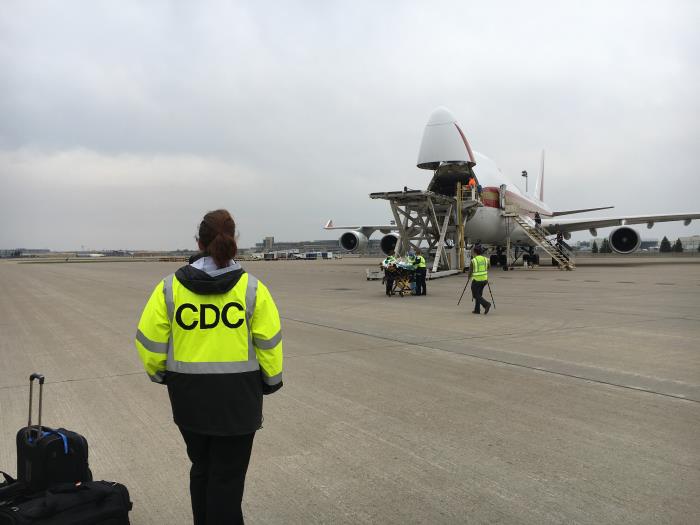
You read the Pandora Report every week and now it’s time for you to show off what you know! The first person to send the correct answer to biodefense@gmu.edu will get a shout out in the following issue (first name last initial). Our question this week is: “In the 2011 film Contagion, Dr. Erin Mears (played by Kate Winslet) is an officer in which CDC program?”
Shout out to Sam R. for correctly answering last week’s trivia. Our question was: “The Forced Evolutionary Virus was developed by the the West Tek Corporation’s NBC Division in what popular video game franchise?” The answer is the Fallout franchise.







 The Pandora Report