Scientists Withhold Details on New Botulinum Toxin

Scientists have discovered a new form of botulinum toxin, but have taken the unusual measure of withholding key details of the discovery, citing concerns over bioterrorism. What does everyone think? We’d love to hear your comments.

NPR – “That’s because botulinum toxin is one of the most poisonous substances known. It causes botulism, and the newly identified form of it can’t be neutralized by any available treatment. The researchers published two reports describing their work online in The Journal of Infectious Diseases. The information in those reports is deliberately incomplete, to prevent anyone from using it as the recipe for a potent new bioweapon. ‘This is not the usual process for publishing manuscripts. We thought in this case an exception was appropriate,’ says David Hooper, an infectious disease specialist at Massachusetts General Hospital who serves as one of the editors of the journal. Normally, the journal would require that the scientists disclose the genetic sequences needed to make the toxin. In this case, however, the researchers didn’t want to do that because of the security risk.”

Read more here and then come back and tell us what you think!

Walker, October Seminar Speaker, on Destroying Chemical Weapons

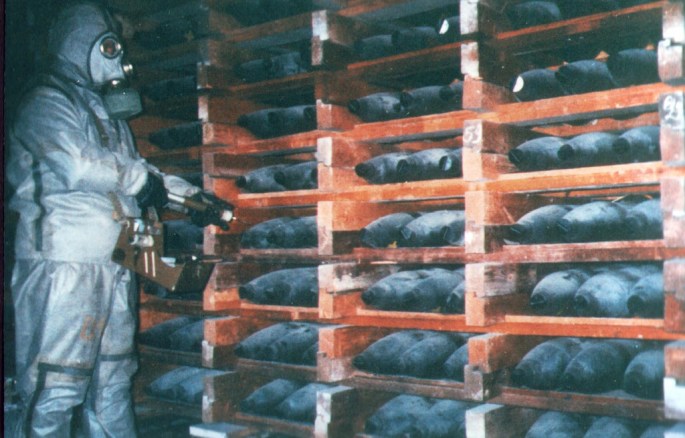
As destruction efforts in Syria seem to be continuing apace, the question many of us have asked ourselves is how does one destroy a chemical weapon? Dr. Paul Walker concisely addresses this in his recent Bulletin of Atomic Scientists piece, “How to destroy chemical weapons?”. To hear more, be sure to join us next Wednesday evening for our October Biodefense Policy Seminar featuring Dr. Walker, who will discuss efforts to destroy Syrian CW at length. For more information, please visit our events page.

Bulletin of Atomic Scientists – “The recent news that Syrian President Bashar al-Assad is willing to accede to the international Chemical Weapons Convention (CWC) has raised the question: How might one actually go about eliminating Syria’s chemical munitions?

The CWC entered into force in 1997. Seven CWC member countries have declared existing chemical weapons stockpiles—Albania, India, Iraq, Libya, Russia, South Korea, and the United States. Three of these—Albania, India, and South Korea—completed stockpile destruction in the last few years. Three more—Libya, Russia, and the US—expect to complete their destruction programs over the next decade. And Iraq, which joined the convention in 2009, is planning the destruction of its chemical weapons equipment and agents left from the 1991 Gulf War.

There are essentially three broad categories of destruction approaches, all used successfully in the above programs. These approaches can be mixed and matched, depending on the type, size, quantity, and condition of the agents, munitions, and containers…”

Read more here.

(image: Jen Spie/Flickr)

Two Killed in Polio Vaccination Drive in Pakistan

A bomb killed two and injured 20 others during a polio vaccination drive in Pakistan. Pakistanis one of just three remaining states where polio remains endemic. An anti-Taliban group member and police officer comprised the fatalities. This is just the latest in a long campaign against aid workers, doctors, nurses, and public health officials working to try and eradicate the crippling disease in the region. The vaccinators, often relatively poor women, often work to inoculate local populations at great personal risk, usually travelling door-to-door in an attempt to reach as many children as possible.

Poliomyelitis, or polio, is an often fatal disease spread by the poliovirus. Once contracted, the disease is incurable, and can result in complete paralysis of the legs. The disease is easily preventable through a vaccine administered as oral drops.

The Independent – “When the authorities are unable to provide sufficient security, these women bear the brunt of the Taliban attacks. Last year, gunmen killed four female polio workers in the city of Karachi on the same day, and two women were killed in Peshawar, very close to where Monday morning’s bomb was detonated, apparently by remote control. In Nigeria, Islamist gunmen killed nine health workers in February.”

Read more here.

Bioweapons Alarmism in Syria

by Dr. Sonia Ben Ouagrham-Gormley, originally published in the Bulletin of Atomic Scientists

As Secretary of State John Kerry challenged Syrian President Bashar al-Assad to hand over Syria’s chemical weapons in early September, articles published in the Washington Post and National Interest argued that the current focus on Syria’s chemical weapons is distracting the international community from a much deadlier threat: Syria’s biological weapons. The sources for the Washington Post article (one of whom also happens to be a co-author of the National Interest piece) warn that Assad’s regime could use its biological weapons in retaliation against Western forces or its own population. Both articles assert that Syria has maintained a dormant program since the country last engaged in biological weapons developments in the 1970s and 1980s and could easily reactivate its program to produce, on short notice, the stockpile of agents required to retaliate against its enemies. This threat is real, the argument goes, because Syria could tap into its pharmaceutical and agricultural industries to support the effort. Finally, the articles warn that Syria might have retained a strain of smallpox from a 1972 outbreak, which could be used to develop a devastating biological weapon.

These two articles provide no tangible evidence to support their claims. More important, their speculations contradict extant empirical evidence on the difficulty of achieving the level of biological weapons capability that the articles claim Syria maintains or could reestablish. To avoid falling prey to the same biological weapons hysteria that led to the invasion of Iraq in 2003, it is important to look carefully at such claims. Close examination shows them to be exaggerated, at best.

To evaluate Syria’s ability to revive a dormant program, one would need to know what kind of research and production infrastructure the Syrian government currently possesses. There is, however, very little publicly available information on the scope of Syria’s bioweapons program, if any.

If Syria retains only a small research capability developed in its bioweapons program of the 1970s and ‘80s, the likelihood that it would be able to quickly produce sufficient amounts of bioweapons for retaliation is very slim. The country would first need to create the research, development, production, and weaponization infrastructure needed for a crash program, a process that may take several months to even years, particularly in a war zone. Assuming that the Syrians already have stocks of agents—and it is pure speculation to say they do— they will need to conduct exploratory research to determine which agent is the most promising as a bioweapon and develop a production process that will maintain the agent’s lethal characteristics during scale-up and storage. Creating this production capability is also neither easily or quickly achieved.

In the early 1980s, Iraq attempted to reactivate a biological weapons program that had been largely abandoned in the preceding decade; it took the Saddam Hussein regime three years—from 1983 to 1986—to conduct the needed exploratory research and identify the agents most desirable for bioweapons work. Even then, the Iraqis were able to develop only crude liquid agents that lost toxicity within six to eight months. They were also unable to develop a bioweapons-specific dissemination capability, relying instead on personnel from their chemical weapons program to adapt chemical bomb casings and warheads for bioweapons use. This strategy resulted in ineffective weapons that would have released agents upon impact, destroying most of the bio-agent in the process.

Even if Syria already has significant bioweapons infrastructure in place, reactivating it would not necessarily be a quick or simple process. When in the early 1980s Soviet-era authorities decided to activate the mobilization facility in Stepnogorsk, Kazakhstan in order to produce anthrax, it took about two years to launch production, even though the facility had been established for several years and had the equipment and minimum staff needed for its operation. The suggestion that Syria could swiftly launch a crash program from a long-dormant infrastructure and produce effectively weaponized agents in amounts sufficient for a retaliatory military attack seems a considerable stretch from likely reality.

Read the rest of the piece here.

(Image credit: Scott Montreal/Flickr)

DTRA’s Chem Bio division develops highly sensitive bio-agent detector

The Defense Treat Reduction Agency through its collaborative Ruggedized Antibody Program project, has developed a bio-agent detector 1000x more powerful than currently used ELISA methods.

From DVIDS– ” This technology has demonstrated exquisite analytical and clinical sensitivity, as well as a broad dynamic range. The combination of these two technologies will robustly increase the Department of Defense’s diagnostic armamentarium. This could lead to warfighters being able to detect lower levels of the toxin, therefore decreasing false negatives in environmental samples and earlier discovery in the course of clinical intoxication. SdAbs are recombinant ligand binding antibody fragments derived from the unusual structure of native antibodies found in camels and llamas. These unique heavy chain binding elements offer many desirable properties such as their small size (~15 kDa) and thermal stability, which makes them attractive alternatives to conventional monoclonal antibodies.”

Read more here.

 (image courtesy of DTRA)

Chemical weapons team arrives in Syria; Blair on our options

In the last 48 hours, chemical weapons inspectors have crossed the border into Syria, reaching Damascus last night. The 19-member inspection team, sent from the Organization for the Prohibition of Chemical Weapons in the Hague, will be responsible for verifying and dismantling the 1,000 tonne Syrian chemical weapons arsenal. The team will have approximately nine months to conduct their investigation and help the Syrian government destroy their arsenal by the middle of next year.

Charles Blair, GMU adjunct professor and columnist at the Bulletin of Atomic Scientists, recently published a piece on the fundamental issue at stake here – will it make any difference?

“Regardless of how Lavrov-Kerry fares, the Obama administration faces a high-stakes dilemma. If the agreement is successful, the Syrian civil war still threatens to metastasize—further destabilizing the entire region and, due to the West’s dependence on oil from the Middle East, threatening the world economy. In short, even without a Syrian chemical arsenal, and apart from the normal winter ebb in fighting, the civil war shows no signs of slowing down.

“But failure to rid Syria of the stockpile could result in additional chemical weapons use by the Assad regime and hastens the day when extremists acquire these arms, too. If Syria does not abide by the agreement, the United States would likely resort to air strikes, amid strong calls for a redoubling of efforts to quickly arm opposition forces with more weaponry. Both actions are inherently risky. Indeed, significant sections of Syria could fall under the rule of violent Islamists armed with chemical weapons. As an authority on terrorism at the RAND Corporation, Michael Jenkins, recently wrote me, ‘the Syrian civil war has significantly raised the risk that its chemical weapons will fall into the hands of terrorists, creating a greater international crisis than the one we think we have just solved.’”

Read more at the Bulletin.

(image: Steven Damron/Flickr)

Using a Fish Army to fight Dengue

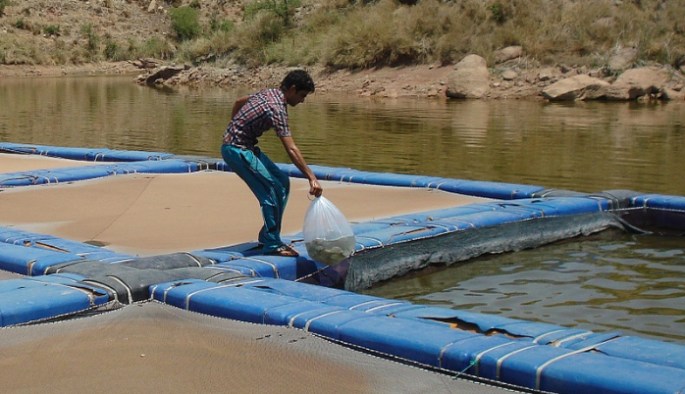
In what has to be one of the strangest public health strategies to date, health officials in the Punjab districts of Pakistan have released over a million Tilapia into pools, ponds, large puddles – just about any body of standing water – in an effort to combat dengue. Pakistan has a long rainy season which creates thousands of pools of water where the mosquitoes who carry dengue lay their eggs. By releasing the fish into these pools, the larvae are eaten before they can hatch, killing the virus’ vector and preventing its spread.

While it may be tempting to dismiss the strategy as a bizarre version of the woman-who-swallowed-the-fly nursery rhyme, don’t – apparently, it’s working. In 2011, the Punjab districts had over 20,000 cases of dengue, including 300 fatalities. So far this year, following the release of over 1.6 million fish, there have been just 100 cases total.  The question of what happens to the fish when the pools evaporate has not yet been addressed, but we’re still impressed – can you imagine having to pitch this idea to your superiors?

Read more about this very innovative use of fish at the Guardian.

(Image: Tilapia farmer in Pakistan, courtesy of USDA/Flickr)

October Seminar Speaker Paul Walker Wins Swedish Rights Prize

Dr. Paul Walker, International Director of the Environmental Security and Sustainability (ESS) Program for Green Cross International (GCI), and our October Biodefense Policy Seminar Speaker, was awarded the Swedish Right Livelihood Award on Thursday for his lifelong work eliminating chemical weapons.

The award was founded by Swedish philanthropist Jakob von Uexkull, following refusal by the Nobel Foundation to honor efforts in international and environmental development.

Speaking about selecting Dr. Walker, Director of the Right Livelihood Award Foundation Ole von Uexxkul said, “Chemical weapons are easy to manufacture but very difficult to get rid of. Walker has 20 years of experience in how to eliminate them both politically and technically…It is his knowledge that is needed right now in Syria.”

Walker expressed delight at receiving the award, emphasizing the extreme urgency to eliminate Syria’s chemical weapons and potential positive impact on the region. “Israel and Egypt, being neighbors of Syria, really feel pressure now to join the Chemical Weapons Convention. They don’t need the option of chemical weapons and should join the rest of the world,” he said.

Walker will be formally presented with the award at a ceremony in the Swedish parliament later this year.

GMU Biodefense will host Dr. Walker on October 16th at 7:20 PM. Join us for an extremely timely discussion on Syria and elimination of chemical weapons. For more information, please see here.

To find out more about the Right Livelihood Award, visit their website here.

(Image: Stockholm Environmental Institute)

New developments in legal battle over H5N1 research

Ron Fouchier, the virologist at the center of the last year’s controversial gain-of-function H5N1 research, is back in the media following the ruling on his research in Dutch courts this week. The ruling surrounded the legality of the Dutch government’s decision to request Fouchier to first obtain an export licenses before sending his H5N1 research out to the magazine Science. The government did so after classifying Fouchier’s work as dual-use research of concern, the dissemination of which could be perceived as potential proliferation. This week’s ruling not only supported the government’s requirement of an export license, but extended the requirement to all future work on H5N1 transmission. Needless to say, Fouchier is not pleased. He’s accused the Dutch government of disadvantaging Dutch scientists and mitigating their academic freedom.

Read more at Science.

(Image: Selbe B./Flickr)

New Bio-containment Lab in Kazakhstan

The Defense Threat Reduction Agency (DTRA), working with the Nunn-Lugar Cooperative Threat Reduction Program have helped fund a new, high-security lab in Kazakhstan for the study of dangerous pathogens. The Central Reference Laboratory (CRL), set to open in 2015, will help provide competitive jobs to local scientists, discouraging them from instead selling their skills to the highest bidder. As many of you know, during its height the the Soviet BW program employed approximately 60,000 individuals, of which 10,000 were thought to highly-skilled researchers and scientists. Kazakhstan in particular was a key location for biological weapons facilities.  When the USSR halted all offensive BW in 1992, most of these 10,000 scientists suddenly found themselves unemployed – programs like these have therefore been critical to preventing proliferation of knowledge.

Reminiscent of the former Soviet “plague stations”, the CRL will focus in particular on Yersinia pestis, which is endemic in the area.

Read more on the lab here.

(image credit: William Weih/DTRA)