Week in DC: Events

March 9, 2015

Ukraine: Public Opinion Amid War
Date: March 9, 11:00am
Location: United States Institute of Peace, 2301 Constitution Ave NW, Washington DC

The survey of 2,000 Ukrainians, led by political psychologist Dr. Steven Kull at the University of Maryland and administered by the Kyiv International Institute of Sociology, was conducted Feb. 13-22, beginning one day after the latest ceasefire was to take effect and spanning the fall of Dabaltseve to Russian-backed separatists.  Conducted primarily through face-to-face interviews (telephone was used in some of the conflict areas), the poll also queries Ukrainians on how they think the United States, Russia, Germany, France and the EU are handling the crisis.

Kull is director of the University-affiliated Program for Public Consultation, which develops methods for enhancing the capacity of governments to consult their publics on policy decisions. He also is Senior Research Scholar at the University’s Center for International and Security Studies at Maryland (CISSM). Dr. Kull plays a central role in the BBC World Service global poll, and regularly briefs members of the U.S. Congress as well as officials of the State Department, the United Nations, and the European Commission.

RSVP here.

The Ukraine Crisis and Japan’s Russia Challenge
Date: March 9, 12:30pm
Location: East-West Center, Sixth Floor Conference Room, 1819 L Street NW, Washington DC

The crisis in Ukraine – Russia’s annexation of the Crimea and its intervention in Eastern Ukraine – has had global implications. Resisting any attempt to change the status quo by force or coercion used to be a challenge mainly in East Asia. However, in the wake of the Ukraine crisis, Europe and Japan (and Asia as a whole) are now facing in common the same challenge. Still, the question of how to manage the relationship with Russia remains tricky for Tokyo, particularly in the context of the territorial dispute and peace treaty negotiations between the two countries and the rise of China. The Shinzo Abe government invested a lot in cultivating relations with Moscow – or with Putin personally. It is, therefore, not surprising that Japan has often been seen as among the most reluctant of G7 members along with Germany regarding economic sanctions on Russia, while firmly committed to the process of G7 coordination. Japan, in short, faces its own Russia challenge in the wake of the Ukraine crisis.

Dr. Michito Tsuruoka will discuss what considerations and calculations have been at work behind Japan’s response to the crisis in Ukraine. It is much more than just about the bilateral relationship between Japan and Russia. He will also examine (alleged) extended deterrence implications as well as concerns about “hybrid warfare.”

RSVP here.

A Conversation on the Middle East with Stephen Hadley
Date: March 9, 1:00pm
Location: Johns Hopkins School of Advanced International Studies, Nitze Building, Kenney Herter Auditorium, 1740 Massachusetts Ave NW, Washington DC

Stephen Hadley served as the National Security Advisor to President George W. Bush from 2005 to 2009. From 2001 to 2005, Mr. Hadley served as Deputy National Security Advisor. In addition to covering the full range of national security issues, he had special responsibilities in several areas including a U.S./Russia political dialogue, the Israeli disengagement from Gaza, and developing a strategic relationship with India.

From 1993 to 2001, Mr. Hadley was both a principal in The Scowcroft Group (a strategic consulting firm headed by former National Security Advisor Brent Scowcroft) and partner in the Washington D.C. law firm of Shea & Gardner (now part of Goodwin Proctor). In his consulting practice, he represented U.S. corporate clients investing and doing business overseas, including in China, the United Arab Emirates, and Western and Eastern Europe. At Shea & Gardner, he represented U.S. corporate clients in transactional and international matters—including export controls, foreign investment in U.S. national security companies, and the national security responsibilities of U.S. information technology companies. From 1989 to 1993, Mr. Hadley served as Assistant Secretary of Defense for International Security Policy for President George H.W. Bush, and from 1974 to 1977 he served on the National Security Council staff of President Gerald R. Ford.

Mr. Hadley remains engaged on U.S. national security policy, currently serving on the State Department’s Foreign Affairs Policy Board. He is also a Director of the Atlantic Council, serving on its Executive Committee and is a member of the Board of Managers of the Johns Hopkins University’s Applied Physics Laboratory, Chairman of RAND’s Center for Middle East Public Policy Advisory Board, and a member of Yale University’s Kissinger Papers Advisory Board. He previously held positions as co-chair of the 2010 Quadrennial Defense Review Independent Panel, a member of the Department of Defense Policy Board, and a trustee of the Carnegie Endowment for International Peace.

Mr. Hadley also serves as Senior Advisor on International Affairs to the United States Institute of Peace (USIP). In this capacity, Mr. Hadley has co-chaired a series of senior bipartisan working groups on topics ranging from Arab-Israeli peace to U.S. political strategy in Afghanistan and Pakistan to U.S./Turkey relations. He also contributes to the Institute’s programs in the Middle East and Asia.

Register here.

America’s Strategic Dilemma: A Revisionist Russia in a Complex World
Date: March 9, 2:15pm
Location: Center for Strategic and International Studies, 2nd Floor Conference Center, 1616 Rhode Island Ave NW, Washington DC

The Brzezinski Institute on Geostrategy is pleased to invite you to a conversation with Senator Robert Menendez (D-NJ), Ranking Member of the Senate Foreign Relations Committee, and Dr. Zbigniew Brzezinski, former National Security Adviser and current CSIS counselor and trustee. On March 18th, 2014, Russian President Vladimir Putin gave an historic speech to the Russian Assembly which formally annexed Crimea and ushered in a new Russian chauvinistic policy of protecting ethnic Russians beyond Russia’s borders.  As a result, Russia’s relations with its European neighbors and American counterparts have descended to their lowest level since the Cold War. As the one year anniversary of this historic speech nears and as the conflict in the Donbass region of Ukraine continues to spread claiming thousands of Ukrainian lives, it is time for the U.S. to re-think its reactive policy response to Russian actions and formulate a more durable and multidimensional policy approach which addresses the Kremlin’s hybrid and comprehensive toolkit of information, economic, political, energy, and military tools.  How significant is the threat Russia poses to the interests of the United States and its allies?  What are the key elements of a new American  policy?  Are the American people prepared for a long-term crisis with Russia?

Register here.

Of Marines, the Universal Declaration of Human Rights, Guantanamo, and Beyond
Date: March 9, 4:30pm
Location: Institute of World Politics, 1521 16th Street NW, Washington DC

This event is sponsored by The Center for Human Rights and International Affairs, a project of Good of All and The Institute of World Politics.

David Iglesias’ 30 year legal career has been exceptionally diverse and global; United States Attorney, U.S. Navy JAG Officer, White House Fellow, college professor, political economy think tank director, state prosecutor, military war crimes/terrorism prosecutor and spokesman, rule of law instructor in Latin America, Africa, Eastern Europe and Asia; civil rights defense attorney, state-wide political candidate, and criminal defense attorney (represented legendary Navy SEAL Team Commanding Officer Dick Marcinko). He also defended a Marine in Guantanamo Bay, Cuba that partially inspired the hit movie “A Few Good Men”, was named to Esquire Magazine’s 2009 “Best and Brightest” list and authored the book “In Justice”. He is the son of missionaries and was raised tri-cultural and tri-lingual in Panama and New Mexico. Retired Navy JAG Captain Iglesias is a graduate of a public high school in Santa Fe, Wheaton College and the University of New Mexico School of Law.

RSVP here.

March 10, 2015

The Future of U.N. Peace Operations
Date: March 10, 9:00am
Location: United States Institute of Peace, 2301 Constitution Ave NW, Washington DC

U.N. Secretary-General Ban Ki-moon created the High-level Independent Panel on U.N. Peace Operations on October 31, 2014, to undertake a comprehensive review of peace operations. Join the U.S. Institute of Peace on March 10 for a discussion with a delegation from the U.N. panel co-hosted with the U.S. Department of State’s Bureau of International Organization Affairs and the Better World Campaign.

The independent panel is charged with reviewing the broad range of issues, including the changing nature of peacekeeping environments, evolving mandates, good offices and peacebuilding challenges, managerial and administrative reforms, planning, partnerships, human rights, and protection of civilians.

Speakers will include:

  • Mr. Anthony Blinken, Keynote Address
    Deputy Secretary of State
  • Mr. Jose Ramos-Horta, Remarks
    Former President of Timor-Leste
  • Ambassador William Taylor, Welcoming Remarks
    Acting Executive Vice President, USIP
  • Ambassador George Moose, Panel Introductory Remarks
    Vice Chair, USIP Board of Directors
  • Ms. Sheba Crocker, Introductory Remarks
    Assistant Secretary of State
  • Mr. Peter Yeo, Closing Remarks
    Vice President of Public Policy, U.N. Foundation
    President of the Better World Campaign

Other members of the High Panel will participate in the Q&A session. Complete agenda. Register here.

Conflict in Ukraine: The Unwinding of the Post-Cold War Order
Date: March 10, 12:00pm
Location: Heritage Foundation, Lehrman Auditorium, 214 Massachusetts Ave NE, Washington DC

The current conflict in Ukraine has spawned the most serious crisis between Russia and the West since the end of the Cold War. It has undermined European security, raised questions about NATO’s future, and put an end to one of the most ambitious projects of U.S. foreign policy – building a partnership with Russia. It also threatens to undermine U.S. diplomatic efforts on issues ranging from terrorism to nuclear proliferation.

This book puts the conflict in historical perspective by examining the evolution of the crisis and assessing its implications both for the Crimean peninsula and for Russia’s relations with the West more generally. Experts in the international relations of post-Soviet states, political scientists Rajan Menon and Eugene Rumer clearly show what is at stake in Ukraine, explaining the key economic, political, and security challenges and prospects for overcoming them. They also discuss historical precedents, sketch likely outcomes, and propose policies for safeguarding U.S.-Russia relations in the future. In doing so, they provide a comprehensive and accessible study of a conflict whose consequences will be felt for many years to come.

RSVP here.

Sharing Secrets: Obstacles and Solutions to International Intelligence Sharing
Date: March 10, 12:00pm
Location: New America Foundation, 1899 L Street NW, Suite 400, Washington DC

Newly recruited intelligence officers are taught that there are no friendly intelligence agencies, only intelligence agencies of friendly countries. This old adage still rings true, yet intelligence sharing between these unfriendly agencies is more important and more developed today than ever. Whether it’s about fighting terrorism or WMD proliferation, intelligence agencies are sharing information and cooperating to an unprecedented degree. How effective is this cooperation? What can promote it and increase it? Where does it stop?

New America is pleased to welcome our keynote speaker Gen. (ret.) Michael Hayden, former Director of the Central Intelligence Agency and of the National Security Agency; as well as Dr. David Gioe, a former FBI and CIA officer now Assistant Professor at West Point and an expert on the special intelligence relationship between the US and the UK; and Dr. James Walsh, Professor of Political Science at the University of North Carolina and author ofThe International Politics of Intelligence Sharing.

RSVP here.

Combatting Terrorism: Looking Over the Horizon
Date: March 10, 12:30pm
Location: Johns Hopkins School of Advanced International Studies, Rome Auditorium, 1740 Massachusetts Ave NW, Washington DC

Recognizing that a military approach alone is insufficient for eradicating terrorism, Under Secretary of State for Civilian Security, Democracy, and Human Rights Sarah Sewall will outline the United States government’s broad-based strategy to address violent extremism. Her remarks will explain why non-military foreign policy tools, such as development, stabilization efforts, humanitarian assistance, and peacebuilding are essential to current counterterrorism efforts and to prevent the rise of future threats. Under Secretary Sewall will also discuss the successful White House Summit to Counter Violent Extremism, convened by President Obama in February 2015, and the vision for a multi-institutional approach – inclusive of governments, civil society, and the private sector – to operationalize the prevention strategy.

RSVP here.

Japan’s Global Diplomacy: Views from the Next Generation
Date: March 10, 2:00pm
Location: The Stimson Center, 1211 Connecticut Ave NW, 8th Floor, Washington DC

The Stimson Center’s latest publication Japan’s Global Diplomacy offers a collection of policy briefs identifying key relationships that have emerged under Prime Minister Abe’s “diplomacy that takes a panoramic view of the world map” (chikyuugi wo fukan suru gaiko) initiative. The briefs have been written by Japanese leading experts, who have each examined Japan’s relations with India, Russia, Australia, and Europe while addressing Japan’s national interests and policy goals, the background and context of each relationship, the challenges and obstacles to Japan’s policy goals, prospects for US-Japan engagement and policy recommendations for issue areas.

RSVP here.

March 11, 2015

The Islamic State’s Ideology & Propaganda
Date: March 11, 10:00am
Location: Brookings Institution, Falk Auditorium, 1775 Massachusetts Ave NW, Washington DC

While the Islamic State dominates headlines through its brutal tactics and online propaganda, questions persist about its ideology and recruitment techniques. Two new Brookings papers break down ISIS’ ideology and social media methods to trace how the group rose from a “paper state” of little influence to a global jihadi movement.

Drawing from private correspondence, speeches, and Islamic theology, Cole Bunzel analyzes the Islamic State’s doctrines and development since 2002 in “From Paper State to Caliphate: The Ideology of the Islamic State.” In “The ISIS Twitter Census,” J.M. Berger and Jonathon Morgan answer fundamental questions about how many Twitter users support ISIS, who and where they are, and how they participate in its highly organized online activities.

On March 11, the Project on U.S. Relations with the Islamic World will convene a panel of the papers’ authors and experts on the Islamic State’s propaganda to discuss what the group wants and how to counter it. After the discussion, the panelists will take audience questions.

This event will be webcast here or register here to attend in person.

Update on Security in Nigeria and the Campaign Against Boko Haram
Date: March 11, 10:00am
Location: Atlantic Council, 1030 15th Street NW, 12th Floor, West Tower, Washington DC

After the Independent National Electoral Commission announced a six-week delay in the scheduled presidential election, the Nigerian military launched a major offensive against Islamist terrorist group Boko Haram with military support from neighboring countries, including Chad, Niger, Cameroon, and Benin.

Please join the Africa Center on Wednesday, March 11, for a discussion with Air Chief Marshal Alex Badeh, Chief of the Defence Staff of the Federal Republic of Nigeria. Badeh will provide an update on the offensive against Boko Haram and assess the current security situation throughout Nigeria in view of the upcoming elections. The Chief of the Defence Staff will be joined by Professor Chidi Odinkalu, Chairman of the Governing Council of the National Human Commission of the Federal Republic of Nigeria, who will address the issue of internally displaced persons in the country.

Register here.

Putin’s Third Term: Assessments Amid Crisis
Date: March 11, 11:00am
Location: Center on Global Interests, Lindner Commons, 1957 E Street NW, Room 602, Washington DC

Russia’s turbulent year has prompted numerous questions on the country’s long-term trajectory under the leadership of President Vladimir Putin. Can Russia rebound from its current economic crisis? What, if any, vestiges of cooperation with the West exist for 2015 and beyond? What is the Kremlin’s domestic policy and how is it adjusting to the rapidly evolving world around it?

The Center on Global Interests and The Institute for European, Russian, and Eurasian Studies at The George Washington University are pleased to invite you to a lunch discussion with Mark Galeotti, Harley D. Balzer, and Robert Orttung on assessing Russia’s challenges and prospects at the mid-point of President Putin’s third term. The event will mark the release of CGI’s latest report, Putin’s Third Term: Assessments Amid Crisis, coauthored by Harley D. Balzer, Mark Galeotti, and Richard Sakwa of the University of Kent. CGI Program Director Konstantin Avramov will moderate the discussion.

Lunch will be served. Space is limited: please RSVP here.

Confronting National Security Threats in the Technology Age
Date: March 11, 1:30pm
Location: Brookings Institution, Saul/ Zilkha Rooms, 1775 Massachusetts Ave NW, Washington DC

Cutting-edge technology has led to medical breakthroughs, the information age, and space exploration, among many other innovations. The growing ubiquity of advanced technology, however, means that almost anyone can harness its power to threaten national, international, and individual security. In their new book, The Future of Violence: Robots and Germs, Hackers and Drones—Confronting a New Age of Threat (Basic Books, 2015), Benjamin Wittes and Gabriella Blum explore the potential dangers of modern technology when acquired by hostile groups or individuals.

On March 11, Governance Studies at Brookings will host a book event to discuss the new threats to national security and the developing framework for confronting the technology-enabled threats of the 21st century. In order to manage the challenges and risks associated with advanced technology, governments, organizations, and citizens must reconsider the intersection of security, privacy, and liberty. What does this mean for domestic and international surveillance? How will the government protect its citizens in an age of technology proliferation?

After the program, panelists will take audience questions.

Register here.

Creating Kosovo: International Oversight and the Making of Ethical Institutions
Date: March 11, 3:00pm
Location: Woodrow Wilson International Center for Scholars, 1300 Pennsylvania Ave NW, 6th Floor, Washington DC

In shaping the institutions of a new country, what interventions from international actors lead to success and failure? Elton Skendaj’s investigation into Kosovo based on national survey data, interviews, and focus groups conducted over ten months of fieldwork, leads to some surprising answers. Dr. Skendaj will discuss his book, Creating Kosovo: International Oversight and the Making of Ethical Institutions, which highlights efforts to build the police force, the central government, courts, and a customs service.

RSVP here.

March 12, 2015

A New Approach to the Nuclear Fuel Cycle: Best Practices for Security, Nonproliferation, and Sustainable Nuclear Energy
Date: March 12, 9:00am
Location: Center for Strategic and International Studies, 1616 Rhode Island Ave NW, Washington DC

Every generation or so, experts debate whether we need to do more to control the technologies that can be used to make fissile material for nuclear weapons or for peaceful nuclear energy. Most recently, concerns about capabilities in Iran and North Korea have raised the question: Is the current approach on the fuel cycle – leaving uranium enrichment and spent fuel reprocessing capabilities in the hands of national governments – too risky on proliferation and security grounds?

In early 2011, the Nuclear Threat Initiative and the CSIS Proliferation Prevention Program launched the New Approaches to the Fuel Cycle (NAFC) project to develop an integrated approach to nuclear supply and demand that would improve the robustness of the nonproliferation regime without dampening the sustainability of nuclear energy. Drawing from industry, government, and NGO community expertise in the United States and abroad, the NAFC project is the first comprehensive approach to managing nuclear energy that would address “future Irans,” seeking to close gaps in the system that allow the spread of sensitive fuel cycle technologies and enable states to produce weapons-usable nuclear material.

Register here.

Between the Milestones: The Status of Iraq’s Minorities Since the Fall of Mosul
Date: March 12, 9:00am
Location: Carnegie Endowment for International Peace, Conference Center, 1799 Massachusetts Ave NW, Washington DC

We are pleased to invite you to attend a public panel in conjunction with the release of a new report, Between the Millstones: The State of Iraq’s Minorities Since the Fall of Mosul. This report, jointly produced by the Institute for International Law and Human Rights, Minority Rights Group International, No Peace Without Justice, and the Unrepresented Nations and Peoples Organization, offers a detailed account of the humanitarian crises and abuses suffered by Iraq’s ethnic and religious minorities, women, and children since June 2014. It also provides an analysis of these atrocities within an international legal framework, as well as recommendations to various communities and stakeholders.

This discussion will focus on several key questions: What abuses have been committed in Iraq since June 2014, and what is the current status of affected minorities? What international conventions are applicable to human rights abuses committed in Iraq, and how can they be used to bring justice to perpetrators of violence in Iraq? What actions can international human rights and humanitarian organizations take to ameliorate the conditions in which Iraq’s minorities currently find themselves? And how can the international community work to prevent future abuses in Iraq?

RSVP here.

Crypto Wars 2.0: How Should the U.S. Balance Privacy and National Security?
Date: March 12, 9:00am
Location: Information Technology and Innovation Foundation, 1101 K Street NW, 610 A, Washington DC

President Barak Obama, British Prime Minister David Cameron, and Chinese President Xi Jinping, among other world leaders, have suggested that companies should not create IT products and services so secure that governments cannot gain access. FBI Director James Comey has gone so far as to criticize companies that build consumer devices designed without back doors for law enforcement, and one Justice Department official has labeled devices with strong encryption a “zone of lawlessness.” These statements reflect a deep disconnect between ongoing efforts, including within the federal government, to build ever more secure systems for data and attempts by the intelligence community and law enforcement to circumvent them. The tension also reflects a significant threat to the future economic success of the U.S. tech industry, since foreign competitors are likely to offer more secure alternatives in the global market.

While the Crypto Wars of the 1990’s may be over, there are clearly more battles ahead. Join ITIF for a panel to discuss how these proposed policies will affect consumers’ privacy and security, the implications for the U.S. tech sector, and alternative policy options that might strike a better balance the needs of law enforcement and robust security practices.

Passcode, the privacy and cybersecurity vertical of the Christian Science Monitor, will serve as the events exclusive media sponsor.

Register here.

Israel’s Periphery Doctrine and Search for Middle East Allies
Date: March 12, 2:00pm
Location: Brookings Institution, Saul/ Zilkha Rooms, 1775 Massachusetts Ave NW, Washington DC

Israel’s objectives of national security and stability amidst a complex geopolitical environment led it to pursue, shortly after the founding of the nation in 1948, an overarching foreign policy strategy known as the “periphery doctrine.”

Author Yossi Alpher outlines this doctrine in his new book, Periphery: Israel’s Search for Middle East Allies (Rowman & Littlefield, 2015). The strategy sought to develop and maintain relations with non-Arab and non-Muslim countries and minorities in the Middle East, as a means of fortifying Israel from adversarial Arab nationalist elements. Greater recognition of Israel achieved through the Sadat Initiative, the 1991 Madrid Conference, and the 1993 Oslo Accords led to a decrease in periphery strategy thinking and implementation. However, the rise of Islamist movements in the Middle East following Arab revolutions, coupled with the threats that Israel perceives from Iran and Turkey, has generated discussion of a possible new periphery strategy and alternative foreign alliances within Israel’s strategic policy community.

On March 12, The Intelligence Project at Brookings will host Alpher, a former Israeli intelligence officer, for a discussion of the components, successes, and failures of the periphery doctrine; the strategy’s recent revitalization; and how the doctrine should be adapted to meet new global challenges. Brookings Senior Fellow Bruce Riedel, director of The Intelligence Project, will provide introductory remarks and moderate the discussion. Following Alpher’s remarks, he and Riedel will take questions from the audience.

Register here.

Intelligence in Flux: From the Cold War to the Present
Date: March 12, 4:30pm
Location: Institute of World Politics, 1521 16th Street NW, Washington DC

About the lecture: Mr. Hunt will discuss select operations from his experiences during six field tours to illustrate the cases faced during the Cold War, including a major 30 year program directed against the United States and American businesses. He will also discuss the motivations that operations officers contend with: greed, deception, revenge, resentment, courage, and risk taking. Finally, he will discuss current issues including a profession in flux, the impact of intelligence leaks, and the growing complexity of technological and cyber capabilities. He will take questions on any aspect of intelligence.

About the speaker: David P. Hunt retired in 1995 as a senior officer from the Central Intelligence Agency, where he served for 32 years, primarily in the Directorate of Operations. His tours included Italy, Vietnam, Somalia, Norway, France, and New York City. He served twice as Deputy Chief of Station (Norway and France) and twice as Chief of Station (Somalia and New York City). Mr. Hunt is an expert in Soviet operations, European affairs, and counterintelligence. Mr. Hunt holds the Donovan Award for Excellence, as well as the CIA’s Distinguished Intelligence Medal, its highest award. Mr. Hunt is a graduate of St. Paul’s School and holds a B.A. in History/Government from Colby College in Maine. He served in the U.S. Army Counterintelligence Corps and spent a year in Korea. He now resides in New York City. Mr. Hunt is currently Chairman of both Charles Pratt & Co., LLC in New York City and the Dosoris Trust Company. He serves on the boards of the Adirondack Chapter of the Nature Conservancy, the Carnegie Council for Ethics in International Affairs, and the Sustainable Development Institute in Washington, D.C.

Register here.

Crackdown in the New Russia: LGBT Rights in Russia and Crimea
Date: March 12, 7:00pm
Location: Newsuem, Knight Conference Center, 555 Pennsylvania Ave NW, Washington DC

The Religious Freedom Center of the Newseum Institute, in collaboration with the Pulitzer Center and the Arcus Foundation, presents “Crackdown in the New Russia: LGBT rights in Russia and Crimea” with grantees Nora FitzGerald and Misha Friedman, and special guest Dmitry Chizhevsky, a Russian who was a victim of anti-LGBT violence in St. Petersburg. The program is the second in the series “Faith, Freedom, Sexuality & Silence.”

Journalist Nora FitzGerald discusses her reporting on Russia’s government crackdown on the LGBT community and how it fuels an increase in the AIDS epidemic in Russia. Photojournalist Misha Friedman shares images from “Crimea: The Human Toll” and “Official Homophobia in Russia”, projects documenting the impact on the LGBT community in Crimea of the homophobic rhetoric now legitimized by federal law after Russia’s military annexation of the Crimean Peninsula from Ukraine.

Dmitry Chizhevsky, 26, now lives in Washington, D.C., and is seeking political asylum. In November 2013, Dmitry was the victim of a hate crime in Saint Petersburg. He was at a community party at the local LGBT center when assailants burst in shouting anti-gay epithets and shooting people randomly with a pellet gun. As a result, he lost the sight in one eye.

Misha Friedman photographed Dmitry in the hospital in Saint Petersburg. There was no arrest at the time of the attack and a rather lackluster investigation, as often happens in Russia with these crimes. The violent attack reflects a disturbing trend of harassment and intimidation of the LGBT community, a trend that has worsened with the government crackdown of the past few years.

RSVP here or watch live online here.

March 13, 2015

Japan-Korea Relations at 50: The Weakest Link in Asia
Date: March 13, 9:00am
Location: American Enterprise Institute, 1150 17th Street NW, Twelfth Floor, Washington DC

This year marks the 50th anniversary of normalized diplomatic relations between Japan and South Korea. Unfortunately, the relationship between these two wealthy democracies remains hamstrung by historical resentment and territorial disputes. Although the United States needs to foster cooperation among its Asian partners in the face of growing Chinese aggression, Seoul and Tokyo are incapable of working together on basic issues. What political factors have contributed to current tensions, and what does the future hold for Japan–South Korea relations?

Please join us for a panel discussion on the state of Japan–South Korea affairs and America’s role in fostering cooperation between two of its most important Asian allies.

RSVP here.

“Empire” and “Invitations”: Gier Lundestad’s Impact on Cold War Scholarship in Perspective
Date: March 13, 3:00pm
Location: Woodrow Wilson International Center for Scholars, 1300 Pennsylvania Ave NW, 5th Floor, Washington DC

Geir Lundestad has been the Director of the Norwegian Nobel Institute in Oslo and Secretary of the Norwegian Nobel Committee since 1990, retiring at the end of 2014 as director of the Norwegian Nobel Institute. Geir has made an enormous scholarly contribution to the field of history and supported many scholarly endeavors in the social sciences through the Nobel Institute fellowship and symposia program inaugurated under his leadership.

Born in 1945 in Sulitjelma, a mining community in Northern Norway, Lundestand received his MA (Cand. philol.) in history from the University of Oslo in 1970 and a PhD from the University of Tromsø¸ in 1976. He held various positions at the University of Tromsø¸ from 1974-1990, including Associate Professor of History, Professor of American Civilization, and Professor of History. He has also been a research fellow at Harvard University (1978-79, 1983) and at the Woodrow Wilson Center in Washington, D.C. (1988-89). Concurrent to his position as Director of the Nobel Institute, Lundestad is also Adjunct Professor of International History at the University of Oslo. Lundestad is the author of numerous books and articles in English and Norwegian; covering a broad range of topics including Norwegian history, the European community, the Cold War, and American foreign policy. He is a frequent commentator on Norwegian television and radio.

Please join us for a symposium honoring Professor Geir Lundestad at the Woodrow Wilson Center.

RSVP here.

Pandora Report 3.8.15

This whole “spring forward” thing is the worst, right? We won’t get that hour of sleep back until November! No matter, we must press on. This week we’ve stories about engineering TB-resistant Cows, McDonald’s chicken, Ebola vaccine strategy, and loads of other stories you may have missed.

Have a great week, enjoy the warm weather, and we’ll see you back here next weekend!

Tuberculosis-Resistant Cows Engineered in China

We often talk of tuberculosis as a problem for humans, but the bacterial disease also affects animals—from circus elephants, to badgers, and cows. This week, scientists in China announced production of a heard of genetically modified cattle capable of resisting bovine tuberculosis. This was done through the insertion of a TB resistant mouse gene, into the cow’s genetic makeup. Though the work is still in the early stages, a genetically modified cow could have massive benefits for farmers who could minimize the overuse of antibiotics within their herds.

Popular Science—“Many countries have tried unsuccessfully to get rid of the disease, often slaughtering thousands of cattle per year to try to stem the disease’s spread. The United Kingdom in particular is waging a war against the disease. In 2013, the government announced that it would wipe the disease out of the country in 25 years. But even a timeline of a quarter century a tricky proposition, as cattle aren’t the only host for the disease. Bovine TB can also thrive in wildlife like badgers, elk, and even deer, which can pass the disease to cattle and vice versa.”

Your McNuggets: Soon Without a Side of Antibiotics

First Chipotle, then Chick fil-A, now McDonalds. The fast food giant announced this week that within two years the company will stop buying chicken raised with certain antibiotics for its U.S. stores. This move doesn’t stop the overuse of antibiotics on farms, however, McDonald’s is the largest food-service buyer of chicken in America, so the decision could affect other restaurants and the production of other meats.

Wired—“The reason this announcement is so important is that, for decades, researchers have been linking the use of antibiotics in livestock-raising (and to a lesser extent in fish farming and fruit production) to the rise of antibiotic-resistant infections in humans. Multiple pieces of research show that low-dose antibiotic use on farms — use that doesn’t cure animal illness, but promotes growth and prevents infections — creates resistant bacteria that move off farm properties in water, dust and the meat that animals become. Those bacteria infect humans directly — via meat or because the bacteria contaminate a home or restaurant cooking surface — and they pass their resistance DNA to other bacteria as well.”

Guinea Ebola Vaccine Trial Uses Smallpox Strategy

Two different vaccines are being tested in the three West African countries affected by the recent Ebola outbreak. As the last Ebola patient in Liberia heads home, and the Vice President of Sierra Leone has put himself in voluntary quarantine after the death of one of his security personnel, Guinea looks to the successful eradication of smallpox as their model for their Ebola vaccination plan, which began on March 7. This, of course, was the use of “ring vaccination” in the 1970s.

NBC News—“Ring vaccination involves finding all the direct contacts of new Ebola cases and vaccinating them, creating a “ring” of immunity around patients.

“An effective vaccine to control current flare-ups could be the game-changer to finally end this epidemic and an insurance policy for any future ones,” said WHO assistant Director-General Marie-Paule Kieny.”

Stories You May Have Missed

Image Credit: Christopher Michel

Readings on the Islamic State

By Erik Goepner

What ISIS Really Wants” by Graeme Wood, The Atlantic

A provocative and interesting article, Wood suggests that while much of what the Islamic State does makes no sense to a Western mind, their actions are, largely, sensible “in light of a sincere, carefully considered commitment to returning civilization to a seventh-century legal environment, and ultimately to bringing about the apocalypse.”

Wood goes on to assert that the Islamic State is, as they claim, Islamic. He yields the point that IS has attracted some psychopaths, but that the preaching of IS results from “coherent and even learned interpretations of Islam.”

Of particular interest to policy makers, Wood argues that ignoring IS’ “intellectual genealogy” will promote U.S. responses that inadvertently strengthen the group. Similarly, he cautions against assuming that if religious ideology does not matter much in Washington, it must not matter in Iraq and Syria.

What is the State of Islamic Extremism: Key Trends, Challenges and Implications for U.S. Policy?

Testimony before the House Armed Services Committee, 13 February, by Lt Gen (ret) Flynn, Dr. Lynch, professor at George Washington, and William Braniff, Executive Director National Consortium for the Study of Terrorism and Responses to Terrorism.

Of note, Mr. Braniff referenced scholarly research that suggests one of the critical predictors of increased terrorist group lethality is competition among terrorist groups. Each group attempts to “outbid” the others in terms of attacks.

Image Credit: Mo Riza

Week in DC: Events

March 2, 2015

Can the U.S. Have Normal Diplomatic Relations with Cuba?
Date: March 2, 10:00am
Location: Woodrow Wilson International Center for Scholars

The United States and Cuba will meet for a second round of talks today. The promise of normalized relations between the two countries has given way to the tough diplomatic work of agreeing on the parameters for a new bilateral relationship. While both sides are committed to the process of negotiation, both countries are being asked to sort out age old disagreements and overcome distrust. The size of future diplomatic missions, whether diplomats will be allowed open travel, and if and how Cuba is removed from the State Department’s list of “State Sponsors of Terror” are just a few of the issues that are being discussed.

Join us BY PHONE as three experts in the U.S. and Cuba discuss the results of these crucial talks and what might be done to put relations on a better path.

RSVP here.

Relooking Europe: The Role of Land Forces
Date: March 2, 10:00am
Location: Center for Strategic and International Studies, 1616 Rhode Island Ave NW, Washington DC

Please join us for a discussion with COL Foster about the future of land forces in Europe and the role of the 173rd Airborne Brigade going forward. The discussion will cover a range of issues and current events facing USAREUR, the 173rd Airborne Brigade’s mission as part of OPERATION ATLANTIC RESOLVE, joint exercises with European allies, and the brigade’s upcoming training mission in Ukraine.

Register here.

Islam Belongs to Germany?!
Date: March 2, 12:00pm
Location: Georgetown University, Edward B. Bunn, S.J. Intercultural Center, 462, 37th and O Street NW, Washington DC

Dr. Heinrich Kreft is a career diplomat and currently Deputy Chief of Mission of the German Embassy in Madrid. Prior to this he was Ambassador and Director General for International Academic and Educational Relations and Dialogue among Civilizations in the German Foreign Ministry. Prior to this assignment he served as Senior Foreign and Security Policy Advisor in the German Bundestag (2006-2010). As diplomat he was stationed in La Paz (1988-91), in Tokyo (1991- 94) and Washington D.C. (2002-04). In the Foreign Ministry he was a member of the Policy Planning Staff (in charge of the Americas, Asia and Economic Issues 1996-2001); Visiting Fellow at The Henry L Stimson Center (July-December 2001), at the Heritage Foundation (January – March 2002) and the Woodrow Wilson Center (April – June 2002) in Washington, D.C.; Senior Strategic Analyst and Deputy Head of the Policy Planning Staff of the German Foreign Ministry in Berlin (2004-06); Lecturer on International Politics. Numerous publications on major power political and economic relations; International Security; the Arab World; European, American and Asian political and economic affairs. Most recent publications on the Arab Awakening; Islam and German Foreign Policy; Geopolitics and Culture and on German and European Foreign Policy. Dr. Kreft is currently a fellow at the Transatlantic Academy in Washington, D.C.

Register here.

The Israeli Elections and a Future Peace Process in the Light of Past Negotiations
Date: March 2, 12:00pm
Location: Woodrow Wilson International Center for Scholars, 5th Floor Conference Room, 1300 Pennsylvania Ave NW, Washington DC

The Joseph and Alma Gildenhorn Middle East Forum of the Middle East Program at the Woodrow Wilson Center presents The Israeli Elections and a Future Peace Process in the Light of Past Negotiations with Galia Golan, Former Fellow, Woodrow Wilson Center, and Professor of Government and Chair of the Program on Diplomacy and Conflict Studies at the School of Government, Diplomacy and Strategy at the Interdisciplinary Center Herzliya.

Galia Golan will discuss the upcoming March 17 Israeli elections and reflect on her latest book Israeli Peacemaking Since 1967: Factors Behind the Breakthroughs and Failures. Examining the Israeli-Arab conflict as an “intractable conflict,” the book seeks to determine just which factors, or combination of factors, impacted on Israel’s position in past peace-making efforts, possibly accounting for breakthroughs or failures to reach agreement.

RSVP here.

The Future of the Fight Against ISIL
Date: March 2, 6:30pm
Location: Atlantic Council, 1030 15th Street NW, 12th Floor, West Tower, Washington DC

Please join the Atlantic Council’s Brent Scowcroft Center on International Security for a special event with General John Allen, USMC (Ret.), the Special Presidential Envoy for the Global Coalition to Counter ISIL, to discuss what may lie ahead in the US-led fight against the Islamist group that straddles Iraqi and Syrian territory.

Ever since General Allen’s appointment in September, he has sought to “help build and sustain the coalition so it can operate across multiple lines of effort in order to degrade and ultimately destroy ISIL.” The coalition of over sixty countries currently contributes in “various capacities…in Iraq, the region, and beyond,” to achieve the stated strategy. How will the Coalition sustain the fight against the terrorist group? What role will the United States play as the Coalition broadens and deepens its efforts? Can the fight be ultimately won? And if so, how does the Coalition define success? To answer these and other questions, General Allen will join Atlantic Council President and CEO Fred Kempe on stage. This event will be on the record and open to press.

General John Allen is the Special Presidential Envoy for the Global Coalition to Counter ISIL. He was appointed September 16, 2014 by President Barack Obama. Allen is a retired US Marine four-star General and former Commander of the NATO International Security Assistance Force and US Forces in Afghanistan from July 2011 to February 2013. Upon his retirement from the US Marine Corps, he was appointed as the Senior Adviser to the Secretary of Defense on Middle East Security.

Watch live online here.

March 3, 2015

The Future of Religion and Diplomacy
Date: March 3, 9:30am
Location: Newseum, Knight Conference Center, 555 Pennsylvania Ave NW, Washington DC

Recognizing the centrality of religion to the nation’s diplomacy and development objectives, in July 2013, the White House issued the National Strategy on Integrating Religious Leader and Faith Community Engagement into U.S. Foreign Policy. That same month, in order to strengthen the State Department’s capacity to execute on this strategy, Secretary of State John Kerry created the Office of Religion and Global Affairs.

Former Secretary of State Madeleine Albright will join experts from the Office of Religion and Global Affairs to discuss the ways the State Department is engaging religious actors and institutions to: 1) promote sustainable development and more effective humanitarian assistance; 2) advance pluralism and human rights; and 3) prevent, mitigate, and resolve violent conflict and contribute to local and regional stability and security.

Charles C. Haynes, director of the Religious Freedom Center, will moderate the panel.

Watch live online here.

Future Trends in the Gulf
Date: March 3, 12:00pm
Location: Carnegie Endowment for International Peace, 1779 Massachusetts Ave NW, Washington DC

Amid a region beset by civil wars and terrorism, the Arab states of the Gulf Cooperation Council are facing growing challenges from an increasingly youthful population, aging rulers, economic pressures, and a new information environment. How well are Gulf regimes responding to these challenges? A panel of Gulf experts will explore the region’s shifting landscape and the imperatives for sustainable political and economic reforms.

Register here.

New Voices from Japan: Changing Economy, Rivalry with China, and Nuclear Policy
Date: March 3, 12:30pm
Location: East-West Center, 1819 L Street NW, 6th Floor Conference Room, Washington DC

Open communication and the exchange of ideas is a key component of both US-Japan relationship and the New Voices of Japan Program. Three participants in this SPF-sponsored initiative, designed to provide opportunities for international dialogue to a new generation, will present their research on contemporary Japanese policy.

In his presentation on A Change of Japanese Industry Structure and Objectives of the Japan Association of New Economy (JANE), Dr. Jun Makita will discuss how the Japanese Association of the New Economy (JANE) is aiding representatives of Japan’s new, largely IT service-based economy with forming new business regulation policies to put before the Japanese government. However, JANE must navigate a business climate dominated by the Keidanren, Japan’s biggest economic organization, with which it has certain different characteristics.

Discussing Competition or a Strategic Choice: International Politics over China-led New Investment Bank, Dr. Aki Sakabe-Mori will address the following questions: (1) Why China seeks support from the developed countries for the Asian Infrastructure Investment Bank (AIIB); (2) Reactions from the US, Japan, Australia and South Korea; and (3) Current discussion in the Japanese government with regard to the AIIB. She will argue that key members of the existing financial institutions will more easily exercise leverage if they participate in the AIIB. Participation will lead to better governance, transparency, and economic sustainability of the AIIB.

Dr. Shin Tomotsugu’s talk, entitled From Hiroshima to Fukushima: The Evolution of Japan’s Nuclear Policy, will focus on the history and current situation of Japan’s policy on nuclear energy, and the impact of the severe accident at Fukushima on nuclear non-proliferation policy.

RSVP here.

The Use of Long-Range Armed Drones: Fact v. Myth
Date: March 3, 1:00pm
Location: Rayburn House Office Building, B-339, Washington DC

On February 17, the Obama administration announced a new policy setting standards for exporting and using armed drones which will allow for the wider export of armed drones to allied nations.

Join us on March 3rd at 1:00 p.m. when a panel of RAND experts will seek to dispel some of the myths that have arisen with respect to the use of long-range armed drones:

Register here.

Tackling Corruption in the Midst of War: Can Ukraine Change the Equation
Date: March 3, 2:00pm
Location: United States Institute of Peace, 2301 Constitution Ave NW, Washington DC

The Ukrainian government has pledged to undertake a major campaign to root out corruption. But a year after the departure of former President Yanukovych, the pace of reform continues to drag.  USIP invites you to join a panel discussion on Tuesday, March 3, that will evaluate the prospects for reducing corruption in Ukraine and how change could be accelerated.

Panelists will examine prospects for reform of the energy, judicial and regulatory sectors, among others, while conflict rages in the country’s East. The discussion will gauge the political will of the Ukrainian leadership and the risks of a public backlash, and explore the role of the media and civil society in the reform effort. The panel also will examine the assistance required from international financial institutions and donors.

This event is part of a larger USIP effort to analyze the impact of the Ukraine conflict for the broader region.

RSVP here.

The Modern Mercenary: Private Armies and What They Mean for World Order
Date: March 3, 3:30pm
Location: Atlantic Council, 1030 15th Street NW, 12th Floor, Washington DC

Contractors are indispensable to modern war, and yet, little is known about the industry’s structure, operations, and future. Typically led by ex-military men, contractor firms are by their very nature secretive; even the US government—the entity that usually pays them—knows relatively little.

In The Modern Mercenary, Africa Center Senior Fellow Sean McFate lays bare this opaque world, explaining the economic structure of the industry and showing in detail how firms operate on the ground. A former US Army paratrooper and private military contractor, McFate provides perspective into the nuts and bolts of the industry.

McFate’s book looks back to the European Middle Ages, when mercenaries were common and contract warfare the norm. He concludes that international relations in the twenty-first century may have more in common with the twelfth century than the twentieth. This “back to the future” situation, which he calls “neomedievalism,” is not necessarily a negative condition, but it will produce a global system that contains rather than solves problems.

In its review of the book, the Economist called The Modern Mercenary “fascinating and disturbing… The worrying trends [McFate] describes makes this book a powerful call to arms to those who do not want a world awash with mercenaries.” ADM James Stavridis, USN (Ret.), former Supreme Allied Commander at NATO, added that “McFate helps us understand this complex world beyond the cartoon criticisms and film-inspired lore to see both the obvious dangers and the potential benefits provided by a shadowy industry.”

Please join the Atlantic Council on Tuesday, March 3 for a discussion of this new security landscape, its historical origins, and what it means for the future of war.

Register here.

The Impact of Organized Crime on Governance, Development, and Fragility in Africa
Date: March 3, 5:00pm
Location: Terrorism, Transnational Crime, and Corruption Center, Room 113, Founders Hall, 3351 Fairfax Drive, Arlington, VA

TraCCC welcomes the Global Initiative Against Transnational Organized Crime, in Washington for its 2015 advisory board meeting. The speakers, top specialists on Africa’s organized crime and the crime-terror relationship, will highlight the need to reconceptualize organized crime as an evolving threat to development, and will address the complexities of transnational crime in all  regions of sub-Saharan Africa. Residing in Mali, Kenya and South Africa, the speakers have great personal knowledge and insight of Southern, East, and West Africa.  They will address the complexity and diversity of organized crime, the money flows, and government response. They will address organized crime as an evolving threat and development challenge. They will address conflict in West Africa, wildlife trafficking in Southern Africa, and corruption in East Africa.

Join TraCCC for a lively discussion with these distinguished guests.

The panel will feature experts from throughout Africa:

  • Mark Shaw, Director of the Global Initiative
  • Gladwell Otieno, Director of AfriCog
  • Camino Kavanagh, Independent Expert
  • Peter Gastrow, Senior Advisor, Global Initiative
  • Tuesday Reitano, Head of Secretariat, Global Initiative

RSVP here.

America and Europe: A Conversation with Derek Chollet
Date: March 3, 6:00pm
Location: Johns Hopkins School of Advanced International Studies, 1619 Massachusetts Ave NW, Room 806, Washington DC

Join the SAIS European and Eurasian Studies Program as we kick off our Spring 2015 lecture series, hosted by author James Mann. Our first talk will feature Derek Chollet, counselor and senior advisor for security and defense policy at the German Marshall Fund of the United States, speaking about the relationship between Europe and the United States.

Derek Chollet joined GMF in February 2015. Previously, he was the U.S. Assistant Secretary of Defense for International Security Affairs, where he oversaw international security strategy and defense policy issues related to the nations and international organizations of Europe (including NATO), the Middle East, Africa, and the Western Hemisphere.

Register here.

Schooling in a Crisis: The Case of Syrian Refugees in Turkey
Date: March 3, 6:00pm
Location: Elliott School of International Affairs, 1957 E Street NW, Washington DC

Dr. Selin Nielsen will provide insight into the challenges of educating Syrian children living in the refugee camps of Turkey, the conditions in which they live, and the domestic and multilateral policies which shape refugee response in Turkey. Dr. Nielsen will focus on the relationship between education and language learning and the hostilities and mistrust between Syrian refugees and Turkish nationals. ; Through academic research and extensive fieldwork, Dr. Nielsen offers an intimate look into the lives of the individuals living within refugee camps and their struggle to overcome adversity through education.

RSVP here.

March 4, 2015

European and International Security: Countering Violent Extremism and Foreign Policy Aggression
Date: March 4, 9:00am
Location: Center for Strategic and International Studies, 2nd Floor Conference Room, 1616 Rhode Island Ave NW, Washington DC

The Brzezinski Institute on Geostrategy is pleased to invite you to a Statesman Laureate Lecture by Felipe González, the longest-serving Prime Minister of Spain and chairman of the European Union’s independent Reflection Group, which was established to help the Union anticipate and meet long-term challenges. Mr. González will address the future of Europe in the context of the crisis in Ukraine, the threat of violent extremism, and evolving global power dynamics.

Register here.

Arab Public Opinion on Terrorism: A Ground View from Iraq, Syria, Jordan, Yemen, and Libya
Date: March 4, 10:00am
Location: Center for Strategic and International Studies, 1st Floor Conference Room, 1616 Rhode Island Ave NW, Washington DC

Join Dr. Munqith Dagher who will present findings from a major public opinion project on Arab public opinions towards terrorism and terrorist organizations conducted throughout Iraq, Syria, Jordan, Yemen, and Libya.

Hosted by Burke Chair in Strategy Anthony Cordesman, the conversation will explore the sudden rise of ISIS, Arab attitudes towards ISIS and other terror groups, shifting public opinion towards terror groups in the region, and support for ongoing counter-terrorist efforts. 

Register here.

New Security Challenges in Georgia and the Caucasus
Date: March 4, 10:00am
Location: Atlantic Council, 1030 15th Street NW, 12th Floor, West Tower, Washington DC

Georgia has produced quite a bit of history since independence. There were the hectic but lasting reforms of the Rose Revolution; the Kremlin’s war of 2008 to change the borders of Georgia; and the landmark elections in 2012 that marked the country’s first constitutional transfer of power.

From Georgia, Moscow has moved on to conducting a hybrid war in Ukraine’s East. Yet in Tbilisi, Georgia’s leadership continues to deal with consequences of the 2008 war as they seek to establish a clear and successful course for the country’s future.

In Georgia’s democracy, Chairman Usupashvili and the Georgian Parliament will play a critical role in implementing that vision. Mr. Usupashvili has chaired the Parliament of Georgia since October 2012 and is the Deputy Chairman of the ruling Georgian Dream coalition.

He will offer his insights into the security challenges facing Georgia and the Caucasus as well as a strategy for pursuing Georgia’s Euro-Atlantic aspirations.

Register here to attend in person or here to watch live online.

Russia/ Eurasia Forum: “Public Opinion in Russia and Ukraine About the Russian Invasion: with Harley D. Balzer
Date: March 4, 12:30pm
Location: Johns Hopkins School of Advanced International Studies, 1619 Massachusetts Ave NW, Room 535-The Rome Building, Washington DC

Join the European and Eurasian Studies Program as we host Georgetown Professor Harley D. Balzer as he discusses his newest article on Russian and Ukranian public opinion on current events in Ukraine.

RSVP here.

Defector Empowerment in South Korea: Implications for North Korea’s Future
Date: March 4, 6:00pm
Location: Johns Hopkins School of Advanced International Studies, Rome Auditorium1619 Massachusetts Ave NW, Washington DC

The U.S.-Korea institute at SAIS, North Korea Strategy Center, and the Sejong Society of Washington, D.C. are pleased to present “Defector empowerment in South Korea: Implications for North Korea’s future.”   Please join us for a discussion with North Korean defectors and activists Kang Cheol Hwan, Se Jun Park and Eunju Kim to talk about some of the programs and projects the defector community has undertaken, and how they hope to affect the future of the DPRK.

Register here.

March 5, 2015

Back to the Future? Battlefield Nuclear Weapons in South Asia
Date: March 5, 9:30am
Location: Institute of World Politics, 1521 16th Street NW, Washington DC

Dr. Jeff McCausland is the Founder and CEO of Diamond6 Leadership and Strategy, which provides executive leadership development for both public and private organizations.  For the past several years this has included a particular effort with large urban school districts.  He is the former Distinguished Visiting Professor of Research and Minerva Chair at the United States Army War College and is currently a Visiting Professor of International Security at Dickinson College in Carlisle, Pennsylvania.  In addition, he serves as a Senior Fellow at the Stockdale Center for Ethical Leadership at the United States Naval Academy and the Carnegie Council for Ethics in International Affairs in New York.  Prior to these appointments he was a Visiting Professor of International Law and Diplomacy at the Penn State Dickinson School of Law and Graduate School of International Affairs.

Dr. McCausland is a retired Colonel from the US Army and completed his active duty service in the United States Army in 2002 culminating his career as Dean of Academics, United States Army War College. During his military career Dr. McCausland served in a variety of command and staff positions both in the United States and Europe.  This included Director for Defense Policy and Arms Control on the National Security Council Staff during the Kosovo crisis.  He also worked on the Treaty on Conventional Armed Forces in Europe (CFE) as a member of the Office of the Deputy Chief of Staff for Operations, US Army Staff, the Pentagon.  Following this assignment he assumed command of a field artillery battalion stationed in Europe and deployed his unit to Saudi Arabia for Operations Desert Shield and Storm in 1990 and 1991. Dr. McCausland has both published and lectured broadly on military affairs, European security issues, the Gulf War, and leadership throughout the United States and over twenty-five countries.

Register here.

A New Defense Technology Frontier in the U.S.-Japan Alliance
Date: March 5, 11:00am
Location: Carnegie Endowment for International Peace, 1779 Massachusetts Ave NW, Washington DC

In a series of bold steps that could open a new avenue of U.S.-Japan security cooperation, Japan’s government is overhauling the way it develops, procures, and exports defense equipment and technology. This effort coincides with a recent U.S. initiative to address concerns that America’s qualitative advantage in defense technology is eroding. How Japan’s entry into the global arms market will impact the security situation in East Asia depends on how Tokyo implements its new policies, as well as the allies’ ability to capitalize on this opportunity to cooperate.

Carnegie’s James L. Schoff has closely followed Japan’s new defense equipment policies and convened a study group of representatives from the private and public sectors to review the first year of their implementation. At this event, Schoff will explain his findings and moderate a discussion on the potential impact of this new frontier of alliance cooperation.

Register here.

After the Paris and Copenhagen Attacks: Muslim Minorities and the Future of Democracy in Europe
Date: March 5, 4:00pm
Location: Berkley Center for Religion, Peace, & World Affairs, Georgetown University, Copley Hall, 37th and O Street NW, Washington DC

The recent terrorist attacks in France and Denmark continue to reverberate. What have we learned about the mix of religious and ideological beliefs that motivated the perpetrators? How will the political response to terrorist attacks affect Muslim minorities and the future of democracy in Europe? Does the United States provide a positive model for Europeans grappling with challenges of religious pluralism and social and political integration? The Berkley Center’s Tom Banchoff and several leading scholars will address these questions.

RSVP here.

Human Rights Abuses in Russian Occupied Crimea
Date: March 5, 4:30pm
Location: Atlantic Council, 1030 15th Street NW, 12th Floor, West Tower, Washington DC

Last March, Russian forces illegally annexed the Ukrainian territory of Crimea. As the one year anniversary of Crimean annexation approaches, please join the Atlantic Council’s Dinu Patriciu Eurasia Center and Freedom House for a presentation of a monograph Crimea: Human Rights Under Russian Occupation and discussion with the author, Andrii Klymenko.

Since Russian occupation, human rights abuses in Crimea have not received wide media attention. But grave and ordinary abuses of basic political, civil, and human rights are part and parcel of daily life on the peninsula.  The report chronicles how the Russian authorities suppress opposition voices to create an “information ghetto” in Crimea. Today, those perceived as disloyal by the Kremlin run the risk of physical harassment, deportation, or imprisonment. By revealing the mechanisms of repression, Mr. Klymenko, an independent journalist and civil rights crusader, makes an important contribution to our understanding of what has happened in Crimea in the year of Russian occupation.

Please join the Atlantic Council’s Dinu Patriciu Eurasia Center for a panel discussion moderated by Ambassador John Herbst, and featuring Mark Lagon, President of the Freedom House, and David Kramer, Senior Director for Human Rights and Human Freedom at McCain.

Register here to attend in person or here to watch live online.

March 6, 2015

The Other Saudis: Shiism, Dissent, and Sectarianism—A Conversation with Toby Matthiesen
Date: March 6, 12:00pm
Location: Elliott School of International Affairs, Lindner Family Commons, Room 602, 1957 E Street NW, Washington DC

Toby Matthiesen is a research fellow in Islamic and Middle Eastern Studies at Pembroke College, University of Cambridge. He is the author of  Sectarian Gulf: Bahrain, Saudi Arabia, and the Arab Spring That Wasn’t (Stanford University Press, 2013). POMEPS hosted Matthiesen in 2013 to discuss Sectarian Gulf in POMEPS Conversations 28. On March 6 will discuss his recent release The Other Saudis: Shiism, Dissent and Sectarianism (Cambridge University Press, 2014). Kristin Smith Diwan will offer comments. Diwan is an assistant professor at American University and a visiting scholar at the George Washington University’s Institute for Middle East Studies.

RSVP here.

Pandora Report 3.1.15

My apologies for no update last week, I had to make an unexpected, emergency, work-related trip to Dulles Airport, my old stomping grounds. But everything is under control and we’re back at it, covering stories from the past two weeks. Fittingly, we start off with airport screening, and also cover the Black Death, chemical weapons in Libya, Ebola, and other stories you may have missed.

Have a great week and stay safe in the weather out there!

Airport Screening for Viruses Misses Half of Infected Travelers

A team led by UCLA researchers has found that airport screening—for viruses like H1N1 and Ebola—misses at least half of infected travelers. The team found that no more than 25% of passengers answered honestly about their exposure to influenza in 2009 and that some may have been able to hide symptoms by taking over-the-counter drugs like acetaminophen. Timing of the screening may impact detection ability, too.

Science 2.0—“‘We found that for diseases with a long incubation period, such as Marburg and Ebola, taking passenger’s temperature to test for fever is particularly ineffective at the start of the epidemic but does pick up more cases as the epidemic stabilizes,” said Katelyn Gostic, a lead author of the study and a UCLA doctoral student in the laboratory of Professor James Lloyd-Smith. “With diseases such as swine flu, which take a shorter time to incubate, fever screening is the most effective method throughout an epidemic.’”

Plague Pandemic May Have Been Driven by Climate, Not Rats

Rats may have been incorrectly receiving centuries of blame for European plague, or Black Death. According to Nils Stenseth, of the University of Oslo, the introduction, and re-introduction, of the disease to Europe may have been caused by Asian climate events. Additionally, black rats where rare in Northern Europe, so the likely rodent culprit may have actually been gerbils. Moreover, the plague is not naturally found in Europe, but it is endemic in Asia in the rodents that live there. However, when the climate becomes warmer and wetter, rodent numbers drop and the fleas seek out alternative hosts, like domestic animals and humans.

Smithsonian—“The scientists will need more data to prove that Asian climate was responsible for all the reintroductions of plague to Europe. For instance, analysis of plague DNA from European victims who died at different time periods could strengthen the link between climate and outbreaks. “If our theory of climate-driven successive reintroductions is correct, we would expect to find great genetic bacterial variation between plague victims across time,” Stenseth explains. If the bacteria had instead come from a single introduction, there would be less genetic variation in the pathogen’s DNA, even when taken from victims from different times and locations.”

ISIS Chemical Weapons Libya: Military Warns Islamic State Might Have Mustard Gas, Sarin

Islamic State fighters in Libya have allegedly seized large amounts of chemical weapons including mustard gas and Sarin that reportedly belonged to the regime of Moammar Gadhafi. Last year, though, Libyan officials said they destroyed the last known stockpile from Gadhafi’s regime.

International Business Times—“The weapons are likely 10 years old and in a degraded state, but remain dangerous, former British Army officer Hamish de Bretton-Gordon told The Daily Mail Sunday. “While we don’t know how much IS has acquired, and though the Libyan Sarin dates back to the Gadhafi era, it would still have a toxicity and pose a danger,” he said. “Libya is virtually Europe and so the fear factor from a European perspective is huge. I should think the security forces will be watching this situation very closely.’”

This Week in Ebola

It’s been awhile since an Ebola update, but there was some good news worthy of coverage as schools re-opened in Liberia on February 16, as a sign that life is starting to return to normal. Countries are still keeping an eye out for the virus, including, inexplicably, North Korea, who has banned foreign runners from their April marathon (yes, that is actually a thing!) A piece appeared in the Journal of the American Society of Microbiology that indicated it is “very likely that at least some degree of Ebola virus transmission currently occurs via infectious aerosols generated from the gastrointestinal tract, the respiratory tract, or medical procedures.” However, there is some good news including a new product, similar to hand sanitizer, that can kill bacteria and viruses within 15 second of application and can work for up to six hours and a rapid diagnostic test for both Ebola and Dengue. Lastly, it wouldn’t be an Ebola update without a questionable article—this one is about a Baltimore wedding gown designer who went to New York Fashion with an Ebola suit. Sigh.

Stories You May Have Missed


Image Credit: Micah Sittig

The So-Called Islamic State

By Greg Mercer

Ever since al Qaeda in Iraq rebranded itself as the Islamic State in Iraq and the Levant in 2013 and split from al Qaeda at large, there has been some confusion as to how exactly to refer to the entity. The extremist group’s growing paramilitary force is attempting to create an independent state governed by a Wahhabist ideology. It has been referred to as the Islamic State, IS, ISIS, and ISIL, with no convention appearing to have emerged, and there has been just as much coverage about the debate surrounding this nomenclature vacuum.

The Associated Press, writing in June of 2014, notes that the Arabic name Al-Dawla Al-Islamiya fi al-Iraq wa al-Sham translates to the Islamic State of Iraq and al-Sham, and that al-Sham, which encompasses the Middle East from southern Turkey to Egypt, and is also referred to as “the Levant.” Based on this interpretation, the AP argues that “ISIL” is both the most accurate translation and a clear indication of the group’s aims, as “Islamic State in Iraq and Syria” implies that the group is interested in only two countries. Finally, they note that ISIL is the abbreviation used by the United Nations.

Ishaan Tharoor, writing for the Washington Post in June of 2014, notes that ISIL is used by the State Department and President Obama. However, he points out that the translation leading to ISIL might not be infallible. Citing Hassan Hassan, he notes that “the Levant” might be considered an outdated term, and that “Greater Syria” can be used to refer to the area in question, in which case the Islamic State of Iraq and Greater Syria, and thus ISIS, could be appropriate. He also notes that ISIS is attractive for the way it rolls off the tongue. Tharoor says that the difference between ISIS and ISIL is not as politically charged as, for example, the difference between “Burma” and “Myanmar.”

In September of 2014, Ian Black, writing for The Guardian (which uses ISIS as its in-house standard), noted the sordid history of Islamic State names, and explained that the French government had offered up the term “Daesh,” the Arabic acronym for Al Dawla al-Islamyia fil Iraq wa’al Sham, and which is disliked by Islamic State supporters for notably leaving out the “Islamic” signifier. CNN covered this policy as well.

”You have to name things correctly,” French Foreign Minister Laurent Fabius told Christiane Amanpour. “They are not a state… they are not representative of Muslims.”

Fabius noted that using the term, which is disliked by extremists for its pronunciation similar to Arabic words for “trample,” or “crush,” is an appropriate response to the group’s brutality. Daesh, then, is a much more politically charged name than IS, ISIS, or ISIL, chosen not just for accuracy, but also for the connotation that it carries for the enemy. It also, notably, leaves out “Islamic,” an attractive option for those who desire to make it clear that these extremists are not representative of Islam or Muslims.

Among this debate though, there is an underlying solidarity. The news of France’s refusal to use Islam-based names came alongside their addition to the forces conducting strikes against targets in Iraq. President Obama might have used a different term than France, but he did so in praising France’s military actions.

Referring to the term Daesh, Army Lt. Gen. James Terry said, “Our partners, at least the ones that I work with, ask us to use that, because they feel that if you use ISIL, that you legitimize a self-declared caliphate. … They feel pretty strongly that we should not be doing that.”

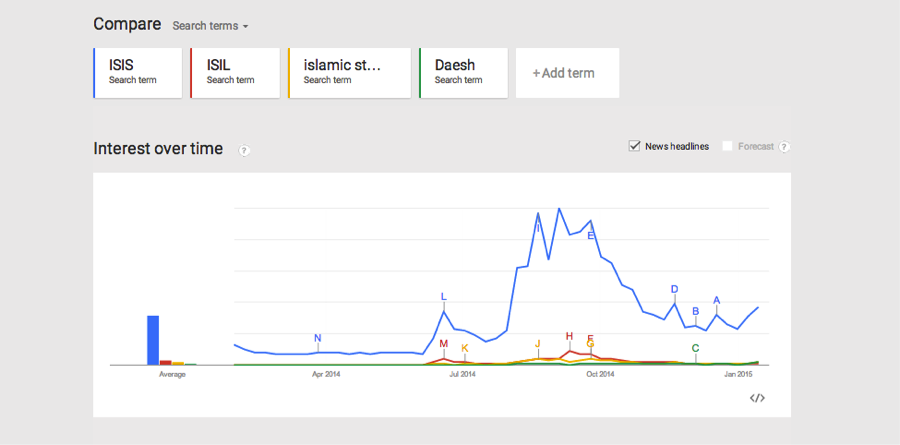
A Google Trends search for ISIS, ISIL, Islamic State, and Daesh reveals the overwhelming popularity for ISIS among Google searches:

ISIS GoogleGoogle

While some of the searches for ISIS can be attributed to it being a word with other connotations (an Egyptian goddess, for instance), the search volumes for all of the terms appear to spike at the same times, indicating major news events, with a much higher volume of searches containing ISIS than the other names. While this might not indicate which is the most popular among governments or news outlets, it shows that ISIS seems to be the name of choice for Google users, and the general public.

Regardless of the naming conventions that they adopt, many countries see a common threat in Iraq and Syria.


(Image Credit: Wikimedia Commons)

Week in DC: Events

February 23, 2015

Ebola Rapid Diagnostic Tests: What Lies Ahead?
Date: February 23, 10:00am
Location: Center for Strategic and International Studies, 2nd Floor Conference Room, 1616 Rhode Island Ave NW, Washington DC

As the Ebola epidemic continues in West Africa, a major challenge impeding international efforts to “get to zero” Ebola cases and deaths is the absence of effective, portable, and affordable Ebola diagnostic tools. There has been a considerable push by industry, governments, NGOs, international organizations, and foundations to develop these new tests. While there are many promising tools on the horizon, there are still a number of challenges and unknowns that need to be considered in terms of research and development, and implementation.

Please join us at CSIS on Monday, February 23rd at 10:00am for a roundtable to discuss the status of Ebola diagnostic technologies, the current gaps that exist, and potential solutions. Our panel will include Dr. Michael Kurilla, Director of the National Institute of Allergies and Infectious Diseases’ Office of BioDefense, Research Resources, and Translational Research; Rosemary Humes, Diagnostic Science Advisor at Health and Human Services; and Gene Walther, Independent Consultant to the Paul G. Allen Family Foundation on Ebola Diagnostics. J. Stephen Morrison, Senior Vice President and Director of the CSIS Global Health Policy Center will moderate.

Register here.

Standing Under ISIS Narratives: Implications of a Narrative Lens for Countering Extremism
Date: February 23, 12:00pm
Location: The Wilderness Society, 1615 M Street NW, Washington DC

ISIS continues to undermine the stability of the Middle East, as well as the security of western nations, spreading extremism via social media and recruiting globally. While the military effort to “degrade and destroy” ISIS has had some successes on the ground, the US and its allies find themselves unprepared to counter extremism or contain ISIS’s social media campaign. We cannot “counter” via rational arguments or logic. And the political strategies for pressuring compliance with international policy or promoting a negotiated peace are neither possible, nor practical. “Thinking narrative” offers not only a new lens on ISIS, but it also opens up new possibilities for changing the narrative landscape, at the international level, opening up new options for “countering extremism.” Sara Cobb will offer a short analysis of the ISIS narrative, which will provide the foundation for a discussion of what kinds of contributions a narrative lens could offer US policy makers.

Register here; Free for WFPG members, $25 for non-members.

Challenges Against Poverty, Malnutrition, and Infectious Disease
Date: February 23, 2:00pm
Location: U.S.-Japan Research Institute, Conference Room A, 2000 M Street NW, Washington DC

Climate change is one of the defining challenges of the century and increasingly recognized as a public health policy. Previous studies reported the relationship between the increased risk of infections and climate related disasters. Many countries have a high burden of climate-sensitive diseases, but public health capability to respond is not always optimal. Major diseases that are sensitive to climate change often become serious among vulnerable population. Household food security and maternal malnutrition are known to be linked with child mortality and growth. Low birth weight (LBW; <2,500g) is a major determinant of mortality, morbidity and disability in neonates, infancy and childhood and has long term impact on health outcomes in adult life. The prevalence of LBW is estimated to be 16% worldwide with a range of 3-40% and occurs mostly in developing countries. The incidence of LBW in Bangladesh, predominantly the result of intrauterine growth restriction, is one of the highest in the world. This study aims to describe the impact of climate-sensitive diseases on maternal and child health in Bangladesh. The results would contribute new evidence on vicious cycle of poverty and malnutrition, and facilitate policies how to mitigate the impact of climate change among vulnerable population.

Register here.

Central Asian Fighters in Syria
Date: February 23, 3:00pm
Location: Elliott School of International Affairs, Room 505, 1957 E Street NW, Washington DC

A discussion with Noah Tucker (Registan.net) and Eileen O’Connor, Deputy Assistant Secretary of State in the Bureau of South and Central Asian Affairs.

RSVP here.

IERES’ Behind the Headlines Series Presents: Russia’s Security Agenda Under Putin: A Blurring of Internal and External Securities
Date: February 23, 4:00pm
Location: Elliott School of International Affairs, Voesar Conference Room, Suite 412, 1957 E Street NW, Washington DC

This talk investigates the evolution of Russia’s security policy under President Vladimir Putin in the 21st century, using a critical security studies approach. In particular, Snetkov examines the interrelationship between the internal-external nexus and the politics of (in)security and regime-building in Putin’s Russia.

RSVP here.

The Strategist: Brent Scowcroft and the Call of National Security
Date: February 23, 4:00pm
Location: Woodrow Wilson International Center for Scholars, 6th Floor, 1300 Pennsylvania Ave NW, Washington DC

For four decades Brent Scowcroft has exerted a quiet, continued, and sometimes great influence over the conduct of US national security policy. Drawing on his new biography, The Strategist: Brent Scowcroft and the Call of National Security, Bartholomew Sparrow discusses how Scowcroft rose to become national security advisor under presidents Gerald Ford and George H. W. Bush. He explores those occasions when Scowcroft’s voice particularly mattered, and addresses the relevance of his life and career to policymakers today.

Bartholomew Sparrow is a professor of Government at the University of Texas. He is the author of From the Outside In: World War II and the American StateThe Insular Cases and the Emergence of American Empire, and Uncertain Guardians: The News Media as a Political Institution. Sparrow has been a Woodrow Wilson Center Fellow and a Joan Shorenstein Center Fellow, and is the recipient of the Leonard D. White Award and the Franklin L. Burdette/Pi Sigma Alpha Award from the American Political Science Association.

RSVP here.

February 24, 2015

2015 Index of U.S. Military Strength
Date: February 24, 11:30am
Location: Heritage Foundation, Allison Auditorium, 217 Massachusetts Ave NE, Washington DC

The 2015 Index of U.S. Military Strength is a path-breaking, comprehensive research project, to be published annually, which assesses the ability of the United States Armed Forces to provide for the common defense. Taking its place as a flagship publication alongside Heritage’s Index of Economic Freedom and Index of Culture and Opportunity, the Military Strength Index analyzes the U.S. military’s status in capacity, capability, and readiness against an enduring strategic benchmark: the ability to fight and win two major regional contingency operations simultaneously. The publication further looks at how evolving threats and opportunities around the globe contribute to and influence this ability. Finally, the 2015 Index of U.S. Military Strength provides individual analysis of overarching security themes such as how to think about National Security, the implications of prioritized national security policies like the Asia-Pacific pivot, and the critical roles played by strategic enablers such as the United States’ nuclear weapons capability and Special Operations Forces. Join us as for a special discussion of The Heritage Foundation’s new Index of U.S. Military Strength.

RSVP here to attend in person or watch online.

Japan’s Changing Security Policy and the Japan-U.S. Alliance
Date: February 24, 3:00pm
Location: East-West Center in Washington, Conference Room, 1819 L Street NW, Suite 600, Washington DC

Japanese security policy and the Japan-U.S. alliance are now in simultaneous transformation. On July 1, 2014, the Abe administration made a Cabinet decision on development of seamless security legislation, including the Government’s new view on Article 9 of the Constitution so that Japan may exercise the right of collective self-defense. Now the National Security Secretariat in the Cabinet Secretariat plays a central role in legislation work. In parallel, the Japanese Government is working with the U.S. Government to revise the 1997 Guidelines for Japan-U.S. Defense Cooperation. In this presentation, first of all, I will explain what Japan’s Self-Defense Forces (SDF) can do under the current legislation related to the 1997 Guidelines and what the SDF did for the Global War on Terrorism in the 2000s. Next, my presentation will describe major changes in Japanese security policy after Prime Minister Shinzo Abe took office in December 2012. Finally, I will discuss the impact of Japan’s changing security policy on the Japan-U.S. alliance. My overall argument is that although the ongoing transformation of Japanese security policy should not be overestimated, it is still instrumental in strengthening and updating the bilateral alliance for the new security environment. 

Register here.

The Military and Indian Democracy Since Independence
Date: February 24, 3:30pm
Location: Carnegie Endowment for International Peace, 1779 Massachusetts Ave NW, Washington DC

At the dawn of India’s independence in 1947, many worried about the threat India’s army might pose to democracy thanks to recruitment based explicitly on caste and religion. Yet, unlike in neighboring Pakistan, India’s army has not intervened in politics and the country has successfully preserved its democracy.

Steven Wilkinson will discuss how and why India has succeeded in keeping its army out of politics, drawing on research for his new book, Army and Nation: The Military and Indian Democracy Since Independence (Harvard University Press, 2015). He will explain the structures India has devised to balance army and nation, and consider their prospects for continued success in light of India’s rapidly changing society and external environment.

Carnegie’s Ashley Tellis, author of the recent report Unity in Difference: Overcoming the U.S.-India Divide, will serve as discussant. Milan Vaishnav will moderate.

Register here.

A Conversation with Colonel Lawrence Wilkerson, Former Chief of Staff to Colin Powell
Date: February 24, 8:10pm
Location: Elliott School of International Affairs, 1957 E Street NW, Washington DC

Join the International Affairs Society for a conversation with Colonial Lawrence Wilkerson. Colonial Wilkerson served as Chief of Staff to Secretary of State Colin Powell, but since retiring, has become an active critic of the War in Iraq. In his talk with the IAS, he will be discussing the need for a new grand strategy in the United State’s security and foreign policy.

Register here.

February 25, 2015

U.S.-Ukraine Cooperation: Views from Ukrainian Parliamentarians
Date: February 25, 8:30am
Location: National Democratic Institute, Boardroom, 455 Massachusetts Ave NW, 8th Floor, Washington DC

The National Democratic Institute and the Brookings Institution invite you to join them on Wednesday, February 25, for a conversation with Ukrainian Members of Parliament, including key committee leaders, on the situation in Ukraine and opportunities for U.S.-Ukrainian partnerships.

Register here.

Maidan Film Screening
Date: February 25, 5:00pm
Location: Carnegie Endowment for International Peace, 1779 Massachusetts Ave NW, Washington DC

Maidan is a 2014 documentary from the acclaimed Ukrainian director Sergei Loznitsa. From a protest to a movement to a full-scale revolution, the film chronicles the events that took place on Independence Square in Kyiv last winter. According to the New York Times, “Maidan is a film of scale and immediacy, finding artistry, for better or worse, in bearing witness.” One year after the overthrow of President Yanukovych, Carnegie invites you to join a screening ofMaidan and to a discussion reflecting on the dramatic events that led to the current crisis in relations between Russia and the West. The film will be shown in Ukrainian with English subtitles.

Following the screening, BuzzFeed’s Max Seddon and the Wall Street Journal’s Philip Shishkin—two reporters who have covered the conflict from eastern Ukraine over the past year—will discuss the film and the crisis. The discussion will be off the record. Light refreshments will be served.

Register here.

February 26, 2015

The Future of Cybersecurity Innovation
Date: February 26, 10:00am
Location: Regis Hotel, 16th and K Street NW, Washington DC

The US intelligence community has ranked cyberattacks as the No. 1 threat to national security – more than terrorist groups or weapons of mass destruction. But the military’s cyberwarriors fight these battles hunkered over computers, working with strings of code – a laborious process that requires advanced engineering skills. That’s why the Pentagon’s advanced research arm, the Defense Advanced Research Projects Agency (DARPA), is building a system to give the military instantaneous knowledge of network attacks by displaying them in real-time with rich graphics and 3-D visualizations.

Frank Pound, manager of the program, will join Passcode to give a demonstration of the in-progress system called Plan X. He’ll discuss how he’s building an “app store” to streamline cyber operations– which could fundamentally shift the way the military operates on the virtual battlefield. What will DARPA’s version of the Internet actually look like? How could technology like this help the military and the private sector in the future?

With one of DARPA’s most cutting-edge projects in mind, Passcode will then host a conversation about the broader themes of innovation in cybersecurity.

Register here.

Book Talk: “Answering the Call: Popular Islamic Activism in Sadat’s Egypt”
Date: February 26, 12:30pm
Location: Georgetown University, ACMCU, ICC #270, 3700 O Street NW, Washington DC

In this talk, Professor Al-Arian will explore the causes for the re-emergence of the Muslim Brotherhood following its two-decade absence from Egyptian society. The decade of the 1970s was a vibrant era that saw the rise of a dynamic student movement in Egypt. Coupled with Sadat’s release of veteran Muslim Brotherhood figures from prison, the opportunity arose for a renewed Islamic movement to take root within an increasingly fraught political atmosphere. By the end of the Sadat era, the Muslim Brotherhood was reconstituted in large part due to the ability of the leadership to incorporate a broad segment of the student activist movement into its ranks. Professor Al-Arian will conclude by discussing the role that this generation has played in Egyptian society and politics in the decades since, including during the 2011 uprising and its aftermath.
Register here.

Unpacking the ISIS War Game: Preparing for Escalation
Date: February 26, 12:30pm
Location: Atlantic Council, 1030 15th Street NW, 12th Floor, West Tower, Washington DC

The current US strategy to “degrade and ultimately destroy” ISIS has achieved important tactical successes, but Washington is still far from achieving its stated goals. Even more, the strategy has not yet been fully tested by ISIS. However, events on the ground over the past few months suggest that the likelihood of escalation on the part of ISIS is increasing. Conventional as well as terrorist attacks by ISIS in Libya, Saudi Arabia, Egypt and Lebanon suggest that it may be only a matter of time before the movement attacks core US strategic interests in the region.

An off-the-record, high-level war game recently conducted at the Brent Scowcroft Center’s Middle East Peace and Security Initiative challenged US strategy by analyzing two hypothetical scenarios in which ISIS resorted to escalation. How can Washington and its allies and partners in the coalition better prepare for these contingencies?

Please join the Atlantic Council on Thursday, February 26 from 12:30 p.m. to 2:00 p.m. for a discussion on the key findings from the war game and the strategic implications of potential ISIS escalation for the US-led coalition.

Register here to attend in person or watch online here.

Public Address by Her Excellency Ellen Johnson Sirleaf
Date: February 26, 1:30pm
Location: Hart Senate Office Building, Room 216, Washington DC

On February 26, Her Excellency Ellen Johnson Sirleaf, President of Liberia, will speak at an event hosted by U.S. Senator Chris Coons (D-Del.) and the U.S. Institute of Peace in Hart Senate Office Building. The speech will come during her first trip to Washington since Liberia’s declaration of a state of emergency over the Ebola outbreak last July.

President Sirleaf will offer her thanks to the American people for their support during the Ebola crisis, to Congress for authorizing funding to help stop the outbreak, to the Administration for its deployment to the region, and to aid organizations for going to the region to care for those infected. The President will also discuss the need for sustained investment in the region’s public health infrastructure in order to prevent future outbreaks.

Register here.

The Rise of the Islamic State, the U.S. Military Campaign, and the Future of Iraq
Date: February 26, 2:00pm
Location: International Institute for Strategic Studies—U.S., 2121 K Street NW, Suite 801, Washington DC

The fall of Mosul, Iraq’s second largest city, to the Islamic State in June 2014, indicated that the country had entered another profound crisis that once again put its very survival in question.  President Obama’s decision to launch an air campaign in support of the new Iraqi government indicated how serious the US government viewed the situation.  However, in spite of the undoubted military threat that the Islamic State poses, their rise is a symptom of a much larger set of primarily political pathologies that have dogged the Iraqi state since 2003.  This means Iraq cannot be stabilized through a military campaign alone.  A sustainable Iraqi state, at peace with its own population and its neighboring states would entail the fundamental reworking of the political structures put in place after regime change. Professor Dodge will examine how this process could be started and the chances of it succeeding.

RSVP here.

Countering Violent Extremism in Pakistan: Opportunities and Obstacles for Civil Society
Date: February 26, 2:30pm
Location: Woodrow Wilson International Center for Scholars, 5th Floor, 1300 Pennsylvania Ave NW, Washington DC

The December 16, 2014, school massacre in Peshawar is a sobering reminder of the still-potent threat of militancy in Pakistan. Encouragingly, nongovernmental organizations have been developing grassroots initiatives to counter violent extremism—from candlelight vigils to anti-Taliban protests. These promising efforts, however, have to this point not grown into a nationwide campaign. What does Pakistani civil society hope to achieve with its anti-extremism movement? What can be done—by Pakistan and the United States—to help strengthen Pakistani civil society in its efforts against violent extremism? And what role can or should foreign assistance play? This event, coming on the heels of the White House’s Summit to Counter Violent Extremism, marks the release of “A Strategic Plan for Empowering Pakistan’s Civil Society to Counter Violent Extremism,” published by WORDE, and will feature presentations by researchers and activists on the front lines of civil society’s anti-extremism efforts in Pakistan.

RSVP here.

Poland and the Transatlantic Security System
Date: February 26, 4:00pm
Location: Elliott School of International Affairs, Voesar Conference Room, 1957 E Street NW, Suite 412, Washington DC

Since the outbreak of the current Ukraine crisis, Poland’s national security has deteriorated. For the first time since the end of the Cold War, Poland’s latest National Security Strategy of the Republic of Poland (adopted in November 2014) indicates that Poland is threatened with military attack and that Russia represents the main threat. For this reason, Poland has undertaken intensive actions to strengthen its national security. This talk will address the role of the Ukraine crisis in developing the transatlantic security system. It will provide a Polish perspective on U.S. actions in the ongoing crisis in the context of the three pillars of Poland’s security and defense policy: (1) building up the state’s own military resources and capabilities; (2) NATO membership and close relations with the USA; and (3) cooperation within the EU framework.

RSVP here.

A New U.S.-Cuba Policy: Did Cuba Win?
Date: February 26, 5:00pm
Location: Heritage Center at the Navy Memorial, 701 Pennsylvania Ave NW, Washington DC

President Obama’s surprise announcement in December of his intention to reestablish formal diplomatic relations between the United States and Cuba has stirred vigorous debate.

Supporters justify the move by arguing that 50-plus years of diplomatic stalemate and sanctions have failed to bring freedom to the Cuban people.  They believe it was past time for a new policy that would give Cubans greater exposure to the United States and lead to more liberalization on the island.  Such a policy would also advance American interests in the Western Hemisphere more broadly given the unpopularity of U.S. sanctions against the Castro regime.

Opponents of the change argue that the Castro dictatorship has been handed a victory — formal recognition by the United States — in exchange for very little. Democratic opponents of the regime did not benefit, while the regime’s stranglehold on human freedom persists and the U.S. has relinquished key leverage for political change on the island.

On February 26, the McCain Institute will continue its Debate and Decision Series as leading experts tackle the question: A New U.S.-Cuba Policy:  Did Cuba Win?

Register here.

The Arab Spring@4–What Next?
Date: February 26, 6:30pm
Location: Project for Study of the 21st Century (PS21), 1333 H Street NW, Washington DC

To celebrate the launch of its PS21 MIDEAST blog, the Project for Study of the 21st Century and Young Professionals in Foreign Policy bring you a discussion on a region in flux. Four years after the revolutions in Egypt, Tunisia and Libya, the Middle East appears as stable as at any point in recent history. What went wrong, what might happen next and what, if anything, can the United States do to influence events?

The event will be on the record. Register here.

February 27, 2015

The U.S. Rebalance to Asia: The Political and Economic Roles of TPP in the Region
Date: February 27, 10:00am
Location: Woodrow Wilson International Center for Scholars, 6th Floor, 1300 Pennsylvania Ave NW, Washington DC

In his latest State of the Union address, President Obama stressed the need for TPP to conclude successfully in order to keep the United States competitive in global markets. But as heated negotiations to conclude the world’s most ambitious trade deal continue, there is debate too about what exactly TPP will mean for broader economic stability and relations among Asian nations. Could TPP deepen regional cohesion among Asian nations and enhance political as well as economic stability in the region? Will TPP impact U.S. relations with TPP member countries and non-members, and if so, how? Join us in a discussion about the prospects for regional economic integration and how leadership in Asia may be influenced by TPP.

This event will be hosted together with the U.S.-Japan Research Institue (USJI)

RSVP here.

An Effective P5+1 Nuclear Deal with Iran and the Role of Congress
Date: February 27, 1:00pm
Location: National Press Club, First Amendment Lounge, 529 14th Street NW, 13th Floor, Washington DC

Negotiators from the P5+1 (China, France, Germany, Russia, the United Kingdom, and the United States) and Iran are racing to try to conclude a political framework agreement for a comprehensive, long-term nuclear deal to block Iran’s potential pathways to nuclear weapons by the end of March, with technical details on a final deal to be ironed out by the end of June.

Over the past year, Iran and the P5+1 have made significant progress on long-term solutions on several challenging issues. Following the most recent round of high-level talks, the two sides reportedly made progress on key remaining issues.

At the same time, key members of Congress are threatening to advance new Iran sanctions legislation and set unrealistic requirements for a nuclear deal. Also, the chairman of the Senate Foreign Relations Committee says he will introduce legislation this month that would give Congress the opportunity to vote to disapprove or approve a comprehensive nuclear agreement once and if it is completed. Both proposals have drawn a veto threat from the Obama administration.

The Arms Control Association will host a special press briefing featuring a former member of the U.S. negotiating team, a former professional staff member of the House intelligence committee, and Arms Control Association experts on the status of the negotiations, the likely outlines of a comprehensive agreement, and the appropriate role for Congress.

RSVP here.

There is a Pattern Here: The Case to Integrate Environmental Security into Homeland Security Strategy

By Jonathon Marioneaux

Recent reports of extreme weather related events, massive industrial catastrophes with hazardous materials, and critical resource shortages have begun to highlight the need to incorporate climate change as part of the national security strategy and its effects on emergency preparedness.  In their article, Dr. Ramsay and Dr. O’Sullivan argue that changing climate and human influences are becoming more important to homeland security and must be increasingly factored into national and international security assessments. The authors argue that the term ‘Environmental Security’ should be placed among homeland security factors because of its immense reach and potential impact upon the nation and its infrastructure.  However, the role of environmental security is not simply localized to a region or country; the global impact of climate change, resource scarcity, and certain industrial disasters have global impacts that will disproportionately affect less developed nations who are not able to cope as quickly or efficiently.  Finally, these impacts must be incorporated into strategic planning more effectively in order to cope with future global security challenges.

The authors begin by laying out the factors that might impact regional security such as rising sea levels, increased storm intensity, increased droughts and floods, and increased spread of disease and explain why they are a security threat.  For example, the authors state that global sea level rise has increased from 0.02 inches per year from 1950 to 2009, however it has increased 0.08 inches per year along the Atlantic Coast.  This is a security concern as large numbers of people and pieces of critical infrastructure are located in close proximity to coastlines with little to no protection.  To provide further evidence, hurricane Sandy smashed into the Northeast and the above discussed increased sea level helped make it the most expensive natural disaster in modern history. A second example is drought that has plagued the Southeast and Western parts of the nation pushing water resources to record lows.  The result has been increased State and Municipal tensions over increasingly scarce water supplies in regions with rapidly growing populations. The resulting experiences have shown the need to increase local, regional, and federal preparedness to weather related disasters, which will continue to worsen in the future.

The authors also explain why industrial accidents and resource shortages should be factored into the national security equation.  Certain industrial accidents—such as the BP New Horizon spill in the Gulf of Mexico—have the power to influence the economy and, by extension, the physical security of regions or nations by rendering an area inhabitable or economically unsustainable. Increased resource scarcity has already been identified as a factor for political instability and will continue to be so in the future.  The authors referenced food scarcity that triggered some Arab Spring revolutions in certain Middle Eastern countries and pushed existing politicians from power and installed new regimes. Finally, increasing environmental concerns have the potential to lead to increasing levels of regional instability and failed states that will only be exacerbated by continuing climate change.

Some steps are already being taken to address these issues such as the Quadrennial Defense Review and intelligence assessments; however more still needs to be done to fully implement environmental security into the national security apparatus. Recent events have shown that increasing environmental security is imperative to increasing both national and international security because global climate changes are not limited by borders and neither are the outcomes.

Image Credit: Wikimedia Commons


Ramsay, J., & O’Sullivan, T. (2013). There’s a Pattern Here: The Case to Integrate Environmental Security into Homeland Security Strategy. Homeland Security Affairs, 9(6).

Is the Islamic State the Biggest Threat Facing the U.S.?

By Erik Goepner

While the situation on the ground today remains largely unchanged to that of October last year, Americans assessing the IS threat as extremely important or critical has jumped from 36% to 84%. Might their grotesque killings and the free media advertising they receive in response explain much of the difference in threat perceptions?

Looking at the numbers, since September 10, 2001 three thousand forty-eight people have been killed by terrorists in America’s borders. If you exclude 9/11, that number drops to 51. In the 14 years before 9/11, 223 lost their lives at the hands of terrorists in the homeland.[1]

Though precisely determining the threat posed by the Islamic State is impossible, we can be more precise in defining why the threat concerns us. For many, the concern is death, more specifically a horrific death that comes as a surprise and leaves its victim feeling powerless. There is, however, no concern that the Islamic State could one day invade the U.S. or otherwise pretend to have a military force even remotely comparable to ours. They will always be Pop Warner to America’s Super Bowl winner. In the end, the concern is death.

One way, then, to compare the threat posed by the Islamic State with other threats is to look at what kills Americans. Including 9/11 and all terrorist attacks within the homeland since, an average of 234 lives have been lost per year. During the same time period, approximately 16,000 Americans have been murdered each year, 34,000 took their own lives, and more than 500,000 died annually from cancer. If you lengthen the timeframe to fifty years, the likelihood of being killed by terrorists in America roughly equates to the likelihood of being killed by a lightning strike or an allergic reaction to peanuts.[2]

Looking at the broader geo-political landscape provides another way to help place the threat of IS within the range of threats facing America. Perhaps Iran sits atop that list. On the Department of State’s list as a state sponsor of terrorism since 1984, their latest report, from 2013, notes Iran has “increased its presence in Africa and attempted to smuggle arms to Houthi separatists in Yemen.” These are the same separatists who recently overthrew the Yemeni government. Additionally, Iran is pursuing a nuclear program, peaceful or otherwise. Russia presents another potential threat.  In 2008, they invaded Georgia and in 2014 they annexed portions of Ukraine. Might a NATO country be next, such as Latvia, Estonia, or Lithuania? Other potential threats include China as it asserts its presence in the South China Sea and elsewhere, North Korea, or even America’s rising debt which may increasingly constrain future U.S. options.

Image Credit: Wikimedia Commons


[1] See UMD’s Global Terrorism Database.
[2] John Mueller, Overblown, see “The Limited Destructiveness of Terrorism” chapter.

Week in DC: Events

February 17, 2015 

Asia Conference: China in the Middle East
Date: February 17, 9:00am
Location: United States Institute of Peace, 2301 Constitution Ave NW, Washington DC

Some regional leaders and scholars express concern about the implications of greater Chinese influence while others argue for a greater Chinese contribution to regional stability. China could leverage its significant soft power to help resolve conflicts, for example. A recent Pew global poll found that China’s favorability rating in the region was higher than that of the United States. Beijing also maintains working relationships with a number of important governments that the United States shuns, such as Syria and Iran, and might consider contributing to the campaign to degrade and destroy ISIS in Iraq and Syria, given its own interests in combating Islamic terrorism.

This conference on China in the Middle East will evaluate China’s nascent regional role, implications for regional security, the reactions of other regional actors, and the impact on U.S. policy. Join the conversation on Twitter with #ChinaMidEast.

The conference is co-sponsored by the U.S. Institute of Peace and the Georgetown University Center for Security Studies, and made possible in part through the generosity of the Philip and Patricia Bilden Asian Security Studies Fund. (PDF Agenda)

RSVP here.

America’s Role in the World
Date: February 17, 11:30am
Location: Atlantic Council, 1030 15th Street NW, 12th Floor, West Tower, Washington DC

The United States faces unprecedented international challenges that together pose significant risks to global security and prosperity. Russia’s invasion of Ukraine, China’s coercive actions in the western Pacific, ISIS’ broadening reign of terror, and other simmering crises all point to the need for reinvigorated US and transatlantic leadership in the world. The demand for vigorous and sustained leadership across all of these fronts requires an effective articulation of a strategic vision, especially on America’s purposes and how it should seek to exercise its role in the world.

On February 17, the Atlantic Council will formally launch its new Strategy Initiative through the Brent Scowcroft Center on International Security. The Council is undertaking efforts to help the United States work with its closest allies and partners to lead in an increasingly complex and turbulent world. These projects will address strategic issues related to US leadership in the world and help catalyze a national debate on American strategy.

Former United States National Security Advisor General James L. Jones, Jr., USMC (Ret.) will provide keynote addresses on the importance of defining, articulating, and assessing America’s role in the world. The keynote address will be followed by a discussion with The Hon. James N. Miller and Mr. Stephen E. Biegun, moderated by Atlantic Council President and CEO Mr. Frederick Kempe. The discussants will address the range of views on America’s role in the world within the Democrat and Republican parties.

Watch live online here or register here to attend in person.

Conflict in Ukraine
Date: February 17, 12:00pm
Location: Carnegie Endowment for International Peace, 1779 Massachusetts Ave NW, Washington DC

The current conflict in Ukraine has spawned the most serious crisis between Russia and the West since the end of the Cold War. It has undermined European security, raised questions about NATO’s future, and put an end to one of the most ambitious projects of U.S. foreign policy—building a partnership with Russia. It also threatens to undermine U.S. diplomatic efforts on issues ranging from terrorism to nuclear proliferation. And in the absence of direct negotiations, each side is betting that political and economic pressure will force the other to blink first. Caught in this dangerous standoff, the West cannot afford to lose sight of the importance of stable relations with Russia. In Conflict in Ukraine, Rajan Menon and Eugene Rumer put the conflict in historical perspective by examining the evolution of the crisis and assessing its implications both for Ukraine and for Russia’s relations with the West.

Please join us for a conversation with the book’s authors, moderated by David Hoffman.  Conflict in Ukraine will be available to purchase, and a book signing will take place at the conclusion of the event. Lunch will be served.

Register here.

Countering Violent Extremism: What to Expect From the White House Summit
Date: February 17, 3:30pm
Location: The National Press Club, 529 14th Street NW, 13th Floor, Washington DC

Over a decade ago, the 9/11 Commission Report warned that, to counter terrorism, “our strategy must match our means to two ends: dismantling the al Qaeda network and prevailing in the longer term over the ideology that gives rise to Islamist terrorism.” The recent spate of terrorist attacks in Ottawa, Sydney, Peshawar and Paris, as well as the Islamic State’s brutal execution of several hostages, make clear that the ideology that spawned the 9/11 attacks continues to incite violence today.

To address this issue, the White House is hosting a Summit on Countering Violent Extremism. Join us for a preview of the summit and a discussion of what more can be done to prevent the spread of violent extremism.
Register here.

The Future of the Fight Against ISIL
Date: February 17, 4:00pm
Location: Atlantic Council, 1030 15th Street NW, 12th Floor, West Tower

Please join the Atlantic Council’s Brent Scowcroft Center on International Security for a special event with General John Allen, USMC (Ret.), the Special Presidential Envoy for the Global Coalition to Counter ISIL, to discuss what may lie ahead in the US-led fight against the Islamist group that straddles Iraqi and Syrian territory.

Ever since General Allen’s appointment in September, he has sought to “help build and sustain the coalition so it can operate across multiple lines of effort in order to degrade and ultimately destroy ISIL.” The coalition of over sixty countries currently contributes in “various capacities…in Iraq, the region, and beyond,” to achieve the stated strategy. How will the Coalition sustain the fight against the terrorist group? What role will the United States play as the Coalition broadens and deepens its efforts? Can the fight be ultimately won? And if so, how does the Coalition define success? To answer these and other questions, General Allen will join Atlantic Council President and CEO Fred Kempe on stage. This event will be on the record and open to press.

General John Allen is the Special Presidential Envoy for the Global Coalition to Counter ISIL. He was appointed September 16, 2014 by President Barack Obama. Allen is a retired US Marine four-star General and former Commander of the NATO International Security Assistance Force and US Forces in Afghanistan from July 2011 to February 2013. Upon his retirement from the US Marine Corps, he was appointed as the Senior Adviser to the Secretary of Defense on Middle East Security.
Register here to attend in person or watch live online here.

February 18, 2015

Yemen and Libya: The Middle East’s Other Civil Wars
Date: February 18, 9:00am
Location: Brookings Institution, 1775 Massachusetts Ave NW, Falk Auditorium, Washington DC

The conflicts raging in Syria and Iraq consume most of Washington and the international community’s attention, but civil wars in Yemen and Libya have brought both countries near total collapse. Houthi rebels continue to gain ground in Yemen and the security situation continues to deteriorate in Libya. Thousands have died, and terrorist groups are gaining strength. The United States and its allies have not stemmed this instability even as the violence spreads.

On February 18, the Center for Middle East Policy at Brookings will host a panel discussion examining the escalating violence in Yemen and Libya. Bringing together a panel of experts on Yemen, Libya and the neighboring region, the conversation will raise questions about what can be done to stem the violence and what counterterrorism implementations can be made.

After the program, the panelists will take audience questions.

Register here.

The Struggle for Iraq’s Future: Is it a Lost Cause?
Date: February 18, 9:00am
Location: American Enterprise Institute, 1150 17th Street NW, Washington DC

Reports on Iraq in recent months have been less than encouraging; the advance of ISIS, sectarian violence, and falling oil prices are just a few problems Baghdad faces today. But what exactly is happening on the ground? Is the situation in Iraq as grim as some report?

We welcome you to join AEI and the Institute for the Study of War for an event featuring experts who have just returned from meetings with government and military officials in Iraq. Panelists will provide their assessment of the situation and discuss whether there is an opportunity for the United States to revise its existing policy toward Iraq.

Register here to RSVP.

The Escalating Shi’a-Sunni Conflict: Assessing Arab Public Attitudes
Date: February 18, 9:30am
Location: The Stimson Center, 1211 Connecticut Ave NW, 8th Floor, Washington DC

Sectarianism has been a driving force of conflict in the Middle East for many years. From Iraq to Yemen, Syria, and Bahrain, conflict and confrontations between Shi’a and Sunni Muslims are on the rise. The emergence of extremist groups such as Al Nusra Front and the Islamic State has further deepened this divide. Each of these groups claims to offer the correct interpretation of Islam. In this tense climate, how do Shi’a and Sunni Muslims in the Arab world view each other?

The panelists will discuss the differences in beliefs and practices between the Shi’a and Sunnis globally and the extent to which members of each group accept the other as “Muslims.” The discussion will also examine differences in political opinions between the Shi’a and Sunnis.

Part of the conversation will present findings on religious tolerance, views toward the current governments, and the role religion should play in politics and international relations based on polling in Iraq, Yemen, and Lebanon.

RSVP here.

Russia/Eurasia Forum: Fiona Hill
Date: February 18, 12:30pm
Location: Johns Hopkins School of Advanced International Studies, The Rome Building, Room 535, 1740 Massachusetts Ave NW, Washington DC

Join the European and Eurasian Studies program for a discussion with Fiona Hill, director of the Center on the United States and Europe and senior fellow in the Foreign Policy program at the Brookings Institution, as she discusses the newest edition of her book (co-authored with Clifford Gaddy), “Mr. Putin: Operative in the Kremlin.”

RSVP here.

Pakistan’s Interior Minister on New Plans to Counter Terrorism
Date: February 18, 2:00pm
Location: United States Institute of Peace, 2301 Constitution Ave NW, Washington DC

Since the Peshawar school attack, which killed more than 150 people, including 134 children, the Pakistani government has pledged to make this the turning point, targeting terrorists of all types. A number of major steps have already been taken.

The country’s federal interior ministry, which has responsibility for addressing domestic terrorism, last year produced Pakistan’s first National Internal Security Policy. The new National Action Plan sets out further ambitious goals to curtail terrorist financing; coordinate intelligence sharing across federal, provincial, and military police and security agencies; and create dedicated counterterrorism forces, among other steps.

Will Pakistan be able to act upon these policy decisions, and will it be able to turn the corner in this long and bloody fight against terrorism? Interior Minister Chaudhry Nisar Ali Khan will assess Pakistan’s counterterrorism efforts and the challenges ahead.

RSVP here.

Mr. Putin: Operative in the Kremlin (and Abroad)
Date: February 18, 2:30pm
Location: Brookings Institution, Falk Auditorium, 1775 Massachusetts Ave NW, Washington DC

With recent events in Ukraine and beyond, many policymakers and foreign policy analysts are asking what motivates Russian President Vladimir Putin. What shapes his policy decisions and how he views the outside world?   Most importantly, officials in Washington and European capitals are left asking what Putin wants and how far is he willing to go. The great lesson of the outbreak of World War I in 1914 was the danger of misreading the statements, actions, and intentions of the adversary. Today, Vladimir Putin has become the greatest challenge to European security and the global world order in decades. Russia’s 8,000 nuclear weapons underscore the huge risks of not understanding who Putin is and what his aspirations are for himself and the people of Russia.

On February 18, the Center on the United States and Europe (CUSE) at Brookings will host a discussion with Fiona Hill and Clifford G. Gaddy, authors of the new and expanded edition of Mr. Putin: Operative in the Kremlin (Brookings Press, 2015). The authors will explore Putin’s motivations and methods and will dispel potentially dangerous misconceptions about Putin.

Thomas Wright, director of the Project on International Order and Strategy at Brookings will provide introductory remarks. Jill Dougherty, public policy scholar at the Woodrow Wilson International Center for Scholars, will moderate the discussion.  After the program, the authors will take audience questions and will be available to sign books following the event.  Join the conversation on Twitter at #MrPutin.

Register here.

Breaking the Cyber Information Sharing Logjam
Date: February 18, 3:00pm
Location: Atlantic Council, 1030 15th Street NW, 12th Floor, West Tower, Washington DC

Cybersecurity information-sharing has been stuck for years.  Anything more than narrow gains have proven elusive. However, the community involved in these efforts might be at the beginning of a new phase of cooperation.  Not only is Congress examining new legislation, but the White House has placed information-sharing on the top of the agenda for securing cyberspace.

Join the Atlantic Council’s Cyber Statecraft Initiative on February 18 from 3:00 p.m. – 4:30 p.m. for a moderated discussion on challenges and solutions for information-sharing, the Administration’s recent proposals for better practices between the private sector and government, and goal-directed approaches to sharing.

The event will be accompanied by the release of a report, which examines the challenges of information-sharing, the Administration’s emerging proposals, along with solutions to breaking the current logjam.

Register here to attend in person or watch live online here.

February 19, 2015

Examining the Syrian Perspectives on Local Ceasefires and Reconciliation Initiatives
Date: February 19, 12:00pm
Location: Johns Hopkins University-SAIS, 1619 Massachusetts Ave NW, Rome Building Auditorium, Washington DC

In the year since the Geneva II talks failed to deliver any discernible progress towards a resolution of the conflict, the humanitarian and security situation in Syria has further deteriorated. With a recalcitrant regime, growing extremism, and a faltering moderate opposition, support among Syrians for a broad-based, internationally negotiated settlement to the crisis has diminished significantly. Increasingly, Syrians only envision the conflict ending once their own side prevails. However, if there are any openings for negotiations, Syrians of all political persuasions and ethno-religious backgrounds tend to favor locally-based conflict resolution initiatives that could eventually lead to a Syrian-led national resolution.

On February 19th at noon, the Syria Justice and Accountability Centre (SJAC) and the Conflict Management Program at Johns Hopkins University School of Advanced International Studies (SAIS) invite you to attend the launch of a new report detailing Syrian perspectives on locally-based conflict resolution initiatives at the SAIS campus in Washington, D.C. “Maybe We Can Reach a Solution”: Syrian Perspectives on the Conflict and Local Initiatives for Peace, Justice, and Reconciliation marks the second phase of a comprehensive research initiative launched by SJAC to investigate the opinions of a diverse group of Syrians on the transitional justice process.  It supplements the findings of last year’s He Who Did Wrong Should Be Accountable: Syrian Perspectives on Transitional Justice report, and could shed valuable light on proposals such as the Aleppo ceasefire plan sponsored by UN Special Envoy for Syria Staffan De Mistura.

An accompanying panel discussion will highlight the opinions of ordinary Syrians regarding locally-brokered ceasefire and reconciliation efforts while providing an in-depth analysis of Syrian perspectives on conflict resolution since the collapse of Geneva II.  Copies of “Maybe We Can Reach a Solution” will be available for attendees upon conclusion of the event.

RSVP here.

The Trade-Security Nexus: Key Regulatory Cooperation Issues for 2015
Date: February 19, 2:30pm
Location: The Stimson Center, 1211 Connecticut Ave NW, 8th Floor, Washington DC

Governments increasingly see an opportunity — and an imperative — to advance national security and economic competitiveness as complementary goals. In its new National Security Strategy, the Obama administration pledges to “make it easier for businesses of all sizes to expand their reach” through a range of regulatory cooperation initiatives pursued with private sector and international stakeholders. Join us for a discussion on current efforts and potential next steps to make good on that pledge, both in North America and through agreements such as the Transatlantic Trade and Investment Partnership (T-TIP) and Trans-Pacific Partnership (TPP).

RSVP here.

Je Suis Charlie? Free Expression in the Aftermath of Paris
Date: February 19, 6:30pm
Location: New York University, Abramson Family Auditorium, 1307 L Street NW, Washington DC

On January 7, 2015 an attack on the Charlie Hebdo headquarters in Paris led to the death of twelve people. Following the attack, people from around the world united in defense of free speech, the foundation of democracy. The actions of a few have ignited discussions about how free societies can share different points of views, without fear of violence. Recently, in the United States, we have seen similar fractures in Ferguson and New York. How can integrated societies work through difference of opinions without resorting to violence, while ensuring the individual’s right to express their point-of-view. Are there limitations to freedom of speech?

RSVP here.

February 20, 2015

Commission of Inquiry on Human Rights in the Democratic People’s Republic of Korea: Lessons Learned
Date: February 20, 12:00pm
Location: Center for Human Rights and Humanitarian Law, 4801 Massachusetts Ave NW, Washington DC

Join the Center for Human Rights & Humanitarian Law for a panel discussion with the Honorable Michael Kirby and Ms. Sonja Biserko, esteemed members of the UN Commission of Inquiry on the Democratic People’s Republic of Korea (DPRK).

Appointed to serve on the Commission by the UN Human Rights Council in March 2013, Mr. Kirby and Ms. Biserko, along with their colleague Mr. Marzuki Darusman, investigated the systematic, widespread, and grave violations of human rights in North Korea, with a view to ensuring full accountability. The historic report, which was presented to the UN Human Rights Council in March 2014, documents wide-ranging and ongoing crimes against humanity.

Please join us in welcoming members of the Commission for a discussion about lessons learned based on their ground-breaking findings.