The Pandora Report 9.13.13

Highlights this week include further evidence linking camels to MERS, a big innovator turning his eye to biodefense, tracking influenza A in Norwegian birds, the “eradicated” measles in the US,  tripling Tamiflu to help us all survive a serious H1N1 pandemic, and this week’s weird piece. Happy Friday!

Blame the Camel

It looks like dromedary camels are indeed the vector transmitting MERS from its proposed bat reservoir to humans. Antibodies against the deadly respiratory virus have been found in blood samples collected from camels across the Middle East, including Egypt, Sudan, Oman, and the Canary Island. However, before everyone starts shunning the desert beast of burden, it should be noted that the vast majority or MERS cases have had no contact with the animals, further suggesting person-to-person spread. Officials are calling for greater surveillance, which to date has been spotty in most states.

New York Times – “…it appears that the first confirmed or suspected cases in three separate clusters may have [had contact with camels], and in two cases, the camels were observed to be ill. According to the Saudi newspaper Asharq, a 38-year-old man from Batin, Saudi Arabia, who died of what was diagnosed as bacterial pneumonia was a camel dealer with at least one obviously sick camel. Later, other members of his family, including a mother, daughter and cousin, fell ill with what was diagnosed as MERS, and two died. They were part of a cluster of cases reported Sept. 7 by the World Health Organization.”

Tech Visionary Focuses Now On Biological Weapons Threat

An interesting interview with a tech mogul formerly associated with Microsoft. Like so many of us in the biodefense field, he’s worried about a domestic terror threat operating out of a small lab. It’s refreshing to see someone outside of the industry, with potential means, getting involved with biodefense in a way that doesn’t just involve anthrax.

NPR – “Biological terror is interesting because it is so damn cheap and yet can be even more lethal than nuclear…In this case, the adversary is going to be hidden. It’s going to be a small lab of people who could be cooking up a bio-terror weapon. They’re very unlikely to announce themselves until after the attack.”

Influenza virus in wild birds in Norway

A group of researchers in Norway have determined that ducks and gulls are a natural host of influenza A. Dabbling ducks in particular are the most prevalent host of the virus. Researchers were interested in determining the primary host in order to better understand patterns of seasonal infection.

Phys.org – “The complete genetic material from a total of five influenza viruses from mallard and common gull were sequenced and characterized. The results showed that the genes of the Norwegian viruses resembled the genes found in influenza viruses from other wild birds in Europe…Due to limited overlap between the routes used by migratory birds in Eurasia and America, influenza viruses with different genetic material have developed between these two continents. However, in some areas, it has been observed that genes can be exchanged between influenza viruses from Eurasia and America.”

Measles still poses threat to US, health officials warn

Measles is making a comeback in the US, thanks to the groups of people who think that vaccinating for measles is a bad idea. Of the 159 cases last year, 82 percent involved those who had not been vaccinated. Technically the disease has been eradicated in the US.

FOX – “Of the patients who had not received measles immunizations, 79 percent had philosophical objections to vaccination, federal health officials said. Results of a National Immunization Survey released today show that 90.8 percent of U.S. toddlers between the ages of 19 and 35 months have received at least one dose of the measles, mumps and rubella vaccine (MMR) – just above the federal government’s target of 90 percent. However, federal health officials warned that measles imported from other countries can still cause large outbreaks in the U.S., especially if introduced into areas with clusters of unvaccinated persons.”

Triple Dose Tamiflu Beats Back H1N1

If at first you don’t succeed, try, try again. A study from the University of Manitoba in Winnipeg revealed that patients critically ill with H1N1 were able to clear the virus within five days if given triple the normal dose of Tamiflu. According to study researcher Dr. Anand Kumar, amongst those patients administered the triple dose of the flu drug, 79%  cleared the virus within the 5-day timeframe, compared with just 11% of patients given the normal dose. It should be noted that past studies involving the doubling  of Tamiflu doses did not yield significant clearance times.

MedPage Today – “‘What we found was that the treatment was well-tolerated, and there were many more patients achieving viral clearance at day 5, which was our study endpoint,’ Kumar said during a session at the Interscience Conference on Antimicrobial Agents and Chemotherapy. Kumar noted that the 5-day endpoint was important because of increased survival benefits from the shortened clearance time and the reduced amount of time a patient has to endure in continued isolation, “which is a source of significant manpower demand for an intensive care unit.”

This week’s weird piece: ‘US provided chemical and biological weapons to Saddam Hussein’ – retired military officer

Disclaimer: This is from Voice of Russia, which is  the Russian government’s broadcast network and therefore not exactly a pillar of journalistic integrity.

(image Adam Foster/Flickr)
Koblentz on the Difficulties of Destroying Syria’s Stockpile

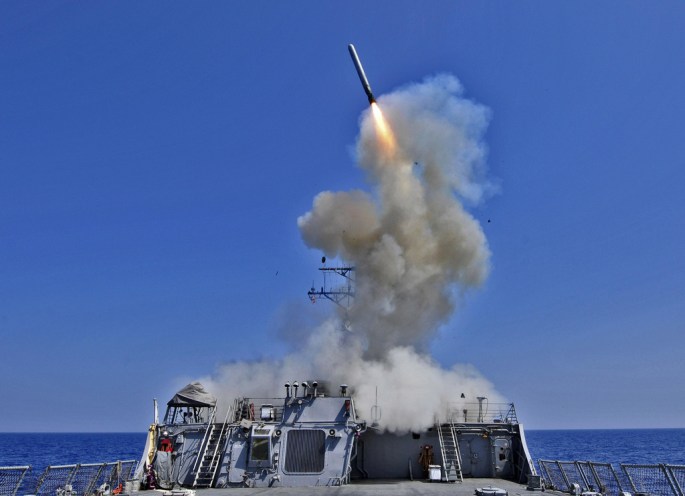
Dr. Gregory Koblentz was quoted in two articles on Syria yesterday. In the first piece in the New Republic, Dr. Koblentz discusses the potential use of Tomahawk missiles (pictured above) should the US decide to pursue military action in Syria.

“The advantage to Tomahawks, according to Gregory Koblentz, a George Mason University political scientist who specializes in weapons of mass destruction, is they are highly accurate, fly low to the ground (and can therefore typically evade air defenses), and can be fired from ships hundreds of miles away (hence the frequently used term “lobbed”)—thereby putting American soldiers at very little risk. The downside to Tomahawks is they pack a comparatively small explosive punch and, particularly because they cannot be reprogrammed in-flight, are best used on stationary targets—an especially problematic proposition given that the regime will likely have had several weeks to move whatever they want to move to different locations.”

In the second piece in Voice of America, Koblentz is quoted on the likelihood of Syria eliminating its chemical weapons stockpile.

“‘I don’t think the Syrian regime is serious about actually turning over all of their chemical weapons, and even if they were to do so in the middle of a civil war would make it virtually impossible for any kind of international group to conduct their work safely and securely. So I don’t see this happening anytime soon, if ever,’ said Koblentz.”

Read the New Republic piece here, and the Voice of America piece here.

(image: U.S. Navy photo by Petty Officer 3rd Class Jonathan Sunderman)

September Biodefense Policy Seminar!

The Biodefense Policy Seminars are back, and our Fall lineup is stellar! We’re delighted to have Dr. Daniel Dodgen of ASPR, Dr. Paul Walker of Green Cross International, and Dr. Kathleen Vogel come and speak to us this semester. As always, the seminars are free and open to the public. Our first Seminar is this Tuesday, September 17th. Details are below – stop by!

September Seminar“The ABCs of Including Special Populations in Biodefense and Public Health Preparedness”
Speaker: Dr. Daniel Dodgen
DateTuesday, September 17th, 2013 at 7:20 PM
Where
: Meese Conference Room, Mason Hall, GMU Fairfax Campus

daniel_dodgenJoin us as Dr. Daniel Dodgen discusses the importance of including special populations in Biodefense & Public Health planning. Dr. Dodgen is the Director for At-Risk Individuals, Behavioral Health, and Community Resilience in the Office of the Assistant Secretary for Preparedness and Response at the U.S. Department of Health and Human Services (HHS). His office is tasked with ensuring that HHS is developing policies and capabilities for emergency planning, response, and recovery activities that integrate at-risk individuals (including children), behavioral health, and community resilience. Dr. Dodgen also served as the Executive Director of the White House directed national advisory group on disaster mental health, and played a coordinating role in the federal response to Hurricanes Sandy, Gustav, Ike, and Dean; the H1N1 epidemic, the BP oil spill, the Sandy Hook school shooting, and other natural and manmade disasters.

RSVP to shover@gmu.edu!

For more information about our Fall lineup, please visit our Events page.

Image of the Week

Last week it was a chemical weapons slideshow (here, if you missed it), so this week we thought we’d swing back to something closer to our  hearts – Ebola!

ebola_NIAID

This rather startling image from NIAID shows Ebola particles “shedding” from infected cells, illustrating that Ebola is just as frightening on a molecular level. The virus’ distinctive, filamentous morphology is clearly visible.

Thrall on the Syrian Compromise – “Let’s Make a Deal!”

Dr. Trevor Thrall, GMU Biodefense Director, reviewed the latest developments in the ongoing Syrian saga yesterday in a piece in the National Interest. In it, he discusses the implications of the recent compromise proposal and potential US responses. Here’s an excerpt:

“The apparently accidental diplomatic overture from Secretary of State John Kerry, suggesting that Syria transfer its chemical weapons to international control to avoid U.S. airstrikes, has immediately received traction. How seriously either the U.S. or Syria will consider this proposal remains unknown. On the one hand, it is easy to argue that Syria will simply latch on to the proposal as a tactic to forestall U.S. action but has no intention of agreeing to give up its weapons. On the other hand, Syria needs Russian support more than it needs chemical weapons, and Assad may calculate that his chances against the rebels are better if the U.S. does not get directly involved militarily.

From the U.S. perspective the proposal has immediate political impact. Obama cannot strike Syria when his primary justification is in such serious question. There may be other reasons for the U.S. to engage in Syria directly, but the White House’s own PR campaign has emphasized the danger of Syria’s chemical weapons and the potential for them to wind up in the wrong hands. If Syria tells the world they are willing to consider giving them up, Obama’s argument crumbles and he cannot take action until the issue is resolved one way or another.

Ironically, for the U.S. this would be a far better outcome than Obama had any right to imagine just days ago. Having foolishly drawn the red line in the first place, and then having made a complete mess of the campaign to build both public and Congressional support, Obama may now have found a path that both gives him a big win while avoiding either an ugly defeat in Congress or having to launch airstrikes of wildly uncertain consequence…”

Read the rest of the piece here.

(image: Freedom House)

Cowpox Case in the Netherlands

A teenage girl in the Netherlands recently developed cowpox, the viral cousin of smallpox, after trying to save a drowning kitten. Within a week of her contact with the kitten, the girl had developed a large necrotic ulcer on her wrist. Cowpox being as rare as it is, by the time doctors correctly diagnosed her, the infection had begun to clear up on its own (it’s naturally self-limiting). Cowpox is famous for being used by Edward Jenner in the first effective vaccine, against the now eradicated smallpox virus. As the above image shows, there was significant resistance on the part of the local population to intentionally infecting themselves with the harmless cowpox virus. To prove the vaccine’s safety and efficacy,  in 1796 Jenner rather dubiously inoculated an eight year old boy with the cowpox virus before infecting him with smallpox. When the boy was shown to be immune to the deadly virus, the concept of vaccination was born.

As for the teenager in the Netherlands, while we’re sure having a giant black ulcer containing dead tissue open up on your wrist is pretty scary, at least she’s protected from smallpox!

Read the full story and look at the very big picture of her ulcer here.

(image courtesy of the Library of Congress)

Fall 2013 Biodefense Policy Seminar Line Up

The Biodefense Policy Seminars are monthly talks focused on biodefense and biosecurity broadly conceived. Free and open to the public, they feature leading figures within the academic, security, industry, and policy fields. Launched in the Spring of this year, the Seminars have been a tremendous success. Our Fall lineup features leaders from across the government and academic sectors, including Dr. Daniel Dogden at ASPR, Dr. Paul Walker of Green Cross, and Dr. Kathleen Vogel.

Fall 2013 Biodefense Policy Seminars

September Seminar“The ABCs of Including Special Populations in Biodefense and Public Health Preparedness”
Speaker: Dr. Daniel Dodgen
DateTuesday, September 17th, 2013 at 7:20 PM
Where
: Meese Conference Room, Mason Hall, GMU Fairfax Campus

daniel_dodgenJoin us as Dr. Daniel Dodgen discusses the importance of including special populations in Biodefense & Public Health planning. Dr. Dodgen is the Director for At-Risk Individuals, Behavioral Health, and Community Resilience in the Office of the Assistant Secretary for Preparedness and Response at the U.S. Department of Health and Human Services (HHS). His office is tasked with ensuring that HHS is developing policies and capabilities for emergency planning, response, and recovery activities that integrate at-risk individuals (including children), behavioral health, and community resilience. Dr. Dodgen also served as the Executive Director of the White House directed national advisory group on disaster mental health, and played a coordinating role in the federal response to Hurricanes Sandy, Gustav, Ike, and Dean; the H1N1 epidemic, the BP oil spill, the Sandy Hook school shooting, and other natural and manmade disasters.

October Seminar Title: “Syria and Chemical Weapons: Building a World Free of Weapons of Mass Destruction”
Speaker: Dr. Paul Walker
Date: October 16, 2013 at 7:20PM
Location: Meese Conference Room, Mason Hall, GMU Fairfax Campus

Paul-Walker_imagePaul Walker will join us to discuss Syrian proliferation concerns. Dr. Walker is the International Director of the Environmental Security and Sustainability (ESS) Program for Green Cross International (GCI) and manages the Washington DC office for GCI and its US national affiliate, Global Green USA. The ESS Program is an international effort to facilitate and advocate the safe and environmentally sound demilitarization, nonproliferation, and remediation of nuclear, chemical, biological, and conventional weapons stockpiles.  Walker has worked, spoken, and published widely in the related areas of international security, threat reduction, non-proliferation, weapons demilitarization, and environmental security for over three decades and took part in the first on-site inspection by US officials of the Russian chemical weapons stockpile at Shchuch’ye in the Kurgan Oblast in 1994. Since that time he has worked closely with the Organization for the Prohibition of Chemical Weapons (OPCW), US and Russian officials, the US Cooperative Threat Reduction (CTR) Program, the G-8 Global Partnership, and other multilateral regimes to help foster cooperative, timely, and safe elimination of nuclear, chemical, and biological weapons and related systems. He has helped to permanently eliminate over 50,000 tons of chemical weapons and millions of munitions in six countries to date. Dr. Walker was also recently awarded the 2013 Right Livelihood Award, widely known as the alternate Nobel Peace Prize. To read more about the award and Dr. Walker’s work, visit their website here.

November Seminar Title: Project BACHUS: Forecasting Bioweapons Threats with Experiment and Demonstration
Speaker: Kathleen Vogel
Date: November 21, 2013, 7:20PM
Location: Meese Conference Room, Mason Hall,  GMU Fairfax Campus

20110912_Fall Scholars 2011Dr. Vogel will describe a 1990s bioweapons threat assessment that involved setting up a mock bioweapons production facility as an “experiment”. The talk will discuss the difference between a scientific experiment and scientific demonstration and why it is important to interrogate what things are labeled as “experiments” and the implications that has for bioweapons assessments. Kathleen Vogel is an associate professor at Cornell, with a joint appointment in the Department of Science and Technology Studies and the Judith Reppy Institute for Peace and Conflict Studies. Vogel holds a Ph.D. in biological chemistry from Princeton University. Prior to joining the Cornell faculty, Vogel was appointed as a William C. Foster Fellow in the U.S. Department of State’s Office of Proliferation Threat Reduction in the Bureau of Nonproliferation. Vogel has also spent time as a visiting scholar at the Cooperative Monitoring Center, Sandia National Laboratories and the Center for Nonprolif­eration Studies, Monterey Institute of International Studies. Her research focuses on studying the social and technical dimensions of bioweapons threats and the production of knowledge in intelligence assessments on WMD issues.

Koblentz on NPR discussing Syria

Dr. Koblentz was featured in two radio interviews last Friday. The first interview, “Why Do Chemical Weapons Evoke Such A Strong Reaction?” appeared as a part of NPR’s All Things Considered.  In the interview, Dr. Koblentz discusses the implications of chemical weapons as “dreaded risks”. Listen to the timely piece here. The second piece, “Syria’s Chemical Arsenal” was featured during the Background Briefing with Ian Masters, and is available here.

This Week in DC: Events

Welcome back everyone! With Congress in session again, DC is alive and humming once more. As always, the week’s most interesting (and free) events in national security, foreign policy, and where possible, science.

Monday, September 9th, 2013

An Evening with Former U.S. Secretary of Homeland Security Michael Chertoff
Elliot School
7:00PM – 8:00PM

The George Washington University International Affairs Society will be hosting the Honorable Michael Chertoff, Former Secretary of Homeland Security (2005-2009), for a discussion on homeland security challenges and the U.S. Department of Homeland Security’s role in shaping domestic security policy. Secretary Chertoff will also reflect on his tenure at the Department and the challenges that it faces ahead.

Tuesday, September 10th, 2013

Beyond Benghazi: Libya’s Transition and the Future of US-Libyan Relations
Freedom House
12:00 – 2:00PM

September 11, 2013 will mark the one-year anniversary of the attack on the US consulate in Benghazi and the tragic loss of Ambassador Chris Stevens and three other Americans. Since then, a deteriorating security situation and growing political chaos signal a country plunging into a deeper state of crisis. Yet Libya’s transition remains critical to the security and political development of the region. What are the main challenges confronting Libya’s transition? Who are the key players in the political realm, and what are the key political dynamics? What are the prospects for the National Dialogue? What role can the United States play to positively influence Libya’s transition? Please join us for a discussion of these and other questions appraising developments in Libya since the tragic events in Benghazi and the crucial steps the US can take to help Libya establish itself as a stable, secure democracy.

Prospects for a Diplomatic Solution with Iran
American Security Project
12:30 – 2:00PM

Tensions with Iran have brought negotiations on nuclear issues to a standstill. Could the election of President Rouhani provide an opening to more productive negotiations? Join us for a conversation on the current state and future prospects for diplomatic solution to Iran’s nuclear program with Joel Rubin, Policy Director for the Ploughshares Fund; Ray Takeyh, Senior Fellow for Middle Eastern Affairs at the Council for Foreign Relations; and Greg Thielmann, Senior Fellow at the Arms Control Association.

Al Qaeda Today
American Enterprise Institute
1:00 – 3:00 PM

Al Qaeda continues to pose a significant threat to the US. The increasing danger has been obscured by confusion about what the current al Qaeda network actually is and how to understand its ramifications. As a result, the US has no coherent strategy for addressing this threat and is making decisions about its military forces, the capabilities of its intelligence services, and its reactions to crises in the Middle East that are profoundly endangering US national security. Understanding the enemy is imperative. Join us on September 10 as Katherine Zimmerman of AEI’s Critical Threats Project releases a groundbreaking paper describing the state of the al Qaeda network, drawing on granular analysis not only of the core al Qaeda group but also of its affiliates and associates that have taken root worldwide.

Wednesday, September 11th, 2013

Trident Alternatives: What Next for British Nuclear Forces?
Brookings
2:00PM – 3:00PM

For 20 years, the British nuclear deterrent has rested on Trident nuclear-armed missiles carried by four Royal Navy Vanguard-class ballistic missile submarines, at least one of which is continuously at sea. The British government is now considering how to maintain a nuclear deterrent after the Vanguard submarines are retired. This summer, the UK concluded a study looking at a range of alternatives, including options other than Trident missiles and options that would no longer maintain a continuous at-sea deterrent presence. On September 11, the Arms Control Initiative at Brookings will host a talk by Danny Alexander, chief secretary to Her Majesty’s Treasury, on the study and how Britain should adjust its future nuclear posture to take account of new financial realities. Franklin Miller of the Scowcroft Group will offer commentary, and Brookings Visiting Fellow Ian Wallace will moderate a discussion with questions from the audience.

Pakistan’s Peace with the Taliban: Is it Possible?
Young Professionals in Foreign Policy
6:30PM – 7:00PM

In response to the terrorist attacks of September 11th, the UN Security Council passed Resolution 1373 authorizing the use of force in Afghanistan. The US and its allies intervened militarily and launched Operation Enduring Freedom (OEF) in October of 2001. The goal of OEF was to disrupt, destroy and oust al Qaeda and their Taliban host from Afghanistan. However, after twelve years of military operations and state building the US, their allies and the Afghan government have been unable to stabilize the Afghan state and defeat the insurgency. On the other side of the Global War on Terrorism (GWOT), Pakistan has been battling an insurgency within it’s own borders. The Pakistani Taliban, the Tehrik-i-Taliban (TTP) and various Islamist militant groups based inside the Federally Administered Tribal Area (FATA) seek resistance against the Pakistani state, enforcement of their interpretation of sharia law and a plan to unite against NATO-led forces in Afghanistan. Pakistan has carried out several major military operations in the region and has suffered thousands of casualties. Can Pakistan’s government even really consider talking to the Taliban? Where should the line be drawn when talking peace?

Thursday, September 12th, 2013

Twenty Years After Oslo: The Search for Israeli-Palestinian Peace
Carnegie Endowment for International Peace
8:15AM – 12:00PM

A panel of U.S. and regional experts assesses the legacy of the 1993 Oslo Accords and the outlook for progress toward peace between Israelis and Palestinians.

The Longevity of Human Civilization: Will We Survive Our World-Changing Technologies?
Baruch S. Blumberg NASA/Library of Congress Astrobiology Symposium
8:30AM – 4:30PM

Will human civilization on Earth be imperiled, or enhanced, by our own world-changing technologies? Will our technological abilities threaten our survival as a species, or even threaten the Earth as a whole, or will we come to live comfortably with these new powers? Baruch S. Blumberg NASA/Library of Congress Chair in Astrobiology David Grinspoon convenes scientists, humanists, journalists, and authors to explore these questions from a wide range of perspectives, and to discuss the future of human civilization in an anthropocene world.

US-Iran Reconciliation Under President Rouhani?
Atlantic Council
9:30AM

The August 4th presidential inauguration of veteran national security official Hassan Rouhani has raised expectations for progress nearly thirty-four years after the United States broke diplomatic relations with Iran. Given Rouhani’s diplomatic demeanor and less confrontational rhetoric in comparison to his predecessor, many analysts see potential for de-escalating the nuclear crisis through Iranian concessions and US compromise on sanctions against Iran. Panelists will discuss the prospects for direct talks and progress in multilateral negotiations and dissect internal factors influencing the chances for reconciliation, including Rouhani’s new cabinet and the amount of leeway the new President is likely to receive from Supreme Leader Ayatollah Ali Khamenei.

Reset the Reset? The Future of U.S.-Russia Relations
The Institute for European, Russian, and Eurasian Studies/Elliot School
12:00 – 2:00PM

In cancelling his planned summit earlier this month with Russian President Vladimir Putin, President Obama suggested it was time to “take a pause, reassess where it is that Russia is going, what our core interests are, and calibrate the relationship.” So how might the U.S.-Russia relationship be calibrated, given core U.S. interests and Russias domestic trajectory? Kimberly Marten, Robert Orttung, and Cory Welt will lead a discussion of U.S.-Russia security relations, the nature of Russian foreign policy decision-making, and the impact of Russian domestic developments on U.S.-Russia relations.

Friday, September 13th, 2013

Technology-Strategy Seminar: NATO’s AirLand Battle Strategy and Future Extended Deterrence
CSIS
9:00 – 11:00AM

NATO’s culminating military strategy in the end-game of the Cold War was AirLand Battle. Tailored for deterrence and to win if deterrence failed, AirLand Battle was also structured to account for the political necessities of assurance and NATO cohesion. Cold War assurance and deterrence is essentially the only experience available on which to base thinking about extended deterrence in the future; although of course not all the Cold War lessons may be valid for the future. Dr. Jim Tegnelia and Dr. Rich Wagner were involved in helping to invent and implement AirLand Battle. They will discuss what it was, how it came to be, and how it worked, politically and militarily, and will speculate on lessons for the future.The seminar will be held at CSIS (1800 K St. NW) in the B1C conference room (in the basement), September 13, 9am-11am. A light breakfast will be served. This event is off-the-record.

Book Discussion: Cyber War Will Not Take Place
Wilson Center
12:00 – 1:30PM

About the Book: “Cyber war is coming,” announced a land-mark RAND report in 1993. In 2005, the U.S. Air Force boasted it would now fly, fight, and win in cyberspace, the “fifth domain” of warfare. This book takes stock, twenty years on: is cyber war really coming? Has war indeed entered the fifth domain? Author and former public policy scholar Thomas Rid discusses his new book, Cyber War Will Not Take Place. He argues that the focus on war and winning distracts from the real challenge of cyberspace: non-violent confrontation that may rival or even replace violence in surprising ways.

(image courtesy of Dell)

The Pandora Report 9.6.13

Highlights: The Syrian BW “threat”, MERS vaccine, Nipah, biological weapons in the Philippines, and al Shabaab contributing to polio. Happy Friday!

On Not Falling Prey to Syrian Biological Weapons Alarmism

There have been a lot of articles (starting with the WaPo, and snowballing to the Telegraph, VoR, etc) discussing the “emerging threat” of Syrian biological weapons. Before the rumors grow and plant seeds, we strongly recommend you take a moment to check out Dr. Ben Ouagrham-Gormely’s excellent rebuttal. Here’s an excerpt from her piece:

“A September 5 Washington Post article raises concern that Syria might resort to biological weapons in retaliation for a Western military strike. The article states that intelligence reports indicate that Syria engaged in bioweapons development in the 1970s and 80s and since then has maintained a “dormant capability,” which some experts interviewed by the Post believe can easily be reactivated to produce biological weapons. it is important to inject a little bit of reality in regard to the question of whether or not Syria might be able to successfully reactivate a “dormant program” and effectively develop and use biological weapons.”

Read the full post here.

MERS Vaccine Passes First Test

The confirmation of another two cases of the Middle Eastern Respiratory Virus in the last week, bringing the global total to 110 cases and 52 fatalities, has the scientific community scrambling to develop a viable vaccine. Now researchers at Loyola Marymount University, working in conjunction with the Erasmus lab in Rotterdam (the same lab who refused to play nice in sharing the MERS genome), have developed a candidate vaccine which can be used in case of a pandemic. However, while the candidate has passed the first pre-clinical trials, if proven efficacious in humans  it would still be at least a year before the vaccine would be ready for production.

Medical Xpress – “The starting point for the new vaccine was a related virus known as Modified Vaccinia virus Ankara (MVA). MVA is an attenuated strain of the virus that causes smallpox, and has been used for more than 30 years for the manufacture of smallpox vaccine. Indeed, MVA is at the heart of a worldwide effort to design and generate vaccines not only against viral pathogens but also against cancers. In this context, MVA serves as the carrier for specific antigens that elicit the production of protective antibodies in the immunized host. MERS-CoV is known to bind to human cells via its so-called spike (S) protein, which is exposed on the surface of its membrane envelope. Sutter and his team therefore used molecular biological methods to introduce the gene for the MERS S protein into the MVA genome.”

Bats spreading deadly virus, Stanford scientist warns

If there’s one thing we’ve learned here at GMU Biodefense, it’s stay good and far away from bats. Whether it’s rabies or MERS, the creatures of the night are bastions for all sorts of nasty diseases.  Now it looks like Pteropus bats in Bangladesh are in the “villain of the week” spotlight. A researcher at Stanford University is voicing concerns over the bats, which range across South East Asia, spreading the deadly virus Nipah.

Stanford News – “Among Nipah’s worrisome traits: Many strains are capable of limited person-to-person transmission, and it is a ribonucleic acid (RNA) virus, which has the highest known rate of mutation among biological agents. If a more efficient human-adapted strain developed, it could spread rapidly in highly populous South Asia before spilling into other regions. The global community must do a better job of estimating and managing the risk, Luby said. That will require stepped-up study of how the virus is transmitted, closer observation of infected people and consideration of vaccinations for at-risk communities.”

Military claims NPA has ‘biological weapons’; Reds laugh off claim

Moving away from the existence, or lack thereof, of Syrian BW, a rebel leader in the Philippines has been accused by the government of using biological weapons. According the Filipino government,  the device in question tested positive for both Enterobacter cloacae and Streptococcus agalacteiae. The government claims the rebels smeared the unexploded landmines with feces. The rebels deny the claims outright. We’ll leave it there.

Inquirer Mindanao – “The military insisted Thursday that the New People’s Army now uses ‘biological weapons’ to further its goal of toppling the government. In a press statement, the Eastern Mindanao Command based here said laboratory examination of unexploded land mines seized from NPA camps in Southern Mindanao showed the presence of ‘deadly toxin’ and bacteria ‘not usually found in steel rebars and nails used as shrapnel.’ The NPA unit operating in the region laughed off this claim, calling it ‘malicious and wildly concocted military propaganda.'”

Somalia: Polio Widespread in Regions Under Al-Shabaab Control

Polio eradication is a bit of a soapbox around here, maybe because as a planet we’ve been so close for so long and because it’s often security issues which hamper efforts. For those of you who have managed to miss our various rants, all but three states – Nigeria, Afghanistan, and Pakistan – have eradicated the virus. Somalia, despite its numerous failings, worked extremely hard to become polio-free in 2007. The news that the terrorist organization al-Shabaab, which controls large swathes of Southern Somalia, is refusing to allow supplies into territory it controls, while also telling local populations that the vaccine causes AIDS and sterility, is infuriating.

All Africa – “Al-Shabaab’s refusal to allow the supply of the polio vaccine in areas under its control is causing panic among residents at a time when aid workers are struggling to contain an outbreak of the crippling virus.’The polio outbreak plaguing Somalia has spread despite significant efforts to curb the disease,’ the United Nations Office for the Co-ordination of Humanitarian Affairs (OCHA) said in a statement August 15th, adding that insecurity is hampering efforts to contain the virus. Six years after Somalia was declared free of the virus, at least 105 cases have been confirmed in the country, the ‘worst outbreak in the world in a non-endemic country’, according to OCHA.

(image: Hakan Dahlstrom/Flickr)