The Pandora Report 2.21.14

Editor’s note: Hello all Pandora Report subscribers! This is unfortunately my last week as author of the Pandora Report. It’s been such a pleasure having the opportunity to write the Pandora Report, and I would like to thank all of you for taking the time to subscribe and read it. I leave you all in the trusty hands of the new Pandora Report team – goodbye, thank you, and remember to stay away from the bats.

Highlights include PEDv, 1918 Spanish Flu, MERS-CoV, and Ebola. Happy Friday!

As deadly pig virus spreads, USDA warns of impact on hog supply

Porcine epidemic diarrhea virus (PEDv)has spread to a further two states, with Montana and Idaho reporting cases for the first time. The virus, which has a fatality rate approaching 100% in piglets, has swept across the country, with 3,528 cases in 25 states. Contaminated feed was recently put forth as a potential source of the virus’ spread. Before you start autoclaving your pork products, remember that the virus poses no threat to humans.

Chicago Tribune – “PEDv causes diarrhea, vomiting and severe dehydration in pigs. Research by the U.S. hog industry determined it is spread orally through infected pig manure, and can be carried by trucks, boots, clothes and water. But feed containing porcine by-products, including but not limited to plasma, recently came into focus as a means of transmission. The Canadian Food Inspection Agency (CFIA) found the virus in samples of U.S.-origin plasma from a third-party manufacturer for Grand Valley Fortifiers, a livestock feed company based in the province of Ontario. The company recalled the feed.”

Study revives bird origin for 1918 flu pandemic

According to a new study published in Nature, the 1918 (H1N1) Spanish flu virus originated not from reassortment in pigs, but from domestic water and shore birds. This most recent study contradicts finding in a persuasive 2009 study which found the virus to have circulated in humans and pigs for up to 15 years prior to the pandemic. Historical epidemiology is critical to better understanding, and therefore predicting, emerging  pandemic threats.

Nature – “The virus that caused the 1918 influenza pandemic probably sprang from North American domestic and wild birds, not from the mixing of human and swine viruses. A study published today in Nature1 reconstructs the origins of influenza A virus and traces its evolution and flow through different animal hosts over two centuries. ‘The methods we’ve been using for years and years, and which are crucial to figuring out the origins of gene sequences and the timing of those events, are all flawed’, says lead author Michael Worobey, an ecologist and evolutionary biologist at the University of Arizona in Tucson. Worobey and his colleagues analysed more than 80,000 gene sequences from flu viruses isolated from humans, birds, horses, pigs and bats using a model they developed to map evolutionary relationships between viruses from different host species. The branched tree that resulted showed that the genes of the deadly 1918 pandemic virus are of avian origin.”

Saudi Arabia’s MERS Death Toll Reaches 60

The sixtieth MERS-CoV fatality in Saudi Arabia was a 22-year old male with previously existing conditions. The young man was also battling cancer. There have been 182 cases of the virus globally, of which 165 have been in Saudi Arabia. All but nineteen of the fatalities have been in Saudi Arabia. No word yet on whether he had previous contact with camels.

Gulf Business – “The virus, which first appeared in 2012, has affected around 182 people globally and has resulted in 79 deaths till date, according to World Health Organisation (WHO). MERS, a deadly but less transmissible virus than SARS, has symptoms such as coughing, fever and pneumonia. Although the worldwide number of MERS infections is fairly small, the high death rate among confirmed cases and the spread of the virus beyond the Middle East is keeping scientists and public health officials on alert. Cases have been reported in Saudi Arabia, Qatar, Kuwait, Jordan, UAE, Oman and Tunisia as well as in several countries in Europe.”

Man steals phone from Ebola patient, gets infected

As this is my last Pandora Report, it is only appropriate Ebola is mentioned at least once. This story is making the rounds again following it’s use in a promotional AARP blog post (bold move, AARP, bold move). Its moral? Don’t steal things from hospitals. Especially things located in a hospital’s active quarantine zone. Especially things located in a hospital’s active quarantine zone during an Ebola outbreak.

The Daily Monitor (Uganda) – “Security and medical officials in Kibaale District have registered a case in which a man allegedly went in an isolation ward at Kagadi Hospital and stole a cellular phone from one of the Ebola patients…Police detectives began tracking him after he apparently began communicating to his friends using the phone. But as police zeroed in on him, he developed symptoms similar to those of Ebola and sought medication at the hospital…In his confession made to the police, the suspect, now patient, claimed he had visited the isolation ward to give them comfort although he confessed to knowing none in person.”

(image courtesy of NIAID)

H1N1 Deaths on the Rise

From the Washington Post – “The H1N1 virus responsible for the 2009 global pandemic is back. State health officials from across the country say the resurgence is resulting in a dramatic rise in flu deaths in young and middle-aged adults and in children this season. While the reported death tolls so far are only a fraction of what they were four years ago, they are significantly higher than last year. The Centers for Disease Control and Prevention said the flu has been killing at epidemic levels since mid-January. Graphic Since October, 6,655 Americans were hospitalized with the flu. Click Here to View Full Graphic Story Since October, 6,655 Americans were hospitalized with the flu. With one month to six weeks to go in the flu season, which typically ends in March or April, the CDC said the number of people visiting doctors and hospitals for flu-like symptoms is declining overall, but some states are continuing to see high levels of flu activity or even increases in activity. Although the flu usually disproportionately affects the very old and the very young, this season 60 percent of those hospitalized for influenza have been age 18 to 64.”

Read more here.

Image of the Week: Influenza

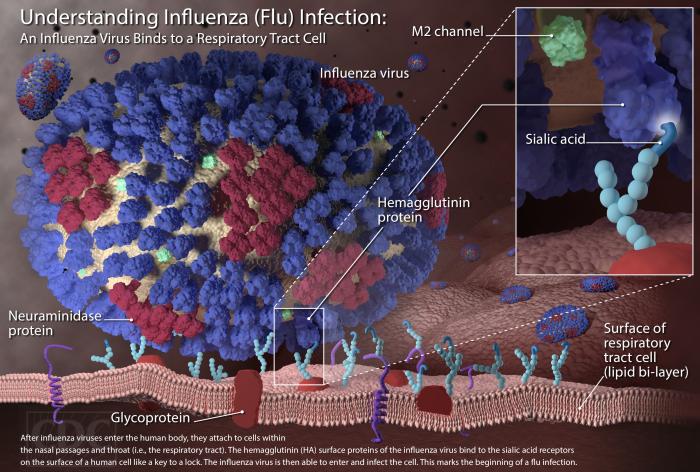
For those of you wondering what influenza’s mechanism of infection looks like, please see the below! Hemagglutinin is the H portion, and neuraminidase is the N – H1N1 therefore refers to the H1 hemagglutinin and the N1 neuraminidase. Both are surface glycoproteins responsible for host cell binding.

influenza

(Image: Arizona Department of Health)

International Cooperation to Eliminate Syria’s Chemical Weapons

While the delays in Syria’s transfer of chemical agents has received significant media attention lately, less attention has been paid to the impressive international coalition that has been assembled to remove and destroy these chemicals. Although the original agreement for Syria to join the Chemical Weapons Convention (CWC) and destroy its chemical weapons was the result of U.S.-Russian diplomacy, implementing this agreement has become a truly international initiative. Within only a few months, the international community devised a plan to eliminate Syria’s chemical weapons program and put in place the resources necessary to achieve this objective.

The extent to which Syria’s chemical disarmament has been internationalized is reflected in a recent fact sheet published by the Organization for the Prohibition of Chemical Weapons (OPCW), the international organization charged with implementing the CWC and destroying Syria’s chemical weapons. The fact sheet provides details on the financial and in-kind contributions made by states to the organization’s program to eliminate Syria’s chemical weapons. While the OPCW received approximately $1.2 million when it won the 2013 Nobel Peace Prize, this amount is only a fraction of the expected cost of destroying Syria’s stockpile of 1,390 tons of chemical weapons. So far, twenty-six countries have pledged or contributed more than $86 million to support this effort. Fifteen nations have also provided in-kind assistance to the United Nations or to Syria to facilitate Syria’s chemical disarmament. Granted, the provision of field kitchens by Belarus and ambulances by China might sound mundane, but in war-torn Syria such resources are in short supply.

An international flotilla of ships from six nations has assembled in the Mediterranean to support the removal and destruction of Syria’s chemical arsenal. So far, the Dutch and Norwegian cargo ships Ark Futura and Taiko have picked up three loads of chemicals from the Syrian port of Latakia, comprising about 11% of the Syrian stockpile. The centerpiece of this maritime “coalition of the willing” is the U.S.-supplied MV Cape May which will use a Field Deployable Hydrolysis System to destroy 560 tons of Syrian chemicals at sea. Italy has offered the use of the port of Gioia Tauro for the transfer of chemicals from the Dutch and Norwegian cargo ships to the Cape May. Warships from China, Denmark, Norway, Russia, the United Kingdom and the United States will protect these vessels during the removal and destruction process.

In addition to this at-sea destruction, the United Kingdom has agreed to destroy 150 tons of chemical weapon precursors at a commercial facility and a state-owned enterprise in Germany will dispose of the waste generated by the destruction of the chemical warfare agent mustard. On February 14, the OPCW awarded contracts to private firms in Finland and the United States to destroy and dispose of the remainder of Syria’s chemical stockpile.

Thanks to the efforts of the United Nations and OPCW, supported by the financial and material contributions of thirty nations, there is now a comprehensive system in place to safely and securely remove and destroy Syria’s stockpile of chemical agents. Syria has already missed two deadlines for getting rid of its stockpile. The time for delay is over. The international community has done its part. Now it is up to Syria to deliver on its promise of chemical disarmament.

Delving Deeper: Everything You Wanted to Know About PHSBPRA (Part Two)

This is Part Two of our series on PHSBPRA – read the first part here.

By Yong-Bee Lim

III. The Public Health Security and Bioterrorism Preparedness Response Act of 2002: Purpose and Implementation

Part of the Bioterrorism Act of 2002 was meant to build on the precedent of the Patriot Act: the tradition of further defining and narrowing the scope in which individuals and institutions could legitimately have access and possess select biological agents. In fact, the Act greatly expanded upon previous legislation related to the possession, transport, and use of select agents. However, the Act also sought to make many improvements to the public health and emergency preparedness infrastructures.

The Act itself has five core titles. Four of these titles outline a plan to prepare for, respond to, and protect against biological agents. The last title, Title 28, is an additional amendment to the Public Health Services Act. While all of the titles involved in this particular piece of legislation have to do with public health emergency preparedness and bioterrorism, the two titles of greatest importance for this paper are those of Title 1 and Title Two: National Preparedness for Bioterrorism and Other Public Health Emergencies, and Enhancing Controls on Dangerous Biological Agents and Toxins, respectively.[1]

Title 1 of the Act highlights five goals that need to be addressed to achieve better national and public health preparedness. These goals include

  • Goal 1: “Providing effective assistance to state and local governments in the event of bioterrorism or some other public health emergency”
  • Goal 2: “Ensuring that state and local governments have appropriate capacity to detect and respond effectively to emergencies through effective public health surveillance and reporting mechanisms at state and local levels, appropriate laboratory readiness, properly trained and equipped personnel, proper health and safety protection of workers responding to emergencies, efficient coordination of health and mental health services during and after emergencies, and participation in communication networks that can effectively disseminate relevant information in a timely and secure manner to appropriate public and private entities”
  • Goal 3: “Developing and maintaining medical countermeasures (such as drugs, vaccines, and other biological products, medical devices, and other supplies) against biological agents and toxins that may be involved in acts of bioterrorism or other public health emergencies”
  • Goal 4: “Ensuring coordination and minimizing duplication of federal, state, and local planning, preparedness and response activities during investigation of a suspicious disease outbreak or other potential public health emergency”
  • Goal 5: “Enhancing the readiness of hospitals and other health care facilities to respond effectively to various types of emergencies”[2]

Title 2 of the Act gets more into fundamentally defining, expanding, and enhancing legal and accountability structures for select agents. This Title mandates:

  • “The formation of lists of biological agents and toxins that have the potential to pose severe threats to the public’s health and safety by the U.S. Department of Health and Human Services (HHS) and the Department of Agriculture (USDA)”
  • “The promulgation of regulations by HHS and USDA in establishing safety measures for select agents including proper training and appropriate skills to handle select agents and proper laboratory facilities to contain and dispose of the agents; the security of select agents to prevent their use in domestic and international terrorism; procedures to protect the public safety in the event of the transfer of such materials in violation of the act; and ensure the availability of biological agents and toxins for research, education and other legitimate purposes”
  • “The promulgation of regulations by HHS and USDA for the possession, use, and transfer of select agents, registration of individuals including provisions to ensure that persons register have a lawful purpose to possess, use, and transport the agents; and procedures to identify and characterize the agents held at a facility”
  • “Prompt notification of the release of a select agent outside the biocontainment area”
  • “The promulgation of regulations by HHS and USDA to ensure that appropriate ssafeguards and security arrangements for persons possession, using, or transferring the agents exist at a facility. Registered persons shall have their names and other identifying information submitted to the Department of Justice (DOJ). Access shall be denied to those identified as restrict persons; access shall be granted to only those individuals identified by the Secretaries of HHS, USDA, and DOJ; the DOJ shall use criminal, immigration, national security and other electronic databases to determine if a person is a restricted person or otherwise suspected of committing a crime, being involved in an organization that engages in domestic or international terrorism, or being an agent of a foreign power”
  • “That DOJ establishes penalties for violation of the Act”[3]

As seen in the act, a number of agencies are required to work independently, as well as in concert, to effectively implement the PHSBPRA. One such agency, the Department of Homeland Security (DHS), was originally crafted in November 2002 following the reorganization of 22 disparate Federal agencies. DHS’s mission is primarily responsible for protecting the nation and managing national emergency preparedness. Current manifestations of DHS’s role within the structure of the PHSBPRA includes Management Direct (MD) 026-03, which entrusts “the Undersecretary for Science and Technology at DHS with the responsibility of ensuring the proper implementation of and compliance with the statues and related regulations for the safeguard of select agents and toxins in activities conducted or sponsored by DHS.”[4]

Another key agency in the PHSBPRA is the Department of Health and Human Services (HHS). This agency, which had already been in existence, was designated as the primary federal agency responsible for implementing activities relating to public health and hospital emergency preparedness. To this end, HHS led itself and its partners to gradually move from a threat-based to an all-hazards approach of emergency preparedness.[5] In addition, the Bioterrorism Act vested new authorities concerning food safety and security within the domain of HHS. Intiatives such as the Strategic Partnership Program Initiative promoted collaboration between federal, state, and industry partners through the use of a vulnerability assessment tool to identify sector-wide vulnerabilities involving food security.[6]


Yong-Bee Lim is a PhD student in Biodefense at George Mason University. He holds a B.S. in Psychology and an M.S. in Biodefense from George Mason University as well. Contact him at ylim3@masonlive.gmu.edu or on Twitter @yblim3.

[1] “Bill Text: 107th Congress (2001 – 2002): HR 3448.ENR,” The Library of Congress (Thomas), accessed 01/16/2014, http://thomas.loc.gov/cgi-bin/query/F?c107:1:./temp/~c107EKVknu:e947:

[2] Ibid.

[3] Ibid.

[4] “MD Number 026-03: Select Agent and Toxin Security,” Department of Homeland Security: Directives System, accessed on 01/16/2014, http://www.dhs.gov/xlibrary/assets/foia/mgmt-directive-026-03-select-agent-and-toxin-security.pdf

[5] Secretary of HHS, Michael O. Leavitt, “On HHS Bioterrorism and Public Health Emergency Preparedness before the Committee on Health, Education, Labor and Pensions,” Testimony for the United States Senate at Washington, DC, March 16, 2006.

[6] Ibid.

The Pandora Report 2.14.14

Highlights include H7N9 in Hong Kong, H5N1, a new case of MERS, and a new global initiative to counter infectious diseases. Happy Friday, stay warm, and Happy Valentine’s day!

Hong Kong Reports Fifth H7N9 Bird Flu Case

We wrote earlier this week about the H7N9 case in Malaysia, in which a Chinese tourist brought the virus to Malaysia. Hong Kong has since reported its fifth case of the virus. The patient is a 65 year old male with underlying medical conditions.  Tensions are understandably running high in the area, with Chinese authorities recently arresting a man for spreading false rumors about the virus.

Naharnet – “Preliminary investigations showed the man had traveled to the neighboring Chinese province of Guangdong from January 24 to February 9, and had purchased a slaughtered chicken in the village near his residence on January 29. Seven family members had remained asymptomatic, with five classified as close contacts to be admitted to hospital for observation and testing. Hong Kong late last month slaughtered 20,000 chickens after the deadly H7N9 bird flu virus was found in poultry imported from Guangdong. Fears over avian flu have grown following the deaths of three men from the H7N9 strain in the city. All had recently returned from mainland China.”

Canadian who died from H5N1 flu might have caught it in illegal bird market
It is thought the Canadian who contracted H5N1 became infected after passing through an illegal live poultry market in Beijing. Such markets have been banned in the city since 2005 – local demand for fresh poultry, however, has caused a thriving illicit industry to spring up.

CBC – “The source of the woman’s infection has been a mystery; she spent her entire trip in Beijing, where H5N1 reportedly hasn’t been discovered for some time, and her travelling companion said she did not have contact with live birds while there. But scientists from Beijing’s Centre for Disease Prevention and Control are hypothesizing that illegal live bird markets may have been the source of the woman’s infection.”

Camel-owner in Abu Dhabi in intensive care after contracting MERS virus
A camel-owner in the UAE has presented with MERS, giving further credence to the theory of camels as potential hosts. The 67-year old man had previously existing medical conditions, becoming symptomatic on January 20th.  There have been 182 laboratory-confirmed cases of the virus to date, with 79 deaths.

The National – “A camel owner in the emirate has become the latest person to be infected with the Mers coronavirus. The Emirati, 66, is in intensive care after complaining of respiratory problems and was found to have contracted the virus, it was confirmed on Thursday…He owns camels in the UAE and had recently travelled to Oman where he was in contact with other beasts, the World Health Organisation says.”

U.S. launches new global initiative to prevent infectious disease threats
Working with WHO, the Food and Agriculture Organization, and the World Organization for Animal Health, the US launched a new global initiative to help countering emerging infectious diseases. Speaking about the threat of emergent infectious diseases, Health and Human Services Secretary Kathleen , “A threat anywhere is indeed a threat everywhere”.

Washington Post – “Faced with what they describe as a perfect storm of converging threats from infectious-disease epidemics, U.S. officials launched a global effort Thursday with more than two dozen countries and international organizations to prevent deadly outbreaks from spreading. The goal is to prevent, detect and respond to infectious-disease threats where they start. That’s more effective and less costly than treating sick people after diseases spread. The new initiative is intended to bolster security at infectious-disease laboratories, streng-then immunization programs and set up emergency-response centers that can react to outbreaks within two hours.”

First H7N9 Case Outside of China

The first case of H7N9 detected outside of China has been detected in Malaysia. A Chinese tourist in the country fell ill and has subsequently been stabilized in a local hospital.

From The Star (Malaysia) – “The Health Ministry has confirmed the first Influenza A (H7N9) case in the country, involving a female tourist from China. The import case involves a 67-year-old Chinese woman, who had travelled from Guangdong, China, to Kuala Lumpur on Feb 4. The woman went to Sandakan, Sabah the next day before going on to Kota Kinabalu on Feb 6. ‘The woman was referred to a private hospital in Kota Kinabalu on Feb 7, and (after two screenings) on Feb 11, the sample tested positive for the Influenza A (H7N9) virus. She is currently receiving treatment in the ICU, put on ventilator and is in a stable condition,’ Health Minister Datuk Seri Dr S Subramaniam said in a press conference, here, Wednesday. Dr Subramaniam stressed that there was no cause for panic over the matter as the risk for human transmission of H7N9 is ‘very low’.”


Image of the Week: Hantavirus!

This week in viral wallpaper, we’d like to present…Hantavirus!

hantavirus

Image and caption from  the CDC: “This image reveals some of the cytoarchitectural features seen in a lymph node specimen that had been extracted from a patient suspected of a Hantavirus illness. Note the concentration of lymphohistiocytic infiltrates, almost all cases have expanded paracortical regions, or T-cell regions with immunoblasts, which sometimes extend into the cortex and into the medulla.”

TONIGHT: February Biodefense Policy Seminar feat. Charles Duelfer

Our February Biodefense Policy Seminar is tonight! The Biodefense Policy Seminars are monthly talks focused on biodefense and biosecurity broadly conceived. Free and open to the public they feature leading figures within the academic, security, industry, and policy fields. Launched in the Spring of this last year, the Seminars have been a tremendous success.

cduelferFebruary Biodefense  Policy Seminar
Speaker: Charles Duelfer
Date: Tuesday, February 11th, 2014
Time: 7:20 PM
Location: Research Hall, Room 163, GMU Fairfax Campus

We  are delighted to announce our February speaker, renowned WMD expert Mr. Charles Duelfer. Charles Duelfer was the Special Advisor to the Director of Central Intelligence for Iraq WMD. He led the Iraq Survey Group (ISG) investigation in Iraq, which conducted the investigation of Iraq’s WMD programs. The ISG was a unique intelligence organization of over 1600 military and civilian staff that investigated Iraq WMD programs. It used all possible collection and analytic capabilities in a hostile environment. The Duelfer Report (2004) is the definitive work on the relationship of the Saddam Regime to WMD.

Previously, Mr. Duelfer was the Deputy Executive Chairman of the UN Special Commission on Iraq (UNSCOM) from 1993 until its termination in 2000. For the last several months of its existence he was the acting chairman.

Duelfer also served in the Political-Military Bureau of the State Department for several years in a variety of capacities including directing regional security programs in Africa (including Somalia, Sudan and Chad), Latin America, and the Middle East. He also participated in the policy development for nuclear weapons and arms control subjects.

From 2006-2008, Duelfer was chairman and CEO of Transformational Space Corporation, a small entrepreneurial company developing a launch system for transportation to low earth orbit. Presently he is Chairman of Omnis, Inc, a consulting firm in McLean, Virginia.

He is the author numerous articles on security and intelligence and the book, Hide and Seek: The Search for Truth in Iraq (Public Affairs Books 2009).

Spike in H7N9 Cases Elicit new warnings

From Shanghai Daily – “At least 31 people died from H7N9 bird flu in China this year, the government announced yesterday, while health experts predicted more H7N9 cases in the near future. A total of 127 human H7N9 cases have been confirmed so far this year, with Zhejiang and Guangdong provinces the worst affected, according to a statement by the National Health and Family Planning Commission. The number is almost as high as for the whole of last year, when China had 144 confirmed cases, including 46 deaths. The commission said that there will continue to be sporadic reports of H7N9 infections. Flu viruses are seasonal and the first human cases emerged in February 2013, so that the outbreak did not encompass all of last winter. It has reignited fears that a bird flu virus could mutate to become easily transmissible between people, threatening a pandemic.”

Read more here.