
By Meghan Waters, Biodefense MS Student
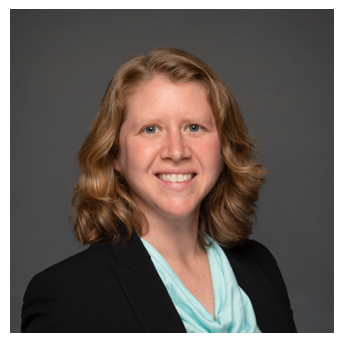
This spring, the Schar School of Policy and Government’s Biodefense Graduate Program welcomes Dr. Sarah R. Carter as a new adjunct professor who will teach BIOD 610: AI and Biosecurity, the first graduate-level course of its kind in the country. Artificial intelligence is changing what researchers can do with biology and raising new questions about how those capabilities could be misused. For students interested in what happens when emerging technology meets public policy, Carter’s course offers an opportunity to examine these challenges with someone who has worked at that intersection firsthand.
What to Expect in the Classroom
The rise of AI has accelerated biological discovery while introducing new security risks. This course will examine several ways AI intersects with biosecurity, from chatbots that could provide technical “uplift” to someone working in a laboratory to biological design tools that predict pathogen properties or generate viral genomes. While these technologies can support beneficial applications, the same capabilities create new opportunities for misuse. This dual-use dilemma raises difficult questions about how to encourage scientific innovation while reducing risks. Students will examine the risks and evaluate how new AI governance efforts fit alongside existing frameworks, such as the Biological Weapons Convention and nucleic acid synthesis screening. The goal is to provide students with the analytical tools to evaluate emerging technologies, understand the limits of what is known about their risks, and make sense of the policy debates shaping their future. Whether students ultimately work in government, research, consulting, or the private sector, these questions are increasingly relevant to the future of biodefense and biosecurity.
Meet Dr. Carter
For students who come to the Biodefense Graduate Program hoping to bridge the gap between science and policy, Dr. Carter’s path is proof that a lab background is a foundation, not a detour. She holds a bachelor’s degree in biology from Duke University and a PhD in neuroscience from the University of California, San Francisco, where she worked in molecular biology. She knew early on that a career at the lab bench was not for her. “I felt like the more I learned, the less I knew,” she recalls, describing the experience as “learning more and more about less and less.” That led her to science policy fellowships: the Mirzayan Science and Technology Policy Fellowship at the National Academy of Sciences, which she recommends to any graduate student curious about policy, and then two years as an AAAS Science and Technology Policy Fellow in the federal government. Early in her career, she worked on policy at the J. Craig Venter Institute and at the White House Office of Science and Technology Policy, where she was able to use her scientific training doing work that felt productive and fulfilling in a way that working at the lab bench had not.
Today, Dr. Carter is the principal of Science Policy Consulting LLC, where she focuses on the societal and policy implications of emerging biotechnologies, including responsible innovation, biosafety, and biosecurity. In recent years she has supported the Nuclear Threat Initiative (NTI) on DNA synthesis screening and on the implications of AI for biosecurity and has also supported the Coalition for Epidemic Preparedness Innovations (CEPI) to develop practical biosecurity approaches for higher risk biological AI tools.
She traces the moment AI landed on the biosecurity radar to two milestones: AlphaFold 2’s leap in protein structure prediction in 2020, and the release of ChatGPT in November 2022. The latter, she recalls, gave people the feeling that they were talking to “another entity” for the first time. By the spring of 2023 she was working with NTI on a project that produced a report on the convergence of AI and life sciences, covering where the risks come from and how to address them. It was among the earliest comprehensive efforts on the topic. For Dr. Carter, biosecurity has always been about the preventing the misuse of the tools used to engineer biology. Over the last 50 years, advancements in recombinant DNA, PCR, synthetic DNA, and CRISPR have brought new security concerns and prompted questions about how those capabilities might be misused. For Dr. Carter, AI is “the latest and greatest enabler of engineering biology, and one of the more chaotic.” That combination of scientific promise and security risk is at the heart of Dr. Carter’s work—and the questions she will bring to the classroom this spring.
Current students can enroll in the class starting October 27 by logging into Patriot Web. To learn more about the Schar School’s Biodefense Graduate Programs, including the MS, PhD, and graduate certificates, click here.


One thought on “Meet Dr. Sarah R. Carter: Where Artificial Intelligence, Biosecurity, and Policy Converge”