
Welcome to this week’s Pandora Report! This issue highlights the next generation of global biosecurity leaders, the evolving H5N1 outbreaks in the Pacific Northwest, and international efforts to strengthen chemical and biological weapons norms.
📣 Interested in Graduate Study in Public Policy, Biodefense, or International Security?
The Schar School of Policy and Government is hosting a series of upcoming virtual information sessions for prospective master’s and PhD students. These interactive sessions offer a direct opportunity to learn about curriculum structure, career pathways in biodefense and policy, and the student experience at George Mason University.
From DC to Geneva: ELBI 2026 Fellows Conclude Year of Biosecurity Collaboration
By Kimberly Ma, PhD Candidate in Biodefense at George Mason University
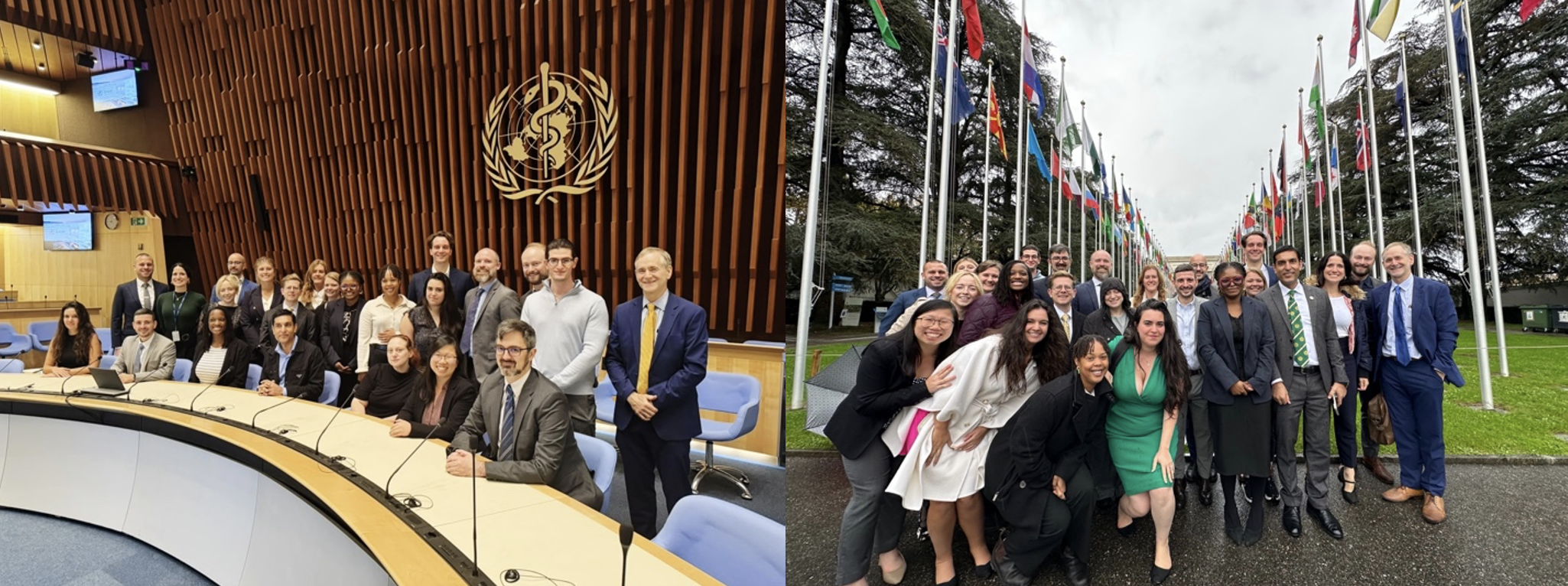
The Johns Hopkins University Center for Health Security’s Emerging Leaders in Biosecurity Initiative has officially wrapped up its final workshop for its 2026 cohort of ELBI fellows! ELBI had three events in 2026: a workshop in DC in March, the ELBI research symposium in July, and a trip to Geneva in late October.
Fellows brought a wide range of sectors, experience, specialties, and home countries (this year’s fellows covered 5 different continents!), and the first workshop served as both an opportunity to start to get to know each other and a way to level-set so that all fellows had the foundational knowledge to engage in discussions. The July event was a fantastic display of the broad expertise and passions of the ELBI fellows’ network, as current and former fellows came together for a research symposium to present on their current efforts and discuss thoughts on future directions. For the most recent October event, fellows traveled to Geneva, where they met with renowned experts in the biodefense and biosecurity fields, including leadership members from the WHO and BWC ISU. It concluded with a tabletop exercise where fellows played major leadership members and had to decide how best to respond to and mitigate an evolving pandemic.
Biodefense PhD candidate Kimmy Ma was a member of the 2026 cohort, and she highly recommends that GMU Biodefense PhD and master’s students apply to ELBI in the future. “I am so grateful for all of the exposure to topic areas that I am less well-versed in, and for the immensely interesting and entertaining discussions that my cohort and I had at the formal programming. However, at the end of the day, my biggest takeaway was that ELBI’s value is in the people that it brings together. The knowledge that I now am part of a global network of people whose hearts are all in the right place gives me both comfort and motivation that I will be able to make a positive impact in the future — not by myself, but alongside fellow ELBIs and other passionate biosecurity folks.”
Avian Flu Reaches Oregon as Washington Cases Grow
By Margeaux Malone, Pandora Report Associate Editor
On November 10, Oregon confirmed its first case of highly pathogenic avian influenza (HPAI) H5 clade 2.3.4.4b in dairy cattle in Morrow County. The virus was first flagged on November 6 by Oregon State University through the state’s routine milk surveillance program, then confirmed by USDA’s National Veterinary Services Laboratories. The herd had consistently tested negative under the National Milk Testing Strategy before this detection and no other affected dairies have been identified. The farm is now quarantined with enhanced biosecurity measures while an epidemiological investigation takes place. Oregon is the 22nd state to report the virus in dairy herds, only about a month after neighboring Washington state reported its first dairy HPAI detection.
Although no human cases have been reported in Oregon at this time, the situation in Washington continues to progress. The state has had 41 confirmed HPAI cases in dairy cattle in the last 30 days, most in Yakima County. To date, county officials have reported three human infections and one death, a resident with underlying health conditions who was exposed to infected cattle. However, the United Farm Workers union claims the number of human cases is vastly underreported. The union stated that it has connected with several workers who are sick with avian flu-like symptoms ranging from mild respiratory illness and pinkeye to severe cough, fever, and bone pain, but have not been tested for the virus. It pointed to fear of immigration enforcement as one reason workers are reluctant to engage with public health agencies. “UFW staff are trying to support sick workers, but there are many barriers,” the union stated. “Workers with milder symptoms are reluctant to be tested or miss work because sick cattle still need care. Workers are very afraid of ICE-related retaliation if they don’t follow employer’s instructions.” Lack of sick leave and gaps in personal protective equipment training have also reportedly contributed to an increase in human cases. No human-to-human transmission has yet been reported, but farm workers remain one of the highest risk groups for contracting the virus due to their prolonged exposure to infected cattle.
Further Reading:
- “How the US was left exposed to the flesh-eating screwworm, years into the outbreak,” Cassandra Garrison, Leah Douglas and Adriana Barrera, Reuters
- “More H9N2 avian flu cases confirmed in China,” Stephanie Soucheray, CIDRAP
- “Bird flu has caused catastrophic die-offs – could a wave of extinctions follow?” Gloria Dickie, The Guardian
- “State ag directors press USDA for bird flu vaccine for cattle,” Don Jenkins, Capital Press
Chemical and Biological Security at the 2026 EU Non-Proliferation and Disarmament Conference
The EU Non-Proliferation and Disarmament Consortium held its annual conference on November 9-10, 2026, in Brussels, Belgium. Biodefense Program director, Professor Gregory Koblentz, spoke on the panel “Evolving Threats, Enduring Norms: Chemical and Biological Weapons in a Changing World,” about the current challenges facing the norm against chemical weapons and the Organization for the Prohibition of Chemical Weapons (OPCW), which represents the international legal embodiment of the norm. His talk was based on two recent articles, “Chemical Security is National Security” and “Cleaning Up Assad’s Toxic Legacy.” The other panelists were Emma Ross, Director of the Global Health Programme at Chatham House, who spoke about the convergence of challenges in global health, geopolitics, and international development assistance that is weakening global health security; Professor Margaret E. Kosal at the Sam Nunn School of International Affairs at Georgia Institute of Technology, who spoke about how policy-makers can better assess the risks and benefits of emerging technologies in the fields of chemistry and biology; and Ambassador Leonardo Bencini, an Italian diplomat who served as the president of the Ninth Review Conference of the Biological Weapons Conventions (BWC) and provided his insights into what to expect at the pivotal BWC meetings that will be occurring in Geneva in December. Together the panelists provided a comprehensive overview of some of the key challenges and opportunities facing the chemical and biological nonproliferation regimes considering recent developments in geopolitics and advances in science and technology. The panel was ably moderated by Tatyana Novossiolova, Senior Analyst at the Center for the Study of Democracy in Bulgaria and featured a lively Q&A session with the audience.
IN OTHER NEWS
Biological Weapons, AI & Biosecurity
- “From the Irkutsk Lab to Global Threats: How Protected Is the World from Biological Weapons?” Voices of America interview with Gregory Koblentz
- “A Startup Wants to Fight AI Bioweapons With AI,” Emily Mullin, Wired
- “Biosecurity in the Age of AI – From Identifying What is Dangerous to Understanding What is Becoming Possible,” Kiwako Tanaka, Sasakawa Peace Foundation
- “Dual-use virology research in the age of AI,” Alexander Norman and Dalan Bailey, Nature Microbiology
- “Seeking the source: Biological attribution from anthrax to AI,” Bipartisan Commission on Biodefense at Atlantic Council
- “AI’s next act: medical miracle or biological disaster?” James Titcomb and Matthew Field, The Telegraph
- “To deter bioterrorism, U.S. imposes new rules on ordering synthetic DNA,” Phie Jacobs, Science
- “Why didn’t LLMs uplift novices in the lab?” Christopher Rodriguez, Nelly Mak, Gabrielle Admans, and Jon Sanders, SecureBio Substack
Chemical & Nuclear Weapons
- “Islamic State supporters share nuclear and biological weapons guides on forum infiltrated by LBC,” Rebecca Henrys, LBC
- “From humble beginnings, an SA weapons programme takes advantage of a growing chemical industry,” Wilmot James, Brendan Beng and Andrea Uhlig, Daily Maverick
- “Chemical Weapons Under International Law: The CWC, OPCW and Accountability,” Edmarverson A. Santos, Diplomacy and Law
- “Syria on the Road to Trials of Chemical Weapons Use: Attributing an Attack Does Not Prove Individual Criminal Responsibility,” Fadel Abdulghany, Just Security
- “The Russian Scientist Behind the Deadly Novichok Nerve Agents Has Died,” Clay Risen, New York Times
- “Man sues OpenAI alleging ChatGPT encouraged his wife to poison him,” Jessica Guynn, USA Today
- “Persistent claims: Sudan denies chemical-weapons allegations,” Annemiek Dols and Karl Dewey, IISS
Emerging Infectious Diseases & Public Health
- “Lab leak disease outbreaks: the long, murky history,” Chris Baraniuk, BMJ
- “Ebola Response in Congo Struggles Despite Nearly $1 Billion in Funding, MSF Says,” Jason Gale, Bloomberg
- “NIH revives network to study emerging diseases—but its new restrictions baffle scientists,” Jon Cohen, Science
- “The U.S. Has Lost Its Measles-Elimination Status, Data Suggests,” Apoorva Mandavilli, New York Times
- “CDC chief says agency will not change measles response if US loses elimination status,” Yasmeen Abutaleb, Reuters
- “Expert Takes on the Future of Global Health After the U.S. Midterm Election,” Alejandra Martinez and Katherine Leach-Kemon, Think Global Health
- “Trump’s global health strategy is emerging. What will the Democratic Congress say?” Gabrielle Emanuel, NPR
Science Policy & Research Funding
- “Young Talent Fueled American Scientific Dominance. Now It’s Disappearing.” Katrina Miller, Vimal Patel, Jeff Adelson and Irena Hwang, New York Times
- “Cuts, evictions, and job losses: A view from the trenches of climate science in 2026,” Adam Sobel, Bulletin of the Atomic Scientists

After NSCEB: What Comes Next for U.S. Biotech Policy
Tuesday, November 17 | 2:00 – 6:00 pm ET
From the National Security Commission on Emerging Biotechnology (NSCEB): “The Commission’s authority ends December 31. What it built is the beginning. Carrying it forward takes Congress, industry and capital. In April 2025, the Commission called for $15 billion over five years to secure American leadership in biotechnology. Join Commission leadership, members of Congress, founders and investors for an afternoon on who carries that work into 2027.”
Canadian Biosafety Guidelines: Risk Management for Dual-Use Potential in Life Science Research – Webinar
Thursday, November 26 | 1:00 – 2:00 pm ET
From the Public Health Agency of Canada: “Life science research drives breakthroughs that benefit society, but how can organizations and researchers ensure those advances are pursued responsibly? Join the Centre for Biosecurity for an upcoming webinar to learn about the new Canadian Biosecurity Guideline on Risk Management for Dual-Use Potential in Life Science Research. Participants will gain an overview of the newly published guideline, learn the importance of dual-use risk management, and explore practical approaches for identifying, assessing, and mitigating associated risks.”
Gordon Research Seminar (GRS) on Chemical and Biological Defense
Saturday, February 27 – Sunday, February, 2027 | Ventura, CA
Held directly before the main Gordon Research Conference (see below), this two-day seminar, “Integrated Response Strategies for Complex Threats in Chemical and Biological Defense,” provides a unique forum for early-career researchers, doctoral students, and postdocs to present original work, discuss emerging threats, and build professional networks. Key topics include threat detection, characterization, and convergent approaches spanning in silico, in vitro, and in vivo models. The program features oral presentations, poster sessions, and a mentorship panel on “Career Pathways and Perspectives in Chemical and Biological Defense.” Abstract submission deadline for talk consideration is November 22, 2026; general applications close January 30, 2027.
Gordon Research Conference (GRC) on Chemical and Biological Defense
Sunday, February 28 – Friday, March 5, 2027 | Ventura, CA
Join international researchers, policy leaders, and scientists for a Gordon Research Conference, “The Convergence of In Silico, In Vitro, and In Vivo Models to Address the Divergent and Intersecting Profiles of Chemical and Biological Threats.” This five-day premier conference focuses on cutting-edge research in chemical and biological defense. Session topics include AI-accelerated science, agent-agnostic threat detection, attribution of CBRN events, medical countermeasure design, and biosecurity policy governance. Applications are due by January 31, 2027.

