
Welcome to this week’s Pandora Report! This issue examines NextGen GMU’s inaugural biological crisis tabletop exercise, alumni achievements at CISA, biosecurity capabilities across the Global South, the new U.S. National Policy on Nucleic Acid Synthesis Screening, Syria’s chemical weapons compliance, and emerging viral threats in U.S. and European dairy cattle.
📣 Interested in Graduate Study in Public Policy, Biodefense, or International Security?
The Schar School of Policy and Government is hosting a series of upcoming virtual information sessions for prospective master’s and PhD students. These interactive sessions offer a direct opportunity to learn about curriculum structure, career pathways in biodefense and policy, and the student experience at George Mason University.
NextGen GMU Hosts Inaugural Biological Crisis Tabletop Exercise
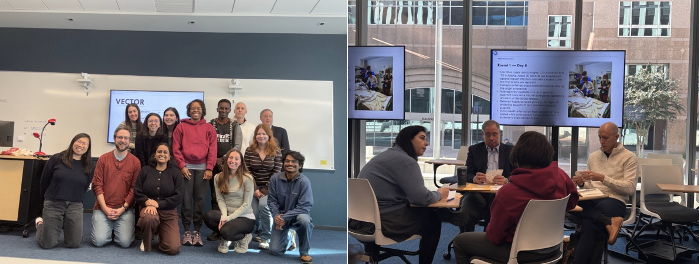
The Next Generation Global Health Security Network at GMU (NextGen @ GMU) hosted its inaugural biological crisis tabletop exercise on October 24 at Mason Square. Designed by Biodefense PhD Candidate and NextGen Treasurer Annette Prieto, the interactive wargame tasked Schar School students and alumni with managing a hypothetical outbreak of ambiguous origins amid escalating geopolitical tensions between rival great powers. Participants stepped into government and international stakeholder roles to respond to evolving and incomplete epidemiological data, conflicting intelligence, and mounting international pressures. The exercise highlighted the complex dynamics of distinguishing outbreak origin from intent, demonstrating how geopolitical friction can complicate outbreak management, shape health security priorities, and strain multilateral cooperation under uncertainty.
BIOD Alum Moves to CISA
On November 2, 2026, Brian Mazanec, Biodefense PhD ’14, was sworn in as the new Acting Executive Assistant Director for Infrastructure Security at the Cybersecurity and Infrastructure Security Agency (CISA) in the Department of Homeland Security. In this role, he supports CISA’s national effort to secure critical infrastructure from all hazards by managing risk and enhancing resilience through collaboration with the critical infrastructure community. With more than two decades of experience in risk assessment, all-hazards preparedness, critical infrastructure protection, and public-private coordination, he brings a wealth of experience across the national security and homeland security enterprise. Brian most recently served as a Deputy Assistant Secretary and Director of the Center for Preparedness within the Administration for Strategic Preparedness and Response (ASPR) at the U.S. Department of Health and Human Services (HHS), overseeing healthcare and public health readiness and resilience, situational awareness and operational coordination, and continuity and security. Brian is also an adjunct professor at the Schar School where he teaches about cybersecurity.
Biosecurity and the Global South
As AI and synthetic biology lower the barriers to biological weapons, how prepared is the Global South? On November 2, 2026, Medical Events Global convened experts from Stanford, Harvard, the University of Zimbabwe, Brown University, WHO, and the African Society for Laboratory Medicine (ASLM) for a critical virtual workshop: “Frontier Threats: AI, Biosecurity, and Pandemic Preparedness in the Global South.” The panel warned that while AI-designed pathogens face biological constraints, the lack of DNA synthesis screening capabilities across Africa poses a severe vulnerability. Drawing on frontline examples including Zimbabwe’s typhoid outbreak where antimicrobial resistance surged to 75%, speakers emphasized that African researchers must lead the development of AI evaluation frameworks and regional genomic data governance. Read the full event summary and next steps here, and access the transcript here.
New US Policy on Nucleic Acid Synthesis Screening
On November 5, 2026, the Trump Administration released a National Policy for Nucleic Acid Synthesis Screening to replace a policy promulgated during the Biden Administration. The new policy establishes new, government-wide screening requirements for synthetic DNA and the equipment used to make it. It will ensure that companies selling nucleic acid sequences and synthesis equipment know their customers and screen orders to prevent the malicious use of these materials and tools. All recipients of Federal funding will be required to purchase synthetic nucleic acids from providers who have been certified under the new policy. The National Institute of Standards and Technology (NIST) will be responsible for establishing U.S. government-wide procurement screening and physical security standards for synthetic biology and certify that screening tools and services meet these standards, while HHS and USDA will certify synthetic biology providers.
Cleaning Up Assad’s Toxic Legacy
Dr. Gregory Koblentz, director of the Biodefense Graduate Program at the Schar School, published an article in Arms Control Today on the progress made since the fall of the Assad regime in bringing Syria into compliance with the Chemical Weapons Convention and remaining challenges in addressing the toxic legacy of the Assad regime’s chemical weapons program. In his article, Dr. Koblentz explains that a comprehensive effort to clean up Assad’s toxic legacy rests on three pillars: verification and destruction of the former Syrian government’s chemical weapon program; accountability for regime officials who were responsible for using chemical weapons; and support for the victims of these chemical attacks. So far, Syria has made the most progress on verification and destruction and taken promising steps toward accountability. Providing support for victims and their families has received the least attention. Likewise, international assistance to Syria has been most extensive, but still insufficient, for verification and destruction, while it is just beginning to take shape on accountability and is completely lacking when it comes to supporting victims. The serious challenges that Syria faces in each of these areas are surmountable, but only through close cooperation with the OPCW and other international partners.
Deadly Dairy Viruses on Both Sides of the Atlantic
By Margeaux Malone, Pandora Report Associate Editor
Health officials in Yakima County, Washington, reported two additional human cases of H5N1 avian influenza earlier this week, including one death. It is the first US death from H5N1 this year and the third since the virus was first detected in U.S. dairy cattle in 2024. The individual has not been publicly identified, but officials did state they had underlying health conditions. Fortunately, the other new patient has not become severely ill or required hospitalization. All three human cases in the county involved known exposure to infected dairy cattle, and officials have found no evidence of human-to-human transmission. Since October 8, Washington state has confirmed H5N1 in 40 herds, with all but one in Yakima County. Sequencing on two farms identified the B3.13 genotype, which has circulated in US dairy cattle since spring 2024. Indiana reported its first ever H5N1 dairy cattle detections this week, in two operationally connected herds in Newton County. Colorado also identified its first positive herd since 2024. Both states made the detections from routine milk testing.
H5N1 avian influenza is not the only emerging viral concern in dairy cattle. Shamonda virus (SHAV), initially identified in Nigerian cattle in 1965, was detected in Europe for the first time this summer and has now caused a human death. The virus, from the genus Orthobunyavirus, belongs to the Simbu serogroup which also includes Oropouche virus (sloth fever) and the livestock pathogen Schmallenberg virus. It is spread by biting Culicoides midges and can also infect sheep, goats, and horses. Adult animals rarely die, but infected pregnant animals can miscarry or give birth to offspring with birth defects. There is currently no vaccine for animals or people.
Historically found in Africa and Asia, SHAV was identified in Europe in June 2026 after veterinarians investigated unusual cases of acute fever, diarrhea, lethargy, and marked reductions in milk production in dairy cattle in eastern France for which routine testing could not identify a known cause. Two variants (SHAV-EU1 and SHAV-EU2) have since been detected in 14 European countries, and, just this week, Great Britain reported its first cases on two dairy farms. In early October, a 61-year-old man in Lyon, France, who was being treated for leukemia and had received a stem cell transplant, died from the virus. This is the only known detection of the virus in a human, and French authorities suspect the man may have acquired the virus from a midge bite.
As Shamonda virus is not reportable or notifiable in animals, the significance of the viral detections in Europe, the extent of the spread, and the potential long-term implications are unknown. Given the very limited data regarding the zoonotic potential of the virus, the World Health Organization (WHO) stated the public health risk remains uncertain and cannot yet be reliably assessed, though there is currently no evidence of sustained human-to-human transmission. WHO has called for authorities to strengthen surveillance, promote One Health investigations to better characterize SHAV circulation, and increase coordination and communication between human and animal health experts to address the uncertainties and inform any subsequent adjustment of public health risk assessment and guidance.
Further Reading:
- “Emerging threat of avian influenza to the world’s vultures,” Jon Morant, Andrea Santangeli, Pablo Plaza, and Sergio A. Lambertucci, Conservation Biology
- “Evidence of widespread sequencing errors in global avian influenza study,” Michelle Wille, et al., Nature Communications
- “Explainer: What is Shamonda virus and what are the risks to humans and animals?” Reuters
- “Shamonda virus: What does the first human case mean for the Americas?,” Pan American Health Organization
IN OTHER NEWS
Schar School and Faculty Features
- “The Troubled History of Russia’s Antiplague Institute,” Daria Matviichuk and Thomas Grove, The Wall Street Journal – quoting Schar School Biodefense faculty Dr. Gregory Koblentz and Dr. Sonia Ben Ouagrham-Gormley
- “From Uganda to George Mason: Biodefense Student Helps Assess Africa’s Health Security,” Buzz McClain, George Mason University
Chemical, Biological and Non-Proliferation
- “First-Ever Indictment for Chemical Weapon Use,” Yuriy Larin, Institute for War & Peacemaking
- “Russian Allegations of Chemical and Biological Activities on NATO’s Eastern Flank,” GP WMD Counter Disinfo
- “Russian scientist who helped develop Novichok nerve agents dies at the age of 80,” The Insider
- “Peace-driven science rises from the ashes of apartheid-era bioterrorism,” Wilmot James, Brendan Beng and Andrea Uhlig, Daily Maverick
Biosafety, Dual-Use Technology, and Global Health
- “Possible plague lab leak shows global biosecurity gaps,” Lawrence Gostin, Nature Health
- “Kimi K3.1 Pro Biology Capabilities Assessment,” Shiv Muthupandiyan and Farhan Azam, SecureBio
- “How Trump Is Dismantling America’s Scientific Research Machine,” Christopher Flavelle, Irena Hwang, Adam Sella, Alan Blinder, Sheryl Gay Stolberg, Benjamin Mueller, and Michael C. Bender, New York Times
- “Doctors in Ukraine Try Treating Infections Like Biological Warfare Attacks,” Gina Kolata and Marc Santora, New York Times
- “A record number of health professionals are running for office. Could they help heal US politics?” Jen Christensen, CNN
- “Public Health Experts Cheer ‘Revenge of the Nerds’ Midterm Rout,” Jessica Nix and Rachel Cohrs Zhang, Bloomberg
🎙️ What We’re Listening To:
- “Foreword: Listening to Shadows,” The Brown Political Review Podcasts
NEW: Biosecurity and Artificial Intelligence: Risks, Myths, and Opportunities
Tuesday, November 10 | 5:30 – 7:00 pm ET
From Nixon Peabody: “Artificial intelligence’s expanding role in biotechnology is sharpening a consequential debate: how much does AI lower the barriers to biological misuse, and how can its benefits be realized without creating unacceptable risks? As important, what can and should be done about it? These discussions underscore the need to distinguish demonstrated capabilities from speculative claims and to develop safeguards proportionate to the threat. For government, industry, and investors, the challenge is to strengthen security while advancing the technologies that could improve disease detection, accelerate medical countermeasures, and build resilience against biological threats.”
NEW: From Anthrax to AI: Biological Attribution Then and Now
Thursday, November 12 | 9:00 am ET
The Bipartisan Commission on Biodefense at the Atlantic Council will explore how biological attribution has evolved since the 2001 anthrax attacks and how emerging technologies are reshaping the challenge. The meeting will examine how lessons from the anthrax attacks inform biodefense today, how attribution shapes national security decisions when evidence is incomplete, and how AI is changing the biological threat landscape and the capabilities available to investigators.
NEW: Canadian Biosafety Guidelines: Risk Management for Dual-Use Potential in Life Science Research – Webinar
Thursday, November 26 | 1:00 – 2:00 pm ET
From the Public Health Agency of Canada: “Life science research drives breakthroughs that benefit society, but how can organizations and researchers ensure those advances are pursued responsibly? Join the Centre for Biosecurity for an upcoming webinar to learn about the new Canadian Biosecurity Guideline on Risk Management for Dual-Use Potential in Life Science Research. Participants will gain an overview of the newly published guideline, learn the importance of dual-use risk management, and explore practical approaches for identifying, assessing, and mitigating associated risks.”
After NSCEB: What Comes Next for U.S. Biotech Policy
Tuesday, November 17 | 2:00 – 6:00 pm ET
From the National Security Commission on Emerging Biotechnology (NSCEB): “The Commission’s authority ends December 31. What it built is the beginning. Carrying it forward takes Congress, industry and capital. In April 2025, the Commission called for $15 billion over five years to secure American leadership in biotechnology. Join Commission leadership, members of Congress, founders and investors for an afternoon on who carries that work into 2027.”
Gordon Research Seminar (GRS) on Chemical and Biological Defense
Saturday, February 27 – Sunday, February, 2027 | Ventura, CA
Held directly before the main Gordon Research Conference (see below), this two-day seminar, “Integrated Response Strategies for Complex Threats in Chemical and Biological Defense,” provides a unique forum for early-career researchers, doctoral students, and postdocs to present original work, discuss emerging threats, and build professional networks. Key topics include threat detection, characterization, and convergent approaches spanning in silico, in vitro, and in vivo models. The program features oral presentations, poster sessions, and a mentorship panel on “Career Pathways and Perspectives in Chemical and Biological Defense.” Abstract submission deadline for talk consideration is November 22, 2026; general applications close January 30, 2027.
NEW: Gordon Research Conference (GRC) on Chemical and Biological Defense
Gordon Research Conference (GRC) on Chemical and Biological Defense
Sunday, February 28 – Friday, March 5, 2027 | Ventura, CA
Join international researchers, policy leaders, and scientists for a Gordon Research Conference, “The Convergence of In Silico, In Vitro, and In Vivo Models to Address the Divergent and Intersecting Profiles of Chemical and Biological Threats.” This five-day premier conference focuses on cutting-edge research in chemical and biological defense. Session topics include AI-accelerated science, agent-agnostic threat detection, attribution of CBRN events, medical countermeasure design, and biosecurity policy governance. Applications are due by January 31, 2027.
Strengthening Biosafety and Biosecurity in Farm and Livestock Settings: A One Health Approach to Influenza Preparedness – Call for Experts
Sunday, November 8 | 11:59 PM ET
The National Academies of Sciences, Engineering, and Medicine (NASEM) are seeking nominations for a 10–12-member volunteer expert committee to evaluate biosafety and biosecurity across commercial and informal livestock systems (poultry, swine, cattle). The study will focus on mitigating influenza spillover risks, identifying implementation challenges, and developing near-term (2–5 years) and long-term One Health recommendations for federal/state agencies and producers. Targeted expertise includes influenza research, pandemic preparedness, veterinary epidemiology, farm biosecurity, agricultural economics, behavioral science, and agricultural occupational health.

