DTRA’s Chem Bio division develops highly sensitive bio-agent detector

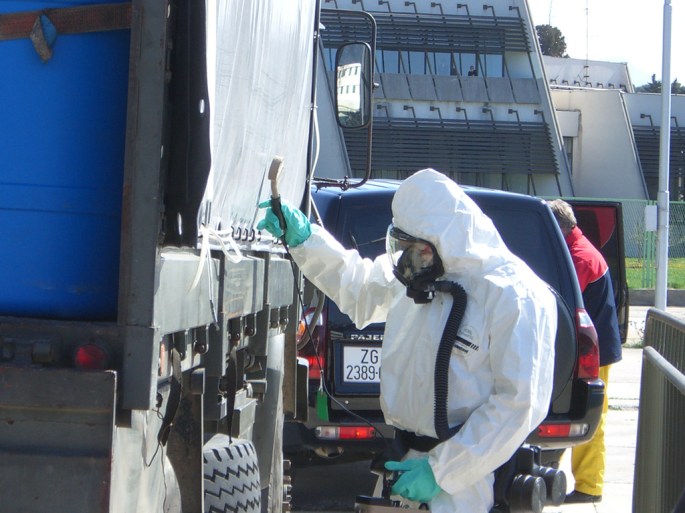
The Defense Treat Reduction Agency through its collaborative Ruggedized Antibody Program project, has developed a bio-agent detector 1000x more powerful than currently used ELISA methods.

From DVIDS– ” This technology has demonstrated exquisite analytical and clinical sensitivity, as well as a broad dynamic range. The combination of these two technologies will robustly increase the Department of Defense’s diagnostic armamentarium. This could lead to warfighters being able to detect lower levels of the toxin, therefore decreasing false negatives in environmental samples and earlier discovery in the course of clinical intoxication. SdAbs are recombinant ligand binding antibody fragments derived from the unusual structure of native antibodies found in camels and llamas. These unique heavy chain binding elements offer many desirable properties such as their small size (~15 kDa) and thermal stability, which makes them attractive alternatives to conventional monoclonal antibodies.”

Read more here.

 (image courtesy of DTRA)

Video of the Week: OPCW Weapons Inspectors Leaving for Syria

What does a chemical weapons inspector leaving to investigate chemical arsenals at a country in the middle of a raging civil war pack? Markers, apparently. The last thing they do before getting on said plane? You guessed it, fill out paperwork.  Meet some of the men and women helping keep us out of Syria below.

(credit: OPCW)

Chemical weapons team arrives in Syria; Blair on our options

In the last 48 hours, chemical weapons inspectors have crossed the border into Syria, reaching Damascus last night. The 19-member inspection team, sent from the Organization for the Prohibition of Chemical Weapons in the Hague, will be responsible for verifying and dismantling the 1,000 tonne Syrian chemical weapons arsenal. The team will have approximately nine months to conduct their investigation and help the Syrian government destroy their arsenal by the middle of next year.

Charles Blair, GMU adjunct professor and columnist at the Bulletin of Atomic Scientists, recently published a piece on the fundamental issue at stake here – will it make any difference?

“Regardless of how Lavrov-Kerry fares, the Obama administration faces a high-stakes dilemma. If the agreement is successful, the Syrian civil war still threatens to metastasize—further destabilizing the entire region and, due to the West’s dependence on oil from the Middle East, threatening the world economy. In short, even without a Syrian chemical arsenal, and apart from the normal winter ebb in fighting, the civil war shows no signs of slowing down.

“But failure to rid Syria of the stockpile could result in additional chemical weapons use by the Assad regime and hastens the day when extremists acquire these arms, too. If Syria does not abide by the agreement, the United States would likely resort to air strikes, amid strong calls for a redoubling of efforts to quickly arm opposition forces with more weaponry. Both actions are inherently risky. Indeed, significant sections of Syria could fall under the rule of violent Islamists armed with chemical weapons. As an authority on terrorism at the RAND Corporation, Michael Jenkins, recently wrote me, ‘the Syrian civil war has significantly raised the risk that its chemical weapons will fall into the hands of terrorists, creating a greater international crisis than the one we think we have just solved.’”

Read more at the Bulletin.

(image: Steven Damron/Flickr)

Using a Fish Army to fight Dengue

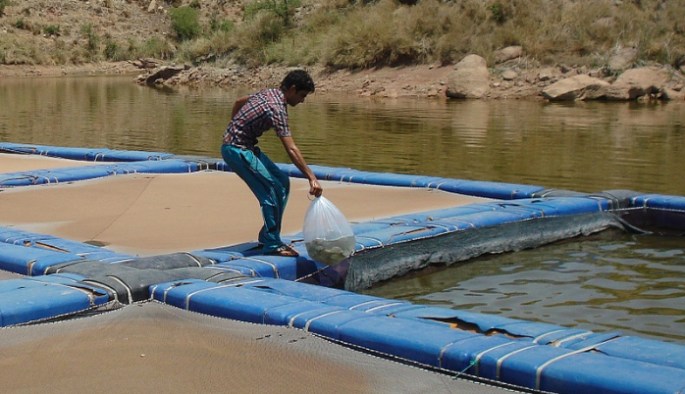
In what has to be one of the strangest public health strategies to date, health officials in the Punjab districts of Pakistan have released over a million Tilapia into pools, ponds, large puddles – just about any body of standing water – in an effort to combat dengue. Pakistan has a long rainy season which creates thousands of pools of water where the mosquitoes who carry dengue lay their eggs. By releasing the fish into these pools, the larvae are eaten before they can hatch, killing the virus’ vector and preventing its spread.

While it may be tempting to dismiss the strategy as a bizarre version of the woman-who-swallowed-the-fly nursery rhyme, don’t – apparently, it’s working. In 2011, the Punjab districts had over 20,000 cases of dengue, including 300 fatalities. So far this year, following the release of over 1.6 million fish, there have been just 100 cases total.  The question of what happens to the fish when the pools evaporate has not yet been addressed, but we’re still impressed – can you imagine having to pitch this idea to your superiors?

Read more about this very innovative use of fish at the Guardian.

(Image: Tilapia farmer in Pakistan, courtesy of USDA/Flickr)

This Week in DC: Events

Lots of events to take your mind of the possible government shutdown tomorrow.

Tuesday, October 1, 2013

Narrative and Syria: Popular Discourses that limit alternative conflict resolution options with Rich Rubenstein
GMU School for Conflict Analysis and Resolution
2:00 – 4:00PM

This roundtable will explore how certain discourses consciously or unconsciously limit certain alternative conflict resolution options. This will be a discussion, so please bring your thoughts regarding various discourses relating to this conflict including stories told by rebels, regime supporters, USG people, peace advocates, etc.

Strategy: A History [Book Discussion]
Woodrow Wilson Center for International Scholars
4:00 – 5:30PM

In Strategy: A History, Sir Lawrence Freedman, one of the world’s leading authorities on war and international politics, captures the vast history of strategic thinking, in a consistently engaging and insightful account of how strategy came to pervade every aspect of our lives.A brilliant overview of the most prominent strategic theories in history, from David’s use of deception against Goliath, to the modern use of game theory in economics, this masterful volume sums up a lifetime of reflection on strategy.

Successfully Conducting Information, Psychological, and Military Deception Operations
Institute of World Politics
4:00 – 6:00PM

Brigadier General Thomas Draude, USMC (Ret.) was in charge of the Marine Corps Information Operations during the Gulf War. He successfully oversaw the Military Deception & Psychological Operations that resulted in diverting Iraqi forces from the main attack by U.S. Marine and Army forces during the beginning of Operation Desert Storm. He will talk about the history of conducting successful information and military deception operations including during the Gulf War and the effective use of these operations in the future. Brigadier General Draude is the President of the Marine Corps University Foundation and a professor at the Marine Corps University at Marine Corps Base Quantico.

Wednesday, October 2nd

An Assessment of Rouhani’s Visit to New York: Real Diplomacy or Failed Expectations?

Woodrow Wilson International Center for Scholars
12:00 – 1:00PM

Two experts will provide a candid assessment of how realistic diplomacy may be after Presidents Barack Obama and Hassan Rouhani spoke at the United Nations General Assembly.

Cybersecurity One-on-One Luncheon
Politico
12:00PM

Join POLITICO for Cybersecurity one-on-one conversations focused on the intersection of policy and information security. This event will be held as part of the Visa Global Security Summit.

Thursday, October 3rd

Cybersecurity Summit
Washington Post
8:30AM – 12:30PM

The 2013 Cybersecurity Summit at The Washington Post will bring together leading national security officials, industry experts and those who write about them, including syndicated columnist David Ignatius. What are top officials most focused on and why? We will discuss efforts to defend the nation’s critical infrastructure, financial system, and intellectual property. What is the current thinking about the government outsourcing of cyber security efforts and its collaboration with private industry? How safe is the information stored in the Cloud? Few issues are as urgent as the concern about cyber theft and cyber espionage. The full program will live stream on their website Oct. 3.

Hearing – Al-Shabaab: How great a threat?
House Committee on Foreign Affairs
9:45 AM

Chairman Royce on the hearing: “We’’ve known for some time that the al-Qaeda-affiliated terrorist group al-Shabaab remains a threat in the Horn of Africa. Following the recent brutal attack on Nairobi’s Westgate shopping mall, it is critical that the United States and our allies reassess the threat that al-Shabaab poses outside of Somalia and outside the region. This hearing will examine the extent of the al-Shabaab threat to the interests of the United States around the world and those of our allies.”

The New Battle for the Pacific: How the West is Losing the South Pacific to China, the UAE, and Just About Everyone Else
East-West Center
2:00 – 3:30 PM

The South Pacific is usually considered as being, literally, at the edge of the map. However, as the world pivots to the Asia-Pacific, the South Pacific region’s true geopolitical, strategic and economic value is coming to the fore. In transit terms alone, as U.S. Pacific Command Commander Admiral Samuel Locklear said in the Cook Islands in 2012: “Five trillion dollars of commerce rides on the (Asia-Pacific) sea lanes each year, and you people are sitting right in the middle of it.” Far from being small island states, the Pacific Island Countries are showing themselves as large ocean states, with vast fisheries, potential seabed resources, and increasingly important geostrategic positioning – as the range of military bases dotted throughout the region can attest. However, just as the region is showing its importance, Western influence is waning. When the larger Western powers pulled out of the region following the end of the Cold War (the United Kingdom, for example, closed three South Pacific High Commissions in 2006), they turned to Australia and New Zealand to “manage” the area for the West.

Friday, October 4th 

Echoes of the Spring: How the Arab World’s Transitions are Resonating in Russia, Iran and Iraq

Radio Free Europe
11:30AM – 12:30AM

The pro-democracy protests of the Arab Spring rippled through North Africa and the Middle East in 2011, bringing down once-secure authoritarian regimes and setting loose passions that continue to roil much of the Arab World. Many people living in the RFE/RL broadcast region express similar desires for change. How has the Arab Spring phenomenon affected attitudes and events in places such as Russia, Iran and Iraq?

Monday, October 7th

Domestic Barriers to Dismantling the Militant Infrastructure in Pakistan
US Institute for Peace
2:00 – 3:30PM

Please join USIP on Monday October 7 for a discussion on the nature of Islamist militancy, and to examine the barriers to dismantling the militant infrastructure in Pakistan. Pakistan’s inability to tackle Islamist militancy within its borders and to prevent cross-border attacks from its soil remains a constant worry for the world. While the Pakistani state pledges lack of capacity to deal with the various facets of the militant challenge, the world is unconvinced of the ‘will’ of the Pakistani leadership to fight with determination. The Pakistani security establishment has been seen as selectively targeting certain Islamist outfits while ignoring, supporting, or abetting others.

Big Data Keynote Speaker Series: A Conversation With Michael Leiter, Former Director of NCTC
YPFP
6:30 – 7:00 PM

Join YPFP and learn from the one of most prominent practitioners of data analysis, Michael E. Leiter, Senior Counselor to the CEO of Palantir Technologies and former Director of the National Counterterrorism Center (NCTC). A leader in applying data analysis principles to the arenas of politics and security in both the public and private sectors, Mr. Leiter has been invited as part of the Keynote Speaker Series for the Big Data and Analytics incubator in order to help future leaders of foreign policy understand the role of data analysis in developing foreign policy and crafting solutions to critical global challenges.

(image: Dell)

October Seminar Speaker Paul Walker Wins Swedish Rights Prize

Dr. Paul Walker, International Director of the Environmental Security and Sustainability (ESS) Program for Green Cross International (GCI), and our October Biodefense Policy Seminar Speaker, was awarded the Swedish Right Livelihood Award on Thursday for his lifelong work eliminating chemical weapons.

The award was founded by Swedish philanthropist Jakob von Uexkull, following refusal by the Nobel Foundation to honor efforts in international and environmental development.

Speaking about selecting Dr. Walker, Director of the Right Livelihood Award Foundation Ole von Uexxkul said, “Chemical weapons are easy to manufacture but very difficult to get rid of. Walker has 20 years of experience in how to eliminate them both politically and technically…It is his knowledge that is needed right now in Syria.”

Walker expressed delight at receiving the award, emphasizing the extreme urgency to eliminate Syria’s chemical weapons and potential positive impact on the region. “Israel and Egypt, being neighbors of Syria, really feel pressure now to join the Chemical Weapons Convention. They don’t need the option of chemical weapons and should join the rest of the world,” he said.

Walker will be formally presented with the award at a ceremony in the Swedish parliament later this year.

GMU Biodefense will host Dr. Walker on October 16th at 7:20 PM. Join us for an extremely timely discussion on Syria and elimination of chemical weapons. For more information, please see here.

To find out more about the Right Livelihood Award, visit their website here.

(Image: Stockholm Environmental Institute)

The Pandora Report 9.27.13

Highlights include MERS, more MERS, Marburg & Ebola, chemical weapons antidotes, universal vaccine. Happy Friday!

Saudi Efforts to Stop MERS Virus Faulted

Saudi Arabia is being accused both of withholding information and conducting incomplete epidemiological investigations on MERS. While health officials have been careful to collect as much information as possible from infected individuals, they have been accused of neglecting to interview healthy contacts of infected patients. Such interviews are critical to determining possible routes of transmission. Saudi officials have vehemently denied these accusations, arguing it’s impossible to withhold what they don’t know.

Wall Street Journal – “‘It’s very difficult to give all the details to the people when we don’t know all the details,’ Ziad Memish, the deputy health minister, said last week at his office in Riyadh, the Saudi capital. ‘”Where’s it coming from? We don’t know. How is it transmitted? We don’t know.'”

Middle Eastern Respiratory Syndrome Update

Speaking of MERS, the CDC has updated its epi information on the virus. According to this week’s Morbidity and Mortality Weekly Report, there are now 130 cases, of which 45% of were fatal. While cases have occured in eight countries, all infected patients had recently visited or resided in just four countries – Jordan, Qatar, Saudi Arabia, and the UAE. Also of note, just over a fifth of cases (21%) were asymptomatic. No new information on mvectors, reservoirs, or route of infection.

CDC –  “To date, the largest, most complete clinical case series published included 47 patients; most had fever (98%), cough (83%), and shortness of breath (72%). Many also had gastrointestinal symptoms (26% had diarrhea, and 21% had vomiting). All but two patients (96%) had one or more chronic medical conditions, including diabetes (68%), hypertension (34%), heart disease (28%), and kidney disease (49%). Thirty-four (72%) had more than one chronic condition (7). Nearly half the patients in this series were part of a health-care–associated outbreak in Al-Ahsa, Saudi Arabia (i.e., a population that would be expected to have high rates of underlying conditions) (8). Also, the prevalence of diabetes in persons aged ≥50 years in Saudi Arabia has been reported to be nearly 63% (9). It remains unclear whether persons with specific conditions are disproportionately infected with MERS-CoV or have more severe disease.”

New Marburg & Ebola Theraputics?

Tekmira Pharmaceuticals Corporation has developed a Marburg treatment which protects non-human primates from the virus completely (100%), even if administered 24 hours after post infection. This is very exciting. The company has also received funding to undertake a similar Ebola treatment, with Phase I clinical trials set to begin early next year.

Street Insider – “In a presentation entitled ‘Medical Countermeasures for Filovirus Infection: Development of siRNA Therapeutics Under the Animal Rule’ data were presented that showed successful anti-viral therapy with the application of Tekmira’s LNP technology to hemorrhagic fever viruses, including multiple strains of the Ebola and Marburg viruses. Newly presented data resulting from a collaboration between Tekmira and the University of Texas Medical Branch (UTMB) showed 100% survival in non-human primates infected with the Angola strain of the Marburg virus in two separate studies. In the first study, 100% survival was achieved when dosing at 0.5 mg/kg TKM-Marburg began one hour after infection with otherwise lethal quantities of the virus. Dosing then continued once daily for seven days. In the second study, 100% survival was achieved even though treatment did not begin until 24 hours after infection.

Scientists at UNC-Chapel Hill, Wake Forest work on antidotes to nerve gas

The Defense Threat Reduction Agency has awareded UNC-Chapel Hill a $4.47 million grant to develop antidotes to nerve gas. While the timing of the award may seem a little reactionary, apparently discussions on the project began over a year ago. Researchers are hoping to create an adhesive bandage, pre-loaded with the antidote which would be administered through tiny needles in the bandage itself. The advantage of a bandage over an injected serum is self-administration – no medical professional would be needed to administer it.

Charlotte Observer – “‘We can load them up with antidotes to nerve agent, including enzymes that combat nerve agent,’DeSimone [a professor of chemistry at UNC-CH and chemical engineering] said. ‘The idea was to put them directly into a dissolvable microneedle that’s painless – just a patch – and rapidly get them into the bloodstream’ Such a device could be used by the military or civilians during an attack, when poison gas can kill within minutes. The patch could be easily disseminated and transported, DeSimone said, and would have a long shelf life.

Researchers Move Step Closer to Universal Seasonal Flu Vaccine

It’s nearly flu season again, and for many of us that means shots. For scientists, it means hoping their predictions as to which strain of flu will strike are right, and that the vaccine in the shots is actually useful. Making things easier for everyone, scientists at the Imperial College of London have determined a “blueprint” for a single vaccine against all types of influenza. Scientists there have found that by boosting CD8 killer T cells, rather than trying to trigger antibody production, the vaccines are significantly more effective.

Voice of America – “’Such a vaccine would induce T cells that would be able to recognize new viruses that have not even been identified yet. In other words, future pandemic strains. In that sense, it’s a universal vaccine. And it will be different to existing vaccination where currently every year a new vaccine has to be developed, which is why we are always one step behind…'”

(image courtesy of CIDRAP)

New developments in legal battle over H5N1 research

Ron Fouchier, the virologist at the center of the last year’s controversial gain-of-function H5N1 research, is back in the media following the ruling on his research in Dutch courts this week. The ruling surrounded the legality of the Dutch government’s decision to request Fouchier to first obtain an export licenses before sending his H5N1 research out to the magazine Science. The government did so after classifying Fouchier’s work as dual-use research of concern, the dissemination of which could be perceived as potential proliferation. This week’s ruling not only supported the government’s requirement of an export license, but extended the requirement to all future work on H5N1 transmission. Needless to say, Fouchier is not pleased. He’s accused the Dutch government of disadvantaging Dutch scientists and mitigating their academic freedom.

Read more at Science.

(Image: Selbe B./Flickr)

Image of the Week: H1N1

Pictured below is H1N1, the pandemic virus better known (however unfairly) as “swine flu”. As many of you undoubtedly recall, H1N1 swept the globe in 2009, causing approximately 17,000 deaths.

niaid

“Colorized transmission electron micrograph showing H1N1 influenza virus particles. Surface proteins on the virus particles are shown in black.” Image and caption: NIAID

New Bio-containment Lab in Kazakhstan

The Defense Threat Reduction Agency (DTRA), working with the Nunn-Lugar Cooperative Threat Reduction Program have helped fund a new, high-security lab in Kazakhstan for the study of dangerous pathogens. The Central Reference Laboratory (CRL), set to open in 2015, will help provide competitive jobs to local scientists, discouraging them from instead selling their skills to the highest bidder. As many of you know, during its height the the Soviet BW program employed approximately 60,000 individuals, of which 10,000 were thought to highly-skilled researchers and scientists. Kazakhstan in particular was a key location for biological weapons facilities.  When the USSR halted all offensive BW in 1992, most of these 10,000 scientists suddenly found themselves unemployed – programs like these have therefore been critical to preventing proliferation of knowledge.

Reminiscent of the former Soviet “plague stations”, the CRL will focus in particular on Yersinia pestis, which is endemic in the area.

Read more on the lab here.

(image credit: William Weih/DTRA)