Video: Dr. Paul Walker’s talk on Chemical Weapons Destruction

For those of you unable to attend our October Biodefense Policy Seminar last week, Dr. Paul Walker gave a very interesting and timely presentation on the challenges of chemical weapons destruction, both in Syria and globally. See the first part of his presentation below, and then head over to our YouTube channel to watch the rest. His slides are also included below.

Dr. Walker’s Slides: October Biodefense Policy Seminar_Dr. Paul Walker

Event: The Chemicals, The Conflict, & The Challenges in Syria

Speakers: Dr. Paul Walker, Green Cross International, Michael Moodie, International CBW Commentator, Dr. Chen Kane, Center for Nonproliferation Studies
Event Location: American Association for the Advancement of Science, 2nd Floor, 1200 New York Avenue NW, Washington DC 20005
Event Details:  October 23, 2013  5:00 – 6:30pm
Light refreshments to follow
RSVP

The use of chemical weapons by any nation constitutes a significant threat to international peace and security. Nevertheless, in 2013 chemical weapons were used in Syria, sparking international outrage and condemnation. With pressure from the U.S. and Russia, Syria acceded to the Chemical Weapons Convention in September 2013 and agreed to participate in an accelerated process to destroy the chemical weapons. While this has been received as an unexpected yet positive development, the implementation of such a process raises significant science and security issues.

On October 23, the American Association for the Advancement of Science’s Center for Science, Technology and Security Policy and the Federation of American Scientists are convening a panel to discuss the science and security involved in the implementation of the Chemical Weapons Convention and U.N. Security Council Resolution 2118 in Syria.

The speakers will explore the technical, political, and regional issues surrounding chemical weapons in Syria, including: the technical solutions and expertise required to ensure accelerated destruction of chemical weapons; the broader regional impact of Syria’s accession to the Chemical Weapons Convention; and the challenges involved in carrying out destruction in a civil war environment.

Walker, October Seminar Speaker, on Destroying Chemical Weapons

As destruction efforts in Syria seem to be continuing apace, the question many of us have asked ourselves is how does one destroy a chemical weapon? Dr. Paul Walker concisely addresses this in his recent Bulletin of Atomic Scientists piece, “How to destroy chemical weapons?”. To hear more, be sure to join us next Wednesday evening for our October Biodefense Policy Seminar featuring Dr. Walker, who will discuss efforts to destroy Syrian CW at length. For more information, please visit our events page.

Bulletin of Atomic Scientists – “The recent news that Syrian President Bashar al-Assad is willing to accede to the international Chemical Weapons Convention (CWC) has raised the question: How might one actually go about eliminating Syria’s chemical munitions?

The CWC entered into force in 1997. Seven CWC member countries have declared existing chemical weapons stockpiles—Albania, India, Iraq, Libya, Russia, South Korea, and the United States. Three of these—Albania, India, and South Korea—completed stockpile destruction in the last few years. Three more—Libya, Russia, and the US—expect to complete their destruction programs over the next decade. And Iraq, which joined the convention in 2009, is planning the destruction of its chemical weapons equipment and agents left from the 1991 Gulf War.

There are essentially three broad categories of destruction approaches, all used successfully in the above programs. These approaches can be mixed and matched, depending on the type, size, quantity, and condition of the agents, munitions, and containers…”

Read more here.

(image: Jen Spie/Flickr)

Bioweapons Alarmism in Syria

by Dr. Sonia Ben Ouagrham-Gormley, originally published in the Bulletin of Atomic Scientists

As Secretary of State John Kerry challenged Syrian President Bashar al-Assad to hand over Syria’s chemical weapons in early September, articles published in the Washington Post and National Interest argued that the current focus on Syria’s chemical weapons is distracting the international community from a much deadlier threat: Syria’s biological weapons. The sources for the Washington Post article (one of whom also happens to be a co-author of the National Interest piece) warn that Assad’s regime could use its biological weapons in retaliation against Western forces or its own population. Both articles assert that Syria has maintained a dormant program since the country last engaged in biological weapons developments in the 1970s and 1980s and could easily reactivate its program to produce, on short notice, the stockpile of agents required to retaliate against its enemies. This threat is real, the argument goes, because Syria could tap into its pharmaceutical and agricultural industries to support the effort. Finally, the articles warn that Syria might have retained a strain of smallpox from a 1972 outbreak, which could be used to develop a devastating biological weapon.

These two articles provide no tangible evidence to support their claims. More important, their speculations contradict extant empirical evidence on the difficulty of achieving the level of biological weapons capability that the articles claim Syria maintains or could reestablish. To avoid falling prey to the same biological weapons hysteria that led to the invasion of Iraq in 2003, it is important to look carefully at such claims. Close examination shows them to be exaggerated, at best.

To evaluate Syria’s ability to revive a dormant program, one would need to know what kind of research and production infrastructure the Syrian government currently possesses. There is, however, very little publicly available information on the scope of Syria’s bioweapons program, if any.

If Syria retains only a small research capability developed in its bioweapons program of the 1970s and ‘80s, the likelihood that it would be able to quickly produce sufficient amounts of bioweapons for retaliation is very slim. The country would first need to create the research, development, production, and weaponization infrastructure needed for a crash program, a process that may take several months to even years, particularly in a war zone. Assuming that the Syrians already have stocks of agents—and it is pure speculation to say they do— they will need to conduct exploratory research to determine which agent is the most promising as a bioweapon and develop a production process that will maintain the agent’s lethal characteristics during scale-up and storage. Creating this production capability is also neither easily or quickly achieved.

In the early 1980s, Iraq attempted to reactivate a biological weapons program that had been largely abandoned in the preceding decade; it took the Saddam Hussein regime three years—from 1983 to 1986—to conduct the needed exploratory research and identify the agents most desirable for bioweapons work. Even then, the Iraqis were able to develop only crude liquid agents that lost toxicity within six to eight months. They were also unable to develop a bioweapons-specific dissemination capability, relying instead on personnel from their chemical weapons program to adapt chemical bomb casings and warheads for bioweapons use. This strategy resulted in ineffective weapons that would have released agents upon impact, destroying most of the bio-agent in the process.

Even if Syria already has significant bioweapons infrastructure in place, reactivating it would not necessarily be a quick or simple process. When in the early 1980s Soviet-era authorities decided to activate the mobilization facility in Stepnogorsk, Kazakhstan in order to produce anthrax, it took about two years to launch production, even though the facility had been established for several years and had the equipment and minimum staff needed for its operation. The suggestion that Syria could swiftly launch a crash program from a long-dormant infrastructure and produce effectively weaponized agents in amounts sufficient for a retaliatory military attack seems a considerable stretch from likely reality.

Read the rest of the piece here.

(Image credit: Scott Montreal/Flickr)

Video of the Week: OPCW Weapons Inspectors Leaving for Syria

What does a chemical weapons inspector leaving to investigate chemical arsenals at a country in the middle of a raging civil war pack? Markers, apparently. The last thing they do before getting on said plane? You guessed it, fill out paperwork.  Meet some of the men and women helping keep us out of Syria below.

(credit: OPCW)

Chemical weapons team arrives in Syria; Blair on our options

In the last 48 hours, chemical weapons inspectors have crossed the border into Syria, reaching Damascus last night. The 19-member inspection team, sent from the Organization for the Prohibition of Chemical Weapons in the Hague, will be responsible for verifying and dismantling the 1,000 tonne Syrian chemical weapons arsenal. The team will have approximately nine months to conduct their investigation and help the Syrian government destroy their arsenal by the middle of next year.

Charles Blair, GMU adjunct professor and columnist at the Bulletin of Atomic Scientists, recently published a piece on the fundamental issue at stake here – will it make any difference?

“Regardless of how Lavrov-Kerry fares, the Obama administration faces a high-stakes dilemma. If the agreement is successful, the Syrian civil war still threatens to metastasize—further destabilizing the entire region and, due to the West’s dependence on oil from the Middle East, threatening the world economy. In short, even without a Syrian chemical arsenal, and apart from the normal winter ebb in fighting, the civil war shows no signs of slowing down.

“But failure to rid Syria of the stockpile could result in additional chemical weapons use by the Assad regime and hastens the day when extremists acquire these arms, too. If Syria does not abide by the agreement, the United States would likely resort to air strikes, amid strong calls for a redoubling of efforts to quickly arm opposition forces with more weaponry. Both actions are inherently risky. Indeed, significant sections of Syria could fall under the rule of violent Islamists armed with chemical weapons. As an authority on terrorism at the RAND Corporation, Michael Jenkins, recently wrote me, ‘the Syrian civil war has significantly raised the risk that its chemical weapons will fall into the hands of terrorists, creating a greater international crisis than the one we think we have just solved.’”

Read more at the Bulletin.

(image: Steven Damron/Flickr)

Slide Show: What does a chemical weapon look like?

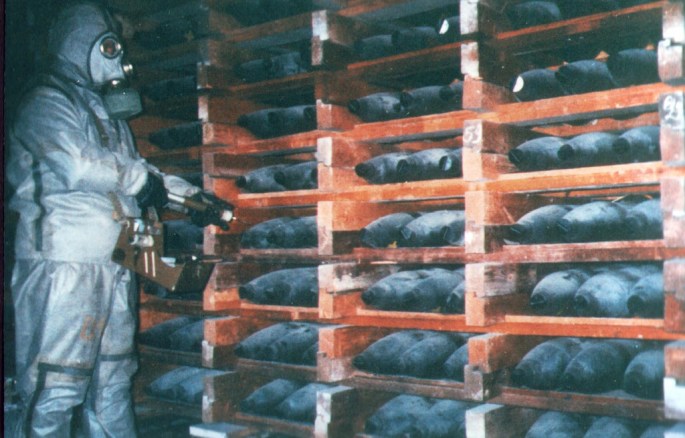
Image of the Week: What does a chemical weapon look like? While we can’t show you the chemical weapons of Syria (we suggest youtube for that), we can show you images the CIA collected whilst doing analysis of the former Iraqi program. The images below focus on the weapons themselves, and are pulled almost exclusively from various CIA intelligence reports.

This slideshow requires JavaScript.

(header image: CIA)

The Pandora Report 8.30.13

Highlights include MERS case updates, dengue raging through Central America, Syria’s CW (obviously), eastern equine encephalitis, and the cetacean morbillivirus. Happy Friday, and a very happy Labor Day Weekend to everyone! Stay away from the dolphins!

WHO: MERS global case count 108, 50 deaths 

MERS continues to spread throughout Saudi Arabia, with an additional four cases confirmed today. The total global case count is now 108, with a fatality rate of just below 50%. Two of Saudi Arabia’s four most recent cases involved immunocompromised patients, while the other two are children aged 16 and seven respectively. Interestingly, both children are currently asymptomatic, despite testing positive for the virus. The World Health Organization (WHO) has not recommended travel restrictions to Saudi Arabia, promoting instead strong surveillance and testing measures.

World Health Organization – “Globally, from September 2012 to date, WHO has been informed of a total of 108 laboratory-confirmed cases of infection with MERS-CoV, including 50 deaths.Based on the current situation and available information, WHO encourages all Member States to continue their surveillance for severe acute respiratory infections (SARI) and to carefully review any unusual patterns. Health care providers are advised to maintain vigilance. Recent travellers returning from the Middle East who develop SARI should be tested for MERS-CoV as advised in the current surveillance recommendations”.

Dengue fever epidemic sparks public health emergency in Central America

Central America is currently experiencing a serious Dengue outbreak, with over 120,000 cases in three states across the region. If not effectively contained, a number of external factors will likely result in the outbreak “exploding”. The rainy season in the area is set to last another three months, with high heat resulting in ideal breeding grounds for dengue’s mosquito vector. Containment of the outbreak in Honduras particularly has proven challenging, prompting the state to turn to the Red Cross for help. The 2010 outbreak of dengue in the area lead to 1.6 million cases, of which 49,000 were severe. Dengue eradication efforts are hampered by its infection through four, distinct serotypes, no one of which offers cross-protection against the other three.

The Guardian – “The poor suburbs of Central American capitals are the main targets for campaigns to raise public awareness. Poor housing, the lack of a mains water supply and the accumulation of household waste make such neighbourhoods an ideal breeding ground for mosquitoes. The authorities have dispatched paramedics, police and the military to remote villages in order to stamp out the epidemic in the areas most at risk. Latin America is particularly exposed to dengue epidemics, which recur on a three- to five-year cycle. In 2010 the fever caused 132 deaths. ‘Aedes aegypti was eradicated in the subcontinent in the mid-20th century, but with increasing global trade it returned in the 1970s, from Asia,’ says Philippe Brémond, an epidemiologist at France’s Institute of Research for Development (IRD).”

Syria’s Red Line

We know everyone’s talking about chemical weapons in Syria (ourselves included), and with President Obama now apparently set on unilateral (ugh) military action in the area, we wager everyone will continue to talk about Syria for a good while longer. We’re including Jeanne Guillemin’s review article because it’s a thorough overview of the storied history and political maneuverings of chemical weapons use. Read it and be an expert.

The Boston Review – “When the present crisis in Syria is resolved, as inevitably it will be, the CWC [Chemical Weapons Convention] must be made universal. It almost is: 188 states adhere to it; 7 are holdouts (Israel, Syria, Egypt, Myanmar, Angola, North Korea, and South Sudan). Syria must allow its chemical weapons to be identified, contained, and destroyed. It should have been done years ago. Israel and Egypt must also be persuaded to join the treaty and comply with it, before more chaos erupts. ‘Almost universal’ is simply not good enough.”

Eastern equine encephalitis threat level raised to ‘high’ in four communities

Ongoing detection of eastern equine encephalitis (EEE) in four communities in Massachusetts has prompted local health authorities to raise threat levels to “high”, encouraging residents to avoid outdoor evening activities until the end of the mosquito season. Although most cases of EEE are aysmptomatic, in severe cases the virus can cause permanent brain damage and death. We can’t remember if we already posted this, but here is an excellent Nature article explaining why it would actually be totally fine if we exterminated all mosquitoes.

Boston – “The EEE threat is high in Easton, Raynham, Taunton, and West Bridgewater. Residents in high-risk areas are urged to avoid evening outdoor events for the remainder of the mosquito season, said the statement from the Massachusetts Department of Public Health…There has been one human case of EEE this year, in a Norfolk County woman in her 80s, who died earlier this month. There were seven cases of EEE in 2012, including three deaths.Symptoms of EEE show up about 3 to 10 days after a person is bit by an infected mosquito and they include high fever, a stiff neck, headache, and lack of energy.”

Because People Will Ask: Measles-like virus may be cause of dolphin deaths on U.S. coast

Included so you can assure concerned friends and families that the virus, which is killing bottlenose dolphins up and down the East Coast, cannot be transmitted to humans. Since July, 333 dolphins – 10 times the normal number for the same period – have died from cetacean morbillivirus, a measles-like virus which is thought to cause immunosuppression.  Virginia’s beaches have seen the highest number of strandings, at 174 n the last couple months. While the virus cannot be transmitted to humans, beach goers are advised not to approach any stranded dolphins, as they may carry other bacterial or fungal infections.

National Geographic – “‘Along the Atlantic seaboard, this [outbreak] is extraordinary,’ Rowles said. The last morbillivirus outbreak in the region occurred from June 1987 to May 1988, and resulted in the deaths of at least 900 bottlenose dolphins. Officials are unsure of how long the current outbreak will last. ‘Typically, outbreaks will last as long as there are susceptible animals,’ Rowles said. But if it plays out like the 1987-1988 outbreak, ‘we’re looking at mortality being higher and morbillivirus traveling southwards and continuing until May 2014,’ she added. Right now, experts think this current outbreak is probably due to a dip in herd immunity.”

(image credit: Jeff Kraus/Flickr)

In-Depth: The Syrian “Red Line” and the Importance of Multilateral Action

The Chemical Weapons Red Line: a tedious response to the Syrian crisis and how international treaties should guide multilateral reaction

By Chris Brown, PhD Candidate

Inspectors from the United Nations (UN) are expected to report their findings on Saturday about whether chemical weapons (CW) were used in rocket attacks in Syria last week. Depending on the degradation rate and other properties of a chemical agent, if any, used in the attack, the UN investigation may also reveal what kind of weapon(s) was deployed. Sarin and VX nerve agents top the list of likely possibilities given the types of symptoms and number of casualties reported after the attacks. But determining if and which chemical agent(s) was used in Syria is only the beginning of what should be a far more complex investigation before any international action occurs. It is crucial to determine who used the agent, against whom, and what international legal obligations the user was bound by at the time of use. Only then can the international community establish a clear basis for action in Syria.

Popular opinion at present holds that Syrian President Bashar al-Asaad’s forces likely deployed CW against rebel groups and civilians. Despite the fact that the regime risks loss of power by inviting international intervention as a result of CW use, and that CW use would signal waning confidence in its forces’ ability to maintain control through conventional tactics; international opposition to the al-Asaad government, led largely by the U.S., maintains that the ruling government is to blame. “There is also very little doubt, and should be no doubt for anyone who approaches this logically, that the Syrian regime is responsible for the use of chemical weapons on August 21st outside of Damascus,” White House Spokesman Jay Carney said Tuesday.[1] Claims that Syrian rebel forces have the know-how and motivation to launch CW attacks lose strength given that the alleged CW-containing rockets were fired on a rebel-controlled region of Damascus, where civilians in the area sympathize with opposition forces.[2]

Given the assumption that Syrian forces used CW against rebels, the international intolerance for the use of CW on moral grounds alone seems to compel some sort of action. But there is little legal footing on which to base an intervention under the 1993 Chemical Weapons Convention (CWC), the primary international agreement aimed at preventing this kind of behavior by outlawing production, stockpiling and use of CW. Why? Syria never signed the treaty.

Other international agreements can and should be invoked in this situation, however. Despite not being a state party to the CWC, Syria has been a party to the Geneva Protocol since 1968.[3] The Geneva Protocol prohibits use of CW, but does not outlaw development and stockpiling, an omission that is commonly interpreted as prohibiting only first-use of CW in conflicts. Unless more conclusive evidence surfaces that rebel forces deployed CW against Syrian troops first, Syria is presumably in violation of its obligations under the Geneva Protocol, breaches of which are handled through the United Nations (UN) Security Council.

However, the formal channel of redress for Geneva Protocol violations pits the U.S. against China and, perhaps more importantly, Russia, a fairly reliable backer of the al-Asaad government. Despite the fact that Russian and Chinese participation in diplomatic efforts failed to stop alleged Syrian CW use several weeks before reports of other gas attacks in the spring leaves both states less than poised to veto U.N. security council authorization of action, Russia is reportedly bolstering its naval forces in the Mediterranean Sea. At best, this is a sign of solidarity with al-Asaad and surely an indicator that Obama and U.N. Ambassador Samantha Power will have no easy time securing the security council nod for military strikes against Syria.

Though some indirect options for continuing to support rebel forces in Syria remain viable—providing them with effective medical countermeasures and protective equipment against the state forces’ CW, for instance—direct military intervention (e.g., missile strikes) may be the only effective action left in the U.S. toolbox. However, direct U.S. action stands to produce a number of negative consequences that must be considered, including provocation of Syria’s allies, including Iran; and loss of support from Russia and China against other atrocities in the ongoing Syrian conflict. Moreover, the U.S. must be able to guarantee the stability of any new Syrian government and its ability to safely and securely handle whatever CW, biological weapons (BW), or other weapons of mass destruction may be in al-Asaad’s stockpile if and when he is ousted.

With either course of action—continued indirect support or new direct intervention—it is worth considering two additional tasks: first, at the outset of any new Syrian government, implementation of the same type of coercive diplomacy that was employed in dealing with Iraq’s BW programs in the early 1990s. The terms of the ceasefire with Iraq after the first Gulf War required Iraq to ratify the Biological and Toxin Weapons Convention.[4] If the international community (or the U.S. alone) helps a new government ascend to power in Syria, or intervenes to defeat or subdue the al-Asaad regime, it would be wise to insist that Syria accede to the CWC. Second, Syria’s alleged acquisition or development from component chemicals of sarin gas may also warrant further investigation into the supplier of materials or foreign assistance. The CWC prohibits any export of Schedule 1 chemicals (including sarin and its methylphosphonyl difluoride precursor). A state party to the CWC guilty of helping Syria acquire or develop sarin would likely be in violation of the treaty and should face appropriate consequences.

Chris Brown is a PhD candidate in biodefense at George Mason University. He holds a Master of Public Health in biostatistics and epidemiology from the University of Nebraska Medical Center, and received his undergraduate degree in biology with a minor in Spanish from the University of Louisville. Contact him at cbrown12@gmu.edu or on Twitter @ckbrow07.


[1] Jay Carney, “Press Briefing by Press Secretary Jay Carney,” August 27, 2013, accessed August 28, 2013, http://www.whitehouse.gov/the-press-office/2013/08/27/press-briefing-press-secretary-jay-carney-8272013/.

[2] Eyder Peralta, “Is It Possible the Syrian Rebels (Not Assad) Used Chemical Weapons?,” National Public Radio, August 27, 2013, accessed August 28, 2013, http://www.npr.org/blogs/thetwo-way/2013/08/27/216172145/is-it-possible-the-syrian-rebels-not-assad-used-chemical-weapons.

[3] “Protocol for the Prohibition of the Use of Asphyxiating, Poisonous or Other Gases, and of Bacteriological Methods of Warfare,” June 17, 1925, accessed May 1, 2013, http://www.icrc.org/applic/ihl/ihl.nsf/States.xsp?xp_viewStates=XPages_NORMStatesParties&xp_treatySelected=921B4414B13E58B8C12563CD002D693B/.

[4] “NTI Country Profiles, Iraq, Overview,” Nuclear Threat Initiative, December 2011, accessed May 1, 2013, http://www.nti.org/country-profiles/iraq/.

(image courtesy of Syria Freedom House/Flickr)

Slideshow: The Chemical Weapons of Syria

In the face of what seems to be recent chemical weapons use by the Assad regime on the Syrian rebels, and potential US military action as a result, now is a good time to gain a basic understanding of the key chemical weapons in play. Charles Blair, writing in his capacity as a columnist with the Bulletin of Atomic Scientists, has a new multimedia piece out in which he succinctly describes the history and effects of six of the most common chemical weapons agents used today.

View the full slideshow here.

(image courtesy of R. Sameer/Flickr)